A marine battery that fails mid-channel or leaves you stranded at the ramp isn’t just an inconvenience — it’s a safety hazard. Group 27 AGM batteries have become the go-to standard for boaters and RV owners who need a sealed, spill-proof power source that delivers reliable cranking current and steady deep-cycle endurance without the maintenance overhead of flooded cells.
I’m Amir — the founder and writer behind Four Wheel Ask. Over years of analyzing battery specification sheets, comparing build quality across brands, and aggregating thousands of verified owner experiences, I’ve developed a clear picture of which Group 27 AGM and lithium drop-in replacements actually deliver on their advertised ratings.
This guide breaks down the top contenders across chemistry types, price tiers, and use-case scenarios so you can match the right battery to your boat, RV, or off-grid setup. I’ve analyzed specs and thousands of owner reports to identify the top options for finding the right best group 27 agm marine battery for your boat or RV.
How To Choose The Best Group 27 AGM Marine Battery
Group 27 batteries share a standard footprint — roughly 12 x 6.8 x 8.3 inches — but the internal construction, plate thickness, and chemistry differences create dramatically different performance profiles. Understanding a handful of key specifications will help you avoid buying a battery that looks right on paper but fails when you need it most.
Cold Cranking Amps vs Reserve Capacity vs Amp-Hours
Cold Cranking Amps (CCA) measures the battery’s ability to start an engine at 0°F. For marine applications, Marine Cranking Amps (MCA) is the more relevant metric since it’s measured at 32°F. Reserve Capacity (RC) tells you how many minutes the battery can deliver a 25-amp load before dropping below 10.5 volts — critical for running bilge pumps, live wells, and electronics when the engine is off. Amp-Hours (Ah) at the 20-hour rate provides the total energy storage capacity. A battery that advertises high CCA but low RC is optimized for starting, not for powering accessories.
AGM vs Lithium: Chemistry Trade-Offs
AGM batteries use absorbed glass mat technology to immobilize electrolyte between lead plates. They are spill-proof, vibration-resistant, and can be mounted in any orientation. Lithium LiFePO4 batteries weigh roughly one-third as much as AGM, deliver deeper discharge cycles (80-100% depth of discharge vs 50% for AGM), and last 5-10 times longer in cycle life. The trade-offs are higher upfront cost and the need for a lithium-compatible charger. Some lithium models include low-temperature charge protection that prevents charging below freezing, a critical feature for northern climates.
Dual-Purpose vs Dedicated Roles
Dual-purpose batteries combine starting and deep-cycle capability in a single unit, saving space and simplifying wiring. However, they compromise at both extremes — they cannot deliver the raw cranking current of a dedicated starter battery nor the deep-discharge endurance of a true deep-cycle battery. If your boat has a dedicated starter battery and a separate house bank, a pure deep-cycle AGM will outperform a dual-purpose unit for trolling motors and electronics. For small boats with a single battery, a quality dual-purpose AGM is the pragmatic choice.
Quick Comparison
On smaller screens, swipe sideways to see the full table.
| Model | Category | Best For | Key Spec | Amazon |
|---|---|---|---|---|
| OPTIMA D27M BLUETOP | AGM | Dual-purpose starting & cycling | 800 CCA, 66 Ah, 140 min RC | Amazon |
| NOCO NLX27 | Lithium | Premium starting & deep-cycle | 1400A peak, 100 Ah, 6,000 cycles | Amazon |
| Litime 12V 100Ah Bluetooth | Lithium | Smart monitoring & lightweight | 100 Ah, 22.85 lbs, Bluetooth BMS | Amazon |
| VMAX MR127 | AGM | Heavy-duty deep cycling | 100 Ah, 68 lbs, AGM deep-cycle | Amazon |
| OPTIMA 34M BLUETOP | AGM | Compact dual-purpose power | 800 CCA, 50 Ah, SpiralCell | Amazon |
| Mighty Max MM-G27M | AGM | High-capacity dual-purpose | 100 Ah, 800 CCA, 700 cycles | Amazon |
| Weize BCI Group 27M | AGM | Reliable dual-purpose value | 92 Ah, 580 CCA, 175 RC | Amazon |
| UPLUS BCI Group 27M | AGM | Strong starting & moderate cycling | 92 Ah, 800 CCA, 175 RC | Amazon |
| CYCLENBATT 12V 100Ah LiFePO4 | Lithium | Lightweight drop-in replacement | 100 Ah, 20.8 lbs, 5-year warranty | Amazon |
In-Depth Reviews
1. OPTIMA D27M BLUETOP
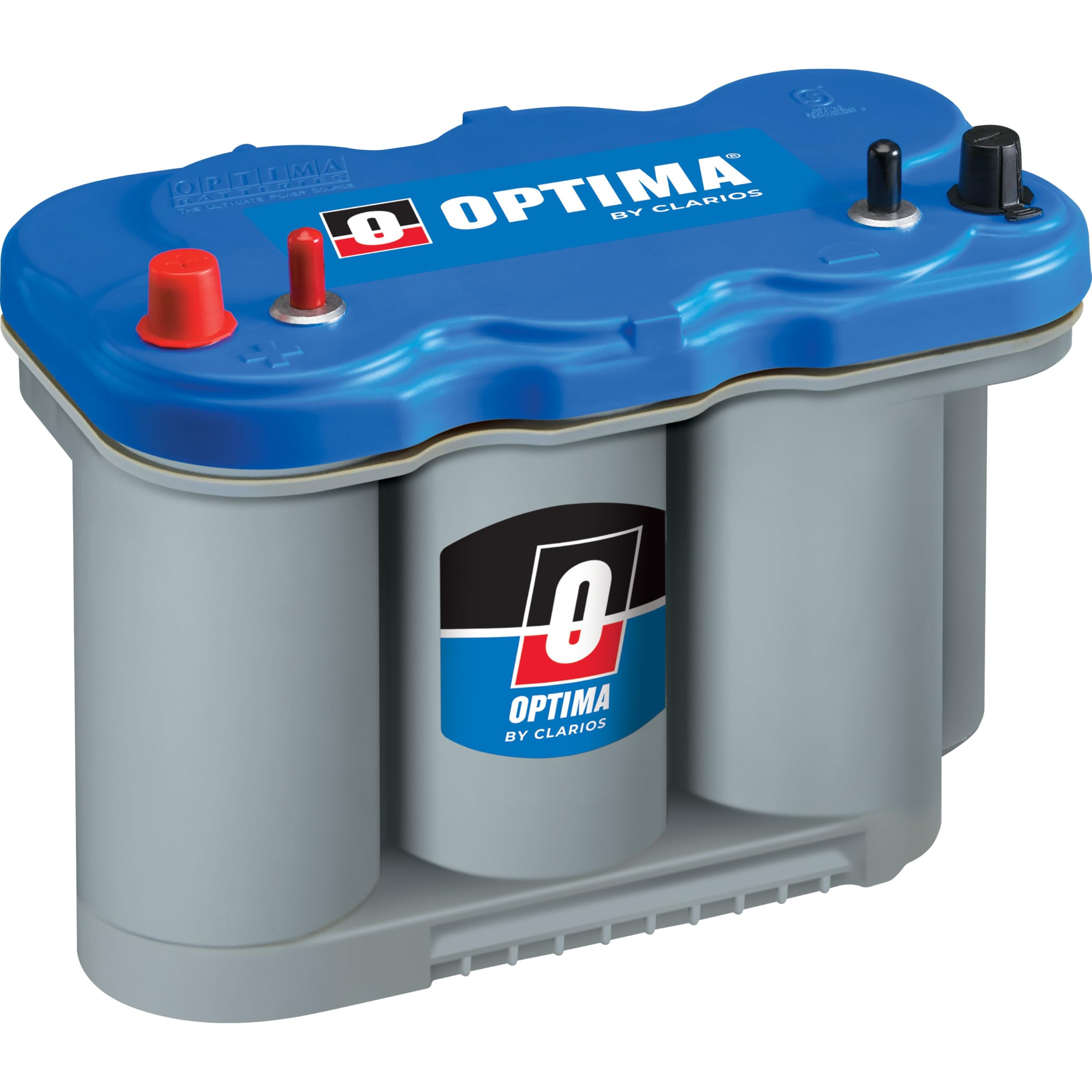
OPTIMA’s D27M BLUETOP is the benchmark that other Group 27 dual-purpose batteries are measured against. Its SpiralCell design wraps 99.99% pure lead plates between glass mat separators in a spiral configuration, delivering 800 CCA and 66 Ah of capacity with a 140-minute reserve. The dual terminal layout — SAE posts plus 5/16-inch stainless steel studs — provides wiring flexibility for boats and RVs with multiple connection points. At just over 50 pounds, it is significantly lighter than many AGM competitors with similar ratings.
Owner feedback consistently highlights the D27M’s ability to sit for weeks without a trickle charger and still fire up an engine instantly. Multiple reports mention getting five to ten years of service life in seasonal marine use, far outpacing the typical three-to-four-year lifespan of flooded marine batteries. The 800 CCA rating proves adequate for engines up to 350 horsepower, and the deep-cycle capability handles overnight electronics loads without issue.
Where the D27M shows its age is in raw energy density compared to lithium alternatives — 66 Ah is modest relative to the 100 Ah that many lithium drop-ins offer in the same footprint. The reserve capacity of 140 minutes is solid for a dual-purpose AGM but trails dedicated deep-cycle AGM batteries that push past 200 minutes. Some buyers have reported receiving units with manufacturing dates several months old, so checking the date code upon arrival is wise.
What works
- SpiralCell construction delivers exceptional vibration resistance for rough water
- Dual terminal design simplifies installation in boats and RVs
- Long service life with many owners reporting 5+ years of reliable use
What doesn’t
- 66 Ah capacity is modest compared to lithium alternatives at similar price points
- Reserve capacity trails dedicated deep-cycle AGM batteries
- Premium pricing reflects brand reputation as much as raw specifications
2. NOCO NLX27
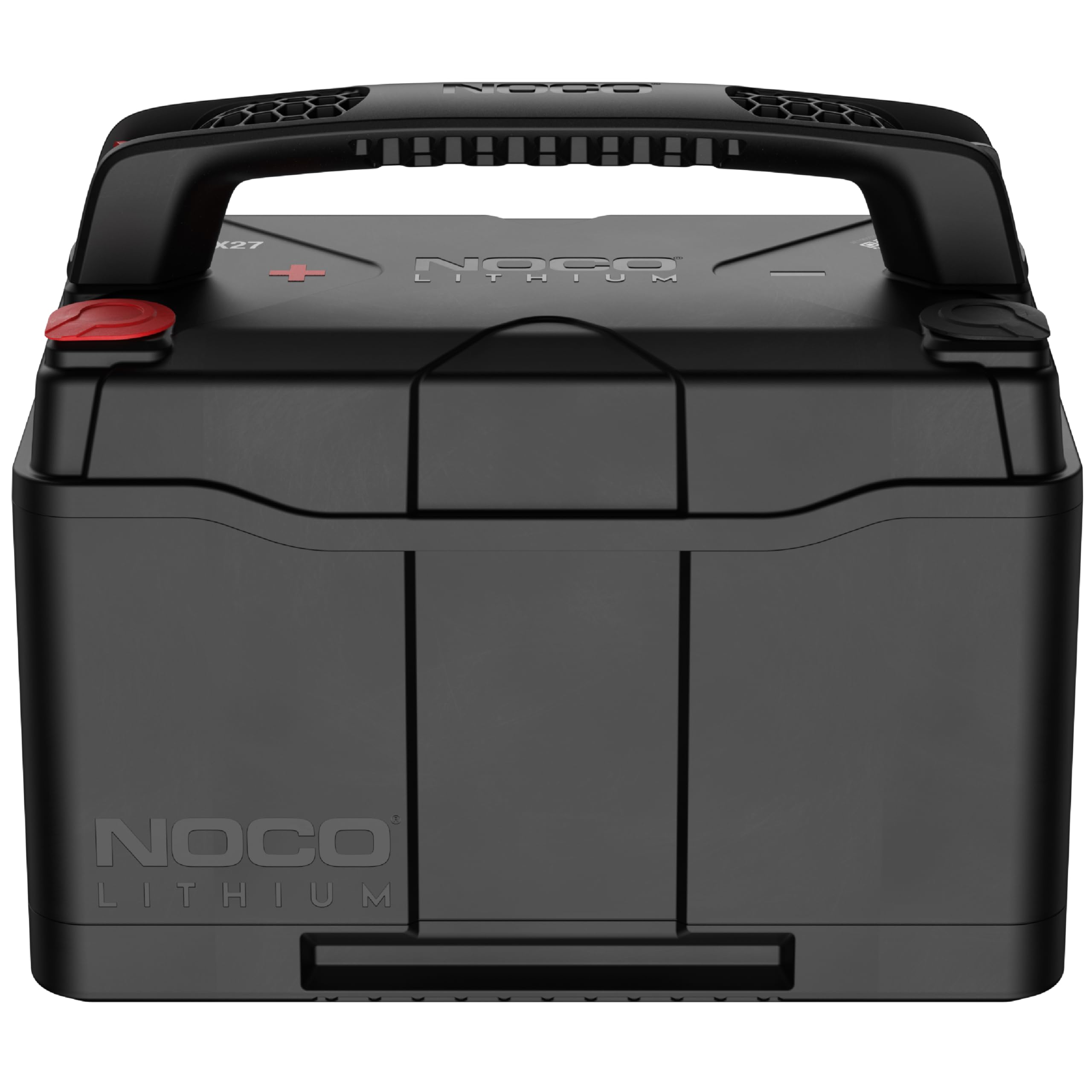
The NOCO NLX27 represents a significant engineering departure from traditional AGM marine batteries. It is a dual-purpose lithium iron phosphate (LiFePO4) battery that delivers 1,400 peak amps for starting — roughly double what most AGM batteries can produce — alongside 100 Ah of deep-cycle capacity with no voltage drop-off throughout the discharge curve. The quad-post terminal layout includes threaded, SAE, and button head options, accommodating virtually any connection configuration in series or parallel up to four batteries.
Owner reports from marine and automotive applications praise the NLX27’s ability to start large engines effortlessly, including diesel motors that typically require dual AGM batteries. The 33-pound weight is roughly half that of a comparable AGM battery, making installation and removal significantly easier. The dynamic BMS provides bidirectional cell balancing and active thermal monitoring without requiring manual resets after protection events. UL listing adds an independent safety certification that few lithium marine batteries carry.
The primary barrier is the substantial investment required, which positions the NLX27 as a long-term value play rather than a budget-friendly option. The tall terminal height can create fitment issues in some vehicles and battery boxes, as a few owners discovered when attempting installations with fixed wiring harnesses. The battery is also not designed for starting-only applications like golf carts, despite its impressive peak current, so verifying compatibility with your specific use case matters.
What works
- 1,400 peak amps provide effortless starting for large gas and diesel engines
- 100 Ah capacity with flat voltage curve delivers consistent power throughout discharge
- Quad-post terminal system offers maximum connection flexibility
What doesn’t
- Premium investment is significantly higher than AGM alternatives
- Terminal height can cause fitment issues in tight battery boxes
- Limited track record due to recent market introduction
3. Litime 12V 100Ah Bluetooth LiFePO4
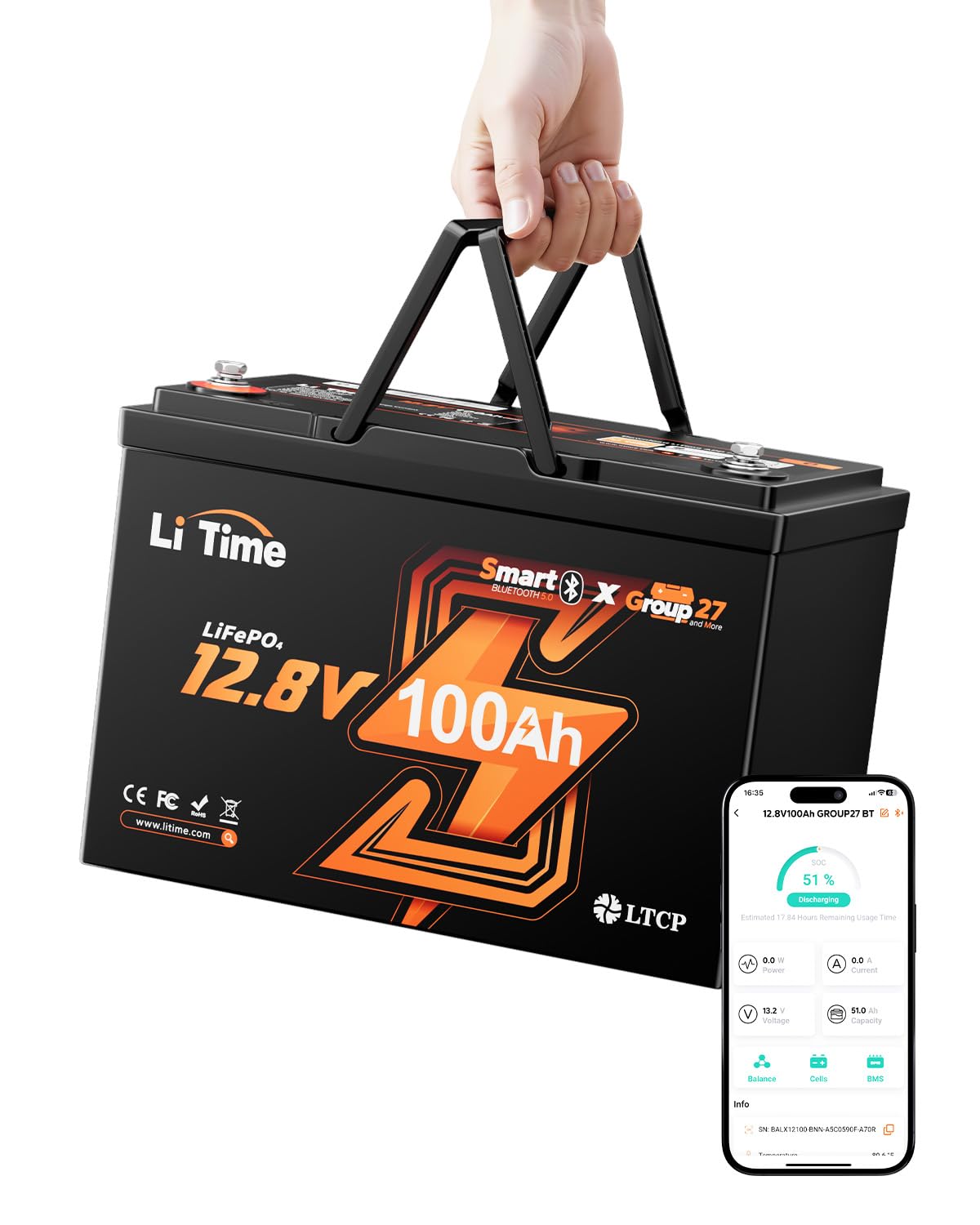
Litime’s Group 27 lithium battery integrates Bluetooth 5.0 monitoring directly into the BMS, allowing real-time tracking of voltage, current, state of charge, and cell balance through the LiTime app. The 100 Ah capacity delivers 4,000+ deep cycles at 80% depth of discharge, roughly ten times the cycle life of a comparable AGM battery. At 22.85 pounds, it is one of the lightest Group 27 batteries available, making it particularly appealing for kayaks, small boats, and RV applications where weight distribution matters.
Owners consistently report strong real-world performance with trolling motors, with multiple users documenting multi-day fishing trips on a single charge. The IP65 rating and salt-spray resistance make it suitable for exposed marine environments where moisture intrusion is a concern. The 20+ built-in safeguards include overcharge, overdischarge, overcurrent, short circuit, and high-temperature protection, plus low-temperature charging cutoff that prevents charging below 32°F. Expandability up to 16 batteries in series or parallel allows for future capacity growth.
Bluetooth activation requires an initial charge with a LiFePO4-compatible or MPPT charger, which adds a step for first-time users. The battery is explicitly not designed for engine starting applications — Litime markets it as a deep-cycle storage battery for trolling motors, RV house banks, and solar systems. Some owners noted that the Bluetooth range is limited to about 30 feet, which may require proximity to the battery compartment for reliable monitoring.
What works
- Bluetooth monitoring provides real-time battery data and state of charge visibility
- Ultra-lightweight design at under 23 pounds simplifies handling and installation
- IP65 rating and salt-spray resistance suit exposed marine environments
What doesn’t
- Not designed for engine starting applications despite high capacity
- Bluetooth range is limited and requires proximity for reliable monitoring
- Requires lithium-compatible charger for initial activation
4. VMAX MR127

The VMAX MR127 is a dedicated deep-cycle AGM battery built around thick lead-tin alloy grids and an electrolyte suspension system that fully absorbs electrolyte without silica gels or contaminants. The 100 Ah capacity provides genuine deep-cycle endurance, and the heavy-duty grid construction is designed to withstand repeated over-discharges that would damage standard AGM batteries. At 68 pounds, the MR127 is one of the heaviest Group 27 batteries, which reflects the amount of active lead material packed inside.
Long-term owner reports consistently praise the MR127’s ability to power trolling motors for full-day outings. Multiple users have documented using 55-pound thrust Minn Kota motors for six-plus hours per day across multiple days between charges. The integrated carrying handles are frequently mentioned as a practical feature given the battery’s substantial weight. The marine-grade terminals accept standard ring terminals and hold up well to corrosion in saltwater environments.
The 68-pound weight is a genuine drawback for anyone who needs to remove the battery regularly for storage or transport. Some owners have reported charging quirks when using standard automotive chargers, with the battery occasionally refusing to accept a charge after deep discharge until a specific charging profile is applied. The one-year warranty is shorter than many competitors, and the terminal layout lacks the dual-post flexibility that some installations require.
What works
- Thick lead-tin alloy grids withstand repeated deep discharges without damage
- 100 Ah capacity delivers genuine all-day trolling motor runtime
- Integrated carrying handles improve handling despite the heavy weight
What doesn’t
- 68-pound weight makes regular removal and installation cumbersome
- Some chargers require specific AGM profiles to avoid charging issues
- One-year warranty is shorter than the competition
5. OPTIMA 34M BLUETOP

The OPTIMA 34M BLUETOP packs the same SpiralCell technology found in the D27M into a more compact BCI Group 34M case measuring roughly 10 x 6.9 x 7.8 inches. It delivers 800 CCA and 1,000 MCA with a 100-minute reserve capacity, making it a viable option for installations where the standard Group 27 case is too large. The dual terminal design includes both SAE posts and 5/16-inch stainless steel studs, and the 38.4-pound weight is manageable for a single-person installation.
Owner feedback frequently highlights the 34M’s longevity, with multiple reports of batteries lasting 8 to 10 years in seasonal marine service. The vibration resistance from the SpiralCell construction is a recurring theme — owners using these batteries in off-road vehicles, boats pounding through chop, and even heavy construction equipment report that the OPTIMA holds up where flooded batteries failed. The faster charging capability compared to conventional AGM batteries is another commonly cited advantage.
The 50 Ah capacity at the C20 rate is modest for any application requiring sustained deep-cycle power. This battery is best suited as a dedicated starting or dual-purpose battery for small to medium boats where deep-cycle demands are light. The compact footprint means it will not fit standard Group 27 battery boxes without adaptation. Some buyers have reported receiving units with less than full charge, and verifying the manufacturing date before installation is recommended.
What works
- SpiralCell design delivers exceptional vibration resistance and long service life
- Compact footprint fits installations where standard Group 27 cases are too large
- Lightweight 38-pound build simplifies handling and installation
What doesn’t
- 50 Ah capacity limits deep-cycle endurance for electronics and trolling motors
- Compact case does not fit standard Group 27 battery boxes without adaptation
- Moderate reserve capacity of 100 minutes for sustained accessory loads
6. Mighty Max MM-G27M
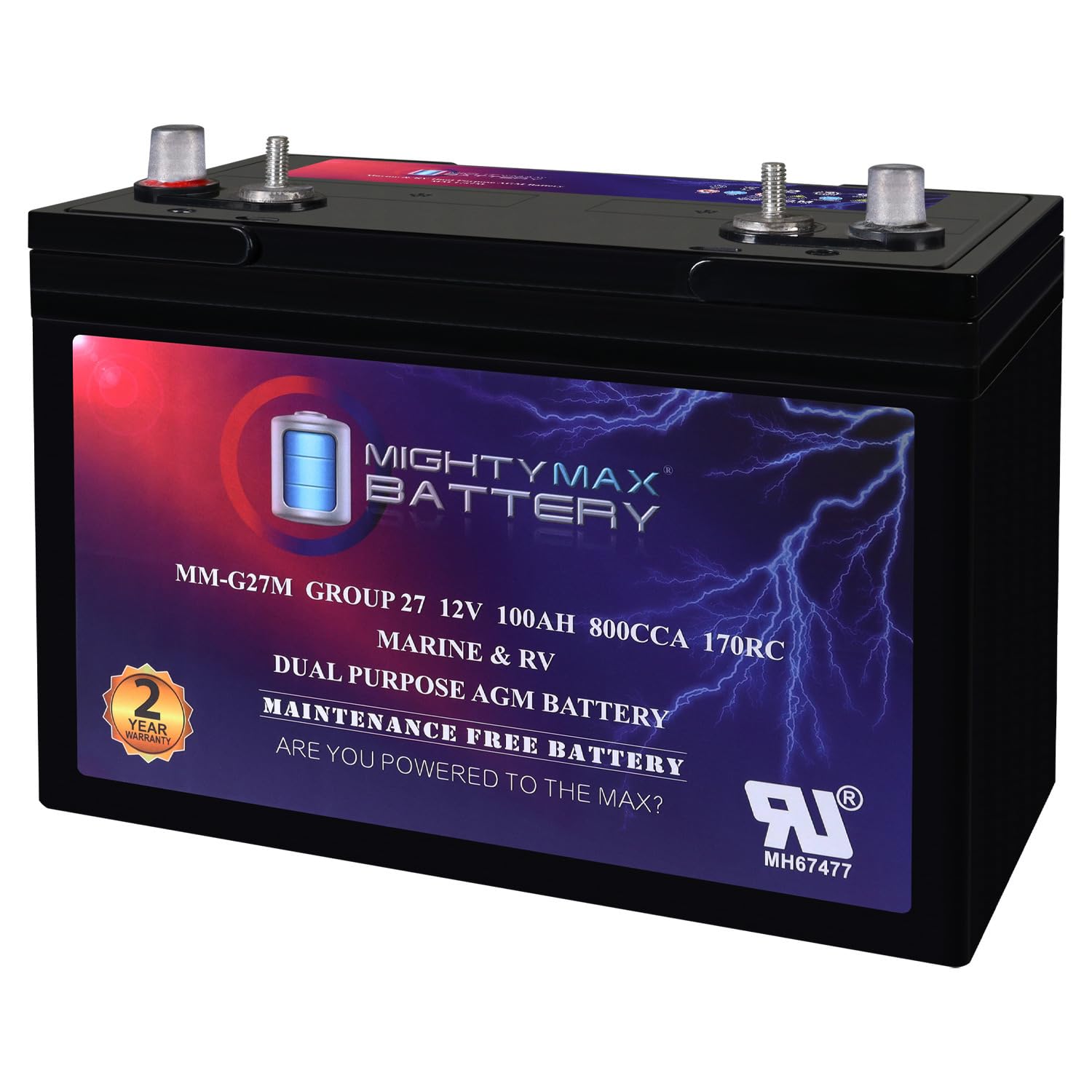
The Mighty Max MM-G27M is a dual-purpose AGM battery that balances strong starting power with genuine deep-cycle capacity. It delivers 100 Ah of energy storage alongside 800 CCA and 850 MCA, with a 170-minute reserve capacity that positions it among the more capable dual-purpose options in the Group 27M category. The rugged ABS case resists impacts and heat, and the spill-proof, maintenance-free design suits marine environments where corrosion is a concern.
Long-term owner reports indicate that the MM-G27M holds up well through multiple seasons of use, including exposure to freezing temperatures. One owner documented two years of service with the battery living in a truck bed during winter nights, with the battery still accepting and holding a charge. Trolling motor users report three to four hours of run time at moderate speeds on a single charge. The 800 CCA rating handles small to medium outboards and I/O engines without hesitation.
The substantial 63.7-pound weight makes the MM-G27M one of the heavier dual-purpose options, which is a consideration for portable applications. Some owners noted that the battery arrives at a storage voltage rather than fully charged and requires an initial charge cycle before use. The one-year manufacturer warranty is shorter than the warranty periods offered by some competitors, though several owners report the battery outliving this period without issues.
What works
- 100 Ah capacity combined with 800 CCA delivers true dual-purpose capability
- 170-minute reserve capacity provides solid deep-cycle endurance for electronics
- Rugged ABS case construction withstands demanding marine environments
What doesn’t
- 63.7-pound weight is heavy for regular handling and transport
- Arrives at storage voltage and requires initial charging before use
- One-year warranty is shorter than the competition
7. Weize BCI Group 27M Dual Purpose AGM
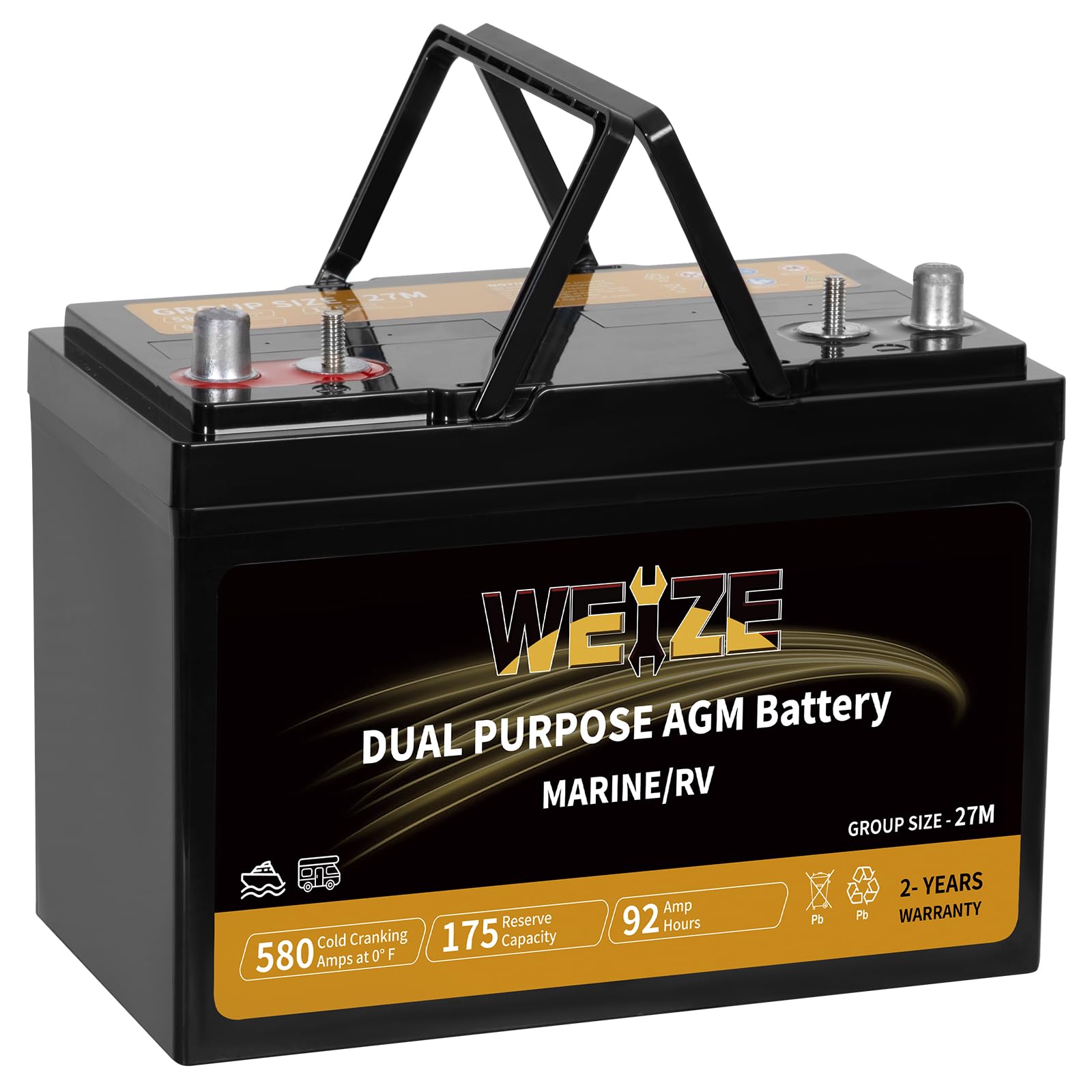
Weize’s Group 27M dual-purpose AGM battery delivers 92 Ah of capacity with 580 CCA and a 175-minute reserve capacity. The advanced AGM construction provides twice the cycle life of traditional flooded marine batteries, and the quick-charge capability allows the battery to accept a charge up to five times faster than conventional AGM designs. The 20-times greater vibration resistance compared to flooded batteries makes it a strong candidate for boats that operate in rough conditions.
Owner feedback frequently highlights the solid build quality and robust packaging that ensures the battery arrives undamaged. Multiple buyers have used the Weize as a replacement battery for backup sump pumps, RVs, and boat starting applications, with consistent reports of fully charged delivery and immediate readiness for service. The dual terminal configuration provides both SAE posts and threaded studs, accommodating standard automotive and marine connections. The 59.5-pound weight is typical for a Group 27 AGM battery with this capacity.
The 580 CCA rating is lower than many competitors, which may be a limitation for larger engines that require higher cold cranking current. Some owners noted that the battery dimensions differ slightly from standard Group 27M specifications, which can create fitment issues in tight battery boxes. The maximum recommended charge current of 18.4 amps is relatively low, requiring longer recharge times than some alternatives when deeply discharged.
What works
- Quick-charge AGM design accepts charge up to five times faster than conventional AGM
- 175-minute reserve capacity provides excellent deep-cycle endurance
- Dual terminal configuration offers flexible connection options
What doesn’t
- 580 CCA rating is low for larger marine engines
- Physical dimensions may differ slightly from standard Group 27M specifications
- Maximum 18.4-amp charge current limits recharge speed on deeply discharged batteries
8. UPLUS BCI Group 27M Dual Purpose AGM

The UPLUS Group 27M dual-purpose AGM battery delivers 92 Ah of capacity paired with 800 CCA and a 175-minute reserve capacity. It is engineered to start engines up to 350 horsepower, making it suitable for a wide range of marine power plants from small outboards to large inboard engines. The dual-purpose design eliminates the need for separate starting and house batteries, simplifying the electrical system and freeing up space in smaller boats.
Owner reports consistently note that the battery arrives fully charged and ready for installation, with integral folding handles that make lifting and positioning the 49-pound unit manageable. Multiple buyers have reported successful use as a starting battery for boats with bilge pumps, live wells, lights, and radios running off the same bank. The extreme vibration resistance and thicker full-frame cast plates are designed to withstand wave pounding and trailer transport without internal damage.
Some owners noted that the battery terminals are configured for standard marine connections but may require adapter posts for certain side-post applications. The 49-pound weight is moderate for a Group 27 AGM but still requires care during installation. A handful of users reported that the battery’s performance in deep-cycle applications is adequate for light accessory loads but not ideal for sustained heavy-draw scenarios like large trolling motors running at high speed for extended periods.
What works
- 800 CCA provides reliable starting power for engines up to 350 horsepower
- Integral folding handles simplify lifting and positioning during installation
- Vibration-resistant design with thicker cast plates for durability
What doesn’t
- Marine terminal configuration may require adapters for some side-post applications
- Deep-cycle performance is adequate but not ideal for sustained heavy-draw loads
- Limited owner track record due to relatively recent market introduction
9. CYCLENBATT 12V 100Ah LiFePO4

CYCLENBATT’s Group 27 lithium battery offers 100 Ah of capacity in a package that weighs just 20.8 pounds — roughly one-third the weight of an equivalent AGM battery. It uses Grade A square lithium iron phosphate cells paired with a 100-amp smart BMS that provides overcharge, overdischarge, overcurrent, short circuit, high-temperature, and low-temperature charging protection. The low-temperature charging cutoff prevents the battery from accepting a charge below 32°F and automatically resumes when the temperature returns to 40°F.
Owner feedback is overwhelmingly positive, with users reporting successful drop-in replacement of lead-acid batteries in RVs, trolling motor setups, and emergency communication stations. Multiple owners documented running RV furnace and lighting systems for a full week on a single charge. The weight savings are frequently cited as transformative for applications where every pound matters — one owner noted that his wife could easily carry the battery thanks to the built-in handle. The five-year warranty provides confidence that exceeds what most AGM competitors offer.
The lithium chemistry requires a compatible charger that supports LiFePO4 charging profiles, which adds an initial expense if you do not already own one. Some owners noted that the M8 terminal size requires ring terminals that may not match existing wiring without adapters. The battery is not designed for engine starting applications, so it is best suited as a deep-cycle house battery or trolling motor power source rather than a replacement for a dedicated starter battery.
What works
- Ultra-lightweight 20.8-pound design transforms handling and installation ease
- Grade A cells and comprehensive BMS provide reliable protection and long life
- Five-year warranty exceeds most AGM battery warranty periods
What doesn’t
- Requires a LiFePO4-compatible charger for proper charging
- M8 terminals may require adapter ring terminals for existing wiring
- Not designed for engine starting applications
Hardware & Specs Guide
AGM Technology Explained
Absorbed Glass Mat (AGM) batteries use a fiberglass mat separator that wicks electrolyte between the lead plates, holding it in suspension through capillary action. This design eliminates free liquid electrolyte, making the battery spill-proof and allowing installation in any orientation. AGM batteries have significantly lower internal resistance than flooded batteries, which means they can deliver higher current on demand and recharge faster. The tightly compressed plate structure also provides superior vibration resistance, a critical advantage in marine applications where wave pounding and trailering can damage conventional flooded batteries.
Capacity Ratings Decoded
Cold Cranking Amps (CCA) measures the battery’s ability to start an engine at 0°F for 30 seconds while maintaining at least 7.2 volts. Marine Cranking Amps (MCA) is the same test conducted at 32°F and typically reads about 25% higher than the CCA rating. Reserve Capacity (RC) indicates how many minutes the battery can sustain a 25-amp load before voltage drops to 10.5 volts — higher RC numbers directly translate to longer runtime for bilge pumps, radios, and lights with the engine off. Amp-Hours (Ah) at the 20-hour rate represents total energy storage; a 100 Ah battery can theoretically deliver 5 amps for 20 hours, though real-world usable capacity is typically 50% for AGM and 80-100% for LiFePO4.
FAQ
Can I use a Group 27 AGM marine battery for my trolling motor?
What is the difference between Group 27 and Group 27M batteries?
How long does a Group 27 AGM marine battery last?
Final Thoughts: The Verdict
For most boaters and RV owners seeking the best group 27 agm marine battery, the winner is the OPTIMA D27M BLUETOP because it delivers proven SpiralCell reliability, genuine dual-purpose performance, and a track record of long service life that few competitors match. If you want maximum power density with modern lithium technology, grab the NOCO NLX27 for its 1,400-amp peak output and 100 Ah deep-cycle capacity. And for a budget-friendly lithium upgrade that saves over 40 pounds compared to lead-acid, nothing beats the CYCLENBATT 12V 100Ah LiFePO4.

Certification: BSc in Mechanical Engineering
Education: Mechanical engineer
Lives In: 539 W Commerce St, Dallas, TX 75208, USA
Md Amir is an auto mechanic student and writer with over half a decade of experience in the automotive field. He has worked with top automotive brands such as Lexus, Quantum, and also owns two automotive blogs autocarneed.com and taxiwiz.com.