A battery box is the single most overlooked component in any 12V power system — and that mistake usually shows up at the worst possible moment. Whether you are outfitting a travel trailer, a trolling rig, or a solar backup setup, the housing that contains your battery determines how long it lasts, how safely it operates, and how convenient the whole system is to use. A poorly chosen box leads to corrosion, loose connections, and needless frustration. A well-chosen one disappears from your mind entirely, doing its job silently and reliably for years.
I’m Amir — the founder and writer behind Four Wheel Ask. I have spent years analyzing market data, comparing product specifications across dozens of brands, and aggregating owner feedback from thousands of real-world installations to understand exactly what separates a durable, well-engineered battery enclosure from one that cuts corners.
After deep owner feedback and specs analysis, the best group 24 battery box choices combine rugged build, smart ports, and reliable protection for marine or RV use.
How To Choose The Best Group 24 Battery Box
Selecting the right enclosure for your Group 24 battery is a balance of materials, features, and intended environment. A box that works perfectly in a garage may fail within months on a saltwater boat. Understanding a few core criteria removes the guesswork and ensures your investment lasts.
Material Matters: Plastic vs. Steel
Polymer boxes dominate the market for good reason — they are lightweight, corrosion-proof, and excellent insulators. High-quality plastics like PC/PBT blends handle extreme temperatures and resist impact. Steel boxes offer unmatched rigidity and a premium feel but require a quality powder coat to fend off rust. For marine environments, polymer is typically the safer long-term choice. For stationary RV or workshop use where you need structural stiffness, steel can be a valid option.
Ventilation and Safety Certifications
Lead-acid batteries release hydrogen gas during charging. A sealed box without venting creates an explosion hazard. Look for boxes with built-in vent ports, hose fittings, or louvered grilles that allow gas to escape. US Coast Guard CFR 183.420 and ABYC E-10.7 certification means the box has passed rigorous safety testing for marine use — a strong benchmark even for land-based applications.
Smart Features and Power Distribution
Modern battery boxes do far more than contain a battery. Integrated voltmeters let you check state of charge without opening the lid. USB charge ports, 12V cigarette sockets, and Anderson-style connectors turn a simple box into a portable power station. Built-in circuit breakers protect downstream electronics and prevent over-current damage. Evaluate which ports you actually need; every extra component is a potential failure point in a harsh environment.
Interior Dimensions and Battery Fit
Not all Group 24 boxes are the same size internally. Measure your battery — including terminal height and any protruding handles — before purchasing. A box advertised for Group 24 may also accommodate Group 27 or 31 batteries, which are taller and wider. Check the internal height carefully if you plan to install a LiFePO4 battery, which often has a slightly different form factor than a traditional lead-acid unit.
Quick Comparison
On smaller screens, swipe sideways to see the full table.
| Model | Category | Best For | Key Spec | Amazon |
|---|---|---|---|---|
| ALL-TOP Smart Battery Box | Smart Box | Best Overall | 50A Anderson connectors, voltmeter, dual USB | Amazon |
| SUNAPEX Smart Battery Box | Smart Box | Built-in light & convenience | 16A breaker, USB ports, built-in LED light | Amazon |
| Newport Vessels Smart Box | Marine Box | Trolling motor setups | 10A & 60A breakers, battery meter, USB | Amazon |
| Camco 55370 | Dual Box | Two Group 24 batteries | Vented, USCG compliant, holds 2 batteries | Amazon |
| Litime Portable Box | Smart Box | Premium lightweight build | QC3.0 & Type-C ports, 16A breaker | Amazon |
| OKLPF Smart Battery Box | Smart Box | USB-C PD charging | QC3.0 & Type-C PD, 50A Anderson plugs | Amazon |
| Peastorm Steel Box | Steel Box | Rugged steel protection | Lockable, waterproof, powder coated steel | Amazon |
| SeaSense Deluxe Power Station | Power Station | Built-in battery tester | 10A breaker, LED light, external terminals | Amazon |
| NOCO HM408 4D Box | Commercial Box | Large commercial batteries | USCG certified, impact-resistant to -40F | Amazon |
| Universal Mounting Tray | Tray | Budget secure mounting | Adjustable alloy steel tray, hollowed design | Amazon |
| DC HOUSE 100Ah LiFePO4 | Battery | Battery upgrade for box systems | 100Ah, Bluetooth, low-temp cutoff, 15000 cycles | Amazon |
In‑Depth Reviews
1. ALL-TOP Smart Battery Box

The ALL-TOP Smart Battery Box represents the most complete, pre-wired power center in this category. It converts a standard Group 24, 27, or 31 battery into a multi-function power station without requiring any drilling or modification. The built-in 50A Anderson-style quick connectors, each protected by a 60A fuse, allow high-current input from solar panels or output to appliances like refrigerators and ovens — a capability that most competing boxes simply do not offer at this level.
Beyond the high-current ports, the box includes external positive and negative terminals, a digital voltmeter accurate to within a tenth of a volt, dual USB ports, and a 12V cigarette socket protected by a 16A resettable circuit breaker. Owners consistently report that the voltmeter matches lab-grade multimeter readings, and the Anderson connectors eliminate the need for adapters when pairing with solar charge controllers or inverters. The polymer construction keeps weight manageable while providing adequate impact resistance for mobile installations.
Some users note the absence of a carry handle, a minor ergonomic oversight that an aftermarket strap can solve. The lighter socket also drew criticism for feeling slightly fragile during the first connection, though this appears to be an outlier rather than a systemic flaw. For anyone building a DIY solar generator, a portable jump station, or a clean marine power hub, this box delivers the most versatile feature set per dollar spent.
What works
- Dual 50A Anderson connectors with 60A fuses handle high-current solar or appliance loads
- Digital voltmeter is accurate and easy to read at a glance
- Compatible with 12V and 24V systems across Group 24, 27, and 31 batteries
What doesn’t
- No integrated carry handle requires an aftermarket strap
- 12V cigarette lighter socket feels less robust than the rest of the build
- No internal battery retention frame means smaller batteries may shift
2. SUNAPEX Smart Battery Box
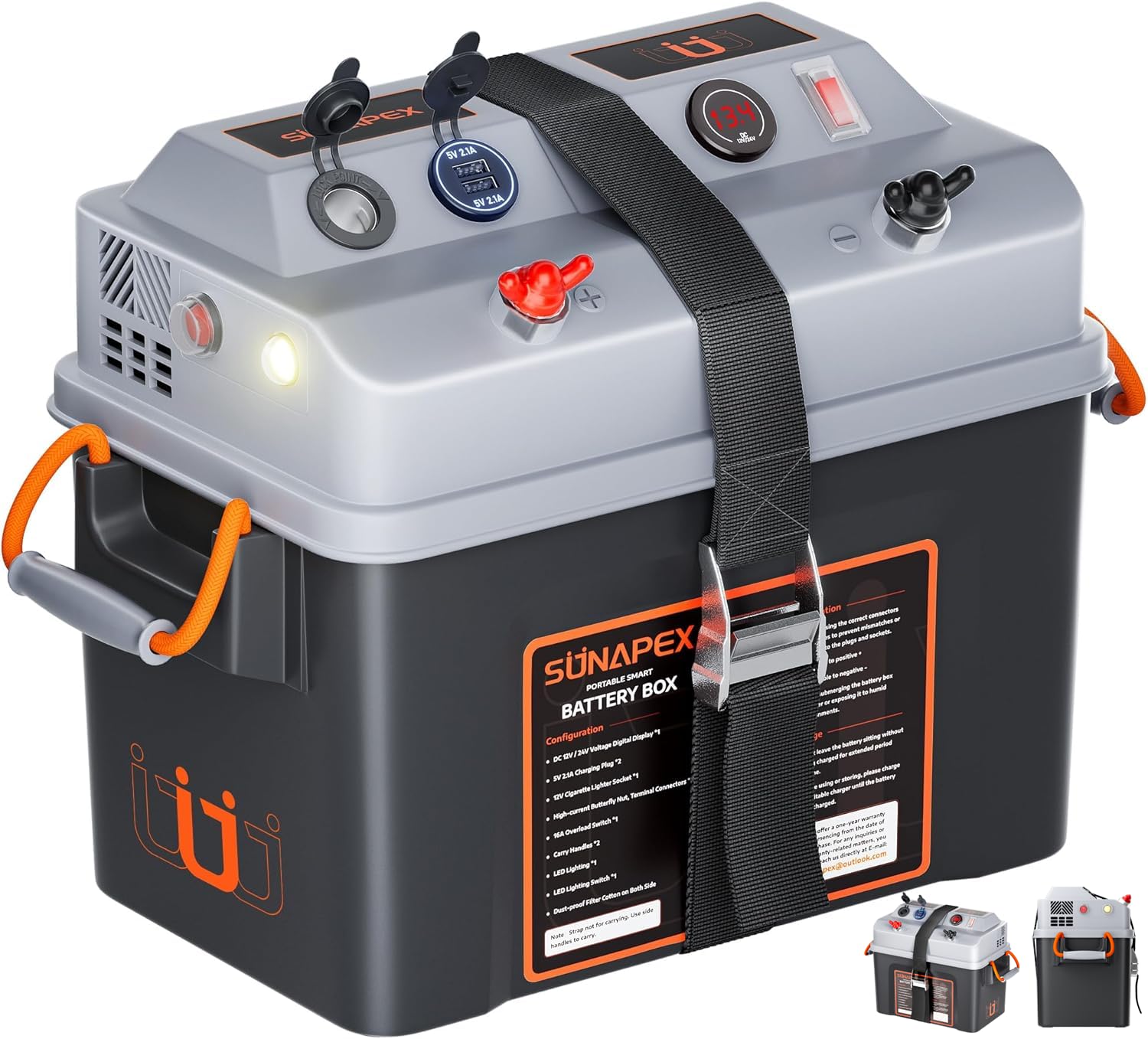
The SUNAPEX Smart Battery Box brings thoughtful everyday usability features to the Group 24 enclosure space. Its standout addition is a built-in LED light mounted on the left side that provides several feet of illumination — a genuinely useful feature for late-night camp setups, dark boat lockers, or emergency roadside situations. The box includes a 16A overload switch, a 12V cigarette lighter socket, dual USB 5V 2.1A ports, high-current terminals, and a digital voltmeter, all integrated into a gray-and-black polymer body.
Owner feedback highlights the box’s versatility across marine and van-life applications. Users have run fans and chargers for extended periods and appreciate the dedicated power switch that prevents parasitic drain when the system is idle. The voltmeter provides real-time state-of-charge data without needing to open the lid. External dimensions of roughly 14 by 12.6 by 8.5 inches allow it to accommodate Group 24, 27, and 31 AGM or lithium batteries, making it a flexible platform for evolving power needs.
Several reviewers note that the plastic walls, while adequate, flex under heavy loads and lack the premium feel of thicker-molded alternatives. The rubberized coating on certain surfaces has also been described as poorly adhered in a small number of cases. These are trade-offs at this price tier, and for the majority of users who prioritize feature density and portability over ultra-rigid construction, the SUNAPEX delivers strong value.
What works
- Integrated LED light provides practical illumination in dark compartments
- Dedicated on/off switch prevents battery drain when not in use
- Compatible with Group 24, 27, and 31 AGM or lithium batteries
What doesn’t
- Plastic housing flexes noticeably under heavier battery weights
- Rubberized coating on some panels has durability concerns
- Side handles are adequate but not designed for heavy repeated carrying
3. Newport Vessels Smart Battery Box
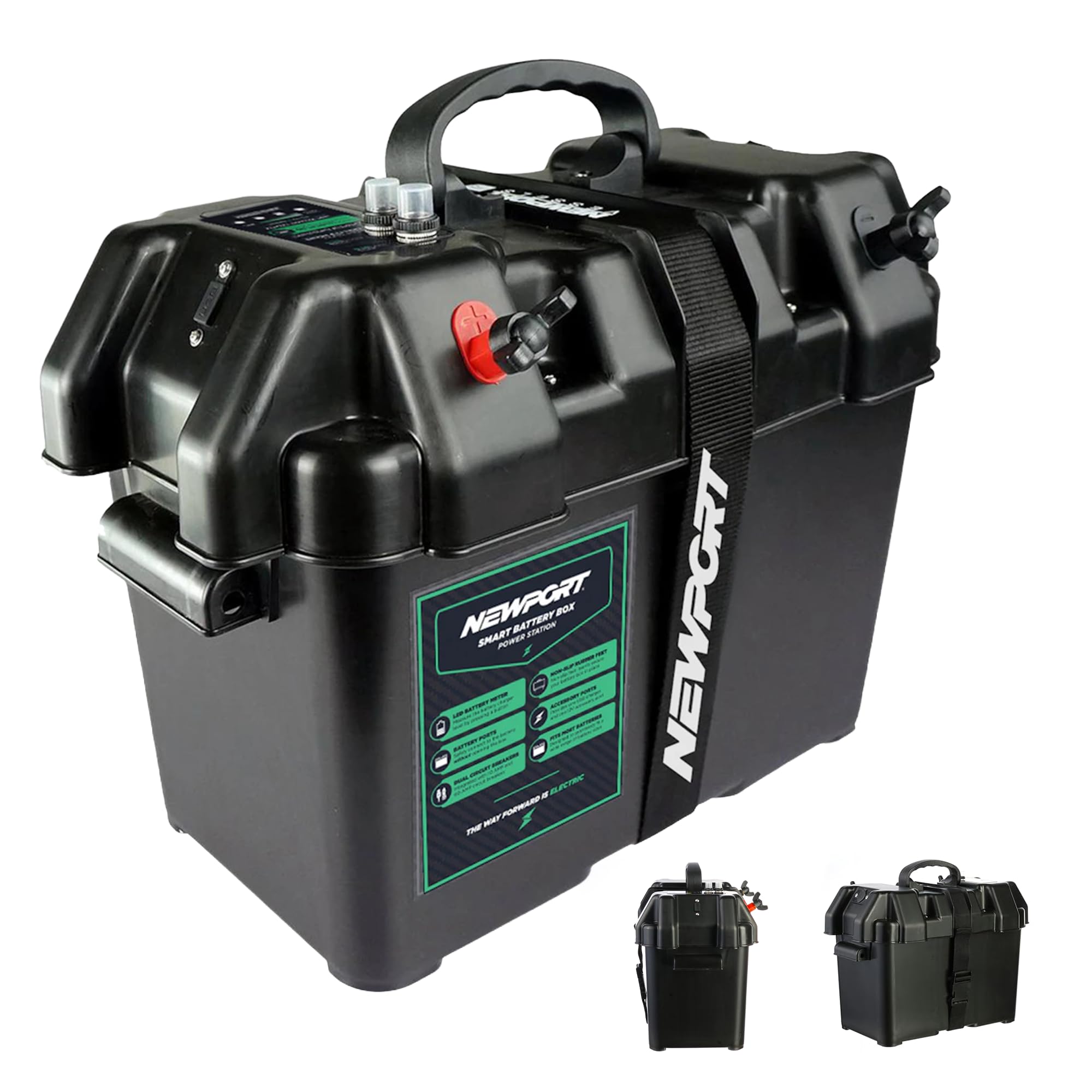
Newport Vessels designed this smart battery box specifically for the marine environment, with a focus on trolling motor setups and small watercraft. The box integrates dual circuit breakers — a 10A breaker for accessory circuits and a 60A breaker for the main trolling motor feed — providing two layers of protection against overloads and wiring mistakes. External battery terminals allow tool-free connection of the motor and fish finder without opening the lid, keeping the system clean and reducing corrosion risk.
Owner reports are unusually enthusiastic about this box’s real-world durability. One account describes the box surviving a complete submersion in a lake after an inflatable boat capsized; the watertight seal kept the battery dry, and the connectors held under heavy strain, with the unit functioning perfectly after drying out. The built-in battery meter works with lead-acid batteries and gives a reasonable state-of-charge estimate, though it is not compatible with lithium-ion chemistries — a limitation worth noting for owners planning to switch to LiFePO4.
The circuit breaker cover has drawn criticism for using thin plastic that can tear after limited use, and the carrying strap tends to loosen under the weight of larger batteries, rendering the top handle less useful. For anglers and small-boat owners running lead-acid deep-cycle batteries, these are manageable compromises given the box’s excellent core feature set and proven real-world resilience.
What works
- Dual 10A and 60A circuit breakers protect both accessories and main motor
- Watertight seal has proven itself in extreme submersion scenarios
- External terminals simplify connections without opening the lid
What doesn’t
- Battery meter is not compatible with lithium-ion batteries
- Circuit breaker cover uses thin plastic prone to tearing
- Carrying strap loosens under heavier battery loads
4. Camco 55370 Vented RV/Marine Battery Box
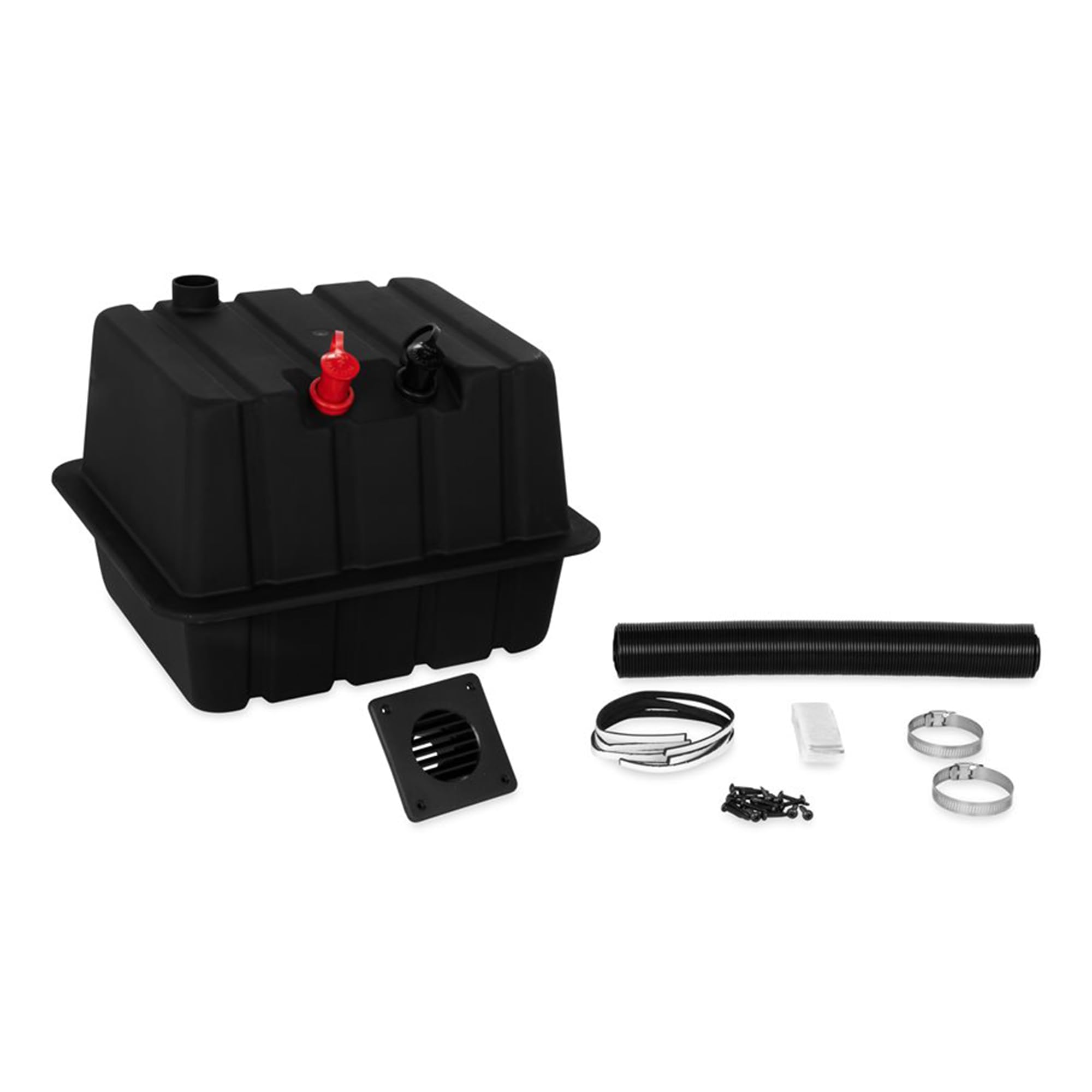
Camco’s 55370 is a specialized solution for setups requiring two Group 24 batteries side by side — common in fifth-wheel trailers, larger RVs, and marine installations where capacity redundancy matters. The box is constructed from a durable polymer blend and meets both US Coast Guard CFR 183.420 and ABYC E-10.7 specifications, giving it verified safety credentials for marine environments. The vented design includes a louvered grille, a hose, and a hose mount plate to safely expel hydrogen gases outside the storage compartment.
Owners consistently praise the box for its precise fit and robust construction. The heavy-duty vent hose and included mounting hardware make installation straightforward, and the box has enough internal volume to accommodate standard GC2 golf-cart batteries side by side, which many users prefer for 6V series setups. The integrated battery terminals with 3/8-inch studs simplify cable connections, and the foam and putty tape help create a sealed installation that keeps contaminants out.
Some users note that the box is taller than expected and requires the vent hole to be positioned at least 6 inches above the box itself — a detail that can complicate installations in compartments with limited overhead clearance. Quality control has also been flagged in a few cases, with one owner receiving a box missing the positive terminal connection. For dual-battery applications where certified safety is non-negotiable, this remains a top-tier choice.
What works
- USCG and ABYC certified for marine safety compliance
- Fits two Group 24 or GC2 batteries side by side
- Complete venting kit includes hose, grille, and mounting plate
What doesn’t
- Tall profile requires ample overhead clearance for vent installation
- Quality control inconsistencies reported on terminal components
- No integrated handles for easy servicing of the box
5. Litime Portable Battery Box

Litime has engineered this portable battery box specifically with lightweight lithium batteries in mind, though it technically accommodates Group 24, 27, and 31 batteries of any chemistry. The internal dimensions measure approximately 14 by 8.1 by 8.7 inches, and the box weighs only about 3 pounds — remarkably light for a fully featured enclosure. The PC/PBT plastic material is rated to withstand battery weights up to 66 pounds, which covers virtually all Group 31 deep-cycle options.
The power management system includes two 15A cigarette ports, one USB QC3.0 port, one USB Type-C port, and a 16A automatic reset circuit breaker that cuts power during DC overload without requiring manual intervention. External terminals with 6AWG silicone cables and M8 ring terminals make connection straightforward. A built-in digital voltmeter provides continuous voltage monitoring so you can check state of charge without lifting the lid. Many owners highlight the included carry handles on both the side and top as a practical design choice that makes transport easy.
The most significant limitation is structural: the box is not designed for heavy lead-acid batteries. One owner reported that the handle separated when used with a 52-pound flooded battery, and Litime’s customer service promptly offered a full refund. For lithium batteries weighing roughly 25 pounds, the box performs admirably. The strap buckle also drew criticism for feeling too flimsy, with one unit breaking during initial tightening.
What works
- Ultra-light PC/PBT construction at just over 3 pounds
- Includes both QC3.0 and Type-C fast-charging ports
- Automatic reset 16A circuit breaker adds safety without hassle
What doesn’t
- Not structurally suited for heavy lead-acid batteries over 50 pounds
- Plastic buckle on the retaining strap is prone to breaking
- Lacks the rigid feel of thicker polymer competitors
6. OKLPF Smart Battery Box

The OKLPF Smart Battery Box positions itself as a modern power center with an emphasis on contemporary device charging. It features a USB Type-A QC 3.0 port and a USB Type-C PD port, allowing fast charging for phones, tablets, and laptops directly from your 12V battery. Two 50A Anderson-style plugs handle high-current input or output, and an LCD voltmeter provides clear voltage readout. A 10A resettable circuit breaker and an on/off switch round out the integrated electronics.
Owners have successfully used this box for a variety of applications beyond its intended marine and RV audience. One reviewer paired it with a 12V lithium battery and a portable winch setup, successfully pulling a car onto a trailer with no issues. Others have integrated it into trailer winch systems, portable lighting rigs, and backup power stations. The box accommodates Group 24, 27, and 31 batteries, and the inclusion of a Type-C PD port sets it apart from most competitors that only offer standard USB-A.
Build quality complaints center on the plastic strap buckle, which one owner described as too thin and prone to breaking when tightened securely. Another reviewer received a unit that had been repackaged and was missing the box strap entirely. The polymer construction feels adequate for the price tier but does not match the rigidity of premium options. For buyers who prioritize modern charging standards and Anderson connectivity at a reasonable entry point, the OKLPF delivers strong functionality.
What works
- USB Type-C PD port enables fast charging for laptops and modern devices
- Dual 50A Anderson plugs handle high-current applications
- LCD voltmeter provides clear, easy-to-read voltage information
What doesn’t
- Plastic strap buckle is too thin and prone to breakage
- Polymer walls lack the rigidity of premium-tier boxes
- Packaging quality control issues reported in some units
7. Peastorm Trailer RV Marine Battery Box
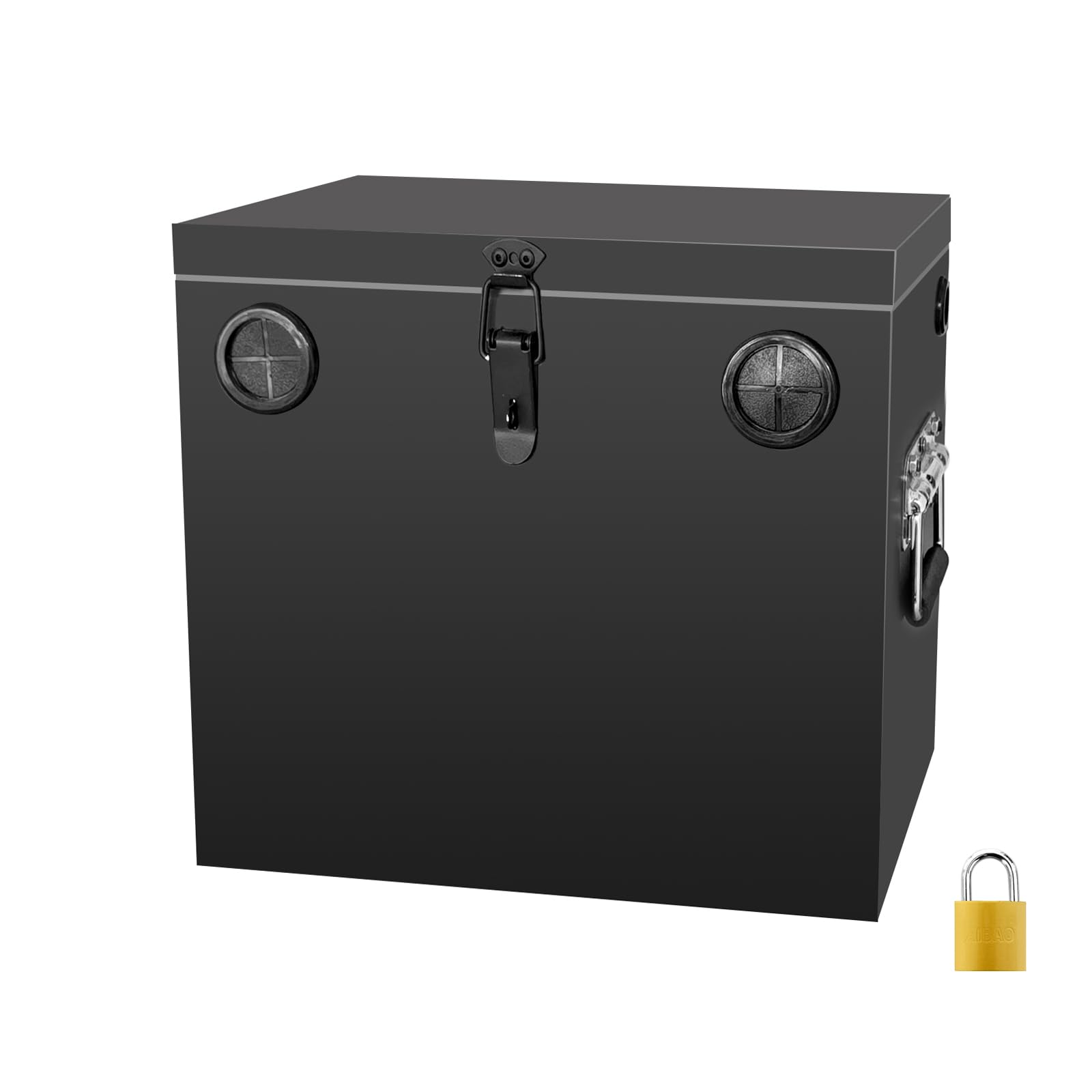
The Peastorm battery box takes a fundamentally different approach than the polymer competition — it is built from heavy-gauge steel with a black powder-coated finish. This gives it a substantial feel and superior physical protection against impacts, theft, and crushing forces. The box is designed exclusively for Group 24 batteries with maximum internal dimensions of 11 by 7.8 by 11 inches. A lockable latch secures the lid, and rubber grommets protect the pre-drilled cable entry holes from chafing.
Owner feedback confirms the box’s robust construction and straightforward installation. RV owners have used it to solve battery removal and security issues, appreciating that the pre-drilled mounting holes align well with standard angle-iron frames. The included rubber rings and screws simplify wiring, and the spring latch operates smoothly. The compact footprint makes it suitable for trailers, kayaks, and other space-constrained installations where a polymer box might feel too bulky.
Several users caution that the 14-inch width specification is slightly off by about 1/16 of an inch, requiring minor adjustment during installation. The side handles, while aesthetically pleasing, are largely superfluous in RV installations and can snag on nearby components. Corrosion has also been reported around the handle welds after several months of exposure, suggesting the powder coating is thinner in those areas. The included padlock is low quality and best replaced immediately with a Masterlock or comparable unit.
What works
- Heavy-gauge steel construction provides superior impact and theft protection
- Lockable latch adds security against battery removal
- Compact footprint fits tight trailer and kayak compartments
What doesn’t
- Corrosion reported around handle welds after extended exposure
- Width dimension tolerance is slightly off in some units
- Included padlock is low quality and should be replaced
8. SeaSense Deluxe Power Station Battery Box

SeaSense has been producing marine and trailer products since 1984, and the Deluxe Power Station Battery Box reflects that legacy of practical, no-nonsense design. This box fits Group 24 or 27 batteries and includes external terminals with vinyl-coated steel wing nuts, a 10A circuit breaker, a built-in LED light, a one-touch battery tester, and a 12V accessory socket. The battery tester measures state of charge without requiring any tools or opening the lid — just connect, wait one minute, and push the button.
Owners consistently note that the box performs exactly as advertised for basic trolling motor and marine installations. The built-in tester gives a reasonable approximation of battery condition, though several users mention that a dedicated multimeter provides more accurate readings, especially under load. The 10A breaker provides adequate protection for small accessories and fish finders, and the external terminals make it easy to connect and disconnect the trolling motor without fumbling with the lid.
The carrying strap has been flagged as a weak point: it tends to loosen under the weight of a fully loaded battery, making the top handle effectively unusable over time. The box also lacks the advanced features — USB ports, voltmeters, Anderson connectors — that many newer designs include as standard. For straightforward marine power needs where simplicity and proven reliability matter more than feature count, the SeaSense remains a sensible choice that has earned its longevity in the market.
What works
- One-touch battery tester provides quick state-of-charge check without tools
- Vinyl-coated wing nuts resist corrosion in marine environments
- Longstanding brand reputation with proven reliability since 1984
What doesn’t
- Carrying strap loosens under heavy loads, making handle less usable
- No USB ports, voltmeter, or Anderson connectors included
- Battery tester is less accurate than a dedicated multimeter
9. NOCO HM408 4D Commercial-Grade Battery Box

The NOCO HM408 is a commercial-grade enclosure designed for Group 4D batteries — significantly larger than Group 24 — but it earns a place in this guide because many owners use it to house dual 12V LiFePO4 batteries end to end, effectively creating a high-capacity bank with proper containment. The box meets US Coast Guard CFR 183.420 and ABYC E-10.7 specifications, and its rugged polymer construction is impact-resistant down to minus 40 degrees Fahrenheit while resisting acid, gas, oil, and UV exposure.
Owner reports confirm the box’s exceptional build quality. The four-corner fastening system and captive lid make installation secure and straightforward, and the large cable entry holes accommodate heavy-gauge wiring without struggle. The full-flow ventilation system releases battery gases safely, and the integrated acid reservoir provides an extra layer of containment for flooded batteries. Several users have fit two 12V LiTime LiFePO4 batteries end to end with foam spacers for a clean, custom installation.
The primary drawback is cost — this box commands a premium over Group 24-specific options, and its larger footprint may not fit in compartments designed for standard Group 24 enclosures. Some owners also note that while the lid covers well, the box is not completely weathertight, so additional sealing may be needed for exposed outdoor installations. For those building a serious dual-battery bank or needing commercial-grade certification, the NOCO HM408 is a benchmark product.
What works
- Commercial-grade construction with USCG and ABYC certification
- Impact-resistant design functions reliably down to -40F
- Large interior fits dual LiFePO4 batteries for expanded capacity
What doesn’t
- Premium price point relative to Group 24-specific boxes
- Not fully weathertight; additional sealing may be needed outdoors
- Large footprint requires adequate compartment space
10. Universal Battery Mounting Tray

This universal battery mounting tray from XIKOBY takes a different approach than enclosed boxes — it is an open-frame tray designed to secure the battery in place while providing maximum airflow and easy access. Constructed from premium alloy steel with a laser-cut, hollowed-out design and an electrostatic spray coating, the tray prioritizes strength and corrosion resistance. Adjustable bolts on L-shaped pull hooks allow the tray to accommodate Group 24, 34, 35, 51, 51R, and 78 batteries, making it one of the most versatile mounting solutions available.
Owners consistently describe the tray as sturdy and well-made, with several noting its clean appearance and ease of installation. One reviewer used it to relocate a battery from under the floorboard to the engine compartment of a classic 1954 truck, praising its adaptability. The multiple mounting holes prevent rainwater retention and facilitate heat dissipation — a smart design detail that extends battery life. The inclusion of all necessary hardware simplifies installation, though the bolt selection has been described as unconventional.
The open design offers no protection against weather, debris, or accidental terminal contact, so this solution is best suited for engine compartments, enclosed trailers, or indoor installations where environmental exposure is minimal. Some users noted sharp edges on the cut steel and recommend wearing gloves during installation. For budget-conscious buyers who need a secure, adjustable mount rather than a full enclosure, this tray delivers solid value.
What works
- Adjustable design fits multiple battery group sizes beyond just Group 24
- Alloy steel construction with corrosion-resistant electrostatic coating
- Excellent airflow and drainage prevents moisture buildup
What doesn’t
- Open design offers no weather or debris protection
- Sharp edges on cut steel require careful handling during installation
- Bolt selection is unconventional and may not suit all applications
11. DC HOUSE 12V 100Ah LiFePO4 Battery
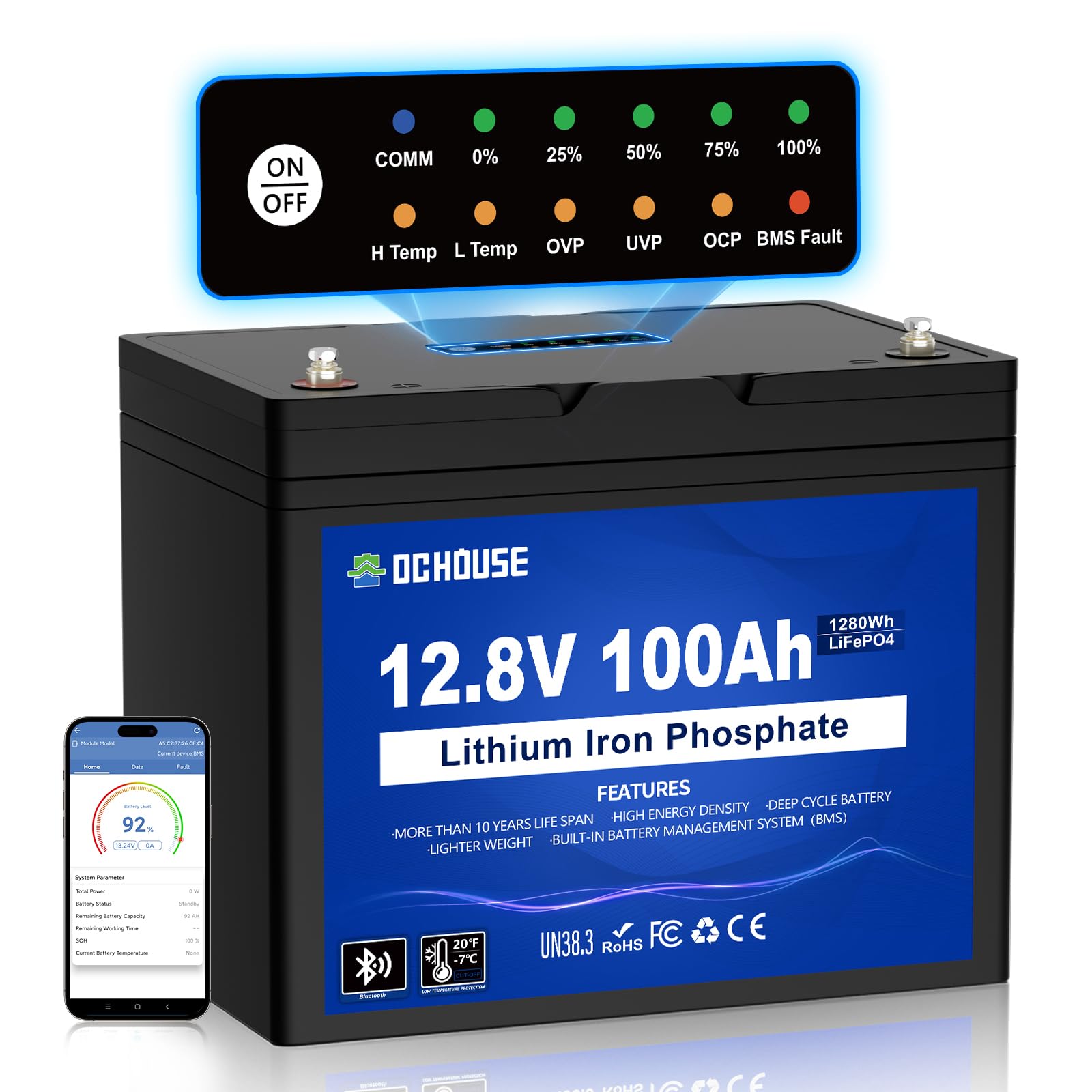
The DC HOUSE 12V 100Ah LiFePO4 battery represents the ideal companion for any of the battery boxes reviewed above. Lithium iron phosphate technology delivers up to 15,000 cycles and a 10-year service life — a dramatic improvement over the 200-500 cycles typical of lead-acid batteries. This specific model includes a visual SOC indicator with LED lights for at-a-glance state of charge, plus Bluetooth monitoring that connects to a dedicated app for detailed data on voltage, current, and individual cell health within a 5-10 meter range.
Owner feedback emphasizes the battery’s light weight — about 23 pounds versus 50-plus for an equivalent lead-acid — and its compact dimensions of roughly 10.2 by 6.6 by 9.2 inches, which fit comfortably inside most Group 24 battery boxes. The built-in 100A smart BMS protects against overcharge, over-discharge, short circuits, and high or low temperatures. The low-temperature cutoff is particularly valuable: charging is disabled below 19.4F and discharging below -4F, with automatic recovery when temperatures rise above 32F, preventing the irreversible damage that cold charging causes to LiFePO4 cells.
Some owners noted that the newer version includes anti-swelling technology but measures about half an inch taller than earlier production runs, which can create fitment issues in tight battery boxes. The leaflet included with the battery warns that older boxes without proper fixation may reduce battery life by up to 30 percent — a strong recommendation to pair this battery with a box that includes internal retention features. For anyone building a lithium-based power system, this battery offers an excellent balance of capacity, smart features, and cycle life.
What works
- Bluetooth BMS provides detailed cell-level monitoring via smartphone app
- Exceptional 15,000-cycle lifespan with 10-year service life
- Low-temperature cutoff protects against cold-charging damage
What doesn’t
- Newer version is taller, potentially causing fitment issues in some boxes
- Proper battery box retention is essential to maintain warranty and lifespan
- Requires a LiFePO4-specific charger for optimal performance
Hardware & Specs Guide
Plastic vs. Steel Construction
Polymer boxes (PC/PBT blends, polypropylene) dominate the market because they are lightweight, corrosion-proof, and electrically insulating. High-quality polymer resists impact down to sub-zero temperatures and does not rust. Steel boxes offer greater rigidity and a more premium feel but require a robust powder coating to prevent corrosion, especially in marine environments. Plastic is the better long-term choice in saltwater or humid conditions; steel is preferable for stationary installations where structural stiffness and theft resistance are priorities.
Ventilation and Gas Management
Lead-acid batteries emit hydrogen and oxygen during charging — a potentially explosive combination if trapped inside a sealed enclosure. Proper battery boxes include vent ports, hose fittings, or louvered grilles that direct gases outside the compartment. The US Coast Guard CFR 183.420 standard requires that battery boxes in marine applications be vented to prevent gas accumulation. Even for RV or solar installations, ventilation is a critical safety feature that should not be overlooked. Lithium batteries also benefit from ventilation for thermal management.
Circuit Protection and Power Distribution
Built-in circuit breakers protect both the battery and connected devices from over-current damage. Resettable breakers in the 10A to 60A range are common, with lower amperage protecting accessory ports and higher amperage handling main loads like trolling motors or inverters. Some boxes fuse each output independently. External terminals allow high-current direct connections, while USB ports, cigarette sockets, and Anderson connectors provide standardized power distribution without additional wiring. Always match breaker ratings to your specific load requirements.
Battery Chemistry Compatibility
Not all battery boxes are chemistry-agnostic. Lead-acid and AGM batteries are heavier and require robust structural support. Lithium LiFePO4 batteries are significantly lighter and smaller for the same capacity but may have slightly different form factors — particularly in height — that affect fit. Some smart boxes with built-in battery meters are calibrated for lead-acid voltage curves and will not accurately report state of charge for lithium batteries. Verify compatibility with your chosen battery chemistry before purchasing.
FAQ
What is a Group 24 battery box?
Can I use a Group 24 box for a larger battery?
Are plastic or steel battery boxes better?
Do I need a vented battery box?
Final Thoughts: The Verdict
For most buyers, the best group 24 battery box winner is the ALL-TOP Smart Battery Box because it delivers the most complete feature set — dual 50A Anderson connectors, a precise voltmeter, and robust circuit protection — in a versatile design that fits multiple battery groups. If you want integrated lighting and a compact form factor, grab the SUNAPEX Smart Battery Box. And for a rugged, lockable steel enclosure that prioritizes physical protection, nothing beats the Peastorm Trailer RV Marine Battery Box.

Certification: BSc in Mechanical Engineering
Education: Mechanical engineer
Lives In: 539 W Commerce St, Dallas, TX 75208, USA
Md Amir is an auto mechanic student and writer with over half a decade of experience in the automotive field. He has worked with top automotive brands such as Lexus, Quantum, and also owns two automotive blogs autocarneed.com and taxiwiz.com.