Choosing the right deep cycle battery is rarely straightforward when gel, AGM, and lithium chemistries all claim to outperform each other. The real difference lies in how each handles repeated discharge cycles, temperature extremes, and long-term storage without degrading prematurely. A gel cell battery uses a silica-thickened electrolyte that resists stratification and leakage, making it a strong contender for stationary solar, marine, and RV applications where vibration and climate swings are everyday factors.
I’m Amir — the founder and writer behind Four Wheel Ask. My research focuses on comparing manufacturer specs, cycle life data, BMS architectures, and real-world owner feedback across dozens of deep cycle battery models to separate marketing claims from genuine performance.
For reliable deep cycle energy storage, identifying the best gel cell battery requires a careful comparison of gel, AGM, and lithium technologies for your specific setup.
How To Choose The Best Gel Cell Battery
Every deep cycle battery serves the same basic purpose — store energy and release it steadily — but the internal chemistry dictates how long it lasts, how heavy it is, and how it behaves under stress. Gel cell batteries occupy a specific niche between standard flooded lead acid and modern lithium iron phosphate, offering spill-proof operation and slower self-discharge without the high upfront cost of LiFePO4. Understanding the trade-offs between these chemistries is the first step toward a purchase you won’t second-guess.
Chemistry and Cycle Life
Gel batteries use a thickened electrolyte that remains immobilized, reducing internal corrosion and allowing deeper discharges than AGM in some cases. A quality gel cell typically delivers 500 to 1500 cycles at 50% depth of discharge, while LiFePO4 batteries can reach 4000 to 15000 cycles depending on the BMS quality and discharge depth. If you cycle the battery daily off-grid, lithium pays for itself over time. For seasonal or backup use where the battery sits charged for weeks, gel’s lower self-discharge rate is a real advantage.
Temperature Tolerance and Safety
Gel batteries handle extreme cold better than standard flooded lead acid because the gel electrolyte resists freezing, and they tolerate heat without drying out like AGM can in high-temperature environments. LiFePO4 operates across a wider range with built-in thermal cutoffs, but the BMS adds a layer of complexity. For unheated garages, northern winters, or enclosed battery compartments, gel offers reliable performance without active management.
Physical Fit and Terminal Configuration
Group size (BCI standard) determines whether the battery drops into your existing tray. Group 24, Group 27, and Group 31 are common for marine and RV use. Terminal type matters too — many gel batteries use M8 or internal thread (INT) terminals that require specific bolts. Always check the physical dimensions and terminal layout against your current setup before ordering. A battery that fits poorly invites vibration damage and loose connections.
Quick Comparison
On smaller screens, swipe sideways to see the full table.
| Model | Category | Best For | Key Spec | Amazon |
|---|---|---|---|---|
| Mighty Max ML100-12 GEL | Gel SLA | Best Overall — true gel with UL cert | 12V 100Ah, 60 lbs, INT terminal | Amazon |
| ExpertPower EXP-100 GEL | Gel SLA | Solar & RV deep cycle | 12V 100Ah, 59.5 lbs, M8 terminal | Amazon |
| Mighty Max ML110-12 GEL | Gel SLA | Extra capacity for heavy loads | 12V 110Ah, 66.3 lbs, INT terminal | Amazon |
| Rvpozwer 100Ah LiFePO4 | Lithium | Long cycle life alternative | 12.8V 100Ah, 23 lbs, 120A BMS | Amazon |
| HRBEENERGY 100Ah LiFePO4 | Lithium | IP67 waterproof marine use | 12.8V 100Ah, 20.9 lbs, 100A BMS | Amazon |
| ECO-WORTHY 50Ah LiFePO4 | Lithium | Budget-friendly trolling motor | 12.8V 50Ah, 12.7 lbs, 4A charger incl. | Amazon |
| Newport 12V50Ah Marine AGM | AGM SLA | Entry-level marine deep cycle | 12V 50Ah, 32 lbs, marine terminal | Amazon |
| WEIZE 12V 100Ah SLA | Lead Acid | Heavy-duty stationary power | 12V 100Ah, 63 lbs, Group 31 | Amazon |
In‑Depth Reviews
1. Mighty Max Battery ML100-12 GEL

The Mighty Max ML100-12 GEL is one of the few batteries on this list that uses genuine gel electrolyte technology rather than AGM or flooded construction. The silica-thickened gel immobilizes the acid, which means the battery can be mounted in multiple orientations without leakage and handles vibration better than standard lead acid designs. At 60 pounds for 100 amp-hours of capacity, it fits squarely into the Group 31 footprint and uses internal thread (INT) terminals that accept M6 bolts — a detail that matters when you’re securing cables in a moving vehicle or marine environment.
Owner reports consistently highlight the slow self-discharge rate, with many users noting the battery holds a usable charge for months in seasonal equipment. The UL certification adds a layer of confidence for those installing the battery in enclosed spaces where safety compliance matters. Compared to AGM batteries at a similar price point, the gel formulation delivers more consistent voltage under sustained load and better recovery after deep discharges, which is critical for solar and trolling motor applications where partial state of charge operation is common.
Why it earns the top spot: this is a true gel battery at a mid-range price that outperforms AGM alternatives in cycle stability and self-discharge. The 100Ah capacity covers most RV, marine, and solar setups without overspending on lithium you may not fully utilize. For buyers who want genuine gel technology with a trusted brand and clear specs, this is the benchmark.
What works
- True gel construction with UL certification
- Slower self-discharge than typical AGM batteries
- Robust vibration and shock resistance
- Consistent voltage delivery under deep discharge
What doesn’t
- Heavier than LiFePO4 alternatives of same capacity
- Internal thread terminals require specific bolts
- Cycle life lower than premium lithium options
2. ExpertPower EXP-100 GEL Deep Cycle Battery

ExpertPower has built a reputation around accessible deep cycle storage, and the EXP-100 GEL continues that trend with a sealed gel design rated for 12 volts and 100 amp-hours. The battery uses M8 terminals rather than the INT style found on some competitors, which simplifies cable attachment if your setup already uses standard ring terminals. At 59.5 pounds, it is marginally lighter than the Mighty Max equivalent while delivering the same nominal capacity, and the dimensions (13.11 x 6.81 x 8.74 inches) conform to the Group 31 footprint used in many RV battery compartments.
The gel electrolyte in this battery is designed to resist stratification — the acid concentration gradient that gradually kills flooded batteries left partially charged. Owner feedback from solar and travel trailer installations indicates the EXP-100 holds steady voltage through repeated discharge cycles with minimal capacity fade over the first two years. The maintenance-free construction eliminates the need for water top-offs, and the spill-proof seal makes it safe for interior compartments where acid fumes would be unacceptable. ExpertPower backs this battery with standard lead acid warranty terms consistent with the category.
This battery is a strong choice for off-grid solar systems and RV house banks where the battery remains in place for long periods. The gel construction gives it an edge over AGM in environments where temperatures fluctuate widely, and the M8 terminals make installation straightforward. It occupies the premium slot because the build quality and brand consistency justify the investment for buyers who prioritize reliability over absolute lowest cost.
What works
- Genuine gel electrolyte with spill-proof seal
- Standard M8 terminals for easy installation
- Strong resistance to temperature fluctuation
- Low self-discharge during storage periods
What doesn’t
- Premium price compared to AGM competitors
- Heavy at nearly 60 pounds
- Limited cycle life versus lithium chemistry
3. Mighty Max Battery ML110-12 GEL
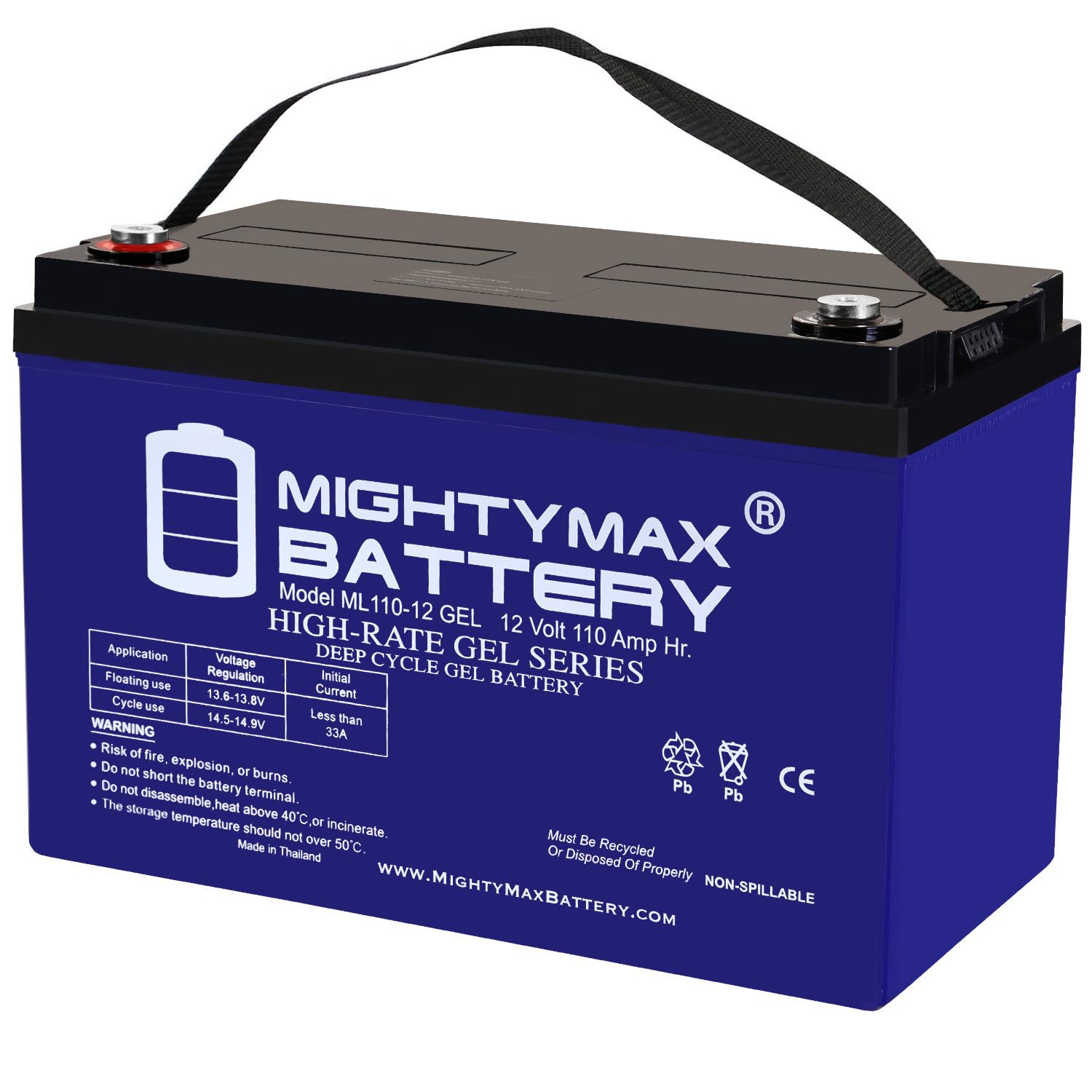
The ML110-12 GEL pushes capacity to 110 amp-hours while retaining the same gel electrolyte construction that defines the Mighty Max GEL series. The additional 10 amp-hours over the ML100 model translates to roughly 10 percent more runtime before hitting the same depth of discharge, which matters for overnight boondocking or extended trolling motor use. Weighing in at 66.3 pounds, this battery is noticeably heavier, reflecting the extra lead and electrolyte volume required to deliver that higher capacity within the same Group 31 form factor.
Like its 100Ah sibling, the ML110 uses internal thread (INT) terminals that accept M6 bolts and comes with the same 1-year manufacturer warranty. The gel formulation provides the same slow self-discharge and vibration resistance, but the higher density of active material means the battery can sustain heavier loads for longer before voltage sag becomes noticeable. Owner reports from marine and solar installations indicate the extra capacity provides a meaningful buffer for users who regularly draw the battery down to 50% depth of discharge or deeper.
For buyers who need the extra runtime and are willing to carry the additional weight, the ML110-12 GEL delivers genuine performance headroom within the same footprint. It is the highest-capacity true gel battery in this roundup, earning the performance label for users who prioritize endurance over weight savings. The trade-off is straightforward: more lead, more capacity, more mass.
What works
- 110Ah capacity in standard Group 31 size
- Genuine gel technology for low self-discharge
- Excellent vibration and shock resistance
- Consistent voltage under sustained load
What doesn’t
- Heavy at over 66 pounds
- INT terminals require specific bolts
- Higher upfront investment than 100Ah models
4. Rvpozwer 12V 100Ah LiFePO4 Battery
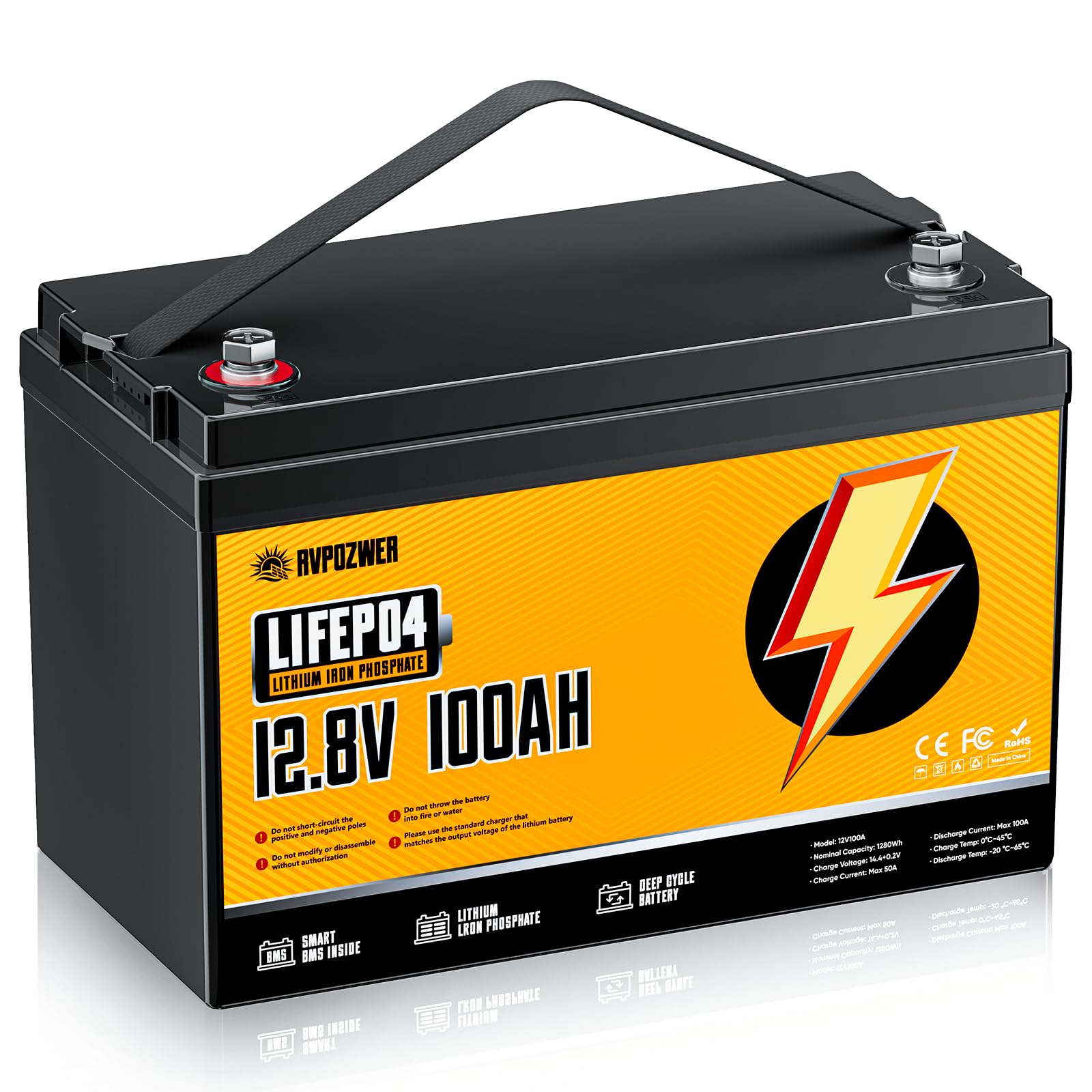
The Rvpozwer 100Ah LiFePO4 battery represents a different chemistry approach entirely, using lithium iron phosphate cells with a built-in 120A smart BMS. Weighing only 23 pounds — roughly one-third the weight of a comparable gel battery — it delivers the same 100Ah capacity with a flat discharge curve that maintains voltage above 12.8V for most of the discharge cycle. The BMS handles overcharge, over-discharge, over-current, over-voltage, and short circuit protection, plus temperature cutoffs that make the battery safe for enclosed installations.
Cycle life is where lithium truly separates itself from gel. Rvpozwer rates the battery for 4000 cycles at 100% depth of discharge, 6000 cycles at 80% DOD, and up to 15000 cycles at 60% DOD. Even at the most aggressive cycling rate, that is roughly 11 years of daily use — far beyond what any gel or AGM battery can deliver. The battery can be connected in series up to 48V or in parallel up to 400Ah, giving it scalability for larger solar arrays or RV house banks. The nylon handle makes transport manageable despite the dense internal cell arrangement.
This battery earns the value label because it undercuts most gel batteries on a cost-per-cycle basis while delivering dramatically more lifetime energy throughput. For anyone cycling a battery weekly or daily, the Rvpozwer pays for itself within the first few years. The trade-off is the need to understand BMS behavior and the higher initial outlay, but the total cost of ownership is lower than any lead acid alternative over a five-year horizon.
What works
- Exceptional cycle life up to 15000 cycles
- Lightweight at only 23 pounds
- Advanced 120A BMS with full protections
- Expandable in series or parallel configuration
What doesn’t
- Higher upfront cost than gel or AGM
- BMS adds complexity for some users
- Requires compatible lithium charger for optimal life
5. HRBEENERGY 12.8V 100Ah LiFePO4

The HRBEENERGY 12.8V 100Ah LiFePO4 battery brings an IP67 waterproof rating to the table, which is rare in the deep cycle market and meaningful for marine, boat, and trolling motor applications where water exposure is a constant threat. The Group 24 footprint is more compact than Group 31, measuring 10.23 x 8.5 x 6.6 inches, and the battery weighs just 20.9 pounds — lighter even than the Rvpozwer despite the same capacity. The built-in 100A smart BMS provides the standard suite of protections with low and high temperature cutoffs.
HRBEENERGY rates this battery for 8000+ cycles, with a 1280Wh energy capacity that supports practical loads like running a 500W heater for over 2.5 hours or a 12W lamp for over 106 hours. The M8 terminals are standard for Group 24 lithium batteries, and the IP67 seal means the battery can survive submersion in up to one meter of water for 30 minutes — a meaningful safety margin for wet environments. The manufacturer backs the unit with a 10-year warranty and 24/7 customer service, which is among the strongest coverage in this roundup.
This battery is the best choice for installations where water ingress is a real risk — bilge compartments, open fishing boats, and exposed solar setups. The combination of IP67 protection, Group 24 compact size, and high cycle life makes it a specialized tool for harsh environments. The price positions it as a premium lithium option, but the warranty and certification provide concrete value for buyers who need durability over absolute lowest cost per amp-hour.
What works
- IP67 waterproof rating for wet environments
- Compact Group 24 size saves space
- 8000+ deep cycle rating
- 10-year manufacturer warranty
What doesn’t
- Premium pricing for IP67 certification
- Group 24 may not fit Group 31 trays
- BMS limits series connection options
6. ECO-WORTHY 12V 50Ah LiFePO4 with Charger
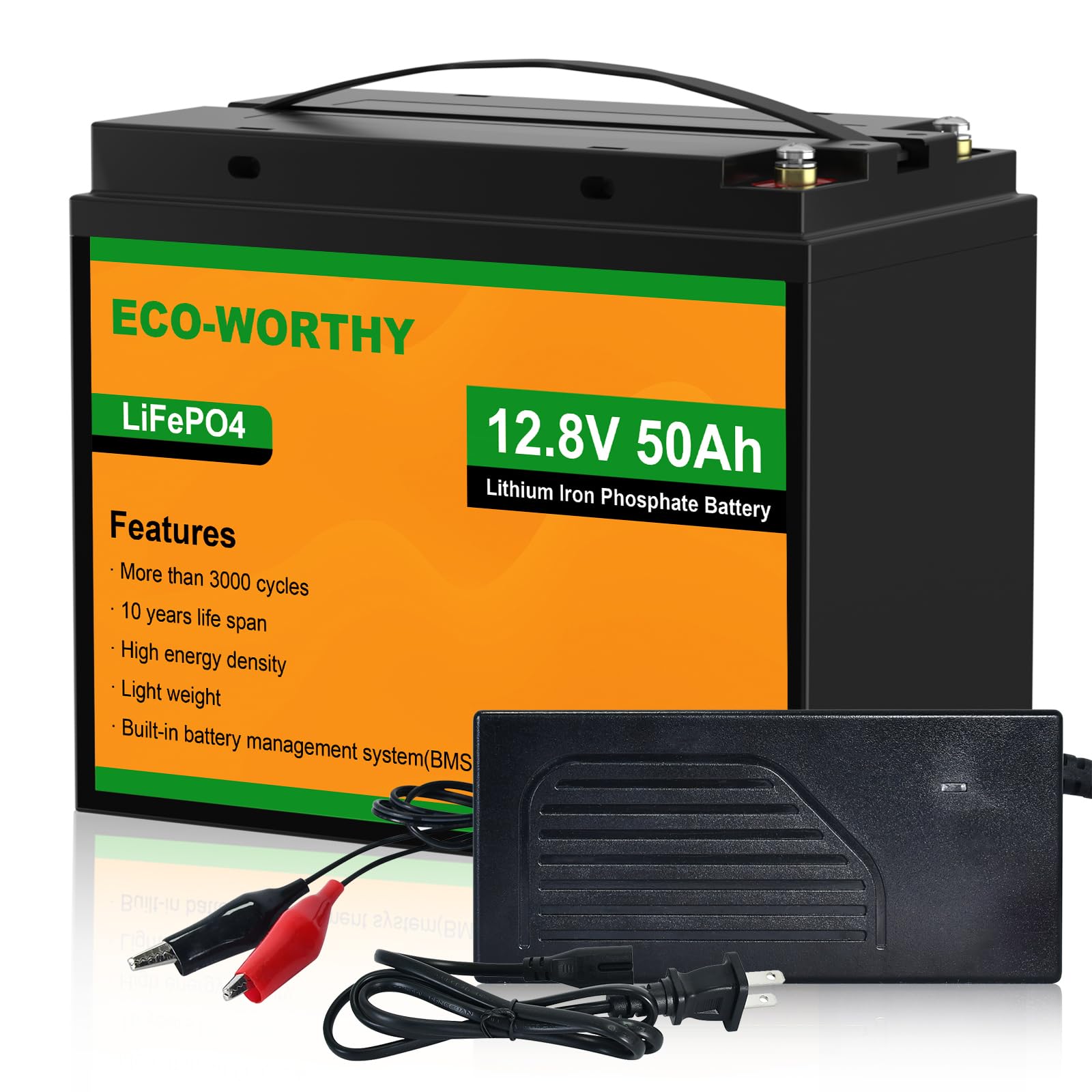
The ECO-WORTHY 12V 50Ah LiFePO4 battery targets a different use case — smaller loads where 50 amp-hours is sufficient and weight matters. At just 12.7 pounds, this battery is easy to carry and install in kayaks, small trolling motors, portable solar kits, and emergency lighting setups. The built-in BMS provides protection against overcharge, over-discharge, over-temperature, and short circuit, and the robust ABS casing resists impact better than many SLA batteries.
This package includes a 4A smart multi-in-one charger that can charge the battery in roughly 12.5 hours and also acts as a maintainer, alerting the user when voltage drops. The battery is rated for 3000 to 15000 cycles depending on depth of discharge, and the LiFePO4 chemistry eliminates the memory effect and high self-discharge rate of lead acid. ECO-WORTHY specifies the battery for 30 to 55 lb thrust trolling motors, solar power storage, and RV accessory power, but explicitly states it cannot be used as a starter battery due to the BMS current limitations.
For users who need a lightweight, portable power source for occasional use, the ECO-WORTHY 50Ah bundle provides strong value. The included charger simplifies the buying process, and the cycle life far exceeds what a gel or AGM battery of similar capacity could deliver. The trade-off is lower capacity at the same price point as some 100Ah SLA batteries, but the lithium advantages in weight and longevity compensate for the reduced amp-hour rating.
What works
- Very lightweight at 12.7 pounds
- Includes 4A smart charger and maintainer
- Long cycle life up to 15000 cycles
- Compact size for portable applications
What doesn’t
- Only 50Ah capacity limits runtime
- Not suitable for engine starting
- Charger included ships in separate package
7. Newport 12V50Ah Deep Cycle Marine Battery
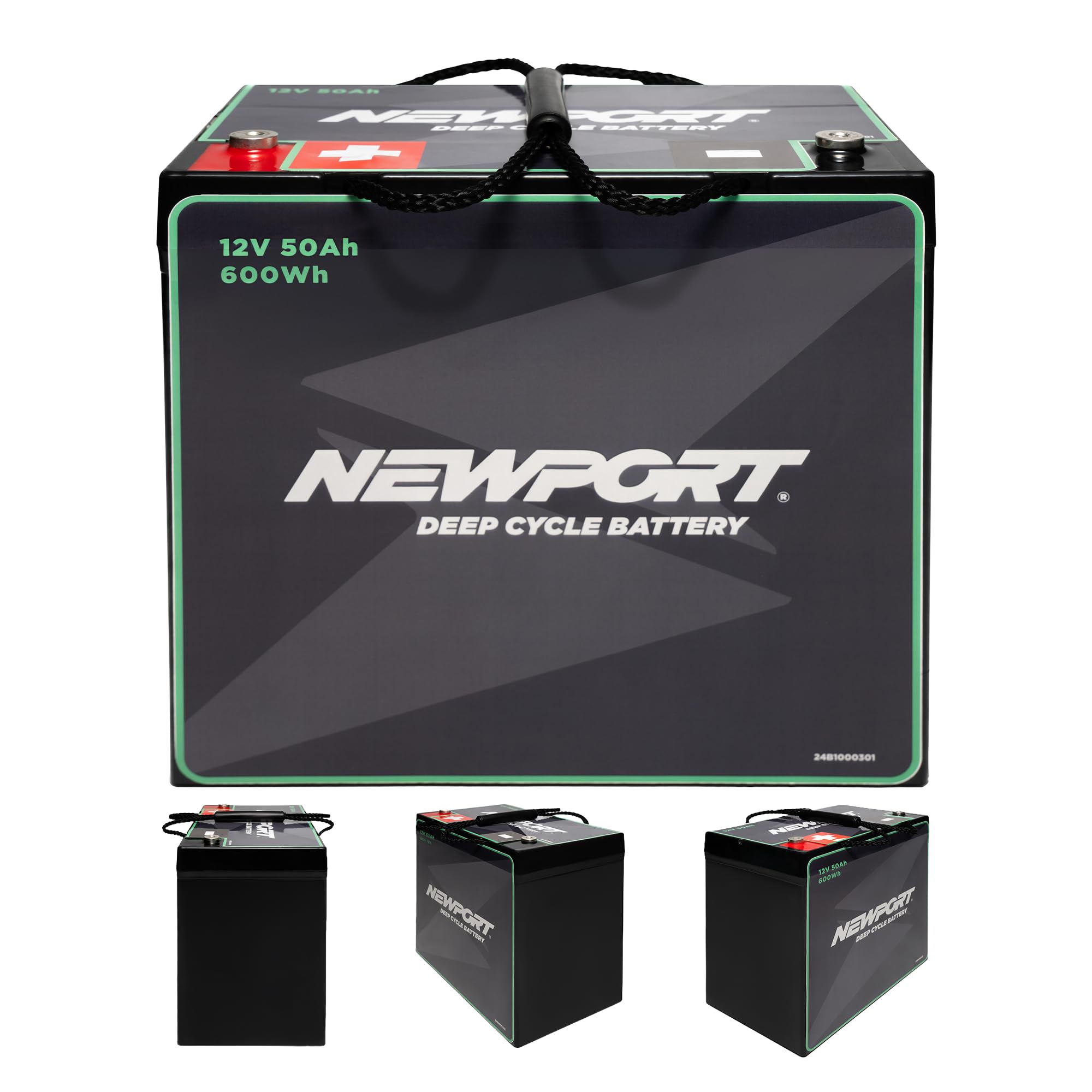
The Newport 12V50Ah Deep Cycle Marine Battery uses AGM (Absorbent Glass Mat) construction rather than gel, positioning it as a more affordable entry point for boat owners who need a sealed, maintenance-free battery for trolling motors and marine electronics. At 32 pounds, it is notably lighter than a gel battery of similar capacity, and the marine terminal design accepts standard ring connectors without adapters. The 50Ah capacity is well-suited for smaller boats with modest electrical loads, such as 30 to 40 lb thrust trolling motors and fish finders.
Newport specifies a 1-year limited warranty for this battery, which is standard for AGM lead acid products in this price range. The sealed construction prevents leaks and allows mounting in positions other than upright, though AGM batteries generally benefit from being kept on a maintainer during long storage periods to prevent sulfation. Owner feedback highlights the balance between weight and performance, with many users noting the battery meets expectations for day trips on the water without the expense of lithium. The 50Ah rating means users should plan for recharging after moderate use rather than expecting multi-day capacity.
This battery earns the design label because it optimizes for a specific use case: lightweight marine power at an accessible investment. It is not a gel battery, but it serves as a practical comparison point for buyers deciding whether true gel technology is worth the premium for their application. For small boat owners who stay near charging infrastructure, this AGM solution delivers reliable performance without overcapitulating on capacity.
What works
- Lightweight AGM design at 32 pounds
- Marine terminals for easy connection
- Sealed and maintenance-free operation
- Good for small trolling motors and fish finders
What doesn’t
- Only 50Ah capacity — limited runtime
- Not true gel technology
- Requires maintainer for long storage
- 1-year warranty is shorter than some competitors
8. WEIZE 12V 100Ah Deep Cycle Battery

The WEIZE 12V 100Ah Deep Cycle Battery uses sealed lead acid (SLA) construction with AGM technology, making it another non-gel alternative that competes on raw capacity and price. At 63 pounds, this Group 31 battery delivers the same 100Ah capacity as the gel batteries in this roundup but at a significantly lower investment, making it one of the most accessible options for large-capacity deep cycle storage. The dimensions (12.99 x 6.73 x 8.34 inches) fit standard Group 31 trays, and the terminal configuration features left positive (red) and right negative (black) with a standard lead post design.
WEIZE rates this battery for deep cycle applications including wheelchairs, scrubbers, generators, lawn and garden tools, trolling motors, UPS systems, emergency lighting, and alarm security. The 3% self-discharge rate is competitive for SLA technology, and the spill-proof design allows safe indoor installation. Owner feedback from the RV and solar communities indicates the battery delivers rated capacity when new, though cycle life expectations should align with standard AGM performance — roughly 300 to 500 cycles at 50% depth of discharge. The 1150A max discharge current makes it suitable for applications with high surge demands.
This battery fills the value slot for buyers who need 100Ah of capacity at the lowest possible investment and are willing to trade cycle life and weight for upfront savings. It is not a gel battery, but it represents the budget-friendly end of the 100Ah deep cycle spectrum. For seasonal use or backup power where the battery is cycled infrequently, the WEIZE delivers the capacity without the premium of gel or lithium technology.
What works
- 100Ah capacity at a budget-friendly investment
- Standard Group 31 size fits most trays
- Low self-discharge rate for SLA
- Spill-proof and maintenance-free design
What doesn’t
- Heavy at 63 pounds
- Not true gel technology
- Cycle life limited to 300-500 cycles
- No BMS for over-discharge protection
Hardware & Specs Guide
Gel Electrolyte Chemistry
Gel cell batteries use a silica additive that turns the liquid electrolyte into a thick, gelatinous paste. This immobilized electrolyte resists stratification (acid settling at the bottom) and allows the battery to be mounted in multiple orientations without leakage. The gel formulation also reduces internal corrosion and gas recombination, resulting in slower self-discharge compared to AGM — typically 1-3% per month versus 2-5% for AGM at the same temperature. This makes gel batteries particularly well-suited for seasonal or backup applications where the battery may sit unused for weeks or months.
BCI Group Size and Physical Fit
The Battery Council International (BCI) group size standard defines the physical dimensions, terminal location, and polarity of lead acid batteries. Group 24 measures roughly 10.25 x 6.8 x 8.9 inches, Group 27 is slightly longer at 12.1 x 6.8 x 8.9 inches, and Group 31 is the largest common size at 13.0 x 6.8 x 9.4 inches. Always measure your existing battery tray before ordering, and note that terminal type (M8, INT, marine post) determines which ring terminals or bolts you need for a secure connection. A battery that shifts during travel can develop internal damage from vibration.
Cycle Life and Depth of Discharge
Cycle life is the number of complete charge-discharge cycles a battery can deliver before its capacity drops below 80% of the original rating. Depth of discharge (DOD) directly affects cycle life — a gel battery may achieve 1500 cycles at 50% DOD but only 500 cycles at 80% DOD. LiFePO4 batteries typically handle 4000 to 15000 cycles depending on DOD, making them far more cost-effective over time for daily cycling. For occasional use where the battery is rarely drawn below 50%, gel provides a reasonable balance of upfront cost and longevity.
BMS and Charger Compatibility
LiFePO4 batteries require a Battery Management System (BMS) to balance cells and protect against over-voltage, under-voltage, over-current, and temperature extremes. Gel and AGM batteries do not have a BMS, so they depend entirely on the external charger to regulate voltage and current. Using a lead acid charger on a LiFePO4 battery can trigger BMS disconnection or degrade cells over time, while charging a gel battery with a lithium profile can cause over-voltage gassing. Always match your charger profile to the specific battery chemistry to maximize cycle life and safety.
FAQ
Can I use a gel cell battery as a starter battery for my engine?
How do I charge a gel cell battery correctly?
What is the difference between AGM and gel cell batteries?
How long does a gel cell battery last in storage?
Can I replace an AGM battery with a gel cell battery?
Final Thoughts: The Verdict
For most buyers, the best gel cell battery winner is the Mighty Max ML100-12 GEL because it delivers genuine gel technology with UL certification at a reasonable weight and footprint. If you want extra capacity without changing form factor, grab the Mighty Max ML110-12 GEL. And for a complete departure from lead acid with dramatically longer cycle life, nothing beats the lightweight Rvpozwer 100Ah LiFePO4 for users who cycle their battery bank frequently enough to justify the transition.

Certification: BSc in Mechanical Engineering
Education: Mechanical engineer
Lives In: 539 W Commerce St, Dallas, TX 75208, USA
Md Amir is an auto mechanic student and writer with over half a decade of experience in the automotive field. He has worked with top automotive brands such as Lexus, Quantum, and also owns two automotive blogs autocarneed.com and taxiwiz.com.