Nothing kills the first ride of spring faster than a motorcycle that coughs, sputters, or refuses to fire after months in storage. The culprit is almost always degraded fuel — gasoline that has oxidized, absorbed moisture, or formed sticky varnish deposits inside the carburetor or fuel injectors. A purpose-formulated stabilizer prevents that chemical breakdown, but not all additives deliver the same level of protection for motorcycle fuel systems.
I’m Amir — the founder and writer behind Four Wheel Ask. My focus is on dissecting fuel additive formulations, analyzing ASTM stability test data, and cross-referencing long-term owner storage reports to identify which products genuinely prevent gum formation, phase separation, and corrosion over extended downtime.
Drawing from extensive spec analysis and real owner feedback, this guide identifies the best gasoline stabilizer for motorcycles for worry-free safe storage.
How To Choose The Best Gasoline Stabilizer For Motorcycles
Selecting the right stabilizer comes down to understanding the chemical threats your fuel faces during storage and how each additive package addresses them. Motorcycles with small fuel tanks, carburetors, or sensitive fuel injection systems require a stabilizer that protects against oxidation, moisture accumulation, and ethanol-related corrosion without leaving residue.
Oxidation Resistance and Antioxidant Chemistry
Gasoline begins to oxidize the moment it is exposed to air, forming peroxides that break down into gum and varnish. A high-quality stabilizer uses antioxidant compounds — typically hindered phenols or amines — to interrupt this chain reaction. Products tested against ASTM D525 oxidation stability standards provide measurable proof of how long they keep fuel fresh. Look for stabilizers that guarantee at least 12 to 24 months of protection, as this directly reflects the potency of the antioxidant package.
Ethanol Blending and Water Management
Ethanol attracts moisture from the air, which can lead to phase separation — a condition where water and ethanol separate from the gasoline and settle at the bottom of the tank. This corrosive layer damages fuel system components and causes hard starting. Effective motorcycle stabilizers include water-scavenging agents that bind to small amounts of moisture and disperse it safely into the fuel, preventing phase separation and protecting metal surfaces from rust.
Storage Duration and Dosage Accuracy
Short-term storage (a few weeks) requires less aggressive chemistry than a full winter layup. Many stabilizers offer different dose rates depending on how long the vehicle will sit. A product that treats a specific volume of gasoline per ounce allows you to calculate the exact amount needed for your motorcycle’s tank size. Overdosing rarely causes harm, but underdosing leaves fuel vulnerable to degradation during the critical storage window.
Compatibility with Carbureted and Fuel-Injected Systems
Older motorcycles with carburetors are especially sensitive to gum formation in small passages and float bowls. Fuel-injected bikes face different risks — injector nozzle clogging and fuel pump corrosion. The best stabilizers work across both architectures, providing a protective film on metal surfaces without leaving a sticky residue that clogs precision orifices. Products that also clean the combustion chamber offer added value for bikes that see intermittent use.
Quick Comparison
On smaller screens, swipe sideways to see the full table.
| Model | Category | Best For | Key Spec | Amazon |
|---|---|---|---|---|
| STA-BIL Storage Fuel Stabilizer | Fuel Stabilizer | Long-term storage | 32 oz., treats 80 gal | Amazon |
| Yamaha Yamalube Fuel Stabilizer & Conditioner | OEM Stabilizer | Yamaha motorcycle owners | 32 oz., OEM formula | Amazon |
| Quicksilver Quickstor Fuel Treatment | Marine Stabilizer | Marine & powersports | 12 oz., treats 60 gal | Amazon |
| Lucas Oil Safeguard Ethanol Fuel Stabilizer | Ethanol Stabilizer | Ethanol fuel protection | 16 oz., treats 80 gal | Amazon |
| HappyFuel Premium Fuel Stabilizer | Premium Additive | Classic cars & collectors | Single can, treats up to 20 gal | Amazon |
In‑Depth Reviews
1. STA-BIL Storage Fuel Stabilizer

STA-BIL Storage is the most widely referenced fuel stabilizer in the powersports community for good reason. Its antioxidant and anti-corrosion formula is designed to keep gasoline fresh for up to 24 months, making it a straightforward choice for riders who store their motorcycles for entire off-seasons. The 32-ounce bottle treats up to 80 gallons of fuel at a ratio of one ounce per 2.5 gallons, which means a single bottle covers multiple machines or several seasons of storage.
The proprietary chemistry includes detergents that help prevent gum and varnish buildup in carburetor passages and fuel injectors. Owner reports consistently highlight that machines treated with STA-BIL fire up on the first or second crank after months of sitting, without the need to drain the tank or run the carburetor dry. The product is effective with all ethanol-blended fuels up to E85, which gives it broad compatibility across different fuel grades and regional blends.
Lab testing confirms that STA-BIL outperforms generic stabilizers in preventing fuel oxidation, and its long shelf life — two years after opening, five years from production — means occasional users do not need to worry about degraded chemistry. For riders who want a proven, data-backed stabilizer that works across motorcycles, lawn equipment, and generators alike, this is the standard to measure against.
What works
- Industry-standard formulation with extensive real-world validation
- Treats an exceptionally large volume per bottle
- Effective with ethanol blends from E10 through E85
What doesn’t
- Bottle design requires careful measuring for small motorcycle tanks
- Not optimized specifically for high-performance or race fuel
2. Yamaha Yamalube Fuel Stabilizer & Conditioner

Yamaha Yamalube Fuel Stabilizer & Conditioner is the OEM-specification additive developed specifically for Yamaha powersports engines, but its chemistry works across any gasoline-fueled motorcycle. The 32-ounce bottle uses a formulation that not only stabilizes fuel against oxidation but also actively cleans the combustion chamber and fuel system. Owner reports describe noticeable improvements in idle smoothness and throttle response after the first treated tank, which indicates real detergent activity beyond simple stabilization.
One of the most telling user accounts involves a carbureted rider mower that had been left outdoors for years with water contamination. After a fresh tank of treated fuel, the engine ran cleanly enough to pass a bore-scope inspection — a strong testament to the product’s ability to dissolve existing deposits while preventing new ones. This dual-action approach makes it particularly valuable for motorcycles that sit for long stretches between rides, where fuel system varnish builds up gradually over multiple storage cycles.
OEM-engineered additives undergo validation testing against the manufacturer’s own fuel system components, which gives owners confidence that seals, gaskets, and injectors will not be damaged by aggressive solvents. For riders who prefer brand-matched maintenance products or who own a Yamaha and want to stick with the factory-recommended chemistry, this stabilizer delivers OEM-grade protection without the guesswork.
What works
- OEM-formulated for Yamaha engines with full compatibility validation
- Cleans combustion chambers and fuel systems while stabilizing
- Large 32-ounce bottle provides excellent coverage per purchase
What doesn’t
- Premium positioning means a higher upfront cost per ounce
- Less independent test data compared to more universal brands
3. Quicksilver Quickstor Fuel Treatment & Stabilizer

Quicksilver Quickstor is built to Mercury Marine’s original equipment specifications, which means it was formulated to withstand the harsh conditions of marine storage — high humidity, temperature swings, and ethanol-laden fuel. This engineering DNA translates directly to motorcycle storage, where similar moisture and temperature challenges exist. The stabilizer prevents regular and ethanol-blended gasoline from breaking down and oxidizing, keeping fuel stable for up to two years at a dose of one ounce per five gallons.
Long-term users consistently report trouble-free spring startups after treating their boat or personal watercraft fuel systems with Quickstor. The same chemical package that protects marine engines from corrosion in a damp bilge environment also shields motorcycle fuel tanks from internal rust, especially in bikes stored in unheated garages or sheds where condensation forms on tank walls. The 12-ounce bottle treats 60 gallons of fuel, making it suitable for both single motorcycle storage and multi-engine households.
The product meets Mercury Marine’s rigorous OEM specifications, which require additives to pass extended corrosion and oxidation tests before approval. For riders who want stabilizer chemistry that has been validated against a demanding marine standard — where fuel system failure is not an option — Quickstor offers a level of performance assurance that generic additives cannot match. Its track record with boat owners who winterize annually is exceptionally strong.
What works
- OEM-spec formulation tested against demanding marine standards
- Strong corrosion protection for humid storage environments
- Simple 1-oz-per-5-gal dosing for easy measurement
What doesn’t
- Smaller bottle size requires more frequent repurchase for high-volume users
- Marine focus may not include combustion-cleaning detergents
4. Lucas Oil Safeguard Ethanol Fuel Stabilizer
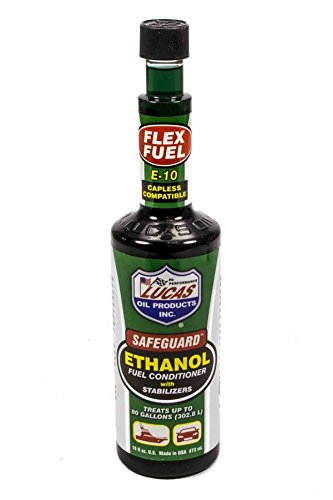
Lucas Oil Safeguard Ethanol Fuel Stabilizer focuses on the specific threat that ethanol poses to fuel systems — moisture absorption, phase separation, and accelerated corrosion of metal components. The 16-ounce bottle treats up to 80 gallons of fuel at a ratio of one ounce per five gallons, making it one of the most cost-effective options for riders who want reliable ethanol protection without spending a premium. The chemistry is designed to stabilize fuel for extended periods while lubricating the upper cylinder and fuel pump components.
Owner reports from high-ethanol fuel users are particularly positive. One verified review from a tuned CLS63 owner running E40 fuel noted zero high-pressure fuel pump or seal issues after eight months of continuous use, despite aggressive ethanol content. Motorcycle owners in the review pool report smoother idle and fewer cold-start misfires after incorporating the stabilizer into their storage routine. The product works prophylactically — added at each fill-up or before storage — to prevent problems before they develop.
Lucas Oil is a well-established brand in the automotive additive space, and the Safeguard line benefits from decades of lubricant and fuel treatment research. While the formulation is not specifically marketed as a heavy-duty storage stabilizer for multi-year layups, it performs admirably for seasonal storage and regular ethanol protection. For budget-conscious riders who need a trustworthy stabilizer for routine off-season storage, this bottle delivers strong value per gallon treated.
What works
- Excellent cost per gallon treated for budget-minded buyers
- Specifically formulated to combat ethanol-related fuel issues
- Trusted brand with decades of additive manufacturing experience
What doesn’t
- Not marketed for extended multi-year storage scenarios
- Fewer explicit corrosion-test certifications than premium competitors
5. HappyFuel Premium Fuel Stabilizer

HappyFuel is a newer entrant to the stabilizer market that differentiates itself with a science-first approach, backing its formulation with ASTM D525 oxidation stability testing. The product uses a four-pronged chemical strategy: bonding with gasoline compounds to prevent evaporation of light-end components, forming a protective layer on engine metal to block moisture corrosion, preventing corroded metal ions from catalyzing fuel degradation, and scavenging water to inhibit biological growth at the tank bottom. This multi-mechanism design targets fuel stability from every angle.
User feedback from the classic car and motorcycle community highlights noticeable improvements in engine smoothness and reduced backfiring after treatment. One Harley-Davidson FLHXS owner reported that the stabilizer eliminated a persistent popping sound during downshifting, along with a perceived drop in engine operating temperature. These anecdotal results suggest that the additive package does more than just stabilize — it may also improve combustion characteristics by restoring some of the fuel’s original volatility.
The metal can packaging is a practical touch, as it eliminates the risk of plastic bottle degradation in a hot garage over multiple seasons. Each can treats a single fuel tank fill-up, which simplifies dosing for riders who do not want to measure precise ounce amounts. For collectors and enthusiasts who value a laboratory-validated formula with transparent test data, HappyFuel offers a modern alternative to legacy stabilizer brands.
What works
- ASTM D525 oxidation test validation provides measurable performance data
- Multi-mechanism chemistry addresses oxidation, moisture, and corrosion
- Metal can packaging avoids plastic degradation issues
What doesn’t
- Single-can format limits flexibility for varying tank sizes
- Newer brand with less long-term owner history than established competitors
Hardware & Specs Guide
Oxidation Stability
Oxidation stability measures how long a fuel resists chemical breakdown when exposed to oxygen. ASTM D525 is the standard test method, where fuel is pressurized with oxygen and heated until a pressure drop indicates oxidation. Stabilizers with strong antioxidant packages — typically hindered phenols or aromatic amines — significantly extend the induction period. Products that guarantee 12 to 24 months of fuel freshness have antioxidant concentrations calibrated to match real-world storage conditions.
Water Scavenging Capacity
Ethanol-blended fuels are hygroscopic, meaning they actively absorb moisture from the air. When water content exceeds the fuel’s saturation point, phase separation occurs — a water-ethanol layer settles at the tank bottom, creating a corrosive environment. Effective stabilizers use demulsifiers or solubilizers to disperse small amounts of water into the fuel, preventing separation. The best formulas can handle up to several milliliters of water per liter of fuel before phase separation becomes a risk.
Corrosion Protection
Metal fuel system components — steel tanks, aluminum carburetor bodies, brass jets, and fuel pump internals — are vulnerable to rust and galvanic corrosion when exposed to moisture-laden fuel. Stabilizers incorporate film-forming inhibitors that bond to metal surfaces, creating a hydrophobic barrier that blocks water contact. Accelerated corrosion tests per ASTM D665 or similar standards quantify protection levels, with the best products showing zero rust formation on steel spindles after extended immersion.
Dosage and Fuel Compatibility
Stabilizer concentration directly affects performance. Underdosing leaves fuel vulnerable to oxidation, while overdosing — within reason — rarely causes harm but wastes product. Most stabilizers specify a ratio between 1 oz per 2.5 gallons and 1 oz per 5 gallons, depending on the desired storage duration. All major stabilizers are compatible with ethanol blends from E10 to E85, pure gasoline, and racing fuels, though some formulations work better with oxygenated fuels than others.
FAQ
How much stabilizer should I add to my motorcycle tank?
Can I use the same stabilizer in my car and motorcycle?
Does fuel stabilizer expire or lose effectiveness over time?
Should I add stabilizer to fresh fuel or can I treat fuel that is already stale?
Do I need to run the engine after adding stabilizer?
Final Thoughts: The Verdict
For most buyers, the best gasoline stabilizer for motorcycles winner is the STA-BIL Storage Fuel Stabilizer because it combines 24-month protection, broad ethanol compatibility, and the most extensive real-world validation across the powersports community. If you want OEM-grade chemistry matched to your bike’s fuel system, grab the Yamaha Yamalube Fuel Stabilizer & Conditioner. And for a science-backed option with transparent ASTM test data, nothing beats the HappyFuel Premium Fuel Stabilizer.

Certification: BSc in Mechanical Engineering
Education: Mechanical engineer
Lives In: 539 W Commerce St, Dallas, TX 75208, USA
Md Amir is an auto mechanic student and writer with over half a decade of experience in the automotive field. He has worked with top automotive brands such as Lexus, Quantum, and also owns two automotive blogs autocarneed.com and taxiwiz.com.