Every mechanic knows the frustration of a siphon hose that refuses to start, leaks fuel everywhere, or leaves you tasting gasoline for hours. Whether you are rotating stored fuel, draining a boat tank, winterizing an RV, or changing gear oil, a poorly designed pump turns a five-minute job into a messy ordeal that wastes time and money.
I’m Amir — the founder and writer behind Four Wheel Ask. I specialize in dissecting product specifications, analyzing build quality across price tiers, and aggregating owner feedback from hundreds of real-world users to separate the few durable tools from the many disposable ones.
After extensive analysis of dozens of models and owner feedback, I’ve identified the top contenders for anyone in need of the best fuel siphon pump.
How To Choose The Best Fuel Siphon Pump
Selecting the right transfer tool depends on understanding a few critical variables that determine whether a pump becomes a trusted shop companion or a one-use frustration. The three factors that separate premium tools from disposable novelties are the priming mechanism, hose construction, and connection quality.
Priming Mechanism
Manual jiggler or shaker-style siphons use a weighted brass or copper nozzle with an internal ball bearing that creates a seal when shaken rapidly. These require no batteries and no mouth contact, but they demand a minimum fluid depth — typically around six inches — to function. Bulb-style hand pumps use a rubber squeeze bulb to pull the initial vacuum, which works better in shallow reservoirs but adds a potential leak point at the bulb connection. Battery-powered electric pumps eliminate manual effort entirely and deliver consistent flow, though they require battery replacement and are sensitive to corrosive fluids.
Hose Construction and Diameter
Hose diameter directly dictates flow rate: a half-inch hose moves roughly two to three gallons per minute, while a three-quarter-inch or one-inch hose can push four or more gallons per minute. However, larger hoses are stiffer and harder to route into tight filler necks — many modern cars feature anti-siphon screens that reject anything wider than half an inch. Material matters equally; PVC hoses with internal spiral wire resist kinking and collapse under suction, while plain vinyl tubing tends to flatten, crack, and yellow after limited exposure to fuel additives.
Connection Quality and Leak Prevention
Brass or copper fittings outperform plastic barbs in longevity and sealing. Look for shark-bite style quick-connect fittings that lock the hose to the pump body without requiring clamps — these dramatically reduce the chance of leaks at the joint. Stainless steel worm-drive clamps provide a backup seal on barbed connections. Avoid pumps that rely solely on friction-fit plastic collars, as these frequently loosen after the first use and cause drips that create both a mess and a fire hazard.
Quick Comparison
On smaller screens, swipe sideways to see the full table.
| Model | Category | Best For | Key Spec | Amazon |
|---|---|---|---|---|
| MILADO Gas Transfer Pump | Bulb Pump Kit | Heavy-duty home & boat use | 10 ft x 1 in hose, dual operation | Amazon |
| Swess Siphon Hose Kit | Bulb Pump Kit | Fast fuel & water transfer | 8 ft x 5/8 in hose, anti-kink spring | Amazon |
| BestCosy Electric Pump | Battery Powered | Quick, hands-free transfer | 2.4 GPM, 24 in hose, D-cell power | Amazon |
| Gerguirry Heavy Duty Siphon | Jiggler Hose | Boats, ATVs & tractors | 8.2 ft x 1 in hose, brass nipple | Amazon |
| FlowPro Shaker Siphon | Jiggler Hose | Marine & pool draining | 8 ft x 1/2 in hose, 4 GPM | Amazon |
| SMART JERRY Multi-Function Pump | Shark-Bite Kit | Transmission & coolant work | Shark-bite fittings, 3 adapter kit | Amazon |
| Wadoy Self-Priming Siphon | Self-Priming Kit | Emergency & bugout bags | 6 ft x 1/2 in hose, food-grade silicone | Amazon |
| Darnassus Siphon Hose | Basic Jiggler | Pools, ponds & general water | 10 ft x 3/4 in hose, brass connector | Amazon |
| ELEAD Multi-Function Pump | Shark-Bite Kit | Snowblower & differential oil | Shark-bite button, 3 adapters, 3+ GPM | Amazon |
| Wadoy Shaker Siphon 2-Pack | Shaker Hose | Multi-vehicle fleet fueling | 6 ft x 1/2 in hose, 2-pack, 3.5 GPM | Amazon |
| MADHOLLY RV Winterizing Kit | Bulb Pump Kit | RV antifreeze & coolant work | 3/4 in NPT brass connector, leakproof clamps | Amazon |
In‑Depth Reviews
1. MILADO Gasoline Transfer Pump

The MILADO kit stands out for its thick two-point-five millimeter PVC hose and dual-operation design that lets you use either the grenade-style bulb pump or shake the copper siphon head to start flow. Owners consistently report that the large diameter hose moves fluid aggressively, making it ideal for pulling ten gallons of old gas from a boat tank or transferring diesel between drums without babysitting the flow. The one-piece copper head and heavy-duty rubber bulb feel substantially more robust than the thin plastic assemblies found on cheaper competitors.
A critical limitation surfaced during analysis: the one-inch hose diameter prevents insertion into many modern car filler necks equipped with roll-over valves or anti-siphon screens. Users who attempted to drain a passenger vehicle tank found the hose too wide to pass the restrictor. This is a non-issue for lawn tractors, boats, generators, and open-top barrels, where that same large bore delivers the fastest transfer speed in the lineup. The included shut-off valve gives precise flow control, a feature rarely seen at this price tier.
Build quality is the strongest argument for this pick. The brass siphon nozzle, stainless steel clamps, and submersible PVC construction indicate a unit designed for repeated use rather than single-season disposal. Owner reports spanning multiple transfer sessions note no cracking, no kinking, and no degradation from gasoline exposure. For anyone who needs a go-to pump for home, boat, or small-fleet use and does not require automotive filler-neck compatibility, this is the most capable all-around tool in the field.
What works
- Thick-walled PVC resists cracking and kinking far better than budget tubing
- Dual operation (bulb pump or copper jiggler) provides redundancy in the field
- High flow rate moves large volumes quickly for drums and boat tanks
What doesn’t
- Large one-inch hose cannot fit modern car filler necks with anti-siphon screens
- Heavier construction reduces portability for emergency roadside kits
2. Swess Siphon Hose Kit

The Swess kit distinguishes itself with a five-eighths-inch diameter hose that strikes an intelligent compromise between flow rate and filler-neck compatibility — wide enough to move several gallons per minute yet narrow enough to slide into most boat and generator fuel ports without struggle. The integrated anti-kink spring prevents the PVC tubing from collapsing during suction, a failure mode that plagues cheaper hoses when the liquid level drops below halfway. Owner reports consistently praise how quickly the bulb pump establishes prime compared to jiggler-only designs.
Material selection here reflects an understanding of real workshop conditions. The oil-resistant PVC, heavy-duty rubber bulb, and stainless steel clamps are all rated for gasoline and diesel exposure without swelling or becoming brittle. The included brass jiggler nozzle with retainer clips adds a secondary priming method, and the adjustable hose clamp doubles as a shut-off valve to hold liquid in the hose between transfers. Users who have owned this unit for multiple seasons report no hose yellowing or cracking, which is a strong indicator of compound quality.
The only consistent point of criticism involves the plastic retainer clips, which several owners describe as flimsy and prone to breaking if overtightened. These clips are not structural — the brass nozzle and stainless clamps carry the load — but their failure diminishes the out-of-box experience. For the buyer who wants a versatile, well-constructed kit that bridges the gap between budget disposability and professional-grade cost, this kit delivers the best balance of features and reliability in the mid-premium tier.
What works
- Five-eighths-inch hose balances fast flow with wide filler-neck compatibility
- Anti-kink spring maintains suction even at low fluid levels
- Oil-resistant materials show no swelling or cracking after extended gasoline exposure
What doesn’t
- Plastic retainer clips feel cheap and may break under repeated tightening
- Bulb pump requires a few extra squeezes compared to electric alternatives
3. BestCosy Portable Transfer Pump
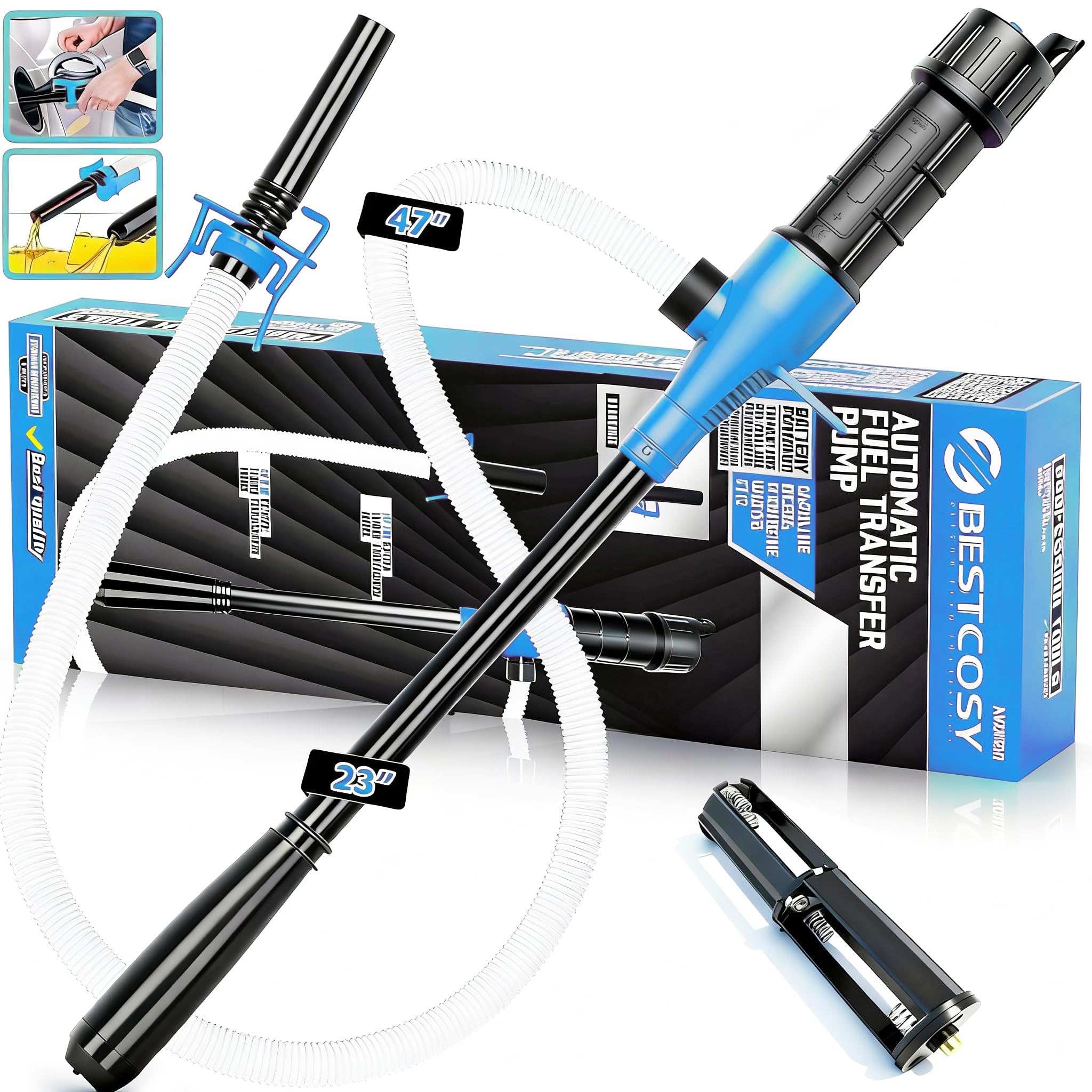
The BestCosy electric pump removes the manual labor equation entirely, using two D-cell batteries or six AA batteries to drive an impeller that delivers a consistent two-point-four gallons per minute without any shaking, squeezing, or priming ritual. Owner reports confirm the pump transfers over one thousand gallons on a single set of batteries, making it a practical investment for anyone who regularly drains multiple tanks or rotates stored fuel. The aluminum body and brass fittings provide corrosion resistance that plastic-bodied pumps cannot match, particularly when used with diesel or kerosene.
Versatility is the defining strength of this unit. The kit includes two hoses, four metal clamps, a hose clip, and a brass extender, enabling adaptation to various container sizes and fluid types. Users report success transferring gasoline, diesel, water, and light oil, with several describing how it pumped two five-gallon buckets of diesel into an RV tank with zero residue left at the bottom. The twenty-four-inch discharge hose and sixteen-inch suction tube fit standard three-to-five-gallon gas cans without requiring the user to hold the pump in place.
The battery requirement is both the feature and the limitation. While battery power frees the user from manual effort, it also creates a dependency — if the batteries die mid-job and no spares are available, the pump becomes dead weight. Several owners noted that the pump works best with fresh alkaline cells and that rechargeable batteries with lower voltage may reduce flow rate. For the DIY mechanic or outdoor enthusiast who plans ahead and keeps spare batteries in the toolbox, this pump delivers unmatched speed and convenience for repetitive transfer tasks.
What works
- Eliminates manual priming effort with battery-powered impeller operation
- Aluminum and brass construction resists corrosion from diesel and kerosene
- Pumps over 1000 gallons per battery set for high-volume users
What doesn’t
- Requires two D-cell or six AA batteries which are not included in the kit
- Rechargeable batteries with lower voltage may reduce flow performance
4. Gerguirry Heavy Duty Siphon Hose
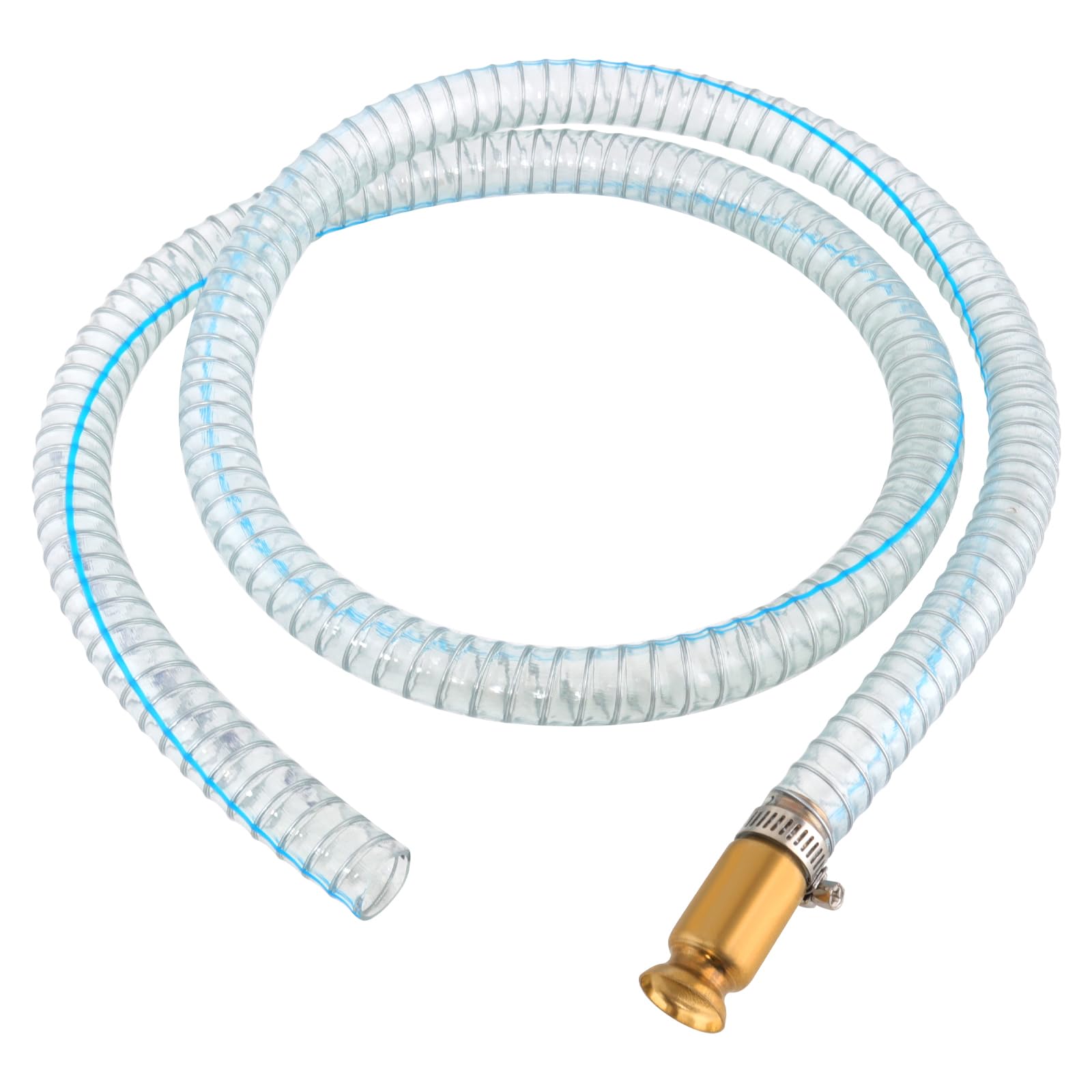
The Gerguirry jiggler siphon addresses the two most common failure points of traditional transfer hoses — kinking and nozzle retention — with thoughtful engineering. A built-in spiral spring runs the full length of the eight-point-two-foot PVC hose, preventing the tube from collapsing under suction or flattening when stored in a toolbox. The pure lead-free copper nipple features industrial-strength glass balls for the self-priming mechanism, paired with a metal buckle that prevents the nozzle from slipping into the tank during use, a detail that sounds minor until you have fished a brass fitting out of a fuel tank.
The one-inch diameter delivers the highest flow rate in this comparison, making it the fastest option for transferring fuel between large containers, boat tanks, and tractor reservoirs. Owners who use it for diesel transfer from pickup truck tanks report that the wire reinforcement maintains the hose shape even when coiled tightly for storage, and the transparent tubing allows visual confirmation of flow initiation. The self-priming jiggler action typically starts within a few seconds of rapid vertical shaking, provided the nozzle end is submerged by at least six inches of fluid.
Reliability reports show a split pattern: owners who maintain the hose properly — draining it after each use and storing it dry — report consistent performance over multiple seasons. Those who leave diesel residue in the hose between uses eventually experience ball valve sticking, which is a maintenance issue rather than a design flaw. A small number of users reported that the hose did not prime on the first attempt, which may indicate the need for a deeper fluid level or a more aggressive shake motion. For high-volume transfer work where speed matters and the user is willing to perform basic post-use care, this is the most efficient manual option available.
What works
- Internal spring prevents hose collapse and kinking under suction or storage
- One-inch bore delivers the fastest flow rate in the comparison group
- Metal buckle on the copper nozzle prevents accidental loss inside the tank
What doesn’t
- Requires a minimum fluid depth of about six inches for reliable priming
- Fuel residue left in the hose between uses can cause the ball valve to stick
5. FlowPro Shaker Siphon

The FlowPro shaker siphon has earned a strong reputation among marine owners and pool maintainers for its reliable self-priming mechanism and anti-static material construction that inhibits spark generation when transferring flammable liquids. The half-inch diameter hose with lead-free copper nozzle and industrial-grade glass ball delivers up to four gallons per minute under ideal height differentials, and the heavy-duty PVC tubing resists the yellowing and stiffening that affects lower-grade materials after repeated gasoline exposure. Owners report that the hose remains flexible even after months of storage in hot garage environments.
Application versatility is broad. Users have successfully employed this siphon for draining boat fuel tanks, refilling jet skis, removing water from pool covers, and even circulating water in cold plunge setups. The shaker action is straightforward — insert the nozzle, shake vertically for several seconds, and gravity takes over. The anti-static additive provides genuine safety reassurance for anyone transferring gasoline or diesel in close proximity to ignition sources, a feature that is conspicuously absent from most budget competition.
Quality control inconsistencies surfaced in the owner feedback data. A minority of units experienced glass ball sticking after limited use, preventing the siphon from priming. Some owners reported that the tubing developed kinks that persisted even after attempting to straighten the hose. These reports are not universal — the majority of users rate the product highly — but they suggest batch-to-batch variability in manufacturing. For buyers who prioritize safety features and proven flow performance and are comfortable with a small risk of unit-to-unit variation, this siphon delivers strong value at a reasonable entry point.
What works
- Anti-static materials reduce spark risk when transferring flammable liquids
- Four gallons per minute flow rate is among the fastest in the half-inch class
- Copper nozzle and industrial glass ball provide durable priming components
What doesn’t
- Quality control varies between batches with some units failing to prime after initial use
- Tubing may develop persistent kinks that restrict flow over time
6. SMART JERRY Multi-Function Siphon Pump
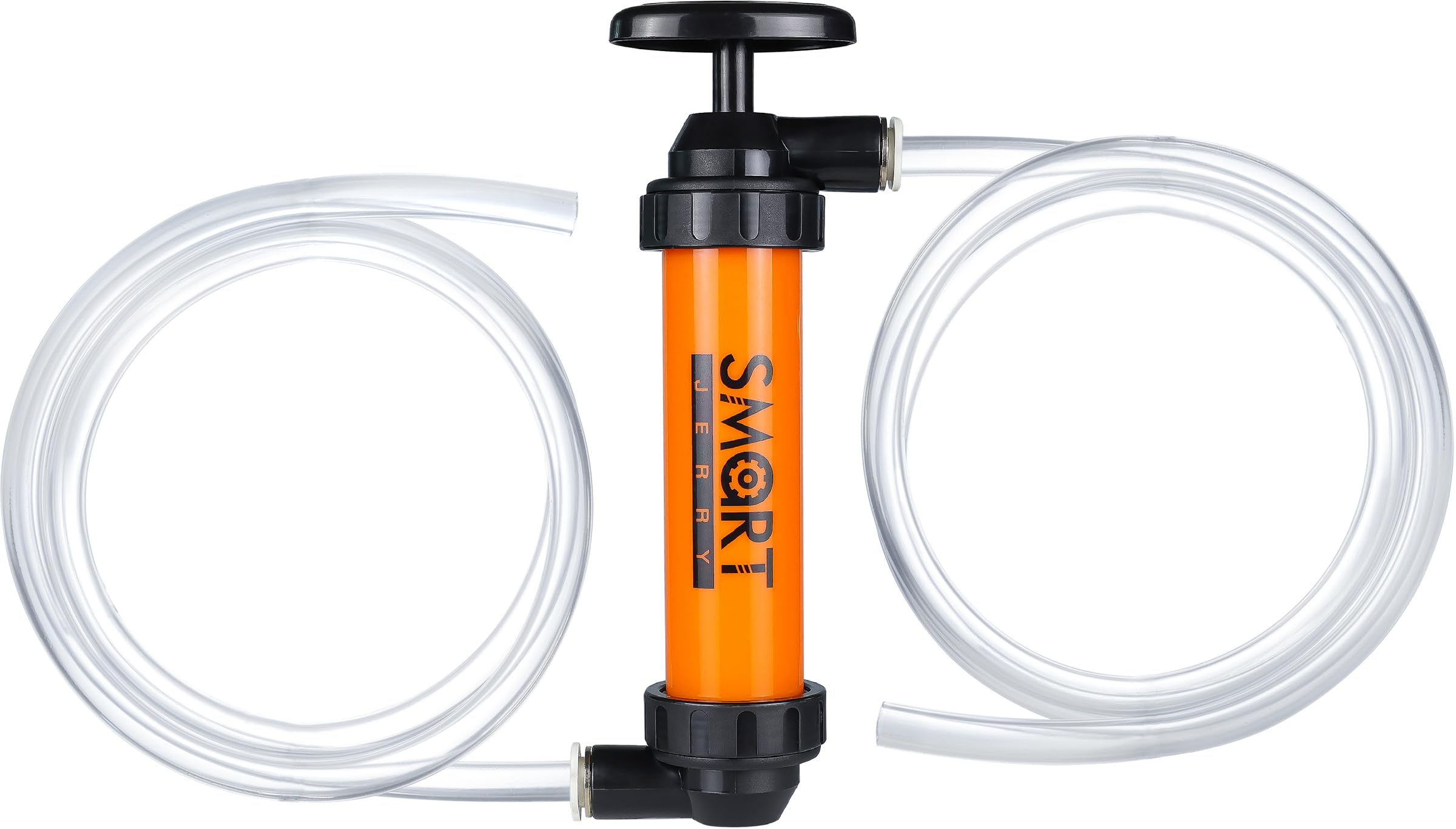
The SMART JERRY kit brings automotive-grade shark-bite quick-connect fittings to the budget-friendly manual pump category, eliminating the need for hose clamps and the associated leak points. The locking mechanism creates an audible click when the hose is fully seated, providing instant feedback that the connection is secure. Owners report that this design makes assembly possible in under ten seconds straight out of the box, and users who transferred transmission fluid through a dip tube on a Grand Caravan confirmed zero leaks at the connection point, a challenging test for any pump.
Flow rate testing with water shows two-point-five to two-point-seven gallons per forty-five to fifty seconds, translating to roughly three gallons per minute in real-world gasoline transfer conditions. The three included adapters — inflator hose, needle valve, and balloon adapter — transform the pump into a multi-function tool capable of inflating sports balls and toys, though the primary value remains fluid transfer. Owners consistently praise the ease of cleaning, noting that the smooth internal surfaces flush clean with minimal effort compared to jiggler-style hoses that trap residue in the ball valve chamber.
Construction quality is solid for the price point, with a plastic pump body that feels durable enough for regular seasonal use. The most common complaint involves the plunger shaft seal, where a small amount of fluid can escape during aggressive pumping. This is a seep rather than a stream, and it does not affect the primary transfer function, but it is a detail that distinguishes this kit from premium alternatives with double-sealed shafts. For the home mechanic who needs a quick, clean, leak-free transfer solution for occasional oil changes, fuel rotation, or coolant work, this is a well-executed value pick.
What works
- Shark-bite quick-connect fittings lock securely without tools or clamps
- Multi-function adapters add inflation capability beyond fluid transfer
- Easy to clean with smooth internal surfaces that resist residue buildup
What doesn’t
- Plunger shaft may seep small amounts of fluid during hard pumping
- Plastic pump body lacks the impact resistance of all-brass or metal alternatives
7. Wadoy Self-Priming Siphon Hose Pump Kit
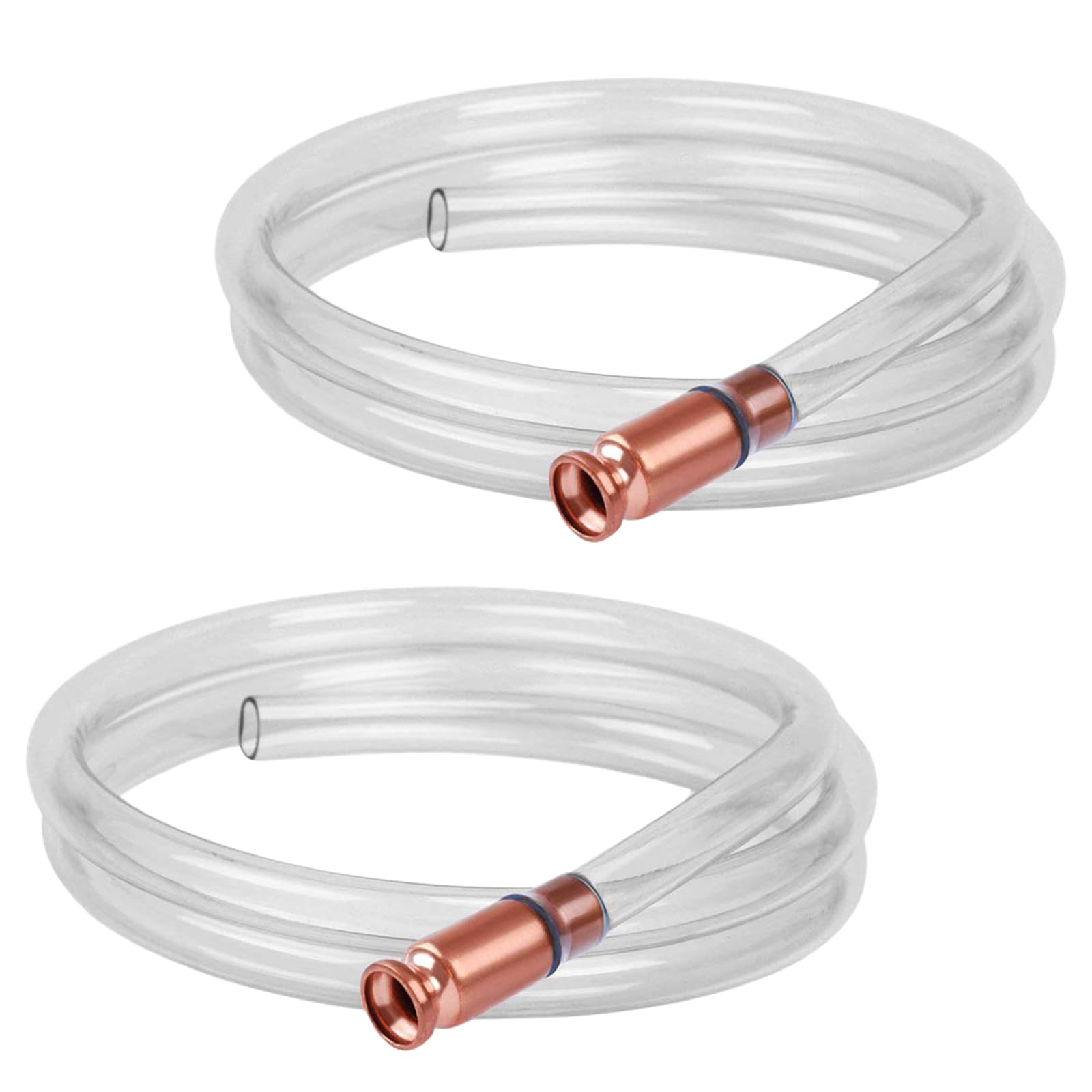
The Wadoy self-priming kit takes a fundamentally different material approach than the PVC-heavy competition, using FDA-compliant food-grade silicone tubing that remains flexible from minus forty degrees Fahrenheit up to four hundred degrees Fahrenheit. This temperature tolerance makes it uniquely suited for siphoning hot automotive fluids and for use in extreme cold weather emergency kits where PVC would stiffen and crack. The built-in auto shut-off valve instantly stops flow when the hose end is lifted above the liquid surface, a safety feature that prevents accidental spills when the destination container fills unexpectedly.
The self-priming mechanism requires three to five squeezes of the ergonomic pump bulb to initiate flow, after which gravity maintains the siphon. Owners report that the mechanism works reliably with water, gasoline, diesel, and even aquarium fluids, though there is a limitation: the hose needs a reasonable fluid depth — approximately six inches — because the priming action depends on the bulb being able to draw liquid upward. Users who attempted to siphon from very shallow puddles or nearly empty tanks found the pump unable to establish prime. The two-pack format provides a backup unit that can be stored in a vehicle or workshop without adding significant cost.
Durability feedback is predominantly positive, with many owners reporting years of trouble-free service when the hose is flushed clean after each use. The silicone material does not degrade from gasoline exposure the way PVC eventually does, and the corrosion-proof connectors outlast the plastic fittings found on cheaper alternatives. The main trade-off is flow speed: the half-inch silicone tubing moves liquid more slowly than larger-diameter PVC hoses, and the internal ball valve mechanism creates some flow restriction. For emergency kits, winter use, and applications requiring food-grade safety, this is the most versatile material choice in the lineup.
What works
- Food-grade silicone remains flexible in extreme cold and resists fuel degradation
- Auto shut-off valve prevents spills when the destination container is full
- Two-pack format provides a backup unit for vehicle or workshop storage
What doesn’t
- Requires a minimum fluid depth of roughly six inches to establish prime
- Half-inch diameter and internal ball valve reduce flow speed versus larger hoses
8. Darnassus Siphon Hose Pump
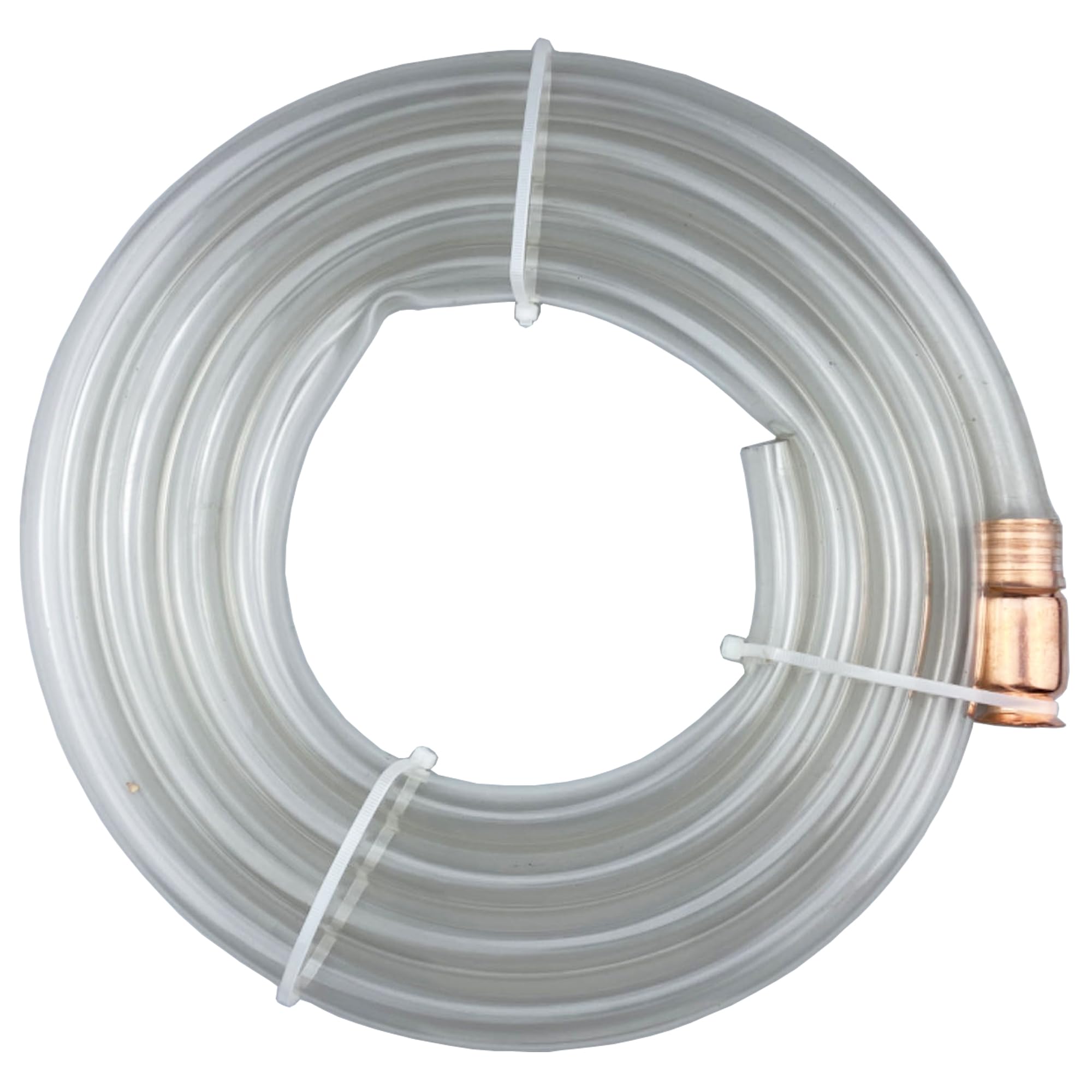
The Darnassus siphon offers a straightforward no-frills jiggler design with a three-quarter-inch valve that balances flow rate against hose flexibility better than both the narrow half-inch tubes and the stiff one-inch hoses. The three-layer PVC construction with a high-quality brass fitting provides durability that exceeds what the modest price point would suggest. Owner reports show consistent praise for its performance in non-automotive applications such as draining kiddie pools, duck ponds, and large water containers, where the ten-foot length gives ample reach from source to destination.
The self-priming jiggler mechanism uses the standard shake-to-start method, and most users report success within a few seconds of vertical agitation. The brass connector provides a corrosion-resistant interface that outlasts the zinc alloy fittings found on ultra-budget siphons. Owners who use it for transferring gasoline into lawn mowers and four-wheelers from five-gallon cans report that the three-quarter-inch bore moves fuel quickly enough to make the task noticeably faster than pouring, with no spillage and no heavy lifting required.
The primary refinement opportunity lies in the hose material. While the three-layer PVC is thick enough for regular use, it arrives with a pronounced coil memory from packaging, and some users find that the hose wants to retain a curved shape that can be awkward to position into tight filler openings. This relaxes over time but requires patience during the first several uses. The lack of a shut-off clamp or flow-control valve means the siphon continues running until the source container is empty or the user lifts the hose end, which can lead to minor spills if the destination tank fills unexpectedly. For simple, high-volume transfer between open containers, this is a reliable and affordable workhorse.
What works
- Three-quarter-inch bore offers a good compromise between flow rate and hose flexibility
- Three-layer PVC and brass fitting provide surprising durability for the price tier
- Ten-foot length is generous for reaching between containers without repositioning
What doesn’t
- Hose retains coil memory from packaging, making initial positioning awkward
- No shut-off valve means flow continues until the source is empty or hose is lifted
9. ELEAD Multi-Function Fluid Transfer Pump
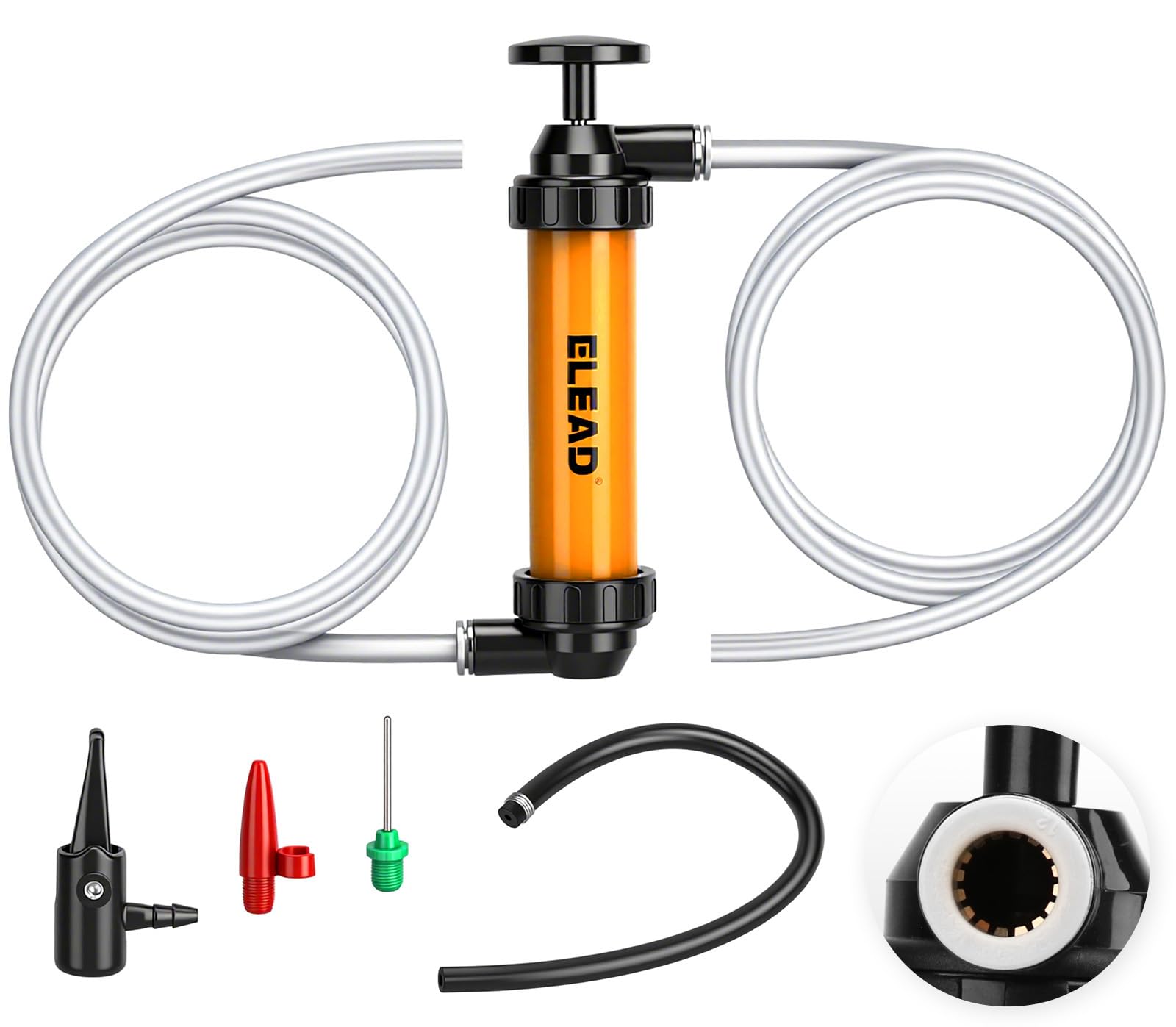
The ELEAD pump introduces a shark-bite button connection system that provides a stronger mechanical grip than traditional push-on hose fittings, reducing the likelihood of blow-off leaks during high-flow transfer. The kit includes three specialized adapters — inflator hose, needle valve, and balloon adapter — that expand its utility beyond fluid transfer into tire inflation and inflatable toy filling. Owner feedback confirms that the pump delivers over three gallons per minute in real-world use, making it approximately three times faster than a basic gravity siphon for draining snowblower tanks or performing emergency fuel rotations.
Versatility is the central selling point. The same tool that transfers gasoline from a storage can into a lawn mower can be reconfigured in seconds to inflate a basketball or inflatable paddleboard. Users report successful transfer of gear oil from front and rear differentials — a thicker fluid that stalls many budget pumps — with no leaking at the connections. The quick-assembly design requires no tools and no clamps, which is a genuine convenience for roadside situations where finding a screwdriver is not practical.
Quality control is the dividing line with this unit. The majority of owners report a well-functioning pump that performs exactly as described, but a vocal minority experienced seal failure at the pump body, with one user describing a leak that rendered the unit unusable after transferring only two gallons. The clear stiff tubing also drew criticism for making it difficult to form the U-shape needed to reach the bottom of certain fuel tanks. For buyers who prioritize multi-function capability and fast assembly and are comfortable with a small risk of unit-to-unit variation, this kit offers compelling value at a budget-friendly entry point.
What works
- Shark-bite button connection prevents hose blow-off during high-flow transfer
- Three adapters enable inflation tasks in addition to fluid pumping
- Tool-free assembly is genuinely convenient for roadside and emergency use
What doesn’t
- Seal quality varies between units with some developing leaks early in their service life
- Stiff clear tubing resists forming the U-shape needed for certain tank configurations
10. Wadoy Shaker Siphon 2-Pack
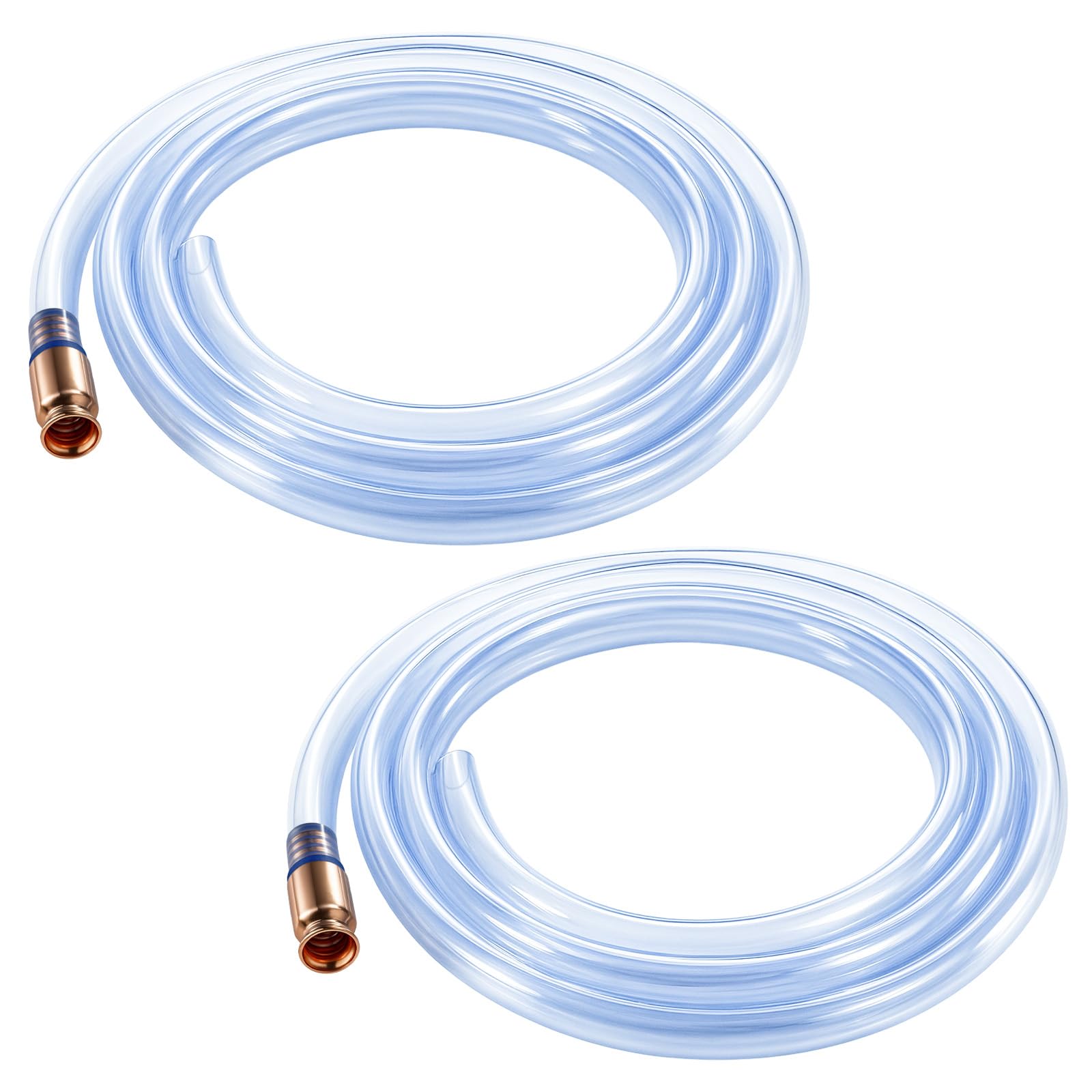
The Wadoy shaker siphon two-pack delivers exceptional value for fleet owners or households with multiple vehicles and power equipment, providing two fully functional jiggler hoses at a price that undercuts many single-unit competitors. Each six-foot hose with half-inch inner diameter moves up to three-point-five gallons per minute, and the PVC construction is rated safe for both drinking water and fuel transfer, giving it dual-purpose utility. Owner reports consistently highlight how quickly the shake-to-prime mechanism empties a five-gallon can — approximately one minute — without requiring the user to lift or tip heavy containers.
Application feedback spans a wide range of use cases. Boat owners report setting the gas can on the swim platform, jiggling the hose to start the siphon in seconds, and filling the tank without any spillage. Pool and pond owners use it for water removal, and generator owners rely on it for fuel rotation. The half-inch diameter is a practical choice for modern filler necks, as it slides past the anti-siphon screens found on many late-model vehicles and small engines. The garden hose adapter adds another layer of utility, allowing the siphon to connect to standard spigots for water transfer.
The primary durability concern involves the hose wall thickness. While the flow rate is competitive, several owners noted that the tubing feels thinner and more pliable than premium alternatives, raising questions about long-term resistance to fuel additives and UV exposure. One owner reported that the hose began to collapse under suction after several months of regular use, suggesting that the wall thickness may be the point of cost reduction. For users who need multiple siphons for occasional use across different locations and are prepared to replace them if they degrade, the two-pack format is a logical and economical choice.
What works
- Two-pack format provides excellent value for multi-vehicle households or fleet owners
- Half-inch diameter fits past anti-siphon screens on modern filler necks
- Garden hose adapter expands utility beyond fuel transfer to water tasks
What doesn’t
- Thinner hose walls may collapse under suction after extended regular use
- PVC material may yellow and stiffen faster than thicker-walled alternatives
11. MADHOLLY Hand Fuel Transfer Pump
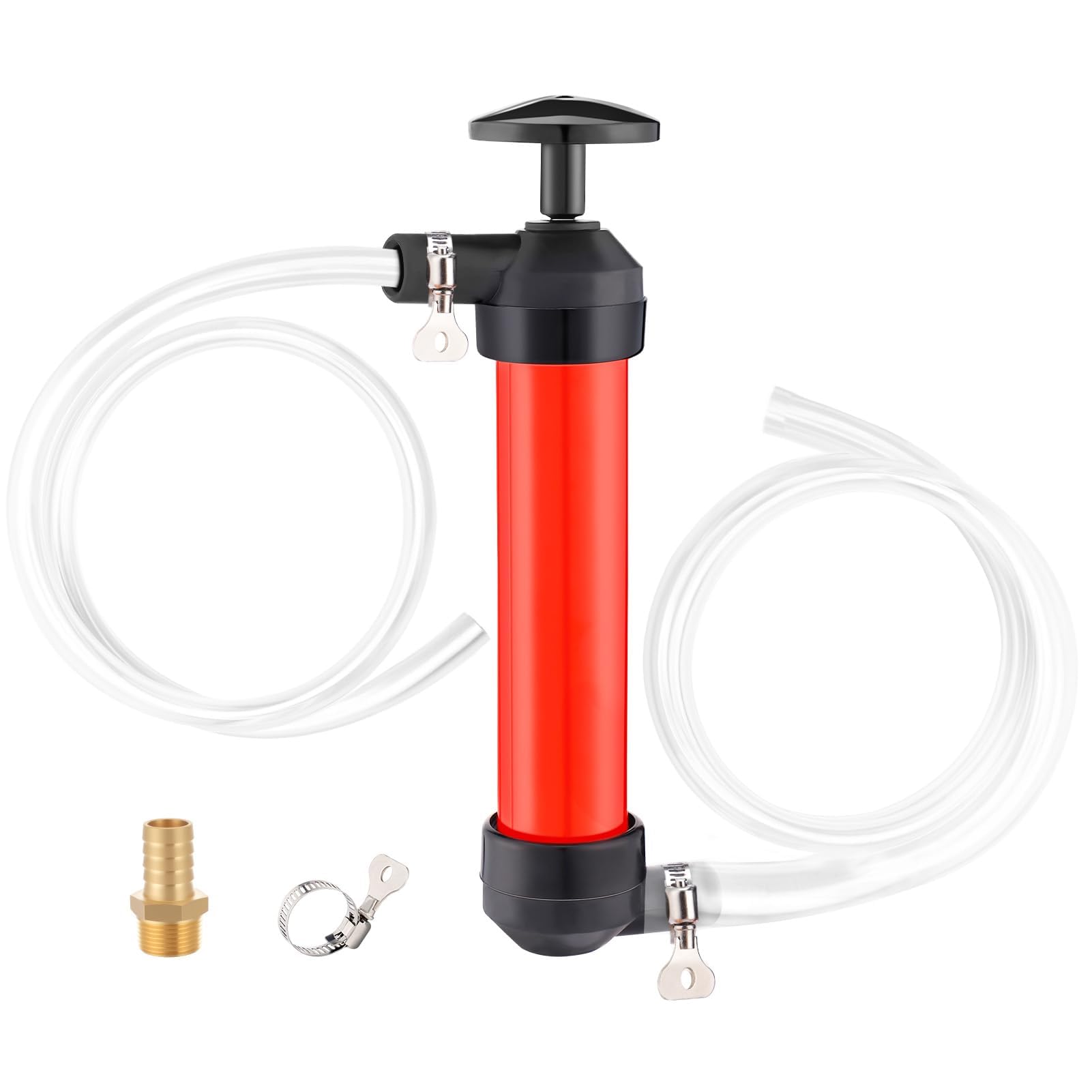
The MADHOLLY pump targets the RV and camper winterization market specifically, with a three-quarter-inch NPT brass connector designed to mate with standard RV city water inlets for easy antifreeze filling. The kit includes three heavy-duty stainless steel clamps that secure the hose connections tightly, addressing the drip and leak issues that plague pumps relying on friction-fit connections. Owners who used it for winterizing travel trailers report that the pump setup is straightforward and that the clamps provide confidence that the connections will not blow off under pressure.
Beyond RV winterization, the pump handles gasoline, diesel, kerosene, motor oil, antifreeze, and water transfer, making it a versatile tool for the multi-vehicle household. The manual winding power source requires no batteries and no priming fluid — just a few squeezes of the bulb to establish flow. Owner reports confirm that it works well for emergency roadside refueling, lawn mower maintenance, and motorcycle oil changes, though the primary use case remains RV antifreeze circulation where the brass connector provides a significant compatibility advantage over universal fittings.
Two consistent criticisms emerged from the owner feedback. First, the brass connector uses NPT threads rather than the GHT threads standard on most RV city water connections, meaning the fitting may not seal properly or may damage the RV threads if forced. Several owners could not use the pump as intended and had to source a separate adapter. Second, the included hoses are relatively short, limiting reach between the antifreeze jug and the RV inlet without repositioning the container. The plastic pump body feels durable enough for seasonal use, but the threading incompatibility is a genuine oversight for a product positioned as an RV winterization kit. For buyers who verify their RV thread standard before purchasing, this is a capable and well-sealed pump.
What works
- Stainless steel clamps provide genuine leak-proof connection security
- Brass 3/4-inch NPT connector simplifies RV antifreeze filling for compatible rigs
- Multi-fluid capability handles gasoline, diesel, oil, and antifreeze without issue
What doesn’t
- NPT threads may be incompatible with standard RV GHT city water inlets
- Included hoses are shorter than ideal for reaching from jug to RV inlet
Hardware & Specs Guide
Hose Diameter and Flow Rate
The internal diameter of the siphon hose is the single most important determinant of transfer speed. A half-inch hose typically moves two to three gallons per minute, which is adequate for topping off a lawn mower or draining a snowblower. Stepping up to three-quarter-inch increases flow to around three-point-five gallons per minute, and one-inch hoses can push four or more gallons per minute — dramatically reducing the time required to empty a boat tank or fifty-five-gallon drum. The trade-off is flexibility: larger hoses are stiffer and less likely to fit past the anti-siphon screens and roll-over valves that manufacturers install on modern car and truck filler necks. For automotive use, stick with half-inch or five-eighth-inch diameter. For open-top tanks, drums, and marine applications, the largest diameter that fits the port is always the fastest choice.
Materials and Durability
Hose material determines how long the tool remains functional after repeated fuel exposure. Standard PVC tubing degrades through two mechanisms: plasticizers leach out, causing the hose to stiffen and crack, and fuel additives swell the material, reducing internal diameter and flow rate over time. Premium hoses use either thicker PVC walls with UV stabilizers or food-grade silicone that inherently resists fuel degradation. Brass and copper fittings outperform zinc alloy and plastic barbs in both sealing and corrosion resistance. Stainless steel worm-drive clamps provide adjustable, reusable sealing force, while crimped or friction-fit collars are single-use connections that frequently leak after the first disassembly. The internal priming mechanism — whether a ball valve in jiggler hoses or a rubber diaphragm in bulb pumps — should be made of metal or industrial glass rather than plastic, as plastic balls can swell and seize after gasoline exposure.
FAQ
Can I use a siphon pump on a modern car with an anti-siphon screen?
How do I start a jiggler or shaker siphon hose?
Is it safe to siphon gasoline with a manual pump?
How do I clean and store a siphon hose after use?
What is the difference between a bulb pump and a jiggler siphon?
Final Thoughts: The Verdict
For most buyers, the best fuel siphon pump winner is the MILADO Gasoline Transfer Pump because it combines a thick-walled high-flow hose with dual priming options and premium brass fittings at a price that undercuts specialist marine pumps. If you need a battery-powered solution for hands-free operation, grab the BestCosy Portable Transfer Pump. And for the fastest possible manual transfer from open-top tanks and boat fuel fills, nothing beats the Gerguirry Heavy Duty Siphon Hose with its spring-reinforced one-inch bore and anti-loss metal buckle.

Certification: BSc in Mechanical Engineering
Education: Mechanical engineer
Lives In: 539 W Commerce St, Dallas, TX 75208, USA
Md Amir is an auto mechanic student and writer with over half a decade of experience in the automotive field. He has worked with top automotive brands such as Lexus, Quantum, and also owns two automotive blogs autocarneed.com and taxiwiz.com.