A leaking fuel line coupler turns a routine maintenance job into a fire hazard and a diagnostic headache. Whether you are repairing an outboard motor, replacing a brittle factory connector, or building a custom fuel system from scratch, the difference between a fitting that seals for years and one that dribbles after a season comes down to material quality, dimensional accuracy, and application-specific design. This guide compares the strongest options on the market across brass barb fittings, quick-connect adapters, and marine-grade connectors so you can match the right hardware to your specific fuel line setup.
I’m Amir — the founder and writer behind Four Wheel Ask. My approach to fuel system components involves cross-referencing manufacturer tolerance data with long-term owner reports to identify which connectors maintain a leak-free seal under vibration, temperature cycling, and ethanol-blended fuel exposure.
Whether you need a quick-connect for an outboard or a brass barb for a custom fuel system, selecting the best fuel line coupler ensures a leak-free join.
How To Choose The Best Fuel Line Coupler
Fuel line couplers look like simple hardware, but the wrong choice leads to air leaks, fuel starvation, or dangerous drips. Three factors separate a reliable connector from one that fails prematurely: the material it is made from, the dimensional match to your existing line, and whether the design accounts for the specific environment — engine bay heat, marine salt air, or ethanol fuel chemistry.
Material Selection: Brass vs Plastic vs Steel
Brass is the dominant material for barb fittings because it resists corrosion from ethanol-blended fuels, machines to tight tolerances, and provides a rigid sealing surface for hose clamps. Alloy steel connectors, such as those used in Dorman quick-connect adapters, offer higher tensile strength for applications where the fitting must withstand physical strain from hose movement. Plastic and nylon components are lighter and resist galvanic corrosion in marine environments, but they can become brittle over time when exposed to UV radiation or fuel additives. For permanent installations inside a vehicle or boat, brass or machined steel provide the longest service life.
Size and Thread Compatibility
Every fuel line coupler must match two dimensions: the inside diameter of the hose it connects to and the thread pitch of the mating port. Hose ID is typically measured in fractions of an inch (5/16-inch is the most common for small-engine and automotive fuel lines) or millimeters (6mm for many outboard applications). Threads follow NPT (National Pipe Thread) or straight-thread standards depending on the port. A 1/2-inch NPT male thread requires a matching female port; mixing thread standards guarantees a leak. Always measure your existing hose ID with a caliper and verify the thread type before ordering.
Application-Specific Design
Marine outboard connectors must seal against vibration from two-stroke engines and resist saltwater corrosion. Automotive quick-connect adapters need to tolerate underhood temperatures and repeated disconnect cycles for filter changes. General-purpose brass barb fittings work for fuel lines, heater hoses, and coolant systems but may lack the retention features — positive-locking tabs or double O-rings — that specialized connectors provide. Matching the coupler to the exact application environment is the single best way to avoid a repeat repair.
Quick Comparison
On smaller screens, swipe sideways to see the full table.
| Model | Category | Best For | Key Spec | Amazon |
|---|---|---|---|---|
| Quicksilver 13563Q3 | Quick Disconnect | Mercury/Mariner outboard engines | 5/16″ (8mm) I.D. fuel line | Amazon |
| Dorman 800-081 | Adapter | Steel-to-nylon line conversion | 5/16″ steel to 5/16″ nylon | Amazon |
| Aynaxcol FPLXF376 | Barb Connector Set | Yamaha outboard engines | 1/4″ (6mm) barb female + male | Amazon |
| Five Oceans FO2885 | Female Quick Connector | OMC/Johnson/Evinrude engines | 5/16″ barb fitting | Amazon |
| LTWFITTING Brass Barb | Brass Barb Fitting | Multiple connections and bulk projects | 5/16″ hose x 1/2″ NPT (5-pack) | Amazon |
In‑Depth Reviews
1. Quicksilver 13563Q3 Quick Disconnect Fuel Line Fitting

The Quicksilver 13563Q3 is the genuine OEM quick-disconnect fitting for Mercury, Mariner, and Force outboard engines, which means the dimensional tolerances and seal geometry match the factory fuel system exactly. Owner reports confirm that this fitting snaps into place with a positive lock and maintains a dry connection even after repeated disconnect cycles. The double seal design provides a secondary barrier against leakage if the primary O-ring degrades over time.
Fitting 5/16-inch (8mm) internal diameter fuel line, the Quicksilver connector includes a hose clamp and uses a barbed retention system that grips the hose securely without requiring special tools. The construction uses materials selected specifically for marine fuel exposure, including resistance to ethanol-blended gasoline. For owners of Mercury or Mariner outboards, this part eliminates the guesswork of aftermarket compatibility.
Feedback from long-term users highlights the consistent sealing performance over multiple seasons. The only consideration is that this connector is designed exclusively for the engine-side connection on compatible outboards — it is not a general-purpose barb fitting for arbitrary fuel line repairs. For the specific application it serves, however, the reliability data is exceptional.
What works
- Genuine OEM fit for Mercury/Mariner/Force engines
- Double seal provides redundant leak protection
- Includes hose clamp for immediate installation
- Consistent long-term sealing reported by owners
What doesn’t
- Limited to Mercury-compatible engine and tank ends
- Not a universal barb fitting for custom applications
2. Dorman 800-081 Fuel Line Quick Connector

The Dorman 800-081 solves a specific problem: adapting 5/16-inch steel fuel line to 5/16-inch nylon tubing without requiring a complete line replacement. This two-pack of quick connectors uses a machined alloy steel body with nylon retention clips, combining metal durability at the threaded interface with plastic flexibility at the quick-connect latch. Owner feedback indicates a leak-free seal when installed correctly on compatible factory fuel lines.
Dorman backs this connector with a limited lifetime warranty, which reflects confidence in the manufacturing quality. The adapter design allows a straightforward push-connect installation on the nylon side and a standard threaded or barbed connection on the steel side. For vehicles where the factory steel line needs to transition to a serviceable nylon section — common in older trucks and sedans — this part eliminates the need for flaring tools or custom fabrication.
The primary critique from owners involves the white plastic retainer clips, which can be difficult to release once engaged. Some users report that the clips break during removal, requiring replacement of the connector. For installations where the connection will remain permanent, this is not a concern, but for applications requiring periodic disconnection, the clip design is less forgiving than metal alternatives.
What works
- Direct adapter between steel and nylon fuel lines
- Limited lifetime warranty from a domestic manufacturer
- No special tools required for installation
- Two-pack provides a spare or allows dual repairs
What doesn’t
- Plastic retainer clips can break during removal
- Limited to 5/16-inch line diameter only
3. Aynaxcol 1/4″ Barb Female and Male Fuel Connector
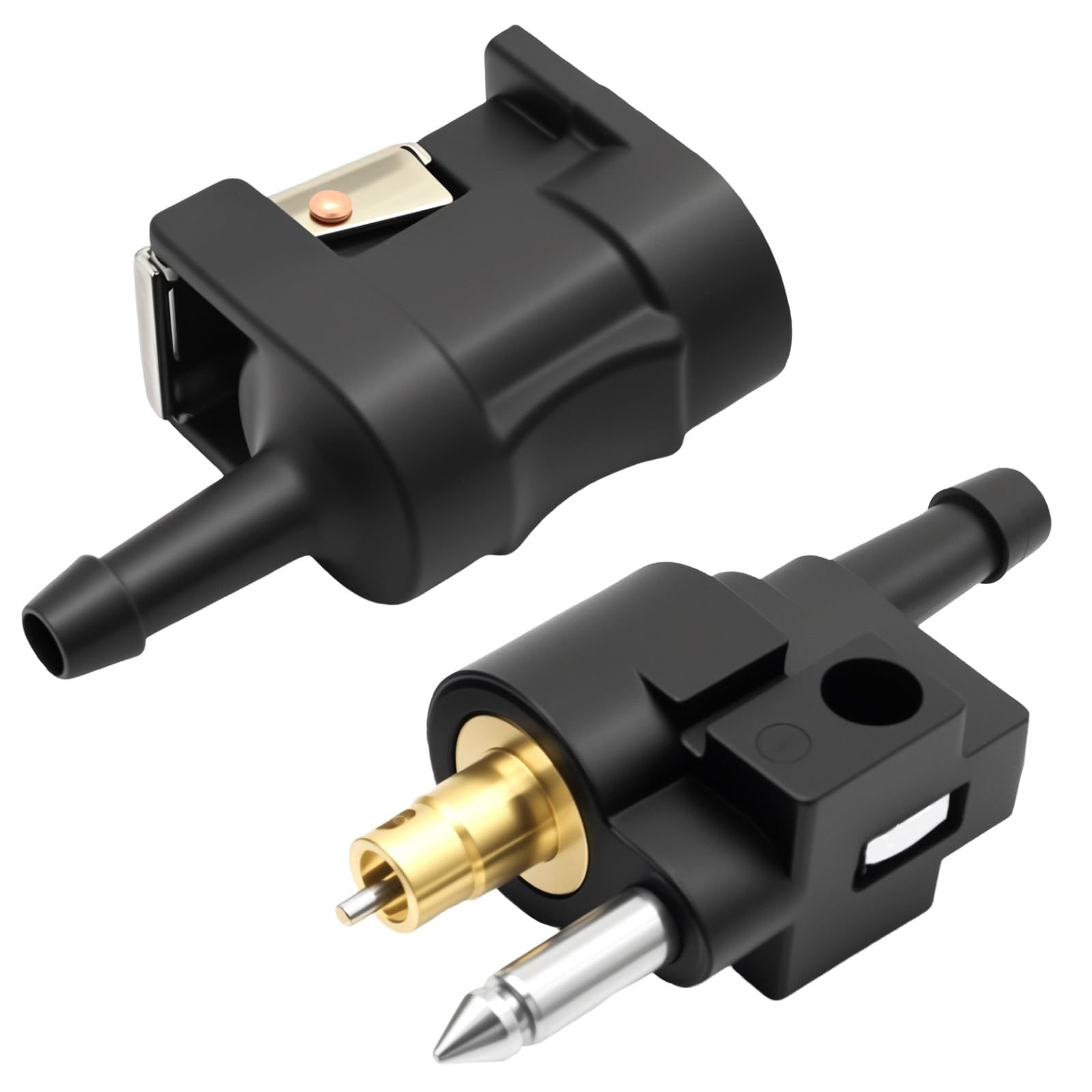
The Aynaxcol connector set provides both the female and male halves needed to replace the full fuel line connection on Yamaha outboard motors and most portable fuel tanks. The female half uses brass construction for the barbed hose interface, while the male fitting is machined from aluminum, balancing corrosion resistance with weight savings. Owner reports confirm a precise fit on 1/4-inch (6mm) fuel lines common to Yamaha two-stroke and four-stroke outboards.
Installation is straightforward: the barbed ends accept a standard hose clamp, and the push-connect interface engages with a positive audible click. Users running Yamaha 40hp and smaller outboards report that the connector snaps into the engine-side receptacle without modification. The brass barb resists deformation from clamp torque better than plastic alternatives, maintaining a tight seal at the hose interface over repeated thermal cycles.
One owner documented using this connector set in a custom auxiliary fuel tank setup for an inverter generator, indicating the fittings handle continuous flow without leakage. The main limitation is the 1/4-inch (6mm) sizing — these connectors will not fit 5/16-inch or 3/8-inch fuel lines without a reducer. For Yamaha outboard owners, however, this set provides an exact match for the factory connector geometry.
What works
- Includes both male and female halves for full replacement
- Brass and aluminum construction resists marine corrosion
- Precision fit for Yamaha outboard fuel systems
- Positive click engagement confirms secure connection
What doesn’t
- Limited to 1/4-inch (6mm) fuel line diameter
- Not compatible with 5/16-inch or larger hoses
4. Five Oceans 5/16″ Barb Female Fuel Line Hose Connector FO2885

The Five Oceans FO2885 is a female quick connector designed specifically for OMC, Johnson, and Evinrude outboard engines, using low-permeation materials that minimize fuel evaporation through the connector wall. This is a meaningful differentiator in marine applications where fuel sitting in the line for weeks between trips can evaporate through standard plastic fittings. The barbed fitting accepts 5/16-inch internal diameter hose and connects to the engine-side male fitting found on vintage and current OMC products.
Construction uses a durable plastic compound selected for the marine environment, with owner reports indicating no cracking or brittleness after multiple seasons exposed to sunlight and salt spray. The connector engages with a positive latch that prevents accidental disconnection from engine vibration. Five Oceans includes a one-year warranty, which is reasonable for a component subjected to harsh marine conditions.
Several owners have used this connector on four-wheelers and portable generator tanks with success, noting the leak-free seal when clamped onto standard fuel hose. The main observation from users is that the plastic construction, while durable, lacks the perceived heft of a brass fitting. For the intended OMC/Johnson/Evinrude application, however, the low-permeation material provides a functional advantage over metal connectors that do not address vapor loss.
What works
- Low-permeation material reduces fuel evaporation
- Exact fit for OMC/Johnson/Evinrude engine and tank ends
- Positive latch prevents vibration-induced disconnect
- Resists UV and saltwater exposure in marine use
What doesn’t
- Plastic construction lacks brass fitting heft
- Limited to OMC/Johnson/Evinrude compatibility
5. LTWFITTING Brass Barb Fitting Coupler 5/16-Inch (Pack of 5)
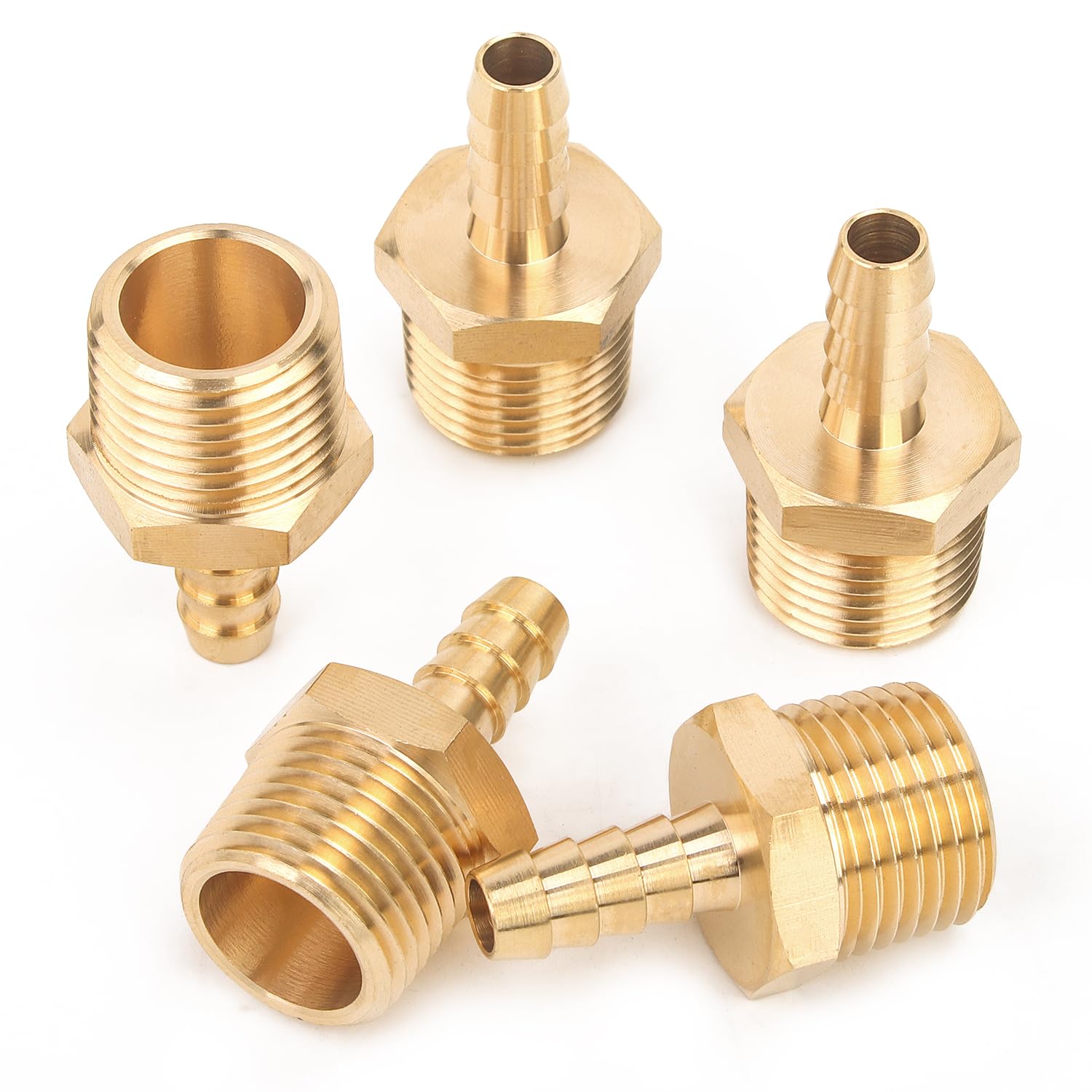
The LTWFITTING brass barb coupler is a straightforward male NPT x hose barb adapter offered in a five-pack, making it the most economical option per fitting in this lineup. Each connector features a 5/16-inch hose barb on one end and a 1/2-inch male NPT thread on the other, machined from solid brass with consistent thread depth. This is a general-purpose fitting suitable for fuel systems, heater lines, and coolant circuits where a threaded port needs to accept a clamped hose.
Owner reports confirm that the barb ridges grip standard fuel hose effectively when paired with a quality hose clamp, and the brass material resists corrosion from ethanol fuels better than zinc-plated steel alternatives. Several users purchased these specifically for K&N cold air intake installations where the factory vacuum-line connector was missing or broken, finding the dimensional accuracy sufficient for a leak-free seal. The five-pack quantity allows for multiple projects or spares without a second order.
The primary trade-off is that these are machined in China, and while the manufacturing quality from this supplier — active since 1999 — meets typical brass fitting standards, the thread tolerances may vary slightly from domestic-sourced fittings. For non-critical applications such as heater hose or vacuum lines, this variance is irrelevant. For high-pressure fuel system use, careful thread engagement verification is recommended before final assembly.
What works
- Five-pack provides excellent per-unit value
- Solid brass construction resists ethanol fuel corrosion
- Standard 5/16″ barb x 1/2″ NPT dimensions
- Suitable for fuel, heater, and coolant applications
What doesn’t
- Thread tolerances may vary from domestic fittings
- Not a quick-connect — requires hose clamp installation
Hardware & Specs Guide
Barb Fitting Dimensions
The barb diameter on a fuel line coupler must match the hose internal diameter exactly — a 5/16-inch barb requires 5/16-inch ID hose. Barb fittings rely on a hose clamp to compress the hose around the barb ridges. The number of barb ridges and their angle determine pull-off resistance; four to five sharp ridges provide the best grip. Brass barb fittings handle clamp torque without deformation, while plastic barbs can collapse if over-tightened.
NPT Thread Standards
National Pipe Thread (NPT) is the most common thread standard for fuel line couplers. NPT threads are tapered, meaning they seal by wedging the male and female threads together. A 1/2-inch NPT thread has a different pitch than 3/8-inch or 1/4-inch NPT, so cross-threading is impossible if the sizes differ. Thread sealant or PTFE tape is recommended on NPT fuel fittings to prevent wicking leaks through the thread spiral.
Quick-Connect Retention Systems
Quick-connect fuel fittings use an internal O-ring for sealing and a metal or plastic retainer for mechanical lock. The retainer may be a push-to-release collar, a clip, or a lock ring. Marine quick-connectors typically use a positive latch mechanism that requires pressing a collar to disconnect, reducing the risk of accidental separation from engine vibration. Automotive quick-connectors often use plastic retainers that are lightweight but can become brittle with age.
Material Compatibility with Ethanol Fuels
Ethanol-blended gasoline (E10, E15, E85) absorbs moisture and can corrode certain metals and degrade some plastics. Brass is highly resistant to ethanol corrosion and is the preferred material for carbureted fuel systems. Nylon and acetal plastics are ethanol-resistant but can swell over time, changing the fit of quick-connect retainers. Uncoated steel fittings will rust when exposed to ethanol fuel that has absorbed moisture from the air.
FAQ
What material is best for a fuel line coupler?
How do I know what size fuel line coupler I need?
Can I use a brass barb fitting on a fuel-injected vehicle?
How often should I replace a fuel line coupler?
Final Thoughts: The Verdict
For most buyers, the best fuel line coupler winner is the Quicksilver 13563Q3 because it provides OEM-grade sealing for Mercury and Mariner outboards with a double-seal design that owners consistently report leak-free after years of use. If you need a versatile adapter for steel-to-nylon conversion in automotive applications, the Dorman 800-081 delivers value with a lifetime warranty. And for Yamaha outboard owners seeking a complete male and female connector replacement, the Aynaxcol set offers precision-machined brass and aluminum construction at a practical price point.

Certification: BSc in Mechanical Engineering
Education: Mechanical engineer
Lives In: 539 W Commerce St, Dallas, TX 75208, USA
Md Amir is an auto mechanic student and writer with over half a decade of experience in the automotive field. He has worked with top automotive brands such as Lexus, Quantum, and also owns two automotive blogs autocarneed.com and taxiwiz.com.