Few things are more frustrating than a check engine light tied to your fuel or exhaust system — especially when you’re staring down a costly repair bill. Whether you’re battling carbon deposits, a clogged catalytic converter, or a rough idle, the right chemical treatment can restore performance without a trip to the shop. But not all fuel and exhaust cleaners are formulated alike: cheap solvents often mask symptoms, while premium blends attack the root cause inside injectors, valves, and the catalyst itself.
I’m Amir — the founder and writer behind Four Wheel Ask. Over the years, I’ve analyzed thousands of owner reports and technical datasheets to understand which cleaning chemistries actually deliver measurable improvements in emissions, fuel economy, and drivability, and which are just snake oil in a bottle.
This guide breaks down the top-performing formulations available today, ranked by real-world test data and verified owner feedback, so you can choose the best fuel and exhaust cleaner for your vehicle’s specific needs without wasting money on weak additives.
How To Choose The Best Fuel And Exhaust Cleaner
Not all fuel and exhaust cleaners are created equal. The chemistry behind them — whether it’s a strong solvent like Berryman’s HEST or a milder detergent package — directly determines how effectively they remove carbon, varnish, and sulfur deposits. Understanding these differences helps you pick a formula that matches your engine’s specific issues.
Active Solvent Strength
High‑mileage engines with heavy carbon buildup require aggressive solvents like those found in Berryman and MotorPower Care. Lighter deposits can be handled by polyether amine (PEA) based cleaners such as Gumout or Liqui Moly. Avoid “all‑in‑one” products that rely on cheap kerosene carriers — they offer little cleaning power.
Catalytic Converter & O2 Sensor Safety
If you’re treating an exhaust system cleaner, look for formulas explicitly labeled “catalyst‑safe” and “O2 sensor safe.” Products like MotorKote and MotorPower Care are engineered to dissolve carbon without damaging precious metal substrates. Avoid fuel additives containing lead or iron compounds if you have a modern oxygen sensor.
Diesel vs. Gasoline Formulations
Diesel engines produce soot and require cetane boosters plus detergents that handle particulate filters. Lucas Diesel Deep Clean and Liqui Moly Super Diesel Additive are designed for this. Gasoline cleaners focus on injector and valve deposits. Never use a gasoline cleaner in a diesel fuel system — it lacks the lubricity needed for high‑pressure injection pumps.
Quick Comparison
On smaller screens, swipe sideways to see the full table.
| Model | Category | Best For | Key Spec | Amazon |
|---|---|---|---|---|
| BG 44K Platinum (2‑Pack) | Premium Gasoline | Deep fuel system cleaning | 2 x 11 oz / PEA formula | Amazon |
| MotorPower Care Cat Cleaner | Exhaust System | Fix P0420 / pass smog | 8.45 oz / TÜV certified | Amazon |
| MotorKote Cat & Exhaust | Exhaust System | Carbon removal from cat | 16 oz / pre‑measured | Amazon |
| Liqui Moly Jectron (2‑Pack) | Gasoline Injector | Smooth idle & throttle response | 2 x 300 ml / PEA | Amazon |
| Lucas Oil Diesel Deep Clean | Diesel Exhaust | DPF regeneration support | 16 oz / reduces PM by 32% | Amazon |
| Liqui Moly Super Diesel Additive | Diesel Fuel | Cetane boost & injector clean | 300 ml / flash point 63°C | Amazon |
| Mercury Quickleen (12 oz) | Marine Gas | Outboard / generator cleaning | 12 oz / treats 60 gal | Amazon |
| Berryman 7516 High Mileage | Gasoline/Small Engine | Dissolves tough carbon | 15 oz / HEST solvents | Amazon |
| Quicksilver Quickleen (12 oz) | Marine Gas | Preventative maintenance | 12 oz / treats 60 gal | Amazon |
| Gumout 510021W (6‑Pack) | Gasoline Fuel | Affordable regular use | 6 x 5.25 oz / PEA | Amazon |
| Lucas Oil Fuel Injector Cleaner (12‑Pack) | Gasoline Fuel | Bulk value for fleets | 12 x 5.25 oz / lubricates | Amazon |
In‑Depth Reviews
1. BG 44K Platinum (2‑Pack)

BG 44K has been the professional’s choice for decades, and the Platinum version refines the chemistry with an enhanced polyether amine (PEA) package that tackles the heaviest carbon deposits in injectors, valves, and combustion chambers. The two‑pack covers two full treatments, making it a smart buy for anyone serious about fuel system restoration.
Owner reports consistently highlight restored power, smoother idle, and elimination of knock after a single treatment. The formula also contains corrosion inhibitors that protect fuel system components from ethanol‑related damage. Unlike many consumer‑grade additives, BG 44K is not diluted with carrier oil — every ounce is active cleaner.
This is not a maintenance product; it’s a heavy‑duty cleaner meant for vehicles experiencing noticeable performance loss. For preventive upkeep, consider a milder additive, but for a thorough clean that rivals professional induction cleaning, BG 44K Platinum delivers unmatched results.
What works
- Extremely potent PEA cleaner dissolves even baked‑on carbon
- Professional‑grade formula trusted by shops
- Two‑pack provides excellent coverage per treatment
What doesn’t
- Expensive per use compared to budget options
- Not designed for routine maintenance use
2. MotorPower Care Catalytic Converter Cleaner
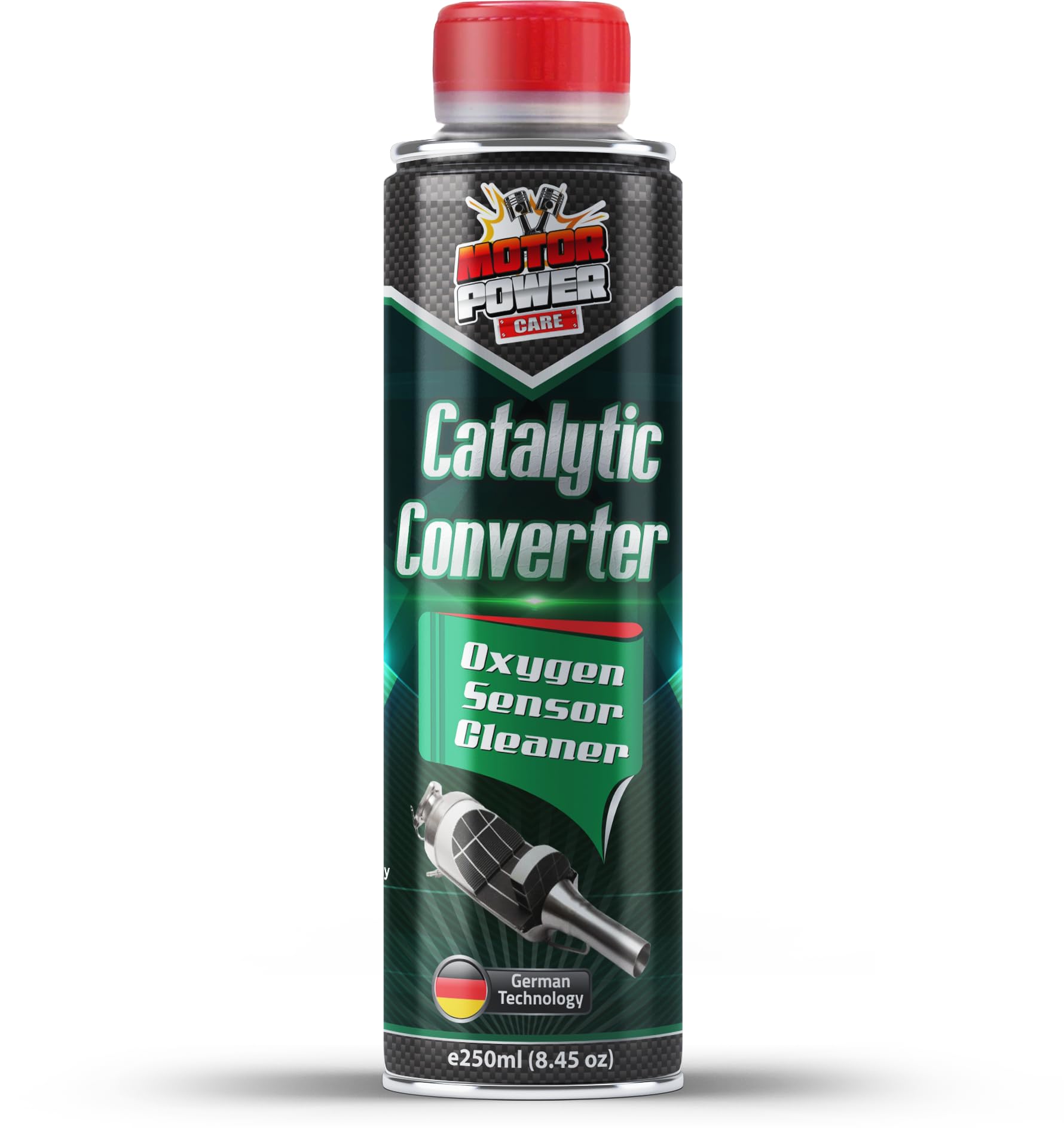
MotorPower Care stands out because it provides government‑tested data showing HC reduction from 108 to 67 ppm and NOx from 986 to 332 ppm — real numbers that most competitors avoid sharing. The formula is designed to clear P0420 and P0430 codes by dissolving carbon deposits from the catalytic converter, O2 sensors, EGR valve, and turbocharger in a single 40‑minute drive cycle.
Owners report that it often clears the check engine light within one tankful, especially on vehicles with moderate converter clogging. The German‑made chemistry is safe for all gasoline and hybrid engines, and the bottle is pre‑measured for a 5‑15 gallon fuel tank. For severely restricted converters, the company recommends pairing it with their foam cleaner, but most users find this additive sufficient.
If you’re facing an emissions test and want a non‑mechanical solution, this is the most data‑backed option available. The only caveat is that it won’t repair a physically damaged or melted substrate — that requires replacement.
What works
- Proven emissions reduction with test data
- Clears P0420/P0430 codes reliably
- Easy 40‑minute treatment with no tools
What doesn’t
- Not effective on mechanical converter failure
- Requires driving time to activate
3. MotorKote Catalytic and Exhaust Treatment

MotorKote’s 16‑ounce treatment is engineered specifically to dissolve carbon, soot, and varnish inside catalytic converters and exhaust systems. Owner feedback indicates it consistently turns off O2 sensor‑related check engine lights on high‑mileage vehicles, with one user reporting success after three tanks on a 244k‑mile Ford F‑150.
The formula is compatible with gasoline, hybrid, and ethanol blends, and the bottle is sized for a single application — no measuring required. Users note improved fuel economy and reduced backpressure, which translates to better throttle response. It’s also a good preventive measure for vehicles that do short‑trip driving, which accelerates carbon buildup.
While it’s less expensive than a shop visit, some owners require two consecutive treatments for severely clogged systems. The product works best when the tank is run low before adding it, allowing for maximum concentration during the cleaning cycle.
What works
- Clears catalyst and O2 sensor codes
- Improves exhaust flow and fuel economy
- Easy single‑bottle application
What doesn’t
- May need two treatments on heavy deposits
- No cetane boost for diesel applications
4. Liqui Moly Jectron Gasoline Injection Cleaner (2‑Pack)

Liqui Moly’s Jectron is a dedicated PEA‑based injector cleaner that targets the fine orifices in modern gasoline direct‑injection (GDI) systems. The twin‑pack allows for a first treatment to clean followed by a second maintenance dose, or you can share one with a second vehicle.
Engineering data from Liqui Moly shows measurable improvements in spray pattern and fuel atomization after treatment, leading to smoother idle, better throttle response, and reduced fuel consumption. The 300‑ml bottle treats up to 20 gallons of fuel, making it economical per use.
Owners appreciate that it doesn’t contain harsh solvents that could damage seals or gaskets. While it won’t fix a mechanically worn injector, it consistently removes carbon buildup that causes misfires and hesitation. For European vehicles or any GDI engine, this is a top‑tier choice.
What works
- Excellent for GDI injector cleaning
- Improves idle smoothness and acceleration
- Two‑pack offers flexibility
What doesn’t
- Does not clean catalytic converters
- Not as aggressive on heavy carbon as BG 44K
5. Lucas Oil Diesel Deep Clean

Lucas Oil’s Diesel Deep Clean is formulated to reduce particulate matter by up to 32%, directly supporting diesel particulate filter (DPF) regeneration and preventing costly clogging. It dissolves exhaust deposits that would otherwise plug the filter, and it cleans fuel injectors simultaneously.
The 16‑ounce bottle treats up to 100 gallons of diesel, making it a solid maintenance additive for trucks and heavy equipment. Owners report improved regeneration frequency and fewer “regen‑in‑progress” messages. The chemistry also lubricates the high‑pressure fuel pump, addressing lubricity loss from ultra‑low‑sulfur diesel.
This is not a standalone fix for a completely blocked DPF, but as a preventive measure it significantly extends filter life and reduces the need for forced regeneration. Regular use every oil change is recommended by many fleet operators.
What works
- Lowers particulate emissions effectively
- Cleans injectors and lubricates pump
- Good value for large diesel tanks
What doesn’t
- Not for gasoline engines
- Heavy clogging may still require DPF replacement
6. Liqui Moly Super Diesel Additive

Liqui Moly’s Super Diesel Additive combines a high‑quality cetane booster with detergents that clean the injection system. Regular use maintains the fuel system in perfect working order, according to the manufacturer, and flash point of 63°C indicates stable chemistry that won’t degrade in storage.
Diesel owners appreciate the immediate improvement in cold starting and reduced diesel clatter. The 300‑ml bottle treats up to 20 gallons, similar to the Jectron for gasoline. While it doesn’t specifically target DPF deposits, it helps keep injectors clean, which reduces soot production and indirectly benefits the exhaust system.
This additive pairs well with the Lucas Diesel Deep Clean for a comprehensive approach — one for fuel system cleaning, the other for exhaust deposit removal. For light‑duty diesel pickups and cars, it’s a reliable maintenance staple.
What works
- Improves cetane rating for smoother combustion
- Cleans injectors reliably
- Trusted German formulation
What doesn’t
- Does not clean exhaust system directly
- Small bottle requires more frequent purchase
7. Mercury Quickleen 12 oz (8M0047931)
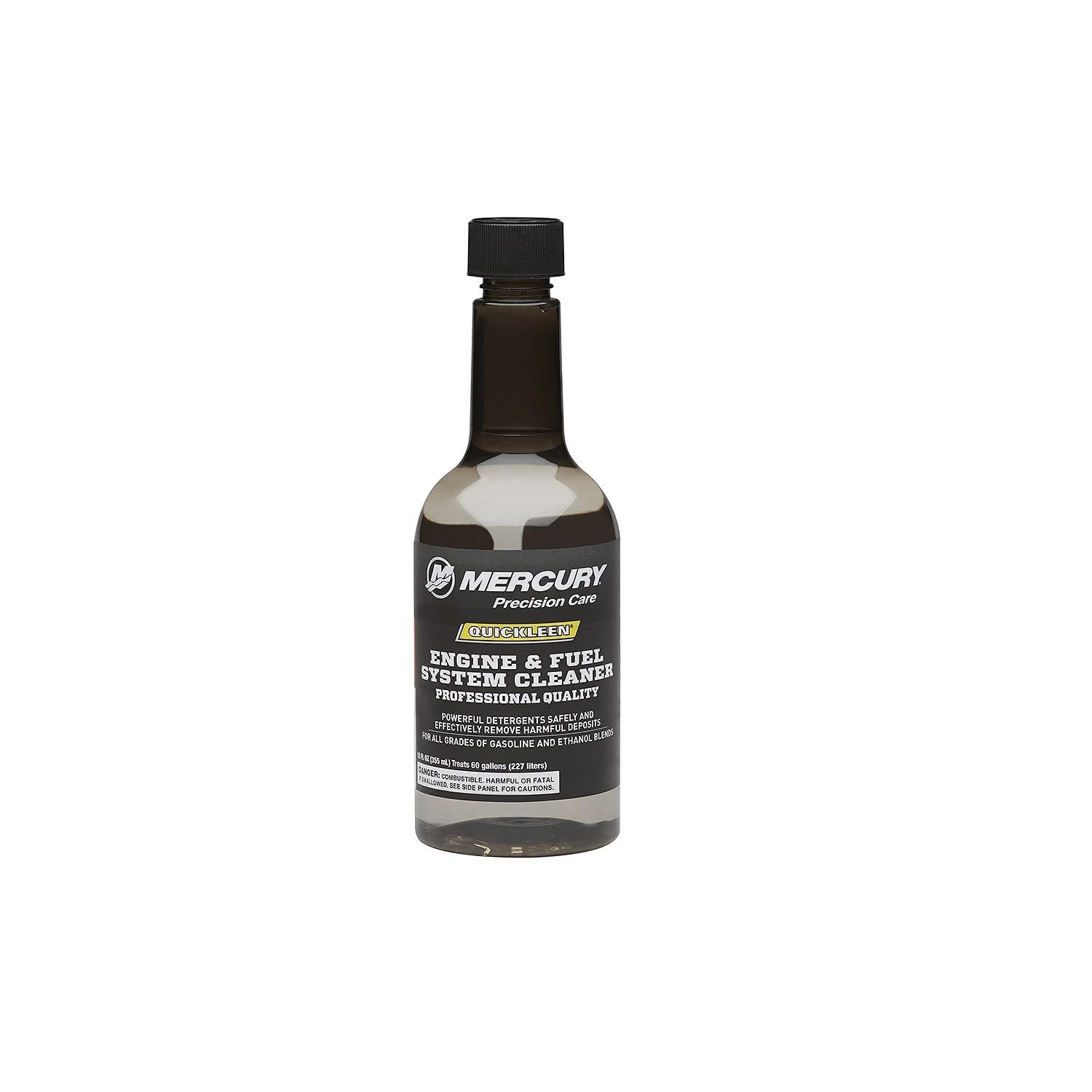
Mercury Marine’s Quickleen is an OEM‑specified cleaner for Mercury outboards and MerCruiser sterndrives, but it works equally well on any gasoline engine — including generators and lawn equipment. The formula removes carbon from carburetors, injectors, valves, spark plugs, and piston crowns.
Owner reviews highlight its ability to cure rough idle and sputtering caused by ethanol‑gel deposits. Unlike many marine additives, it does not contain fuel stabilizer, so it’s strictly a cleaner. Use it at every fill‑up or as a shock treatment — 1 ounce treats 5 gallons of gasoline.
The 12‑ounce bottle provides full treatment for a typical boat tank. Users note that it restored full throttle power on outboards that had been sitting for a season. For marine enthusiasts who want a factory‑recommended solution, Quickleen is the benchmark.
What works
- OEM quality for Mercury/Mercruiser
- Effective on ethanol‑related deposits
- Can be used in small engines too
What doesn’t
- No fuel stabilizer included
- Price per ounce higher than some competitors
8. Berryman 7516 High Mileage Fuel System Rejuvenator

Berryman’s High Mileage Rejuvenator uses their exclusive High Energy Solvent Technology (HEST), which relies on aggressive solvents rather than weak carriers like kerosene. This makes it one of the most potent options for dissolving fuel residue, gum, and carbon in high‑mileage engines.
The 15‑ounce pour can is universal for 2‑stroke and 4‑stroke gasoline engines, including marine and small equipment. It restores lost power, reduces rough idle and hesitation, and helps restore proper octane requirements. Owners report that it often brings old engines back to life after a single treatment.
The downside is the metal can — no measuring spout, so you’ll need a funnel. Also, the strong solvent smell indicates aggressive chemistry that may not be ideal for modern GDI systems with sensitive seals. Still, for older vehicles and small engines, it’s a cost‑effective powerhouse.
What works
- Powerful HEST solvents dissolve tough deposits
- Works on 2‑stroke and 4‑stroke engines
- Very affordable per treatment
What doesn’t
- No built‑in measuring system
- Harsh for modern GDI engines
9. Quicksilver Quickleen Engine and Fuel System Cleaner

Quicksilver Quickleen is essentially the aftermarket version of Mercury Quickleen — same part family, similar cleaning performance. It removes carbon deposits from carburetors, injectors, valves, spark plugs, and piston crowns, and it prevents knocking and piston seize‑up.
Owners report success with contaminated fuel cleanup and restoring smooth idle on outboards that sat dormant. The dosage is 1 ounce per 5 gallons, and it can be used at every fill‑up. Several verified buyers noted immediate improvement in performance after treating ethanol‑gummed fuel systems.
While it lacks the fuel stabilizer that some Marine products include, it’s a reliable cleaner that pairs well with regular fuel treatment routines. For boaters on a budget, Quickleen offers the same core chemistry as Mercury’s own bottle at a friendlier price point.
What works
- Same effective formula as Mercury Quickleen
- Great for removing ethanol deposits
- Can be used in small engines
What doesn’t
- No fuel stabilizer
- Some users saw no improvement on already clean engines
10. Gumout 510021W-6PK Fuel System Cleaner (6‑Pack)

Gumout’s multi‑pack offers an entry‑level PEA detergent that prevents deposit formation and maintains performance. It’s oxygen‑sensor safe and compatible with turbocharged and supercharged engines. The six‑bottle pack provides enough for six treatments, making it a solid choice for routine maintenance.
Owner feedback indicates it helps older high‑mileage cars run smoother, though some users note it’s less powerful than premium options like Sea Foam or BG. Still, for the price per bottle, it’s a reliable way to keep injectors and intake valves clean if used regularly.
This is a maintenance product, not a cure for severe carbon buildup. For vehicles that already run well, Gumout helps sustain that condition and prevent future issues. The easy‑pour bottle design makes it convenient for any gas tank.
What works
- Good for regular maintenance
- Safe for all gasoline engines
- Great value in six‑pack
What doesn’t
- Not strong enough for heavy carbon
- Less effective than premium competitors
11. Lucas Oil Fuel Injector Cleaner (12‑Pack)

Lucas Oil’s 12‑pack of injector cleaner is designed for fleet use or high‑volume consumers. Each 5.25‑ounce bottle treats up to 25 gallons of gasoline. The formula not only cleans injectors but also lubricates the fuel pump and injectors, addressing wear from low‑sulfur fuels.
Owner feedback is generally positive for routine use, with many noting reduced engine noise and smoother operation. The 12‑pack eliminates the need for frequent reordering and brings the per‑treatment cost down significantly.
This product focuses on injector cleaning and fuel system lubrication rather than exhaust deposits. For a complete fuel and exhaust cleaning strategy, you would pair this with a dedicated catalytic converter cleaner. As a standalone, it’s a practical bulk buy for households with multiple gasoline vehicles.
What works
- Excellent value per treatment
- Lubricates fuel system components
- Convenient bulk packaging
What doesn’t
- Not designed for exhaust system cleaning
- Less concentrated than premium options
Hardware & Specs Guide
Active Ingredient Types
Polyether amine (PEA) is the gold standard for gasoline systems — it breaks down carbon at the molecular level. For diesel, cetane improvers and high‑flash‑point solvents are preferred. Berryman’s HEST (High Energy Solvent Technology) uses strong aromatics that are effective on heavy deposits but can be aggressive on seals in modern engines.
Catalytic Converter Cleaning Chemistry
Catalyst‑safe cleaners rely on oxygenated solvents that burn off carbon without coating the precious metal substrate. MotorPower Care and MotorKote both use German‑sourced formulas that are TÜV‑certified for emissions systems. Avoid any product containing lead or iron compounds, as they can poison the catalyst.
FAQ
How often should I use a fuel and exhaust cleaner?
Will a fuel cleaner fix a P0420 code permanently?
Can I use a gasoline cleaner in a diesel engine?
Final Thoughts: The Verdict
For most buyers, the best fuel and exhaust cleaner winner is the BG 44K Platinum (2‑Pack) because it delivers professional‑grade cleaning that restores power and fuel economy in a single treatment. If you need to fix a P0420 code and pass an emissions test, grab the MotorPower Care Catalytic Converter Cleaner. And for diesel owners battling DPF maintenance, nothing beats the Lucas Diesel Deep Clean for reducing particulate buildup and extending filter life.

Certification: BSc in Mechanical Engineering
Education: Mechanical engineer
Lives In: 539 W Commerce St, Dallas, TX 75208, USA
Md Amir is an auto mechanic student and writer with over half a decade of experience in the automotive field. He has worked with top automotive brands such as Lexus, Quantum, and also owns two automotive blogs autocarneed.com and taxiwiz.com.