A cracked bumper after a parking lot scrape or a split in a fender liner often looks like a replacement-only scenario. The cost of a new painted bumper cover can easily run into the hundreds, and junkyard parts remain a gamble on fit and color. A dedicated repair kit shifts that math entirely by letting you fuse plastic back together at the molecular level — turning a discarded shell into a structurally sound component. The trick is knowing which type of kit actually bonds with your specific bumper material and which ones leave you with a brittle seam that reopens under tension.
I’m Amir — the founder and writer behind Four Wheel Ask. My work centers on dissecting product specifications, evaluating build quality reports, and cross-referencing owner feedback across thousands of real-world repair scenarios to separate tools that hold up from those that frustrate.
Whether you choose a hot stapler that embeds metal stitches or a filler that sands smooth, the method matters more than the brand. This evaluation of the best front bumper repair kit examines eleven distinct products to help you choose the right repair approach for your needs.
How To Choose The Best Front Bumper Repair Kit
Modern automotive bumpers are molded from thermoplastics such as polypropylene (PP), ABS, polycarbonate (PC), or TPO blends. Each plastic type responds differently to heat and adhesives, so the ideal repair kit must match your bumper’s substrate. Understanding the three main repair approaches — hot stapling, plastic rod welding, and two-part filler — will determine whether your repair holds or fails under the first warm day.
Staple Fusion vs. Rod Welding vs. Body Filler
Hot stapler kits embed metal staples across a crack using a heated iron, creating a mechanical bridge that resists flexing. This method works well on long splits and thin bumper skins where rod welding might burn through. Rod welding uses a hot iron to melt plastic filler rods into the crack, chemically fusing the material when the rod matches the bumper polymer. Body filler — like lightweight polyester compounds — bonds to the surface without melting the plastic, making it ideal for small chips and gouges where structural reinforcement is less critical. Many premium kits combine stapling and rod welding in one tool, giving you both mechanical and chemical bonding options.
Wattage and Temperature Control
A kit’s wattage determines how quickly the heating element reaches operating temperature and how well it maintains heat when working on thicker plastic sections. Kits in the 100W to 150W range handle most automotive bumper repairs, while 200W-plus units heat faster and recover temperature faster when embedding multiple staples in quick succession. Adjustable temperature control — ideally with a digital display between 200°C and 600°C — lets you dial in the correct heat for different plastic types without burning or under-melting the material.
Accessory Count and Staple Variety
Staple shape matters more than most guides admit. Flat staples bridge straight cracks, wave staples grip along irregular breaks, and M- or V-shaped staples reinforce corners and stress points. A well-equipped kit should include at least 500 staples across four shapes, alongside smoothing heads, stainless steel mesh for reinforcing large gaps, and plastic welding rods in multiple polymer types (ABS, PP, PE, TPE, PC, PUR, PA). Kits that include a carrying case and pliers add practical value for both shop storage and roadside repairs.
Quick Comparison
On smaller screens, swipe sideways to see the full table.
| Model | Category | Best For | Key Spec | Amazon |
|---|---|---|---|---|
| GNI 150W Digital | Welder | Precision temp control | 150W, LCD display, 106 rods | Amazon |
| SHALL Cordless | Welder | Portable, no cord | 2000mAh, USB-C, 200 staples | Amazon |
| VTSHENY 220W | Welder | High-power stapling | 220W, 800 staples, 30 rods | Amazon |
| VEVOR 100W | Welder | Budget starter kit | 100W, 800 staples, LED light | Amazon |
| Ppizkk 130W Deluxe | Welder | Multi-material repair | 130W, 56 rods + 35 color rods | Amazon |
| Ghguole 150W Stapler | Welder | Heavy staple variety | 150W, 1000 staples, 8 rods | Amazon |
| RX WELD 2-in-1 | Welder | All-in-one welding | 100W, 1000 staples, iron tip | Amazon |
| Ghguole 100W 2-in-1 | Welder | Rod + solder versatility | 100W, 56 rods, soldering tip | Amazon |
| WRDLOSY 200W | Welder | Max staple count | 200W, 2000 staples, case | Amazon |
| SONNLER 100W | Welder | Complete kit value | 100W, 1000 staples, metal mesh | Amazon |
| USC 15310 Filler | Filler | Smooth surface finishing | 0.8 gal, lightweight, sandable | Amazon |
In‑Depth Reviews
1. GNI 150W Digital Adjustable Temperature Plastic Welder
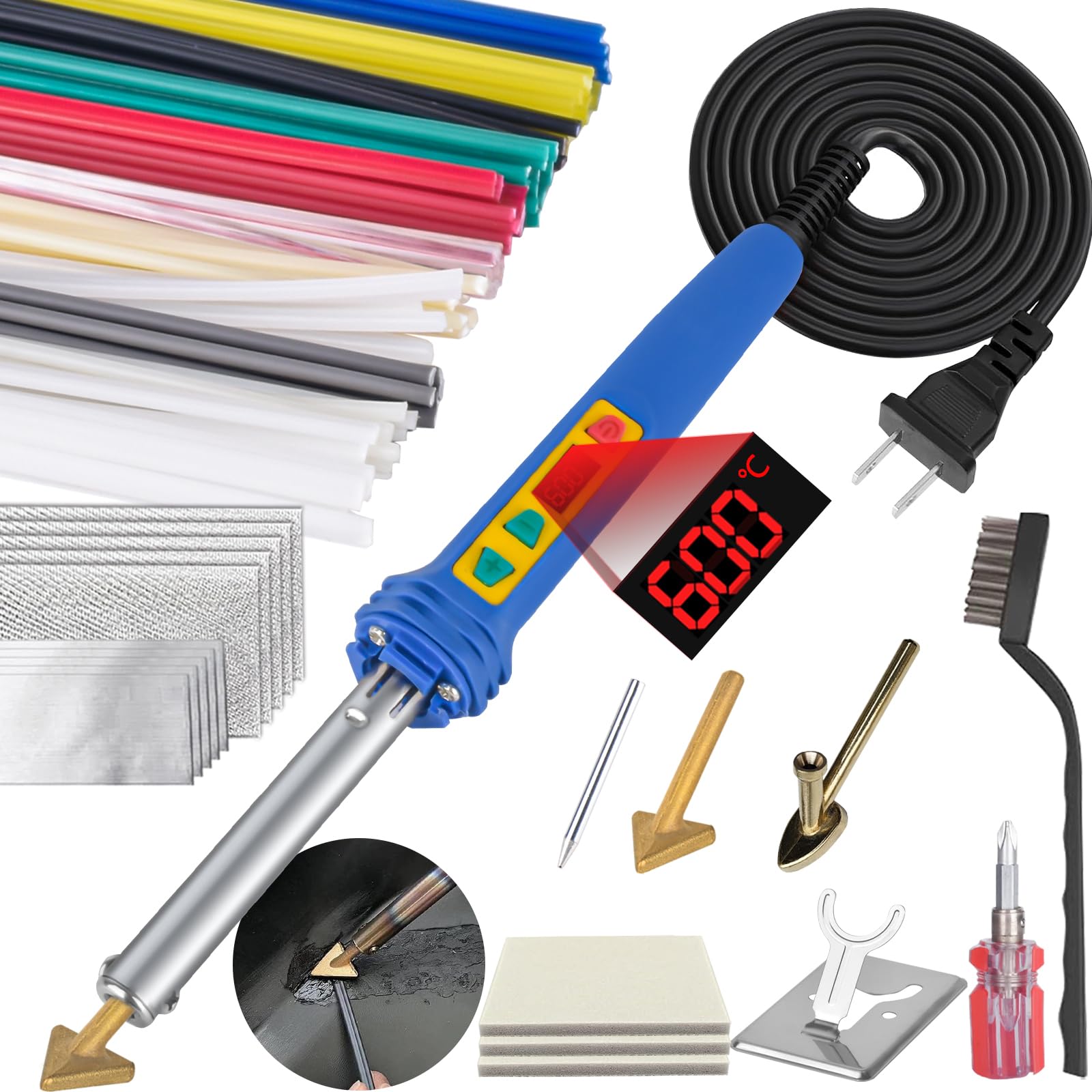
The GNI 150W stands apart from the crowded field of staple welders because it combines a genuine LCD temperature display with 150W of ceramic heating power in a pen-shaped body that offers real control. Most kits in this price bracket use a fixed-temperature iron that either burns the plastic or fails to melt the rod properly. The GNI lets you dial in from 200°C to 600°C and locks the setting, which is critical when you move from a PP bumper to a ABS trim piece and need a different melt profile. The 15-second heat-up time matches what the specification sheet promises, and the six ventilation holes keep the handle cool enough for extended use.
The kit includes 106 plastic welding rods split between 56 rods in seven polymer types (ABS, PP, PE, TPE, PC, PUR, PA) and 50 colored rods for aesthetic matching. Four soldering tips cover both triangular surface repair and pointed electronic work, making this a true 3-in-1 tool rather than a stapler with a few add-ons. Owner reports confirm that the flat triangular tip melts stainless steel mesh evenly for bridging large gaps, and the temperature readout correlates well with actual tip heat when verified with a contact thermometer. The included wire mesh, aluminum foil tape, sandpaper, and metal brush cover the full workflow from crack prep to final sanding.
One recurring observation from users is that the instruction manual offers minimal guidance on which rod type matches which plastic, and the filler rods are not individually labeled by polymer. This forces you to either identify your bumper plastic independently or use the burn-test method. Despite that gap, the core tool delivers professional-grade temperature stability that cheaper fixed-heat guns cannot match. For the DIYer who wants one tool that handles multiple plastic types with precision, this is the most capable package available at this price level.
What works
- Digital temperature control with lock function
- Heats to 600°C in roughly 15 seconds
- 106 rods across 7 polymer types plus colors
- Pen-shaped body offers precise maneuverability
What doesn’t
- Filler rods not individually labeled by type
- Instruction manual lacks material guidance
- Temperature fluctuates slightly under heavy use
2. SHALL Cordless Plastic Welding Kit
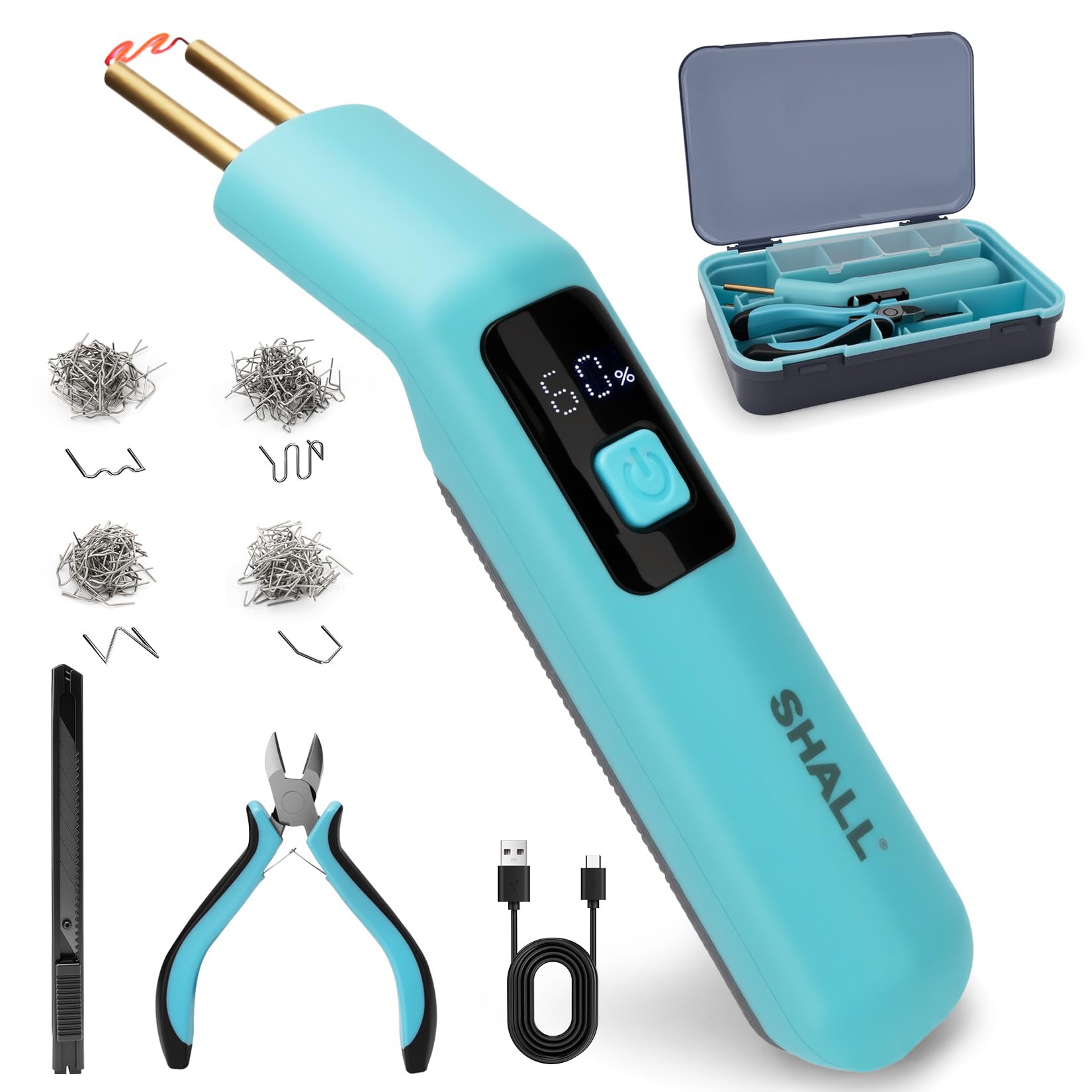
The SHALL Cordless Plastic Welder breaks the biggest constraint of every other kit in this guide: the power cord. With a 2000mAh lithium polymer battery and USB-C charging, this pen-shaped welder delivers over three hours of runtime for stapling repairs without hunting for an outlet. The pressure-activated switch only energizes the tip when a staple is loaded and pressed against the work surface, which eliminates accidental activation and makes it safe to toss in a glove box or tool bag. The digital LED battery meter shows remaining charge in ten-percent increments rather than vague red-green indicators, so you know exactly when to recharge.
Heating performance is genuinely impressive for a battery-powered tool — it reaches 1112°F in roughly two to three seconds and maintains enough heat to melt 0.8mm staples into ABS and PP bumpers without hesitation. The kit ships with 200 staples in four shapes (flat, wave, M, V), a metal plier, an art knife, and a blow-molded storage case that organizes everything without loose pieces rattling around. Users consistently note that the LED nozzle light makes a real difference when working under a vehicle or in dim garage lighting, and the pen shape allows access to tight wheel-well cracks that bulkier gun-style welders cannot reach.
The main trade-off for cordless freedom is thermal mass. The battery-powered iron cannot sustain back-to-back staple Embedding as quickly as a corded 150W unit, so you need to pause roughly 15 seconds between staples to let the tip recover full temperature. This is not a problem for a single crack repair, but it slows down larger jobs like reconstructing a shattered bumper corner. Owners also report that the included art knife and pliers are functional but basic — adequate for prep work but not tools you would rely on daily. For mobile repairs, trail-side fixes, or anyone who values cord-free convenience over raw speed, this is a uniquely capable option.
What works
- True cordless operation with 3+ hour runtime
- Pressure-activated switch prevents accidental burns
- Digital battery meter with precise readout
- Compact pen shape reaches tight spaces
What doesn’t
- Tip recovery time slows continuous stapling
- Included cutting tools are entry-level quality
- Limited to 200 staples in the kit
3. VTSHENY 220W Plastic Welder Bumper Repair Kit

The VTSHENY 220W kit addresses the one limitation that frustrates users of lower-wattage staplers: insufficient heat to melt thicker staples into dense plastic. With 220W on tap, this gun-style welder heats staples to glowing red in seconds and recovers temperature almost immediately after each embed, allowing continuous work along a long crack without waiting. The red metal housing and stainless steel staple construction signal a focus on durability, and the overheating protection circuit automatically cuts power if the tool exceeds safe operating temperature — a feature absent from many budget guns.
The accessory bundle is one of the most complete in this guide: 800 hot staples across six types and two sizes (0.6mm and 0.8mm wave, flat, M, and V), 30 plastic welding rods in flat and round profiles, two thermal smoothing heads, two stainless steel wire mesh sheets, aluminum repair tape, sandpaper, a wire brush, pliers, and a utility knife. The inclusion of both stapling and rod-welding capabilities in one tool makes this a genuine 2-in-1 system rather than a stapler with a few filler rods thrown in. Owners who have used it on scooter body panels, lawn equipment, and automotive bumper covers report that the staple penetration is deeper and more consistent than with 100W guns they had used previously.
Two limitations appear regularly in user feedback. The first is that the tool has a practical duty cycle of roughly 15 minutes before the overheating protection kicks in — sufficient for most single repairs but restrictive if you are tackling multiple cracks in one session. The second is that the plastic welding rods produce a strong odor and some smoke during use, which is typical of melted polymer but more noticeable with the included PP rods. Using the tool outdoors or with a fan is recommended. The cutters included in the kit are functional but basic, and several owners recommend upgrading to flush-cut pliers for cleaner staple trimming.
What works
- 220W delivers rapid heat and fast recovery
- 800 staples across six types for versatility
- Includes both stapling and rod welding capability
- Overheat protection ensures safe operation
What doesn’t
- 15-minute duty cycle before thermal shutdown
- Plastic rods produce strong fumes when melted
- Included cutters are entry-level quality
4. VEVOR 100W Hot Staple Welding Gun
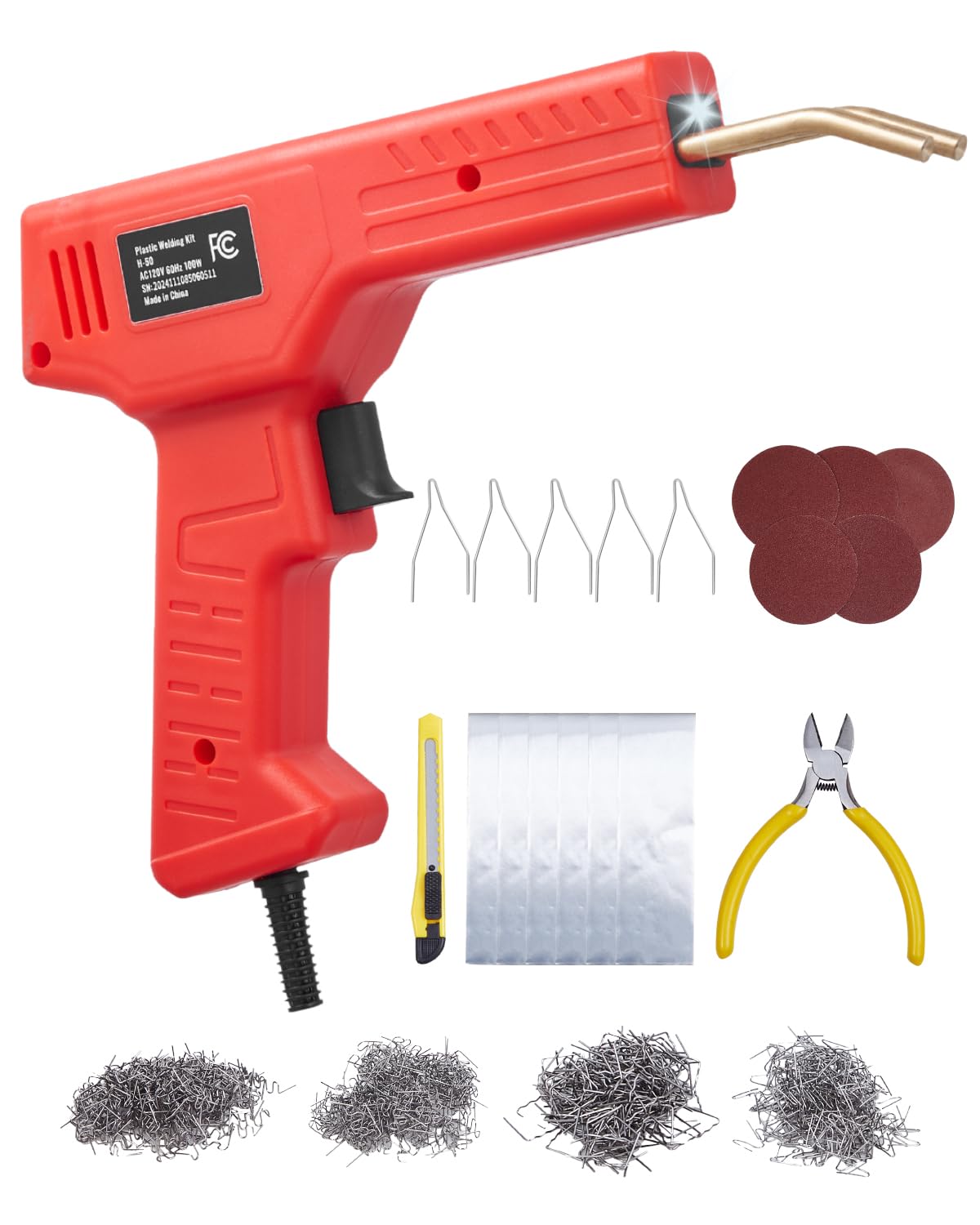
VEVOR brings its typical formula — solid core performance with no unnecessary frills — to the plastic welder category with this 100W hot staple gun. The tool reaches 450°C in one to three seconds, which is consistent with the 100W class, and the ergonomic handle design reduces hand fatigue during extended repairs. The LED light integrated into the front of the gun illuminates the work area directly at the staple point, a feature that proves genuinely useful when repairing a bumper crack in the shadow of the wheel well or inside a dim garage bay.
The kit includes 800 hot staples in four types (large and small wave, V-shaped, and M-shaped) plus five smoothing staples for surface finishing, an art knife, diagonal pliers, five round sandpaper discs, and five aluminum tapes. The smoothing staples are a thoughtful inclusion — they allow you to melt down protruding staple ends flush with the plastic surface without needing a separate smoothing head. Owner feedback highlights that the tool works well for repairing car bumpers, kayaks, canoes, and household plastic items, and the learning curve is minimal even for first-time users. The compact body and lightweight construction (just over 1.5 pounds) make it easy to maneuver in tight spaces.
The main compromise at this price point is the build quality of the accessories rather than the welder itself. Users report that the utility knife and diagonal pliers are functional but lack the precision of dedicated tools — the pliers leave roughly 1/16-inch of wire protruding after cutting staples, which requires additional sanding or filing. The six smoothing staples included are helpful but insufficient for larger repairs, and the welder cannot hold them as securely as the regular staples. For the DIYer who wants a reliable stapler without paying for a premium bundle, the VEVOR delivers where it counts while cutting corners on the peripherals.
What works
- Fast heat-up to 450°C in seconds
- Integrated LED light for dim work areas
- Lightweight and compact for tight access
- Includes smoothing staples for flush finishing
What doesn’t
- Accessory tools are basic quality
- Only six smoothing staples included
- Pliers leave staple protrusions
5. Ppizkk 130W 3-in-1 Deluxe Plastic Welder Kit

The Ppizkk 130W Deluxe kit distinguishes itself through its attention to color matching and material variety. Alongside the standard 56 plastic welding rods in seven polymer types, the kit includes 35 LDPE welding rods in seven distinct colors, allowing repairs on colored plastics to blend visually rather than stand out as a black weld line on a gray bumper. This is a rare feature in the sub- category and matters significantly for visible exterior repairs. The 130W ceramic heating element reaches 1112°F maximum temperature and the pen-style body with a toggle switch offers better control than trigger-operated guns.
The kit includes five welding tips — four brass tips and one stainless steel tip — covering triangular surface repair, pointed detail work, and tips with holes for rod feeding. The inclusion of both larger and smaller triangular tips allows you to match the heat footprint to the repair area. Accessories include five aluminum foil tapes, four stainless steel mesh sheets for reinforcing large gaps, three sandpaper grades, a metal brush, a metal stand, a screwdriver, and an instruction manual. The metal stand is a small but meaningful inclusion — it keeps the hot iron safely parked between welds rather than resting on a workbench surface.
Owner feedback over roughly one year of use indicates the tool holds up well for light to moderate automotive and household repairs. The toggle switch is more durable than push-button designs, and the heat-up time of roughly one to two minutes is reasonable for the 130W power level. Some users note that the tool struggles slightly with very thick or dense plastic sections, where a 150W or 200W gun would maintain temperature better. The included rods are adequate but not premium quality — a few owners report switching to name-brand welding rods for critical structural repairs. For cosmetic bumper repairs where color blending matters, this kit offers value that other kits overlook.
What works
- Seven colored LDPE rods for color-matched repairs
- Five tips including stainless for varied applications
- Pen body with toggle switch for precise control
- Metal stand included for safe hot-parking
What doesn’t
- Struggles with very thick plastic sections
- Included rods are adequate but not premium
- Heat-up takes one to two minutes
6. Ghguole 150W 2-in-1 Hot Stapler Welding Machine

The Ghguole 150W kit focuses heavily on staple variety and quantity, shipping with 1000 hot staples in six configurations across two thicknesses (0.6mm and 0.8mm). This is one of the highest staple counts in the mid-range category, and the range of shapes — wave, flat, M, and V — covers the full spectrum of crack geometries you encounter on automotive bumpers. The upgraded 150W heating element brings the tool to operating temperature rapidly, and the overheating protection function prevents damage during extended use. The gun-style body with a front LED indicator helps visibility in low-light conditions.
Beyond the staples, the kit includes eight plastic welding rods, two thermal smoothing heads, a carrying case, pliers, and a utility knife. The smoothing heads are a practical addition — after embedding staples, you can switch to the smoothing head to melt down protruding wire ends and level the repair surface. The carrying case is blow-molded with custom cutouts for each component, which keeps the kit organized and protects the tool during storage. Owners report successful repairs on automotive bumper covers, refrigerator shelves, plastic storage bins, laundry baskets, and ATV plastics, with many noting that the tool pays for itself on the first repair compared to buying a replacement bumper.
The main criticism from long-term users centers on the welding rods. The kit includes only eight rods, which is sufficient for small repairs but forces a separate purchase for larger or multiple projects. The rods themselves are functional but not labeled by polymer type, requiring you to identify your base plastic independently. The side cutters included leave staple ends protruding roughly 1/16 inch, and several owners recommend upgrading to flush-ground cutters for a cleaner finish. For the user who prioritizes staple volume and variety over rod quantity, this kit delivers outstanding value for money.
What works
- 1000 staples across six types and two thicknesses
- Two smoothing heads for surface finishing
- Blow-molded case keeps everything organized
- Fast heat-up with overheat protection
What doesn’t
- Only eight welding rods included
- Rods not labeled by polymer type
- Cutters leave staple protrusions
7. RX WELD 2-in-1 Plastic Welding Kit

The RX WELD 2-in-1 kit takes a dual-tool approach by including both a plastic welding gun and a separate soldering iron in one package. The welding gun operates at 100W with a maximum temperature of 800°F, which is modest compared to 150W competitors, but the dedicated soldering iron allows you to smooth and detail the repair without swapping tips on a single tool. Having both tools hot and ready simultaneously streamlines the workflow — you can staple a crack with the gun and immediately follow with the iron to melt down any rough edges or blend filler rods into the surface.
The kit ships with 1000 hot staples across multiple configurations, covering most common crack patterns. The build quality of the main welding gun exceeds expectations for this price tier, with a metal handle that feels more substantial than the all-plastic bodies found on many competitors. Owners consistently describe the tool as feeling solid and reliable, with a weight and balance that inspire confidence during use. The heat-up time to full temperature is roughly five minutes, which is slower than the two-to-three-second claims of some rivals but results in more stable temperature maintenance during continuous stapling.
User reports highlight successful repairs on automotive bumper covers, fender flares, truck trim, and plastic interior components, with many noting that the repair holds stronger than the original plastic when properly executed. The included soldering iron proves particularly useful for smoothing over the staple heads and creating a finished surface that looks professional. The main limitation is the 100W power ceiling — users working on thick or heavily reinforced bumper sections report that the gun struggles to fully embed 0.8mm staples compared to 150W or 220W alternatives. For standard automotive bumper repairs and household plastic fix jobs, the dual-tool convenience and solid build quality make this a compelling premium option.
What works
- Separate welding gun and soldering iron for workflow efficiency
- Metal handle construction feels durable
- 1000 staples included in the kit
- Stable temperature maintenance during use
What doesn’t
- 100W power limited for thick bumper sections
- Five-minute heat-up is slower than competitors
- Lower max temperature than 150W+ kits
8. Ghguole 100W 2-in-1 Plastic Welding Kit

The Ghguole 100W 2-in-1 kit prioritizes rod-based plastic welding over staple-based repair, making it the best choice in this guide for users who want to chemically fuse bumper plastic rather than mechanically bridge cracks. The kit includes 56 plastic welding rods in seven polymer types (ABS, PP, PE, TPE, PC, PUR, PA), which covers the vast majority of automotive bumper materials. The 100W motor drives three adjustable temperature settings and heats up quickly, and the gun-style body with a plastic handle stays cool enough to hold comfortably during extended use. The thermal hole design prevents deformation at high temperatures.
The kit ships with two triangular copper heads for plastic welding and one soldering iron tip for electronic repair, making this a genuine 2-in-1 system. Additional accessories include five stainless steel mesh pieces, five foil tapes, three sandpaper sheets, a screwdriver, a metal brush, and an iron stand. The inclusion of the stand is meaningful — it keeps the hot iron safely parked and prevents accidental burns or damage to the work surface. Owners report successful use on motorcycle fairings, car bumpers, kayaks, and household plastic items, with many noting that the tool pairs well with a hot stapler for a combined mechanical and chemical repair approach.
The most significant drawback is that the 100W power level is marginal for melting thicker plastic rods into dense bumper sections. Users working with heavy TPO bumpers or multiple-layer plastic panels report that the tool struggles to maintain sufficient heat for consistent rod flow. The three-speed temperature control offers some compensation, but the lack of a digital display means you are setting temperature by feel rather than precision. The initial use produces a small amount of smoke from the protective liquid on the heating element — this is normal and dissipates after the first session. For rod-focused repairs on standard automotive plastics, this kit offers excellent accessory value.
What works
- 56 rods across seven polymer types for broad compatibility
- Soldering iron tip adds electronics repair capability
- Three adjustable temperature settings
- Includes iron stand for safe parking
What doesn’t
- 100W power struggles with thick bumper plastic
- No digital temperature display
- Initial smoke from protective liquid
9. WRDLOSY 200W Plastic Welder Kit

The WRDLOSY 200W kit leads the category in raw staple count — 2000 staples across four types (outside corner, inside corner, flat, and wave) in a 0.02-to-0.03-inch thickness range. This volume alone makes it the best value for anyone planning multiple repairs or professional-level work where staple consumption is high. The 200W heating element heats rapidly and recovers temperature quickly between embeds, making it suitable for continuous stapling along long bumper cracks without the duty-cycle limitations of lower-wattage guns. The custom carrying case with dedicated cutouts keeps all 2000 staples, pliers, and sandpaper organized and accessible.
User feedback consistently highlights how effortlessly the tool bonds plastic pieces together, with several reviewers calling it the quickest and most effective method they have used for all plastic repairs. The copper and plastic construction keeps the tool lightweight despite the high wattage, and the precision afforded by the gun-style body allows controlled staple placement even on curved bumper surfaces. The kit includes ten sandpaper sheets for surface preparation and finishing, plus a plier for trimming staple ends. The first repair typically pays for the entire kit when compared to the cost of a replacement bumper cover.
The primary limitation is the lack of temperature control. The 200W iron operates at a fixed heat level, which means you cannot adjust the temperature for different plastic types or staple thicknesses. Some users find the tool slightly bulky compared to pen-style welders, though the trade-off is the higher power output. The kit also does not include plastic welding rods, so it is strictly a stapling solution — if you want to combine mechanical stapling with chemical rod fusion, you will need to purchase rods separately. For users who want maximum staple capacity and raw heating power in a single package, this kit delivers unmatched volume.
What works
- 2000 staples — highest count in this guide
- 200W heats fast and recovers quickly
- Custom case keeps everything organized
- Excellent value for multiple repairs
What doesn’t
- No temperature adjustment control
- No plastic welding rods included
- Bulky compared to pen-style welders
10. SONNLER 100W Plastic Welding Kit

The SONNLER 100W kit earns its place as a top-tier value option by bundling nearly every accessory you need for a complete bumper repair in one box. The kit includes 1000 hot staples (900 staples plus additional pieces), a plastic welding gun, a soldering iron, pliers, a utility knife, metal mesh, abrasive paper, and aluminum tape. The 100W ceramic heating element reaches 400°C in two to three seconds, which is competitive with higher-wattage units in this guide, and the temperature is calibrated to melt staples slowly enough to prevent burn-through on thin bumper skins. The front LED light aids visibility in dark work areas.
The standout feature of this kit is the inclusion of both a dedicated plastic welding gun and a separate soldering iron, similar to the RX WELD kit but at a lower price point. This dual-tool approach means you can keep the stapler hot while using the iron for detail work, rather than constantly swapping tips on a single tool. Owner reports confirm successful repairs on automotive bumper covers, interior trim, plastic toys, and household items, with several users noting that the kit paid for itself on the first car bumper repair. The build quality is solid for the price, with a rubber and plastic handle that remains comfortable during extended use.
The main compromises are the 100W power ceiling and the lack of plastic welding rods in the kit. The 100W output is adequate for standard bumper cracks but struggles with thick, reinforced plastic sections where higher heat is needed for full staple penetration. The absence of welding rods means this kit is focused purely on staple-based mechanical repair — if you want chemical fusion capability, you will need to source rods separately. The included tools are functional but not professional-grade, and some users note that the pliers and knife are adequate for occasional use rather than daily shop work. For the DIYer who wants a complete stapling solution out of the box, this kit offers strong component value.
What works
- 1000 staples plus full accessory set included
- Separate welding gun and soldering iron
- Heats to 400°C in two to three seconds
- Front LED light aids visibility
What doesn’t
- 100W power limited for thick plastic
- No plastic welding rods included
- Accessory tools are functional but basic
11. U.S. Chemical & Plastics Special Lite Lightweight Filler
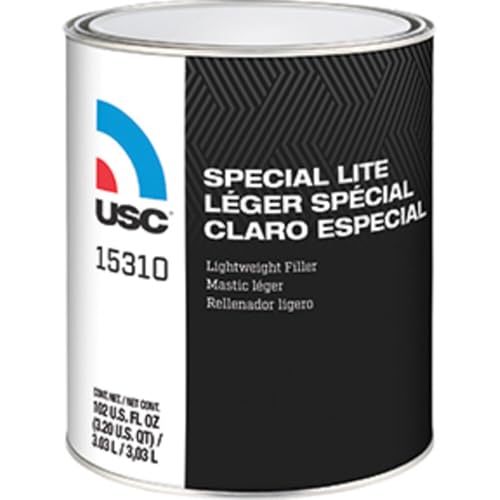
The U.S. Chemical & Plastics Special Lite Filler represents a fundamentally different approach to bumper repair than the staple-based kits in this guide. This is a two-part polyester body filler formulated to be lightweight, creamy, and easy to sand — ideal for filling small chips, gouges, and surface imperfections on bumpers rather than structurally bridging cracks. The 0.8-gallon can provides enough material for multiple repairs and is compatible with fiberglass and metal substrates in addition to plastic, making it a versatile addition to any shop. The full cure time of roughly four hours allows for same-day sanding and painting.
The filler applies with a creamy texture that spreads easily and does not sag excessively on vertical bumper surfaces, though some users note that the blue activator blend performs noticeably better than the standard hardener in terms of consistency. Once cured, the material sands to a smooth, professional finish that accepts paint well. Owners who use this for sculpting and mold making report that it outperforms 3M Bondo in flexibility and workability, and when mixed with polyester or fiberglass resin, it creates a strong support shell for structural repairs. The lightweight formulation is a genuine advantage on large bumper areas where traditional fillers would add excessive weight.
The primary limitation is that this is strictly a surface filler — it does not provide the structural reinforcement that a stapler or rod welder offers for cracks under tension. Using this filler on a moving crack without first stapling or welding the back side will result in the repair failing under stress. Additionally, the packaging is a recurring frustration: Amazon ships the can without lid clips or padding in the box, which frequently results in spilled filler and a safety hazard during transit. For users who need to fill and smooth a bumper after structural welding, this is an excellent companion product rather than a standalone solution.
What works
- Lightweight formulation reduces weight on large repairs
- Creamy texture spreads easily with minimal sag
- Sands to a smooth, paintable finish
- Compatible with plastic, fiberglass, and metal
What doesn’t
- No structural reinforcement for cracks under tension
- Packaging frequently leaks during shipping
- Four-hour cure time slows workflow
Hardware & Specs Guide
Heating Element and Wattage
Ceramic heating elements dominate the mid-range and premium kits in this guide because they heat faster, last longer, and maintain more stable temperatures than older nichrome wire designs. Wattage directly correlates with heat recovery speed — a 150W gun can embed three to four staples before needing a temperature recovery pause, while a 100W gun typically requires a break after two staples. The ceramic core in kits like the GNI 150W and VTSHENY 220W withstands continuous use better than metal-sheathed elements, though all ceramic elements will eventually degrade if run at maximum temperature for extended periods. For bumper repair work, a 130W to 150W ceramic heater represents the sweet spot between cost, speed, and durability.
Staple Metallurgy and Geometry
Hot staples are typically formed from 0.6mm or 0.8mm stainless steel wire, with the thicker 0.8mm staples providing stronger hold in dense bumper plastics but requiring more heat to embed fully. The geometry — flat, wave, M, or V — determines how the staple distributes stress across the crack. Flat staples work best on straight-line cracks where the two edges align evenly. Wave staples grip better on irregular or jagged breaks because the undulating shape creates multiple engagement points. M and V staples are designed for corner repairs and T-junctions where stress concentrates at the intersection. A kit that includes all four shapes at both thicknesses offers the most flexibility for different crack patterns.
Plastic Welding Rod Compatibility
Welding rods must chemically match the bumper polymer to achieve a true fusion bond rather than a surface adhesion. Polypropylene (PP) rods will not bond to ABS, and ABS rods will not bond to polycarbonate. The seven most common automotive plastic types — ABS, PP, PE, TPE, PC, PUR, and PA — cover virtually all bumper substrates found on modern vehicles. Kits that include rods for all seven types, such as the GNI 150W and Ghguole 100W, offer the broadest compatibility. The diameter of the rods (typically 3mm to 5mm) affects how quickly they melt and fill a gap — thinner rods melt faster and are easier to control for small cracks, while thicker rods fill larger gaps in fewer passes.
Ergonomics and Duty Cycle
Gun-style welders distribute weight more evenly across the hand and reduce fatigue during extended repairs, but they are bulkier and harder to maneuver in tight wheel-well areas. Pen-style welders offer superior precision and access but concentrate more heat near the fingers. The duty cycle — the amount of continuous use before the tool needs to cool — varies significantly between kits. The VTSHENY 220W has a roughly 15-minute duty cycle before thermal protection engages, while the GNI 150W can run longer due to its ventilation design. Battery-powered tools like the SHALL Cordless have a different limitation: they can run for hours but need recovery time between individual staple embeds as the tip temperature drops.
FAQ
Can a plastic welder repair any type of bumper crack?
How do I identify the plastic type of my bumper?
Should I staple from the front or back of the bumper?
How long does a plastic welded bumper repair last?
Can I paint over a plastic welded bumper repair?
Final Thoughts: The Verdict
For most buyers, the front bumper repair kit winner is the GNI 150W Digital Adjustable Plastic Welder because its LCD temperature control, 150W ceramic heating, and 106-rod assortment cover the widest range of bumper materials with professional-grade precision. If you want cordless portability for trail-side or mobile repairs, grab the SHALL Cordless Plastic Welder. And for high-volume staple work where raw power matters most, nothing beats the VTSHENY 220W Kit with its 800 staples and fast heat recovery.

Certification: BSc in Mechanical Engineering
Education: Mechanical engineer
Lives In: 539 W Commerce St, Dallas, TX 75208, USA
Md Amir is an auto mechanic student and writer with over half a decade of experience in the automotive field. He has worked with top automotive brands such as Lexus, Quantum, and also owns two automotive blogs autocarneed.com and taxiwiz.com.