Four-stroke bicycle engine kits fill a specific, often misunderstood niche in the motorized cycling world. Unlike their two-stroke cousins, these engines deliver torque from the bottom end, run on straight gasoline without pre-mixing oil, and produce a quieter, more civilized exhaust note at the cost of increased weight and complexity. That trade-off makes them the preferred platform for daily commuters, noise-conscious riders, and anyone who prioritizes reliability over raw peak horsepower.
I’m Amir — the founder and writer behind Four Wheel Ask. I’ve spent years analyzing small displacement engine specifications, mounting geometries, carburetor tuning requirements, and aggregated owner feedback to separate the genuinely well-engineered kits from those that leave you stranded on the side of the road.
After comparing displacement ranges, clutch types, mounting compatibility, and real-world owner experiences, I’ve assembled the definitive guide to the best four-stroke bicycle engine kit currently available online.
How To Choose The Best Four-Stroke Bicycle Engine Kit
The four-stroke bicycle engine kit market is smaller and more specialized than the ubiquitous two-stroke segment, which means new builders often underestimate the importance of frame compatibility and mounting hardware quality. Getting the selection right starts with understanding three critical parameters.
Displacement and Real-World Torque
Four-stroke engines in this category range from 49cc to 125cc. The 49cc units (often 142F pattern engines) produce approximately 2.1 horsepower and deliver peak torque around 4500 rpm. That low-RPM pull is what makes them feel stronger than their peak power suggests — they climb hills without needing to wind the engine to screaming rpm. Jumping to a 125cc four-stroke roughly triples the displacement and pushes power towards 6.5 kW, but the weight penalty and mounting demands increase substantially. For a standard bicycle frame, the 49cc to 53cc range represents the sweet spot between usable torque and manageable installation.
Frame Clearance and Mounting Plate Design
Four-stroke engine blocks are physically larger and heavier than two-stroke units, making frame clearance the number one fitment issue. You need a minimum of 10 inches between the bottom bracket and the top tube on a diamond-frame bicycle. Many kits include universal mounting brackets, but the quality of the mounting plate material — whether stamped steel or thicker aluminum — directly determines how much vibration transfers to the frame. Kits that use a dedicated engine mounting plate with rubber isolation grommets dramatically reduce bolt loosening over time.
Clutch Type: Manual vs Semi-Automatic
Four-stroke bicycle kits fall into two transmission categories. Semi-automatic or centrifugal clutch setups (common on the 49cc units) require no manual clutch lever — you simply twist the throttle, and the clutch engages automatically as rpm rises. This is ideal for new builders or stop-and-go urban riding. Manual clutch designs offer a 4-speed gearbox with a left-hand clutch lever, giving the rider precise control over gear selection for aggressive hill climbing or off-road use. Manual transmissions are mechanically more complex and heavier, but they prevent the clutch slip that plagues centrifugal designs under sustained load.
Quick Comparison
On smaller screens, swipe sideways to see the full table.
| Model | Category | Best For | Key Spec | Amazon |
|---|---|---|---|---|
| GDAE10 49cc 4-Stroke | 4-Stroke | Quiet commuting | 2.1 HP / 7000 rpm | Amazon |
| JAYEUW 53cc 4-Stroke | 4-Stroke | Reliable daily rider | 49 cc displacement | Amazon |
| LIYUANJUN 125cc 4-Stroke | 4-Stroke | Dirt pit bike builds | 6.5 kW / 7500 rpm | Amazon |
| TDPRO Lifan 125cc | 4-Stroke | Trail bike upgrade | Semi-auto clutch | Amazon |
| IMAYCC 80cc 2-Stroke | 2-Stroke | Budget entry level | 2.1 kW / 5000 rpm | Amazon |
| IMAYCC 100cc 2-Stroke | 2-Stroke | Speed on a budget | 2.0 kW / 6500 rpm | Amazon |
| Afranti 80cc 2-Stroke | 2-Stroke | Complete starter kit | 2.8 kW / 6000 rpm | Amazon |
| H-YEEU 110cc 2-Stroke | 2-Stroke | High speed builds | 3.8 kW / 6000 rpm | Amazon |
| H-YEEU 100cc 2-Stroke | 2-Stroke | Lightweight conversion | 60 km/h top speed | Amazon |
In‑Depth Reviews
1. GDAE10 49cc 4-Stroke Bicycle Engine Kit
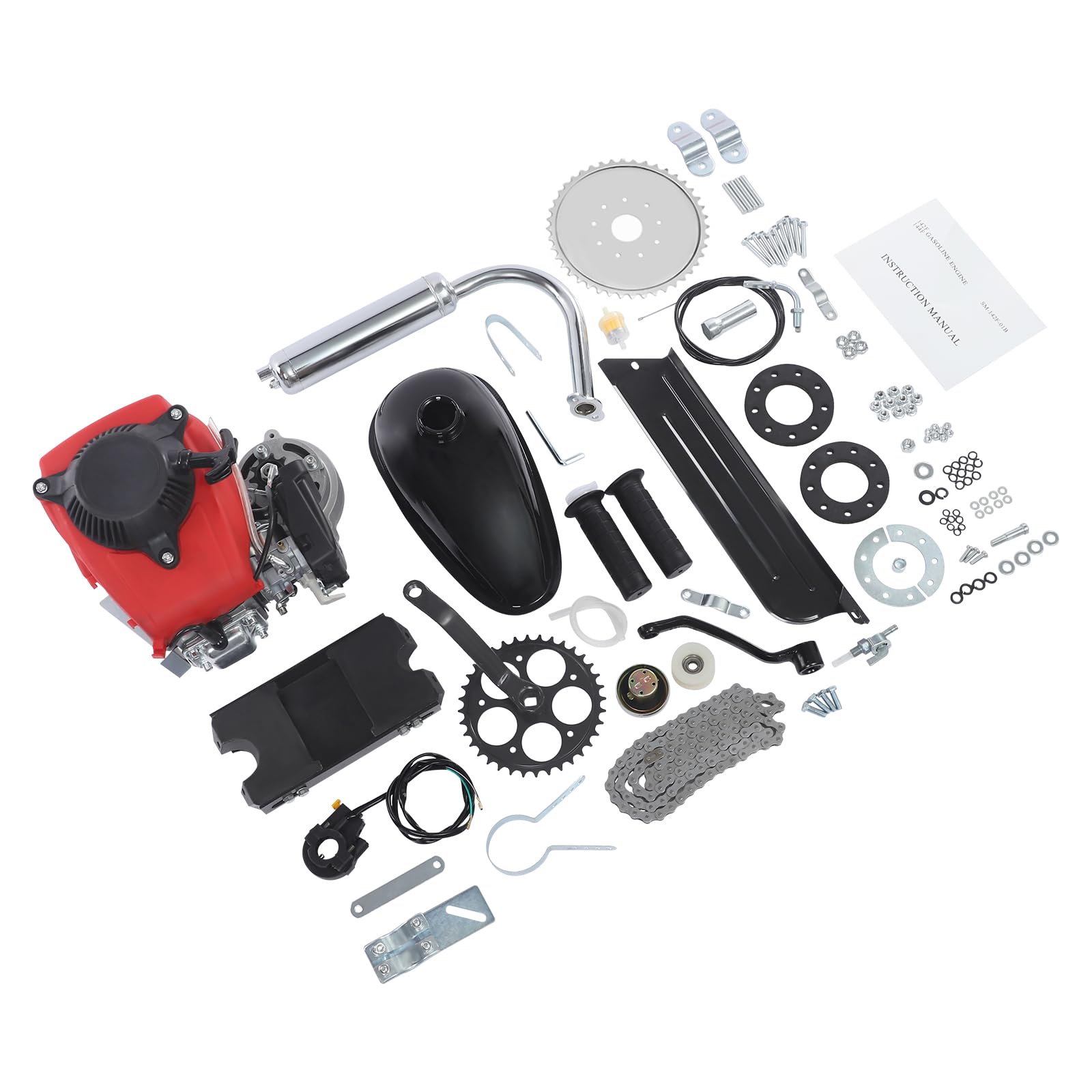
The GDAE10 49cc kit is the benchmark for what a four-stroke bicycle engine conversion should feel like. Its 142F pattern engine produces 2.1 horsepower at 7000 rpm and 2.7 Nm of torque at just 4500 rpm, which means it pulls away from a stop without needing a running start. The OHV valvetrain keeps the engine compact enough to fit most 26-inch V-frame bicycles, and the included double-chain drive system reduces the strain on the drive sprocket compared to single-chain kits.
Builders consistently report first-pull starts once the carburetor is dialed in. The included PZ22-style carburetor is a mixed bag — some kits ship with a well-jetted unit, while others require an immediate swap to a NIBBI or Walbro carb to achieve smooth idling. The fuel tank capacity sits at 2.5 liters, which translates to roughly 60-80 miles of riding depending on terrain and rider weight. The 44-tooth sprocket provides a good balance between acceleration and a top speed of around 28-32 mph on flat ground.
Customer feedback highlights the plastic fuel line fittings and the clutch bell as the two areas needing immediate attention. Several owners noted the clutch bell shipped with a tight tolerance that caused drag on the first test ride, resolved by a light sanding of the bell surface. Once those initial adjustments are made, the engine runs reliably with regular oil changes using SAE 15W-40.
What works
- Truly bolt-on installation for most V-frame 26-inch bikes
- Pull start eliminates the hassle of pedaling to start
- Quiet, low-vibration operation compared to two-stroke equivalents
What doesn’t
- Plastic fuel line components feel fragile and should be replaced with brass fittings
- Clutch bell may require break-in sanding to eliminate drag
- Carburetor tuning out of the box is hit or miss
2. JAYEUW 53cc 4-Stroke Bicycle Engine Kit
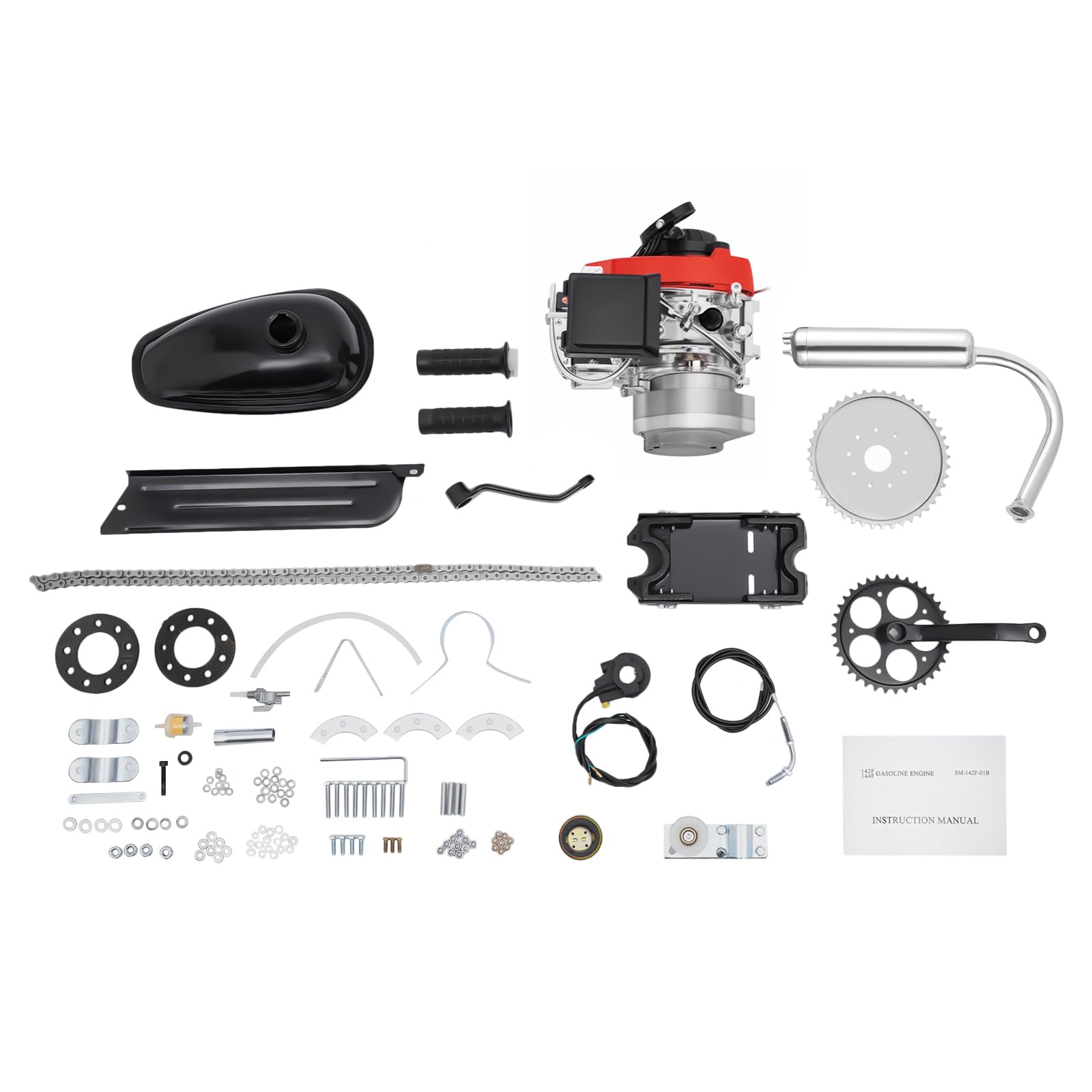
The JAYEUW 53cc kit is essentially the same 142F engine platform as the GDAE10, but it ships with a few key differences that make it a strong mid-range contender. The bore and stroke measurements of 41.8 mm by 36 mm yield the same 49 cc displacement (the 53cc name is a nominal marketing figure), and the net power output sits at the same 2.1 horsepower range. What sets this kit apart is the inclusion of a more complete hardware bundle — the mounting plate, sprocket assembly, and chain are one step above the bare-minimum components found in budget kits.
Owner reports consistently praise the engine’s long-term reliability after the break-in period. Multiple verified buyers reported daily commutes of 15-20 miles for three months without any major failures, provided the oil is changed every 500 km. The twist grip throttle includes a built-in kill switch, which is a small but welcome safety feature that eliminates the need for a separate ignition cut-off. The top speed settles around 27-30 mph on level pavement with a 175-pound rider, matching the advertised range.
The most common complaint involves the supplied spark plug and ignition coil. Several owners replaced the A7TC spark plug with a NGK equivalent and saw immediate improvement in cold starts and idle stability. The frame mounting bracket requires at least 28 mm of clearance between the chainstay and the bottom bracket, which rules out some mountain bike frames with heavy suspension linkage. For standard cruiser and road frames, the installation is straightforward with basic hand tools.
What works
- Proven long-term reliability with regular maintenance
- Kill switch integrated into the throttle assembly
- Full hardware kit reduces trips to the hardware store
What doesn’t
- Spark plug should be upgraded before first start
- Frame clearance issues with suspension mountain bikes
- Slightly heavier than advertised at around 15 kg total
3. LIYUANJUN 125cc 4-Stroke Engine Motor

This 125cc engine from LIYUANJUN is a different beast entirely from the small 49cc units — it is designed to replace the entire drivetrain on a Honda CRF50, XR50, Z50R, or similar mini pit bike chassis, not to clip onto a bicycle frame. The 9.0:1 compression ratio and 6.5 kW power output at 7500 rpm give it more than triple the power of the smaller four-stroke kits, and the 4-speed manual transmission with wet multi-plate clutch provides genuine off-road gearing. This is not a clip-on conversion; it is a full engine swap requiring welding or bolting new mounting tabs onto the frame.
Real-world feedback from owners who swapped this into Apollo 110cc chassis and Kandi 125 buggies confirms the engine runs strong with a proper carburetor. Several buyers discarded the included PZ22 carb and fitted a NIBBI unit, reporting immediate improvements in throttle response and top-end pull. The CDI ignition system is reliable, though the A7TC spark plug should be swapped to a NGK equivalent. The engine oil capacity requires 600-700 ml of SAE 15W-40 four-stroke oil, and the wet clutch benefits from frequent oil changes every 20 hours of operation.
The customer service from LIYUANJUN receives consistent praise for troubleshooting support over the Amazon messaging system. One owner reported a non-sparking ignition issue that was diagnosed remotely and resolved by replacing the stator plate. The engine is heavy at well over 30 pounds, and the kickstart lever can be a pain point if the compression release mechanism is not adjusted correctly during installation.
What works
- Genuine 125cc displacement with real torque for hill climbing
- 4-speed manual transmission offers proper gear selection
- Supportive customer service for troubleshooting
What doesn’t
- Requires significant fabrication for bicycle frame mounting
- Carburetor is unreliable out of the box
- Heavy — adds over 30 pounds to the chassis
4. TDPRO Lifan 125cc Semi-Auto Engine

The Lifan 1P54FMI 125cc engine sold by TDPRO is widely considered the gold standard for pit bike and mini trail bike swaps. The semi-automatic centrifugal clutch means you shift gears with your foot through the N-1-2-3-4 pattern, but there is no clutch lever to pull — the clutch engages automatically as engine speed rises. This makes it much easier to ride in stop-and-go conditions compared to a manual clutch, while still offering four distinct gear ratios for speed control. The 15-tooth 428 chain sprocket on a 20 mm shaft is a standard size that makes sprocket swaps simple.
Owners who installed this engine into Honda CT70 and CT90 frames, Kymco K-Pipe motorcycles, and custom trikes consistently report that the engine starts easily and runs smoothly once the intake manifold is properly torqued. The mounting hole spacing is standard for the Honda horizontal engine family, so it bolts directly into frames that originally housed a 50cc, 90cc, or 110cc engine. The included intake manifold and kick starter are adequate, but the carburetor and air filter are not included in the base kit, which is an important distinction for first-time buyers who expect a complete drop-in package.
At over 53 pounds shipping weight, this is the heaviest engine on the list, and the mounting points require precise alignment to avoid chain misalignment. Owners have noted that the clutch adjustment screw is sensitive — too tight and the centrifugal weights engage prematurely, causing the bike to creep forward at idle. Once dialed in, the engine delivers reliable power across the rpm range and the centrifugal clutch reduces wear on the transmission compared to aggressive manual shifting.
What works
- Centrifugal clutch eliminates manual clutching in traffic
- Standard Honda mounting pattern for direct swap
- High build quality from the Lifan foundry
What doesn’t
- Carburetor and air filter sold separately
- Very heavy — challenges frame balance
- Clutch adjustment is sensitive and requires patience
5. IMAYCC 80cc 2-Stroke Bicycle Engine Kit

The IMAYCC 80cc kit is the most popular two-stroke entry on this list, and for good reason — it offers a complete conversion package at a price point that undercuts most four-stroke kits while delivering 2.1 kW of power at 5000 rpm. The engine is air-cooled with CDI ignition and foot pedal starting, meaning you start the engine by pedaling the bike and releasing the clutch. The included 2.5-liter teardrop fuel tank mounts to the top tube and feeds the carburetor through a simple fuel line. The 44-tooth sprocket and 110-knot chain are standard dimensions that fit most 26-inch and 28-inch rear wheels.
Owner feedback on this kit is polarized, which is typical for the budget two-stroke segment. Buyers who take the time to properly break in the engine at the required 16:1 fuel-to-oil ratio for the first 500 km report long-term reliability. Those who skip the break-in or use poor quality two-stroke oil often experience piston seizures within the first few hours. The included hardware is functional but cheap — the chain is a weak point and many owners replace it immediately with a KMC or similar heavy-duty chain. The digital speedometer included in recent revisions is a nice touch for tracking RPM and distance during break-in.
The biggest complaint relates to the clutch engagement pin length. Multiple buyers reported that the clutch actuator pin was too short, preventing the clutch from fully engaging. The fix involves either grinding down the clutch actuator arm stop or replacing the pin with a longer aftermarket part. This is a known issue with a known solution, but it requires mechanical confidence to address. Once resolved, the engine runs reliably at speeds up to 25-30 mph on flat ground with moderate fuel consumption around 2-2.5 liters per 100 km.
What works
- Complete kit includes fuel tank, speedometer, and all hardware
- Lightweight compared to four-stroke alternatives
- Easy to upgrade parts as needed
What doesn’t
- Clutch engagement pin often too short from factory
- Included chain is low quality
- Requires strict break-in procedure to avoid seizure
6. IMAYCC 100cc 2-Stroke Bicycle Engine Kit
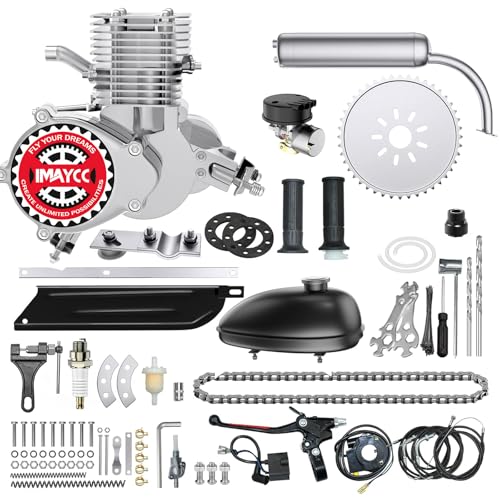
The 100cc iteration of the IMAYCC kit bumps displacement by 20cc over the 80cc version, which translates to a higher torque curve at the expense of slightly increased vibration. The single-cylinder, air-cooled, two-stroke design with CDI ignition delivers approximately 2.0 kW at 6500 rpm, and the larger 3-liter teardrop fuel tank extends the range to about 60 miles between fill-ups. The 44-tooth sprocket and 110-knot chain are identical to the 80cc kit, so sprocket swaps to a 36-tooth or 40-tooth for higher top speed are plug-and-play.
The key selling point of this kit is the broader compatibility with 26-28 inch V-frame bicycles, including mountain bikes, cruisers, and road bikes. IMAYCC explicitly states the 10-inch clearance requirement between the bottom bracket and top bar, which is a useful specification that many budget kits omit. The 36-spoke wheel lacing is a thoughtful inclusion for builders who are also building the rear wheel from scratch, though most buyers will simply attach the sprocket to their existing wheel using the included rubber mounting rings and metal retaining segments.
The lack of verified customer reviews at this point makes it difficult to assess long-term reliability, but the components mirror the 80cc kit closely enough that the same caveats apply. The clutch actuator mechanism, chain quality, and carburetor tuning will likely be the three areas requiring immediate attention. IMAYCC has a track record of improving these components over successive revisions, so this 100cc version may ship with updated hardware.
What works
- 3-liter tank provides excellent range
- Clear compatibility specifications from the manufacturer
- Easy sprocket upgrade path for higher top speed
What doesn’t
- Limited customer feedback available
- Likely shares clutch and chain issues with 80cc version
- No digital speedometer included in this revision
7. Afranti 80cc 2-Stroke Bicycle Engine Kit

Afranti’s 80cc kit differentiates itself by shipping with upgraded hex socket screws and bolts instead of the Phillips-head fasteners that strip easily on cheaper kits. The engine produces 2.8 kW at 6000 rpm, which is slightly higher than the IMAYCC 80cc, and the claimed top speed of 50 km/h is consistent with the 44-tooth sprocket setup. The kit includes a digital speedometer, which is helpful for tracking the crucial break-in period when the engine should not be run at full throttle.
Customer reviews reveal a pattern of mixed experiences. Several buyers reported the carburetor leaked from the float bowl gasket immediately, and the included spark plug failed to produce spark on the first pull. These are the same two components that consistently cause problems across the budget two-stroke segment — replacing the carburetor with a NIBBI unit and the spark plug with a NGK equivalent resolves both issues in nearly every case. Once those parts are swapped, owners report the engine runs strong with good power delivery.
The instruction manual is basic, and first-time builders will benefit from watching installation videos before starting. The fuel tank, fuel lines, and throttle assembly are functional but basic, and the kill switch wiring sometimes arrives with the connectors reversed, causing the engine to die when the switch is in the run position. This is a one-minute fix with a multimeter or simple trial-and-error swapping of the wires.
What works
- Hex socket bolts reduce fastener stripping during installation
- Digital speedometer included for break-in monitoring
- Strong power output for the displacement
What doesn’t
- Carburetor leaks reported straight out of the box
- Spark plug fails frequently and should be replaced immediately
- Wiring polarity on kill switch may be reversed
8. H-YEEU 110cc 2-Stroke Bicycle Engine Kit
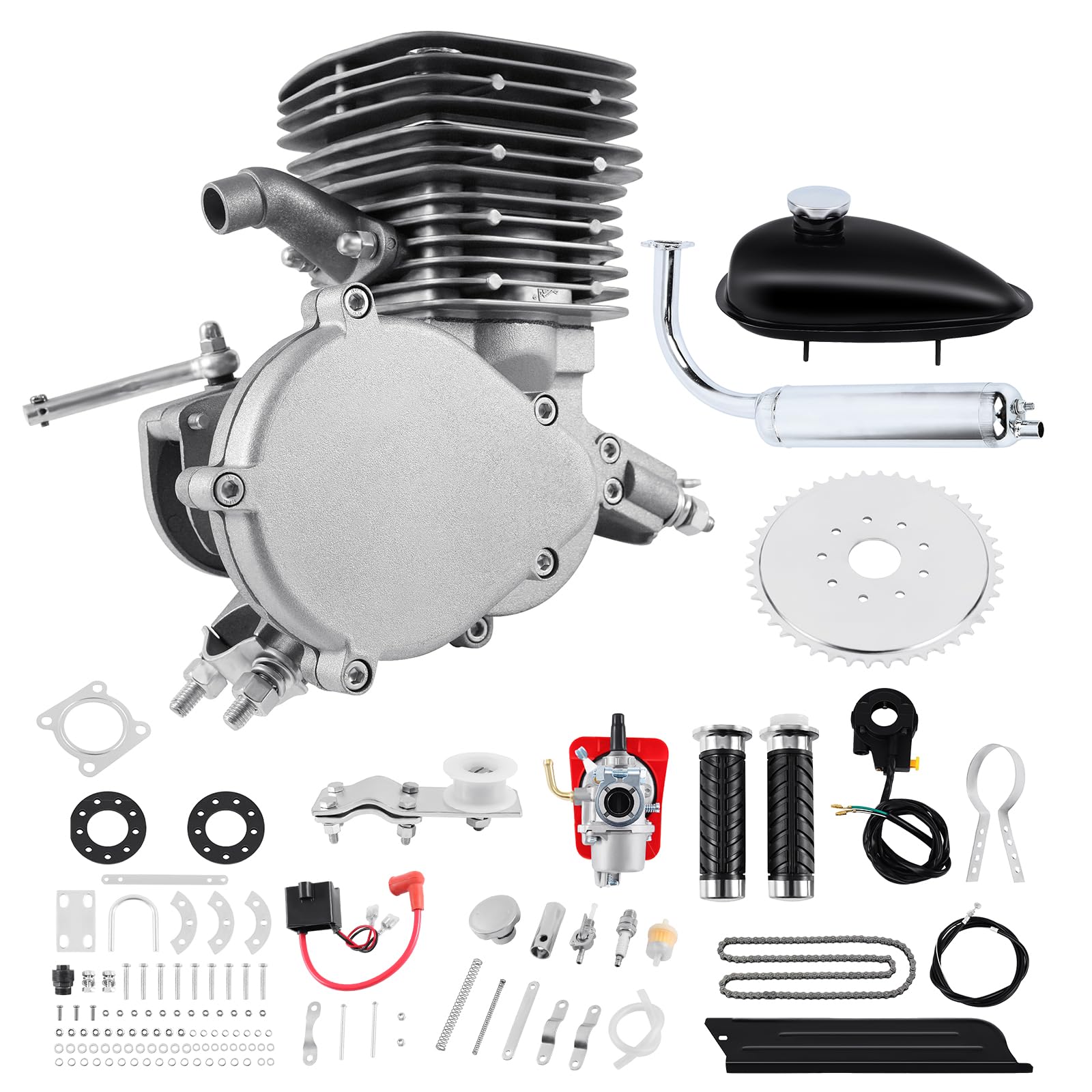
The H-YEEU 110cc kit is the largest two-stroke bicycle engine kit on this list, claiming 150 miles per gallon fuel economy with a 52 mm bore and 40.2 mm stroke that yields 3.8 kW at 6000 rpm. That power output puts it in a different class from the 80cc kits — the 110cc engine can push a bicycle past 35 mph on flat ground with proper gearing. The bore and stroke dimensions indicate a square engine design that balances torque and power band width, making it suitable for both hill climbing and flat cruising.
The kit includes all necessary components for a full conversion, but the frame compatibility requirements are more restrictive than the small-displacement kits. The larger engine block requires at least 11 inches of clearance between the bottom bracket and top tube, and the chain alignment becomes critical because the 110cc engine has a wider crankcase that pushes the drive sprocket offset further from the frame centerline. The included drop bar gear shifter is an unusual choice for a motorized bicycle kit and may require adaptation for standard flat handlebars.
The lack of verified customer reviews for this specific model is a significant risk factor. H-YEEU is a known marketplace seller, but this 110cc kit appears to be a newer listing without the benefit of long-term owner feedback. Buyers should budget for a carburetor upgrade and a heavy-duty chain replacement based on the patterns observed across similar two-stroke kits from the same manufacturer.
What works
- Highest claimed fuel economy of any kit on this list
- 3.8 kW power output for serious speed
- Square bore-to-stroke ratio for balanced torque
What doesn’t
- No customer reviews to validate performance claims
- Large engine block limits frame compatibility
- Drop bar shifter may not suit all handlebar types
9. H-YEEU 100cc 2-Stroke Bicycle Engine Kit
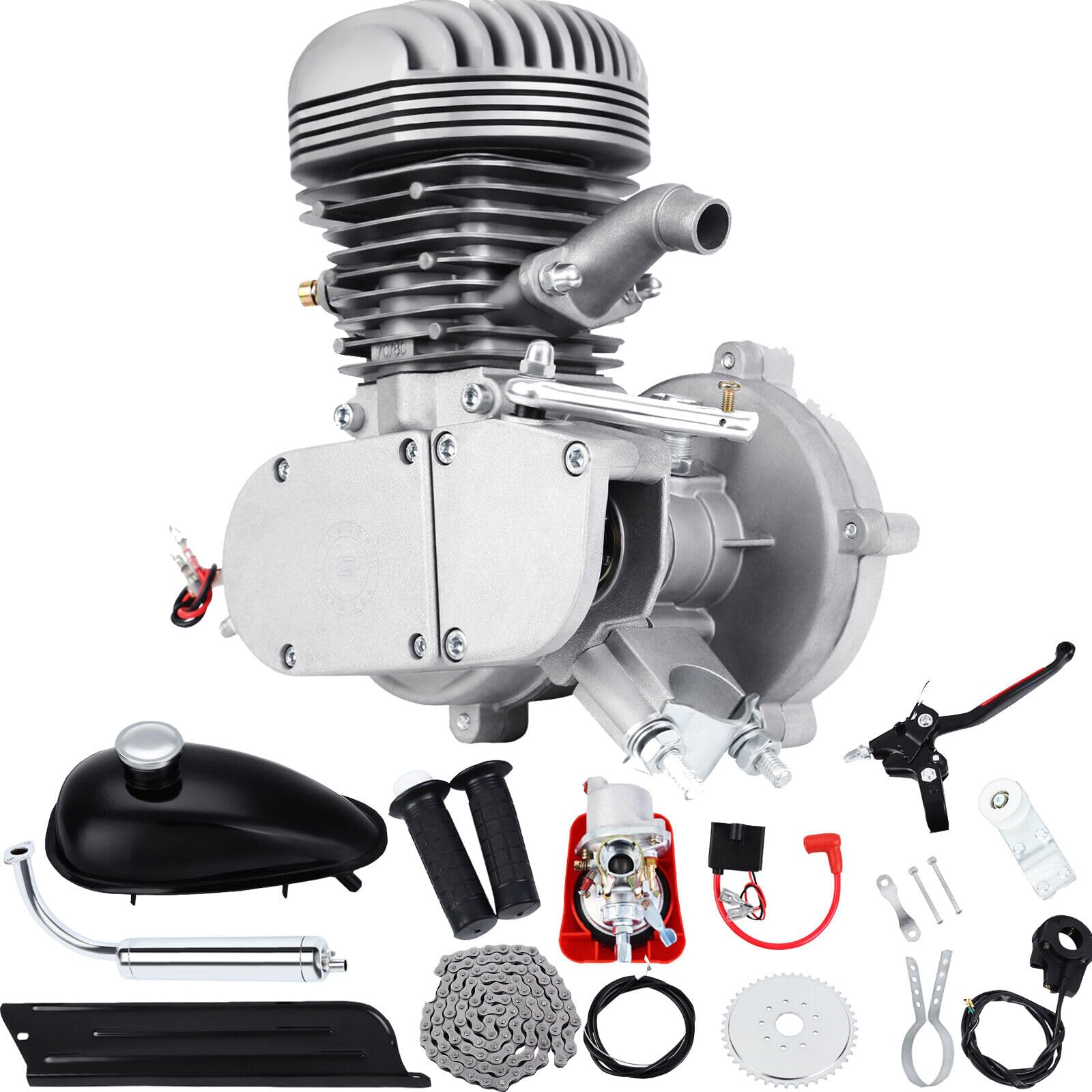
The H-YEEU 100cc two-stroke kit is the most budget-friendly option on this list, targeting entry-level builders who want to experiment with motorized bicycles without a large upfront investment. The engine claims a top speed of 60 km/h and a maximum load capacity of 200 kg, with a fuel consumption rate of 3 liters per 100 km. The oil mixing ratio follows the standard two-stroke break-in procedure — 16:1 for the first 500 miles, then 20:1 thereafter, with a summer blend of 18:1 recommended in hot climates.
The kit is designed to fit 26-inch and 28-inch bicycles, including mountain bikes, road bikes, and cruisers. The bundled throttle assembly uses a twist grip design, and the included chain and sprocket are standard dimensions. The carburetor is the same basic PZ-style unit found on most budget two-stroke kits, and the CDI ignition is sealed against moisture with a rubber boot. Buyers should anticipate replacing the spark plug, carburetor gaskets, and chain within the first 100 miles based on the component quality visible in the specifications.
The absence of customer reviews for this listing makes it a high-risk choice compared to the IMAYCC or Afranti kits with established feedback. The seller has a presence in the motorized bicycle space, but without verified owner reports, the actual power output and reliability remain unconfirmed. This kit is best suited for builders who are comfortable troubleshooting and upgrading components from the start.
What works
- Lowest upfront cost for entry into motorized cycling
- High claimed top speed for the displacement
- Broad bike compatibility with standard mounting
What doesn’t
- No customer reviews to validate claims
- Component quality likely requires immediate upgrades
- Higher fuel consumption than smaller displacement kits
Hardware & Specs Guide
Displacement vs Power Output
Four-stroke bicycle engine kits range from 49cc to 125cc, but power does not scale linearly with displacement. A 49cc 142F engine produces around 2.1 horsepower, while a 125cc unit pushes about 6.5 kW — roughly three times the displacement for three times the power. The real difference is torque delivery: the 125cc engine peaks at a lower rpm and delivers usable torque across a wider band, which makes it feel much stronger for hill climbing despite the modest horsepower-per-displacement ratio. Two-stroke kits in the same displacement range produce higher peak power (a 100cc two-stroke often matches a 125cc four-stroke) but require oil mixing and produce more vibration.
Mounting Plate and Frame Clearance
The mounting plate is the interface between the engine and the bicycle frame. Kits that use a stamped steel plate with universal slotted brackets offer wider compatibility but transmit more vibration to the frame. Thicker aluminum plates with rubber isolation grommets reduce vibration and prevent bolts from loosening over time. The critical measurement is the distance between the bottom bracket center and the top tube — four-stroke engines require at least 10 inches of clearance because the cylinder head sits higher than two-stroke units. For 125cc engines, the mounting footprint is larger and often requires drilling new holes or welding tabs onto the frame.
Clutch Systems and Transmission Types
Four-stroke bicycle kits use either a centrifugal clutch (semi-automatic) or a manual wet multi-plate clutch. Centrifugal clutches engage automatically as engine rpm increases — you simply twist the throttle and go, shifting gears with a foot lever if the engine has multiple gears. Manual clutches use a left-hand lever and allow the rider to feather the clutch for precise control during hill starts or technical terrain. Manual clutches handle sustained slip better than centrifugal units, which can overheat and glaze the friction material after repeated stop-and-go riding. Two-stroke kits universally use a single-speed centrifugal clutch with a manual engagement lever for starting.
Carburetor Tuning and Fuel Delivery
The PZ22 carburetor is the most common unit shipped with both four-stroke and two-stroke kits. It is a simple, float-bowl design with adjustable idle mixture screw and throttle stop screw. The factory jetting is typically optimized for sea-level operation at moderate temperatures, so builders at higher altitudes or extreme temperatures will need to re-jet the carburetor by replacing the main jet and pilot jet. NIBBI carburetors are the most popular aftermarket upgrade because they offer better atomization and more consistent idle quality. Fuel delivery relies on gravity feed from the tank, so the fuel line must descend continuously from the tank outlet to the carburetor inlet — no loops or uphill sections that could trap air.
FAQ
What is the difference between a four-stroke and two-stroke bicycle engine kit?
Will a four-stroke engine kit fit my existing bicycle frame?
How difficult is the installation of a four-stroke bicycle engine kit?
What maintenance does a four-stroke bicycle engine require?
Final Thoughts: The Verdict
For most buyers, the best four-stroke bicycle engine kit is the GDAE10 49cc 4-Stroke Kit because it offers the easiest bolt-on installation for standard V-frame bicycles with the quiet operation and pull-start convenience that make four-stroke ownership worthwhile. If you need more power for hill climbing or off-road use, the LIYUANJUN 125cc Engine provides genuine 125cc displacement and a 4-speed manual transmission, though it requires significant fabrication work. And for budget-conscious builders who want to learn the motorized bicycle hobby, the H-YEEU 100cc 2-Stroke Kit offers the lowest entry price, provided you are comfortable troubleshooting carburetor and ignition issues from day one.

Certification: BSc in Mechanical Engineering
Education: Mechanical engineer
Lives In: 539 W Commerce St, Dallas, TX 75208, USA
Md Amir is an auto mechanic student and writer with over half a decade of experience in the automotive field. He has worked with top automotive brands such as Lexus, Quantum, and also owns two automotive blogs autocarneed.com and taxiwiz.com.