Every engine relies on a constant flow of clean, debris-free air to maintain proper combustion, and the component responsible for that task often goes ignored until performance drops or a dashboard light appears. A dirty or low-quality filter chokes your engine, reduces fuel efficiency, and allows abrasive particles to accelerate wear on cylinders, rings, and bearings. The choice between a budget paper panel and a premium washable unit is not just about price—it is about how much long-term protection your engine actually receives.
I’m Amir — the founder and writer behind Four Wheel Ask. I have spent years analyzing automotive filtration technology, studying OEM specifications, and comparing owner-reported data to identify which filters deliver real performance gains versus those that merely look the part on paper.
This guide breaks down the critical differences in media construction, sealing design, and airflow capacity so you can make an informed purchase. After extensive spec analysis, I have identified what separates a quality best filtro de carro from one that compromises your engine’s long-term health.
How To Choose The Best Filtro De Carro
Selecting the right filter for your vehicle requires understanding three core variables: filter type, media quality, and vehicle-specific fitment. Engine air filters and cabin air filters serve entirely different purposes, and choosing the wrong one for the wrong application is a common mistake that leads to poor performance or no improvement at all. Below are the critical factors to evaluate before you buy.
Filter Type: Engine Air Versus Cabin Air
Engine air filters clean the air entering the intake system for combustion, directly impacting horsepower, fuel economy, and engine longevity. Cabin air filters clean the air entering the passenger compartment, affecting HVAC performance, allergy comfort, and odor control. Some vehicles use the same filter for both, but most treat them as separate service items. Confirm which type your vehicle requires by checking your owner manual or the existing filter part number before ordering.
Media Construction And Filtration Efficiency
Standard paper filters offer adequate protection at a low cost but clog faster and restrict airflow as they load with debris. Cotton gauze filters, like those from K&N, allow higher airflow and can be washed and reused, but require proper oiling to maintain filtration efficiency. Synthetic media filters strike a balance between flow and capture rate, while HEPA cabin filters trap microscopic allergens at the cost of slightly reduced HVAC airflow. Each media type has a specific use case, and matching it to your driving environment matters more than brand preference.
Fitment Verification And OEM Cross-Reference
Even experienced buyers sometimes overlook the importance of exact dimensional fit. A filter that is too short, too thin, or has the wrong gasket shape will allow unfiltered air to bypass the media entirely, defeating the purpose of the replacement. Always cross-reference the OEM part number with the aftermarket equivalent, and use online fitment tools such as Amazon’s My Garage feature. Filters that list multiple OEM replacement numbers typically offer broader compatibility, but you must still verify that your specific year, make, and model appears on the compatibility list.
Quick Comparison
On smaller screens, swipe sideways to see the full table.
| Model | Category | Best For | Key Spec | Amazon |
|---|---|---|---|---|
| K&N 33-5045 | Engine Air Filter | Lifetime washable performance | Cotton gauze, 75k-mile cleaning interval | Amazon |
| PureFlow HEPA PC4211HX | HEPA Cabin Filter | Allergy and odor filtration | 99.97% efficiency, activated charcoal layer | Amazon |
| K&N 33-5050 | Engine Air Filter | Hyundai and Kia performance | Cotton gauze, 75k-mile cleaning interval | Amazon |
| Toyota 17801-0T030 | Engine Air Filter | OEM direct-fit replacement | Paper media, genuine Toyota part | Amazon |
| Kyostar 6″ Universal | Cone Intake Filter | Custom intake builds | 6-inch flange, washable, three-layer media | Amazon |
| PureFlow Cabin PC99594X | Cabin Filter | Hyundai and Kia cabin freshness | Four-layer filtration, activated charcoal | Amazon |
| Spearhead Odor Defense BE-820 | Cabin Filter | Extended-life cabin protection | Coconut carbon, 15k-mile service life | Amazon |
| EPAuto GP413 | Engine Air Filter | Acura RDX owners | Rigid panel, 12k-mile replacement cycle | Amazon |
| Capume JM7050 | Engine Air Filter | Toyota and Lexus hybrids | Hybrid-compatible, multi-OEM cross-ref | Amazon |
| A-Premium APEAF1537 | Engine Air Filter | Nissan and Subaru owners | High-performance media, 11.38 x 7.01 inches | Amazon |
| Motorcraft FA1912A | Engine Air Filter | Universal replacement duty | OEM-grade paper, 10.2 x 2.36 x 7.68 inches | Amazon |
In‑Depth Reviews
1. K&N High-Flow Original Lifetime Engine Air Filter 33-5045
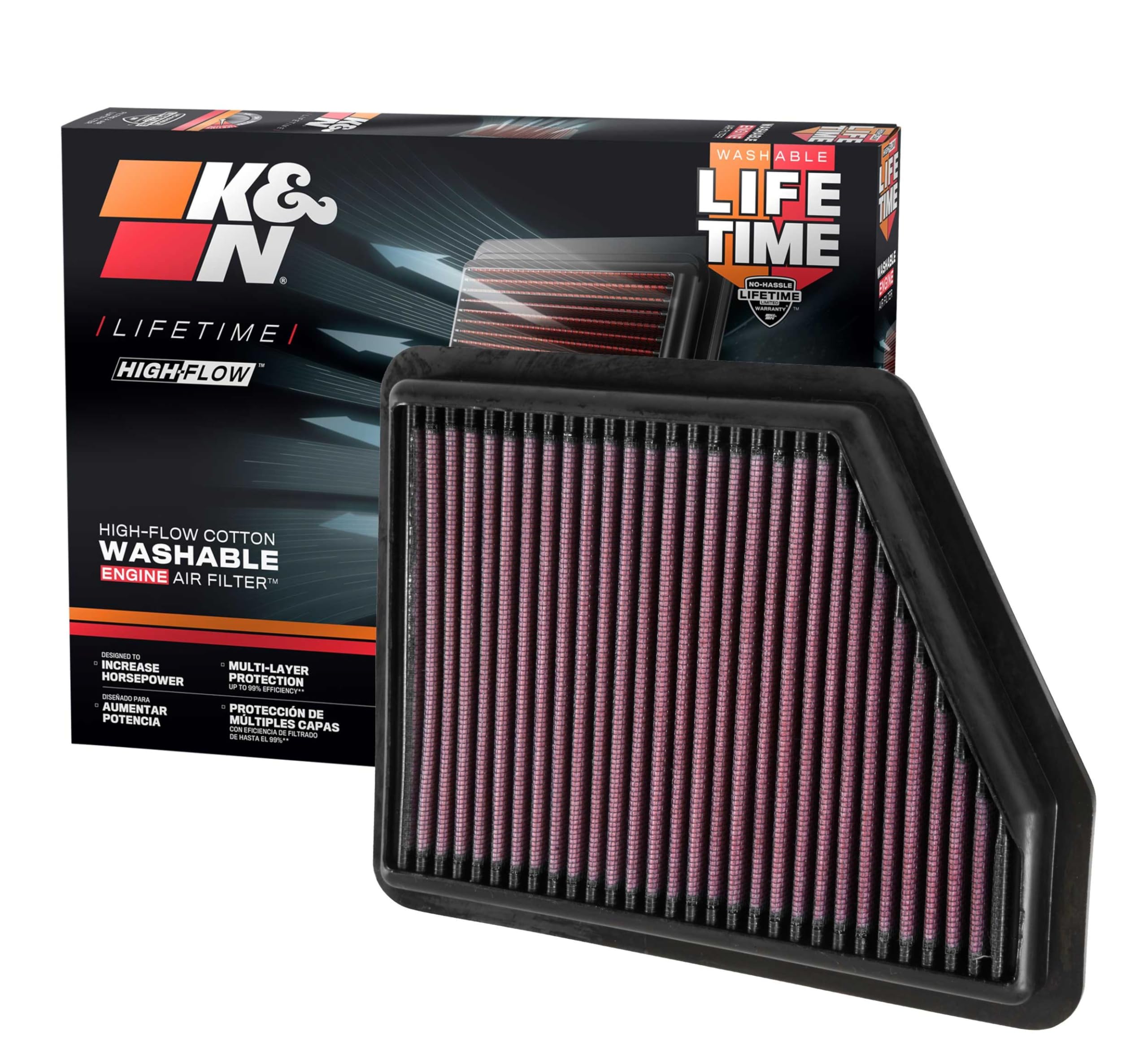
K&N has built a decades-long reputation on its oiled cotton gauze media design that balances high airflow with effective particulate capture. The 33-5045 is engineered specifically for 2016–2025 Honda Civic and HR-V models, dropping directly into the factory air box without any modification. Owner data consistently shows throttle response improvements after installation, though the magnitude varies by driving conditions and engine tune.
The four-layer construction uses tack-treated cotton gauze sandwiched between wire mesh to maintain structural integrity under high intake vacuum. K&N recommends cleaning every 75,000 miles under normal highway driving, which translates to roughly once every five years for the average driver. This dramatically reduces waste compared to disposable paper filters that require replacement every 12,000 to 15,000 miles.
The trade-off involves the required re-oiling after each cleaning. Improper oil application can lead to mass airflow sensor contamination if excess oil migrates downstream. Owner reports on forums indicate that careful adherence to the included instructions eliminates this risk, but it remains a consideration for those who prefer zero-maintenance solutions. The limited lifetime warranty adds long-term value for buyers willing to perform periodic maintenance.
What works
- Washable and reusable for the vehicle’s lifetime
- Noticeable throttle response improvement reported by owners
- Reduces landfill waste from disposable filters
- Backed by a no-hassle limited lifetime warranty
What doesn’t
- Requires periodic cleaning and careful re-oiling
- Higher upfront cost compared to paper filters
- Improper oiling can risk MAF sensor contamination
- Limited vehicle fitment for this specific part number
2. PureFlow HEPA Cabin Air Filter PC4211HX
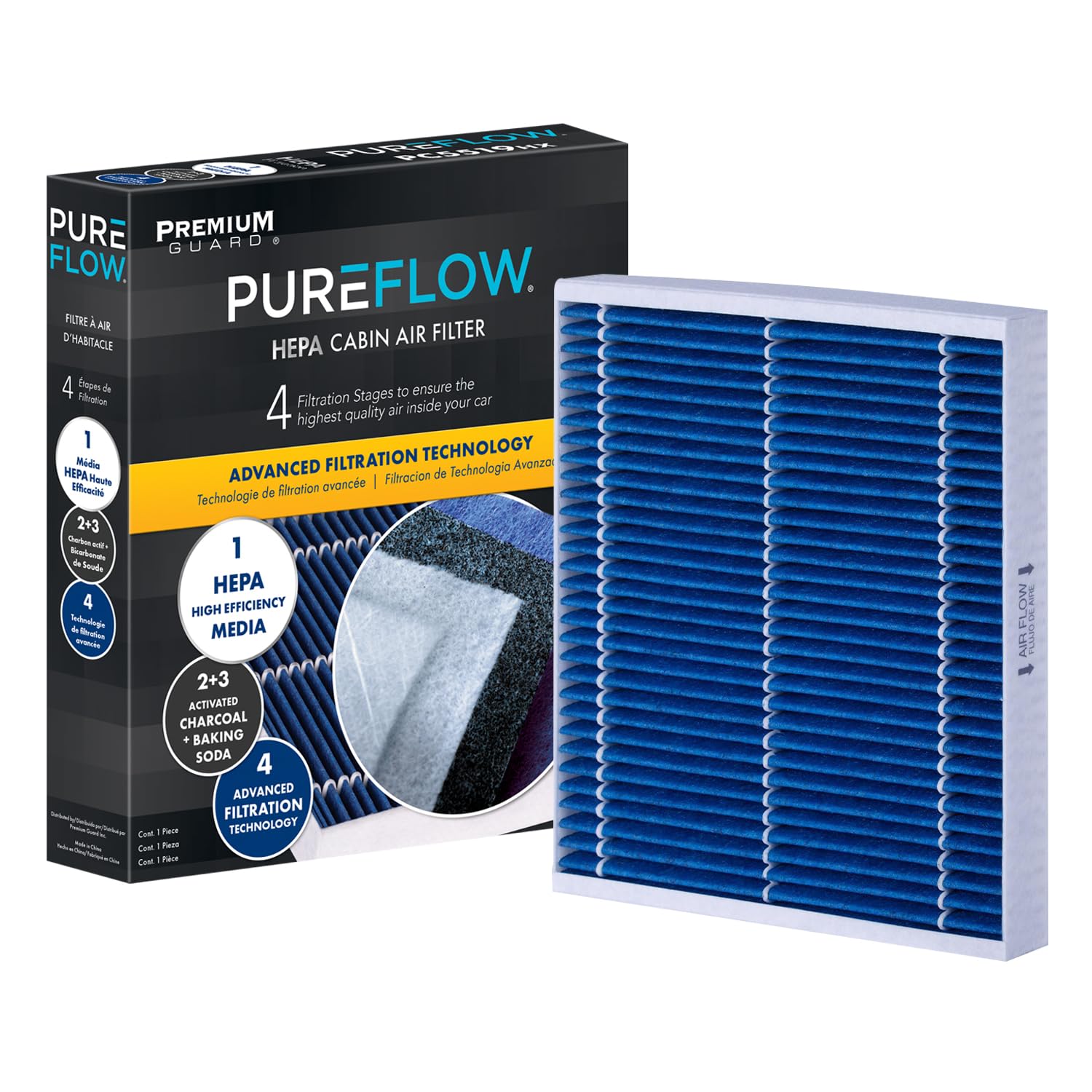
PureFlow’s HEPA cabin filter targets drivers who prioritize passenger air quality above all else. The PC4211HX uses a four-layer filtration stack that includes a true HEPA media layer rated at 99.97% capture efficiency for particles as small as 0.3 microns. This makes it a strong contender for owners who suffer from seasonal allergies or frequently drive in areas with high particulate pollution.
The integrated activated charcoal layer, infused with baking soda, adsorbs gaseous contaminants such as sulfur dioxide, carbon monoxide, and volatile organic compounds that standard paper cabin filters cannot trap. Owner feedback across Chevrolet, GMC, Cadillac, and Buick forums highlights a noticeable reduction in exhaust fume intrusion during stop-and-go traffic. The filter is designed to last roughly 12,000 miles under normal conditions.
One caveat with HEPA cabin filters is that the dense media can slightly reduce HVAC airflow, particularly at lower fan speeds. Some owners report that the defroster performance on max setting still clears fog quickly, but the reduced flow is perceptible on the lowest fan setting. Fitment verification is critical because the PC4211HX covers a broad range of GM platforms from 2016 onward, and the listed compatibility includes Silverado, Equinox, Malibu, Escalade, and many others.
What works
- True HEPA media captures 99.97% of microscopic allergens
- Activated charcoal with baking soda neutralizes odors effectively
- Broad GM platform compatibility across multiple brands
- Noticeable improvement in cabin air quality for allergy sufferers
What doesn’t
- HEPA media can slightly restrict HVAC airflow at low fan speeds
- Higher cost per filter compared to standard paper cabin filters
- Requires precise fitment verification for non-GM vehicles
- Shorter service interval than some carbon-only cabin filters
3. K&N High-Flow Original Lifetime Engine Air Filter 33-5050

The K&N 33-5050 is the sibling to the 33-5045 but tailored for Hyundai and Kia platforms including the Elantra, Kona, Veloster, Forte, Seltos, Soul, and several others from the 2017–2025 model years. The same oiled cotton gauze construction and 75,000-mile cleaning cycle apply, making it a direct competitor to OEM paper filters that must be replaced multiple times over the same mileage interval.
Owner reports across Hyundai and Kia owner clubs indicate that the filter produces a slightly more audible intake growl under hard acceleration, which some enthusiasts appreciate as a side benefit of the increased airflow. The filter is pre-oiled from the factory and ready to install out of the box, so no preparation work is needed before dropping it into the factory air box. The included decals and warranty card are standard K&N practice.
The same maintenance caveats apply as with the 33-5045: proper cleaning and re-oiling are essential to avoid MAF sensor issues. Owners who live in dusty or off-road conditions may need to clean the filter more frequently than the 75,000-mile guideline. The limited lifetime warranty covers manufacturing defects but does not cover damage from improper maintenance, so keeping the cleaning kit on hand is part of the ownership commitment.
What works
- Designed specifically for Hyundai and Kia 2.0L and 1.6T engines
- Washable construction eliminates recurring replacement costs
- Produced in the USA with consistent quality control
- Modest intake sound enhancement under heavy throttle
What doesn’t
- Requires periodic maintenance with K&N cleaning kit
- Oiling errors can cause MAF sensor contamination
- Premium pricing compared to disposable paper filters
- Not compatible with diesel or certain turbo configurations
4. Genuine Toyota 17801-0T030 Air Filter

Genuine Toyota parts carry a level of quality assurance that aftermarket brands must work to match. The 17801-0T030 is the factory-specified air filter for the Corolla, Corolla iM, Matrix, xD, and Yaris models, using media that meets Toyota’s strict contamination capture standards. The paper media is pleated to maximize surface area within the compact housing dimensions of 9.9 by 7.2 by 2.3 inches.
Owner feedback from Toyota forums emphasizes the peace of mind that comes with using an OEM part. There is no guesswork about fitment, no concerns about gasket sealing, and no risk of incompatible media causing irregular airflow readings that might trigger a check engine light. The filter is designed to last the standard 12,000 to 15,000-mile replacement interval recommended by Toyota.
The trade-off is that this is a disposable paper filter with no option for cleaning or reuse. Over the life of a vehicle driven 150,000 miles, the owner will purchase roughly ten to twelve replacement filters. Aftermarket high-flow options may offer better throttle response, but they will not match the exact filtration curve that Toyota engineers validated during vehicle development. For owners who prioritize warranty compliance and proven reliability, the OEM choice remains the baseline benchmark.
What works
- Exact OEM fitment with zero modification required
- Validated filtration curve for Corolla and Matrix engines
- No risk of MAF sensor issues from aftermarket oil
- Backed by Toyota’s quality assurance standards
What doesn’t
- Disposable design requires frequent replacement
- No improvement in airflow or throttle response
- Higher per-filter cost than comparable aftermarket paper filters
- Limited vehicle compatibility outside specified Toyota models
5. Kyostar Universal 6-Inch High-Flow Air Filter

The Kyostar universal cone filter targets the custom intake market where factory air box dimensions do not apply. The 6-inch flange diameter and 7-inch filter height make it compatible with a wide range of aftermarket intake tubes, and the red anodized finish adds an aesthetic element for engine bay enthusiasts. The three-layer media consists of an oiled synthetic outer layer, a cotton gauze middle layer, and a polyurethane support structure.
Owner reviews on automotive forums indicate that this filter performs comparably to name-brand universal cones at a more approachable price point. The washable and reusable design follows the same maintenance philosophy as K&N but at a lower initial investment. The included clamp-on fitting simplifies installation for DIY builders who are fabricating their own intake systems.
The universal nature of this filter means that no vehicle-specific fitment data is provided, placing the burden on the buyer to verify flange diameter, clearance, and intake tube compatibility. The filter is not CARB-exempt in California, which is a consideration for owners in states that follow California emissions regulations. The one-year warranty is shorter than the lifetime coverage offered by premium brands, reflecting the budget-conscious positioning of the product.
What works
- Washable and reusable construction reduces long-term waste
- Universal 6-inch flange fits many aftermarket intake tubes
- Noticeably lower price point than established brand cones
- Three-layer media provides solid filtration for custom builds
What doesn’t
- No vehicle-specific fitment data provided by manufacturer
- Not CARB-exempt for emissions-regulated states
- One-year warranty is shorter than lifetime alternatives
- Requires professional guidance for proper intake system integration
6. PureFlow Cabin Air Filter PC99594X
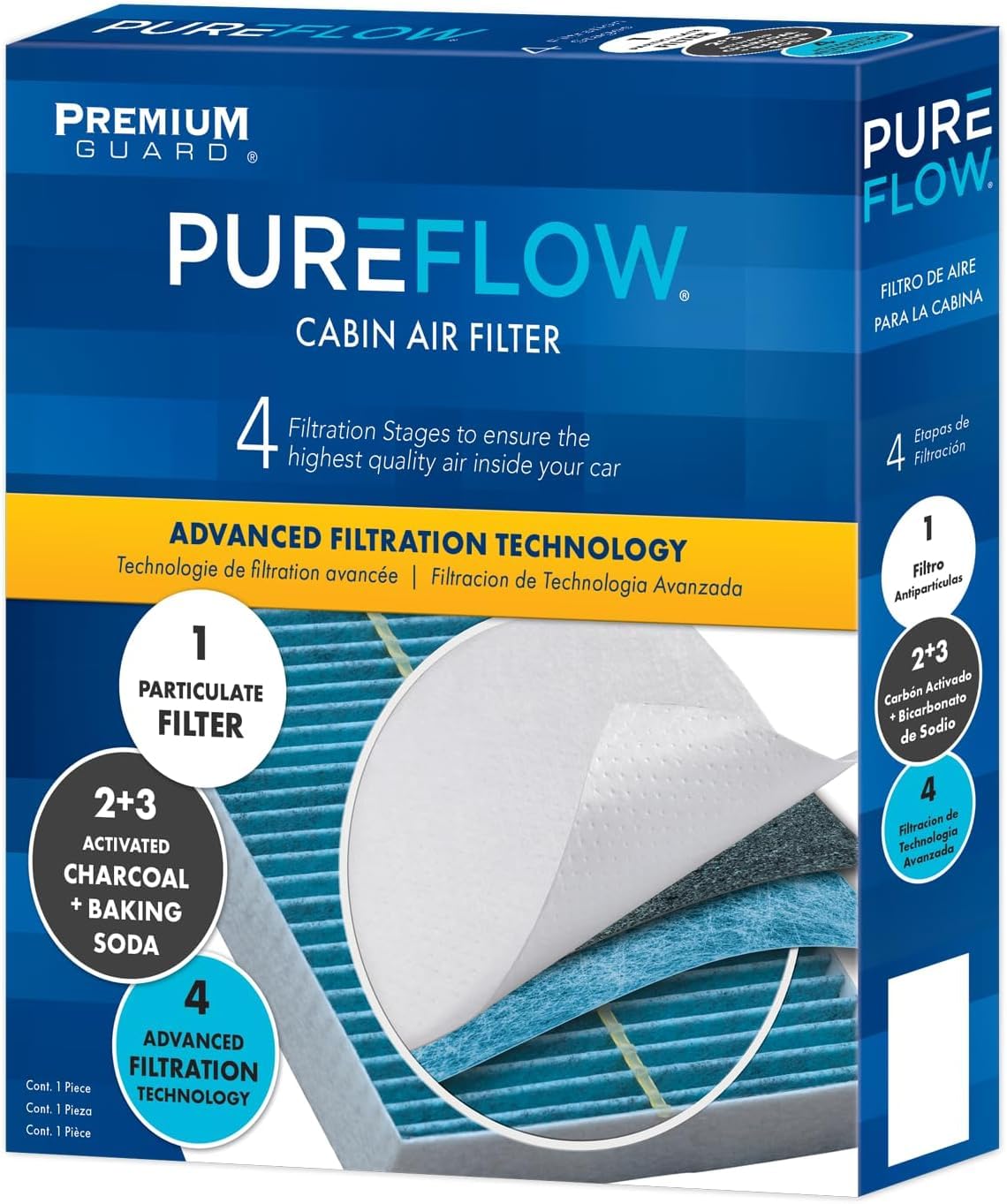
PureFlow’s PC99594X brings the same four-layer filtration philosophy as the HEPA version but without the dense HEPA media layer, allowing higher HVAC airflow while still providing activated charcoal odor absorption. This filter is specifically designed for late-model Hyundai and Kia vehicles including the Tucson, Elantra, Santa Fe, Sportage, Sorento, K5, Santa Cruz, and Ioniq 5 from the 2021–2025 model years.
The filtration stack includes a particulate pre-filter layer, an electrostatic media layer for fine particle capture, an activated charcoal layer infused with baking soda for odor adsorption, and a final support layer. Owner feedback highlights the effectiveness of the baking soda infusion in neutralizing pet odors and smoke smells that standard carbon filters struggle to eliminate completely.
Installation follows the standard cabin filter replacement procedure found in most Hyundai and Kia vehicles, typically accessed behind the glove box. The filter dimensions of 8.9 by 8.23 by 1.19 inches match the OEM specifications for the listed models. One owner-reported consideration is that the filter runs slightly thicker than some OEM paper equivalents, requiring careful compression during installation to avoid bending the frame.
What works
- Four-layer design balances airflow with odor capture
- Baking soda infusion excels at neutralizing stubborn odors
- Compatible with popular Hyundai and Kia platforms
- Straightforward DIY glove-box replacement procedure
What doesn’t
- Slightly thicker media can make installation tight
- No HEPA rating for microscopic allergen capture
- Limited to Hyundai and Kia vehicle applications
- Shorter service life than premium washable alternatives
7. Spearhead Odor Defense Breathe Easy Cabin Filter BE-820
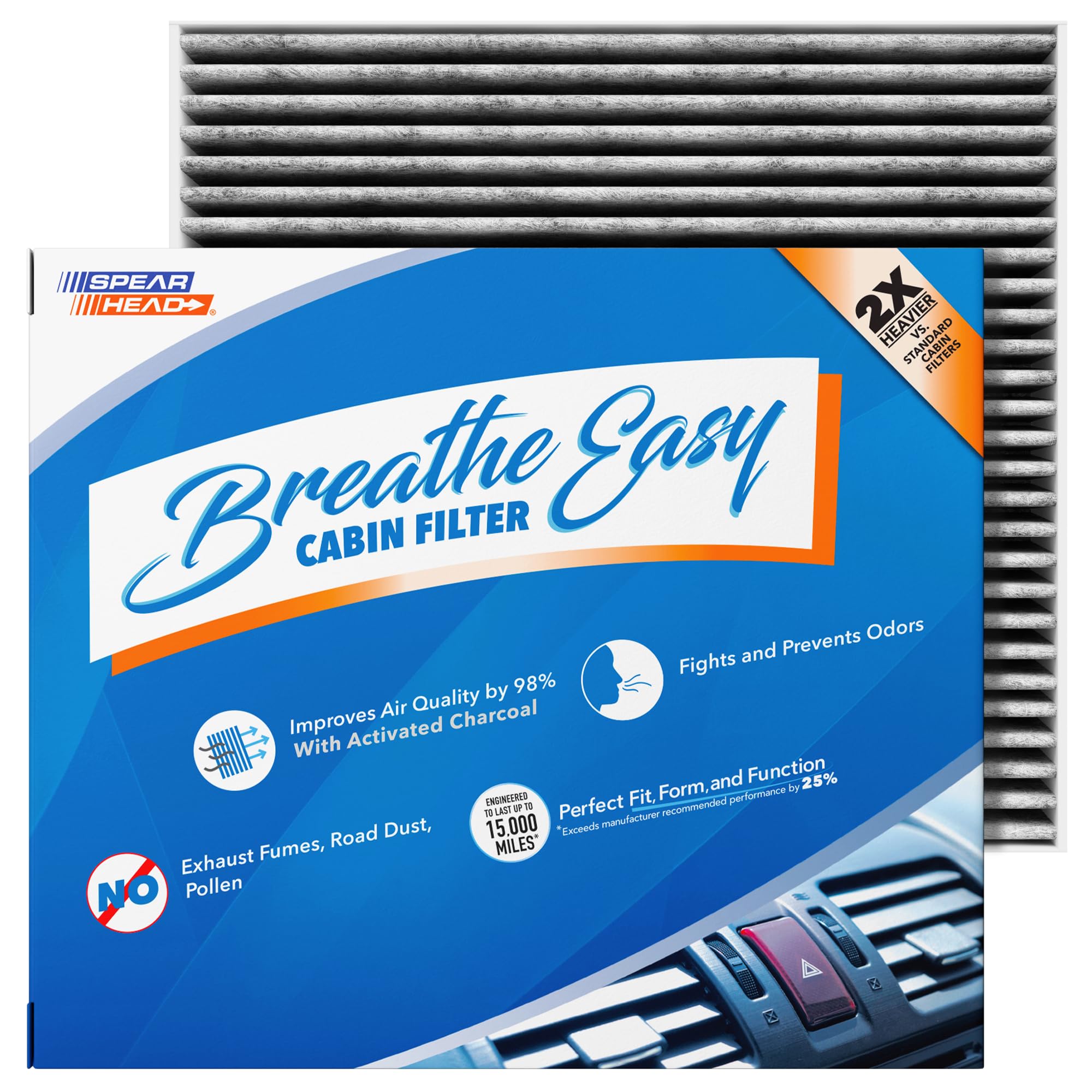
Spearhead positions the BE-820 as a longer-lasting alternative to standard cabin filters, using coconut shell activated carbon for odor adsorption and precision-woven electrostatic media for particulate capture. The manufacturer claims up to 25 percent longer service life compared to standard 12,000-mile filters, targeting the 15,000-mile mark under normal driving conditions. This filter covers the same broad range of Hyundai and Kia vehicles as the PureFlow PC99594X, including the Ioniq 5, Ioniq 6, EV6, EV9, and the entire K5 and Sportage lineup.
The media weight is advertised as twice as heavy as standard cabin filters, which translates to more carbon mass available for odor adsorption before saturation. Owner reports from EV owner forums note that the filter effectively reduces the musty smells that can develop in climate control systems that are not subjected to engine heat cycling. The included installation manual simplifies the DIY process for first-time cabin filter changers.
The heavier media does create slightly more resistance to airflow, though most owners report that the difference is negligible on the higher fan speed settings. The coconut shell carbon is a renewable resource, which appeals to environmentally conscious buyers. One limitation is that the filter is not washable or reusable, so the longer service interval is the primary value differentiator rather than any long-term cost savings from reusability.
What works
- Coconut shell carbon provides effective odor neutralization
- Extended 15,000-mile service interval reduces replacement frequency
- Dual-density media captures fine particles and gases
- Comprehensive fitment for latest Hyundai and Kia EVs and ICE models
What doesn’t
- Heavier media can slightly restrict low-speed HVAC airflow
- Not washable or reusable after the service interval
- No HEPA certification for allergen-specific filtration
- Limited to Hyundai and Kia applications only
8. EPAuto GP413 Engine Air Filter
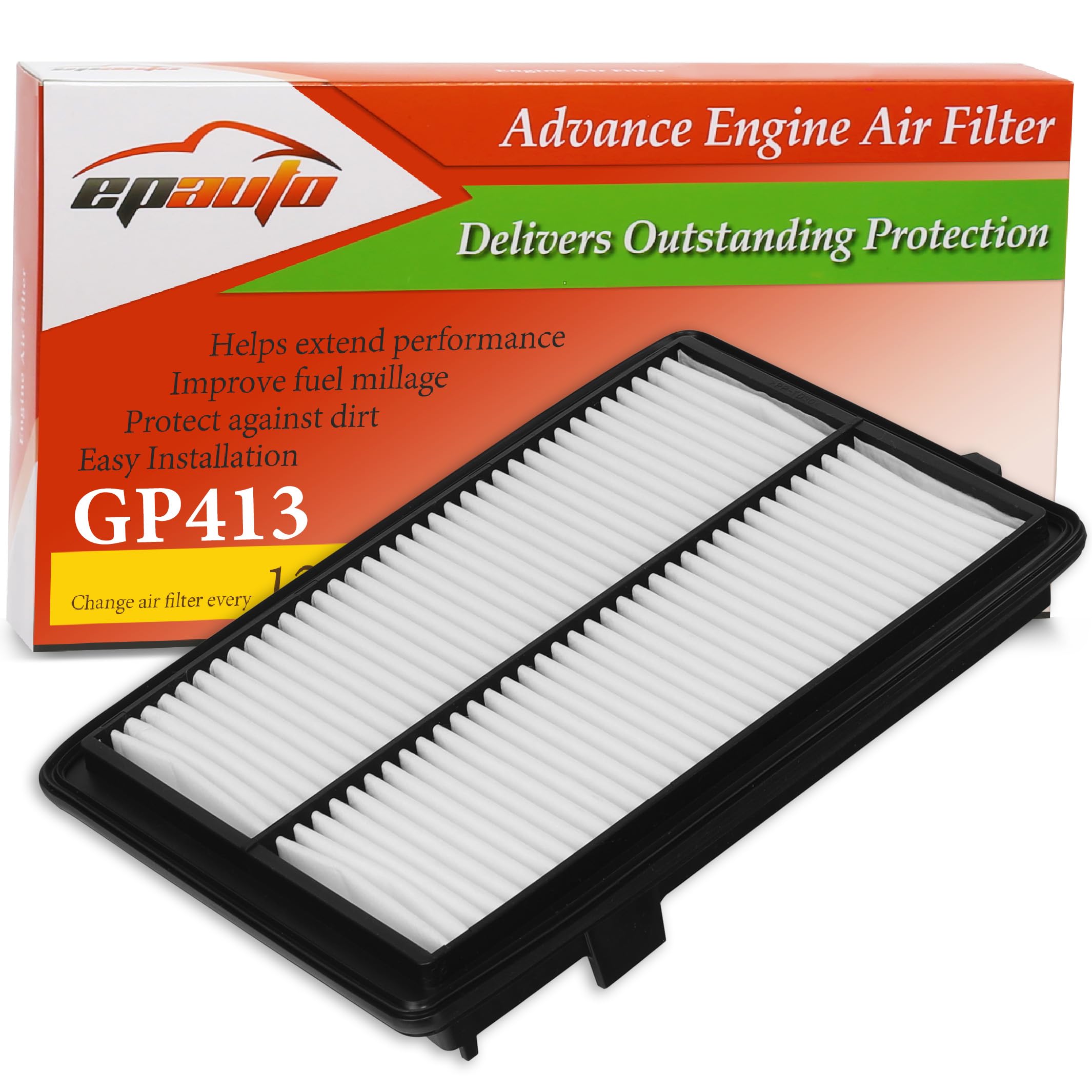
EPAuto has established a reputation for producing reliable replacement filters that meet or exceed OEM specifications at a fraction of the dealership cost. The GP413 is a rigid panel filter designed exclusively for the Acura RDX from the 2013 to 2018 model years, cross-referencing to the FRAM CA11413 and Acura genuine part 17220-R8A-A01. The dimensions of 12.13 by 7.91 by 2.09 inches match the factory housing perfectly.
Owner reviews on Acura forums give this filter high marks for fitment precision and consistent build quality. The pleated paper media provides the standard 12,000-mile replacement cycle recommended for the RDX 2.0T and 3.5L V6 engines. EPAuto recommends pairing this engine air filter with their CP134 cabin air filter for a complete dual-filter service that addresses both combustion air and cabin air quality in a single maintenance session.
The filter uses a rigid perimeter frame that prevents flexing during installation, ensuring a consistent seal around the entire perimeter. Some owners have noted that the gasket material feels slightly less dense than the OEM gasket, but no widespread reports of seal failures or unfiltered air bypass have surfaced in owner communities. The value proposition is straightforward: OEM-equivalent protection at a price point that makes frequent replacement economically painless.
What works
- Precise fitment for Acura RDX 2013–2018 models
- Rigid frame prevents installation flexing and seal gaps
- OEM-equivalent filtration at a budget-friendly price point
- Straightforward 12,000-mile replacement schedule
What doesn’t
- Disposable paper media with no reuse option
- Gasket density feels slightly lighter than OEM
- Limited to Acura RDX applications only
- No performance gain over factory paper specification
9. Capume Engine Air Filter JM7050

Capume designed the JM7050 specifically for the growing segment of Toyota and Lexus hybrid vehicles, as well as select Subaru models. The compatibility list includes the Camry Hybrid, Avalon Hybrid, RAV4 Hybrid, Highlander Hybrid, Sienna, Venza, C-HR, Corolla, and the Lexus ES300h, NX350h, RX350h, and UX200, spanning model years from 2018 to 2025. The cross-reference list covers CA12289, AF5286, and multiple Toyota and Lexus OEM part numbers.
Owner feedback from hybrid owner groups emphasizes that the filter dimensions of 6.02 by 10.63 by 1.58 inches match the unique form factor required by Toyota’s hybrid engine bays, which often have tighter packaging constraints than their non-hybrid counterparts. The paper media uses a dense pleating pattern that maximizes surface area within the compact housing. The recommended 12,000-mile replacement interval aligns with Toyota hybrid maintenance schedules.
The manufacturer explicitly notes that this filter does not fit RAV4 XLE models, which use a different air box design, so buyers must verify their specific trim level before purchasing. The 90-day warranty is shorter than industry average, which reflects the budget positioning of the product. Some owners on Toyota forums have suggested that the filter frame feels slightly less rigid than the OEM equivalent, though no functional issues have been widely reported.
What works
- Specifically designed for Toyota and Lexus hybrid applications
- Cross-references multiple OEM part numbers for broad coverage
- Dense pleating maximizes filtration area in compact housings
- Budget-friendly price for hybrid vehicle owners
What doesn’t
- Does not fit RAV4 XLE trim level
- Frame rigidity feels lighter than OEM according to some owners
- 90-day warranty is shorter than most competitors
- Disposable design with no cleaning or reuse option
10. A-Premium High-Performance Engine Air Filter APEAF1537
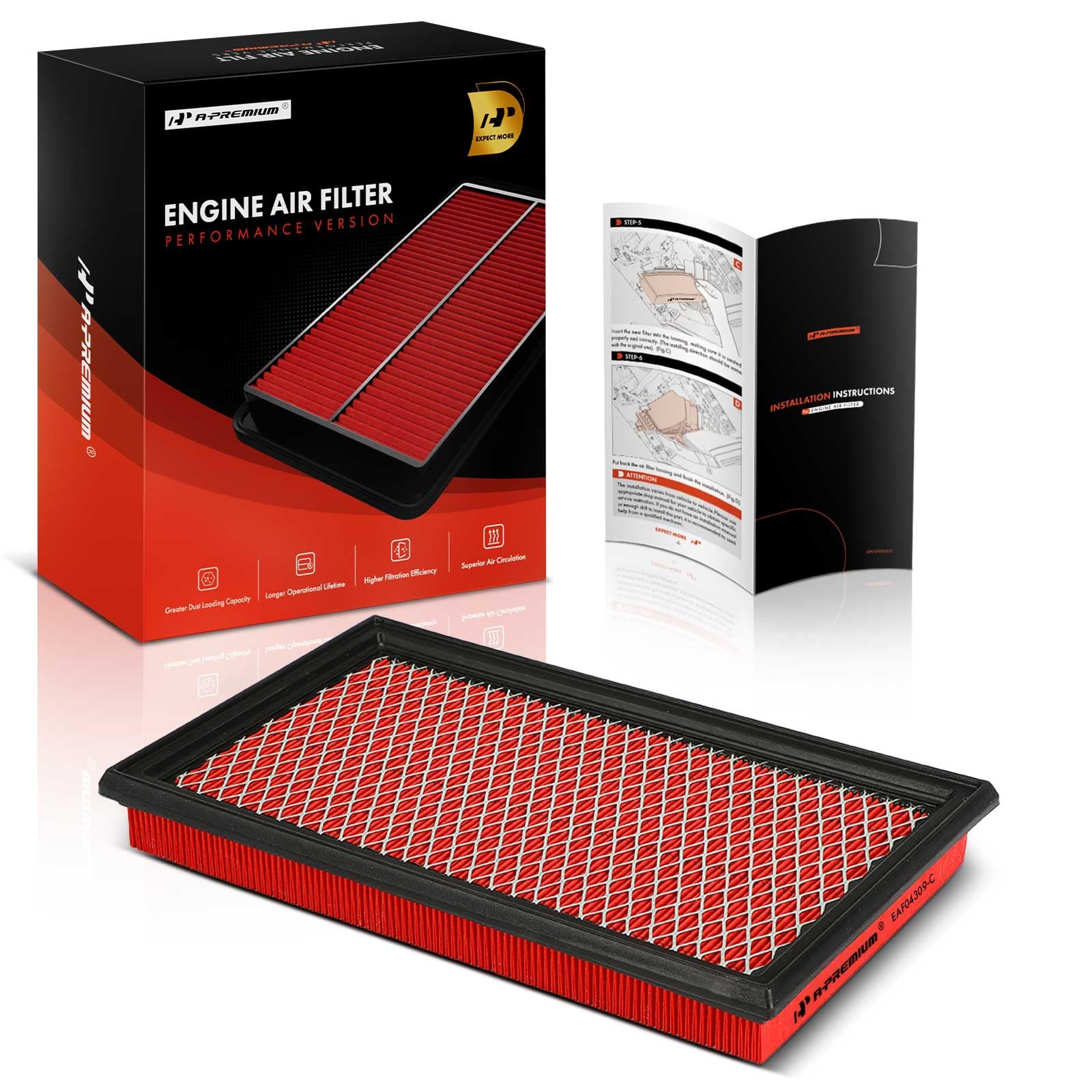
A-Premium’s APEAF1537 offers one of the widest vehicle compatibility ranges in this comparison, covering Datsun, Infiniti, Nissan, Subaru, Saab, and Isuzu models across multiple decades. The filter cross-references to CA4309, SA4309, AF293, and a long list of OEM numbers including multiple Nissan and Subaru part codes. The rectangular dimensions of 11.38 by 7.01 by 1.61 inches fit many Nissan and Subaru air boxes from the 1990s through the 2020s.
The manufacturer emphasizes extended service intervals compared to standard filters, achieved through high-performance filtering materials that resist clogging over longer periods. Owner reviews on Nissan forums note that the filter fits well in the Altima, Maxima, Pathfinder, and Sentra applications, with the gasket providing a consistent seal around the housing perimeter. The one-year unlimited mileage quality guarantee covers the cost of the filter itself but explicitly excludes labor and related repair expenses.
The filter is not washable or reusable, meaning it must be discarded and replaced at the end of its service life. The broad compatibility is both a strength and a potential weakness: the filter covers so many different vehicle models that it may not match the exact media density specifications that a particular Nissan or Subaru engine was originally designed to use. Owners who prioritize exact OEM specifications may prefer a model-specific filter rather than a multi-application unit.
What works
- Exceptional cross-vehicle compatibility across Nissan, Subaru, and Infiniti
- High-performance materials extend service intervals
- One-year warranty provides basic purchase protection
- Easy drop-in installation with consistent gasket seal
What doesn’t
- Multi-application design may not match exact OEM media specs
- Not washable or reusable
- Warranty excludes labor and related repair costs
- Broad fitment requires careful vehicle-specific verification
11. Motorcraft Air Cleaner Element FA1912A
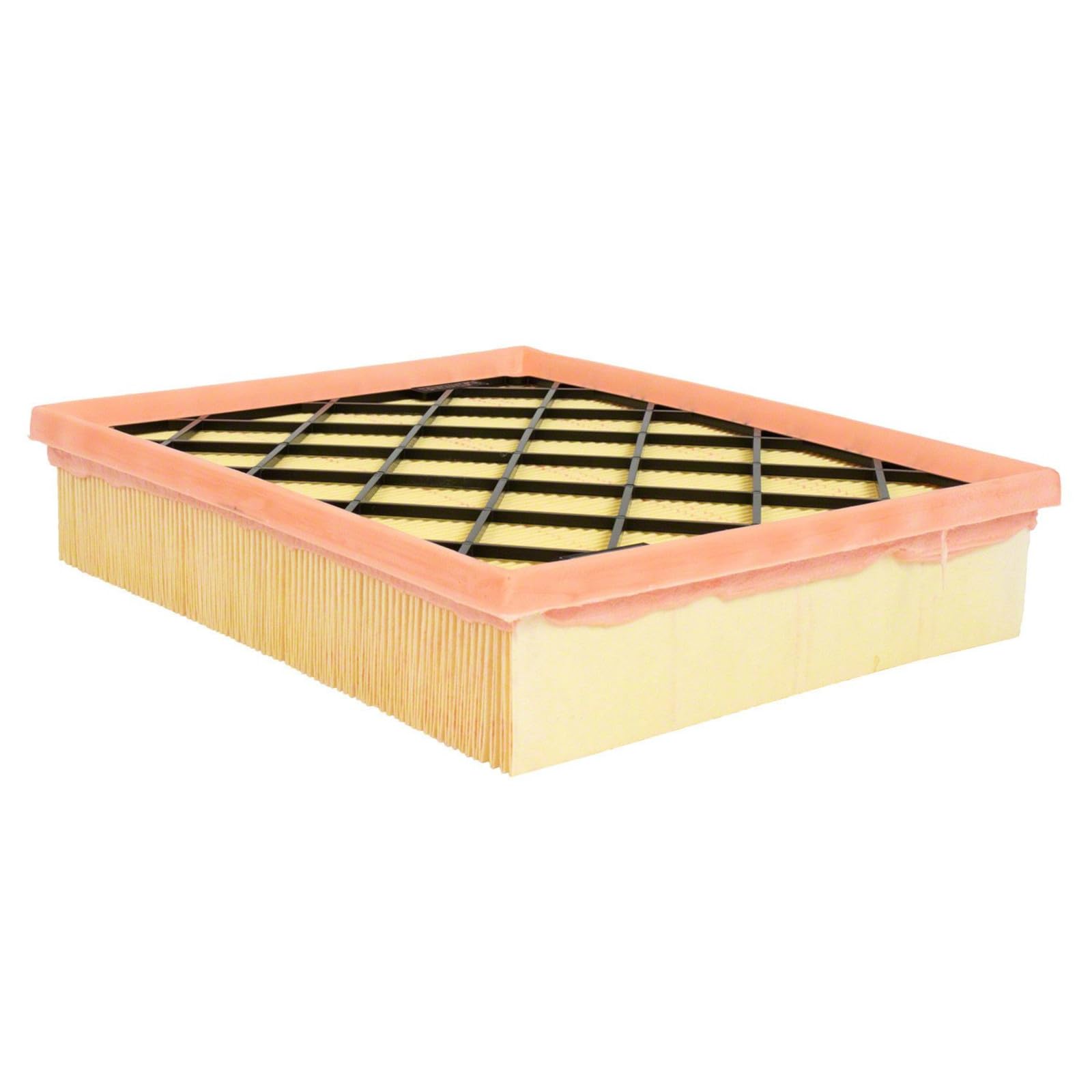
Motorcraft stands as the official original equipment supplier for Ford and Lincoln vehicles, and the FA1912A reflects that engineering pedigree even though it is marketed with a universal fitment designation. The filter dimensions of 10.2 by 2.36 by 7.68 inches provide a rectangular profile that fits a range of Ford, Lincoln, and Mercury applications from the 1990s through the 2010s. The paper media is pleated and bonded to a rigid frame that resists warping under high humidity conditions.
Owner feedback from Ford truck and sedan forums consistently praises the build quality and consistent sealing surface of Motorcraft filters. The universal fitment designation means that some owners have used this filter in non-Ford applications where the dimensional match works, but the primary use case remains Ford and Lincoln platforms. The filter is sourced from Mexico, where Motorcraft maintains dedicated production lines for its filtration products.
The FA1912A is a straightforward disposable paper filter with no washable or high-flow capabilities. It is designed to meet the original engineering specifications that Ford validated for its engines, which means it will not increase horsepower or throttle response beyond the factory baseline. For owners of older Ford vehicles who want a reliable, no-surprises replacement that matches what the dealer would install, the Motorcraft brand carries significant trust equity.
What works
- Motorcraft quality assurance as Ford OEM supplier
- Rigid frame resists warping in humid conditions
- Consistent sealing surface for reliable installation
- Proven compatibility with multiple Ford and Lincoln platforms
What doesn’t
- Disposable paper design with no reuse option
- Universal fitment requires dimensional verification
- No performance improvement over standard OEM specification
- Limited aftermarket support documentation
Hardware & Specs Guide
Filter Media Types
The filtration medium determines both capture efficiency and airflow restriction. Standard paper media, used in most OEM and budget replacement filters, traps particles through random fiber entanglement and is disposable after 12,000 to 15,000 miles. Cotton gauze media, used by K&N and Kyostar, relies on oil adhesion to capture particles while allowing higher airflow, and can be washed and reused for the life of the vehicle. Synthetic blended media, found in PureFlow and Spearhead filters, combines electrostatic attraction with mechanical capture for improved efficiency without the maintenance requirements of oiled gauze. HEPA media, used in the PureFlow PC4211HX, uses a dense mat of microfibers to achieve 99.97 percent capture of 0.3-micron particles at the cost of increased airflow resistance.
MERV Ratings And Filtration Efficiency
MERV, or Minimum Efficiency Reporting Value, quantifies a filter’s ability to capture particles in specific size ranges. Standard automotive engine air filters typically operate in the MERV 4 to MERV 8 range, capturing particles larger than 3 microns while allowing sufficient airflow for combustion. Cabin air filters with activated carbon can reach MERV 8 to MERV 11, and HEPA automotive filters achieve MERV 16 or higher. Higher MERV ratings correlate with better allergen and particulate capture but also with higher airflow restriction, which can reduce HVAC system efficiency in cabin applications or reduce volumetric efficiency in engine intake applications. Matching the MERV rating to your specific driving environment matters more than chasing the highest available number.
Proper Fitment And Vehicle Compatibility
Dimensional fitment is the single most common point of failure in aftermarket filter purchases. A filter that is too small by even a few millimeters will allow unfiltered air to bypass the media, carrying abrasive dust directly into the engine intake or cabin ventilation system. The critical dimensions are length, width, height, and gasket profile. Many filters list multiple OEM cross-reference numbers, but these should be verified against your vehicle’s factory part number rather than treated as guarantees. Tools such as Amazon’s My Garage feature allow you to enter your vehicle’s year, make, and model to filter compatible products, but even these databases occasionally contain errors. Always compare the listed dimensions against your old filter before finalizing the purchase.
Replacement Intervals And Maintenance
Manufacturer replacement recommendations vary widely based on media type and driving conditions. Standard paper engine air filters should be replaced every 12,000 to 15,000 miles, or more frequently in dusty or off-road environments. Washable cotton gauze filters can extend cleaning intervals to 75,000 miles under normal highway driving but require inspection every 25,000 miles to verify that the oil coating remains intact. Cabin air filters with activated carbon should be replaced every 12,000 to 15,000 miles because the carbon layer becomes saturated with adsorbed gases and loses effectiveness even if the particulate media is not fully loaded. HEPA cabin filters follow similar replacement schedules but may require more frequent changes in high-pollution urban environments where the media loads with fine particulate matter more quickly.
FAQ
How often should I replace my car’s air filter?
What is the difference between an engine air filter and a cabin air filter?
Are washable air filters worth the higher upfront cost?
Can a dirty air filter cause my check engine light to come on?
Final Thoughts: The Verdict
For most buyers, the best filtro de carro winner is the K&N 33-5045 because it combines proven cotton gauze filtration, a lifetime washable design, and genuine throttle response improvements for Honda Civic and HR-V owners. If you want HEPA-grade cabin air filtration with true 99.97 percent particle capture, grab the PureFlow PC4211HX. And for a budget-friendly disposable engine filter that covers Nissan, Subaru, and Infiniti models with broad compatibility, nothing beats the A-Premium APEAF1537 for straightforward value.

Certification: BSc in Mechanical Engineering
Education: Mechanical engineer
Lives In: 539 W Commerce St, Dallas, TX 75208, USA
Md Amir is an auto mechanic student and writer with over half a decade of experience in the automotive field. He has worked with top automotive brands such as Lexus, Quantum, and also owns two automotive blogs autocarneed.com and taxiwiz.com.