Avoid the sinking feeling of seeing your auto body repair crack or crumble months after a meticulous paint job. The unique challenge of repairing fiberglass, wood, or metal isn’t just adhesion—it’s matching the structural flexibility of the base material to prevent stress fractures. Get the compound wrong, and your hard work literally delaminates from the inside out.
I’m Amir — the founder and writer behind Four Wheel Ask. My approach focuses on deconstructing manufacturer datasheets and aggregated owner feedback to isolate the real-world performance of each filler compound, from working time and sanding ease to long-term durability.
This guide breaks down the top options on the market to help you find the perfect balance of strength, workability, and drying speed for your project. Read on to discover the best fiberglass body filler for your specific repair needs and skill level.
How To Choose The Best Fiberglass Body Filler
Selecting the right filler is about matching the compound’s physical properties to the demands of your repair. A simple scratch on a fiberglass hood requires a different approach than rebuilding a rotted-out floor pan. Here are the essential factors to consider before you mix your first batch.
Resin System: Polyester vs. Epoxy
The vast majority of automotive body fillers are polyester-based, offering a great balance of strength, sandability, and cost. However, for critical structural repairs or applications requiring maximum waterproofing and adhesion to difficult plastics, a two-part epoxy filler is the superior choice. Polyester is the standard for general auto body work, while epoxy excels in marine and high-moisture environments.
Fiber Reinforcement: Short-Strand vs. Long-Strand
The length of the glass fibers suspended in the filler directly impacts its structural integrity. Short-strand fillers, like standard Bondo, are designed for smoothing and minor cosmetic repairs. They sand easily but lack the strength to bridge large gaps. Long-strand fiber fillers, often called “structural putties,” contain chopped fibers that interlock, providing superior impact resistance and the ability to fill holes up to half an inch without sagging.
Working Time and Cure Speed
Working time is the window you have to apply and shape the filler before it hardens. A fast-setting filler (3-5 minutes) is great for small jobs but can be stressful on large panels. A standard work time of 10-15 minutes provides a better margin for error on bigger repairs. Also, consider the time to sand—some fillers are ready for shaping in 20 minutes, while others require 4 hours for a full cure.
Quick Comparison
On smaller screens, swipe sideways to see the full table.
| Model | Category | Best For | Key Spec | Amazon |
|---|---|---|---|---|
| TotalBoat Structural Repair Putty | Structural Putty | Marine & High-Strength Repairs | Long-Strand Fiber Reinforcement | Amazon |
| U.S. Chemical & Plastics Special Lite | Lightweight Filler | Cosmetic Smoothing & Shaping | Creamy Texture for Easy Sanding | Amazon |
| 3M Bondo Fiberglass Resin | Liquid Resin | Sealing & Laminating Repairs | Waterproof Formula (0.9 Pint) | Amazon |
| J-B Weld Fiberglass Putty | Economy Putty | General Cracks & Small Holes | Short-Strand Reinforced Quart | Amazon |
| 3M Bondo 907 Glazing Putty | Finishing Putty | Filling Pinholes & Fine Scratches | Fast Drying (30 Min to Sand) | Amazon |
In‑Depth Reviews
1. TotalBoat Polyester Structural Repair Putty

This marine-grade putty sets the standard for structural repairs, leveraging long-strand glass fibers to deliver impact resistance and elasticity that standard fillers simply cannot match. The pre-thickened polyester paste consistency is a major advantage; it won’t sag or run on vertical surfaces, making it ideal for filleting deck joints or repairing hull damage. Users consistently report that it stays exactly where you put it, allowing for precise build-up without multiple application layers.
The working time is a practical 15-20 minutes at 70°F when catalyzed with the included 1% MEKP, giving you ample time for larger jobs. Once cured in 30 minutes, the putty sands down cleanly, though it does require a bit more effort than a lightweight filler due to its dense fiber content. It also bonds effectively to a wide range of materials including wood, metal, and polyester laminates, making it a versatile workshop staple.
Where this product truly shines is in high-stress applications like boat stringer bonding or filling deep bolt holes in a truck bed. The long-strand reinforcement creates a matrix that resists cracking from vibration and flex. One caveat: because of its thick, structural nature, it’s not the best choice for a final, pinhole-free skim coat—you’d want to follow it with a finishing putty for a mirror-smooth paint-ready surface.
What works
- Excellent adhesion with no sagging on vertical panels
- Superior impact resistance from long-strand fiber reinforcement
- Versatile for marine, auto, and construction repairs
What doesn’t
- Sanding requires more effort than lightweight fillers
- Not ideal for final cosmetic finish without a topcoat
2. U. S. Chemical & Plastics Special Lite Lightweight Filler
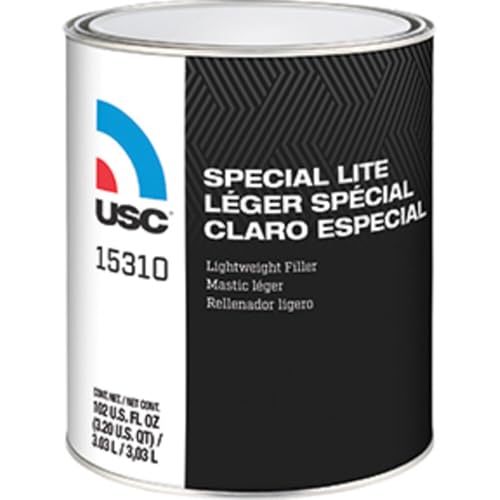
For bodywork where time is money, the US Chemical Special Lite is a standout choice for professionals who prioritize shaping speed. Its creamy, non-sag formula spreads like butter and is engineered to sand effortlessly, dramatically reducing the labor involved in block-sanding large panels. This is not a structural filler; it’s specifically formulated for cosmetic smoothing over metal and properly prepared fiberglass surfaces.
The 0.8-gallon can offers substantial volume for covering a whole quarter panel or multiple repair spots without frequent trips back to the store. The 4-hour full cure time is longer than some fast-setting competitors, but the trade-off is a more forgiving work window and a noticeably smoother sanding experience. Pigment bleed-through is minimal, and the surface takes primer and paint exceptionally well.
This filler is a top pick for restoration shops or anyone who hates spending hours sanding. The creamy consistency also minimizes pinholes, a common frustration with thicker, pastier fillers. However, as a lightweight filler, it lacks the mechanical strength for bridging large holes—always back it up with mesh or a structural product for any void over 1/8 inch.
What works
- Extremely easy to sand with minimal clogging of paper
- Spreads smoothly and resists sagging on verticals
- Good value for the large container size
What doesn’t
- Not designed for structural or deep fill repairs
- Longer cure time before sanding compared to spot putties
3. 3M Bondo Fiberglass Resin (401)
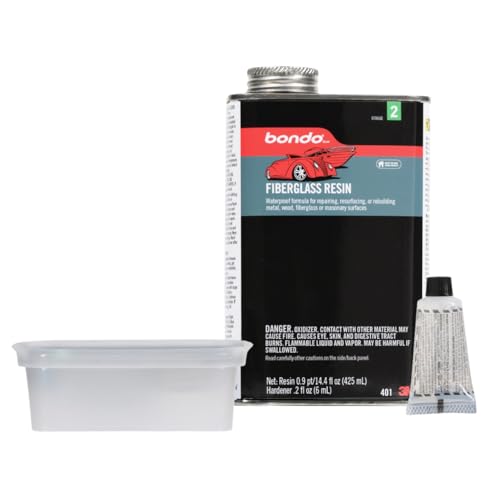
This is the classic liquid polyester resin, perfect for the “laminating” stage of a fiberglass repair. It is not a body filler in the conventional paste sense, but a liquid matrix designed to saturate fiberglass mat or cloth to rebuild a structure. Users praise its thin viscosity which soaks into roving cloth instantly, creating a strong, waterproof bond on materials ranging from wood to concrete.
The 0.9-pint size is ideal for small patching jobs, covering canoe holes or reinforcing a rotting wooden door frame. The included liquid hardener makes measuring straightforward, though some users note the small dropper bottle can be a bit fiddly. Once mixed, the working time is standard for polyester resin—around 15-20 minutes—which is plenty for laying up a few layers of cloth.
A clever trick reported by experienced users is mixing this resin with standard Bondo filler powder to create a custom, high-strength spreading paste. This allows you to tailor the consistency for vertical applications while retaining the liquid resin’s superior bonding properties. However, as a pure liquid, it’s messy for filling deep holes on its own, requiring a filler powder or mat to give it bulk.
What works
- Excellent wet-out of fiberglass cloth for structural repairs
- Compatible with multiple materials like wood and metal
- Small size is budget-friendly for one-off projects
What doesn’t
- Liquid form is messy to control on vertical surfaces
- Requires fiberglass mat to build up volume for deep fills
4. J-B Weld Quart Fiberglass Short-Strained Filler

J-B Weld brings its reputation for strong epoxies into the polyester filler market with this short-strand reinforced putty. It claims 2x the strength of standard body filler, and the addition of short glass fibers does offer a tangible upgrade in structural integrity over a pure talc-based product. It’s a direct, no-nonsense option for repairing cracks up to half an inch in fiberglass, metal, or concrete.
The putty dries in a fast 30 minutes, which is convenient for projects that need to progress quickly. It is mixed just like standard Bondo, meaning you can use the same cream hardener you likely already have on your shelf. The formula sands down well and accepts paint easily, making it a solid all-in-one solution for the weekend mechanic fixing a cracked ATV fairing or a rotted section of a shower wall.
Where this product excels is delivering reliable, consistent strength at a low entry point. It fills voids effectively and doesn’t shrink during cure. The main trade-off compared to premium structural putties like TotalBoat is the fiber length—short strands are less effective at distributing stress across a large repair, making this a great choice for patching holes, but not the first pick for reattaching a broken tab or bracket.
What works
- Faster cure time than many traditional fillers
- Fills cracks up to 1/2 inch easily without sagging
- Paintable and sandable with standard tools
What doesn’t
- Short-strand fibers limit ultimate impact resistance
- Newer product with limited long-term user feedback
5. 3M Bondo 907 Glazing and Spot Putty (4 Pack)

This is not a body filler for rebuilding panels; it is a premium finishing putty designed for the final stage of bodywork. The 907 Glazing Putty is formulated to fill the tiny pinholes, scratches, and surface imperfections that remain after priming—often referred to as “glazing” the surface. Its three-minute working time and ability to be sanded in just 30 minutes make it incredibly efficient for the finishing touch.
The two-part formula comes in convenient tubes that are easy to dispense directly onto the repair surface. It works on metal, fiberglass, and sanded primer, and its non-staining finish ensures you won’t see ghosting or discoloration through your final paint coat. The 4-pack offers excellent value, ensuring you have enough for multiple small jobs or one full car panel.
For a painter, this product is indispensable. It eliminates the frustration of seeing “fisheyes” or porosity in your final color coat by providing a perfectly smooth, sealed base. However, it has virtually no structural strength and should never be used to fill a dent or hole—it will crack. Use it strictly as a spot putty for perfecting the primer layer.
What works
- Ultra-fast sanding time speeds up finishing workflow
- Effectively fills pinholes and light scratches without staining
- Convenient tube packaging minimizes waste
What doesn’t
- Not suitable for structural or deep hole repairs
- Very short working time of 3 minutes
Hardware & Specs Guide
Resin to Hardener Ratio
The ratio of resin to MEKP (Methyl Ethyl Ketone Peroxide) hardener defines the cure speed and final hardness of the filler. Most polyester fillers use a 1% to 2% hardener ratio by weight. Using too little hardener results in a tacky, uncured mess that won’t sand. Using too much can cause the filler to overheat, crack, or become brittle. Always mix thoroughly and follow the manufacturer’s specific ratio, especially for structural putties like TotalBoat.
Fiber Strand Length
Fiber length is the primary determinant of a filler’s mechanical strength. Short-strand fillers (under 1/4 inch) are classified as cosmetic fillers—they provide body but little structural reinforcement. Long-strand fillers (1/2 inch to 1 inch) create a micro-reinforcement matrix that resists impact and distributes load, making them ideal for structural bonding and filleting. For pure laminating strength, you must use liquid resin with separate fiberglass mat.
Cure Time vs. Sanding Time
These two metrics are frequently confused. Cure time is the period required for the filler to reach full structural and chemical stability (often 4 hours or more). Sanding time is when the filler is hard enough to be shaped without gumming up sandpaper, often much shorter (20-30 minutes). For lightweight fillers like USC Special Lite, the sanding window is wide and forgiving, while fast-setting glazing putties require you to sand promptly or risk excessive hardness.
Thixotropy and Non-Sag Properties
Thixotropy refers to a filler’s viscosity under stress—specifically, how well it stays in place on a vertical surface. A thixotropic filler will remain upright like a paste when static but flow smoothly under the shear of a spreader. This is critical for repairing vertical body lines or bulkheads. Structural putties with long-strand fibers naturally have high thixotropy, while thin liquid resins require mat reinforcement to prevent dripping.
FAQ
Can I use fiberglass body filler over existing paint?
What is the difference between body filler and glazing putty?
How do I stop fiberglass filler from sagging on a vertical panel?
Does fiberglass filler require a separate hardener?
Can fiberglass filler be used for marine repairs below the waterline?
Final Thoughts: The Verdict
For most buyers, the best fiberglass body filler winner is the TotalBoat Polyester Structural Repair Putty because it offers the perfect balance of high-strength structural bonding, excellent working properties, and marine-grade reliability for both auto and boat repairs. If you want the easiest sanding experience for cosmetic smoothing, grab the U.S. Chemical & Plastics Special Lite. And for a quick, budget-friendly repair of small cracks and holes, nothing beats the value of the J-B Weld Fiberglass Filler.

Certification: BSc in Mechanical Engineering
Education: Mechanical engineer
Lives In: 539 W Commerce St, Dallas, TX 75208, USA
Md Amir is an auto mechanic student and writer with over half a decade of experience in the automotive field. He has worked with top automotive brands such as Lexus, Quantum, and also owns two automotive blogs autocarneed.com and taxiwiz.com.