A loose exhaust joint turns every drive into a droning headache and robs your engine of proper backpressure. The right clamp eliminates that noise, prevents toxic fumes from seeping into the cabin, and keeps your exhaust system intact through temperature cycles and road vibration. Choosing the correct style and material for your specific pipe diameter and joint type is the difference between a ten-minute repair and a repeat job next season.
I’m Amir — the founder and writer behind Four Wheel Ask. I’ve spent years studying exhaust component metallurgy, clamping geometry, and fastener torque data while cross-referencing thousands of owner reports to identify which clamps actually hold a seal beyond the first heat cycle.
A simple hardware swap can transform a rattling exhaust into a solid system, which is why understanding materials, fitment types, and clamping force helps you select the best exhaust muffler clamps for a permanent, leak-free seal on your vehicle.
How To Choose The Best Exhaust Muffler Clamps
Selecting the right exhaust clamp goes beyond matching a pipe diameter. Material composition, clamp style, and thread design all determine whether the joint stays sealed after thermal expansion and contraction cycles. A poor choice leads to exhaust leaks, rusted fasteners, and a second trip under the car.
Clamp Style: U-Bolt vs. Band vs. Lap Joint
U-bolt clamps are the traditional design, wrapping a saddle around the pipe and tightening with two nuts. They work well for slip joints but can distort thin-wall pipes if over-torqued. Band clamps use a full 360-degree strap that distributes force evenly, making them ideal for butt joints and thin-wall exhaust systems. Lap-joint clamps feature an inner sleeve that bridges two pipe ends, providing a smooth internal bore that minimizes flow restriction and leakage.
Material and Corrosion Resistance
304 stainless steel offers the best balance of corrosion resistance and cost for most daily-driven vehicles. It withstands road salt, moisture, and high exhaust temperatures without rusting through. Low-carbon steel clamps are cheaper but degrade quickly in wet or salty environments. Always verify the bolt and nut material — zinc-plated hardware can seize after a single winter season.
Pipe Diameter and Wall Thickness
Measure the outer diameter of your exhaust pipe with calipers before ordering. Many clamps list an inner diameter that matches a specific OD pipe size. Wall thickness matters too — thin-wall pipes (around 0.065-inch) require band-style clamps that won’t crush the tubing, while thick-wall pipes can handle U-bolt designs without deformation.
Torque Specs and Installation Hardware
Proper torque ensures the clamp grips without damaging the pipe. Look for clamps that specify a torque rating in newton-meters or foot-pounds. Flange nuts or integrated washers prevent galling and allow for even tightening. Avoid clamps that require holding the bolt with pliers while tightening the nut — this usually indicates poor thread design that will spin out under load.
Quick Comparison
On smaller screens, swipe sideways to see the full table.
| Model | Category | Best For | Key Spec | Amazon |
|---|---|---|---|---|
| Walker 36522 | Band Clamp | OEM replacement on GM vehicles | 304 SS, 360-degree seal | Amazon |
| VehiMata 2.5″ Butt Joint | Band Clamp | Track cars needing quick removal | 63 Nm torque, 3-inch strap | Amazon |
| TIROL 2.5″ Narrow Band | Band Clamp | Slip joints and muffler inlets | 304 SS, narrow strap design | Amazon |
| DecoHongDi Lap Joint | Lap Joint | Connecting different pipe sizes | I-block alloy, 2.93-inch strap | Amazon |
| LCGP U-Bolt Set | U-Bolt | General slip-joint exhaust repair | Stainless steel, gusseted saddle | Amazon |
In-Depth Reviews
1. Walker 36522 Exhaust Clamp

Walker’s 36522 exhaust clamp is engineered as a direct replacement for General Motors trucks and SUVs, including the Chevrolet Silverado 1500 and GMC Sierra. The 360-degree band design wraps fully around the pipe joint, distributing clamping force evenly to prevent the localized distortion common with U-bolt styles. Owner reports on 2011-2016 Suburban and Silverado platforms consistently note a perfect fit without modification — the clamp aligns with factory pipe contour and tightens down without binding.
The stainless steel band resists corrosion from road salt and moisture, though several verified buyers in northern climates report that the zinc-plated barrel nuts and bolt can rust after two to three winter seasons. This is a common trade-off on OEM-style hardware, and the clamp remains functional if the fasteners are replaced with stainless equivalents. The bolt accessibility note on the listing is worth paying attention to — orienting the threaded section toward an accessible position during installation saves significant frustration later.
For anyone replacing a factory clamp on a late-model GM vehicle, the Walker 36522 delivers OEM-grade sealing at a fraction of dealer parts counter pricing. The band geometry is specifically tuned for the pipe wall thickness used on these platforms, so you get a leak-free joint without over-torquing. It is not a universal fit for every application, but within its specified compatibility range it outperforms generic alternatives in both fit and longevity.
What works
- Direct OEM fitment on GM trucks and SUVs
- Stainless steel band resists corrosion well
- 360-degree seal eliminates exhaust leaks
What doesn’t
- Hardware (bolt/nuts) can rust in salt-belt regions
- Limited vehicle compatibility outside GM lineup
2. VehiMata 2.5″ Butt Joint Band Clamp Sleeve Coupler

The VehiMata butt joint clamp is designed for joining two sections of 2.5-inch OD pipe without the need for welding. This coupler-style clamp uses a 3-inch-wide stainless steel band with an aluminum alloy I-block that distributes torque evenly across the joint surface. The specified 63 Nm torque rating gives a concrete tightening target — important for achieving consistent clamp force without crushing the pipe walls.
Road racing enthusiasts have noted this clamp’s value for exhaust systems that need to be disassembled frequently for maintenance or inspection. The butt joint design allows individual exhaust sections to be removed and reinstalled without cutting or welding, which is a significant time saver on track cars with tight packaging. The zinc-plated M10 bolts and steel gasket provide adequate corrosion resistance for regular use, though the stainless band is the primary structural element.
Some users have paired this clamp with high-temperature silicone sealant on the pipe interface for an extra layer of leak protection. The clamp alone creates a solid mechanical seal when torqued correctly, but the silicone adds insurance on exhaust systems with minor surface irregularities. Given the moderate price point and the reusable nature of the design, this clamp offers strong value for both DIY repair work and performance applications where exhaust disassembly is routine.
What works
- Easy to install and remove without welding
- Clear 63 Nm torque specification for consistent tightening
- Wide band prevents pipe distortion
What doesn’t
- Not designed for lap joints with overlapping pipe ends
- Bolt threads may need anti-seize for repeated removal
3. TIROL 2.5 Inch Exhaust Clamp Narrow Band

TIROL’s narrow band clamp is a straightforward 304 stainless steel solution for 2.5-inch OD exhaust connections. The band width is narrower than full coupler-style clamps, which makes it particularly effective in tight chassis spaces where a wider strap would not fit. Pre-attached hardware speeds up installation — the bolts and nuts come aligned from the factory so you do not need to juggle loose components under the vehicle.
Owner feedback shows this clamp working well on applications ranging from a Borla S-Type exhaust on a Dodge Challenger to a stock H-pipe connection on a Mercury Mountaineer. The narrow profile creates a clean look that mimics OEM band clamps on many factory exhaust systems. A few users noted that the crimp-style lock nuts require holding the bolt with Vice-Grips during tightening, which is typical for this fastener style and manageable with basic tools.
For the price point, the TIROL delivers genuine 304 stainless construction that will not rust through like cheaper plated steel alternatives. The two-pack format covers a single repair with a spare on hand, or two separate joints on the same vehicle. If you need a reliable band clamp for a standard slip joint and want corrosion resistance without stepping up to premium pricing, this is the smart middle-ground pick.
What works
- True 304 stainless steel for rust resistance
- Narrow profile fits tight exhaust sections
- Pre-attached hardware for faster installation
What doesn’t
- Lock nuts may spin if bolt is not held securely
- Not ideal for thin-wall pipes needing wide-band support
4. DecoHongDi 2.5 Inch Lap Joint Band Clamp

The DecoHongDi lap joint clamp uses an I-shaped aluminum alloy block paired with a 304 stainless steel band to create a sealing system designed specifically for overlapping pipe connections. The lap joint configuration joins a 2.5-inch OD pipe to a 2.5-inch ID pipe, making it ideal for muffler inlet connections where one pipe slides inside another. The 2.93-inch strap width provides generous surface contact that distributes clamping pressure evenly around the joint.
Installation requires partially threading both bolts before tightening in an alternating pattern to prevent the band from distorting. Several owner reports mention wrapping aluminum foil around the connection before clamping — a helpful trick that fills micro-gaps and enhances the seal. The clamp has been used effectively on GM tailpipe repairs and older vehicles where the full replacement cost is not justified. The 304 stainless construction holds up well in exposed underbody locations.
This design excels in repair scenarios where the pipe end is slightly out-of-round or has surface corrosion that would prevent a standard band clamp from sealing completely. The overlapping geometry and the I-block force distribution create a tighter closure than a simple band clamp on imperfect pipes. For a durable, leak-free repair on a lap-style exhaust connection, the DecoHongDi offers an engineered approach at a very accessible price.
What works
- I-block design distributes force evenly for a tight seal
- Lap joint format handles slightly deformed pipes
- Full 304 stainless band resists corrosion
What doesn’t
- Requires careful alternating bolt tightening sequence
- Only works with lap joint pipe configurations
5. LCGP 2.5″ Heavy Duty U Bolt Clamps 2 Pack
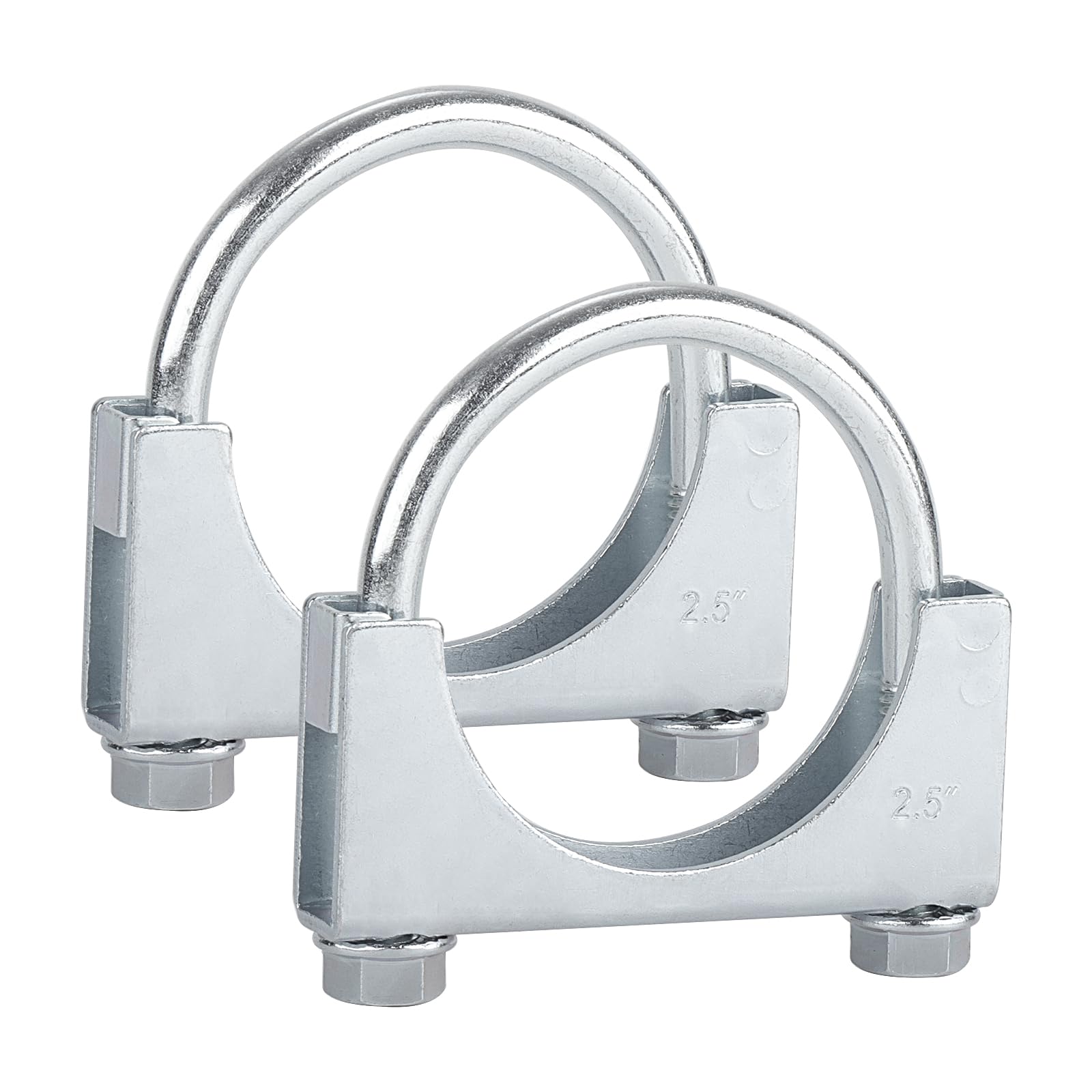
LCGP’s U-bolt clamp set brings a traditional, heavy-duty design to standard slip-joint exhaust connections. Each clamp includes a U-bolt, a gusseted saddle plate, flange nuts, and a protective coating that resists surface corrosion. The saddle features reinforcement gussets on both sides — a detail usually found on more expensive clamps — that prevent the saddle from spreading open when the nuts are torqued down.
Users have installed these clamps on a wide range of vehicles, including a 2012 GMC Canyon exhaust system replacement and a vintage Mustang with dual exhaust. The flange nuts make tightening more predictable than standard hex nuts because they distribute load across a wider surface. Several verified buyers noted the coating is a dark anti-corrosion finish rather than true stainless steel, so these clamps are best suited for vehicles not exposed to heavy road salt or coastal humidity.
For a two-pack priced at entry-level territory, the LCGP clamps deliver genuine heavy-duty construction that outperforms the flimsy stamped-steel clamps found at big-box auto parts stores. The gusseted saddle is the standout feature — it prevents the clamp from deforming during tightening, which ensures consistent clamping force across the pipe surface. If you need a reliable U-bolt clamp for a standard repair and want to keep the investment minimal, this set punches above its weight class.
What works
- Gusseted saddle prevents spreading during tightening
- Flange nuts provide even load distribution
- Two-pack covers multiple joints or a spare
What doesn’t
- Coating is not stainless steel — avoid in salt-belt regions
- U-bolt design can distort thin-wall pipes if over-torqued
Hardware & Specs Guide
U-Bolt Clamp Construction
U-bolt clamps consist of a threaded U-shaped rod, a saddle plate, and two nuts. The saddle sits on the pipe and the U-bolt wraps around it. Gusseted saddles (reinforced with triangular braces) resist spreading and maintain even pressure. These clamps work best on thick-wall exhaust pipes where the localised clamping force will not deform the tubing. Torque should be applied gradually and evenly to both nuts to avoid warping the saddle.
Band Clamp Geometry
Band clamps use a full 360-degree stainless steel strap that wraps completely around the pipe joint. An I-block or T-bolt mechanism compresses the strap evenly, creating a uniform seal without distorting the pipe. Band clamps are the preferred choice for thin-wall exhaust systems and are reusable if the band is not over-torqued. Widths range from narrow (around 1 inch) for tight spaces to wide (over 3 inches) for maximum sealing surface.
304 Stainless Steel Performance
304 stainless steel contains 18 percent chromium and 8 percent nickel, forming a passive chromium oxide layer that resists corrosion from moisture, road salt, and exhaust condensation. It maintains structural integrity at exhaust temperatures up to approximately 870 degrees Celsius in continuous service. Unlike 409 stainless, 304 offers superior corrosion resistance but comes at a moderate cost increase that is justified for long-term installations in corrosive environments.
Torque Specifications and Fastener Quality
Proper torque ensures the clamp grips the pipe without crushing it. Band clamps typically specify a torque range between 50 and 70 Nm, while U-bolt clamps vary by pipe diameter and wall thickness. Flange nuts and hardened washers prevent galling and distribute load. Zinc-plated hardware is standard but degrades over time — upgrading to stainless steel fasteners extends clamp life in wet environments. Always use a torque wrench rather than tightening by feel.
FAQ
What is the difference between a band clamp and a U-bolt clamp?
How do I measure my exhaust pipe for the correct clamp size?
Can I reuse an exhaust clamp after removing it?
Should I use exhaust sealant with a mechanical clamp?
Why does my exhaust clamp keep loosening after installation?
Final Thoughts: The Verdict
For most buyers, the best exhaust muffler clamps winner is the Walker 36522 because it delivers OEM-grade fitment and 360-degree sealing for GM trucks and SUVs without the dealer markup. If you want a reusable clamp for a track car that sees frequent exhaust changes, grab the VehiMata Butt Joint. And for a budget-conscious U-bolt repair that still uses gusseted saddles and flange nuts, nothing beats the LCGP Heavy Duty Set for the price.

Certification: BSc in Mechanical Engineering
Education: Mechanical engineer
Lives In: 539 W Commerce St, Dallas, TX 75208, USA
Md Amir is an auto mechanic student and writer with over half a decade of experience in the automotive field. He has worked with top automotive brands such as Lexus, Quantum, and also owns two automotive blogs autocarneed.com and taxiwiz.com.