A racing wheel transforms a flat-screen lap into something your arms feel and your hands fight — but the entry-level market is a minefield of gear-drive buzzers, plastic pedal slop, and spec sheets that hide more than they reveal. Sorting the actual contenders from the packaging hype requires a clear head and a hard look at the torque numbers, sensor tech, and real-world owner reports that separate a genuine foundation from a toy you will outgrow in a month.
I’m Amir — the founder and writer behind Four Wheel Ask. My approach centers on dissecting force feedback architecture, rotation mechanisms, pedal sensor accuracy, and long-term durability signals from the community to separate marketing claims from honest engineering.
Whether you are aiming for gravel-rally finesse or circuit-lap consistency, the right wheel comes down to torque delivery, rotation precision, and pedal response. Understanding those three pillars is the difference between a purchase you love and one you replace, which is why this guide focuses on the best entry level racing wheel options that deliver genuine performance without forcing a second mortgage.
How To Choose The Best Entry Level Racing Wheel
Entry-level racing wheels span a wider performance gap than most buyers realize. A budget-friendly unit with gear-driven force feedback feels fundamentally different from a direct-drive base with hall-effect pedals. Understanding the core variables — torque strength, rotation range, pedal sensor type, and platform support — keeps you from buying a wheel you will need to replace within a year.
Force Feedback Architecture: Gear, Belt, or Direct Drive
The force feedback system defines the entire driving experience. Gear-driven wheels use helical or spur gears to transmit motor torque to the wheel rim, producing a clunky, notchy feel with noticeable cogging. Belt-driven systems smooth out that roughness using a rubber or kevlar belt but introduce belt stretch and friction over time. Direct drive eliminates both gears and belts by coupling the wheel directly to the motor rotor, delivering instant, silent, and highly detailed force feedback. Entry-level budgets historically limited buyers to gear systems, but direct-drive options like the 3.9Nm MOZA R3 now enter the sub- bracket, making DD the new benchmark for value.
Rotation Angle: 270° vs 900° vs Adjustable
Lock-to-lock rotation determines how many steering wheel turns equal full lock in the sim. Formula and GT cars use 270° to 360° for quick, twitchy inputs, while drift, rally, and truck sims benefit from 900° to 1080° for smooth, hand-over-hand correction. Wheels with adjustable rotation let you flick between modes, but fixed 900° bases can feel sluggish in open-wheel cars, and fixed 270° units feel overly sensitive in Euro Truck Simulator. Prioritize adjustable rotation if you play multiple sim genres.
Pedal Sensor Technology: Hall Effect vs Potentiometer
Pedals are arguably more important than the wheel itself for consistent lap times. Potentiometer-based pedals wear over time, developing jittery signal spikes and inconsistent calibration that hurt braking precision. Hall-effect magnetic sensors are contactless, meaning no wear, no drift, and repeatable linear response across thousands of hours. Entry-level bundles often cheap out on pedals, so a kit with hall-effect pedals — even if it means spending slightly more upfront — saves frustration and future upgrade cost.
Quick Comparison
On smaller screens, swipe sideways to see the full table.
| Model | Category | Best For | Key Spec | Amazon |
|---|---|---|---|---|
| MOZA R3 Simulator 4PCS | Direct Drive | DD Performance Entry | 3.9Nm Direct Drive Base | Amazon |
| Logitech G29 | Force Feedback | PS5/PS4 Sim Racing | 900° Helical Gear FF | Amazon |
| Logitech G920 | Force Feedback | Xbox Sim Racing | 900° Helical Gear FF | Amazon |
| MOZA R3 Wheel & Pedals 3PCS | Direct Drive | DD Value Bundle | 3.9Nm DD + Hall Pedals | Amazon |
| Thrustmaster T128 | Force Feedback | PS5/PC Hybrid Drive | Hybrid Drive FF System | Amazon |
| HORI DLX Racing Wheel | Force Feedback | Xbox Enthusiast Entry | Full-size FF + Metal Paddles | Amazon |
| PXN V99 | Force Feedback | FF Value with Shifter | 3.2Nm Dual-Motor FF | Amazon |
| PXN V9 GEN2 | Entry Wheel | Budget Multiplatform | Hall Pedals + 900° Rotation | Amazon |
| RACGTING Simulator Cockpit | Sim Cockpit | Foldable Rig Solution | Adjustable Foldable Frame | Amazon |
In-Depth Reviews
1. MOZA R3 Racing Simulator 4PCS Bundle

The MOZA R3 4PCS kit represents the most significant value shift in the entry-level segment because it delivers a bona fide direct-drive base at a price point long dominated by gear-driven units. The 3.9Nm DD servo motor eliminates the notchy cogging and belt slack that plague mechanical systems, giving you clean, instant force response that communicates tire slip and curbs with genuine fidelity. Owner reports consistently describe the transition from belt or gear systems as revelatory, noting that the silent operation and lack of friction make extended sessions far less fatiguing.
The ES Lite steering wheel measures 11 inches with an aluminum alloy rim and 22 customizable buttons, paired with a racing-level quick-release system that lets you swap rims without tools. The SR-P Lite pedals use high-strength steel construction with hall-effect sensors for drift-free throttle and brake input, though the bundle omits a clutch pedal — a reasonable trade-off at this price. The included CNC-machined table clamp (5mm steel) provides a rock-solid mounting foundation for desk setups, and the MOZA Pit House software offers deep configurability for force feedback curves, button mapping, and profile management across sim titles.
Community feedback from iRacing, Assetto Corsa, and Forza users highlights the R3’s ability to make drivers faster through consistent pedal feel and instantaneous wheel response. Some users note the 3.9Nm torque is sufficient for most sims but may leave competitive drift or rally drivers wanting more headroom. The ecosystem is upgradeable with MOZA’s accessory line, meaning the base can grow with you over time. For anyone entering sim racing today, this bundle sets a new floor for what entry-level performance should look like.
What works
- True direct-drive torque at a price that rewrites the entry-level benchmark
- Hall-effect pedals deliver consistent, drift-free braking and throttle
- Quick-release rim system enables future upgrades without replacing the base
- Compact, aviation-grade aluminum base with intelligent thermal management
What doesn’t
- No clutch pedal included — two-pedal setup only out of the box
- Limited to PC — no native Xbox or PlayStation compatibility
- Accessory pricing is premium, raising the cost of future expansions
2. Logitech G29 Driving Force
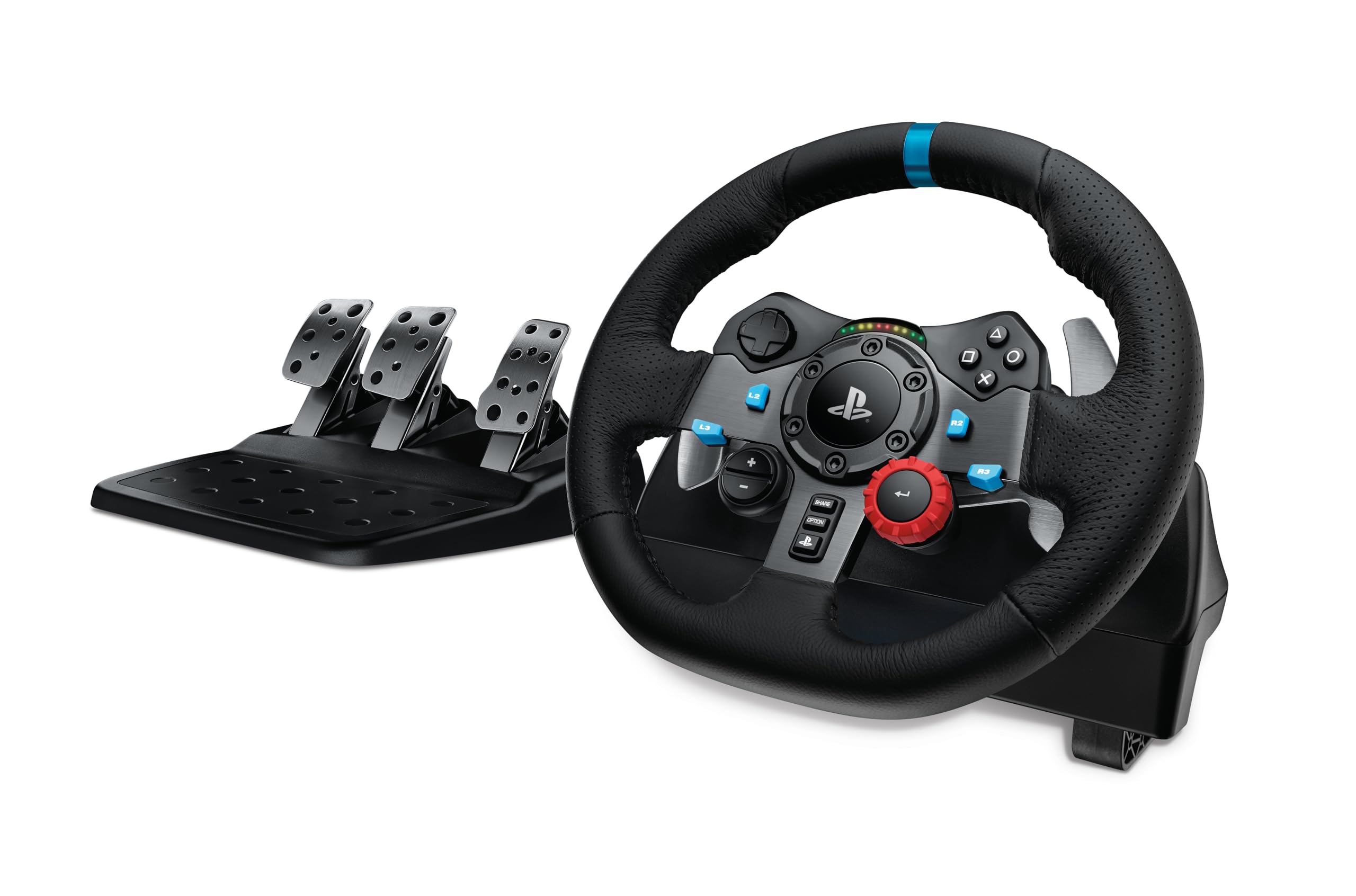
The Logitech G29 has anchored the entry-level segment for years, and for good reason — its helical gear-drive system offers the smoothest force feedback of any gear-based wheel on the market. The hand-stitched leather wheel cover and stainless steel paddle shifters give it a tactile quality that exceeds its price tier, while the 900-degree lock-to-lock rotation range accommodates everything from Formula cars to truck simulators. Owner feedback consistently praises the G29’s durability, with many units still running strong after five or more years of regular use.
The pedal set is where the G29 shows its age. The nonlinear brake pedal uses a rubber bumper to simulate progressive resistance, which works reasonably well out of the box but develops inconsistency over time as the rubber compresses and degrades. The gas and clutch pedals use potentiometers that can develop signal noise after extended use, though cleaning and calibration adjustments mitigate this. The G HUB software provides solid customization for force feedback intensity, button mapping, and wheel sensitivity, making it easy to dial in the feel for specific games.
Platform compatibility is a key strength — the G29 works natively with PS5, PS4, and PC, and the optional Driving Force Shifter adds a dedicated H-pattern gearbox for about the cost of a mid-range game. The main drawback is that helical gear feedback, while smooth for a gear system, cannot match the detail and immediacy of a direct-drive unit. The G29 remains an excellent entry point for console-focused sim racers, but the gap between gear and DD technology has never been wider than it is today.
What works
- Leather-wrapped wheel and metal paddles feel premium for the price
- Proven long-term durability with many units lasting years
- Full PS5, PS4, and PC compatibility out of the box
- Strong software ecosystem via Logitech G HUB for fine-tuning
What doesn’t
- Potentiometer pedals develop drift and inconsistency over time
- Gear-based feedback lacks the detail and speed of direct drive
- Rubber brake bumper degrades, requiring replacement for consistent feel
3. Logitech G920 Driving Force
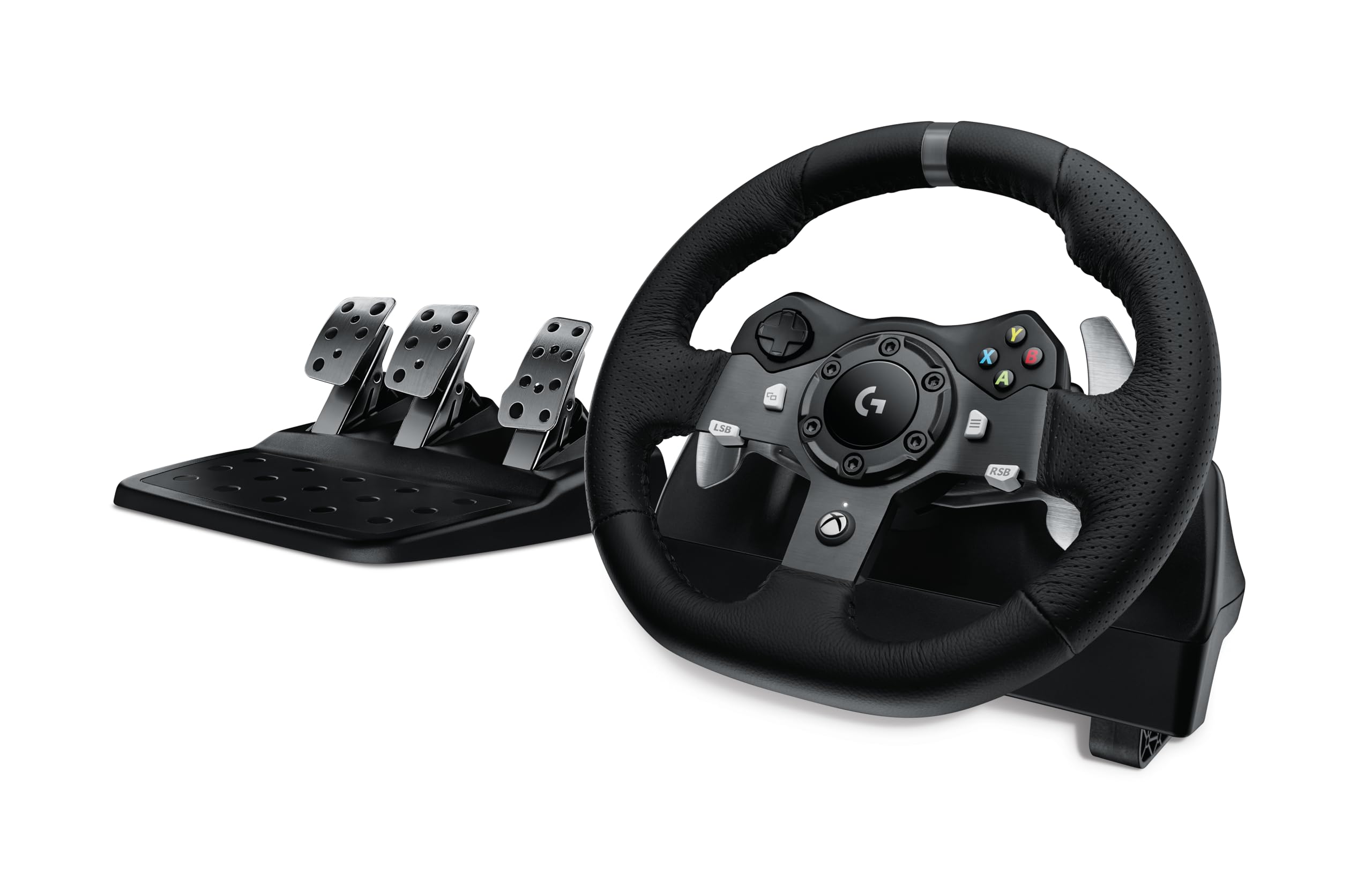
The Logitech G920 is the Xbox-ecosystem sibling of the G29, sharing the same helical gear-drive force feedback, 900-degree rotation, and leather-wrapped wheel construction. The core driving experience is identical — smooth, quiet gear-drive force transmission that communicates road texture and tire slip adequately for an entry-level system, with the same hand-stitched leather cover and stainless steel paddle shifters that define the Logitech feel. Owner reports consistently highlight the G920’s robust build and the reassurance of a brand with deep replacement-part availability.
The pedal set mirrors the G29’s design with a nonlinear brake that uses a compressible rubber insert for progressive resistance. This system is adequate for learning trail braking and threshold control, but the rubber bumper will soften and require replacement over time — a well-documented issue in the community. The pedal base includes adjustable face positions for heel-toe technique, and the included table clamp secures the wheel to desks up to around two inches thick. The G920 also features 52% post-consumer recycled plastic in its construction, aligning with Logitech’s sustainability commitments.
Where the G920 truly shines is the Xbox ecosystem — it works seamlessly with Xbox Series X|S and Xbox One alongside PC, making it the default recommendation for Xbox owners who want a no-compromise console wheel. The helical gearing is notably quieter than older gear-drive systems, which matters for late-night racing sessions. The trade-off is the same as the G29: gear-drive feedback simply cannot match the transient response and detail of a direct-drive system, and the potentiometer pedals will eventually need attention.
What works
- Native Xbox Series X|S and Xbox One support with zero configuration
- Quiet helical gear operation compared to older gear-drive wheels
- Adjustable pedal faces for personalized foot positioning
- Leather wheel cover and metal paddles at an accessible price
What doesn’t
- Potentiometer-based pedals show wear and calibration drift over time
- Rubber brake bumper requires aftermarket replacement for longevity
- Gear feedback lacks the fidelity and speed of even entry-level DD systems
4. MOZA R3 Wheel and Pedals 3PCS Bundle
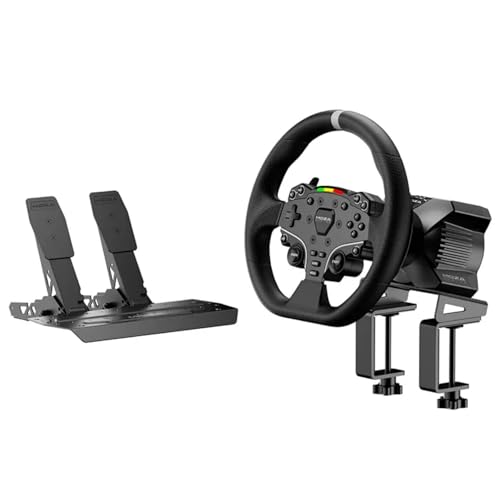
The MOZA R3 3PCS bundle delivers the same 3.9Nm direct-drive base and ES Lite steering wheel as the 4PCS kit but positions itself as a streamlined entry point for PC sim racers who already own a table clamp or plan to mount directly to a rig. The direct-drive architecture is the star — no belts, no gears, no cogging — just the motor rotor connected directly to the wheel rim, providing instant force transmission that makes tire slip, curbs, and weight transfer feel tangible through your hands. Owner reviews consistently emphasize how much more information the DD system communicates compared to gear alternatives at similar price points.
The ES Lite wheel is an 11-inch round rim with a durable ISF polyurethane grip and an aluminum alloy core that keeps weight low without sacrificing rigidity. The 22 customizable buttons and dual analog paddles offer extensive control mapping options for complex sim titles. The SR-P Lite pedals use high-precision hall-effect sensors for the throttle and brake, eliminating the jitter and drift that plague potentiometer-based systems over time. The pedal faces and spacing are adjustable, and the curved pedal plate accommodates different foot angles for comfort during long sessions.
The MOZA Pit House software provides a clean interface for adjusting force feedback curves, button assignments, and system monitoring, with cloud-based profiles accessible via the mobile app. The compact base dimensions make it suitable for desktop mounting, and the included table clamp (in the full bundle) or third-party rig mounting ensures stability. The lack of a clutch pedal and the PC-only compatibility are the main limitations, but as a pure direct-drive entry point, the R3 undersells everything in its class by a meaningful margin.
What works
- 3.9Nm direct-drive base delivers clean, detailed force feedback
- Hall-effect pedals maintain consistent calibration over thousands of hours
- Extensive button count and quick-release rim system for customization
- MOZA Pit House software offers deep tuning without complexity
What doesn’t
- No clutch pedal included — limited to two-pedal operation
- PC-only compatibility excludes console users entirely
- Table clamp not included in this configuration — sold separately
5. Thrustmaster T128 Racing Wheel & Pedal Set

The Thrustmaster T128 occupies a unique position in the entry-level segment by combining Thrustmaster’s proprietary HYBRID drive technology — a mix of gear and belt elements — with the company’s patented H.E.A.R.T magnetic paddle shifters. The result is a wheel that feels smoother than pure gear systems while retaining the robustness of a mechanical drivetrain. The magnetic paddle shifters deliver a crisp, tactile click with zero physical contact, eliminating the wear and mushiness that plague metal-on-metal paddle systems over time.
The 11-inch wheel rim is wrapped in textured rubber with ergonomic grips that reduce hand fatigue during extended sessions, and the 13 programmable buttons provide ample mapping options for most sim titles. The pedal set uses a progressive brake with a rubber stopper, similar to the Logitech approach, providing a nonlinear resistance curve that helps with modulation learning. The quick-attachment table clamp secures to desks up to 5.5 cm thick and is genuinely tool-free, making setup and tear-down fast enough for casual use.
Cross-platform support is a major selling point — the T128 works natively with PS5, PS4, and PC, giving console racers flexibility without needing adapters or workarounds. Owner feedback highlights the paddle shifter feel as a standout feature, with users noting that the magnetic actuation provides confidence-inspiring shift precision. The main downsides are that the hybrid drive, while smoother than pure gear, still cannot match the transient response of a direct-drive system, and the potentiometer pedals will eventually require maintenance or replacement for consistent performance.
What works
- Magnetic H.E.A.R.T paddle shifters deliver crisp, wear-free shifting
- Hybrid drive smooths out gear cogging for a better feel than pure gear systems
- Native PS5, PS4, and PC compatibility with tool-free table clamp
- Ergonomic rubber grip reduces hand fatigue in long sessions
What doesn’t
- Potentiometer pedals lack the long-term consistency of hall-effect units
- Hybrid drive still cannot match direct-drive detail and response speed
- Rubber brake stopper softens over time, altering braking feel
6. HORI Force Feedback Racing Wheel DLX
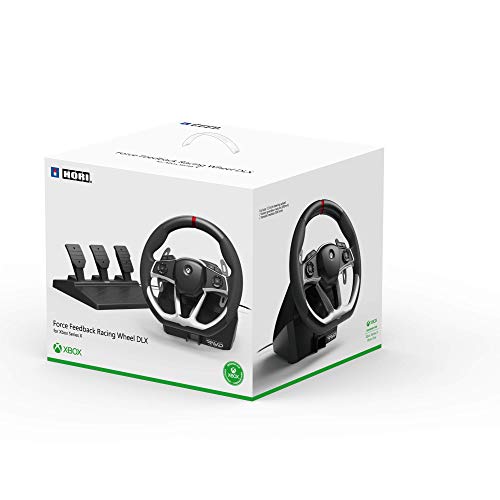
The HORI DLX is an officially Microsoft-licensed racing wheel for Xbox Series X|S and Xbox One, which means it enjoys full console-native compatibility without controller workarounds or adapter dependence. The wheel employs a force feedback system that delivers realistic resistance and vibration cues, with metal paddle shifters that provide a positive, solid actuation feel. The full-size wheel rim and pedal set are designed to match the proportions of real vehicle controls, creating a convincing ergonomic experience for sim titles like Forza Motorsport and F1.
The clamp system is notably sturdy, using a robust mounting mechanism that keeps the wheel planted during aggressive steering inputs. The pedal set features a progressive brake design with a wider pedal face for comfortable foot placement, and the overall build weight of 13.7 pounds gives the unit a planted, non-slip presence on desks and stands. Owner feedback consistently praises the HORI DLX as a strong entry option for Xbox users who want force feedback without the complexity of third-party compatibility layers.
The primary consideration is that the force feedback strength and detail level trail both the Logitech G920 and the Thrustmaster T128, with some users noting the feedback can feel muted or vague in specific sim titles. The lack of a dedicated shifter option in the ecosystem is another limitation for sim racers who want an H-pattern experience. As a pure Xbox entry wheel with official licensing, the HORI DLX delivers a no-hassle setup experience, but sim racers seeking detailed force feedback feedback may find the G920 a more rewarding long-term investment.
What works
- Officially Microsoft-licensed for seamless Xbox Series X|S and Xbox One use
- Sturdy clamp system keeps the wheel secure during aggressive driving
- Metal paddle shifters provide positive, reliable shift actuation
- Full-size wheel and pedal dimensions for realistic ergonomics
What doesn’t
- Force feedback detail and strength trail competitors in the same bracket
- No dedicated H-pattern shifter option available in the ecosystem
- Pedal feel is basic compared to hall-effect or load-cell alternatives
7. PXN V99 Racing Wheel

The PXN V99 enters the ring with a compelling spec sheet: 3.2Nm dual-motor force feedback, a detachable 11.8-inch wheel with TPR rubber grip, four-paddle layout with upper shifters and lower analog paddles, and a complete three-pedal set with hall-effect sensors plus a 6+1 H-pattern shifter — all at a price that undercuts most competitors. The dual-motor setup delivers force feedback that owner reviews describe as surprisingly strong and immersive, with the ability to communicate road texture and collision effects with enough fidelity to keep sim racers engaged for hours.
The hall-effect pedal set is a genuine differentiator at this price point, providing contactless throttle and brake sensing that avoids the jitter and calibration drift inherent to potentiometer pedals. The 6+1 shifter includes two customizable buttons for high/low gear switching and handbrake functions, adding a layer of immersion that most entry-level bundles omit entirely. The wheel offers one-button switching between 270° and 900° rotation, accommodating both Formula-style quick steering and truck-simulator hand-over-hand inputs.
The V99 supports PC, Xbox One, Xbox Series X|S, and PS4, with the standard controller-based pairing process for console use. Owner feedback highlights the strong force feedback as the standout feature, with multiple users noting it feels more powerful and detailed than Logitech gear at a similar price. The main trade-offs are the more budget-oriented build materials — the wheel and shifter use more plastic than metal competitors — and occasional reports of the wheel base overheating and entering thermal shutdown during extended sessions. For the price, the V99 delivers an unusual amount of hardware, but the long-term durability record is still being written.
What works
- Hall-effect pedals provide accurate, drift-free throttle and brake input
- Included 6+1 H-pattern shifter adds immersion rarely seen at this price
- Dual-motor force feedback feels strong and detailed for the bracket
- Detachable wheel with quick-release and four-paddle layout
What doesn’t
- Plastic construction feels less premium than metal-rich alternatives
- Wheel base overheating and thermal shutdown reported in some sessions
- Phone app pairing process can be finicky and inconsistent
8. PXN V9 GEN2 Gaming Steering Wheel

The PXN V9 GEN2 is the budget-friendly entry point in this lineup, but it brings several thoughtful features that elevate it above the absolute bargain-bin alternatives. The wheel base uses a 16-bit magnetic encoder for rotation sensing, providing 270° and 900° modes with smooth, silent operation that avoids the notchiness of cheap optical encoders. The dual vibration motors in the wheel rim deliver multi-level haptic feedback that responds to road surface changes, collisions, and engine RPM, creating a surprisingly immersive experience for the money.
The pedal set is the V9 GEN2’s strongest asset — all three pedals use hall-effect magnetic sensors for contactless, wear-free operation, a feature typically reserved for wheels costing significantly more. The wheel-integrated RGB indicator lights change color based on throttle and brake input, providing a visual reference for pedal application that can help new sim racers develop smoother inputs. The 6+1 H-pattern shifter includes two customizable buttons for high/low gear and handbrake functions, and the included mounting clamp secures to desks up to 4.5 cm thick.
Platform support spans PS3, PS4, Xbox One, Xbox Series X|S, and PC, with the standard controller-tethering process for console pairing. The PXN Wheel mobile app allows customization of steering sensitivity, vibration intensity, and RGB behavior. Owner reviews are mixed — many report a fun, functional entry experience, but a meaningful subset reports shifter failure, clutch pedal non-function, and intermittent disconnection issues. The V9 GEN2 offers impressive features for the price, but the quality control variability means it is best suited for buyers comfortable with potential troubleshooting.
What works
- Hall-effect sensors on all three pedals for drift-free long-term use
- Pedal-responsive RGB provides visual feedback for input refinement
- Broad platform support across PlayStation, Xbox, and PC
- PXN Wheel app enables customization of sensitivity and vibration
What doesn’t
- Quality control inconsistencies reported — shifter and pedal failures appear
- Intermittent disconnection issues noted across multiple platforms
- Plastic build quality feels less durable than metal-reinforced competitors
9. RACGTING Racing Simulator Cockpit
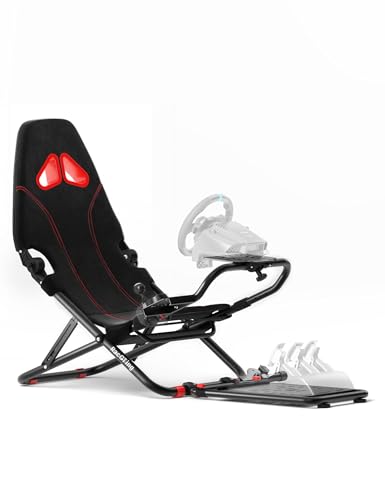
The RACGTING Racing Simulator Cockpit addresses a critical pain point for entry-level sim racers who have already invested in a wheel and pedal set but lack a dedicated mounting solution. This foldable frame provides a sturdy, adjustable platform that accommodates most major wheel brands — Logitech G29/G920/G923, Thrustmaster T248/T300/T150, Fanatec CSL DD, MOZA R3/R5/R9, and SIMAGIC Alpha series — without requiring permanent floor space. The foldable design returns your living area to normal in seconds, making it ideal for apartment dwellers and shared spaces.
The frame offers five-point adjustability: pedal distance, shifter position (mountable on either side), seat angle, wheel tilt, and overall seating length. All adjustments are tool-free, allowing different drivers to swap settings in under a minute without disassembly. Owner reviews consistently praise the comfort and stability for the price, with users weighing up to 150 pounds reporting no flex or creaking during aggressive driving. The included shifter mount plate accommodates both H-pattern and sequential shifters, and the frame folds flat enough to slide under a bed or into a closet.
The main caveat is that this is a frame-only product — the steering wheel, pedals, shifter, and seat are not included, so buyers must already own or purchase those components separately. The shifter mount plate has some reported wiggle that requires careful bolt tightening to eliminate, and the pedal plate angle adjustment range is limited compared to dedicated rigs. For sim racers who already own a wheel bundle and want to graduate from desk mounting without committing to a permanent rig, the RACGTING cockpit represents a practical, budget-conscious bridge solution.
What works
- Foldable design stores flat, ideal for apartments and shared living spaces
- Tool-free adjustments accommodate different drivers and wheel positions
- Compatible with virtually all major wheel, pedal, and shifter brands
- Sturdy construction with minimal flex for the price point
What doesn’t
- Frame only — wheel, pedals, shifter, and seat must be purchased separately
- Shifter mount plate can develop wiggle without careful bolt tightening
- Pedal plate angle adjustment range is more limited than dedicated rigs
Hardware & Specs Guide
Torque and Force Feedback Strength
Force feedback torque is measured in newton-meters (Nm), and this single number correlates more with driving immersion than any other spec. Entry-level gear and belt systems typically deliver 1.5–2.5 Nm of peak torque, which is adequate for feeling road texture and collisions but lacks the authority to communicate fine tire slip angles or weight transfer. Direct-drive entry wheels like the MOZA R3 deliver 3.9 Nm, providing significantly more detail and headroom before clipping. Stronger torque allows the wheel to resist your inputs more realistically, making understeer and oversteer events physically distinct through your hands.
Rotation Angle and Adjustability
Lock-to-lock rotation defines how many full turns of the wheel equal full steering lock in the sim. Fixed 270° wheels suit formula and GT racing where quick, small inputs dominate, while 900° wheels match road cars and trucks for hand-over-hand correction. Wheels with switchable rotation (e.g., PXN V99, PXN V9 GEN2) let you toggle between modes per-game, offering the best versatility for cross-genre sim racers. A wheel that auto-detects rotation based on the game title saves the annoyance of manual switching between sessions.
Pedal Sensor Technology
Pedal accuracy directly impacts braking consistency and lap-time repeatability. Potentiometer pedals use a wiper that slides across a resistive track, wearing down over time and producing jittery, inconsistent signals. Hall-effect sensors use a magnetic field to detect pedal position with no physical contact, eliminating wear and ensuring the same pedal feel after years of use. Load-cell pedals, typically found in mid-range and premium setups, measure pressure rather than position, providing muscle-memory-friendly braking that is unaffected by seating position changes. Entry-level bundles rarely include load cells, but hall-effect pedals are becoming the new minimum acceptable standard.
Platform Compatibility and Ecosystem
Console compatibility remains a major dividing line in the entry-level market. Logitech and Thrustmaster wheels generally support the PlayStation ecosystem (PS5/PS4) or Xbox ecosystem natively, with PC support across the board. MOZA and PXN wheels lean PC-first with console support requiring controller-tethering workarounds. The ecosystem also matters for future upgrades — Logitech and Thrustmaster have extensive accessory ecosystems (shifters, stands, quick-release adapters), while MOZA offers a growing DD platform with swappable wheel rims. Choosing a wheel from a brand with a clear upgrade path prevents total replacement when you eventually want more performance.
FAQ
What force feedback type is best for entry-level racing wheels?
Do I need 900 degrees of rotation for sim racing?
Are hall-effect pedals worth the extra cost?
Can I use a PC racing wheel on Xbox or PlayStation?
Do I need a cockpit or can I use a desk clamp?
Final Thoughts: The Verdict
For most buyers entering sim racing today, the best entry level racing wheel winner is the MOZA R3 4PCS Bundle because it delivers genuine direct-drive torque and hall-effect pedals at a price that rewrites the category floor. If you need native PlayStation or Xbox support, grab the Logitech G29 or Logitech G920 for proven durability and console-native compatibility. And for maximum value with a shifter included, nothing beats the PXN V99 — just keep an eye on thermal management during extended sessions. The right wheel is the one you will still want to use a year from now, and direct drive makes that outcome far more likely.

Certification: BSc in Mechanical Engineering
Education: Mechanical engineer
Lives In: 539 W Commerce St, Dallas, TX 75208, USA
Md Amir is an auto mechanic student and writer with over half a decade of experience in the automotive field. He has worked with top automotive brands such as Lexus, Quantum, and also owns two automotive blogs autocarneed.com and taxiwiz.com.