When that telltale puff of white smoke appears from the exhaust or the dreaded milky residue shows up under the oil cap, the clock starts ticking on an expensive repair bill. For many vehicle owners, a blown or failing head gasket can feel like a financial death sentence, with repair costs often soaring past several thousand dollars. This is precisely when an effective head gasket sealer can transform a potential engine-out scenario into a manageable, budget-friendly fix.
I’m Amir — the founder and writer behind Four Wheel Ask. My work involves deep market research, analyzing hundreds of product specifications, and cross-referencing owner feedback to determine which compounds deliver on their sealing promises across different engine platforms.
The right formula can permanently bond to cracked heads or failing gaskets, but the wrong choice can clog your heater core or waste your time. This guide breaks down the top-performing solutions to help you find the most effective best engine head gasket sealer for your vehicle.
How To Choose The Best Engine Head Gasket Sealer
Selecting the right sealer requires understanding the specific failure mode at play, the material composition of the engine block, and the sealer’s delivery method. Not all formulas are created equal — some rely on ceramic fibers to bridge gaps, while others use chemical curing agents that bond at the molecular level. The goal is to match the product’s strengths to your engine’s specific needs.
Sealing Mechanism and Particle Size
The most critical factor is how the sealer actually fills the gap. Products that rely on large particulate matter can seal larger cracks but may also clog narrow coolant passages in the heater core. Formulas using nanotechnology or nanoscale ceramic particles can penetrate micro-cracks without obstructing flow. Look for descriptions of particle size or mention of a “carrier” that cures upon contact with air or heat.
Compatibility with Coolant and Engine Materials
Engines today use a variety of coolant types — OAT, HOAT, IAT — and some sealers are sensitive to certain additives. A quality head gasket sealer should state clear compatibility with all coolant formulations. Additionally, confirm the product is safe for your engine block material (cast iron, aluminum, or alloy). Some aggressive chemical sealers can corrode aluminum heads if left in the system beyond the recommended period.
Application Process and Cure Time
Ease of use varies widely. Some products require draining the coolant, adding the sealer directly to the radiator, and running the engine at a specific RPM for a set duration. Others can be poured into the overflow reservoir. The most reliable results come from following the manufacturer’s temperature and idle time instructions precisely. Products that require removing the thermostat generally offer a more controlled cure but demand more labor.
Quick Comparison
On smaller screens, swipe sideways to see the full table.
| Model | Category | Best For | Key Spec | Amazon |
|---|---|---|---|---|
| BlueDevil Head Gasket Sealer | Premium Sealer | Permanent repair on aluminum heads | Bonds to metal without particulates | Amazon |
| Bar’s Leaks HG-1 | Value Pick | Budget-friendly blown gasket fix | Carbon fiber reinforced formula | Amazon |
| Green Demon Head Gasket Sealer | Ceramic Blend | Cracked heads and blocks | Ceramic mesh that cures into a bond | Amazon |
| K&W FiberLock Head Gasket Repair | Military Grade | Larger holes and severe cracks | Nanotechnology with military fibers | Amazon |
| Steel Seal Blown Head Gasket Fix | Specialty 4-Cyl | 4-cylinder engine applications | Triple-patented chemical formula | Amazon |
| ATP Automotive AT-205 Re-Seal | Multi-System | Seals and trans fluid leaks | Rubber seal rejuvenation chemistry | Amazon |
| XADO ATOMEX Stop Leak | Elasticity Restorer | Rubber gasket and seal rejuvenation | Elasticity restoration for seals | Amazon |
| K-SEAL ST9501 Coolant Leak Repair | Multi-Purpose | Radiator and freeze plug leaks | Pour-and-go universal formula | Amazon |
| DRiV Fel-Pro 26415 PT | OEM Replacement | Subaru engine gasket replacement | Multi-layer steel with LaserWeld | Amazon |
| FEL-PRO 26515 PT | OEM Replacement | Toyota/Corolla engine rebuilds | Proprietary coating for rough surfaces | Amazon |
| FlatOut QuickStrike Tire Sealant | Tire Repair | Small tire puncture prevention | Kevlar fiber enhanced formula | Amazon |
In‑Depth Reviews
1. BlueDevil Head Gasket Sealer

BlueDevil Head Gasket Sealer commands serious respect in the automotive community for its ability to create a permanent, metallurgical bond without introducing solid particles into the cooling system. The proprietary formula is designed to bond directly to aluminum, cast iron, alloy, and even plastic surfaces, making it one of the most versatile sealers for modern engines. The application process requires a specific idle and drive cycle, but the results reported by owners are consistently impressive.
Aggregated feedback from dozens of users reveals a product that frequently delivers on its promise of a long-term fix. One deeply documented case on a 2003 Nissan Altima 2.5L showed no coolant loss, no misfires, and full cabin heat restored after just two weeks of use, with the fix holding strong for over three years and 58,000 miles. Another Subaru Outback owner reported a full recovery from overheating after a second half-bottle application, saving over a thousand dollars in shop labor. The formula contains no solid or particulate matter, which eliminates the common fear of heater core blockage.
BlueDevil is not a quick fix — it demands careful attention to the preparation steps, including draining coolant and running the engine at idle for up to 80 minutes. The price point is higher than many competitors, but the likelihood of success on a genuine head gasket leak rather than a simple hose weep is substantially better. For owners willing to follow the instructions precisely, this represents the closest thing to a permanent chemical repair available on the consumer market.
What works
- Permanent bond that holds for years, not weeks
- No particulate matter to clog heater cores or radiators
- Works on aluminum, cast iron, alloy, and plastic
- Compatible with both gasoline and diesel engines
What doesn’t
- Requires a 1.5-2 hour idle/drive procedure
- Multiple applications may be needed for stubborn leaks
- Higher cost per bottle than basic stop-leaks
2. Bar’s Leaks HG-1 HEAD SEAL

Bar’s Leaks HG-1 HEAD SEAL is arguably the most famous head gasket sealer on the market, and its reputation is built on a track record of successful saves on extremely high-mileage vehicles. The formula is reinforced with carbon fibers that span gaps and create a durable mechanical seal, all while remaining compatible with every type of antifreeze on the market — OAT, HOAT, IAT, and even plain water. A key selling point is that no coolant flushing or thermostat removal is required, making it one of the most accessible pour-in solutions available.
Owner reports consistently highlight the product’s ability to buy vehicles a second life. A 2007 Toyota FJ Cruiser with over 245,000 miles and a confirmed blown head gasket — showing coolant in cylinder six and a P0306 code — was treated with HG-1 and then driven for over 1,000 miles at highway speeds without any overheating or check engine light. Another owner of a high-mileage Prius facing a six-thousand-dollar repair bill saw the engine light turn off and cold-start shaking disappear after treatment. These real-world accounts suggest the carbon fiber matrix can tolerate significant thermal cycling.
The main limitation is that Bar’s Leaks is not a permanent cure for every case — it works best on engines that can still idle for 15 minutes without overheating. For vehicles with obvious external steam or rapid coolant loss, the product may struggle. The carbon fiber technology is also less effective on hairline cracks in aluminum heads compared to chemical bonding formulas. However, for the price, the number of successful saves documented by owners makes this a smart first attempt for any driver facing a gasket failure.
What works
- No coolant drain, flush, or thermostat removal needed
- Compatible with all coolant types and colors
- Carbon fiber reinforcement for secure gap bridging
- Proven on high-mileage engines over 200k miles
What doesn’t
- Not ideal for rapidly overheating engines
- May not permanently seal large cracks
- Some owners report needing multiple bottles
3. Green Demon Head Gasket and Block Repair
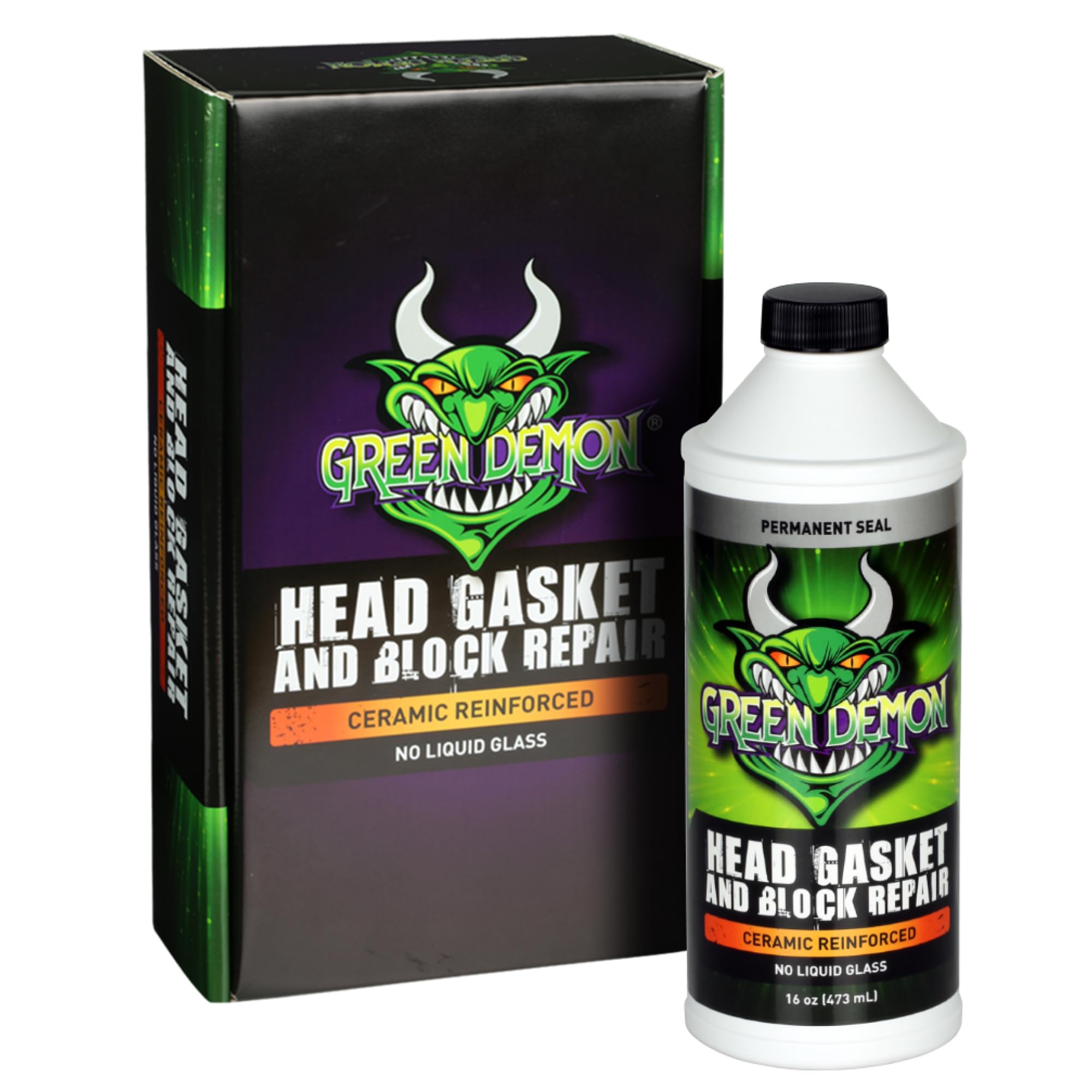
Green Demon stands out by utilizing a ceramic-reinforced formula that creates a “mesh” of particles as it circulates through the cooling system, designed to cure into a permanent sealed bond. The product is marketed toward DIY users who want a simple shake-and-pour experience without needing to drain the cooling system or remove the thermostat. It claims to handle failures ranging from coolant-to-cylinder leaks to warped or cracked cylinder heads and blocks.
User reports on Green Demon reveal a distinct split between dramatic successes and outright failures, which is typical for sealers that rely on particulate bridging. A 2015 Ford Fusion with blown head gaskets was driven for 3,000 miles with zero issues after treatment. Another user sealed a cracked head on a 2012 Pontiac G5, with white smoke disappearing immediately. However, a 2001 Oldsmobile Intrigue saw no improvement at all, and a Cummins ISX owner reported two bottles failed to stop the leak. The product seems to favor vehicles with less severe damage and engines that can still maintain some coolant pressure.
The manufacturer provides a money-back guarantee, which adds a layer of buyer protection absent from many competitors. The application video on the product page is helpful for diagnosing issues like over-pressurization. Green Demon is a solid mid-range option that offers more aggressive sealing capability than basic stop-leaks, but it carries a higher risk of heater core issues than nano-particle formulas. It is best suited for owners who are comfortable following a specific procedure and want a product that works fast when conditions are favorable.
What works
- Fast-acting ceramic mesh for rapid sealing
- No engine flushing or draining required
- Money-back guarantee from manufacturer
- Works on radiators, heater cores, and freeze plugs
What doesn’t
- Inconsistent results across different engine platforms
- Particulate nature may risk heater core blockage
- Poor customer support reported by some users
4. K&W FiberLock Head Gasket & Block Repair

K&W FiberLock, now distributed by CRC Industries, uses a proprietary formula that incorporates military-strength fibers combined with nanotechnology to create a multi-layer, web-like weave over cracks and damaged gasket areas. The product claims to seal larger holes with less fluid loss than competing products, achieving a permanent repair in 30 minutes or less. It also boasts a secondary benefit of lowering operating temperature as it circulates through the cooling system.
Detailed owner accounts support the product’s ability to handle severe failures. A 1995 Honda Civic 1.5L with a blown head gasket — exhibiting overheating, white smoke, and oil contamination — was fully restored after four days of daily commuting. The user emphasized the importance of proper coolant volume and a functioning water pump. Another user on a 2010 Jeep Grand Cherokee 5.7L Hemi reported a hairline crack in the block that caused coolant to enter the crankcase was sealed and held for 7,000 miles with no issues. A 2005 Hyundai Elantra with milky oil and overheating ran without trouble for two months after a single treatment.
FiberLock demands a specific process: the engine must be cold, the product must be added slowly to diluted coolant, and the heater must run at full blast for 30 minutes during the cure. Some users reported finding hardened material around the thermostat after 100 miles, which required a simple replacement. The product is best suited for vehicles with moderate-to-severe leaks where the owner is prepared to invest a little extra labor in the application process for a higher success rate.
What works
- Military-strength fibers bridge larger gaps
- Reduces operating temperature during circulation
- Permanent repair claimed in under 30 minutes
- Works on severe cracks and block failures
What doesn’t
- Application procedure is more involved
- Can leave residue around the thermostat
- Not all users see results on first attempt
5. Steel Seal Blown Head Gasket Fix for 4-Cylinder Engines

Steel Seal is a triple-patented, award-winning formula designed specifically for 4-cylinder engines, which often suffer from head gasket failures due to their compact design and heat concentrations. The product is a do-it-yourself pour-in solution that claims to permanently seal blown head gaskets without removing the engine head. The application requires removing the thermostat and running a specific idle and highway drive cycle to cure the chemical bond.
Owner reports reveal a polarizing product with strong success stories on certain platforms. One user with a 1.8L Prius suffering from a multi-cylinder misfire and confirmed hydrocarbon leak saw the check engine light disappear after a 20-mile drive at 3500–4000 RPM, with no recurrence after 500 miles. Another Corolla owner with overheating, steam from the tailpipe, and antifreeze in the cylinders reported the car ran like new after treatment. A 2010 Corolla with a blown head gasket was still running perfectly after several months. However, a 1.8-liter engine with a pinhole leak saw the seal break after two days, and another user reported the product did not seal even after using two bottles.
User feedback suggests Steel Seal works best when the instructions are followed to the letter — overnight cooldown, water-only coolant, and a sustained 3000–4000 RPM drive. The product carries a premium price, and the mixed success rate indicates it is not a guaranteed solution for every failure. It is a good option for owners of common 4-cylinder cars like the Toyota Corolla, Prius, or Honda Civic who are willing to dedicate a few hours to the procedure.
What works
- Triple-patented formula for 4-cylinder engines
- No engine disassembly required
- Proven success on Corolla and Prius platforms
- Permanent seal when procedure is followed
What doesn’t
- High price point for a single treatment
- Inconsistent results on small leaks
- Thermostat removal required for proper cure
6. ATP Automotive AT-205 Re-Seal

ATP Automotive AT-205 Re-Seal takes a fundamentally different approach from most head gasket sealers — instead of filling gaps with fibers or particles, it chemically rejuvenates the rubber seals and gaskets themselves, restoring their original elasticity. This makes it a unique tool in the fight against oil and fluid leaks, though it is not a traditional head gasket sealer. The product is compatible with conventional and synthetic oils, ATF, gear oil, power steering fluid, and hydraulic oil, making it a versatile maintenance tool.
Owner reports highlight the product’s effectiveness on dried-out rubber components. A 6-speed manual car with a rear main seal leak after long storage was completely sealed after about 5 hours of driving, with zero drips for two weeks. A severe rear main seal leak on a 2002 Escalade 6.0 AWD was stopped immediately, with oil pressure and color remaining perfect after an oil change. Another user on a 2009 Impala saw a power steering rack seal leak reduced to zero fluid loss after 1,200 miles. The product works specifically on seals that have shrunk or hardened, not on torn or physically damaged rubber.
AT-205 is best understood as a maintenance-grade sealer that excels at handling leaks from seals that have lost flexibility due to age or heat cycles. It is not designed for blown head gaskets with combustion gas intrusion but works well on valve cover gaskets, rear main seals, and transmission seals. The price is reasonable, and the 8-ounce bottle treats a 6-quart capacity. For leaks caused by seal shrinkage rather than mechanical failure, this is an excellent first-line treatment.
What works
- Restores elasticity to dried rubber seals
- Works on engine, transmission, and power steering
- Compatible with all synthetic and conventional fluids
- Does not over-swell or break down seals
What doesn’t
- Not effective on torn or physically damaged seals
- Does not fix combustion-related head gasket leaks
- Results vary based on seal condition
7. XADO ATOMEX Oil Additive Stop Leak Engine

XADO ATOMEX is an oil additive designed to restore the elasticity of rubber seals and gaskets, similar in concept to ATP AT-205 but with a specific focus on engine oil leaks and high-mileage sealing. The formula claims to reduce engine noise and oil consumption while rejuvenating seals, valves, and cylinders. It is marketed for universal compatibility across auto, motorcycle, and marine engines, making it a versatile option for fleet or multi-vehicle owners.
Owner feedback indicates the product works well on slow, weeping leaks rather than catastrophic failures. One 2017 F-150 3.5 EcoBoost owner reported that XADO fixed leaking turbo cooling lines and O-rings on other EcoBoost engines, with no leaks or turbo damage after 2 years of use. Another user with a failing rear main seal saw significantly reduced oil loss after 180 miles of driving. An RV generator user reported the product seemed to be working well in a non-automotive application. The general sentiment is that XADO is effective on minor gasket seepage but should not be expected to seal a fully blown head gasket.
The price point is moderate, and the 250ml bottle is small compared to many competitors. The product works best when added to the engine oil and allowed to circulate for a few hundred miles. It is a solid low-cost preventive measure for high-mileage engines that are starting to show signs of oil consumption or minor external leaks. For proactive maintenance rather than emergency repair, XADO offers good value.
What works
- Restores rubber gasket and seal elasticity
- Reduces engine noise and oil consumption
- Compatible with auto, motorcycle, and marine engines
- Long-term protection for high-mileage engines
What doesn’t
- Not designed for blown head gasket repair
- Small 250ml bottle treats only one oil change
- Slow acting — requires hundreds of miles to work
8. K-SEAL ST9501 Coolant Leak Repair

K-SEAL ST9501 is a multi-purpose coolant leak repair formula designed for the Canadian market, engineered to stop leaks in radiators, head gaskets, engine blocks, water pump casings, heater cores, and freeze plugs. The product follows a simple pour-and-go approach that does not require draining the cooling system or removing the thermostat, making it one of the most accessible options for a quick repair attempt.
User feedback is mixed but leans positive for those with minor coolant leaks. One owner described it as “the best coolant stop leak” they had used, and another noted it worked fast and saved a lot of money. A user with a radiator leak reported the leak stopped within a couple of days. However, a dissatisfied user reported that two containers failed to stop a small water pump leak, calling the product a “complete repoff.” The product appears to perform best on small leaks in radiators and gaskets where the failure is not severe.
K-SEAL is best classified as a budget-friendly first-aid option for owners who want to try the cheapest possible solution before committing to a more expensive product or a mechanical repair. The 472ml bottle is a decent size, and the price is low enough that it serves as a worthwhile gamble on older vehicles. For anyone with a confirmed head gasket failure involving combustion gas leakage, a more robust sealer is recommended.
What works
- Extremely easy pour-and-go application
- Works on multiple cooling system components
- Budget-friendly price point
- Fast results on small radiator leaks
What doesn’t
- Inconsistent on water pump and head gasket leaks
- Not designed for severe or combustion-related failures
- Mixed user reviews on larger leaks
9. DRiV Fel-Pro Engine Cylinder Head Gasket 26415 PT

This is not a chemical sealer but a physical replacement head gasket from Fel-Pro, a trusted OEM supplier. The 26415 PT is a multi-layer steel (MLS) gasket designed specifically for Subaru vehicles including the Baja, Forester, and Impreza from 1998 to 2010. It features a proprietary LaserWeld stopper layer technology that creates a unique combustion seal, protecting against blowout and maintaining a superior combustion chamber seal even under extreme conditions.
Owner feedback confirms this gasket meets or exceeds factory quality. One user reported zero coolant leaks or issues after 50,000 miles of driving. Another noted the thicker coating compared to OEM STI gaskets makes it more forgiving on minor surface imperfections. A user praised it as “better than OEM,” specifically citing the three-layer steel construction and blue proprietary coating designed to last for thousands of miles. However, one crucial detail: the product listing is for a single head gasket, not a pair, which has caught buyers off guard.
Fel-Pro 26415 PT is the correct choice for owners planning a mechanical head gasket replacement on a Subaru. It is not a sealer and requires professional installation, including surface preparation and head machining. For those willing to do the labor, this gasket provides a permanent solution that chemical sealers cannot match. The price is moderate for an OEM-grade component and significantly cheaper than dealer parts.
What works
- OEM-grade multi-layer steel construction
- Proprietary LaserWeld combustion seal technology
- Proven reliability over 50,000+ miles
- More forgiving on surface imperfections than OEM
What doesn’t
- Only one gasket per package (needs two for most Subarus)
- Requires full mechanical head gasket replacement
- Not a sealer — labor-intensive installation
10. FEL-PRO 26515 PT Engine Cylinder Head Gasket

Another physical replacement gasket from Fel-Pro, the 26515 PT is engineered for a wide range of Toyota and Lexus vehicles, including the Corolla, Matrix, Prius, Lexus CT200h, and Pontiac Vibe across multiple model years from 2009 to 2021. This MLS gasket features an exclusive coating that can handle rougher sealing surface finishes up to 80 Ra, making it ideal for the repair environment where heads may not be perfectly machined.
User reviews are overwhelmingly positive. A 2009 Toyota Matrix owner reported the gasket worked great with no issues after several thousand miles. A 2014 Prius owner noted the gasket was better quality and sturdier than OEM, recommending replacement of head bolts and thorough cleaning of the engine block surface. Another 2010 Prius owner who had previously used a factory-style gasket that failed after 15,000 miles switched to the Fel-Pro and was confident it would achieve another 250,000 miles. The general consensus is that this is the best aftermarket gasket available for these applications.
This product is strictly for mechanical head gasket replacement, not for chemical sealing. It is the correct choice for DIY mechanics performing a professional-grade repair on common Toyota/Lexus engines. The coating that accommodates imperfect surfaces is a genuine advantage in the real world, where engine decks are not always perfectly flat. The price reflects OEM quality at a competitive aftermarket price point.
What works
- OEM-spec multi-layer steel construction
- Coating handles imperfect sealing surfaces up to 80 Ra
- Better quality and sturdier than Toyota OEM
- Proven long-term reliability on Corolla and Prius
What doesn’t
- Requires full mechanical head gasket replacement
- Single gasket per purchase
- Not a stop-leak product
11. FlatOut QuickStrike Tire Sealant

FlatOut QuickStrike Tire Sealant is a puncture prevention and repair product for small tires, not an engine head gasket sealer. It uses DuPont Kevlar fibers to seal tread area holes up to 1/4 inch instantly. The formula is water-washable and latex/adhesive-free, meaning it won’t dry out or leave a sticky mess inside the tire. It is designed for bicycles, e-bikes, scooters, mobility scooters, mopeds, and one wheels — any tire under 3.5 inches wide.
Owner feedback confirms its effectiveness on small tire platforms. An e-bike owner reported that it prevents flats and is easy to add to tires. Another user sealed a worn Onewheel tire and gained 300 extra miles before needing to refill. A user with a bike praised the easy application and noted that tires had not deflated at all with no punctures. The clogging pump issue was noted by one owner but was easy to clean. The product is not recommended for passenger vehicles.
This product does not belong in the same category as head gasket sealers, but it is included here as a reference for readers who may be searching across multiple automotive repair categories. For anyone looking for a reliable tire sealant for small wheels, FlatOut offers a simple, effective solution with Kevlar reinforcement. For engine head gasket repair, refer to the other ten products in this guide.
What works
- Kevlar fibers seal punctures up to 1/4 inch
- Water-washable, no sticky residue
- One application lasts the life of the tire
- Effective on e-bikes, scooters, and one wheels
What doesn’t
- Not for passenger car tires or head gaskets
- Pump can clog during application
- Slow leaks may require topping up sealant
Hardware & Specs Guide
Chemical Sealer Types
Head gasket sealers generally fall into three categories: nanoparticle formulas that bond at the molecular level without particulates (like BlueDevil), fiber-reinforced compounds that physically bridge gaps (like Bar’s Leaks HG-1 and K&W FiberLock), and elastomer rejuvenators that soften dried rubber seals (like ATP AT-205 and XADO). The nanoparticle options are safest for heater cores but require precise application. Fiber-based products seal larger gaps but carry clogging risk. Rubber rejuvenators are preventive maintenance tools, not cures for blown gaskets.
Application Temperature and Cure Time
Most sealers require the engine to reach operating temperature for the chemical reaction to initiate, typically 15–30 minutes of idle followed by a drive cycle. Products like BlueDevil and Steel Seal demand specific RPM windows (2500–4000 RPM) during the cure to create adequate pressure for the seal to form. Cold engine application is recommended for pouring the product, but the actual sealing process requires heat and circulation. Failure modes often involve interrupting the cure cycle before the bond fully sets.
Coolant System Preparation
Some sealers require draining the existing coolant to avoid chemical interference, while others can be added directly to a 50/50 antifreeze mix. Products that require water-only coolant (like Steel Seal) demand a full system flush and refill. Thermostat removal is another variable — some products need the thermostat removed to maximize flow, while others work with it in place. Understanding your vehicle’s specific cooling system layout, including bypass hoses and heater core routing, is essential before selecting a sealer.
Engine Material Compatibility
Aluminum cylinder heads react differently to chemical sealers than cast iron blocks. Aluminum expands more with heat and can be more prone to cracking, which means sealers that form a rigid bond may stress the surrounding metal. Cast iron is more forgiving of fiber-based seals. Most modern sealers claim compatibility with both materials, but owners of aluminum-head engines (common on Japanese and European vehicles) should prioritize nanoparticle or bonding formulas over thick fiber slurries. The Fel-Pro physical gaskets listed are the only true permanent solution for aluminum engines.
FAQ
Can a head gasket sealer permanently fix a blown head gasket?
Will a head gasket sealer clog my heater core?
How do I know if I need a sealer or a full replacement?
Can I drive immediately after using a head gasket sealer?
Will a sealer fix a leaking head gasket on a diesel engine?
Final Thoughts: The Verdict
For most buyers, the best engine head gasket sealer winner is the BlueDevil Head Gasket Sealer because it offers a permanent bond without particulate matter, backed by years of documented owner success across a wide range of engines. If you want a budget-friendly option with a proven track record on high-mileage vehicles, grab the Bar’s Leaks HG-1. And for owners of 4-cylinder engines who are willing to follow a detailed procedure, nothing beats the specialized triple-patented formula of Steel Seal for targeted, long-lasting results.

Certification: BSc in Mechanical Engineering
Education: Mechanical engineer
Lives In: 539 W Commerce St, Dallas, TX 75208, USA
Md Amir is an auto mechanic student and writer with over half a decade of experience in the automotive field. He has worked with top automotive brands such as Lexus, Quantum, and also owns two automotive blogs autocarneed.com and taxiwiz.com.