Choosing the wrong set of enduro rubber means you’re fighting for grip on every root-slicked climb and watching your rear knobs squirm on the pavement between trailheads. The difference between a tire that hooks up in wet loam and one that washes out in a rut often comes down to a compound’s silica content and the spacing of the center knobs. Enduro riding demands a tire that can claw through mud, hold a line on rock slabs, and survive the hard-pack fire roads—all without chunking out after a hundred miles.
I’m Amir — the founder and writer behind Four Wheel Ask. I’ve spent years comparing tread patterns, rubber compounds, and ply ratings across the enduro tire market to understand what actually keeps a bike upright over technical singletrack and loose descents.
Whether you’re tackling a hare scramble or just want to stretch your dual-sport’s legs on logging trails, choosing the right set of best enduro dirt bike tires comes down to how you balance tread life, terrain match, and sidewall protection against your riding weight and typical trail conditions.
How To Choose The Best Enduro Dirt Bike Tires
Enduro tires live in a contradiction: they need tall, aggressive knobs for off-road grip but must survive tarmac transfers without squirming or wearing flat. Picking the wrong ratio of dirt-to-road capability can ruin a ride before you hit the first trail section.
Terrain Specificity: Soft, Intermediate, or Hard-Pack
Soft-terrain tires use tall, widely spaced knobs that dig into loam and mud but feel vague on hard ground. Intermediate tires (often stamped “soft/intermediate” or “medium”) use a more closely spaced center row that still bites loose dirt while keeping a stable footprint on packed surfaces. Hard-terrain tires have shorter, densely packed tread blocks that resist knob tearing on rock and gravel. Most enduro riders are best served by an intermediate compound that can handle mixed conditions without feeling sketchy on either surface.
Ply Rating and Sidewall Protection
Ply rating directly impacts pinch-flat resistance at the lower pressures (12-18 PSI) enduro riders run for traction. A 6-ply casing offers decent weight savings and flexibility but can pinch flat against a sharp edge. A 12-ply sidewall adds noticeable weight but dramatically reduces the chance of a flat when you slam a rock at speed. For extreme enduro or rocky desert riding, the heavier ply rating is worth every ounce. For flowy single track with fewer sharp impacts, a 6-ply keeps the tire feeling lighter on the bike.
DOT Approval and Road Legality
Some enduro tires carry a DOT stamp, meaning they meet the legal requirements for pavement use. A DOT-approved tire uses a harder compound that resists squaring off on pavement but can feel slick on wet rocks. Non-DOT competition tires use a softer, stickier rubber that provides superior off-road traction but will wear visibly faster if you ride a significant amount of road to connect trails. If your loop includes more than a few miles of asphalt, a DOT tire like the Kenda K270 or Tusk EMEX T-35 is a practical choice.
Quick Comparison
On smaller screens, swipe sideways to see the full table.
| Model | Category | Best For | Key Spec | Amazon |
|---|---|---|---|---|
| Shinko R525 Cheater | Hybrid Trials | Extreme hard enduro & rocky single track | 12-ply, 120/100-18 rear | Amazon |
| Tusk EMEX T-35 (21/18 Set) | Set (Premium) | Soft/intermediate trails & motocross | 12-ply, 80/100-21 & 120/90-18 | Amazon |
| WIG Racing 110/90-19 & 80/100-21 | Set (Value) | Mud, loam, and loose dirt tracks | Includes inner tubes, intermediate compound | Amazon |
| Tusk EMEX T-35 (19/16 Set) | Set (Mid) | Trail riding & smaller-displacement bikes | 6-ply, 70/100-19 & 90/100-16 | Amazon |
| IRC Volcanduro VE-35 | Cross Country | Dry, rocky, and muddy enduro racing | Radial construction, 80/100-21 front | Amazon |
| Kenda K760 Trakmaster | Aggressive Off-Road | 90% dirt / 10% road, loose terrain | 6-ply, 80/100-21 front | Amazon |
| Kenda K270 Dual/Enduro | Dual-Sport | Pavement-heavy mixed riding | 6-ply, DOT, 3.00-21 front | Amazon |
In‑Depth Reviews
1. Shinko R525 Cheater Rear Tire (120/100-18)

The Shinko R525 Cheater bridges the gap between a knobby and a trials tire by using a sticky, soft-compound rubber normally reserved for competition trials rubber, molded into a full-size 120/100-18 knobby tread pattern. The result is a rear tire that conforms to rock shelves and wet roots like a trials tire but still bites into loose loam and braking bumps thanks to the spaced center knobs. The massive 12-ply casing lets you drop pressure to single digits without pinch-flat anxiety, which is why hard enduro riders and extreme single-track specialists consider this the go-to rubber for technical terrain.
Where the Cheater truly excels is in traction under braking on steep, loose descents. The soft compound grabs the ground surface rather than skidding over it, and the side knobs are tall enough to provide cornering bite when you lean the bike over. It is a dedicated off-road, non-DOT tire—so if your loop includes long pavement stretches, expect accelerated wear on the center knobs. The 525 variant is designed for looser, loamier soil, while the 505 is for harder conditions.
Installation is straightforward with a standard 18-inch rim, but the stiff 12-ply sidewalls make mounting by hand a workout. Once seated, the tire balances well and runs true with minimal weight. Riders running a 450 or 300 two-stroke will appreciate the 495-pound load capacity, which handles big-bike torque without shoulder tearing under aggressive throttle.
What works
- Unmatched wet-root and rock grip from the sticky trials compound
- 12-ply casing resists pinch flats at ultra-low PSI
- Knobby pattern still bites in loose loam and braking bumps
What doesn’t
- Soft compound wears fast on pavement miles
- Heavy 17.25 pounds adds rotating mass
- Stiff sidewalls make hand mounting difficult
2. Tusk EMEX T-35 Front & Rear Set (80/100-21 & 120/90-18)

The Tusk EMEX T-35 set delivers a matching front and rear package tuned for soft to intermediate terrain, featuring an aggressive deep tread pattern that hooks up in loose dirt, sand, and loam without feeling vague on packed connecting trails. The 80/100-21 front uses a slightly staggered knob height to maintain stability in corners, while the 120/90-18 rear packs a chunky center row that digs hard under acceleration. The 12-ply rating on both tires provides serious flat protection for rocky all-day rides.
Riders on full-size bikes like the YZ250F or CRF450R report that the front end feels planted in rutted corners and doesn’t push wide when you brake into a berm. The rubber compound resists chunking on sharp rocks, which is a weak point on some budget-priced soft-terrain tires. If you ride a mix of track and trail, this set leans toward the track side of the spectrum but still clears mud well enough for trail use.
The tradeoff with a 12-ply casing is ride harshness and weight. The tires feel noticeably stiffer than a 6-ply equivalent, which translates to a harsher ride over small root chatter. For riders who prioritize flat resistance over plushness, this is a fair compromise. The set is tube-type, so you’ll need to factor in heavy-duty tubes if you run ultra-low pressures.
What works
- 12-ply construction gives near-bulletproof flat resistance
- Front tire tracks stable in rutted corners and berms
- Aggressive tread clears mud effectively at speed
What doesn’t
- Stiff sidewalls transmit more vibration through the bars
- Significant rotating weight compared to 6-ply tires
- Requires heavy-duty tubes for best pinch-flat results
3. WIG Racing 110/90-19 & 80/100-21 Dirt Bike Tires with Inner Tubes

The WIG Racing combo comes as a full front-and-rear package with matching inner tubes, making it a ready-to-mount solution for riders who want to swap tires without buying tubes separately. The 110/90-19 rear and 80/100-21 front use an intermediate rubber compound designed for all-surface grip, with a directional tread pattern that clears mud and loose dirt efficiently. The knob spacing is wide enough to self-clean in wet conditions but tight enough to provide a stable footprint on hard-packed stretches.
Off-road use only is clearly stated, so these are not DOT-legal for street riding. The intermediate compound hits a sweet spot for riders who primarily ride trail and motocross tracks with varied soil conditions. The included tubes are standard rubber tubes that work for trail pressures but may need upgrading to heavy-duty tubes if you consistently run below 15 PSI in rocky terrain.
Owners note that the rear tire holds up well under 250cc four-stroke torque, with minimal knob tearing if you avoid aggressive clutch slipping on pavement. The front tire offers predictable steering feel in loose corners but can feel vague when braking hard on hardpack. For the price of a set with tubes included, this is a hard value proposition to beat for budget-conscious enduro riders.
What works
- Complete set with inner tubes means no extra purchases
- Intermediate rubber works well across varied terrain
- Directional tread pattern self-cleans in mud effectively
What doesn’t
- Not DOT approved — street use voids applicability
- Included tubes are standard weight, not heavy-duty
- Front tire lacks bite on hardpack under heavy braking
4. Tusk EMEX T-35 Front & Rear Set (70/100×19 & 90/100×16)
This Tusk EMEX T-35 set is sized for smaller-displacement enduro bikes, pit bikes, and youth motorcycles that run a 19-inch front and 16-inch rear wheel combination. The 70/100×19 front and 90/100×16 rear carry the same aggressive deep tread design as the larger set, providing excellent traction on soft to intermediate terrain. The 6-ply casing keeps the weight manageable for smaller bikes while still offering decent puncture resistance for trail use.
The tread pattern is identical in philosophy to the adult-size EMEX T-35, using staggered knob heights to maintain cornering stability. On bikes like the Kawasaki KLX140 or Honda CRF150F, this tire set transforms the way the bike hooks up in loose corners. The 6-ply construction is noticeably more compliant than the 12-ply version, which benefits lighter riders who don’t need the extra stiffness for flat protection.
Installation on 16-inch rims is straightforward, and the tire seats easily with a standard tube. The 772-pound load capacity is more than sufficient for youth bikes and even supports adult-sized riders on pit bikes. If you ride in hard-pack conditions, the tall knobs can squirm under aggressive braking on pavement, but on trail they dig exactly as intended.
What works
- 6-ply casing offers good compliance for light bikes
- Deep tread hooks up in loose dirt and sand
- Fits 19/16 wheel sizes for trail and pit bikes
What doesn’t
- Tall knobs feel vague on hardpack pavement
- Not a competitive option for full-size enduro bikes
- Limited size availability beyond 19/16 combo
5. IRC Volcanduro VE-35 Enduro Front Tire 80/100-21

The IRC Volcanduro VE-35 is a front tire engineered specifically for cross-country enduro racing, using a radial construction that allows the tread to flex independently of the sidewall for better surface conformity over rough terrain. The rubber compound is formulated to maintain grip across all surfaces, from dry granite slabs to muddy root sections, without the compound hardening up in cooler conditions. The 80/100-21 size fits the standard enduro front wheel and provides predictable steering feel at trail speeds.
Where the VE-35 stands out is braking stability. The center tread blocks are shaped to dig in under hard front braking without folding over, which is a common failure point on softer-terrain tires. Riders report improved confidence when braking into corners on loose over hard-pack conditions. The radial construction also helps reduce heat buildup during long fire-road sections, keeping the tire from getting greasy.
The downside to radial construction in a dirt bike tire is higher manufacturing cost and slightly more complex mounting compared to bias-ply tires. Some riders note that the tire feels slightly softer in the sidewall than a bias-ply equivalent, which can lead to vagueness at very low pressures below 12 PSI. For riders who race enduros or ride technical cross-country, the grip consistency across changing terrain makes this front tire a strong choice.
What works
- Radial construction conforms to uneven surfaces
- Consistent grip across dry, rocky, and muddy conditions
- Excellent braking stability in loose-over-hard terrain
What doesn’t
- Radial mount can be trickier than bias-ply
- Sidewall feels soft below 12 PSI
- Higher cost than comparable bias-ply front tires
6. Kenda K760 Trakmaster Dual/Enduro Front Tire 80/100-21
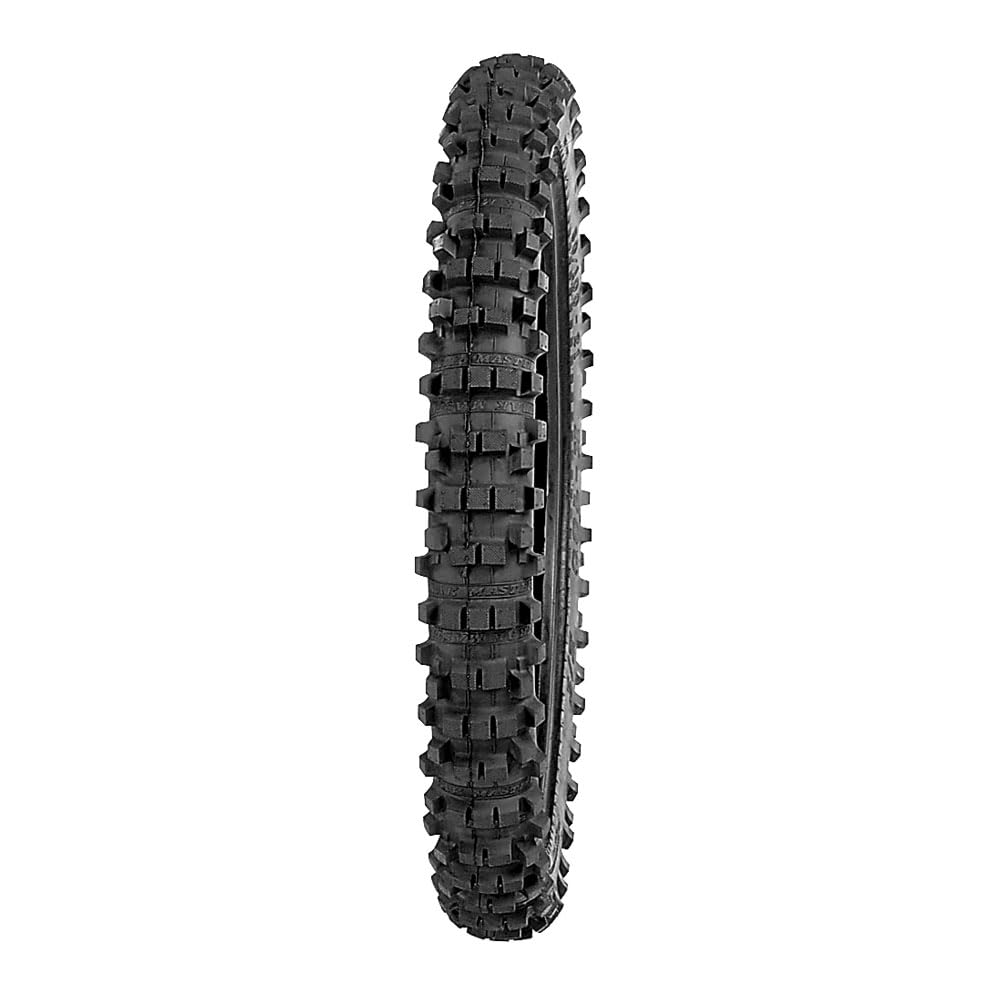
The Kenda K760 Trakmaster has been a staple of the off-road community for years, earning its reputation as a high-value knobby that prioritizes dirt traction over on-road refinement. This front tire is rated 90% dirt and 10% road, meaning the tall, aggressive knobs are spaced wide for maximum bite in loam, sand, and mud. The 6-ply casing keeps weight reasonable while providing enough puncture resistance for rocky trails. The DOT approval means it is street-legal in all 50 states, though the knob squirm on pavement is noticeable.
The Trakmaster’s tread pattern uses a staggered center row that reduces handling vagueness compared to older block-pattern designs. In loose corners, the tire digs in confidently and doesn’t wash out as easily as some bargain off-road tires. On rocks and hard-pack, the tall knobs flex and can feel a bit squirmy under braking, but this is expected behavior from a tire designed primarily for soft terrain.
Where the K760 falls short is on extended road sections. The large knobs wear quickly on asphalt and produce a droning hum at highway speeds. If your enduro loop is mostly trail with short connector roads, the Trakmaster is an excellent choice. If you need to ride 20 miles of highway to reach the trail, a less aggressive dual-sport tire will last longer.
What works
- Excellent bite in loose dirt, sand, and mud
- DOT approved for street-legal dual-sport use
- 6-ply casing offers decent protection at low weight
What doesn’t
- Tall knobs squirm and wear fast on pavement
- Noticeable road noise at highway speeds
- Not ideal for hard-pack or rocky technical terrain
7. Kenda K270 Dual/Enduro Front Motorcycle Bias Tire 3.00-21

The Kenda K270 is the quintessential budget-friendly dual-sport front tire, balancing a 40% dirt and 60% road usage split that prioritizes pavement longevity without giving up too much off-road capability. The 3.00-21 size fits a wide range of dual-sport and enduro bikes from the KLR650 to the XT250, and the tread design uses a semi-knobby pattern that reduces highway squirm while still providing bite on gravel and loose dirt. The 6-ply casing offers a good mix of flexibility and puncture resistance for mixed riding conditions.
Long-term owners consistently report 7,000 to 8,000 miles of rear tire life when paired with a matching K270 rear, with the front lasting even longer due to less drive load. On pavement, the tire tracks straight and doesn’t develop cupping as quickly as knobbier front tires. Off-road, the smaller knobs limit grip in deep mud and loose sand, but for fire roads and hard-pack trails, the K270 is a dependable performer.
Where the K270 is not the right tool is technical single track or wet rocky climbs. The tread pattern lacks the knob height to bite into slimy roots or loose loam. It is a durable, long-wearing commuter tire that happens to also handle fire roads and logging trails. For riders whose enduro loop includes a significant amount of pavement, the K270 delivers the best compromise between road manners and trail capability.
What works
- Exceptional tread life for dual-sport use
- Quiet and stable on pavement at highway speeds
- DOT approved and fits many standard dual-sport bikes
What doesn’t
- Limited off-road grip in mud and loose sand
- Small knobs lack bite on wet rocks and roots
- Not a competitive option for technical single track
Hardware & Specs Guide
Ply Rating and Its Effect on Ride
Ply rating indicates the number of layers (plies) in the tire casing. A higher ply number like 12 translates to a stiffer sidewall that resists pinch flats at low tire pressures but also transmits more trail vibration through the chassis. A 6-ply casing flexes more, offering a plusher ride on trail chatter but with a higher risk of pinching the tube against a sharp edge. Enduro riders who run pressures under 15 PSI should prioritize a 12-ply casing for flat protection.
Tread Pattern Design
Enduro tire treads balance knob height, spacing, and shape to handle mixed terrain. Wide spacing between knobs allows mud to clear, while tall knobs dig into soft ground. Closer spacing creates a more stable footprint on hard surfaces. Directional tread patterns (arrows on the sidewall) must be mounted in the correct rotation to optimize self-cleaning and braking stability. Staggered center knobs reduce handling vagueness compared to block-style patterns.
FAQ
Can I mount a DOT enduro tire on a bike that never sees pavement?
What PSI should I run my enduro tires for trail riding?
How do I know if I need a 6-ply or 12-ply tire casing?
Final Thoughts: The Verdict
For most buyers, the best enduro dirt bike tires winner is the Shinko R525 Cheater because its hybrid trials compound and 12-ply casing deliver unmatched grip on the most demanding rocky and root-infested trails. If you want a complete front-and-rear set optimized for soft-to-intermediate trail riding with excellent flat protection, grab the Tusk EMEX T-35 (21/18 set). And for budget-conscious riders who need a value-packed set that includes inner tubes from the start, nothing beats the WIG Racing 110/90-19 & 80/100-21 combo.

Certification: BSc in Mechanical Engineering
Education: Mechanical engineer
Lives In: 539 W Commerce St, Dallas, TX 75208, USA
Md Amir is an auto mechanic student and writer with over half a decade of experience in the automotive field. He has worked with top automotive brands such as Lexus, Quantum, and also owns two automotive blogs autocarneed.com and taxiwiz.com.