The leap from prop-driven RC planes to electric ducted fan jets is one of the most satisfying moves a pilot can make, but the market is flooded with options that vary wildly in thrust output, build quality, and electronics reliability. Sorting the genuine performers from the underpowered disappointments requires a clear-eyed look at fan efficiency, motor KV ratings, and airframe design — not just marketing claims.
I’m Amir — the founder and writer behind Four Wheel Ask. Over the years I have analyzed hundreds of product specifications, cross-referenced owner-reported performance data, and tracked the reliability patterns of EDF power systems across multiple brands to understand what truly separates a great jet from a frustrating one.
This guide breaks down the top contenders to find the best electric ducted fan rc jets for every pilot skill level.
How To Choose The Best Electric Ducted Fan RC Jets
Selecting the right EDF jet is not just about picking a favorite scale model. Power system compatibility, airframe construction, and your own piloting experience all play a decisive role in whether your first flight ends in triumph or a repair session. Understanding these fundamentals will save you both time and frustration.
EDF Size, KV Rating, and Thrust-to-Weight
The fan diameter — measured in millimeters — directly correlates with the volume of air the unit can move. A 64mm EDF typically generates enough thrust for a lightweight sport jet, while a 90mm fan pushes heavier scale airframes with authority. The KV rating of the motor determines how fast the fan spins under load; higher KV values deliver more top-end speed but draw higher current, requiring a capable ESC and battery. A thrust-to-weight ratio above 1:1 means the jet can accelerate vertically, which is a hallmark of a well-matched power system.
PNP vs. BNF vs. RTF Configurations
Plug-N-Play models require your own receiver, battery, and transmitter, giving experienced pilots the freedom to use their preferred radio gear. Bind-N-Fly includes a receiver pre-bound to specific transmitter families, simplifying setup for pilots already invested in an ecosystem. Ready-to-Fly packages include everything needed to get airborne straight out of the box, making them ideal for newcomers. Your choice here should reflect your existing equipment and willingness to handle initial configuration.
Airframe Materials and Crash Resistance
Molded EPO foam dominates the mid-range market for its combination of light weight and reasonable durability. High-end models sometimes incorporate composite reinforcements or carbon spars to handle higher speeds and G-loads. Cheaper EPS foam is lighter but far more brittle, often shattering on impact. For pilots still mastering landings, EPO with replaceable nose cones and wing tips offers the best balance of repairability and flight performance.
Battery Compatibility and ESC Ratings
Most modern EDF jets run on 4S or 6S LiPo packs, with cell count directly affecting both power output and weight. A 4S 2200mAh pack is a common standard for 64mm and twin 40mm setups, delivering 4-5 minutes of mixed-throttle flying. The ESC must be rated to handle the peak current draw of the motor at full throttle — an underspecified ESC is a common failure point. Always verify that your chosen battery physically fits the bay and that the connector type matches the ESC.
Quick Comparison
On smaller screens, swipe sideways to see the full table.
| Model | Category | Best For | Key Spec | Amazon |
|---|---|---|---|---|
| E-flite F-14 Tomcat | BNF Jet | Scale Enthusiasts | Twin 40mm, Swept Wings | Amazon |
| A-10 Thunderbolt II | PNP Jet | Military Fans | Twin 50mm, 4S Compatible | Amazon |
| FMS Futura 64mm | PNP Jet | Beginner Transition | 64mm 11-Blade, Flaps | Amazon |
| XFLY T-7A Red Hawk | PNP Jet | Intermediate Pilots | 64mm, 4S, Digital Servos | Amazon |
| XFLY Twinliner | PNP Jet | Airliner Fans | Twin 40mm, 4S Compatible | Amazon |
| XFLY F-22 Raptor Twin 40mm | PNP Jet | Military Jet Fans | Twin 40mm, Scale Design | Amazon |
| FLYCOLOR 90mm EDF | Component | Custom Builders | 90mm, 1450KV, Balanced | Amazon |
| DEERC F35 | RTF Jet | Beginners | Brushless, RTF, 2 Batteries | Amazon |
| volantexrc F-16 | RTF Jet | Entry Level | 4CH, Xpilot, RTF | Amazon |
| RCkuler F22 Raptor | RTF Jet | Budget Buyers | 4CH, 3 Batteries, RTF | Amazon |
| GAMRUXI 1:16 RC Car | RC Car | Ground Enthusiasts | 50+ MPH, Brushless | Amazon |
In‑Depth Reviews
1. E-flite F-14 Tomcat Twin 40mm EDF BNF Basic

The E-flite F-14 Tomcat stands as the most ambitious and satisfying EDF model in this lineup, pairing a faithful scale outline with functional variable-sweep wings that actually work in flight. The twin 40mm fan setup with high-RPM outrunner motors delivers sufficient thrust for a model of this size, and the full-flying stabilators provide the pitch authority needed for high-alpha maneuvers. Telemetry data — including real-time battery voltage, current, and RPM — flows back through compatible Spektrum transmitters, giving pilots precise in-flight system monitoring.
Owner feedback consistently praises the fit and finish of the EPO airframe, noting that the wing sweep mechanism operates smoothly without excessive slop. The BNF Basic configuration means you supply your own transmitter, battery, and charger, which works well for pilots already invested in the Spektrum ecosystem. Flight reports indicate that the model tracks well through turns and lands predictably with the wings swept forward, though some owners recommend adding a stabilizer for gusty conditions.
The F-14 is not a beginner model — its complexity and speed demand intermediate to advanced piloting skills. However, for those ready to fly one of the most iconic naval fighters ever built, this EDF delivers an experience unmatched in its price class. The twin fans produce a satisfying turbine-like whoosh that adds to the immersion.
What works
- Functional variable-sweep wings operate cleanly in flight
- Telemetry data provides real-time system monitoring
- Excellent scale fidelity and EPO build quality
- Twin 40mm fans produce authentic turbine sound
What doesn’t
- Requires Spektrum transmitter for full BNF functionality
- Not suitable for novice pilots due to speed and complexity
- Battery and charger not included
2. XFLY A-10 Thunderbolt II Twin 50mm EDF Jet PNP

The XFLY A-10 Thunderbolt II brings one of the most recognizable close-support airframes to the EDF world with a twin 50mm fan arrangement that prioritizes thrust and scale appearance. The updated sprung nose landing gear is a notable improvement over earlier versions, providing better shock absorption during rougher landings and reducing the risk of gear damage. The one-piece reinforced composite wing simplifies installation and removal while adding structural rigidity at higher speeds.
Owners consistently highlight the excellent paint finish and panel line detail, with many noting that the model looks like a museum display piece straight out of the box. The twin 4S-compatible outrunner motors with 12-blade fans deliver solid vertical performance, though the model is heavy enough that it benefits from a 4S 2200mAh pack with a 60C discharge rating for spirited flying. Assembly is straightforward, and the factory-installed digital servos with ball-link linkages provide precise control response.
Flight time on a 4S 2200mAh battery averages around 2.5 to 3 minutes under mixed throttle, which is shorter than the manual suggests but consistent with owner-reported data. This is a jet for intermediate to advanced pilots who appreciate a scale flying experience over outright speed. The A-10’s wide stance and predictable stall characteristics make it more forgiving than many delta-wing EDFs.
What works
- Exceptional scale fidelity with detailed paint and panel lines
- Sprung nose gear improves landing durability
- One-piece composite wing adds rigidity
- Digital servos provide precise, slop-free control
What doesn’t
- Flight time shorter than advertised under real conditions
- Requires high-C rating battery for best performance
- Not suitable for beginners
3. FMS Futura 64mm EDF Sport Jet PNP

The FMS Futura 64mm is engineered specifically as a trainer-friendly EDF, targeting pilots making the transition from propeller planes to ducted fan flight. The 11-blade fan paired with a 2840-KV3150 brushless motor delivers a smooth, turbine-like sound while producing enough thrust for spirited sport flying. The 40A ESC is well-matched to the power system, and the inclusion of functional flaps gives pilots the option to slow down for precise landings — a feature often missing from jets in this class.
Assembly is genuinely glue-free and takes under ten minutes, with the detachable nose cone simplifying battery access and future maintenance. The CNC-machined all-metal landing gear features a shock-absorbing trailing-link design that handles imperfect runway surfaces far better than wire gear. Owners report that the Futura flies predictably with no bad habits, making it a confidence-building step for pilots new to EDFs. The reverse-capable ESC allows the fan to spin backward, helping the jet taxi in tight spaces.
The three available color schemes use water-based paint that holds up well to field use, and the foam construction is durable enough to survive the occasional misjudged approach. While not the fastest jet in this guide, the Futura’s balanced flight envelope and forgiving nature make it one of the most practical choices for pilots serious about progressing into EDF flight without skipping steps.
What works
- Flaps enable slower, more controlled landings
- Glue-free assembly saves time at the field
- CNC metal landing gear absorbs rough landings well
- Reverse ESC function aids ground handling
What doesn’t
- Not the fastest option for experienced jet pilots
- Requires separate receiver, battery, and transmitter
- Paint can chip with rough handling
4. XFLY T-7A Red Hawk 64mm EDF Jet PNP

The XFLY T-7A Red Hawk brings a modern trainer aesthetic to the EDF segment with a 64mm 12-blade fan that delivers strong vertical performance and an impressive turbine-like acoustic signature. The factory-installed digital servos with ball-link equipped linkages provide precise, slop-free control that inspires confidence during high-speed passes. The magnetic top hatch with clear canopy, cockpit detail, and pilot figure adds a level of scale presentation that elevates the overall ownership experience.
Owner reports consistently note that fit and finish are above average for this price point, with clean mold lines and well-seated electronics. The removable landing gear with steerable nose wheel handles paved runways well, though some pilots choose to fly without the gear for cleaner aerodynamics and hand-launch convenience. The recommended 4S 2200-2600mAh battery fits comfortably in the cockpit area, and flight times of around 4.5 minutes are achievable with a mix of throttle settings.
Experienced EDF pilots note that the Red Hawk is not a first jet — it requires familiarity with EDF handling characteristics, particularly during the approach and flare. The aircraft is CG-sensitive, and balancing at or slightly forward of the recommended point is critical for stable pitch response. Owners who take the time to dial in their setup are rewarded with a sharp-flying jet that looks and sounds far more expensive than it is.
What works
- Excellent fit and finish with detailed cockpit
- Ball-link linkages deliver precise control
- Strong vertical performance on 4S
- Turbine-like sound from 12-blade fan
What doesn’t
- CG-sensitive setup requires careful attention
- Not suitable as a first EDF model
- Landing gear can bounce on rough surfaces
5. XFLY Twinliner Twin 40mm EDF Airliner PNP
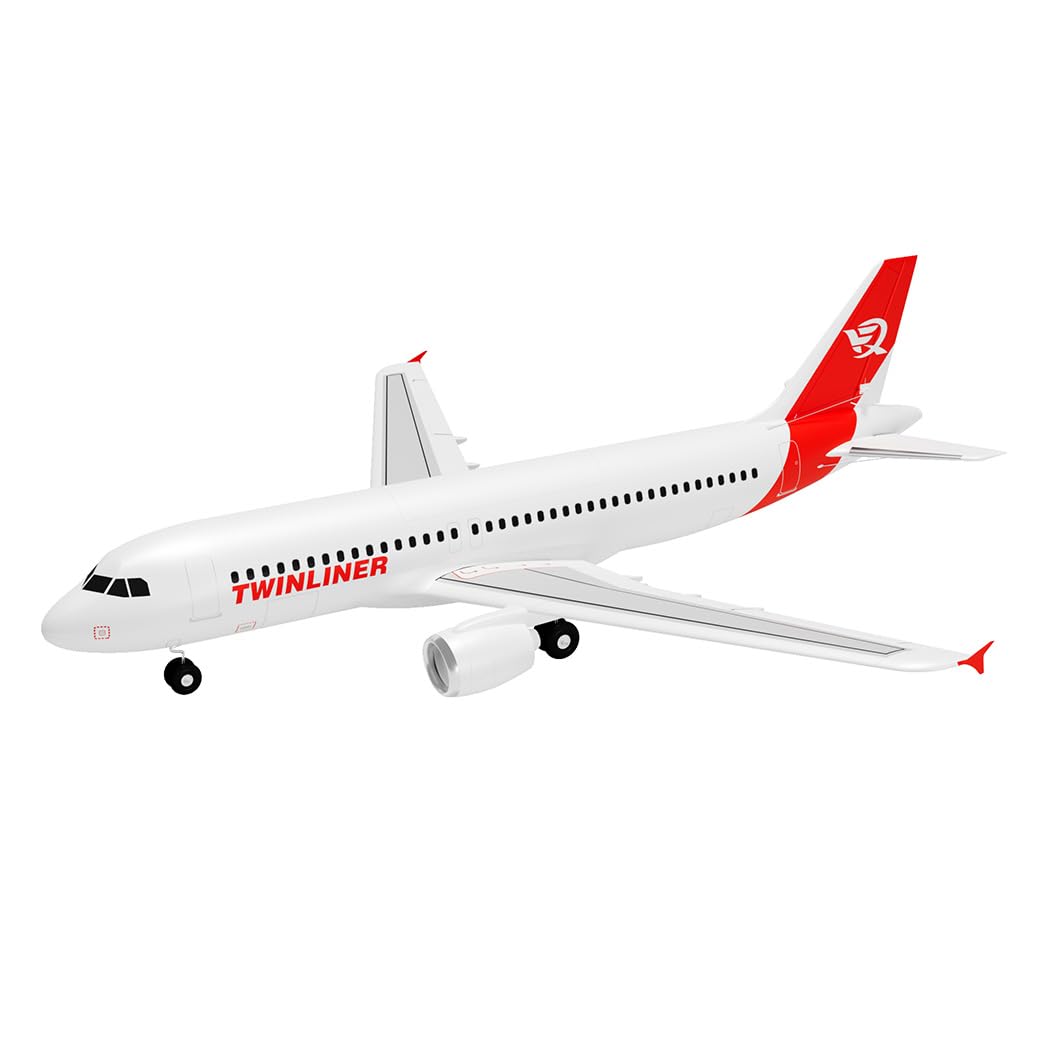
The XFLY Twinliner takes a refreshing detour from the usual fighter jet lineup by offering a twin-engine airliner configuration that stands out at any flying field. The twin 40mm EDF power system delivers an abundance of thrust for comfortable vertical climbs, rolls, and loops — maneuvers that look especially impressive on a commercial airframe. The landing gear with dual wheels provides excellent grip and stability during taxi and takeoff, tracking straight without the wandering tendency of single-wheel setups.
The battery compartment is thoughtfully designed to make CG adjustment straightforward, accommodating 4S packs from 1300mAh to 2600mAh. Flight times range from 5 to 10 minutes depending on throttle management and pack capacity, which is generous for an EDF model. Assembly is quick and requires no glue, with the airframe coming together in clean, well-fitting sections that inspire confidence in the engineering.
Owners who have flown the Twinliner note that it has a commanding presence in the air, with the twin-fan sound adding to the scale illusion. The model handles wind better than its size suggests, and the predictable stall behavior makes it a viable option for pilots moving up from prop-driven trainers. For anyone tired of yet another F-16 or F-22, the Twinliner offers a genuinely different flying experience without sacrificing performance.
What works
- Unique airliner configuration stands out at the field
- Twin fans provide strong thrust and realistic sound
- Extended flight time with larger batteries
- Glue-free assembly simplifies build process
What doesn’t
- Requires separate receiver, battery, and transmitter
- Not ideal for very windy conditions
- Dual-wheel gear adds weight
6. XFLY F-22 Raptor Twin 40mm EDF Jet PNP

The XFLY F-22 Raptor Twin 40mm EDF delivers a streamlined, true-to-scale representation of the world’s premier air superiority fighter. The twin power system provides ample thrust for fast climbs, rolls, and loops, while the low wing loading combined with full-flying stabilators gives the Raptor excellent high-alpha capability — allowing it to pull off nose-high maneuvers that would stall lesser designs. The molded-in finger grips make hand launching straightforward for pilots comfortable with the technique.
Owner feedback highlights the quality of the EPO molding and the clean panel lines that make the model look scale without excessive decal application. The perfectly fitted landing gear design enables smooth takeoffs and landings on paved surfaces, though some owners opt to remove the gear for cleaner aerodynamics and hand-launch-only flying. The recommended 4S battery around 2200-2600mAh fits well within the bay, and flight times of 4-5 minutes are achievable with mixed throttle.
Some experienced owners note that the power system, while adequate for sport flying, lacks the excess thrust needed for unlimited vertical climbs. This is a model that rewards smooth piloting and scale-like flight rather than insane speed. Setup instructions could be clearer regarding receiver installation and mixing, particularly for the full-flying stabilators. Pilots who take the time to configure their radio properly find a jet that tracks beautifully and lands with authority.
What works
- Clean scale lines with excellent EPO molding
- Full-flying stabs enable impressive high-alpha
- Finger grips simplify hand launch
- Smooth landings with correctly fitted gear
What doesn’t
- Limited vertical thrust for advanced maneuvers
- Setup instructions lack detail for stabilator mixing
- Receiver and battery not included
7. FLYCOLOR DD 90mm EDF 12-Blade Ducted Fan with 1450KV Motor

The FLYCOLOR 90mm EDF unit is a component-level upgrade for custom builders who prefer to design their own airframe or retrofit an existing model. The 12-blade fan with 1450KV outrunner motor is dynamically balanced at the factory, resulting in smooth operation across the RPM range with minimal vibration. The maximum continuous current of 124A and peak thrust of 3790 grams on a 6S setup make this a serious power plant for larger scale jets weighing up to around 3.5 kilograms.
The motor features continuous-duty windings with high-temperature resistance, and the silicone wire leads handle the thermal load of sustained full-throttle operation. The removable guide ring design increases compatibility with a variety of airframe intake shapes, and the engineering-grade plastic fan housing maintains structural integrity under high RPM loads. Owners report that the banana plugs are pre-soldered to the motor leads, saving time during installation.
This unit is not a complete aircraft — it is a power system component intended for experienced builders. The recommended 120A ESC and 6S battery represent a significant additional investment, and proper installation requires attention to intake and exhaust ducting for optimal efficiency. Buyers should have a clear understanding of their airframe’s thrust requirements and battery bay dimensions before purchasing. For those who do their homework, this 90mm unit delivers outstanding performance and acoustic character.
What works
- Factory dynamic balancing ensures smooth running
- High 124A continuous current capability
- Removable guide ring for airframe compatibility
- Pre-soldered banana plugs simplify wiring
What doesn’t
- Requires separate airframe, ESC, and battery
- Higher current demands a quality 120A ESC
- Not a complete model — builder skills required
8. DEERC F35 4 Channel Brushless RC Plane EDF Fighter Jet RTF

The DEERC F35 is a Ready-to-Fly EDF jet designed to lower the barrier to entry for pilots wanting to experience ducted fan flight without the complexity of PNP or BNF setups. The 7400KV 1104 brushless motor delivers a thrust-to-weight ratio exceeding 1.2, enabling vertical climbs that impress even experienced pilots. The 6-axis gyro stabilization system offers three levels of assistance, allowing pilots to gradually reduce electronic intervention as their skills improve.
Owner reviews consistently highlight the EPP foam construction as surprisingly durable, with many reporting that the aircraft survived crashes into trees, water, and buildings with minimal damage. The hand-throw and runway takeoff modes provide flexibility depending on your flying site, and the adjustable speed settings mean beginners can fly conservatively while advanced pilots unlock the full performance envelope. The two included 550mAh batteries deliver a combined flight time of approximately 20 minutes, and the 500-foot control range is adequate for most recreational flying.
Some owners report quality control issues with control surface setup, noting that the tail controls may require adjustment before the first flight. The foam construction, while durable, is lighter and less rigid than more expensive EPO alternatives, and the model can be affected by moderate winds. The 3D aerobatic capabilities — including flips, spins, and falling-leaf maneuvers — are genuinely entertaining once the trim is properly set. For the price, this is one of the most accessible EDF experiences available.
What works
- Thrust-to-weight ratio over 1.2 enables vertical flight
- Durable foam survives crashes well
- Two batteries included for extended sessions
- Three-level gyro assists skill progression
What doesn’t
- Quality control on control surfaces varies
- Lightweight foam is affected by wind
- Requires smooth surface for runway takeoff
9. volantexrc 4CH RC Plane F-16 Fighting Falcon RTF
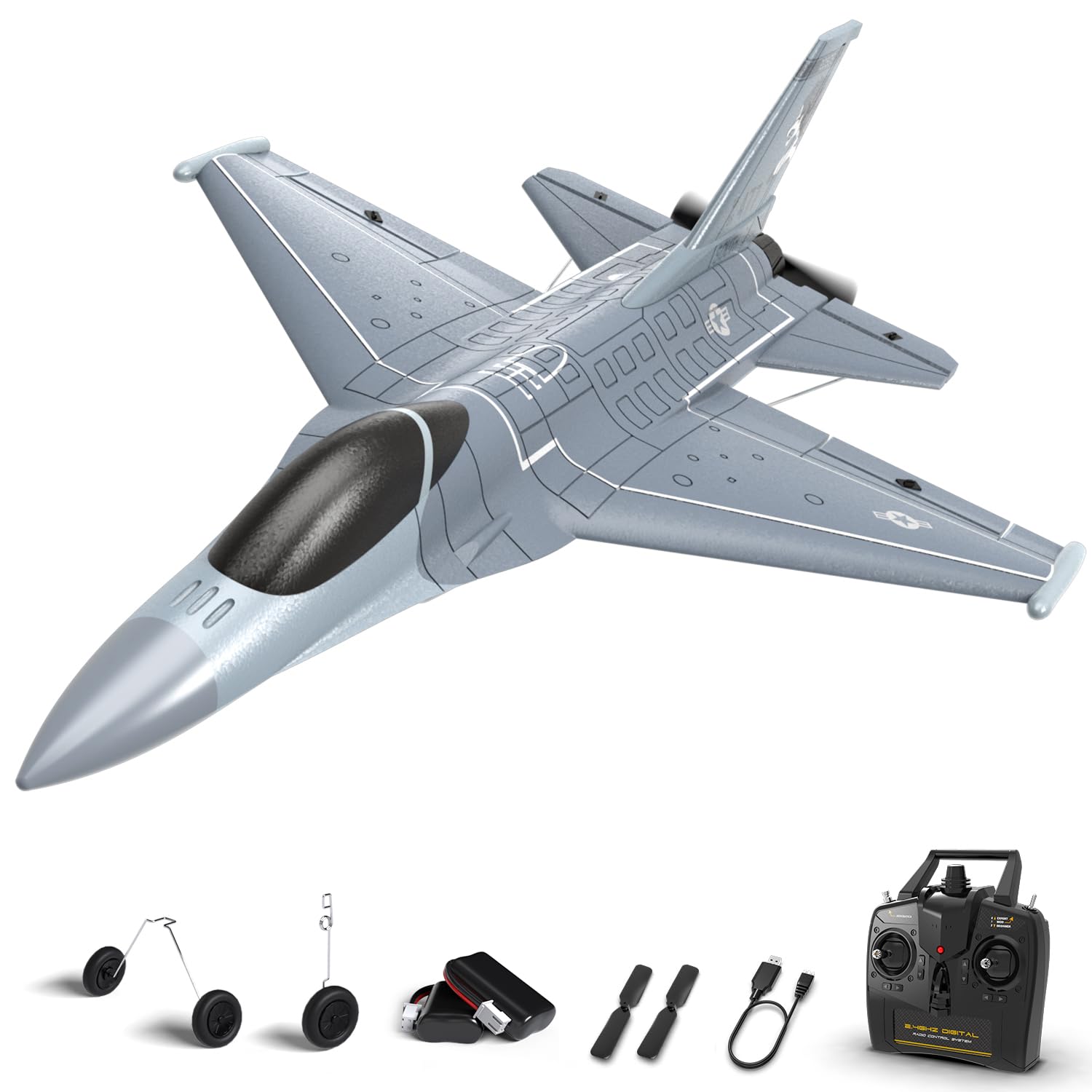
The volantexrc F-16 Fighting Falcon RTF package is purpose-built for newcomers who want a recognizable scale fighter without the technical hurdles of binding receivers or selecting batteries. The Xpilot gyro stabilizer system offers three levels of flight control assistance, from full stabilization for first flights to complete manual control for experienced pilots. The 2.4GHz radio provides a control range of up to 656 feet, and the efficient gearbox-driven power system stretches battery life to an advertised 20 minutes per charge.
The model arrives fully assembled, and getting airborne requires only installing four AA batteries in the transmitter. The EPO foam construction is light enough to keep the wing loading low, which helps newer pilots handle landing approaches with more margin for error. The one-key aerobatic function allows beginners to execute rolls and loops at the push of a button, building confidence before attempting manual aerobatics.
Experienced owners note that this is not a high-performance EDF in the traditional sense — the gearbox system prioritizes efficiency and flight time over raw thrust. The F-16 is best approached as a scale sport flyer that looks great in the air rather than a speed demon. The gray color scheme can be difficult to orient in overcast conditions, and some owners add contrasting decals for improved visibility. For the pilot taking their first steps into EDF flight, this package removes nearly every obstacle to getting airborne.
What works
- Ready-to-fly out of the box with no assembly
- Three-level gyro stabilizer builds pilot confidence
- Long flight time for an EDF model
- One-key aerobatic function simplifies stunts
What doesn’t
- Gearbox system limits raw thrust output
- Gray scheme can be hard to see in low light
- Beginners should expect a learning curve on orientation
10. RCkuler 4CH F22 Raptor Remote Control Airplane RTF
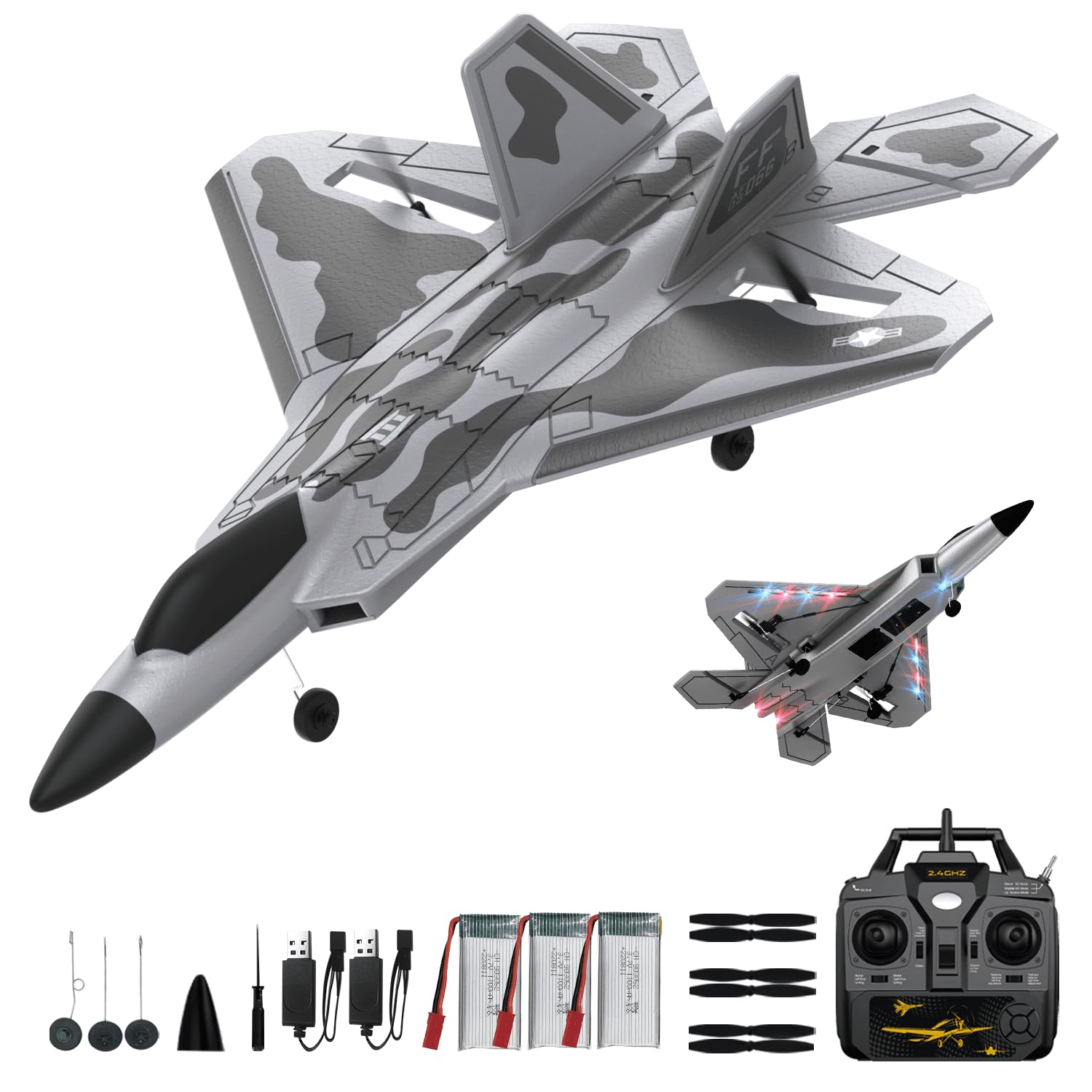
The RCkuler F22 Raptor RTF package delivers an affordable entry point into EDF flight with a strong emphasis on ease of use and extended flying time. The 6-axis gyro stabilization system with three selectable flight modes lets pilots adjust the level of assistance as their skills develop, and the one-key aerobatic function provides instant gratification with rolls and flips. The inclusion of three 1000mAh batteries is a standout feature, providing a combined flight time of approximately 50 minutes across multiple sessions.
The airframe is molded from EPP foam, which offers good flexibility and deformation resistance compared to more brittle materials. The LED light strips add a visual dimension that enhances orientation during evening flights and makes the model more visible against overcast skies. The 14-inch wingspan and 19-inch fuselage length make the F22 compact enough to fly in smaller parks while still presenting a convincing scale silhouette.
Owner feedback indicates that the model handles well in light wind conditions and that the gyro system effectively smooths out turbulence that might challenge an unassisted pilot. The three-level control system genuinely works as advertised, with full assistance mode catching mistakes that would otherwise end in a crash. The included screwdriver, glue, and pry bar suggest the manufacturer expects some repairs, though owners report that the foam holds up well to minor impacts. For the budget-conscious pilot wanting maximum flight time per dollar, this package delivers.
What works
- Three batteries provide exceptional total flight time
- 6-axis gyro with three modes aids learning
- LED lights improve visibility and orientation
- Durable EPP foam handles minor crashes
What doesn’t
- Not suitable for strong wind conditions
- Included tools suggest repairs are expected
- Performance is entry-level, not high-speed
11. GAMRUXI 1:16 Scale Brushless RC Car 50+ MPH
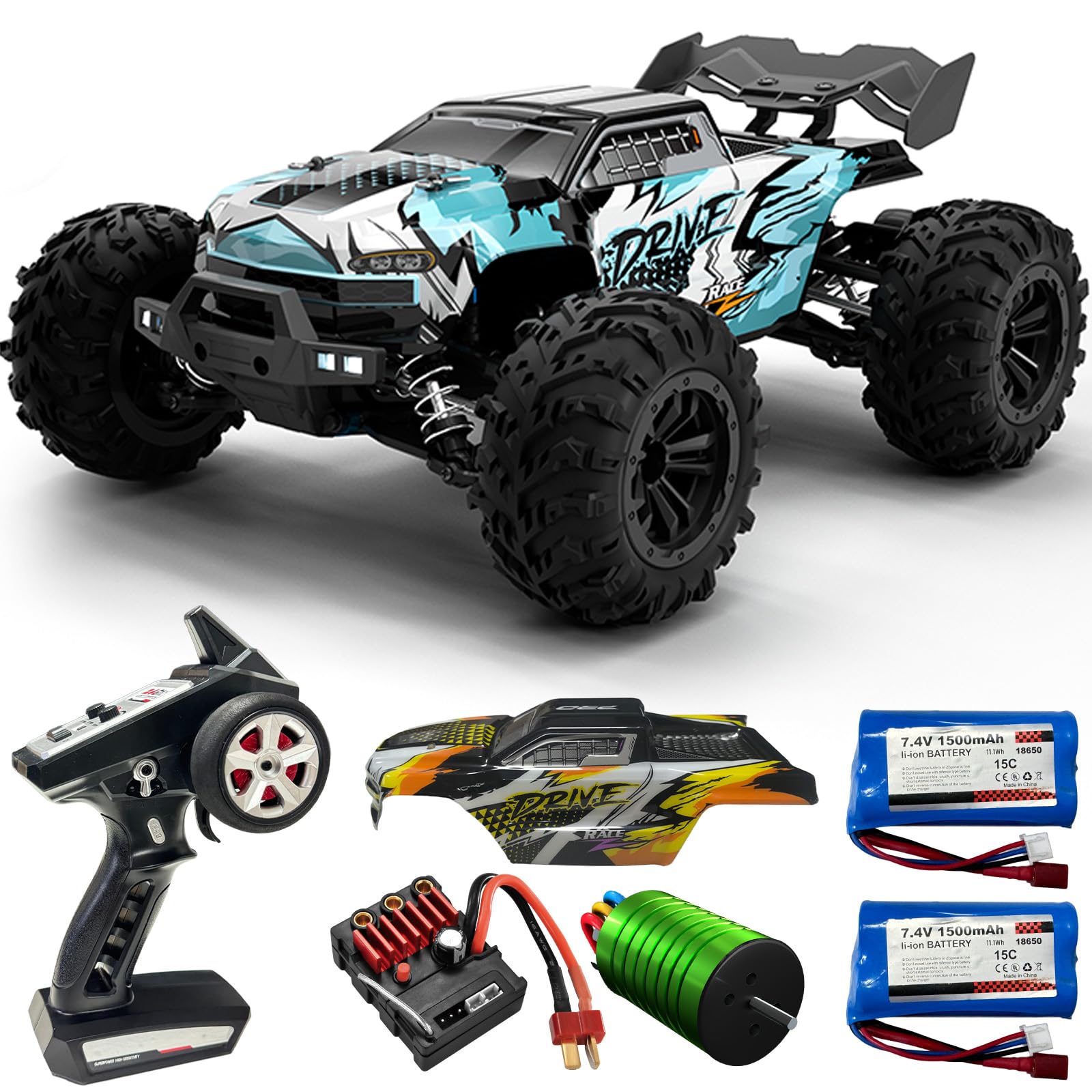
The GAMRUXI 1:16 scale brushless RC car shifts the focus from the skies to the ground, offering a rugged all-terrain monster truck that hits speeds exceeding 50 miles per hour. The 2840 high-torque brushless motor provides rapid acceleration and the full-metal drivetrain components handle the stress of high-speed runs and hard landings. The IPX4-rated waterproof chassis means mud, snow, and shallow puddles are not obstacles but opportunities.
The aerospace-grade ABS frame with aluminum alloy reinforcement bars at critical stress points is designed to withstand drops from up to 15 feet without structural damage. The adjustable hydraulic shocks do an excellent job of absorbing impacts from jumps and rough terrain, keeping the truck planted during high-speed cornering. The 2.4GHz radio system delivers interference-free control up to 300 feet, and the two included 1500mAh 7.4V batteries provide over 50 minutes of combined run time.
This is not an EDF jet — it is a fully independent RC ground vehicle for enthusiasts who want a break from flight or who want a ground-based companion for their flying sessions. The Ready-to-Run package includes everything needed to hit the dirt immediately, and the brushless power system delivers the kind of speed and durability that hobby-grade enthusiasts expect. For pilots who also enjoy RC cars or want a reliable ground vehicle for field support, this is a well-engineered option that punches above its weight class.
What works
- 50+ MPH top speed from brushless system
- Full-metal drivetrain handles high power
- Waterproof chassis enables all-weather running
- Two batteries provide extended run time
What doesn’t
- Not an aircraft — different category entirely
- Requires 3 AA batteries for transmitter
- High speed demands large open spaces
Hardware & Specs Guide
EDF Size and Thrust Ratings
Fan diameter is the primary factor determining how much air the unit moves, which directly translates to thrust. A 40mm EDF typically produces 200-400 grams of thrust, suitable for lightweight micro jets. A 64mm fan generates 600-1000 grams, enough for sport models up to 1.5 kilograms. The 90mm class pushes 1500-4000 grams, supporting heavy scale airframes and vertical performance. Always match the fan size to the all-up weight of your airframe for a thrust-to-weight ratio above 0.8 for sport flying and above 1.0 for aerobatic capability.
Battery and ESC Compatibility
Most modern EDF systems run on 4S (14.8V) or 6S (22.2V) LiPo packs. The cell count determines the voltage available to the motor, with higher voltage enabling higher RPM and thrust at the same current. The ESC must be rated for the peak current draw — a 64mm system typically needs a 40-60A ESC, while 90mm setups often require 120A or more. Always use batteries with a C-rating that can supply the required current; a 2200mAh 50C pack delivers 110 amps continuous, which is adequate for most mid-range EDFs.
Airframe Materials
EPO (Expanded Polyolefin) foam is the gold standard for mid-to-premium EDF models. It is lightweight, holds detail well, and resists impact damage better than cheaper EPS foam. EPP (Expanded Polypropylene) is more flexible and survives crashes with less damage but is heavier and less rigid, affecting high-speed handling. Some high-end models incorporate carbon fiber spars or composite reinforcements to add stiffness without significant weight gain. For beginners, EPO offers the best balance of flight performance and crash survival.
Radio System Requirements
PNP models require a separate receiver and transmitter, giving experienced pilots the flexibility to use their preferred radio system. BNF models include a receiver pre-bound to a specific transmitter family, simplifying setup for pilots already using that ecosystem. RTF models include everything needed to fly immediately. For EDF jets, a minimum of 4 channels (throttle, aileron, elevator, rudder) is required, with 6 channels recommended for models with retractable gear, flaps, or variable-sweep wings. A computer radio with model memory and expo settings greatly improves the flying experience.
FAQ
What does PNP mean in RC jets?
What battery do I need for a 64mm EDF jet?
Is an EDF jet harder to fly than a propeller plane?
How long do EDF jet batteries last per flight?
Can I hand launch my EDF jet?
Final Thoughts: The Verdict
For most buyers exploring electric ducted fan rc jets, the winner is the E-flite F-14 Tomcat because it delivers a unique blend of scale fidelity, functional variable-sweep wings, and telemetry feedback that no other model in this class matches. If you want a durable, trainer-friendly jet with flaps and metal landing gear, grab the FMS Futura 64mm. And for the pilot who values scale presentation and twin-fan performance at a reasonable entry point, nothing beats the XFLY Twinliner.

Certification: BSc in Mechanical Engineering
Education: Mechanical engineer
Lives In: 539 W Commerce St, Dallas, TX 75208, USA
Md Amir is an auto mechanic student and writer with over half a decade of experience in the automotive field. He has worked with top automotive brands such as Lexus, Quantum, and also owns two automotive blogs autocarneed.com and taxiwiz.com.