Wind noise at highway speed is not an annoyance — it is a measured assault on your hearing that begins damaging cochlear hair cells within minutes. Riders who log serious miles know the dull roar inside the helmet is the single fastest path to permanent tinnitus and high-frequency hearing loss, yet many still reach for foam plugs that obliterate every sound except the ringing in their ears. The right earplug preserves the mechanical symphony of your engine, keeps your intercom intelligible, and lets you hear traffic without the punishing decibel spike of wind shear.
I’m Amir — the founder and writer behind Four Wheel Ask. My research focuses on acoustic filter performance, owner-reported fit data across helmet types, and long-term durability patterns drawn from thousands of verified rider reviews.
After analyzing rider feedback and acoustic data, the best earplugs for motorcycle wind noise must reduce fatigue while keeping you alert to traffic.
How To Choose The Best Earplugs For Motorcycle Wind Noise
Selecting a wind-noise earplug is not about grabbing the highest NRR number off the shelf. A plug that over-isolates can mask the growl of a diesel pickup in your blind spot or turn your helmet speakers into muddy distortion. The ideal design delivers enough attenuation to drop wind roar below 85 dB while keeping speech, navigation prompts, and engine pitch clearly audible. Three factors separate a great riding plug from a bad one: filter technology, physical fit under a helmet, and build quality that survives repeated insertion and cleaning.
Acoustic Filter vs. Solid Foam
Foam earplugs attenuate all frequencies uniformly, which is useful for sleeping but dangerous on a motorcycle because it strips away the high-frequency cues you need to judge speed and distance. High-fidelity acoustic filters use a membrane or tuned bore to reduce volume evenly across the spectrum — wind noise drops, but the character of your exhaust and the chirp of a bird remain recognizable. Look for plugs that publish a flat attenuation curve rather than a single NRR number; a 20 dB filter that preserves tonal balance is safer and more comfortable than a 30 dB foam plug that leaves you acoustically blind.
Helmet-Friendly Profile and Stem Height
A plug that protrudes beyond the outer ear will catch on the helmet liner when you pull the chin bar down, dislodging the seal or digging into the anti-inflammatory padding. Low-profile designs with stems shorter than 5 mm sit flush or nearly flush with the ear, allowing the helmet to slide on without interference. Triple-flange or double-cone shapes generally seat deeper into the ear canal than mushroom-style plugs, which improves retention when you turn your head at speed or chew gum during a long tour.
Intercom and Speaker Compatibility
Riders who rely on a Cardo or Sena system need plugs that do not crush the high frequencies required for voice intelligibility. Filters with a gentle roll-off above 4 kHz are ideal because they cut wind hiss without making your riding partner sound like they are talking through a pillow. Some premium plugs ship with multiple filter sets — a moderate filter for around-town commuting and a stronger one for slab work. Verify that the filter cap does not add height that pushes the plug outward into the speaker pod.
Durability and Hygiene
Reusable earplugs accumulate earwax, road grime, and helmet sweat. Medical-grade silicone or TPE materials resist degradation from UV exposure and alcohol wipes better than PVC or thermoplastic rubber. Plugs that include a vented aluminum carry case with a carabiner encourage consistent use — riders who store plugs loose in a jacket pocket tend to lose them after three rides. Look for models with a removal tab or grip ring; tiny slick plugs are difficult to extract when your fingers are cold or gloved.
Quick Comparison
On smaller screens, swipe sideways to see the full table.
| Model | Category | Best For | Key Spec | Amazon |
|---|---|---|---|---|
| Alpine MotoSafe Pro | Premium Filter | Dual-attenuation touring | 20 dB SNR, 2 filter pairs | Amazon |
| EARPEACE Moto | Performance | Adjustable wind reduction | 26 dB max, 3 filter sets | Amazon |
| SureFire EP4 | Tactical | Helmet & comms use | 24 dB NRR, EarLock rings | Amazon |
| Alpine MotoSafe Tour | Touring | Long-haul comfort | 17 dB SNR, hypoallergenic | Amazon |
| Pinlock Motorsport | Custom Fit | Deep-canal seal | 24 dB NRR, TPE material | Amazon |
| Eargasm High Fidelity | Premium | Sound-quality purists | 21 dB reduction, aluminum case | Amazon |
| softvox Moto Lanyard | Convenience | Easy on/off under helmet | 27 dB, magnetic lanyard | Amazon |
| softvox 2-Pair Set | Value | Spare pair for daily riders | 27 dB, aluminum case | Amazon |
| Mumba High Fidelity | Entry | Budget-conscious commuters | 24 dB NRR, 4 tips | Amazon |
| Mack’s Hear Plugs | Budget | Doctor-recommended starter | 12 dB NRR, TPE flanges | Amazon |
| Ear-Goes X27 | Versatile | Multi-environment use | 27 dB, dual cases | Amazon |
In‑Depth Reviews
1. Alpine MotoSafe Pro
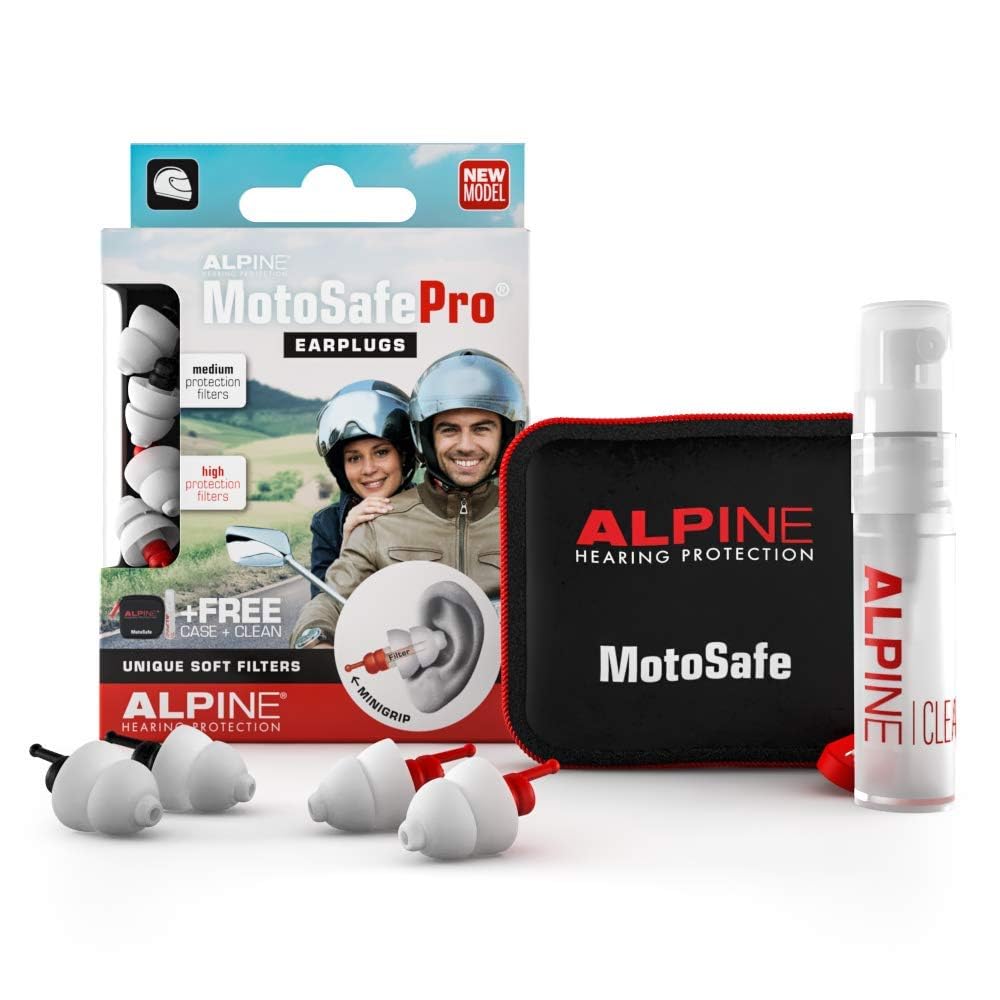
The MotoSafe Pro is Alpine’s most versatile riding plug, shipping with two filter pairs — a black set for moderate attenuation and a red set for maximum wind cut. Owner reports indicate the red filters drop highway roar to a distant hum while leaving exhaust note and Cardo audio clearly legible, making this the best single solution for riders who split time between city streets and open highway.
The patented AlpineThermoShape material softens at body temperature to conform to the ear canal without the pressure points common in harder silicone plugs. Multiple long-distance riders note that the plugs stay comfortable for six-plus hours and do not loosen when the helmet is donned or removed. The mini-grip extraction tab is well-sized for gloved fingers.
Riders with loud aftermarket exhausts should test both filter sets before committing to a long ride — a minority report that the red filters make a boomy pipe sound oppressive inside the helmet, though most find the acoustic balance natural. The included aluminum case is compact enough for a jeans coin pocket.
What works
- Two attenuation levels let you tune for commute vs. highway
- ThermoShape material improves comfort on all-day rides
- Intercom speech remains clear even with red filters inserted
What doesn’t
- Red filters may emphasize low-frequency exhaust boom in some helmets
- Single pair offering — no spare for passengers or backup
2. EARPEACE Moto

EARPEACE Moto stands out for its swappable filter system that offers three attenuation tiers — Medium, High, and Max — letting riders dial in exactly how much wind they want to silence. The double-cone silicone body sits deep enough to avoid helmet interference while maintaining a consistent seal even during aggressive head checks. Owner feedback consistently highlights the Max filters as nearly eliminating wind roar at 70 mph while keeping Sena and Cardo voices crisp.
A side-by-side test reported by a long-distance touring rider found EARPEACE outlasted high-end foam plugs during a 3,000-mile trip: the foam degraded in heat and let wind noise creep in, while the silicone EARPEACE set held attenuation steady across all conditions. The aluminum carry case has a positive-lock lid that does not pop open in a tank bag.
Some riders with small ear canals find even the included Small body slightly bulky, and the filter caps add a small amount of visible protrusion that may contact certain helmet liners. The three-filter approach is excellent, but the cost of replacement filters adds to the long-term ownership expense.
What works
- Three attenuation levels provide precise tuning for any riding condition
- Outlasts foam on multi-day tours without degradation
- Intercom clarity improves because wind hiss is reduced selectively
What doesn’t
- Small ear size may still feel loose for some anatomies
- Replacement filters require ongoing investment
3. SureFire EP4 Sonic Defenders Plus

SureFire’s EP4 builds on a decades-old military design philosophy — a triple-flange stem with seven-point EarLock retention that keeps the plug seated when you are twisting through corners or lifting the visor at triple-digit speeds. The patented filter cap can be opened to allow ambient sound through, though riders report the open position introduces a whistle at highway pace that makes it impractical for motorcycling.
The medical-grade polymer is noticeably firmer than the silicone used by Alpine or EARPEACE, which provides a more predictable insertion depth but can cause pressure points during rides longer than three hours. Low-profile stems sit flush enough to avoid most helmet liner contact, and the audible seal check — you hear a distinct pop when the flanges seat — gives immediate confidence that the plug is working.
Owners who use the EP4 for both shooting and riding appreciate the dual-purpose design, but the firmer material means you must find the exact right size. The medium is the default, and riders between sizes may need to experiment with the included small tips or purchase a different variant.
What works
- EarLock rings provide industry-best retention under helmet movement
- Triple-flange design seals deeply without excessive insertion force
- Open-filter mode useful for pit stops and gas station conversations
What doesn’t
- Firm polymer causes ear fatigue on marathon rides
- Open filter whistles audibly at freeway speeds
4. Alpine MotoSafe Tour
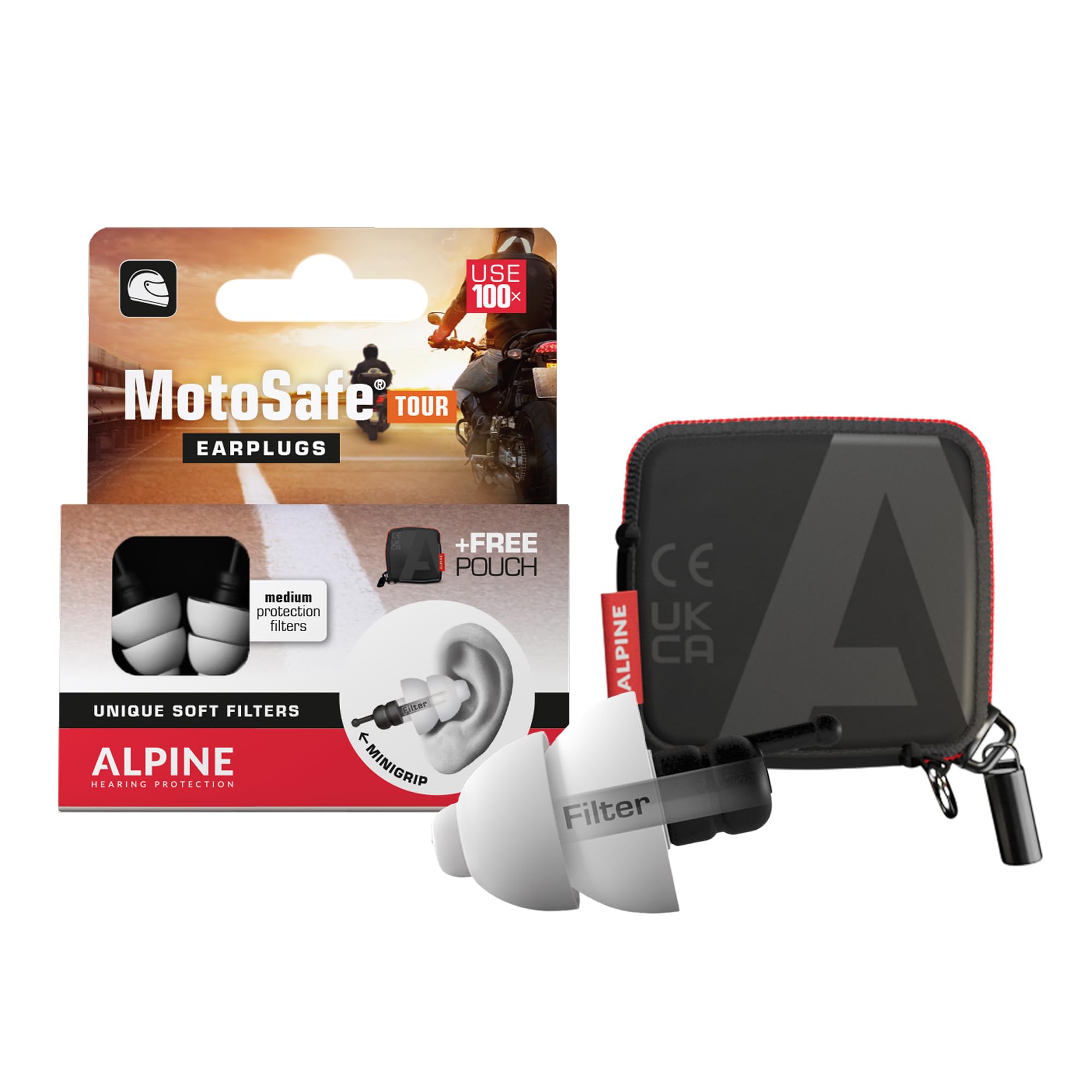
The MotoSafe Tour is the more accessible sibling of the Pro, using the same AlpineThermoShape material and acoustic filter philosophy but offering a single attenuation level rather than a swappable pair. With 17 dB SNR, it targets the touring rider who wants to take the edge off wind roar without losing connection to the road environment. Owner reports indicate the plugs reduce fatigue on eight-hour interstate days without muting the mechanical feedback from a shaft-drive BMW or a V-twin cruiser.
Comfort is the defining strength. Multiple reviews describe forgetting the plugs are in after 30 minutes, a testament to the material’s low irritation profile. The conical shape fits a broad range of ear canals, and the applicator tool helps achieve consistent depth without over-insertion. The carry case is identical to the Pro version — a small, durable aluminum pod with a carabiner.
The single filter cannot be changed, so riders who encounter sudden wind shifts or variable noise environments have no on-the-fly adjustment. A very small number of owners on loud-advancer bikes report the 17 dB reduction is insufficient to prevent post-ride tinnitus.
What works
- Excellent all-day comfort with zero pressure points
- Natural sound profile preserves engine and traffic cues
- Good entry price for Alpine build quality
What doesn’t
- 17 dB may not suffice for very loud exhausts or extreme wind
- No way to increase attenuation without buying the Pro model
5. Pinlock Motorsport Earplugs

Pinlock, best known for anti-fog visor inserts, brings the same optical precision to hearing protection with a three-flange TPE design that seats much deeper than the average motorcycle plug. The deep insertion is the key advantage — the plug sits far enough inside the ear canal that the helmet liner never touches the stem, eliminating the dislodging issue that plagues shorter plugs. Riders report consistent 24 dB attenuation with no noticeable drop-off after hours of wear.
The two included sizes (standard and small) cover most adult ear anatomies, though the small variant is genuinely small — riders who normally use medium foam plugs will likely need the standard size. The lack of a removal tab or grip ring makes extraction slightly fiddly, especially with gloves on, though the deep seat means you have something to pinch if you reach carefully.
Acoustic performance is tuned for motorsport: wind noise is heavily suppressed while voices and intercom remain surprisingly intact. A minority of owners on adventure bikes found the reduction insufficient against extreme crosswind buffeting, but the majority report it as a major upgrade over foam alternatives.
What works
- Deep-canal fit prevents helmet interference completely
- TPE material is durable and easy to clean
- Natural sound balance keeps comms intelligible
What doesn’t
- No extraction tab makes gloved removal tricky
- May not attenuate enough for extreme adventure-touring conditions
6. Eargasm High Fidelity

Eargasm has built a strong reputation in the live-music community, and that acoustic pedigree translates directly to motorcycle use. The proprietary attenuation filter reduces volume by 21 dB with a nearly flat frequency response — wind shear loses its sting while your bike’s intake roar and your riding buddy’s voice maintain their natural character. Riders who use high-end cardo systems report that music and phone calls are noticeably clearer than with foam plugs because the filter cuts the masking effect of wind noise without crushing the midrange.
The silicone shell is available in two sizes, and the included aluminum case is machined with a waterproof gasket that genuinely keeps plugs dry in a downpour. Owners consistently praise the build quality and the company’s customer service, and the aesthetic — clear shells with a blue filter — is one of the more discreet options on the market.
The 21 dB ceiling is lower than some dedicated motorcycle plugs, which means riders on exceptionally loud bikes or those riding through sustained 80 mph headwinds may want more attenuation. The price point is also the highest on this list, reflecting the premium materials and brand positioning rather than any functional advantage for extreme wind scenarios.
What works
- Flat frequency response preserves music and vocal clarity
- Waterproof aluminum case is genuinely protective
- Two shell sizes improve fit reliability
What doesn’t
- 21 dB may not be enough for extremely loud wind environments
- Premium price does not correspond to higher attenuation
7. softvox Motorcycle Ear Plugs with Lanyard
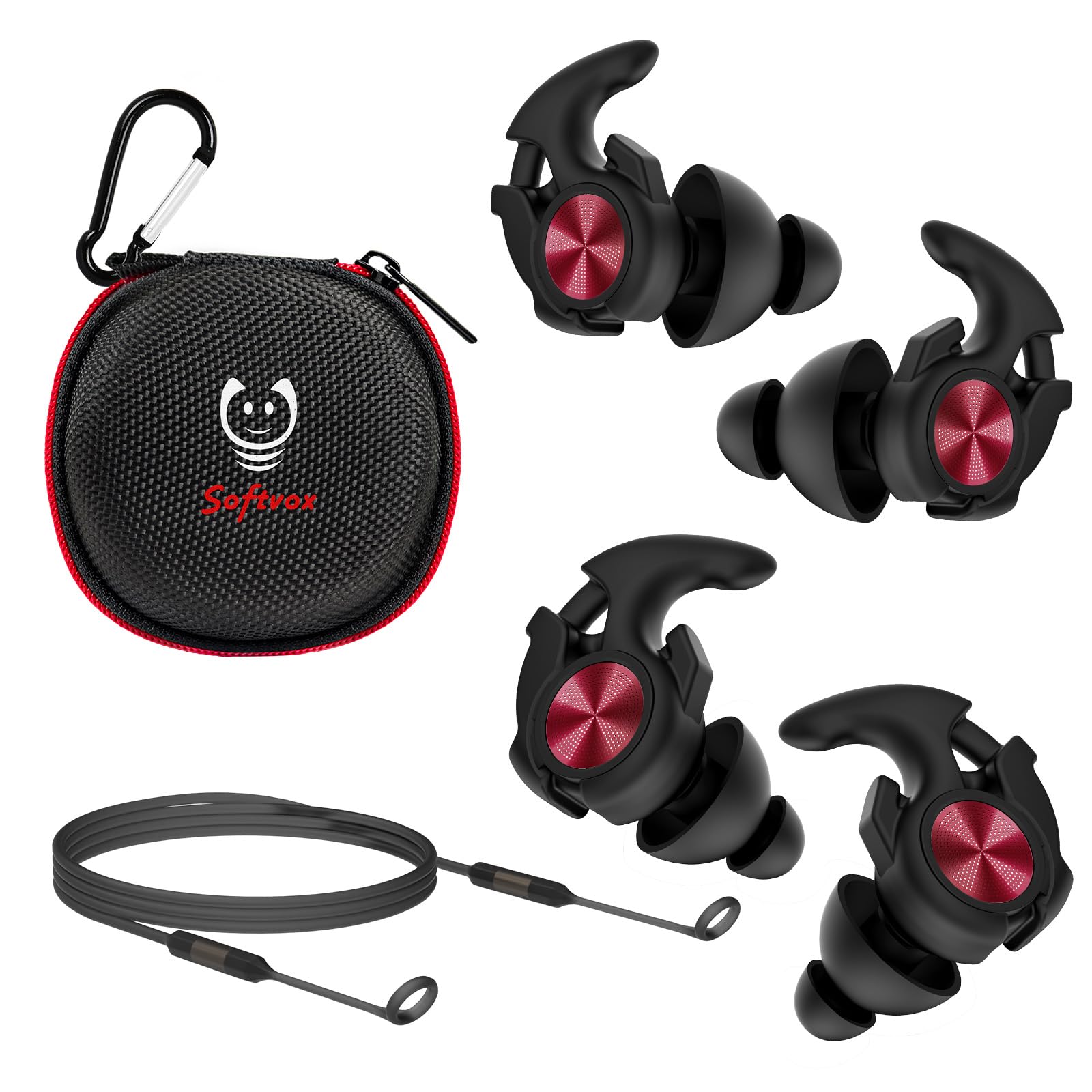
The softvox lanyard model is purpose-built for riders who frequently remove and reinsert their plugs at gas stops or toll booths. The detachable silicone cord uses a magnetic connector that snaps together securely enough to stay put at speed but releases with a light tug if the cord snags on a handlebar. The dual-flange design with a semi-curved earhook provides a stable seal that rider reports confirm stays seated under a full-face helmet even during aggressive head movement.
Two size pairs (S and L) are included, and the 27 dB rating places this among the higher-attenuation options on the list. The filter is tuned to reduce wind roar while preserving engine and communication frequencies, though some owners note that the cord can be felt against the neck on hot days when riding without a buff or balaclava. The lanyard also keeps the plugs clean when they hang around your neck at a rest stop.
Instructional material is sparse — several buyers mention the lack of a clear insertion guide, and new users may need a few tries to find the correct orientation. The earhook shape requires a specific rotation to seat properly, and forcing it in the wrong angle can cause discomfort.
What works
- Magnetic lanyard prevents loss during quick on/off cycles
- 27 dB provides substantial wind noise reduction
- Two size pairs improve fit odds
What doesn’t
- No printed instructions — insertion technique is guesswork
- Cord can feel warm or annoying against bare neck skin
8. softvox Motorcycle Ear Plugs 2-Pair Set
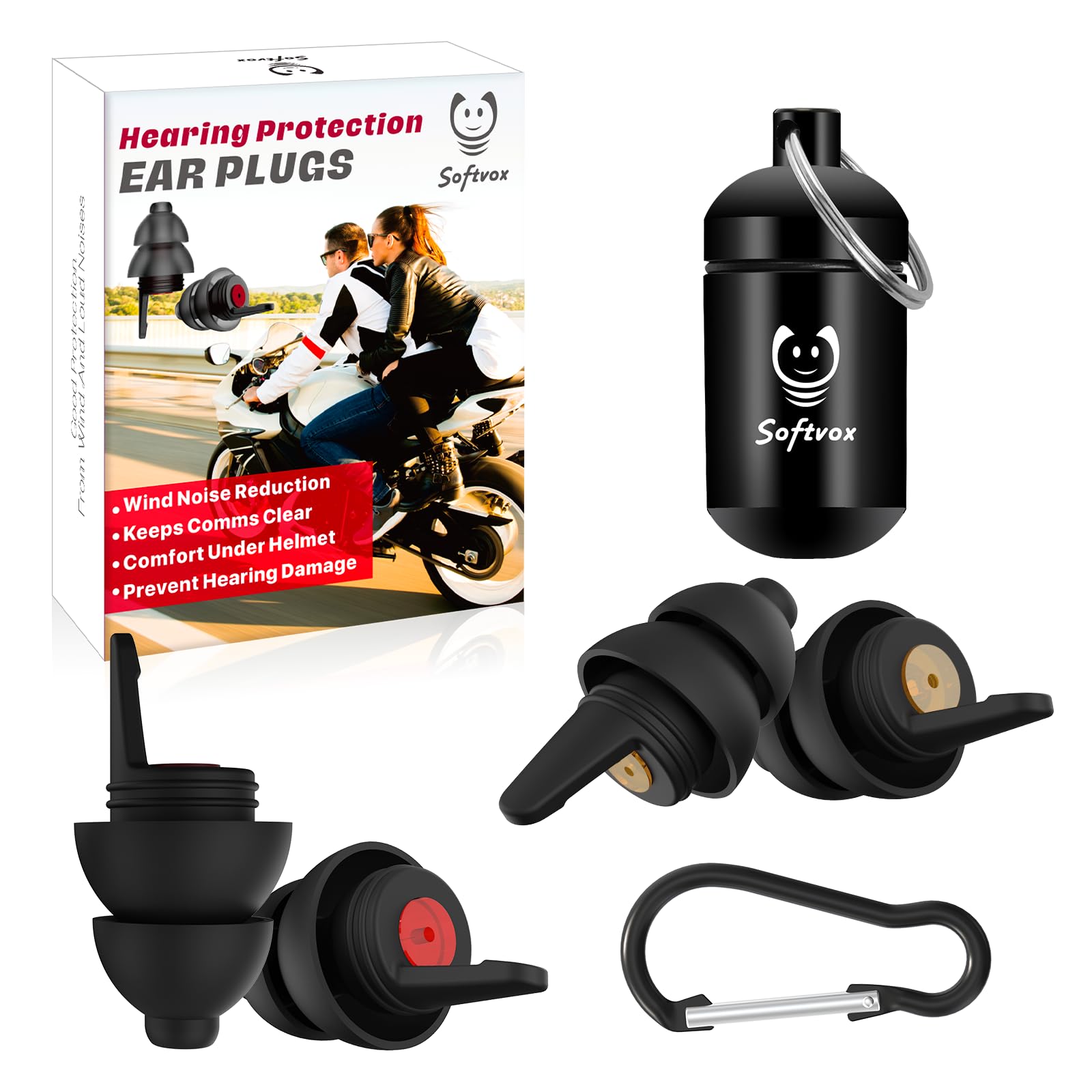
This softvox offering bundles two pairs of dual-flange plugs in a single package, making it an ideal solution for riders who want a backup set or ride two-up. Each pair uses the same 27 dB filter found on the lanyard model, and the dual-flange silicone body is identical in geometry, so the fit and seal are consistent. Owner reports confirm the plug reduces wind roar at 55 mph and above to a manageable level that allows music and GPS prompts to remain clear without needing maximum volume.
The aluminum case with a carabiner is identical to what you would get with premium brands at nearly twice the price, and the pull tab is well-designed for gloved extraction. Multiple riders on loud Harley-Davidson models with aftermarket exhausts report the plugs keep the ride comfortable without muffling the engine character to the point of losing situational awareness.
The dual-flange design can loosen slightly when the rider smiles or flexes the jaw muscles — a few owners mention needing to reseat the plug after a long conversation at a rest stop. The spare pair in the package mitigates the risk of total loss if one plug falls out during a helmet removal.
What works
- Two pairs provide redundancy and passenger coverage
- 27 dB attenuation handles loud pipes and highway wind
- Aluminum case is robust and pocket-friendly
What doesn’t
- Flanges may unseat during facial movement
- Dual-flange depth may not suit very narrow ear canals
9. Mumba High Fidelity Concert Earplugs

Mumba positions its high-fidelity plug as a concert accessory, but the 24 dB NRR filter and triple-flange silicone design translate well to motorcycle duty. The kit includes four tips — two standard and two small — to accommodate a wider range of ear canal sizes than most dedicated riding plugs. Riders who have tested them under a helmet report comfortable fit with no helmet rub and noise reduction that cuts the harsh edge of wind without turning the ride into a muffled experience.
The clear, low-profile shell is nearly invisible when worn, and the aluminum keychain case is identical in concept to premium offerings at three times the price. Owner reviews consistently mention the lack of occlusion effect — that plugged-up, hollow sound that many foam and silicone plugs create — which makes the Mumba plug feel more natural during long rides. The removal tab is elongated enough for easy gloved extraction.
Acoustic performance is tuned for music fidelity rather than wind-specific filtering, so the attenuation curve may not be optimized for the frequency profile of wind shear. Riders on very loud motorcycles may find 24 dB insufficient, though for standard highway riding on a moderately quiet bike, the Mumba plug delivers respectable performance at an entry-level price.
What works
- Four tip sizes provide excellent fit customization
- No occlusion effect makes the ride feel natural
- Included keychain case is convenient and durable
What doesn’t
- Music-tuned filter may not be ideal for wind noise specifically
- 24 dB ceiling limits usefulness for extreme noise environments
10. Mack’s High Fidelity Hear Plugs

Mack’s is the most widely recommended earplug brand by ENT doctors, and the Hear Plugs model uses a patented open-air membrane filter that reduces noise by 12 dB while maintaining a remarkably natural sound signature. For riders who find 20+ dB plugs too isolating, the Mack’s design allows wind roar to be tamed without feeling like you are riding in a sensory vacuum. The medical-grade TPE material is hypoallergenic and soft enough for extended wear.
The kit includes two tip sizes to accommodate small and medium ear canals, and the aluminum case is built to the same standard as more expensive competitors. Owner feedback indicates that the 12 dB reduction is sufficient for around-town commuting and moderate highway speeds but will not be enough for riders who spend hours at 80 mph on a bike without a windscreen. The plugs are also effective for concerts and sporting events, giving them dual-duty utility.
The low attenuation is the primary trade-off — 12 dB is a mild reduction by motorcycle standards, and riders transitioning from foam plugs may be disappointed by how much wind noise remains. Mack’s position as a medical brand means the focus is on hearing safety rather than extreme isolation, which aligns with commuter use but not hard-core touring.
What works
- Doctor-recommended material safety and hypoallergenic design
- Natural sound quality with minimal occlusion
- Excellent for riders who want mild reduction without isolation
What doesn’t
- 12 dB is too mild for sustained high-speed touring
- Single pair offering with no replacement filters available
11. Ear-Goes X27 Reusable Earplugs
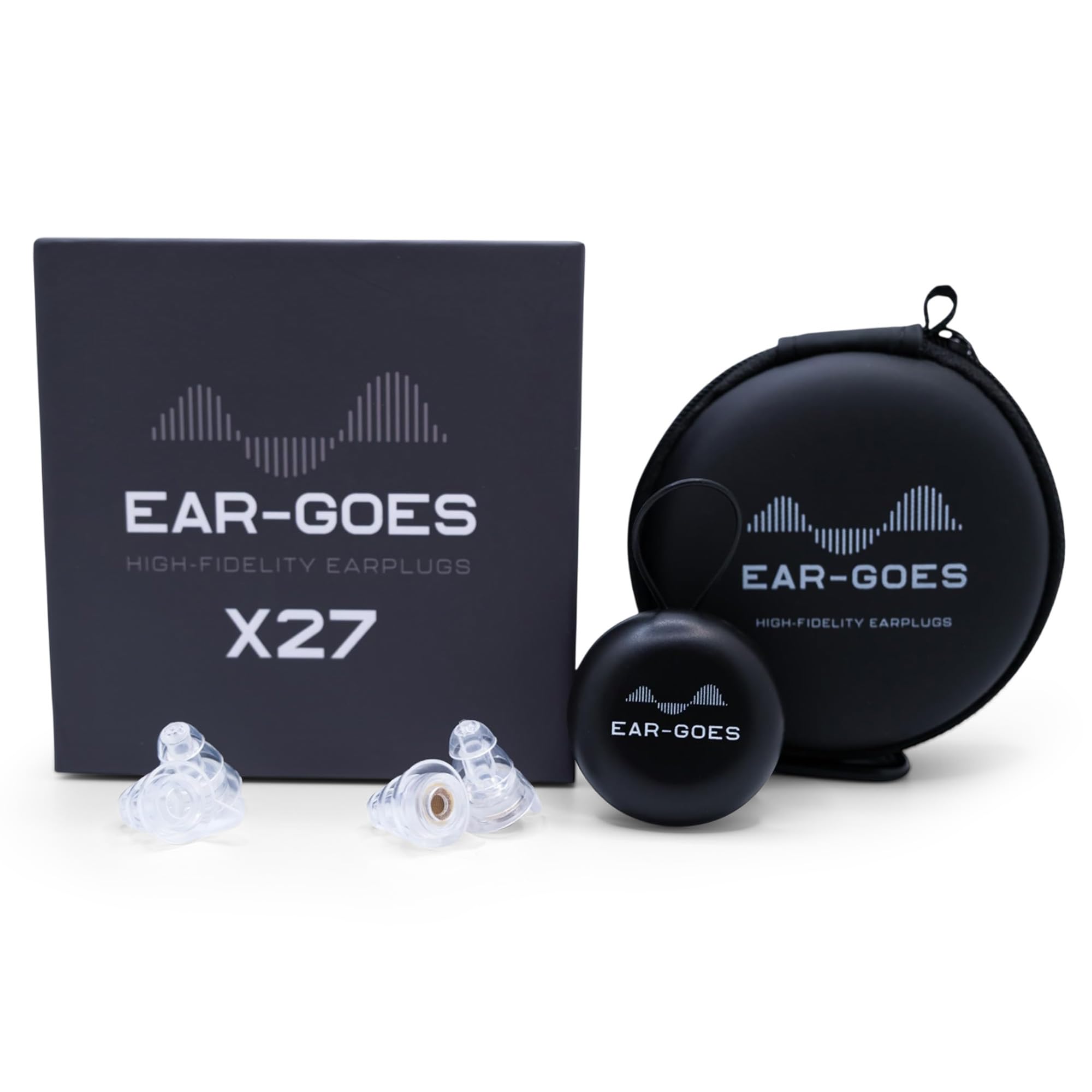
The X27 from Ear-Goes is marketed primarily toward aviation and live-sound users, but its 27 dB high-fidelity filter and dual silicone tip sizes make it viable for motorcycle wind-noise reduction. The attenuation curve is designed to be flat — wind roar drops evenly without hollowing out the midrange where intercom speech lives. Riders who need a plug that can transition from the bike to a concert or a noisy hotel room will appreciate the versatility.
The kit includes two carrying cases: a compact keychain pod and a premium storage box. The silicone tips are soft and form a reliable seal with minimal insertion force, and the low-profile stem sits flush enough to clear most helmet liners. Owner reports from the live-sound community confirm the plugs stay comfortable for hours, which bodes well for all-day saddle time.
Motorcycle-specific feedback is limited because the product is relatively new and has not been widely tested by the riding community. The absence of a removal tab makes extraction slightly fiddly — the smooth silicone body can be slippery with sweaty fingers. Riders with very large ear canals may find the included Large tip still slightly undersized for a perfect seal.
What works
- 27 dB flat attenuation preserves speech and music clarity
- Dual carrying cases provide backup storage options
- Soft silicone tips are comfortable for extended wear
What doesn’t
- Motorcycle-specific testing data is still limited
- Smooth body is hard to grip for removal without a tab
Hardware & Specs Guide
Noise Reduction Rating (NRR) vs. SNR
NRR is the U.S. standard measured in a lab with a test fixture; real-world attenuation is typically 50-70% of the rated value. SNR is the European equivalent using a different test protocol. A plug rated 24 dB NRR will deliver roughly 14-17 dB of actual reduction on a rider’s head, with wind noise at 100+ dB requiring at least 20 dB of real-world attenuation to bring levels below the 85 dB threshold where hearing damage begins.
Flange Geometry and Insertion Depth
Single-flange plugs seal at one point and are prone to leakage when the jaw moves. Triple-flange designs create three sequential seals, which improves consistency but requires deeper insertion — typically 8-12 mm into the ear canal. Double-cone designs sit at an intermediate depth and are generally more comfortable for riders who find triple-flange plugs intrusive. Measured insertion depth is more predictive of real-world attenuation than flange count.
Acoustic Filter Materials
Membrane filters use a thin diaphragm that vibrates to reduce amplitude across all frequencies, producing a flat attenuation curve. Bore-type filters use a precisely machined channel that creates acoustic resistance through friction — these tend to have a slight high-frequency bias that can make wind hiss sound more prominent. Membrane designs are generally preferred for motorcycle use because they do not alter the tonal balance of engine and traffic sounds.
Carrying Case Ergonomics
The difference between a plug you use consistently and one that stays in a drawer is often the case. Keychain-compatible aluminum pods with a carabiner encourage carry-on-person storage. Vented cases allow moisture to evaporate between rides, reducing bacterial growth. Cases with a positive-lock lid prevent the pod from opening inside a jacket pocket or tank bag — a magnetic or friction-fit lid is a reliability risk in a motorcycle environment.
FAQ
Can I wear earplugs with a helmet intercom system?
What NRR rating do I need for highway motorcycle riding?
How often should I replace reusable motorcycle earplugs?
Will earplugs make it harder to hear emergency vehicles or traffic?
Can I use foam earplugs for motorcycle riding?
Final Thoughts: The Verdict
For most buyers, the earplugs for motorcycle wind noise winner is the Alpine MotoSafe Pro because its dual filter system lets you match attenuation to the day’s route while the ThermoShape material delivers all-day comfort under any helmet. If you want the flexibility of three attenuation levels, grab the EARPEACE Moto. And for riders who prioritize deep-canal fit and helmet clearance above all else, nothing beats the Pinlock Motorsport.

Certification: BSc in Mechanical Engineering
Education: Mechanical engineer
Lives In: 539 W Commerce St, Dallas, TX 75208, USA
Md Amir is an auto mechanic student and writer with over half a decade of experience in the automotive field. He has worked with top automotive brands such as Lexus, Quantum, and also owns two automotive blogs autocarneed.com and taxiwiz.com.