An e-bike computer is more than a speed readout — it is your command center for navigation, performance tracking, battery awareness, and route discovery. Choosing the wrong unit means squinting at a dim screen, losing signal mid-ride, or running out of power before your legs do.
I’m Amir — the founder and writer behind Four Wheel Ask. I have spent years analyzing product specifications, comparing build quality across price tiers, and aggregating real owner feedback to separate the reliable performers from the overhyped disappointments.
Whether you commute daily or tackle century tours, understanding which features actually matter under real riding conditions helps you avoid costly mistakes. best e-bike computer choices depend on screen clarity, satellite lock speed, battery endurance, and ecosystem compatibility — not just listed specs.
How To Choose The Best E-Bike Computer
E-bike computers have evolved from simple speed displays to full-featured navigation and training platforms. Knowing where to focus your budget requires understanding a few critical factors that determine daily usability and long-term satisfaction.
Satellite Positioning and Acquisition Speed
Multi-band GNSS support (GPS, GLONASS, Beidou, Galileo, QZSS) directly affects how quickly the device locks your location and how accurate the track remains under tree cover or near tall buildings. A computer that takes more than 30 seconds to acquire a signal will frustrate you before every ride. Look for AGNSS support, which pre-loads satellite almanac data via WiFi or Bluetooth for near-instant locks — some units achieve this in as little as five seconds.
Battery Life and Charging Convenience
Manufacturer battery claims often assume ideal conditions with no backlight and limited sensor use. Real-world endurance depends on screen brightness, GPS logging interval, and connected sensor count. A unit rated for 20 hours may deliver only 14 with a bright display and ANT+ sensors running. USB-C charging is now standard on most modern models, but some budget units still rely on older micro-USB — something to check if you want to carry one cable for both your computer and phone.
Navigation Capability and Map Quality
Not all navigation is equal. Basic units offer breadcrumb-style track lines with turn prompts, while premium models provide full color maps with points of interest, street names, and automatic rerouting if you deviate from the planned route. If you explore unfamiliar roads or trails frequently, a unit with downloadable global maps and on-device route creation is worth the premium over a simple point-to-point tracker.
Quick Comparison
On smaller screens, swipe sideways to see the full table.
| Model | Category | Best For | Key Spec | Amazon |
|---|---|---|---|---|
| Garmin Edge 540 | GPS Computer | Adaptive coaching and navigation | 26h battery, multi-band GNSS | Amazon |
| Bryton Rider 650 | Touchscreen GPS | Long battery with color maps | 33h battery, 2.8″ color touch | Amazon |
| Magene C506 | Touchscreen GPS | Smart navigation and training | 24h battery, touchscreen, WiFi | Amazon |
| GEOID CC600 | Color GPS | Affordable color navigation | 24h battery, 5s GPS lock | Amazon |
| iGPSPORT BSC100S | GPS Computer | Ultra-long endurance rides | 40h battery, 2.6″ screen | Amazon |
| COOSPO BC107 | GPS Computer | Entry-level GPS with ANT+ | GPS+BeiDou, IP67, lightweight | Amazon |
| SIGMA ROX 11.1 EVO | GPS Computer | E-bike system integration | 18h battery, 150+ functions | Amazon |
| SRAM Hammerhead Karoo | Premium GPS | Smartphone-like display and maps | 15h battery, 3.2″ display | Amazon |
| Wahoo ELEMNT ROAM V3 | Premium GPS | Dual-band GPS and route sharing | 25h battery, dual-band GNSS | Amazon |
| Garmin Edge 1050 | Premium GPS | Flagship features and group rides | 20h battery, color touch, speaker | Amazon |
| Bikevee BKV310A | GPS Speedometer | Budget-friendly GPS tracking | 28h battery, IPX7, 2.4″ LCD | Amazon |
In‑Depth Reviews
1. Garmin Edge 540

The Garmin Edge 540 occupies a sweet spot in the cycling computer market by delivering pro-level navigation and training features without the touchscreen premium of its flagship sibling. Its button-controlled interface is deliberate — gloved hands operate it effortlessly in wet or cold conditions, and the lack of a touchscreen extends battery confidence. Multi-band GNSS ensures track accuracy stays reliable even under dense tree canopy or between tall urban structures, a feature that used to be reserved for top-tier units only.
Battery performance is where the Edge 540 punches above its position: up to 26 hours in demanding mode and 42 hours in battery saver mode, which is enough for multi-day tours without a charge. The unit also integrates deeply with Garmin’s ecosystem — daily suggested workouts adapt to your training load and recovery, ClimbPro ascent planner works on any ride without requiring a pre-loaded course, and the Power Guide feature recommends wattage targets throughout a route when paired with a compatible power meter. These tools transform raw ride data into actionable training insights rather than just numbers on a screen.
Owner feedback consistently highlights the reliability of the GPS lock and the clarity of the display in direct sunlight as standout strengths. The absence of a color map display is a trade-off compared to the Edge 1050 or Bryton Rider 650, but the breadcrumb navigation with turn prompts is more than adequate for most route-following needs. For riders who want accurate performance analytics, long battery life, and robust navigation without paying flagship prices, the Edge 540 represents the most balanced offering in this category.
What works
- Multi-band GNSS provides exceptional positioning accuracy in challenging environments
- Battery life comfortably covers multi-day rides even in demanding mode
- Adaptive coaching and ClimbPro features rival much more expensive units
What doesn’t
- No full-color map display, only breadcrumb navigation with turn prompts
- Button-only interface may feel dated to users accustomed to touchscreens
2. Bryton Rider 650
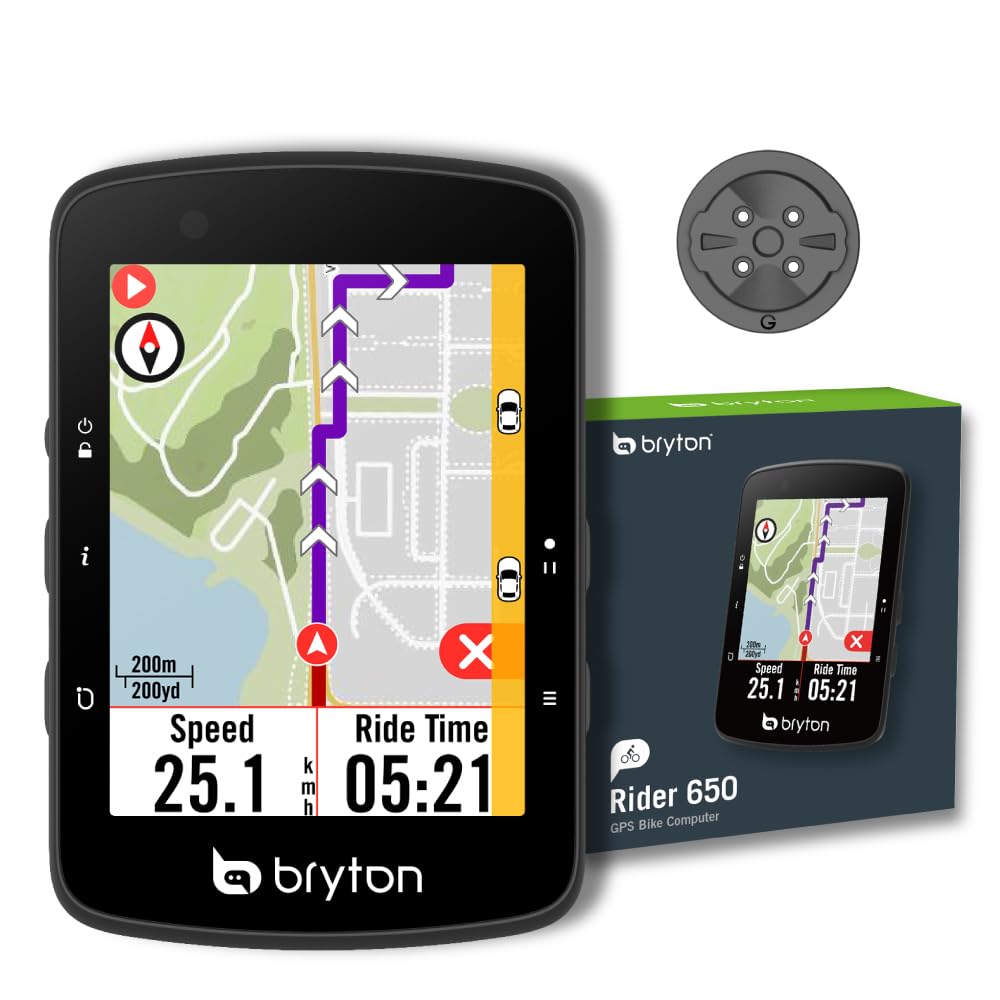
The Bryton Rider 650 challenges the assumption that a full-color touchscreen GPS computer demands a premium-tier budget. Its 2.8-inch color LCD provides a smartphone-like interface that displays detailed OSM maps with street names and points of interest, making navigation feel far more intuitive than simple breadcrumb lines. The ambient light sensor automatically adjusts screen brightness, keeping the display readable in both direct sunlight and dusk conditions without draining the battery unnecessarily.
Battery endurance is the headline figure here — 33 hours of continuous operation dwarfs many competitors, including the Garmin Edge 540 and Wahoo ELEMNT ROAM V3. This makes the Rider 650 a compelling choice for endurance tourists who want a single device to last through a week of commuting or a weekend brevet without needing a recharge. The Climb Challenge 1.0 feature color-codes gradient segments on pre-planned routes, showing grade, distance, and remaining ascent so you can pace climbs intelligently. Live Tracking and rear-view radar support add safety layers for solo riders without requiring a separate device.
Owner reports emphasize the straightforward setup process and the responsive touchscreen that works reliably with sweaty or slightly damp fingers. The Bryton Active app handles route syncing, firmware updates, and data export to Strava and TrainingPeaks without friction. Some users note that the map rendering is not quite as polished as Garmin’s top-tier units, but for the price difference, the Rider 650 delivers exceptional value. It is a strong alternative for riders who want premium navigation features without paying Garmin or SRAM prices.
What works
- 33-hour battery life leads the category for color touchscreen units
- Full OSM maps with street names and POIs for intuitive navigation
- Live Tracking and radar support improve solo rider safety
What doesn’t
- Map rendering quality is not on par with Garmin or Hammerhead flagship models
- Some users report occasional touchscreen lag in cold conditions
3. Magene C506
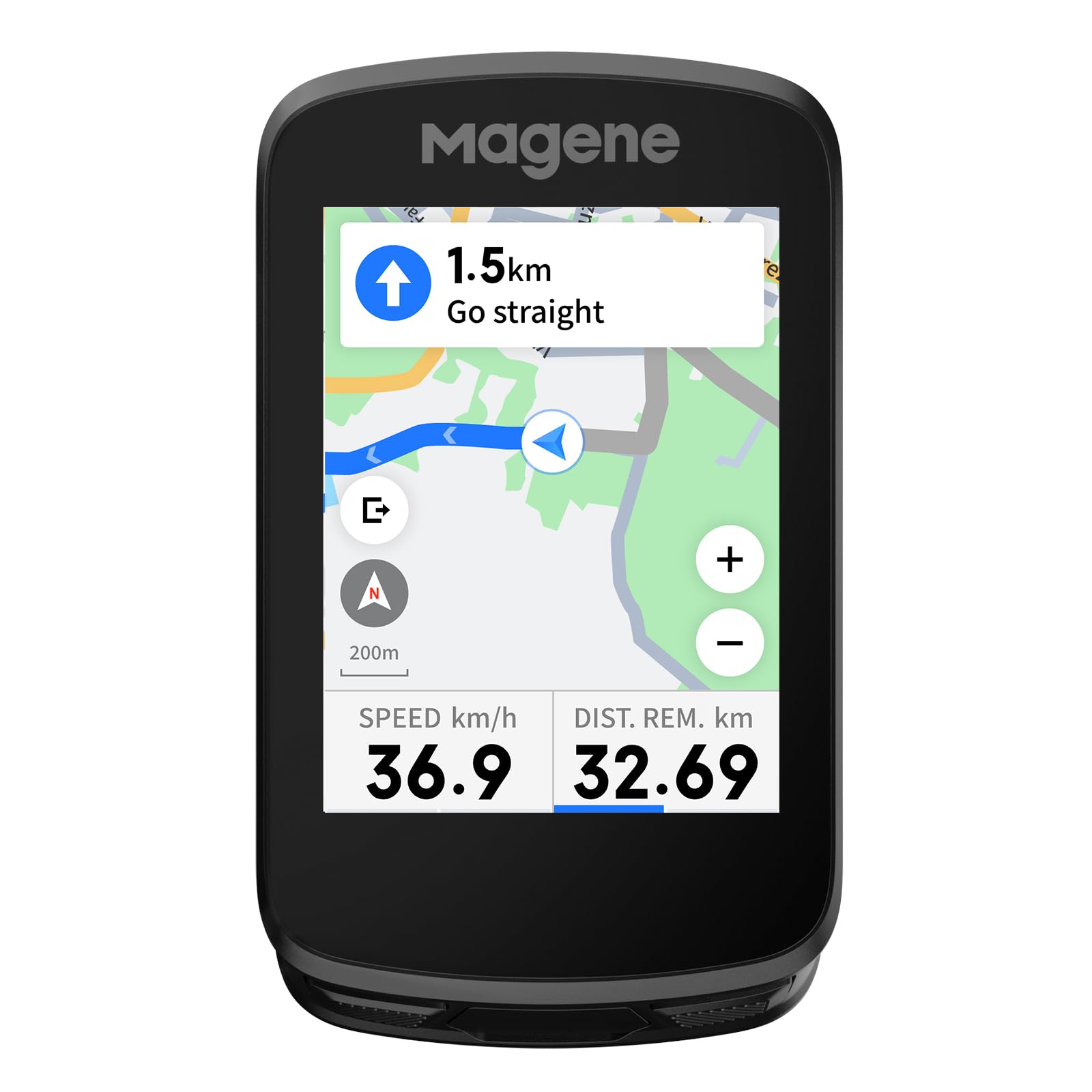
The Magene C506 brings a refreshingly modern design philosophy to the sub-100 dollar GPS computer segment. Its 2.4-inch color touchscreen is paired with three physical buttons, allowing you to interact with the device either by tapping the display or pressing tactile controls — a hybrid approach that works well in both dry and wet conditions. The device weighs only 76 grams, making it one of the lightest color touchscreen computers available, and the ambient light sensor ensures the screen remains visible without manual brightness adjustments.
Smart navigation sets the C506 apart from similarly priced competitors. It supports full global map downloads directly onto the device, turn-by-turn navigation with automatic rerouting, and route creation through the OnelapFit app or GPX file uploads. The Airoha chipset achieves a five-second GPS lock when AGNSS data is synced via WiFi — a speed that rivals units costing twice as much. The Smart Riding Assistant feature adds practical convenience: it can control Magene tail lights without requiring a phone, trigger automatic front light activation at 10 km/h, and provide reminders for hydration, energy intake, and return time based on ride progress.
Owner feedback highlights the responsive touchscreen and the comprehensive data display options — 105 data items across 14 categories, including circular dials, line graphs, and bar charts. The battery life of 24 hours in endurance mode is adequate for most long rides, though heavy navigation use reduces runtime. Some users note that the OnelapFit app is not as polished as Garmin Connect or Wahoo’s companion app, but regular firmware updates have improved stability. For riders seeking modern features like touchscreen navigation and smart accessory control without a premium price tag, the C506 delivers convincingly.
What works
- Color touchscreen with physical buttons offers flexible control in any weather
- Five-second GPS lock speed competes with premium units
- Smart Riding Assistant integrates tail light and hydration reminders
What doesn’t
- Companion app lacks the polish of Garmin or Wahoo alternatives
- Battery life drops noticeably with active navigation and screen use
4. GEOID CC600

The GEOID CC600 enters the market as a strong contender for riders who want color navigation and modern connectivity at a mid-range price point. Its 2.4-inch color screen with Asahi glass offers good durability and clarity, while the three-button interface provides reliable control even with gloves. The device supports five satellite constellations plus AGNSS, achieving a consistent five-second position lock that gets you riding without delay. Internal storage holds up to 100 hours of ride data, reducing the need for frequent syncing during multi-day tours.
Navigation is a clear strength of the CC600. It supports GPX file uploads with automatic rerouting if you stray off course — a feature typically found on more expensive units. The turn-by-turn prompts include zoom-in notifications at approaching turns, so you rarely second-guess your direction. WiFi and Bluetooth dual transmission means AGNSS data and firmware updates happen quickly without requiring a wired connection. The unit connects to up to nine device types via ANT+ and Bluetooth, including heart rate monitors, power meters, smart trainers, and electronic shifting systems from SRAM and Shimano.
Indoor training capability adds further versatility. The CC600 can control a smart trainer with custom power targets, resistance levels, and gradient simulation, making it useful year-round. Owner reviews praise the intuitive data page customization — 108 supported data items displayed across charts, dials, and bar graphs across 10 pages. Some users note that the initial setup process is slightly involved, particularly for syncing AGNSS data via WiFi. Overall, the CC600 delivers impressive feature density for its price bracket, especially for riders who prioritize navigation rerouting and sensor ecosystem support.
What works
- Automatic rerouting during navigation is rare at this price point
- WiFi transmission speeds up data sync and firmware updates significantly
- Indoor trainer control adds year-round training versatility
What doesn’t
- Initial AGNSS setup process can be confusing for less technical users
- Screen brightness in direct sunlight is adequate but not outstanding
5. iGPSPORT BSC100S
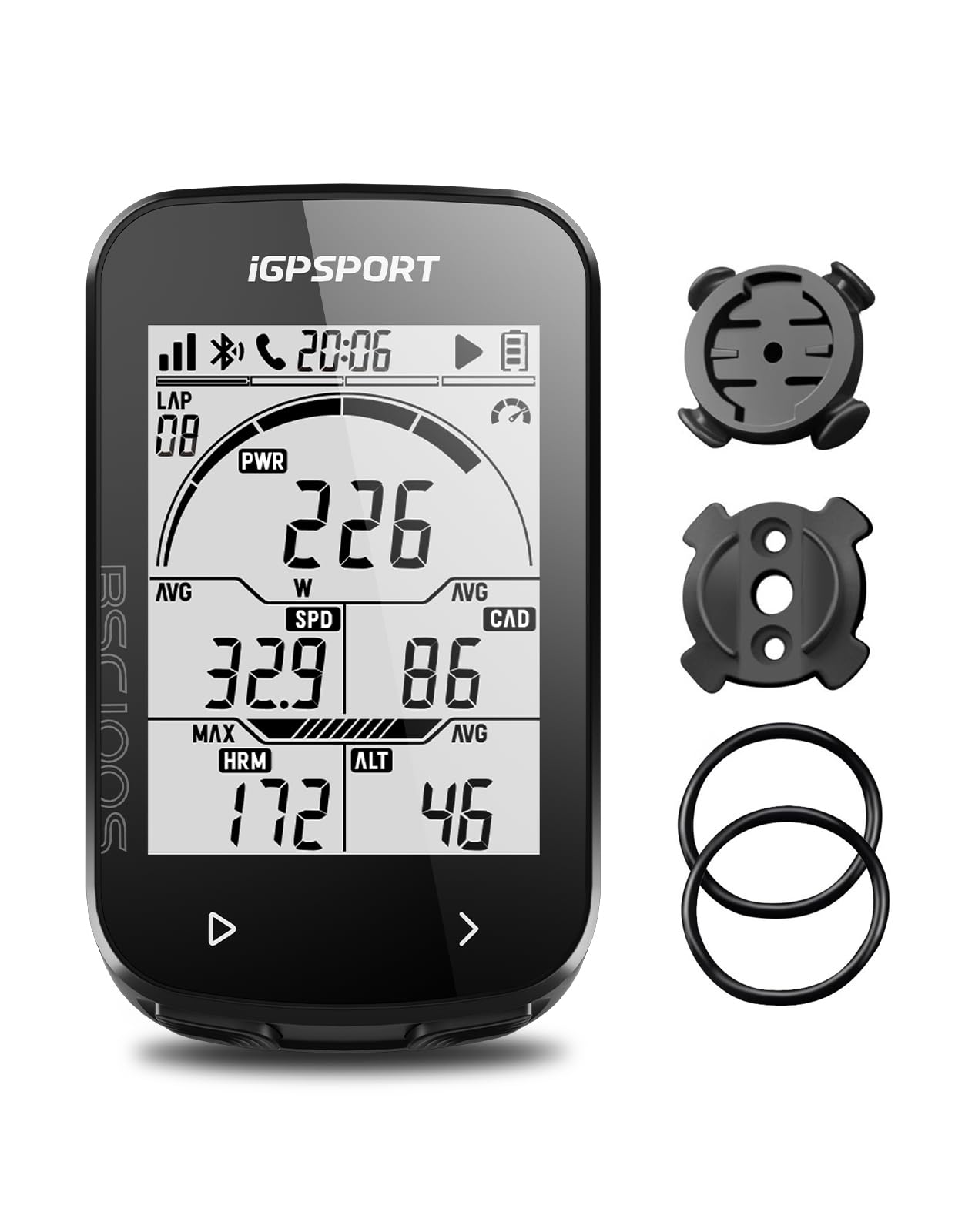
The iGPSPORT BSC100S prioritizes endurance above all else, and its 40-hour battery life immediately sets it apart in the sub-50 dollar category. The 2.6-inch anti-glare LCD screen is one of the largest displays available at this price, making data readable without reading glasses or leaning forward. Five-satellite positioning support (GPS, Beidou, GLONASS, Galileo, QZSS) ensures reliable tracking across different global regions, and the USB-C charging port means faster top-ups and cable compatibility with modern phones and laptops.
Beyond battery endurance, the BSC100S offers more than 40 riding data metrics including speed, distance, grade, cadence, calories, temperature, and time. It connects to ANT+ and Bluetooth 5.0 sensors, allowing integration with speed sensors, cadence sensors, heart rate monitors, and smart watches. The iGPSPORT app provides ride analysis and syncs to Strava and Komoot, though the app interface is more utilitarian than polished. The waterproof IPX7 rating provides peace of mind for riders who face sudden downpours without carrying a cover.
Owner feedback consistently mentions the battery life as the primary reason for purchase — many report completing week-long tours without a single recharge. The large screen is also frequently praised for reducing eye strain during long days in the saddle. Some users note that the device lacks navigation features entirely; it records and displays routes but does not provide turn-by-turn directions or alerts. The included mount uses rubber bands rather than a quarter-turn lock, which can feel less secure on rough terrain. For riders whose priority is maximum runtime and clear data display without navigation complexity, the BSC100S is a top contender.
What works
- 40-hour battery life is class-leading for non-color GPS computers
- Large 2.6-inch anti-glare screen improves readability on long rides
- Five-satellite support ensures reliable global positioning
What doesn’t
- No turn-by-turn navigation or route guidance functionality
- Rubber band mount feels less secure than quarter-turn locking systems
6. COOSPO BC107

The COOSPO BC107 is designed as a no-frills entry point into GPS cycling computers, yet it offers ANT+ sensor compatibility that many budget units omit. The 2.4-inch LCD display is compact and efficient, with a glass-filled ABS and TPU chassis that keeps weight low while providing impact resistance. Dual-mode positioning (GPS only or GPS plus BeiDou) gives riders flexibility depending on their region and desired accuracy level. The IP67 waterproof rating means the unit can handle heavy rain and even brief submersion without issue.
ANT+ connectivity is the standout feature at this price — the BC107 pairs with heart rate monitors, speed and cadence sensors, and power meters, which is unusual for a computer in this segment. Bluetooth is reserved for app connectivity with the CoospoRide app rather than sensor pairing, so users should confirm their sensors use ANT+ rather than Bluetooth. The app handles device setup, ride recording, GPS track mapping, and firmware updates, and it can sync activity files to Strava. The device automatically captures GPS and BeiDou signals on power-up and calibrates the time, so there is minimal fiddling before rides.
Owner feedback notes that the GPS acquisition time is generally fast, typically locking within 30 to 60 seconds under open sky. The compact size appeals to riders with limited handlebar real estate or those who prefer a minimalist setup. Some users express disappointment that the BC107 does not support Bluetooth sensor connections, which limits compatibility with certain newer sensors. The standard mount uses rubber rings rather than a more secure locking system. For budget-conscious riders who want ANT+ sensor integration without moving to a more expensive platform, the BC107 fills a clear gap.
What works
- ANT+ sensor compatibility at a budget price point is rare and valuable
- Compact and lightweight design suits minimal handlebar setups
- IP67 waterproof rating exceeds typical budget computer protection
What doesn’t
- Bluetooth sensor pairing is not supported, only ANT+
- Rubber ring mount may shift on rough terrain without additional security
7. SIGMA ROX 11.1 EVO

The SIGMA ROX 11.1 EVO positions itself as a versatile training and navigation computer with explicit e-bike system integration, making it a strong choice for electric bike owners who want seamless data sharing with their motor system. Its 1.77-inch color display is smaller than many competitors but remains readable through a high-contrast interface. The unit stores up to 100 hours of riding time and offers over 150 functions, including speed, distance, altitude, navigation via track or komoot, and structured indoor and outdoor workouts.
The e-bike readiness is a differentiating factor. The ROX 11.1 EVO connects to compatible e-bike systems and displays motor-specific data such as battery level, assist mode, and range, which is information that standard cycling computers cannot access. This integration means e-bike riders get a unified display rather than having to glance at both a computer and a separate handlebar display. Smartphone connectivity brings crash alert detection and smart notifications — calls and messages appear on the screen when the device is connected to the SIGMA Ride app. The unit is also compatible with smart trainers for indoor training sessions.
Owner feedback highlights the robust build quality and the IP67 waterproof rating that withstands prolonged exposure to rain and mud. The navigation through komoot is praised for its reliability, though some users note that the 1.77-inch screen feels cramped when displaying maps compared to larger 2.6-inch and 3.2-inch competitors. Battery life is rated at 18 hours, which is adequate for long rides but falls short of the endurance leaders in this category. For e-bike owners specifically, the ROX 11.1 EVO offers integration that few other computers match, making it a specialized but compelling option.
What works
- Direct e-bike system integration displays motor, battery, and range data
- 150+ functions cover virtually every metric most riders need
- Crash alert and smart notifications add safety and convenience
What doesn’t
- 1.77-inch screen is small for detailed map navigation
- 18-hour battery life trails competitors by a significant margin
8. SRAM Hammerhead Karoo

The SRAM Hammerhead Karoo offers a smartphone-like experience with its 3.2-inch color display — the largest and highest-resolution screen in this comparison. The combination of a responsive touchscreen and hardware buttons means you can navigate maps and menus intuitively regardless of conditions. Multi-band GNSS technology delivers exceptional positioning accuracy whether you are threading through urban canyons or descending tree-lined singletrack. The 64 gigabytes of internal storage can hold global maps with room to spare, eliminating the need to shuffle map files between trips.
Performance hardware is where the Karoo separates itself from the pack. Four gigabytes of RAM ensure maps render quickly and menus remain responsive even with complex routes loaded. The unit supports surface-specific routing — road, MTB, gravel — and adjusts turn prompts and map styling accordingly. Automatic climb detection works with or without a route, so you get gradient profile data on every hill you encounter. Route syncing from connected accounts is instant, and free global maps are included with no subscription required — a rare policy in the premium segment.
Owner feedback emphasizes the display quality and processing speed as the Karoo’s standout attributes — the screen clarity in direct sunlight is frequently compared favorably to the Garmin Edge 1050 and Wahoo ELEMNT ROAM V3. The 15-hour battery life is the primary compromise for this performance; it is adequate for long rides but requires daily charging for multi-day tours unless you carry a power bank. Some users report that the initial setup and account configuration process is more involved than Garmin or Wahoo alternatives. For riders who prioritize screen quality, map detail, and fast rendering above all else, the Karoo is the current benchmark.
What works
- 3.2-inch display offers the best screen real estate and clarity in its class
- 64GB storage and 4GB RAM deliver fast map rendering and instant route loading
- Free global maps with no subscription required
What doesn’t
- 15-hour battery life is the shortest among premium GPS computers
- Initial account and setup process is more involved than Garmin or Wahoo
9. Wahoo ELEMNT ROAM V3

The Wahoo ELEMNT ROAM V3 refines the formula that made its predecessor a favorite among serious cyclists. Dual-band GPS support provides enhanced positioning accuracy in environments where signals struggle — think dense forest trails, narrow urban streets, and deep valleys. The 2.8-inch display strikes a balance between readability and aerodynamic profile, and the device supports GPS, GLONASS, BeiDou, Galileo, QZSS, SBAS, and NavIC constellations. Automatic route generation on the device itself, along with on-demand route creation from the companion app, means you can explore spontaneously without a pre-planned GPX file.
Navigation versatility is a core strength. The ROAM V3 automatically generates turn-by-turn prompts for GPX and TCX files imported from Strava, Ride With GPS, Komoot, or any other routing source. Public Route Sharing allows any nearby ELEMNT user to view and load your route directly — a useful group-ride feature. The ELEMNT companion app is widely considered the gold standard for setup simplicity, with a straightforward interface that lets you customize data pages, configure sensors, and manage routes without a steep learning curve. Battery life is rated at 25 hours, which covers most rides comfortably.
Owner feedback consistently praises the reliability of the Wahoo ecosystem — the ROAM V3 simply works without requiring frequent troubleshooting or firmware workarounds. The button-controlled interface, supplemented by the companion app for deeper configuration, appeals to riders who prefer minimal distraction during rides. Some users note that the screen, while clear, lacks the vivid color saturation of the Garmin Edge 1050 or Hammerhead Karoo, particularly for map display. The integrated out-front mount is robust and secure, using a quarter-turn locking mechanism that holds the device firmly even on rough gravel descents.
What works
- Dual-band GPS provides exceptional tracking accuracy in difficult environments
- Companion app offers the most intuitive setup and configuration experience
- On-demand route generation and public route sharing enhance group ride flexibility
What doesn’t
- Map display color and detail lag behind Garmin and Hammerhead flagships
- 25-hour battery is good but trails the 33-hour Bryton Rider 650
10. Garmin Edge 1050

The Garmin Edge 1050 represents the current pinnacle of Garmin’s cycling computer lineup, packing every feature the company has developed into a single device. The vivid color touchscreen display is bright and responsive, with an interface that reacts instantly to taps and swipes even with damp fingers. A built-in speaker provides audible workout prompts, navigation cues, and a bike bell function that alerts pedestrians without requiring a separate handlebar accessory — a small addition that reduces cockpit clutter significantly. Battery life reaches 20 hours in demanding use and up to 60 hours in battery saver mode, which is remarkable given the display quality.
Group ride features are a major focus of the Edge 1050. In-ride messaging, live location sharing, incident detection alerts, and in-ride leaderboards for climbs add a social dimension that no other computer matches. Road hazard alerts from fellow cyclists appear on the screen when connected to a compatible smartphone, and riders can contribute their own hazard reports to the community. The ClimbPro ascent planner now works on every ride without requiring a course, showing remaining ascent and grade for any hill you encounter. Power Guide incorporates real-time stamina and wind data to adjust power targets dynamically when paired with a compatible power meter — a level of analysis that approaches professional coaching support.
Owner feedback emphasizes the polish of the overall experience — the touchscreen responsiveness, the clarity of the display in direct sunlight, and the seamless integration with the Garmin Connect ecosystem are frequently cited as reasons for the premium investment. Garmin Pay contactless payments allow purchases on the go without carrying a wallet. Some users note that the 20-hour battery life in demanding mode requires daily charging for multi-day tours without access to power. The price is the highest in this comparison, but for riders who want every available feature and the most refined user experience, the Edge 1050 delivers without compromise.
What works
- Vivid color touchscreen with industry-leading responsiveness and sunlight visibility
- Built-in speaker provides audible cues and bike bell without extra accessories
- Group ride features including messaging, leaderboards, and hazard alerts are unmatched
What doesn’t
- Premium price point is the highest in the category
- 20-hour demanding-mode battery requires daily charging for extended tours
11. Bikevee BKV310A
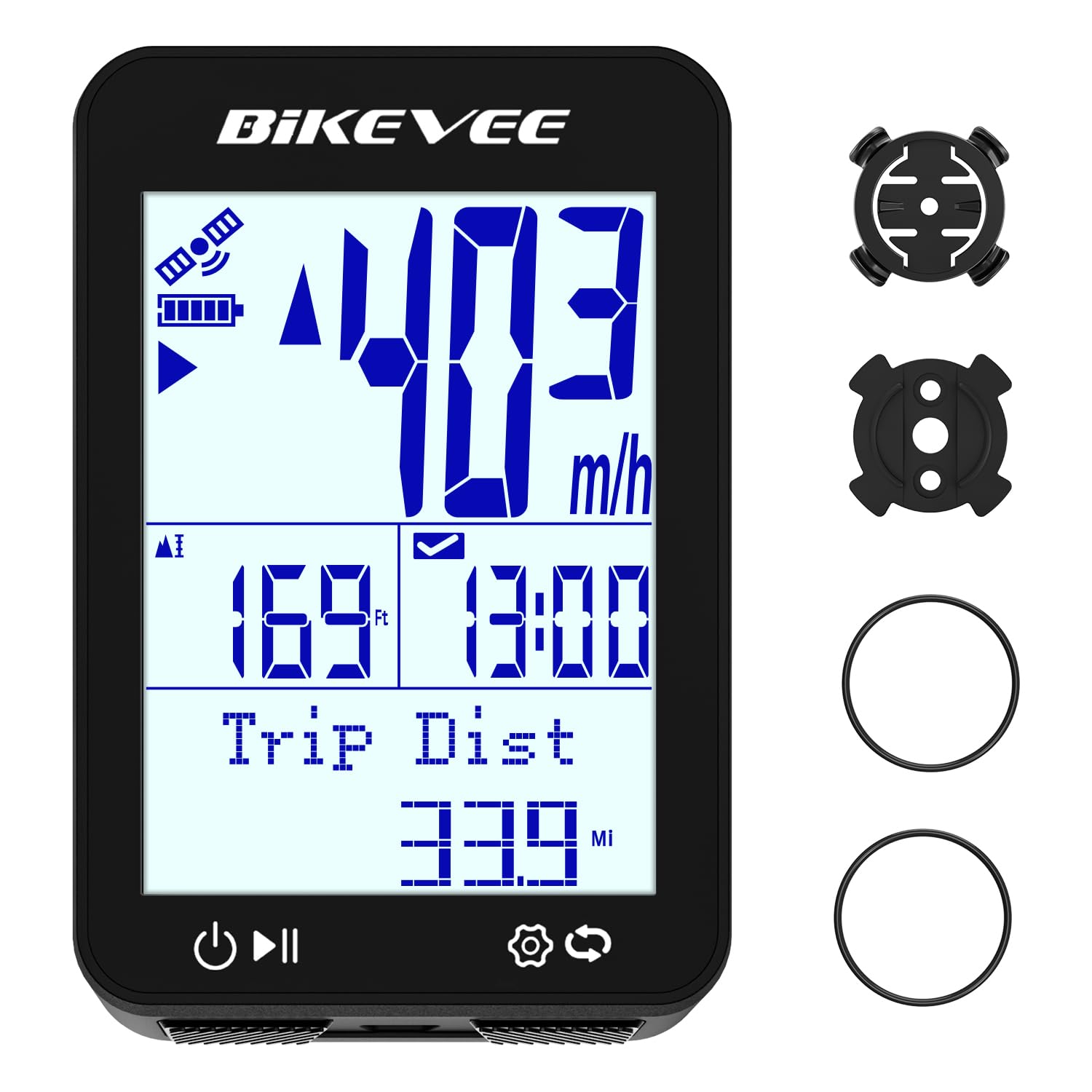
The Bikevee BKV310A is a straightforward GPS speedometer and odometer designed for riders who want core ride data without navigation complexity or sensor ecosystem demands. Its 2.4-inch LCD screen displays speed in MPH or KM/H, trip time, trip distance, total distance, average speed, and max speed — the essential metrics that most recreational riders need. The five-satellite GPS system provides reliable positioning, and the IPX7 waterproof rating means the unit survives heavy rain and accidental submersion without concern. A 650mAh battery delivers up to 28 hours of continuous use, which covers multiple days of commuting or weekend rides between charges.
The simplicity of the BKV310A is both its strength and its limitation. There is no navigation, no turn-by-turn guidance, no map display, and no sensor connectivity — it is a pure speed and distance tracker with GPS accuracy. The included standard bike mount uses rubber rings for attachment, keeping the handlebar area clutter-free. The device supports nine languages for international use, and the USB-C charging port is a welcome inclusion at this price tier. Auto start-stop functionality means the computer begins recording when you start moving and pauses when you stop, eliminating the need to manually start and stop each ride.
Owner feedback highlights the long battery life and reliability as the primary reasons for choosing the BKV310A over more expensive options. The large, clear numbers on the display are easy to read at a glance without taking eyes off the road for too long. Some users note that the GPS acquisition time can be slower than premium units, occasionally taking over a minute to lock. The lack of ANT+ or Bluetooth sensor support means no cadence, heart rate, or power data integration. For riders who simply want accurate speed and distance tracking with minimal fuss and maximum battery life, the BKV310A delivers exactly what it promises at an accessible price point.
What works
- 28-hour battery life covers multiple days of riding between charges
- Large, clear display with essential metrics is easy to read at a glance
- USB-C charging and IPX7 waterproofing are excellent for the price tier
What doesn’t
- No navigation, sensor compatibility, or app connectivity
- GPS lock time can be slow compared to more expensive units
Hardware & Specs Guide
Display Technology and Readability
The screen is your primary interface with the computer, and its quality directly impacts how easily you can glance at data while riding. Two main display types dominate the market: monochrome LCD and color LCD. Monochrome displays, used in units like the iGPSPORT BSC100S and COOSPO BC107, offer superior battery efficiency and remain highly readable in direct sunlight due to their lack of a backlight dependency. Color screens, found on the Bryton Rider 650, Garmin Edge 1050, and SRAM Hammerhead Karoo, provide richer map detail and more intuitive data visualization but consume more power. Anti-glare coatings and ambient light sensors help color screens remain usable in bright conditions, but no color display matches the sunlight readability of a well-designed monochrome panel. Screen size ranges from 1.77 inches on the SIGMA ROX 11.1 EVO to 3.2 inches on the Hammerhead Karoo. Larger screens improve navigation context but increase aerodynamic drag and handlebar footprint.
Satellite Positioning Systems
Modern GPS computers support multiple satellite constellations to improve accuracy and reduce lock times. At minimum, units support GPS and GLONASS, which provides global coverage with redundancy if one system experiences issues. Higher-end models add BeiDou, Galileo, and QZSS for additional satellite visibility, particularly beneficial in challenging environments like urban canyons or dense forests. Multi-band GNSS, featured on the Garmin Edge 540 and Wahoo ELEMNT ROAM V3, uses multiple frequency bands from the same satellite to correct for atmospheric signal distortion, resulting in significantly better positional accuracy. AGNSS (Assisted GNSS) pre-loads satellite almanac data via WiFi or Bluetooth, enabling lock times as fast as five seconds on units like the GEOID CC600 and Magene C506. Without AGNSS, cold start lock times typically range from 30 to 90 seconds depending on sky visibility and satellite geometry.
Battery Chemistry and Real-World Endurance
Battery life ratings from manufacturers are measured under specific test conditions that rarely reflect actual riding scenarios. The most common battery type is lithium-ion, with capacities ranging from 600mAh to 1,500mAh depending on the device. Real-world battery life depends on screen brightness, backlight timeout settings, GPS logging interval, number of connected sensors, and ambient temperature. Cold weather significantly reduces lithium-ion battery performance — expect 20 to 30 percent less runtime in near-freezing conditions. USB-C charging has become the standard across nearly all modern units, with full charge times typically between two and four hours. The iGPSPORT BSC100S leads the category with a 40-hour rated battery, achieved through its efficient monochrome display and power-optimized chipset. Color touchscreen units like the Hammerhead Karoo and Garmin Edge 1050 typically deliver 15 to 20 hours in demanding use, though the Bryton Rider 650 achieves 33 hours by using a more power-efficient display panel and aggressive backlight management.
Sensor Connectivity Protocols
Two wireless protocols dominate the cycling sensor ecosystem: ANT+ and Bluetooth. ANT+ is the more established standard for cycling sensors due to its low power consumption and ability to support multiple sensors simultaneously without pairing overhead. Bluetooth has become more common in newer sensors and offers broader compatibility with smartphones and fitness watches, but can introduce pairing complexity when connecting multiple devices. The Garmin Edge 1050 and SRAM Hammerhead Karoo support both ANT+ and Bluetooth for maximum flexibility. The COOSPO BC107 supports ANT+ only for sensors and uses Bluetooth solely for app connectivity — an important distinction for buyers who own Bluetooth-only sensors. The GEOID CC600 and Magene C506 support up to nine simultaneous device connections, including heart rate monitors, speed sensors, cadence sensors, power meters, smart trainers, radar tail lights, and electronic shifting groupsets from SRAM eTap and Shimano Di2. Riders with multiple sensors should verify that their chosen computer supports the specific protocol each sensor uses.
FAQ
How is an e-bike computer different from a standard cycling computer?
What battery life should I realistically expect from a GPS computer?
Do I need a multi-band GPS computer for city riding?
Can I use a cycling computer without a smartphone?
What is the difference between breadcrumb navigation and full map navigation?
Final Thoughts: The Verdict
For most buyers, the best e-bike computer winner is the Garmin Edge 540 because it delivers multi-band GNSS accuracy, adaptive coaching features, and outstanding battery life at a price that undercuts premium competitors while still offering professional-grade performance. If you want full color maps and a touchscreen without spending flagship money, grab the Bryton Rider 650 for its 33-hour battery and intuitive navigation. And for budget-conscious riders who prioritize maximum battery life and a large readable screen without navigation complexity, nothing beats the iGPSPORT BSC100S.

Certification: BSc in Mechanical Engineering
Education: Mechanical engineer
Lives In: 539 W Commerce St, Dallas, TX 75208, USA
Md Amir is an auto mechanic student and writer with over half a decade of experience in the automotive field. He has worked with top automotive brands such as Lexus, Quantum, and also owns two automotive blogs autocarneed.com and taxiwiz.com.