A Level 2 home charging station is the single most impactful upgrade you can make to your EV ownership experience. The slow trickle of a standard 120V outlet forces you to plan every trip; a 240V solution restores freedom, adding miles of range while you sleep. The decision isn’t just about raw amperage—it’s about matching the charger’s smart features, connector type, and installation path to your specific vehicle and home electrical panel.
I’m Amir — the founder and writer behind Four Wheel Ask. I’ve spent years analyzing the EV charging market, cross-referencing manufacturer specs, CSA/UL certifications, and real owner reports to determine which units deliver reliable daily performance without overcomplicating the setup.
Whether you prioritize a native NACS connector for a Tesla, a rugged J1772 unit for a Chevy Bolt or Ford Mustang Mach-E, or a universal station that serves both, this guide breaks down the best dual electric car charger options so you can confidently choose the right one for your garage.
How To Choose The Best Dual Electric Car Charger
The right home charging station hinges on three interconnected decisions: your vehicle’s charge port, your electrical panel’s capacity, and your need for app-based control. Getting these right ensures you avoid costly electrical upgrades and future-proof your purchase for your next EV.
Connector Type: J1772 vs. NACS
J1772 is the standard for every non-Tesla EV in North America, from the Nissan Leaf to the Ford F-150 Lightning. NACS (formerly Tesla’s proprietary plug) is the emerging standard now adopted by several automakers. If you currently drive a Tesla, a native NACS charger eliminates the need for an adapter. If you own a J1772 vehicle today but anticipate a NACS vehicle in the future, a universal unit like the Tesla Universal Wall Connector—which includes both connectors in the holster—is the most flexible solution.
Amperage and Installation: 40A vs. 48A
Most Level 2 chargers deliver either 40A (9.6 kW) via a NEMA 14-50 plug or 48A (11.5 kW) via a hardwired connection. A 40A plug-in unit is simpler to install if you already have a 50A breaker and a 14-50R outlet, but it caps your speed. A 48A hardwired unit requires a 60A breaker and an electrician run, but it adds roughly 3 extra miles of range per hour. The 48A option also qualifies for the full 30% federal tax credit on equipment and installation costs, which can offset the higher installation expense.
Smart Features and Power Management
Wi-Fi connectivity allows you to schedule charging during off-peak utility hours, track energy consumption, and receive OTA firmware updates. RFID card support adds a layer of security for households where you want to prevent unauthorized use. Power sharing (also called load balancing) is a critical feature for homes with two EVs—it lets two chargers run on a single circuit by dynamically splitting the available amperage between them, avoiding an expensive panel upgrade.
Quick Comparison
On smaller screens, swipe sideways to see the full table.
| Model | Category | Best For | Key Spec | Amazon |
|---|---|---|---|---|
| Generac EV Charger Level 2 Plus | Hardwired | Whole-home power management | 48A / 11.5 kW output | Amazon |
| Tesla Universal Wall Connector | Dual Connector | Multi-brand household (NACS + J1772) | 48A / built-in J1772 holster | Amazon |
| ChargePoint HomeFlex Hardwired | Hardwired | App reliability and network access | 50A max / NACS connector | Amazon |
| Autel 50A AC Elite | Hardwired | High-speed J1772 charging | 50A / 12 kW output | Amazon |
| EMPORIA Level 2 48A | Hardwired | Real-time energy monitoring | 48A / J1772 connector | Amazon |
| EVIQO EVIPOWER NACS | Plug-in | Native NACS for Tesla owners | 40A / 9.6 kW output | Amazon |
| WOLFBOX E40 | Plug-in | Voice control via Alexa/Assistant | 40A / 4.3″ LCD screen | Amazon |
| Autel MaxiCharger 40A Home | Plug-in | Quick 5-minute installation | 40A / NEMA 4X rated | Amazon |
| ApexCharger MACH 2 | Dual Connector | Included NACS adapter for Tesla | 40A / LED display | Amazon |
| IYILO RA40 | Dual Sensor | Plug/connector overheat monitoring | 40A / dual NTC temp sensors | Amazon |
| Lectron Portable Level 1/2 | Portable | Travel and dual-level flexibility | 40A / NACS + dual plug kits | Amazon |
In‑Depth Reviews
1. Generac EV Charger Level 2 Plus
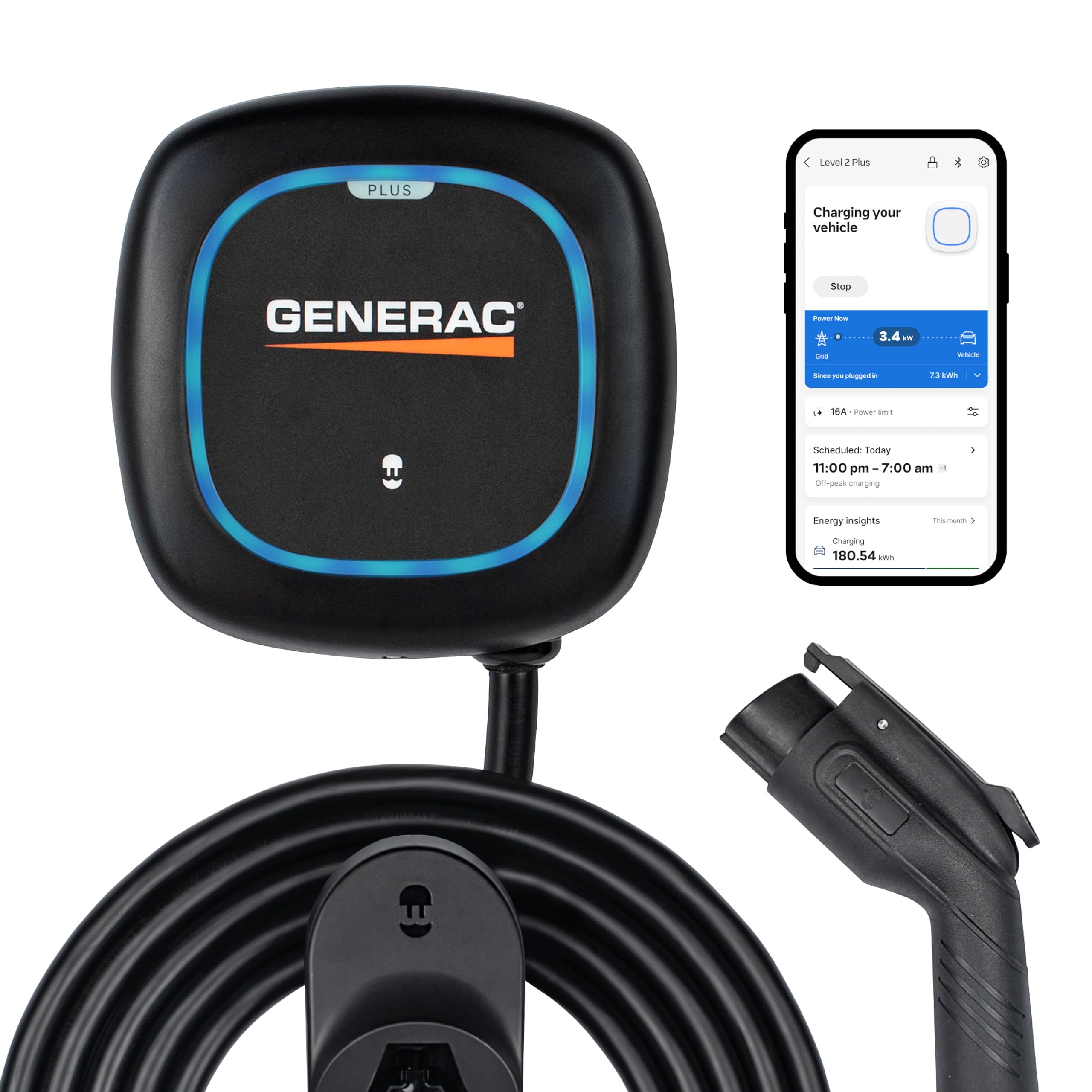
The Generac Level 2 Plus leverages the company’s 65-year legacy in home standby power to deliver a 48A hardwired unit that prioritizes whole-home energy harmony. Its Power Boost technology actively monitors your home’s total electrical load and adjusts the charger’s output in real time—preventing a tripped breaker without requiring a costly panel upgrade. The unit delivers up to 30 miles of range per hour, and the 25-foot cable gives you generous reach across a two-car garage.
Smart control runs through the Generac EV Charging app, which supports scheduling, remote monitoring, and OTA firmware updates. The unit is also compatible with Alexa and Google Home, so you can start or stop a charging session by voice. Power Sharing capability allows multiple Generac chargers to operate on the same circuit, a practical feature if your household runs two EVs.
The compact NEMA 4 ABS enclosure is rated for indoor or outdoor mounting, and the 3-year warranty backs the investment. Owners report that the app interface is intuitive and that the Power Boost feature eliminates the anxiety of overloading a 100A service panel. For homeowners who want a brand with deep roots in residential electrical systems, this is the most complete package available.
What works
- Power Boost Technology prevents breaker trips
- Voice control via Alexa and Google Home
- Power Sharing supports dual EV households
What doesn’t
- Requires a J1772 adapter for Tesla vehicles
- Hardwired installation requires a licensed electrician
2. Tesla Universal Wall Connector

The Tesla Universal Wall Connector solves a growing problem in multi-EV households: two different connector standards under one roof. It ships with a native NACS cable for Tesla vehicles and a separate J1772 holster built into the unit body, allowing seamless switching without adapters. At 48A and 11.5 kW, it delivers up to 44 miles of range per hour, depending on the vehicle and breaker configuration.
The variable amperage dial lets you set the max output anywhere from 12A to 48A, which is helpful when installing on an existing circuit with limited headroom. Power Management features—including load sharing across multiple Wall Connectors—minimize install costs by avoiding a panel upgrade. The 24-foot cable is sufficiently long for most garage layouts, and the indoor/outdoor rating ensures durability in wet or dusty conditions.
For Cybertruck owners, the unit also enables Powershare, letting you power your home for up to three days during an outage. The unit is Energy Star certified and UL listed. Owners consistently rate it highly for build quality and the simplicity of using a single brand ecosystem. If you own a Tesla today and plan to add a J1772 vehicle later, this is the most future-proof single-unit solution.
What works
- Built-in NACS and J1772 support without adapters
- Variable amperage from 12A to 48A
- Powershare compatibility with Cybertruck
What doesn’t
- Premium pricing for the dual-connector design
- Installation requires an electrician for hardwiring
3. ChargePoint HomeFlex Hardwired NACS

ChargePoint operates one of the largest public charging networks in North America, and the HomeFlex brings that ecosystem directly into your garage. This hardwired NACS unit delivers up to 50A, charging a Tesla at up to 45 miles per hour. The mobile app is the gold standard for reliability—it tracks every session, reports energy consumption, and lets you set reminders for maintenance or off-peak scheduling.
The cold-resistant cable remains flexible in freezing temperatures, and the UL-certified enclosure is safe for outdoor mounting. ChargePoint also offers 24/7 support, which is reassuring if you ever encounter a fault. The unit integrates with smart home systems and provides access to over 274,000 public ChargePoint stations through the same app, eliminating the need for separate accounts.
Owners frequently praise the app’s stability compared to lesser-known brands, noting that OTA updates are seamless and rarely disrupt service. The unit requires a dedicated circuit (20A to 80A depending on your chosen configuration), and hardwired installation by a licensed electrician is recommended. For someone who wants a charging station backed by a major network with proven software, this is the benchmark.
What works
- Best-in-class mobile app with reliable connectivity
- Access to 274,000+ public ChargePoint stations through one app
- Cold-resistant cable for winter charging
What doesn’t
- NACS connector only (adapter needed for J1772 vehicles)
- Hardwired installation adds setup complexity
4. Autel MaxiCharger AC Elite 50A
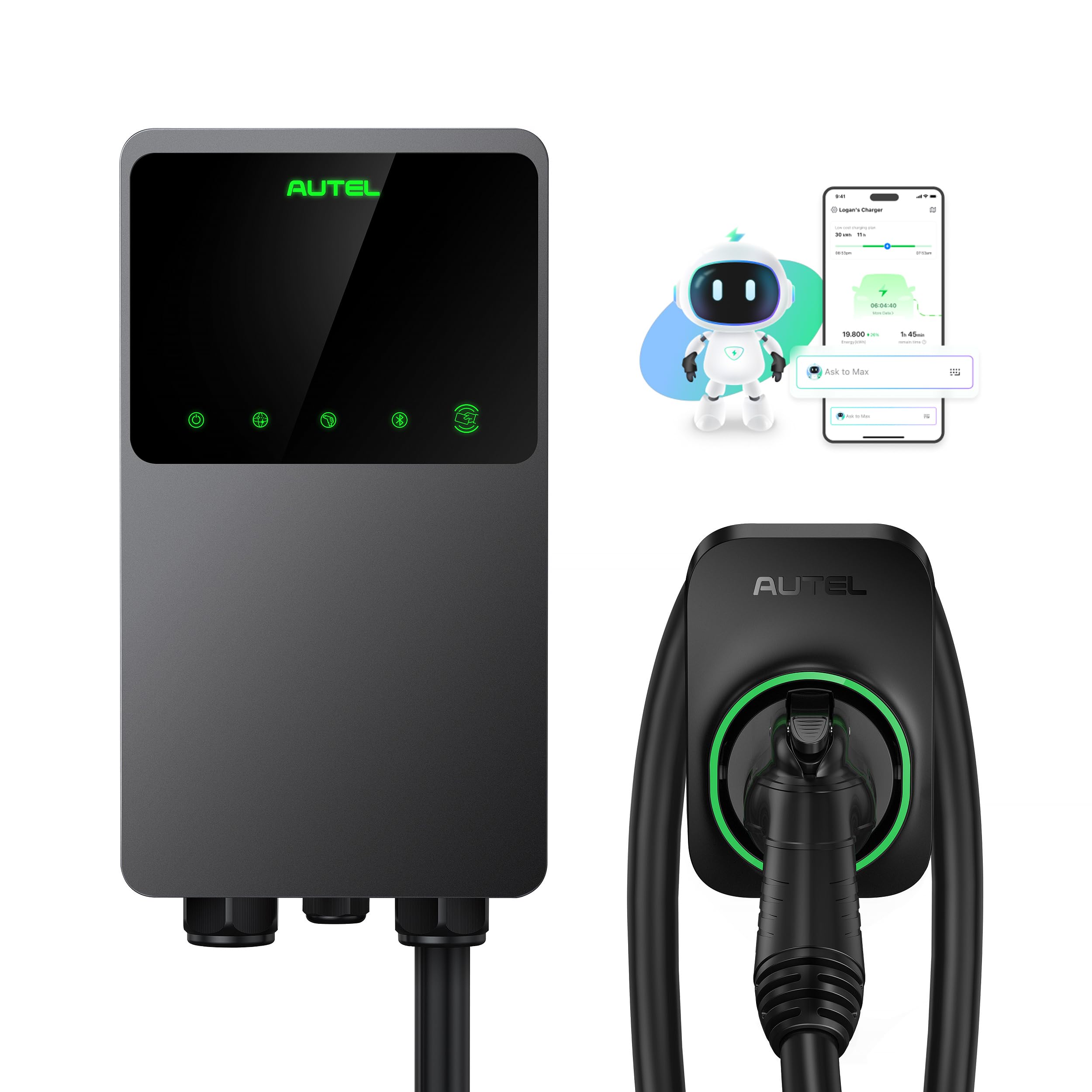
Autel’s AC Elite pushes past the standard 48A ceiling with a 50A hardwired configuration that delivers 12 kW and adds 37 miles of range per hour. That extra 2A doesn’t seem like much on paper, but over a four-hour charge window it translates to roughly eight additional miles—enough to matter on a busy morning. The 25-foot cable is rated for operation down to -40°C, so flexibility in extreme cold is guaranteed.
The CSA-certified NEMA Type 4 enclosure handles snow, rain, and sleet without issue, and the unit is eligible for the 30% federal tax credit. The Autel Charge app supports Wi-Fi and Bluetooth connectivity, with the option to also connect via Ethernet for the most stable link. Scheduling, RFID control, and OTA updates are all standard, and the 3-year warranty provides long-term coverage.
Owners note that the Ethernet port is a standout feature for homes where 2.4 GHz Wi-Fi signals struggle to reach the garage. The app interface is clean and responsive, and the physical build quality of the unit—solid metal backplate, weather-sealed enclosure—inspires confidence. This is the best option for J1772 owners who want the fastest hardwired speed available without moving to a proprietary connector.
What works
- 50A output delivers 37 miles of range per hour
- Ethernet port for stable connectivity in the garage
- Cable remains flexible down to -40°C
What doesn’t
- Hardwired installation is required for full 50A output
- Premium price point reflects the higher amperage
5. EMPORIA Level 2 EV Charger 48A
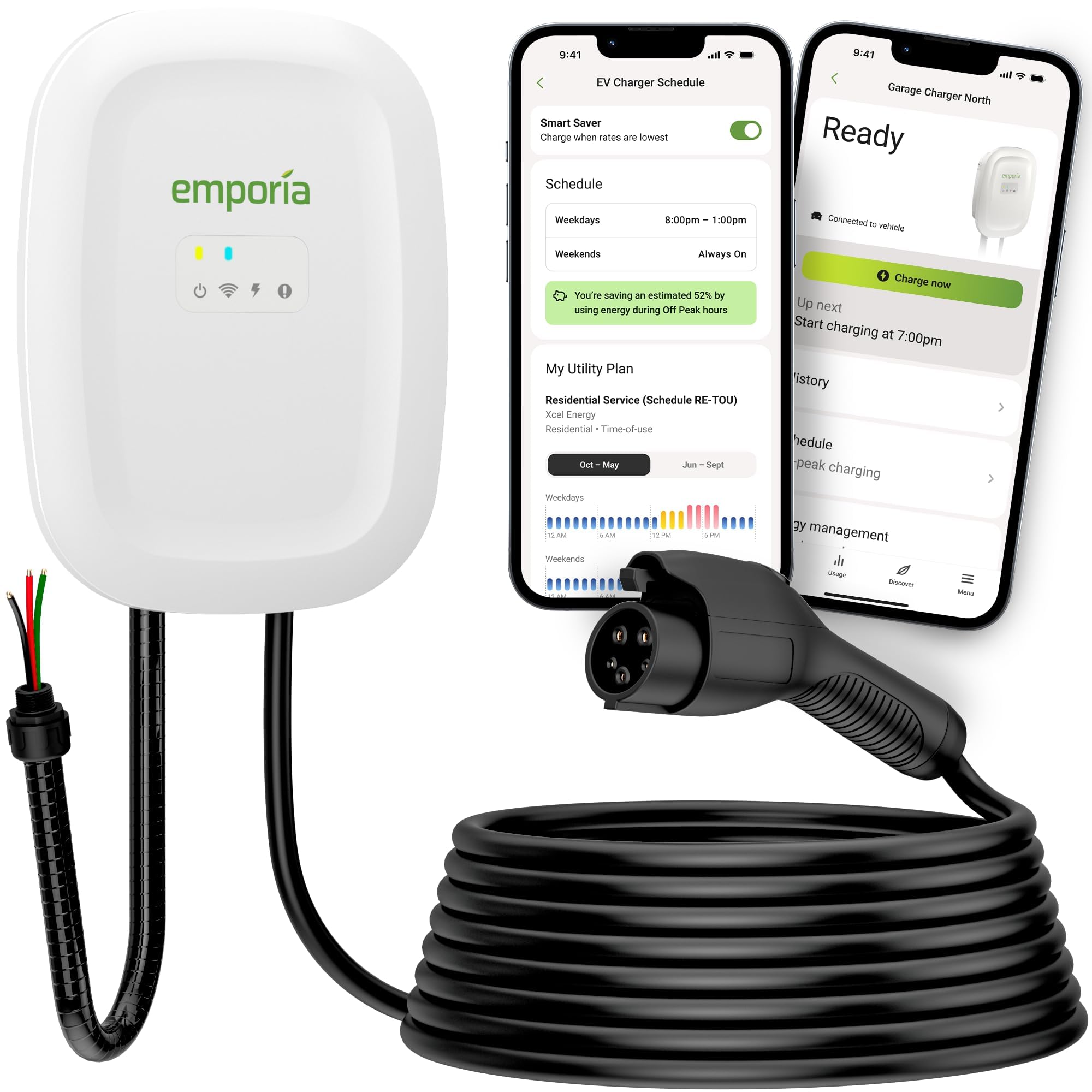
Emporia’s charger is built around a single compelling idea: give the homeowner as much energy data as a utility meter. The 48A hardwired unit delivers up to 46 miles of range per hour via a J1772 connector, but its real strength is the app’s real-time energy dashboard. You can track charging costs per session, set up time-of-use scheduling to align with off-peak rates, and monitor your home’s overall electrical draw if you also use Emporia’s Vue energy monitor.
UL listed and Energy Star certified, the unit meets the strictest safety standards (NEC 625, UL 2594). The 25-foot cable offers good reach, and the included whip simplifies the hardwired connection for an electrician. The charger is compatible with all J1772 vehicles, and Emporia offers a separate NACS version for Tesla owners who want the same monitoring features.
Owner feedback highlights the app’s granular data as a major differentiator—you see exactly how many kilowatt-hours each session consumed and what it cost at your current rate. The unit is not quite as feature-rich in terms of RFID or power sharing as some competitors, but for data-driven homeowners who want to optimize every charging dollar, it’s a standout choice.
What works
- Detailed energy tracking down to the kilowatt-hour
- UL listed and Energy Star certified
- Up to 46 miles of range per hour at 48A
What doesn’t
- No RFID or power sharing features
- Hardwired installation requires professional help
6. EVIQO EVIPOWER NACS 40A
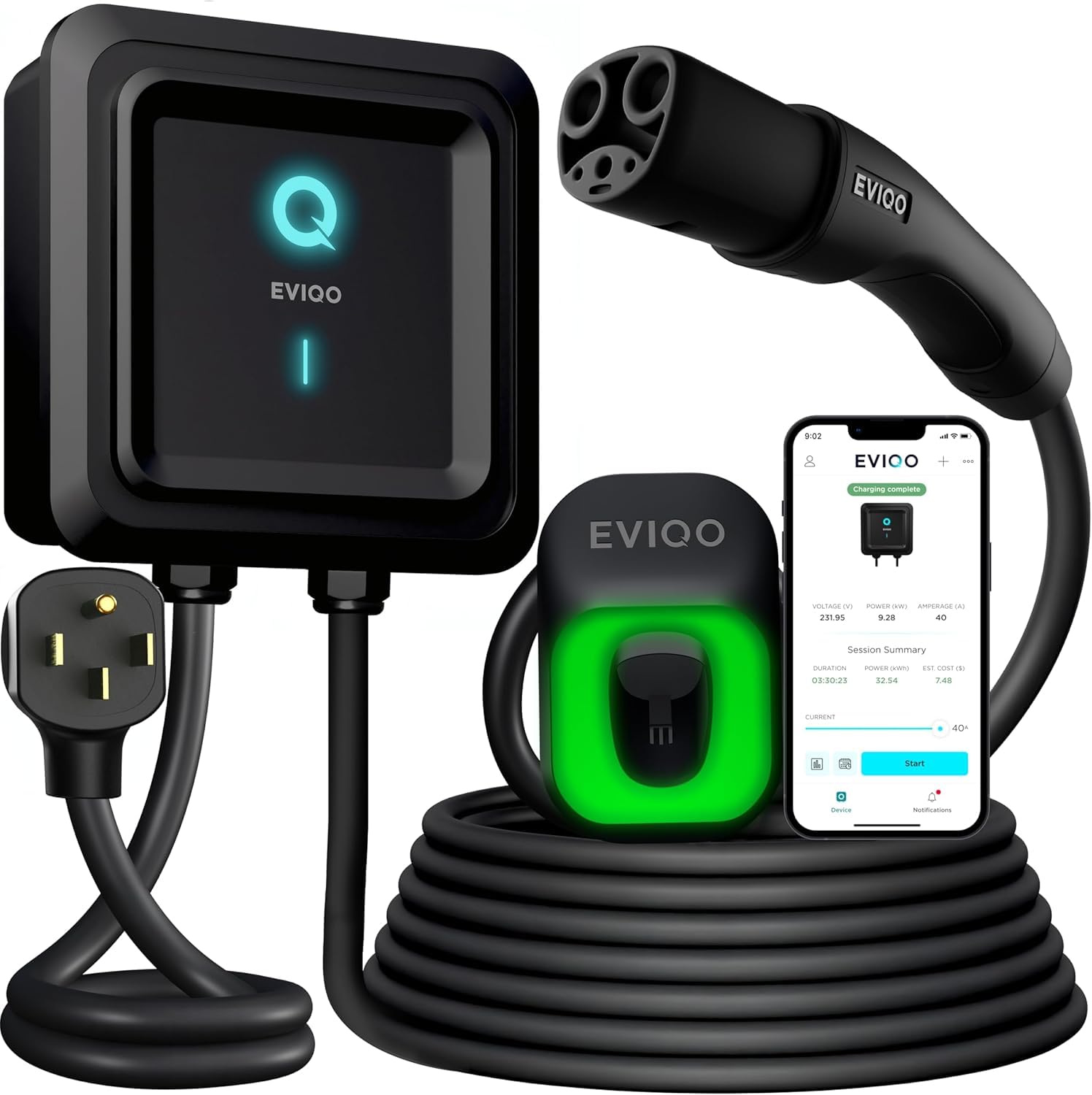
The EVIQO EVIPOWER is a 40A plug-in charger with a native NACS connector, designed specifically for Tesla owners who want a straightforward installation without hardwiring. It plugs into a standard NEMA 14-50 outlet on a 50A breaker and delivers 9.6 kW, adding roughly 38 miles of range per hour. The 25-foot cable provides good reach, and the IP66/NEMA 4 weatherproof enclosure handles rain, snow, and dust without issue.
Smart features include a 2.4 GHz Wi-Fi connection for app-based control—start/stop, adjustable current from 6A to 40A, scheduling, and energy tracking. The fluorescent holster is a clever touch, making it easy to find the connector in a dark garage. A side-mounted reset button lets you clear faults without opening the unit, and the 3-year warranty with US-based support provides peace of mind.
Owners appreciate the OTA firmware updates and the ability to earn the 30% federal tax credit. The unit is UL/ETL and Energy Star certified. If you own a Tesla and want a reliable, plug-and-play Level 2 charger that doesn’t require an electrician to hardwire, this is a well-rounded pick with strong build quality.
What works
- Native NACS connector works directly with all Tesla models
- Plug-in installation is simple and cost-effective
- Fluorescent holster for easy low-light access
What doesn’t
- Limited to 40A output (9.6 kW)
- Requires adapter for J1772 vehicles
7. WOLFBOX E40 EV Charger

The WOLFBOX E40 stands out for its 4.3-inch LCD screen that displays charging rate, time, voltage, and total energy delivered at a glance. The 40A plug-in unit connects via a NEMA 14-50 outlet and provides 7x faster charging than a Level 1 unit, adding roughly 38 miles per hour. The CSA certification and NEMA 4X waterproof housing ensure reliable operation in outdoor or garage installations.
Smart control runs through the WOLFBOX app, which supports scheduling, current adjustment, and monitoring. The unit also integrates with Alexa and Google Assistant for voice commands. RFID card support adds an additional layer of control, and the 25-foot cable offers good flexibility in driveway or garage layouts.
Owners like the ability to check charging progress without pulling out a phone, and the voice control feature is a convenient add-on for hands-free operation. The unit is compatible with all J1772 EVs, and Tesla owners will need a separate adapter. For those who prefer a screen-based interface alongside app control, this is a solid mid-range choice.
What works
- Built-in LCD screen shows real-time charging data
- Voice control via Alexa and Google Assistant
- CSA certified and NEMA 4X rated
What doesn’t
- 40A output limits speed compared to 48A options
- No native NACS connector for Tesla
8. Autel MaxiCharger 40A Home
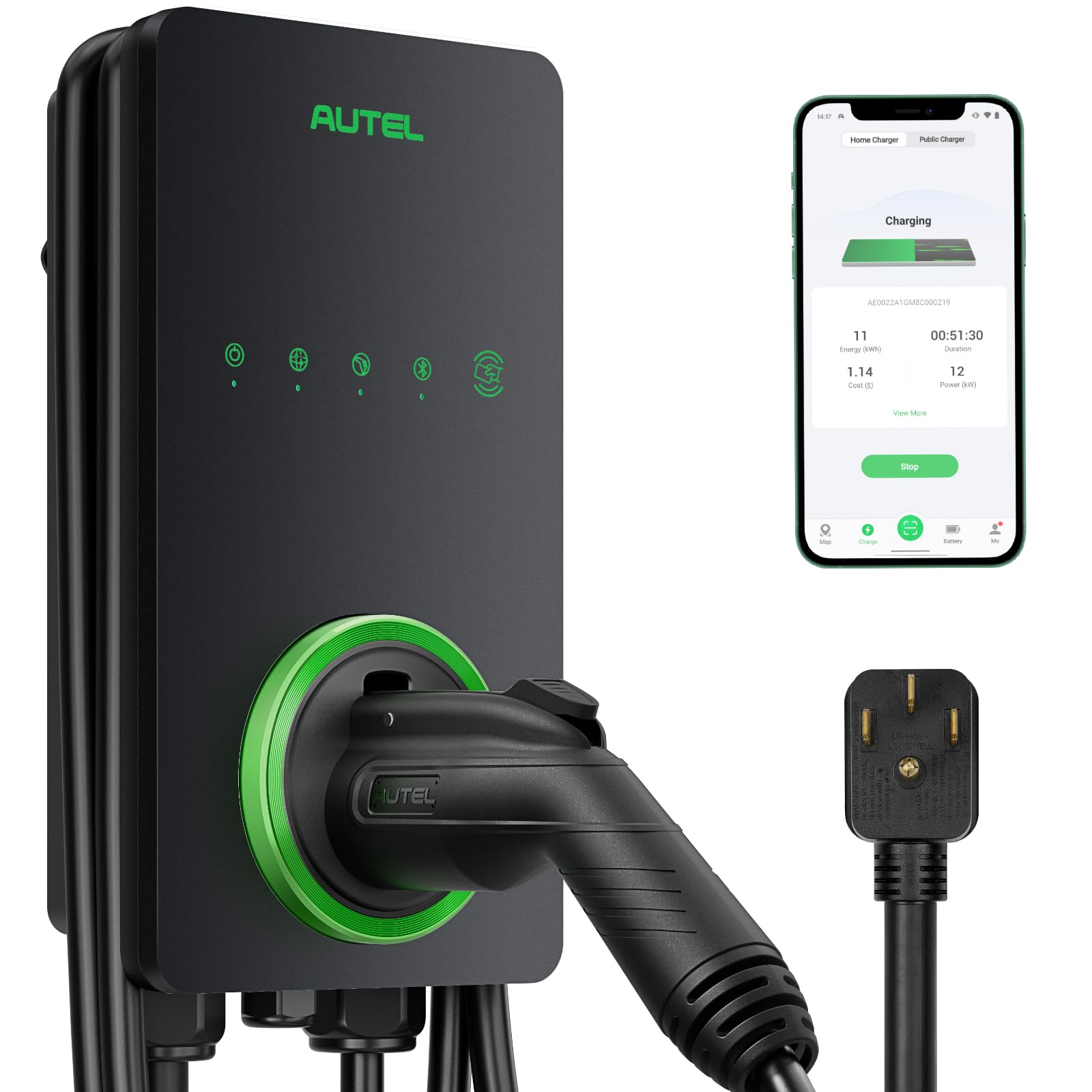
Autel’s 40A Home MaxiCharger is designed for the homeowner who wants a proven brand with a plug-and-play installation. The NEMA 14-50 plug-in design takes roughly five minutes to mount and start charging. The 40A output delivers 9.6 kW, and the J1772 connector is compatible with all major non-Tesla EVs. The NEMA 4X rating means it can be mounted outdoors in any weather without worry.
The Autel Charge app offers adjustable current from 16A to 40A, smart scheduling, and RFID card support for added security. The 3-year warranty and 24/7 customer support are the same terms Autel applies to its premium AC Elite model, giving you solid long-term protection. OTA firmware updates keep the unit running smoothly.
Owners note that the build quality feels substantial for the price point, and the in-body holster keeps the connector neatly stored. The 25-foot cable is standard for the category. If you want a simple, reliable plug-in charger from an established diagnostics company without paying for hardwiring or ultra-high amperage, this is a smart value play.
What works
- Five-minute plug-in installation saves on electrician costs
- NEMA 4X rated for outdoor use in any weather
- 3-year warranty with reliable customer support
What doesn’t
- 40A output is lower than 48A hardwired options
- No native NACS support for Tesla vehicles
9. ApexCharger MACH 2
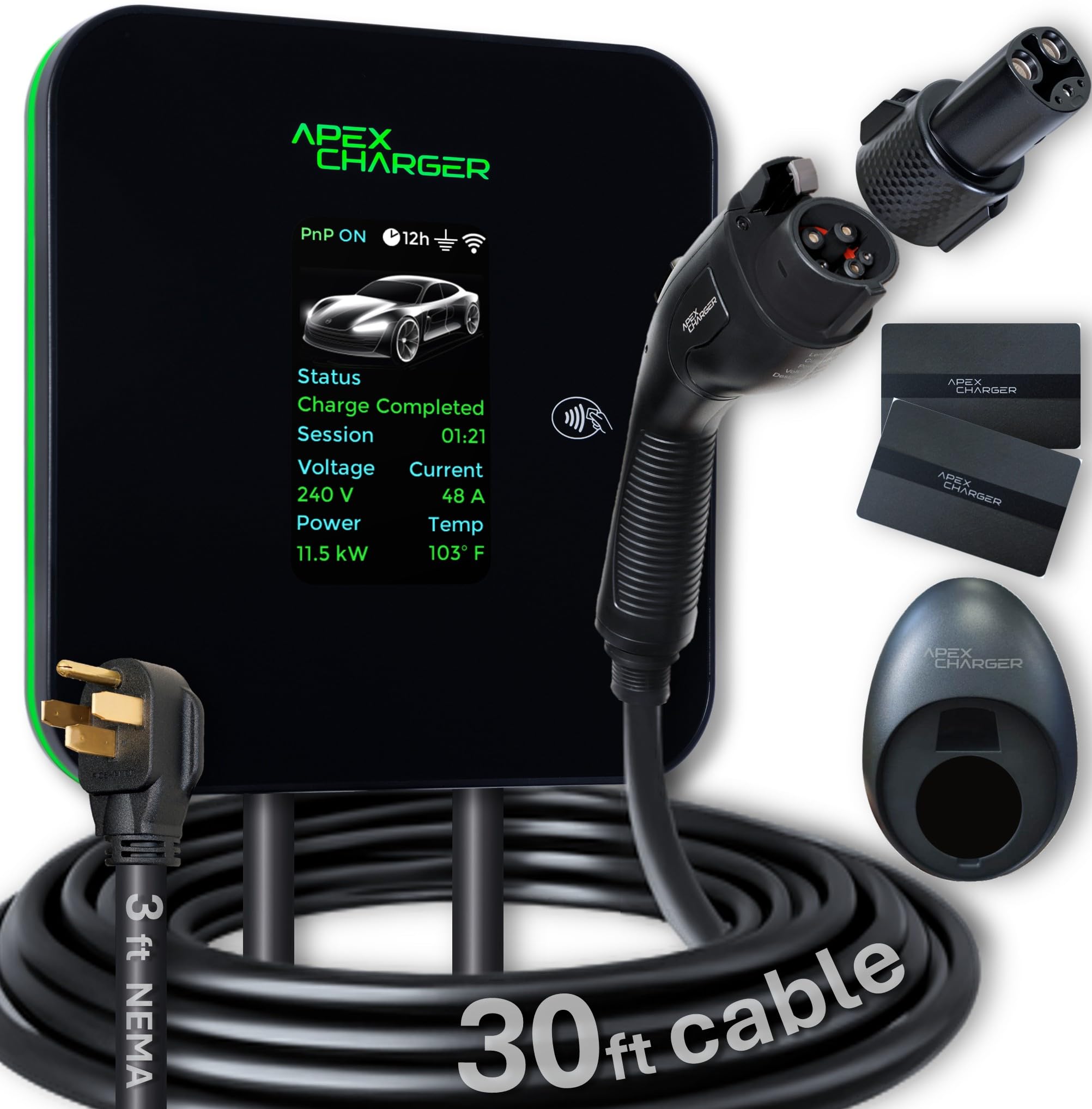
The ApexCharger MACH 2 includes a unique PRO 1 NACS adapter right in the box, making it a turnkey solution for households that own both a J1772 EV and a Tesla. The 40A plug-in unit connects via a NEMA 14-50 outlet and delivers 9.6 kW. An LED display panel shows charging status at a glance, and the breathing light assist indicator adds visual feedback during operation.
The unit features Bluetooth and Wi-Fi connectivity, two RFID cards for access control, and a mobile app for scheduling and monitoring. The included anti-theft bolt and fittings add security for outdoor installations. The MACH 2 is ETL and Energy Star certified, and the 24-hour post-sales support is a nice safety net.
Owners like the included NACS adapter, which eliminates a separate purchase often costing tens of dollars. The display is clear and informative, and the heavy-duty cable with a built-in holder keeps the garage organized. For someone who wants a single charger that can serve both a Tesla and a J1772 vehicle without buying extra accessories, the MACH 2 delivers solid flexibility.
What works
- Includes NACS adapter for Tesla compatibility out of the box
- LED display with breathing light status indicator
- Anti-theft bolt for secure outdoor installation
What doesn’t
- 40A output limits max charging speed
- Plastic enclosure feels less premium than metal units
10. IYILO RA40 Level 2 EV Charger
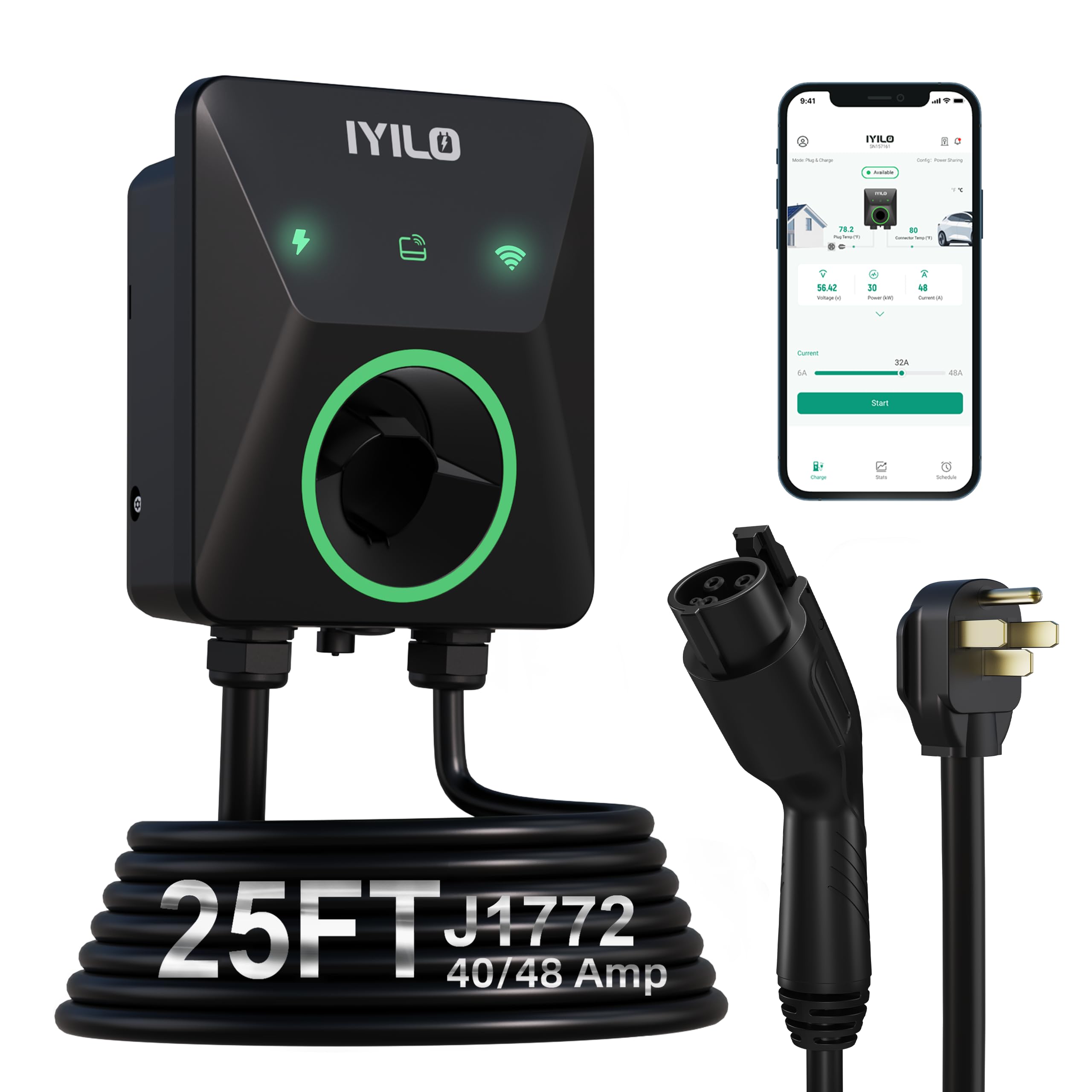
The IYILO RA40 addresses one of the most common safety concerns with Level 2 chargers: heat buildup at the plug and connector. It is equipped with NTC temperature sensors in both the NEMA 14-50 plug and the J1772 connector, monitoring real-time heat and automatically reducing current or stopping charging if overheating is detected. This is a meaningful safety upgrade for older homes or outlets that may have marginal wiring.
The unit can be used as a 40A plug-in or converted to 48A hardwired (via an internal rotary switch), offering flexibility if you later upgrade your panel. The adjustable current from 6A to 48A in 1A steps gives granular control. Power Sharing allows two chargers to share one circuit, and the IYILO app supports scheduled charging, energy tracking, and OTA updates.
ETL and Energy Star certified, the unit features a NEMA 4 waterproof rating and a 25-foot ultra-flex cable. The 3-year warranty backs the purchase. Owners concerned about melting outlets or connector failures will find the dual-sensor safety system a compelling differentiator. For a mid-range price, you get premium safety monitoring that few competitors offer at this level.
What works
- Dual NTC temp sensors in plug and connector for overheat safety
- Convertible from 40A plug-in to 48A hardwired
- Power Sharing supports two chargers on one circuit
What doesn’t
- 2.4 GHz Wi-Fi only (no 5 GHz support)
- App interface is less polished than premium brands
11. Lectron Level 1/2 Portable NACS Charger
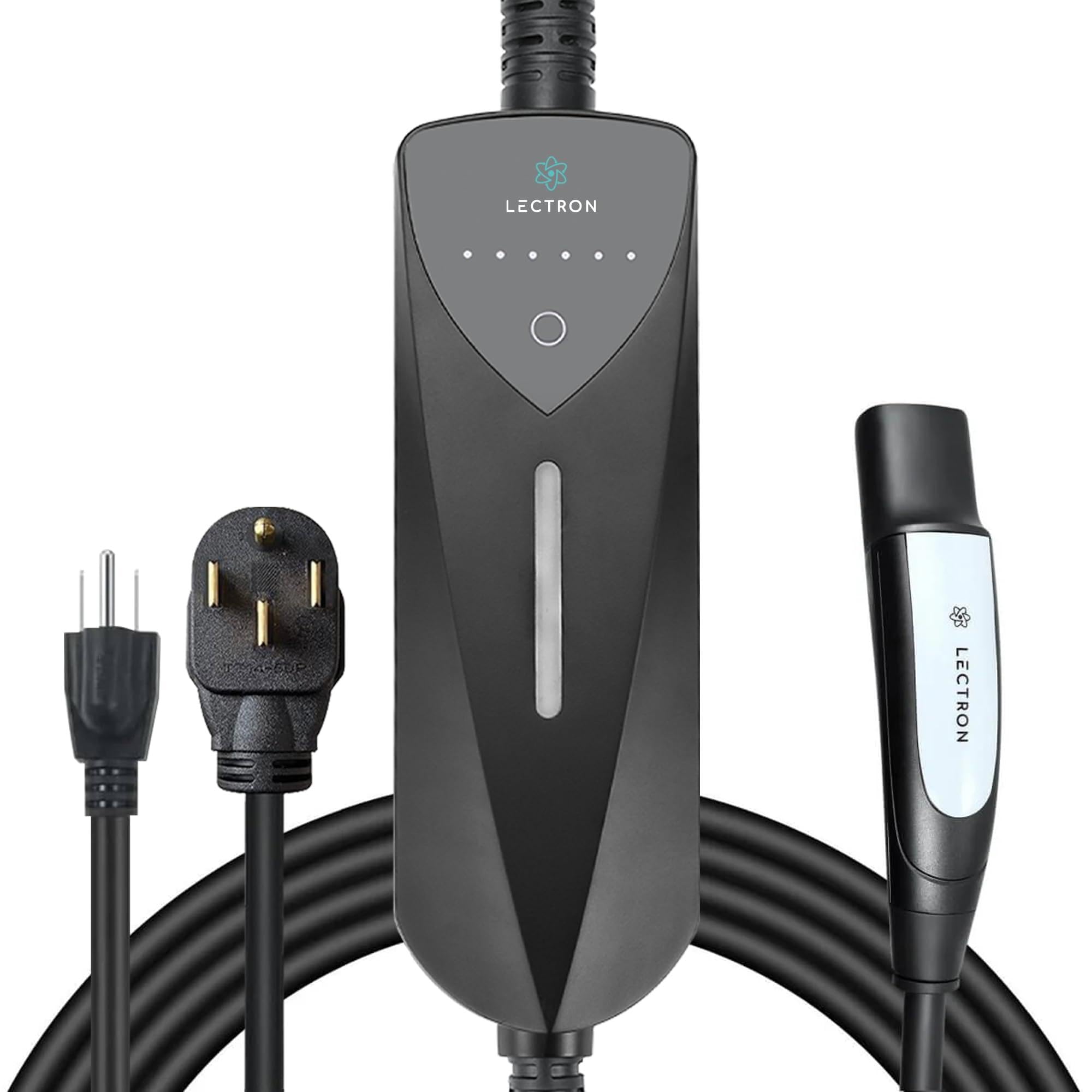
The Lectron Portable EV Charger is the only unit on this list designed for travel, offering both Level 1 (120V at 8A) and Level 2 (240V at 40A) charging in a single compact package. It comes with NEMA 5-15 and 14-50 plug adapters, letting you charge from a standard household outlet or a dedicated RV outlet. The 20-foot cable is shorter than wall-mounted units but still practical for most garages and campsites.
The NACS connector is compatible with all Tesla models and other NACS alliance vehicles, and a J1772 adapter is sold separately if needed. ETL certification covers overvoltage, overcurrent, and over-temperature protection. LED status indicators provide session feedback without an app, making it truly portable and independent of Wi-Fi.
Owners value the dual-level flexibility for road trips and visiting family, where a Level 2 outlet may not always be available. The wall mount included in the box also allows a semi-permanent home installation. If you need a charger that lives in your trunk and handles both daily home use and unexpected travel scenarios, this Lectron unit is the most versatile option in the lineup.
What works
- Dual-level (120V/240V) operation for travel and home
- NACS native with included 5-15 and 14-50 plug adapters
- Portable design with wall mount for semi-permanent use
What doesn’t
- 20-foot cable is shorter than wall-mounted units
- No Wi-Fi app control (LED status only)
Hardware & Specs Guide
NEMA 14-50 vs. Hardwired
A NEMA 14-50 plug-in charger is the easiest DIY option—you simply mount the unit near an existing 14-50R outlet (like an RV or range outlet) on a 50A breaker, and you’re charging at up to 40A. Hardwiring removes the plug and receptacle, replacing them with a direct connection that handles 48A continuous load on a 60A breaker. Hardwiring is safer for high-amperage setups, eliminates the risk of a loose outlet connection overheating, and qualifies for the full 30% federal tax credit on both equipment and installation.
GFCI and Overcurrent Protection
Modern Level 2 chargers include a built-in GFCI (Ground Fault Circuit Interrupter) that detects leakage currents as low as 20 mA and shuts down the circuit in milliseconds. This is critical for outdoor or garage installations where moisture exposure is possible. Overcurrent protection monitors the total current draw and reduces or stops charging if the circuit is overloaded. Units with dual NTC temperature sensors add an extra layer by monitoring heat at the plug and connector, preventing meltdowns before they happen.
FAQ
What amperage do I need for a dual electric car charger setup?
Can I install a Level 2 charger myself if I have a NEMA 14-50 outlet?
How does power sharing work across two chargers on one circuit?
Do I need a separate charger for a Tesla and a J1772 vehicle?
What is the federal tax credit for Level 2 EV charger installation?
Final Thoughts: The Verdict
For most buyers, the dual electric car charger winner is the Generac EV Charger Level 2 Plus because its Power Boost Technology and Power Sharing features allow seamless dual-EV charging without a panel upgrade. If you want a universal connector that serves both Tesla and J1772 vehicles, grab the Tesla Universal Wall Connector. And for the fastest 50A J1772 speed with Ethernet reliability, nothing beats the Autel MaxiCharger AC Elite.

Certification: BSc in Mechanical Engineering
Education: Mechanical engineer
Lives In: 539 W Commerce St, Dallas, TX 75208, USA
Md Amir is an auto mechanic student and writer with over half a decade of experience in the automotive field. He has worked with top automotive brands such as Lexus, Quantum, and also owns two automotive blogs autocarneed.com and taxiwiz.com.