A worn drive belt tensioner sends subtle signals long before the belt snaps — a faint chirp during cold starts, a wobble in the pulley, or a vibration that shouldn’t be there. Catching it early saves more than just money on a tow bill.
I’m Amir — the founder and writer behind Four Wheel Ask. My analysis combines spec-sheet comparisons, owner-reported durability data across tens of thousands of miles, and a close look at manufacturing tolerances to separate components that hold tension from those that don’t.
Replacing a failing tensioner restores proper belt alignment and accessory drive performance, eliminating noise and preventing breakdowns. After extensive analysis of owner feedback and build quality, the best drive belt auto tensioner is the Gates 38274 for its reliable tension and quiet operation.
How To Choose The Best Drive Belt Auto Tensioner
A tensioner’s job seems simple — maintain constant belt tension — but the engineering behind that task determines whether you get 30,000 miles or 100,000 miles of service. The wrong choice can mean persistent noise, belt slippage, or premature accessory wear.
Spring-Design vs Hydraulic Tensioners
Most serpentine belt tensioners use a torsional round spring to apply constant force. The spring absorbs minor vibrations and keeps the belt tight across temperature swings. Hydraulic tensioners, more common on timing belt systems, use oil damping to eliminate flutter across the RPM range. For accessory drive belts, a quality spring design with a robust damping mechanism is usually sufficient and more affordable to replace.
OEM vs Aftermarket: Fitment and Materials Matter
OEM tensioners (from GM Genuine, Motorcraft, or AISIN) are built to the exact factory specifications for their respective vehicles. Aftermarket options from Gates or TUCAREST often match or exceed OE quality when sourced from reputable manufacturers. The critical factor is aluminum vs stamped steel construction — aluminum housings offer better heat dissipation and consistent damping over time, while budget steel units can degrade faster under high-mileage use.
Pulley Bearing Quality and Seal Design
The bearing inside the tensioner pulley sees constant rotation and exposure to heat, dirt, and moisture. Patented labyrinth seals (used by Gates) keep contaminants out without adding drag, extending bearing life significantly. A rough-spinning pulley or one with visible wobble indicates bearing failure — a sign the entire tensioner assembly needs replacement rather than just swapping the pulley.
Quick Comparison
On smaller screens, swipe sideways to see the full table.
| Model | Category | Best For | Key Spec | Amazon |
|---|---|---|---|---|
| Gates 38274 | Aftermarket | Overall reliability & noise reduction | Labyrinth seal, 76 mm pulley diameter | Amazon |
| ACDelco Gold ACK040378HD | Premium Aftermarket | GM trucks & SUVs with belt kit | Includes tensioner and serpentine belt | Amazon |
| GM Genuine 12609719 | OEM | Direct factory replacement for GM models | OE-spec spring tension, aluminum housing | Amazon |
| AISIN BTH-001 | OE | Honda/Acura hydraulic timing tensioner | Hydraulic damping, aluminum die-cast body | Amazon |
| Motorcraft BT-50 | OEM | Ford Powerstroke & heavy-duty trucks | OEM-grade cast construction | Amazon |
| TUCAREST 38332 | Aftermarket | Honda/Acura/Nissan budget replacement | OE-spec torsional spring design | Amazon |
| TUCAREST 38452 | Aftermarket | Ford/Mazda/Mercury entry-level fix | Direct fit, vibration damping system | Amazon |
In‑Depth Reviews
1. Gates 38274 DriveAlign Automatic Belt Drive Tensioner

Gates has been a trusted name in belt and tensioner manufacturing for decades, and the 38274 DriveAlign unit demonstrates exactly why. The patented labyrinth seal protects the internal bearing from road grit and moisture, a design detail that directly contributes to longer service life compared to open-bearing competitors. The torsional round spring delivers consistent tension across temperature extremes without the flutter that causes belt noise on cold mornings.
Owner feedback on this unit spans Ford V10, V8, and modular engine families, with consistent reports of immediate noise elimination and trouble-free installation. The 76 mm pulley diameter matches OE specifications for a broad range of domestic applications, and the aluminum housing provides better heat dissipation than stamped steel alternatives. Several reviewers noted the tensioner felt heavier and more solid than the original factory part they removed.
Fitment is straightforward on most applications, though access on certain transverse-mounted engines requires patience and a long breaker bar. The tensioner ships with the pulley pre-installed and pre-loaded, so no spring compression is needed — remove the old unit, bolt this one in, route the belt, and release the tensioner arm. For the price, this unit delivers build quality that rivals parts costing significantly more.
What works
- Patented labyrinth seal extends bearing life significantly
- Consistent tension eliminates belt chirp on cold starts
- Solid aluminum construction with precise OE-matching dimensions
What doesn’t
- Limited to domestic Ford and Lincoln applications primarily
- No belt included — must purchase separately
2. ACDelco Gold ACK040378HD Serpentine Drive Belt Tensioner Kit
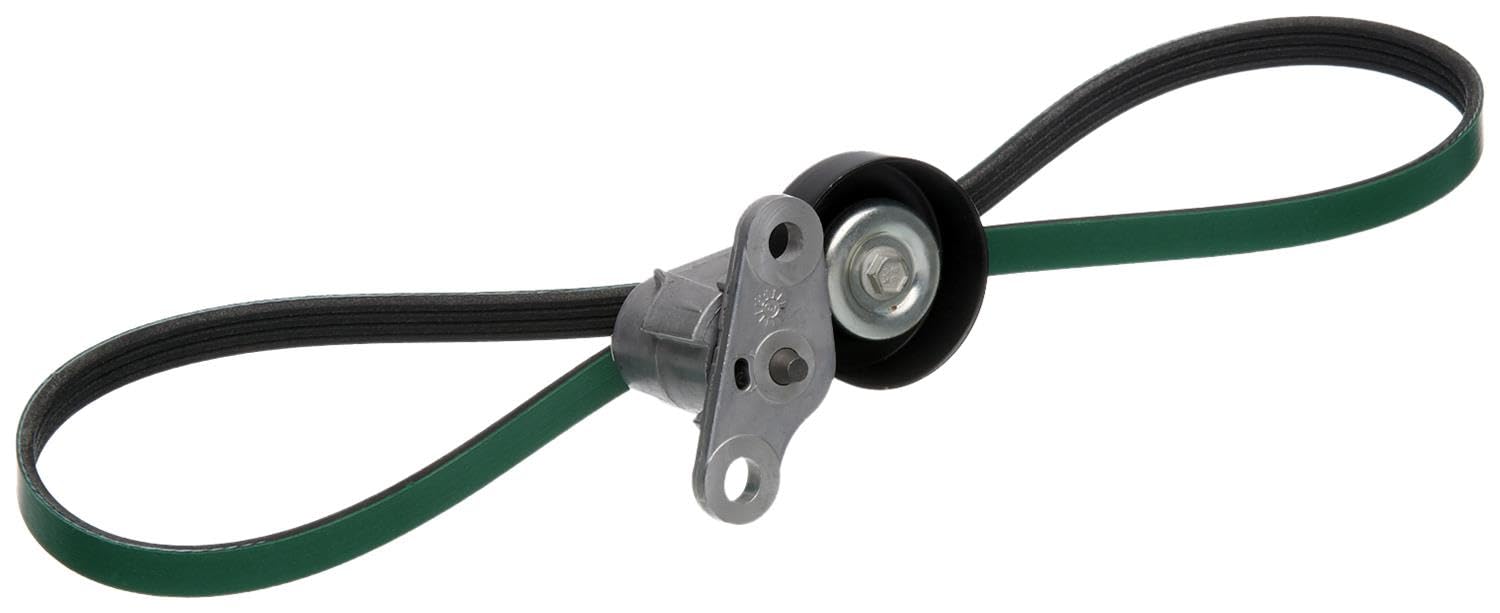
ACDelco Gold parts occupy the sweet spot between genuine GM factory components and budget aftermarket alternatives. This kit bundles the tensioner assembly with a matching serpentine belt, giving DIY installers everything needed for a complete swap in one box. The tensioner body uses the same aluminum alloy and spring rate as the original GM design, ensuring belt alignment and tension damping match the engineering parameters of the vehicle’s accessory drive system.
Owner reports on the ACK040378HD focus heavily on the Chevrolet Silverado and GMC Sierra platforms with the 6.0L V8, where owners reported the kit eliminated both belt squeal and erratic tensioner movement. The included high-quality belt matches the OE length and rib profile, removing the guesswork of belt selection. Reviewers who had previously used budget tensioners noted the ACDelco unit felt noticeably smoother when pivoting the arm by hand, indicating better internal damping.
One practical consideration is that this is a heavy-duty variant — the “HD” suffix means the spring tension is engineered for the higher demands of truck accessory loads, including larger alternators and A/C compressors. This makes it slightly stiffer than standard passenger-car tensioners, which is exactly what a full-size truck needs. Installation mirrors the factory procedure, and the tensioner pulley uses a sealed dual-row bearing that spins freely with zero play out of the box.
What works
- Complete kit includes matched belt for one-stop installation
- Heavy-duty spring rate ideal for truck accessory loads
- OE-grade aluminum housing with sealed dual-row bearing
What doesn’t
- Fitment limited primarily to GM trucks and large SUVs
- Premium price reflects quality but may exceed budget needs for compact cars
3. GM Genuine Parts 12609719 Drive Belt Tensioner
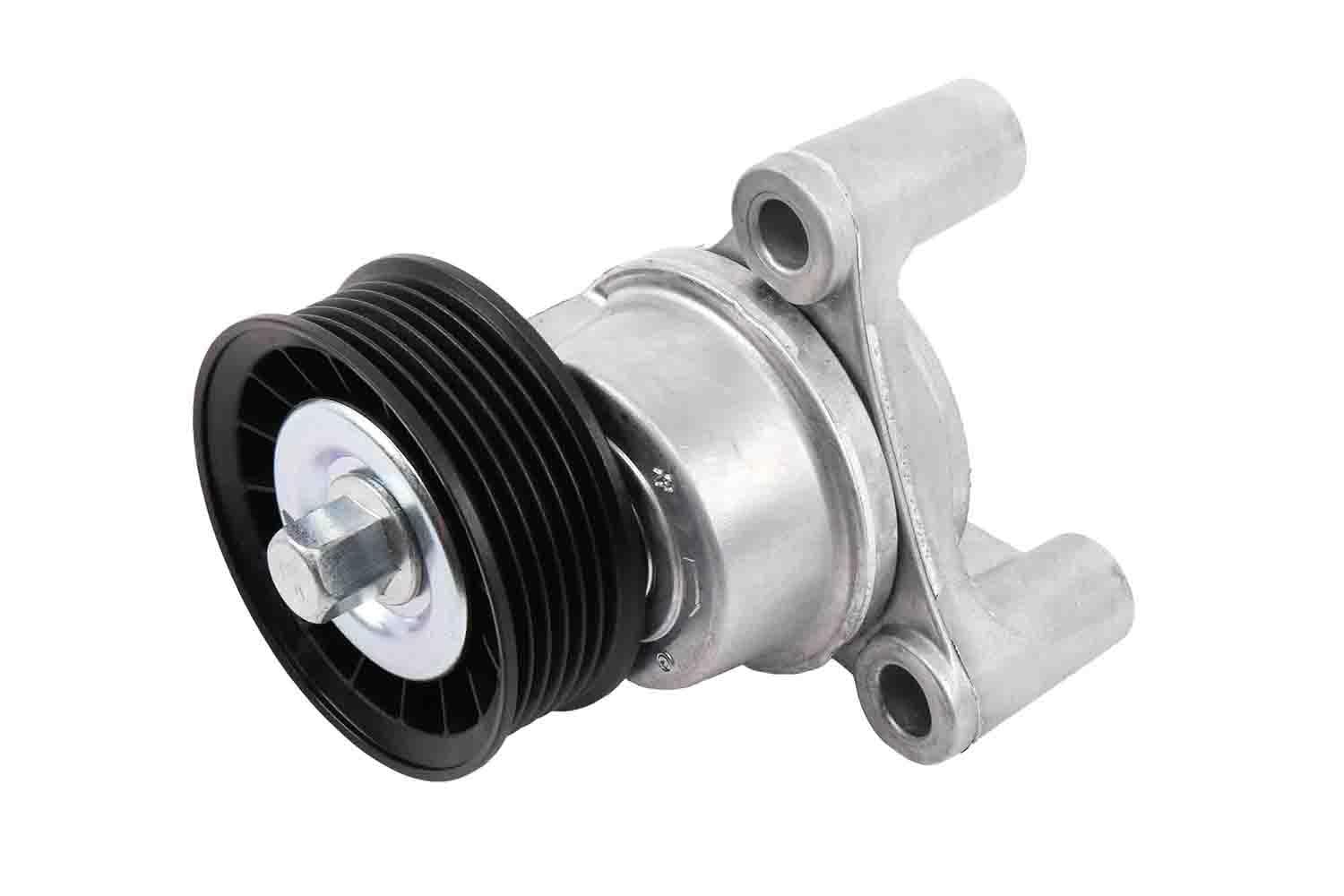
When a vehicle leaves the factory, the tensioner installed is a GM Genuine part — not an aftermarket imitation. The 12609719 is the exact production-line component used on a wide range of Chevrolet, GMC, Buick, and Cadillac models with LS-based V8s and V6s. The spring tension curve, damping characteristics, and pulley alignment are precisely calibrated to the vehicle’s specific accessory drive harmonics, which aftermarket parts sometimes approximate but rarely match exactly.
Owner feedback on this unit is overwhelmingly positive, with Silverado and Yukon owners reporting direct bolt-on fitment and immediate restoration of quiet belt operation. Several reviewers specifically mentioned that aftermarket tensioners they had tried previously introduced a subtle vibration at idle that this GM unit completely eliminated. The housing uses a durable zinc-plated steel construction with a corrosion-resistant finish that holds up well to road salt and moisture exposure in northern climates.
Installation is identical to the factory procedure, and the tensioner accepts the standard 15 mm socket for belt release. One detail that sets genuine GM parts apart is the precise indexing of the arm stop — the tensioner holds the belt at exactly the right position without over-tensioning, which protects alternator and power steering pump bearings from premature wear. For owners who plan to keep their vehicle long-term, the peace of mind from using a part validated by the vehicle’s original engineering team is worth prioritizing.
What works
- Exact factory-spec tension prevents accessory bearing wear
- Corrosion-resistant finish handles harsh winter road conditions
- Precise arm stop indexing for correct belt tension every time
What doesn’t
- Limited compatibility to GM vehicles only
- Stamped steel housing not as heat-dissipative as aluminum alternatives
4. AISIN BTH-001 OEM Hydraulic Timing Belt Tensioner

AISIN is one of the original equipment manufacturers for Honda, Acura, and many Asian automakers — the BTH-001 is the same tensioner that rolls off the assembly line in new vehicles. Unlike spring-style accessory belt tensioners, this hydraulic unit uses oil pressure to dampen timing belt oscillations across the entire RPM range. That internal hydraulic pressurizing mechanism is what eliminates the characteristic cold-start rattle that plagues high-mileage Honda J-series and K-series engines.
Owner feedback on the BTH-001 is emphatic — the phrase “ticking noise is no more” appears repeatedly across reviews for Honda Odyssey, Pilot, Ridgeline, and Accord applications. The hydraulic piston extends smoothly and applies consistent tension regardless of thermal expansion or belt stretch. Many owners paired this tensioner with a new timing belt and water pump kit, noting that the labor involved in reaching the tensioner justifies replacing all three components simultaneously. The aluminum die-cast body is lightweight yet structurally rigid, resisting flex under high-load conditions.
Installation on transverse V6 engines requires removing the passenger-side wheel, splash shield, and engine mount to access the timing cover — it is not a 15-minute job. However, the tensioner itself bolts directly into the factory location without adapters or modifications. The hydraulic damper is factory-charged and sealed, so no bleeding or pre-loading is needed. For owners of Honda and Acura vehicles experiencing timing belt rattle, this is the definitive repair part that restores the engine’s original quiet operation.
What works
- Hydraulic damping eliminates cold-start rattle completely
- Factory OEM part for Honda/Acura — identical to original
- Lightweight aluminum body resists flex under load
What doesn’t
- Labor-intensive installation on transverse V6 layouts
- Higher cost reflects hydraulic design vs simpler spring units
5. Motorcraft Accessory Drive Belt Tensioner BT-50

Motorcraft is Ford’s official parts brand, and the BT-50 is the tensioner specified for a wide range of Ford trucks, including the legendary 7.3L Powerstroke diesel and the modular V10 and V8 gasoline engines. The design uses a robust cast housing with a heavy-duty spring that provides consistent tension under the high-vibration environment of diesel engine operation. The pulley bearing is a double-sealed unit that resists contamination from engine bay debris and belt dust.
Owner feedback on the BT-50 comes heavily from the OBS (1994-1997) Ford truck community, where owners report that the Motorcraft unit solves the notorious bolt-backing-out issue that plagued early aftermarket tensioners on the 7.3L. The tensioner arm geometry is optimized for the tight clearance on the front of the Powerstroke engine, and the indexing mark on the arm allows visual confirmation of correct belt tension without specialized tools. Several reviewers noted that this tensioner eliminated a persistent low-frequency vibration they had been chasing for months.
Installation on the 7.3L Powerstroke requires a longer belt than the original because the tensioner repositions the belt path slightly — this is well-documented in the Ford service literature and is not a defect. For gasoline V8 and V10 applications, the BT-50 bolts directly in place of the original with no belt length change. The tensioner is manufactured to Ford’s QA standards, which means each unit is tested for spring rate consistency and pulley runout before leaving the factory. For Ford truck owners, this is the tensioner that the engineers designed the accessory drive around.
What works
- Solves the bolt-backing issue on 7.3L Powerstroke engines
- Double-sealed bearing resists contamination in harsh conditions
- Factory indexing mark enables visual tension verification
What doesn’t
- May require longer belt on certain diesel applications
- Heavy-duty spring can feel stiff during belt installation
6. TUCAREST 38332 Drive Belt Tensioner (Honda/Acura/Nissan)
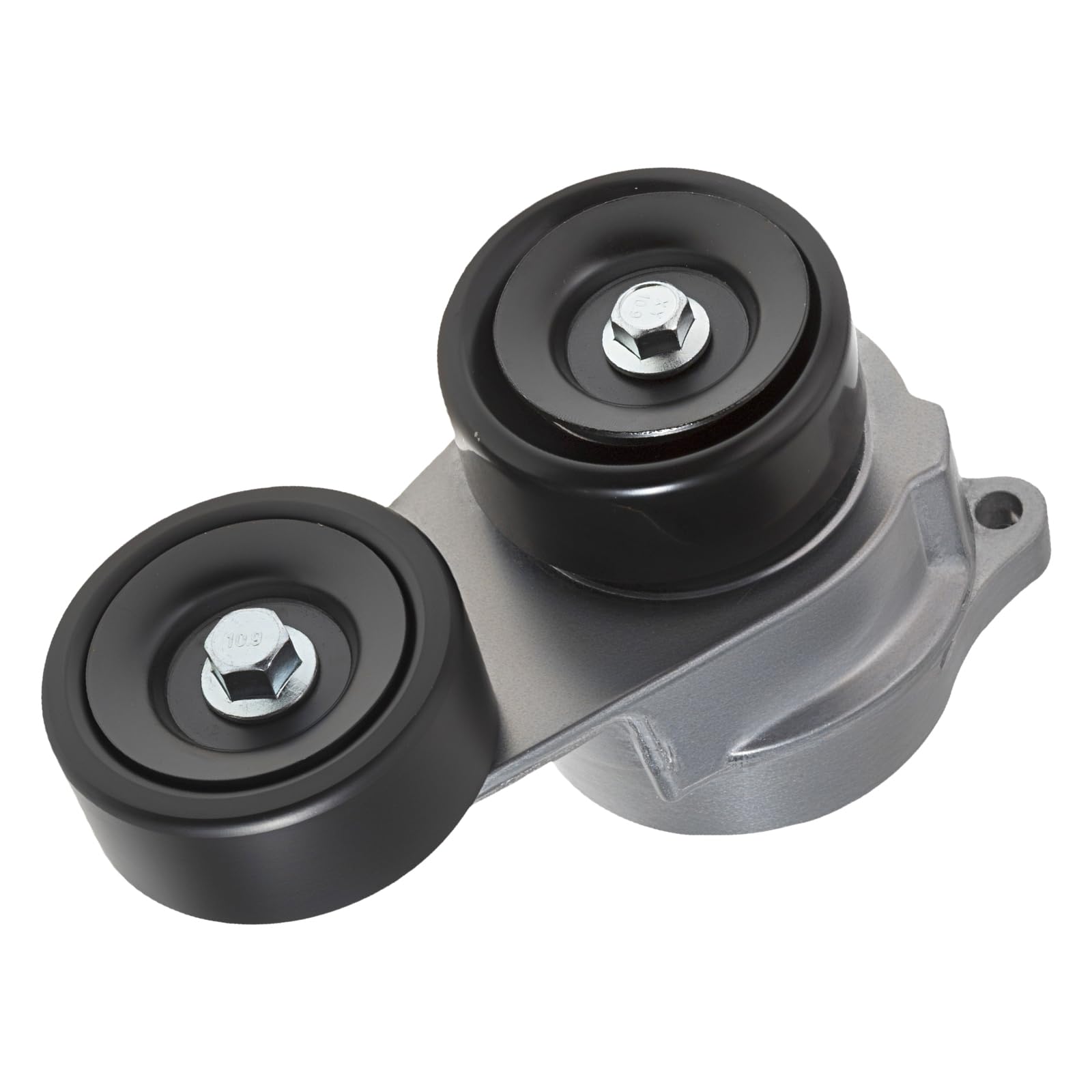
TUCAREST positions itself as a value-focused alternative to OE brands without sacrificing the critical engineering details. The 38332 is built for the popular Honda J-series and K-series engines as well as Nissan VQ applications, covering the Accord, Odyssey, Pilot, and Altima families. The torsional round spring design follows OE specifications, and each unit undergoes multiple quality checks during production — including pulley alignment verification and spring rate testing — before it leaves the factory.
Owner feedback for this model is notably positive, with many reviewers on Nissan Altima and Honda Accord platforms reporting that the tensioner eliminated a persistent belt squeak that had survived multiple belt replacements. The fitment was described as identical to the original part, with bolt holes lining up perfectly and the pulley sitting flush in the belt path. Several long-term updates from owners who installed the tensioner over a year prior confirm that the tension has held steady and no noise has returned.
One detail mentioned in owner reviews is that the aluminum 3/8-inch drive socket hole can be softer than expected — using a six-point socket rather than a 12-point or worn one prevents any rounding during the tension release procedure. The vibration damping system integrated into the housing reduces the resonant frequency that causes belt flutter at certain RPMs, which is a common cause of accessory drive noise. For budget-conscious owners of Asian-market vehicles, this tensioner delivers reliable performance at a fraction of the dealer price.
What works
- Perfect OE-matching fitment for Honda, Acura, and Nissan models
- Quality control checks during production ensure consistent spring tension
- Vibration damping system reduces belt flutter at cruising RPM
What doesn’t
- Socket drive hole can round if not careful during installation
- Limited track record compared to decades-old brands like Gates
7. TUCAREST 38452 Drive Belt Tensioner (Ford/Mazda/Mercury)
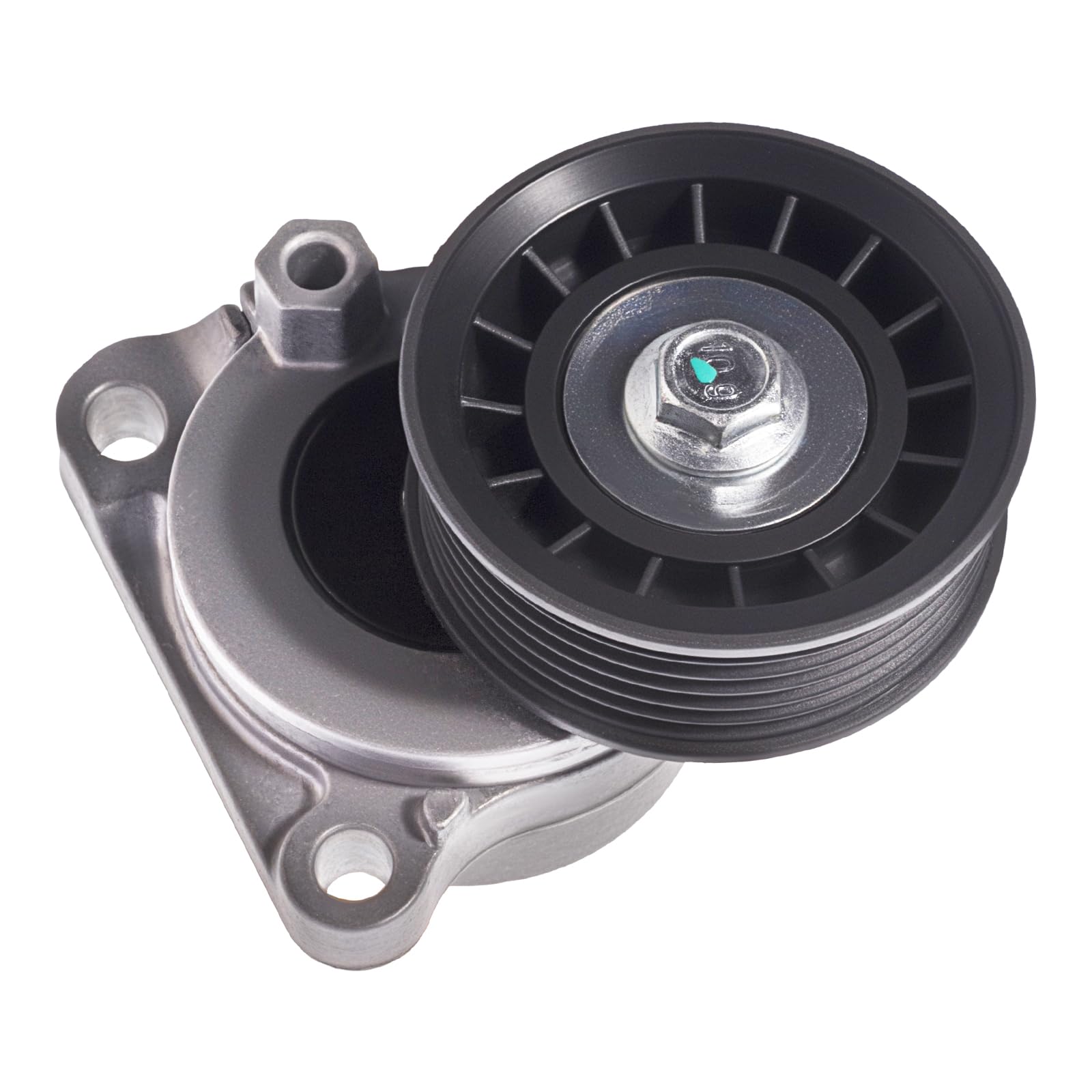
The TUCAREST 38452 is engineered for Ford, Mazda, and Mercury platforms using the 2.0L, 2.3L, and 2.5L engines — covering models like the Ford Escape, Fusion, Mazda Tribute, and Mercury Milan. This tensioner is produced by an OE manufacturer following the same specifications as the factory part, using a torsional round spring design with a vibration damping system to reduce natural frequency oscillations. The metallic finish resists corrosion, and the pulley bearing is sealed to keep contaminants away from the grease pack.
Owner reviews highlight the immediate elimination of belt noise after installation, with several owners of 2012-era Dodge Avengers and Ford Escapes reporting that the tensioner fit perfectly and functioned identically to the original unit. The direct-replacement design means no modifications or adapters are needed — unbolt the old tensioner, transfer the belt, and torque the new one in place using the same hardware. Multiple reviewers noted that the tensioner felt comparable in quality to the factory part they removed, with smooth pulley rotation and consistent spring resistance.
One area where owners suggest caution is the previously mentioned aluminum socket drive — using a high-quality six-point socket reduces the risk of deforming the relief hole during belt service. The tensioner’s compact dimensions make it accessible on transverse engine layouts where space is tight. At this price point, the 38452 represents the most affordable entry point into a reliable belt tensioner replacement, making it a practical choice for high-mileage vehicles where keeping costs manageable is the primary concern.
What works
- Direct fitment for popular Ford, Mazda, and Mercury platforms
- Vibration damping reduces belt noise immediately
- Budget-friendly entry point for high-mileage vehicle repairs
What doesn’t
- Aluminum drive hole may deform with worn or poor-fitting sockets
- Long-term durability data limited compared to established brands
Hardware & Specs Guide
Spring vs Hydraulic Tensioning
Spring-style tensioners (used in Gates, GM Genuine, Motorcraft, and TUCAREST units) rely on a coiled torsional spring to maintain belt tension. These are simpler, more affordable, and easier to replace. Hydraulic tensioners (like the AISIN BTH-001) use oil-pressure damping to absorb belt oscillations, which is ideal for timing belt systems where precise cam timing is critical. For accessory drive belts, a quality spring design with effective damping is the standard choice.
Build Materials & Durability
Aluminum housing tensioners (Gates, ACDelco Gold, AISIN) offer superior heat dissipation compared to stamped steel units (GM Genuine, TUCAREST). Better heat management extends bearing and spring life, particularly in high-load applications like truck accessory drives. Sealed bearings with labyrinth seals (Gates) or double-lip seals (Motorcraft) provide the best protection against contaminants. Budget units typically use standard sealed bearings that are adequate for normal driving conditions.
OE vs Aftermarket Fitment
OEM tensioners from GM Genuine, Motorcraft, and AISIN are identical to the factory-installed part, guaranteeing perfect bolt-hole alignment, correct arm geometry, and appropriate spring rate. Aftermarket units from Gates and TUCAREST are designed to match OE specifications but may use slightly different materials or manufacturing processes. The critical spec is the arm pivot location and pulley offset — mismatched geometry causes belt misalignment, edge wear, and noise.
Signs of Wear & Replacement Intervals
Tensioners typically last 60,000 to 100,000 miles depending on driving conditions and belt replacement history. Key failure indicators include chirping or squeaking at cold start, visible pulley wobble when the engine is running, a loose belt that can be deflected more than half an inch, and a tensioner arm that does not move smoothly through its travel range. Replacing the tensioner with every other belt change is a conservative interval that prevents accessory drive failures.
FAQ
How do I know if my drive belt tensioner is failing?
Can I replace just the pulley instead of the whole tensioner assembly?
How long should a drive belt tensioner last?
What is the difference between automatic and manual belt tensioners?
Final Thoughts: The Verdict
For most buyers, the best drive belt auto tensioner winner is the Gates 38274 because it combines proven engineering, a patented labyrinth seal, and consistent owner satisfaction across a wide range of Ford and Lincoln applications. If you want factory-correct fitment for a GM vehicle, grab the GM Genuine Parts 12609719 for direct OEM replacement. And for eliminating cold-start rattle on a Honda or Acura timing belt, nothing beats the AISIN BTH-001 hydraulic tensioner.

Certification: BSc in Mechanical Engineering
Education: Mechanical engineer
Lives In: 539 W Commerce St, Dallas, TX 75208, USA
Md Amir is an auto mechanic student and writer with over half a decade of experience in the automotive field. He has worked with top automotive brands such as Lexus, Quantum, and also owns two automotive blogs autocarneed.com and taxiwiz.com.