Pulling up to the Christmas tree in an RC drag race is a different kind of pressure. One bad launch, one bogged pass, or a drivetrain that can’t transfer power cleanly and the race is over before you even reach the 60-foot mark. The gap between a winning pass and a losing one often comes down to chassis setup, tire compound, and how well the electronics deliver consistent torque under load.
I’m Amir — the founder and writer behind Four Wheel Ask. I’ve spent thousands of hours analyzing owner-reported pass data, comparing drivetrain architectures, and breaking down how ESC timing, motor KV ratings, and battery discharge curves affect real-world quarter-mile performance across dozens of RC platforms.
Whether you are chasing personal bests or just want a reliable platform to learn the ropes, understanding which components actually hold up under repetitive hard launches is the difference between a trophy and a week of repairs. After weeks of comparing build quality, speed data, and owner feedback reports, I have narrowed down the field to the best drag rc car choices that genuinely deliver at the strip.
How To Choose The Best Drag RC Car
Selecting a drag-specific RC platform requires looking beyond top-speed claims. A car that hits high numbers on paper can still bog off the line if the drivetrain, ESC calibration, and tire setup aren’t matched to the demands of repeated hard launches. Understanding the interplay between chassis layout, power delivery, and battery chemistry will save you both time and money.
Drivetrain Layout: 2WD vs. 4WD
Two-wheel drive platforms dominate organized drag racing because they reduce drivetrain losses and allow more precise tuning of weight transfer during launch. A well-set 2WD car with a soft rear tire and properly tuned slipper clutch can hook harder than many 4WD setups. Four-wheel drive offers more traction on loose or unprepared surfaces but adds rotational mass that can hurt top-end acceleration. Your choice depends on whether you will race on prepared track surfaces or street pavement.
ESC Timing and Motor KV Ratings
Drag racing demands an ESC that supports adjustable timing curves and a high amp rating to handle burst loads during launch. Motors in the 3000–4000KV range work well for shorter courses where acceleration matters more than absolute top speed. Lower KV motors with higher torque can pull taller gearing for higher trap speeds but require a battery pack with sufficient discharge rate to maintain voltage under load. Matching the ESC’s timing advance to your motor’s magnetic pole count is critical for consistent passes.
Tire Compound and Chassis Tuning
Foam tires with a soft compound are the standard for prepared drag surfaces because they deform under load to create a larger contact patch. Rubber tires work better on asphalt or concrete but require preheating to reach optimal grip. Adjustable shock mounting positions, droop screws, and anti-roll bars allow you to control weight transfer during launch and keep the front end planted enough to steer while maximizing rear traction.
Quick Comparison
On smaller screens, swipe sideways to see the full table.
| Model | Category | Best For | Key Spec | Amazon |
|---|---|---|---|---|
| Team Associated DR10 | Drag Car | Strip Dominance | 2WD Brushless RTR | Amazon |
| ARRMA Felony 6S | Muscle Car | Street Bashing | 6S BLX AWD | Amazon |
| CROBOLL RLAARLO | Rally Car | All-Road Speed | Carbon Fiber / 3S | Amazon |
| Hosim MAZEK | Buggy | Extreme Speed | 62+ MPH 4WD | Amazon |
| RIAARIO Rally Car | Rally Car | Precision Handling | Carbon Fiber / 4WD | Amazon |
| DEERC Trophy Truck | Trophy Truck | Off-Road Speed | 60 KM/H Brushless | Amazon |
| HYPER GO 14301 | Drift / Rally | Versatile Driving | Gyro / 4WD | Amazon |
| HAIBOXING 2995 | Buggy | Extended Play | 40+ Min Runtime | Amazon |
| Redcat Racing Piranha | Truggy | Entry-Level | 1/10 2WD | Amazon |
| Womaqu Monster Truck | Monster Truck | Night Driving | LED / 4WD | Amazon |
| UDIRC Rageshark | Monster Truck | Upgradeability | 56 MPH Capable | Amazon |
In‑Depth Reviews
1. Team Associated DR10 2WD Drag Race Car

Team Associated built the DR10 from the ground up as a dedicated 1/10 scale drag platform, not a converted basher or repurposed buggy. The 2WD layout with a longitudinally mounted motor positions the weight low and central, which pays dividends during hard launches. The chassis uses a dual-bellcrank steering system with adjustable Ackerman, giving you fine control over how the car tracks under power.
The RTR package arrives with a brushless power system that offers enough punch to run competitive 330-foot passes right out of the box. Owner feedback highlights how well the slipper clutch handles repeated hard launches without glazing the pads. The rear suspension geometry is designed to plant the tire during acceleration while allowing enough squat to transfer weight without lifting the front end uncontrollably.
One area where the DR10 stands apart from multi-purpose cars is the availability of aftermarket hop-ups. Team Associated’s parts ecosystem includes adjustable motor mounts, different shock tower configurations, and multiple spur gear ratios that let you dial in the car for specific track conditions. The included Spektrum radio provides AVC stability control, which helps keep the car straight under full throttle on less-than-perfect surfaces.
What works
- Dedicated drag chassis with purpose-built geometry
- Strong aftermarket parts support for tuning
- AVC stability control aids straight-line tracking
- Durable slipper clutch handles repeated launches
What doesn’t
- Stock radio programming takes some learning
- Batteries and charger not included in box
2. ARRMA 1/7 Felony 6S BLX Street Bash Muscle Car

The ARRMA Felony is not a traditional drag car in the purest sense, but its 1/7 scale, 6S-capable platform delivers the kind of straight-line brutality that quarter-mile fans appreciate. The chassis is built around the Spektrum Firma 150A Smart ESC paired with a 2050KV brushless motor, giving it the torque to accelerate hard off the line and the top-end to keep pulling well past the 330-foot mark. The all-road muscle car body channels a classic Detroit aesthetic while providing ample room for battery placement and chassis adjustments.
Owner reports consistently mention the Felony’s ability to drift and slide on corner exit, but its real strength lies in how planted it feels during full-throttle runs on prepared surfaces. The dBoots Hoons tires are formulated for street use and require some heat to reach peak grip, but once warm, they provide predictable traction that makes tuning the car’s launch behavior straightforward. The Spektrum SR6110AT receiver with AVC helps maintain stability under hard acceleration, reducing the need for constant steering correction.
The main trade-off with the Felony is its scale. At 1/7, the car is substantially larger than a typical 1/10 drag platform, which means it requires more space to run and larger batteries to sustain full-throttle passes. The composite chassis tub is durable, but owners note that the stock tires wear quickly on abrasive asphalt. Replacement foam tires and aftermarket wheel options exist, but they add to the overall investment.
What works
- Massive 6S power for high trap speeds
- Scale muscle car body with realistic detailing
- AVC system improves stability during hard passes
- Durable drivetrain handles repeated full-throttle runs
What doesn’t
- Stock tires wear quickly on pavement
- Large scale requires more space and larger batteries
- Batteries and charger not included
3. CROBOLL RLAARLO 1/10 Brushless Carbon Fiber RC Rally Car

The CROBOLL RLAARLO brings a carbon fiber chassis and a 3650-3300KV brushless motor to the table, paired with a 60A ESC that includes cooling fans on both the motor and speed controller. The car hits approximately 80 KM/H on the included 3S 2200mAh LiPo battery, which puts it in strong contention for speed-run duty on both pavement and packed dirt. The 5-channel transmitter provides a 350-meter control range and includes a built-in gyro that helps maintain straight-line stability during high-speed passes.
What sets this platform apart from many rally-style cars is the sealed differential design that prevents gravel and debris from damaging the internal gears. The chrome steel helical gears — including the spur, input, and differential gears — provide smoother power transmission and higher torque capacity than standard straight-cut gears. Owners report that the center differential makes the car feel planted and responsive, with good weight distribution during acceleration.
Durability feedback from owners is generally positive, with several users noting that the car survived high-speed crashes that would have sidelined lesser platforms. The 1.2mm polycarbonate body is clip-less, using a locking structure that minimizes body shake at speed. The comprehensive lighting system with exhaust backfire effects adds visibility for evening runs. Some owners note that the stock tires wear quickly on asphalt, and the ESC can come unstuck from its mounting tape during hard rollovers.
What works
- Lightweight carbon fiber chassis improves acceleration
- Sealed differentials keep debris out during off-road use
- Chrome steel helical gears for smooth power delivery
- 3S battery included for immediate high-speed runs
What doesn’t
- Tires wear quickly on pavement surfaces
- ESC mounting tape may fail during hard crashes
- Small screws can snap if over-tightened
4. Hosim MAZEK 1/10 RC Truck 4WD Brushless Buggy
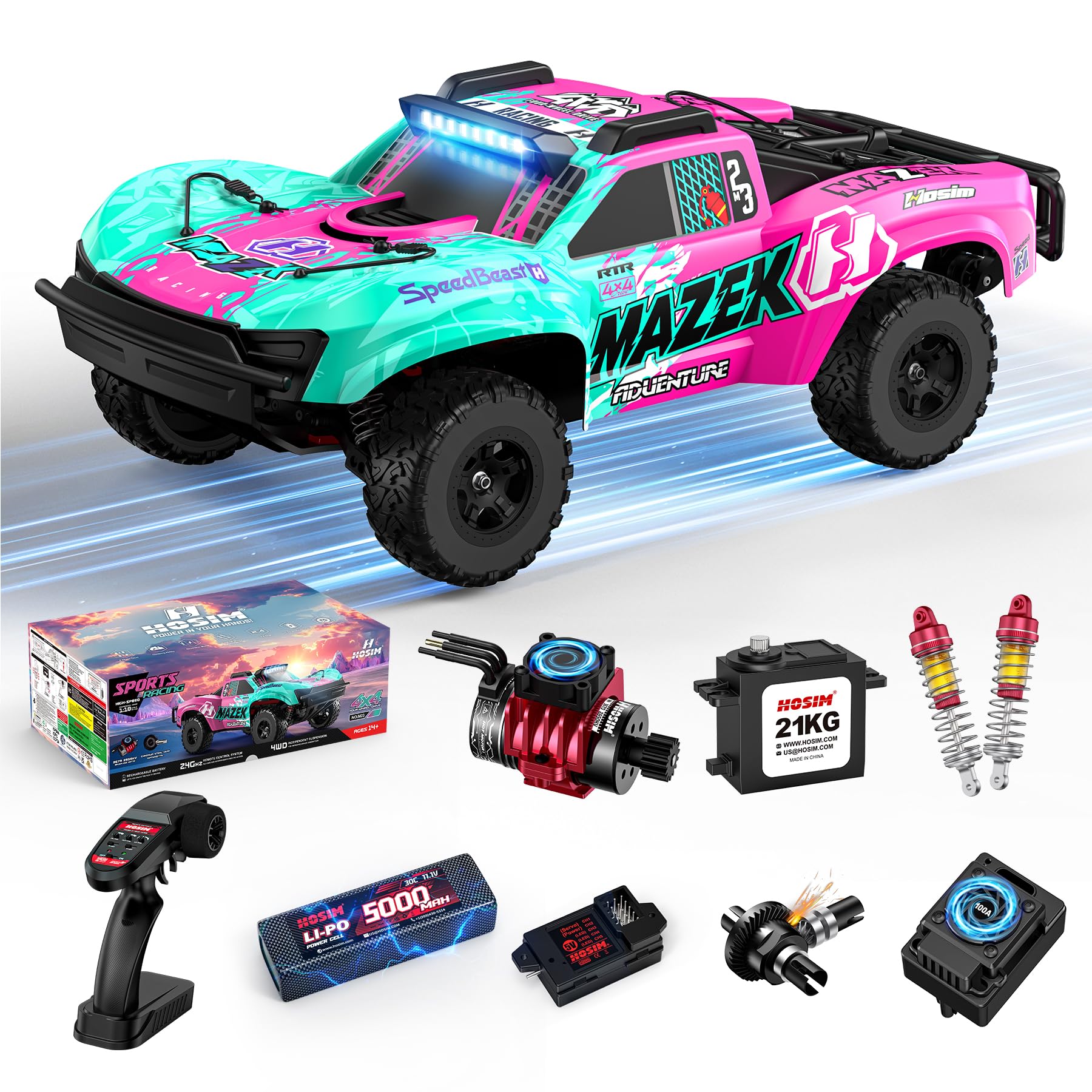
The Hosim MAZEK M23 is a 1/10 scale brushless buggy that punches well above its weight class in terms of straight-line speed. The 3670 2850KV motor paired with a 100A ESC delivers a verified 62+ MPH on 3S power out of the box, with the option to step up to 4S for speeds approaching the 100 MPH mark. The included 5000mAh 11.1V 3S LiPo provides 25 to 30 minutes of runtime per charge, which is generous for a car at this speed level.
Owner feedback emphasizes the durability of the drivetrain. The triple steel differentials, CNC-milled metal suspension links, and chromium steel spiral differential gears form a driveline that handles repeated full-throttle launches and hard landings without failure. The 21kg metal-gear steering servo provides precise control at high speeds, and the oil-filled aluminum shocks keep the chassis stable during acceleration and braking.
The MAZEK is designed as a short-course truck, which gives it a wider stance and better stability than a narrow buggy chassis. The nylon chassis material is more flexible than aluminum, which helps absorb impact energy during hard landings. Some owners note that the tires can slip slightly in tight turns on loose surfaces, but for drag-style acceleration runs, the grip is adequate. The cooling system with heatsink and fan keeps motor temperatures in check during repeated passes.
What works
- Verified 62+ MPH on 3S with 4S upgrade path
- Triple steel differentials for drivetrain durability
- Large 5000mAh battery provides extended runtime
- 21kg servo delivers precise high-speed steering
What doesn’t
- Tires lose grip in fast, tight turns on loose dirt
- ESC can overheat during extended full-throttle runs
- Some early units had axle fitment issues
5. RIAARIO 1/10 Brushless Rally Car
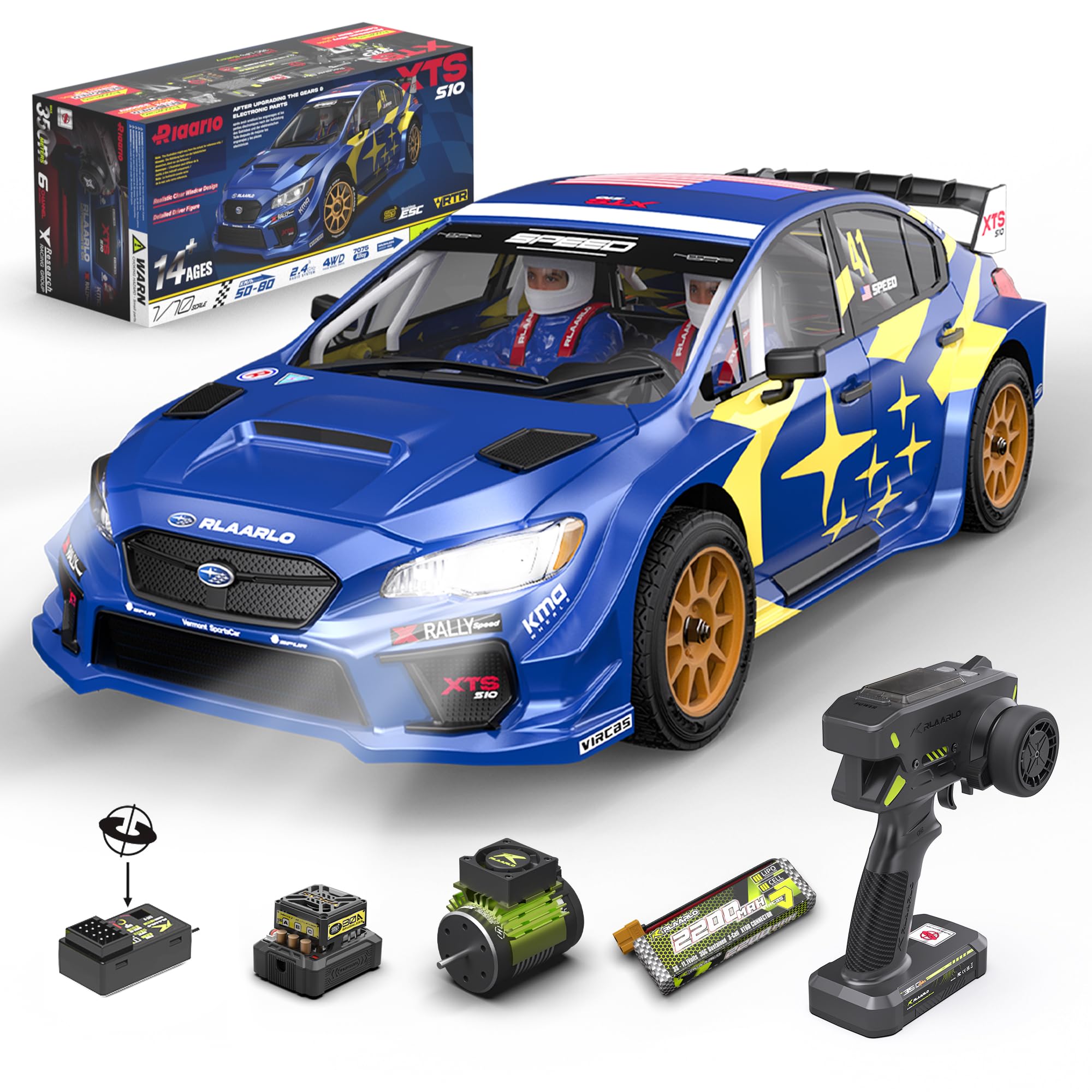
The RIAARIO S10 rally car is built around a 2.5mm 6061 aerospace aluminum alloy chassis with 4mm 7075 aluminum shock towers, creating a rigid foundation that resists flex during hard acceleration. The 3652-3300KV brushless motor paired with an 80A ESC delivers smooth, linear power delivery that makes controlling launch traction more predictable than with a sudden-hit ESC calibration. The included 3S 2200mAh LiPo provides enough capacity for multiple passes in a single session.
One of the standout engineering decisions on this platform is the fully enclosed central differential triangle bracket with a dual-triangle support structure. This design significantly increases chassis rigidity compared to a flat plate chassis, which translates to more consistent power transfer during hard launches. The sealed front and rear differentials maintain consistent fluid viscosity over time, reducing the need for frequent maintenance.
Owner reports highlight the car’s scale detailing as a major selling point. The 1.2mm polycarbonate body is spray-painted and includes complete lighting with directional signals. The 5-level adjustable gyro system allows drivers to dial in the amount of stability assistance they want, from full control for experienced drivers to more intervention for beginners. Some owners recommend trimming the front wheel wells to prevent rubbing at full suspension compression, and the included decal application requires patience.
What works
- Aerospace-grade aluminum chassis resists flex under power
- Dual-triangle central brace improves chassis rigidity
- Adjustable ride height and multi-position suspension mounts
- Comprehensive lighting system with turn signals
What doesn’t
- Front wheel wells may need trimming for full suspension travel
- Decal application is tedious and time-consuming
- Some units have wiring quality inconsistencies
6. DEERC 1/10 Brushless Trophy Truck
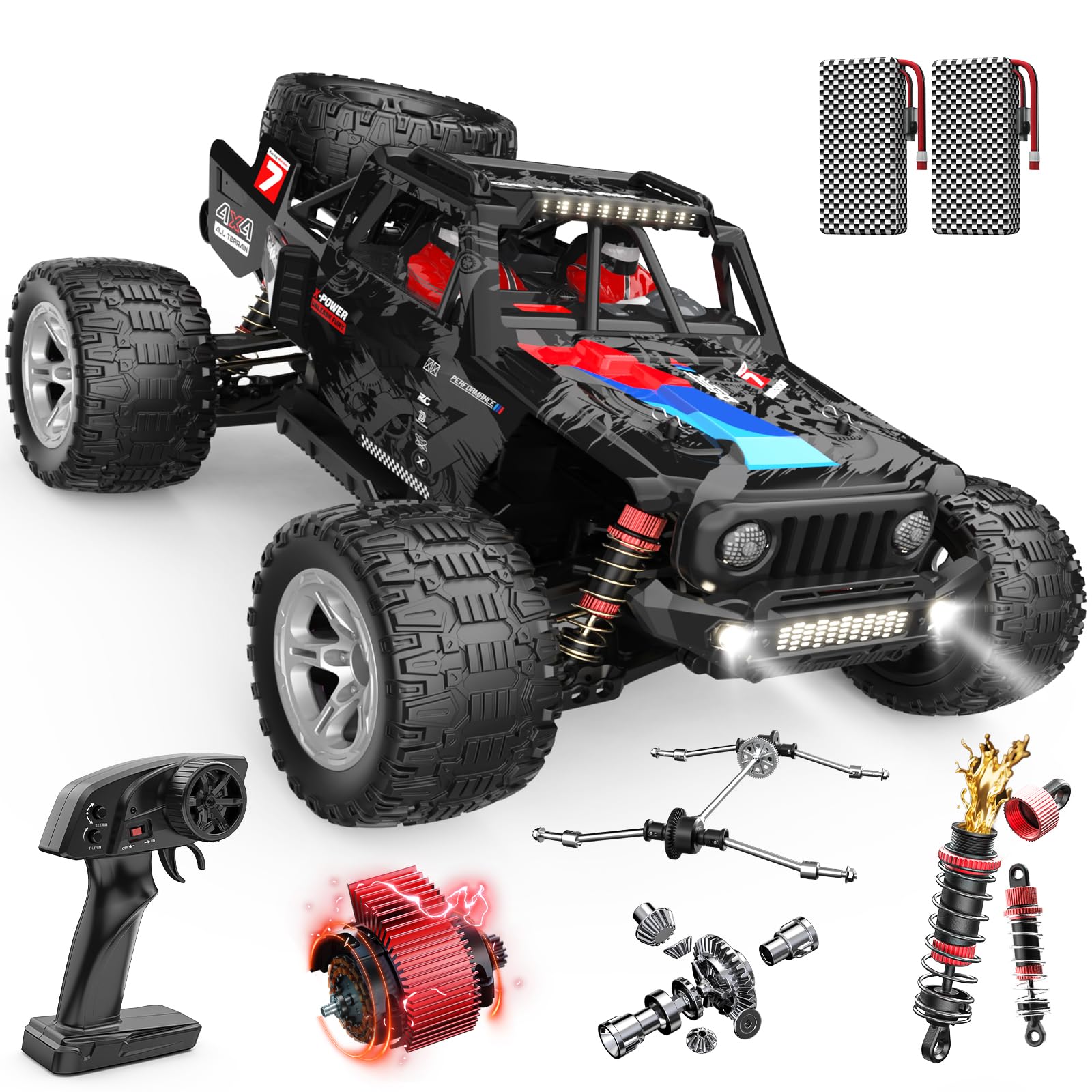
DEERC’s 1/10 scale trophy truck offers a 2847 2300KV brushless motor and waterproof 45A ESC that delivers 60 KM/H out of the box, making it a strong entry point for hobbyists who want drag-style acceleration without committing to a dedicated drag chassis. The truck uses a full metal drivetrain with hardened driveshafts and metal gear differentials, which provides the durability needed for repeated hard launches on both dirt and pavement.
The truck’s trophy-truck body includes bright front and top LEDs that improve visibility during evening runs, along with a spare tire mount that adds scale realism. The wheelie bar is a practical addition that prevents the truck from flipping backward under hard acceleration — a common issue with short-wheelbase trucks running high-power brushless systems. The alloy oil-filled shocks provide sufficient damping to keep the chassis stable during acceleration and over bumps.
Owners appreciate the 3S 11.1V 1500mAh battery that comes in the box, though some note that capacity is modest and that purchasing a spare battery is worthwhile for longer sessions. The metal skid plate protects the underbody during off-road use, and the truck’s all-terrain capability means you can practice launches on grass, gravel, or pavement without switching tires. DEERC’s warranty support is a known strength based on owner feedback.
What works
- Full metal drivetrain with hardened driveshafts
- 60 KM/H brushless system at a competitive price point
- Wheelie bar prevents flip-back during hard launches
- Waterproof ESC allows all-weather driving
What doesn’t
- Included battery has modest capacity for extended sessions
- Trophy-truck body adds weight compared to a buggy chassis
- Stock tires may lack grip on prepared surfaces
7. HYPER GO 14301 V3 1/14 Brushless RC Drift Car

The HYPER GO 14301 V3 is a 1/14 scale platform that packs a surprising amount of capability into a compact package. The 2845 3900KV 4-pole brushless motor with metal heatsink and dual cooling fans runs on a 2S 2000mAh battery to deliver 26+ MPH out of the box, with the option to upgrade to 3S for 38+ MPH. The independent gyro system allows drivers to adjust the level of stability assistance, which is useful for learning how to control power delivery during acceleration.
What makes this car interesting for drag-oriented drivers is the independent receiver and 45A ESC design, which allows for more upgrade flexibility than a combined ESC/receiver unit. The 6061 aluminum alloy chassis provides a rigid foundation, and the all-metal gear drivetrain with metal differentials distributes power reliably to all four wheels. The car comes with three sets of tires for different surfaces, including rubber tires for high-grip tarmac and slick tires for drifting.
The transmitter includes a throttle limiter that lets beginners start at 70% power before working up to full speed. The interactive lighting system with simulated brake lights and turn signals is controllable through the transmitter, adding visibility and realism. The 5.5mm diameter axles and M4 hardware contribute to a durable drivetrain, though the 1/14 scale means the car is smaller and lighter than a 1/10 platform, which can make it more sensitive to surface imperfections.
What works
- Independent gyro system aids straight-line stability
- Three sets of tires included for different surfaces
- Upgradeable to 38+ MPH with 3S battery
- Throttle limiter helps beginners learn gradually
What doesn’t
- Smaller 1/14 scale is more sensitive to surface imperfections
- 3S battery required for top speed sold separately
- Compact chassis limits battery size options
8. HAIBOXING 2995 1/12 Scale RC Buggy

The HAIBOXING 2995 uses a 1/12 scale extended wheelbase that approaches the footprint of a 1/10 scale truck, giving it more stability at speed than its scale suggests. The 550 motor is a larger can than the standard 540, providing additional torque for acceleration without requiring a brushless system. The 42 KM/H top speed is modest compared to the brushless options on this list, but the car’s strength lies in runtime and reliability — two included 1600mAh Li-Po battery packs provide over 40 minutes of combined driving time.
Full sintered metal gear differentials at the front, center, and rear, combined with metal drive shafts and ball bearings throughout the drivetrain, minimize power loss and improve drivetrain efficiency. The center differential reduces side-sliding during cornering, which also helps maintain straight-line stability during acceleration. The IPX4 splash-proof ESC allows driving in damp conditions without worrying about water damage to the electronics.
The 2.4GHz radio system provides a 280-foot control range and includes a speed knob that adjusts throttle from 40% to 100%, making it suitable for drivers of different skill levels. The independent suspension with spring-tension adjustable shocks provides predictable handling. One consideration is that the car requires some assembly — it ships 99% ready-to-run, but minor setup work is needed before the first run.
What works
- Included dual battery packs provide over 40 minutes runtime
- Sintered metal gear differentials reduce drivetrain loss
- IPX4 waterproof ESC allows damp-condition driving
- Speed knob throttle limiter suits multiple skill levels
What doesn’t
- Brushed motor limits top speed compared to brushless options
- Requires some assembly before first run
- Moderate top speed may not satisfy speed-focused drivers
9. Redcat Racing Piranha TR-10 Truggy

The Redcat Racing Piranha TR-10 is a 1/10 scale 2WD truggy that serves as an accessible entry point for drivers who want to learn the fundamentals of RC drag-style driving without a large financial commitment. The 540 brushed motor and waterproof 2-in-1 ESC/receiver combo provide predictable power delivery that makes it easier to learn throttle control and weight transfer compared to the instant hit of a brushless system. The full-function proportional 2.4GHz radio system gives adequate control for learning the basics.
The truggy platform combines buggy-like handling with the stability of a longer wheelbase, and the tunable suspension allows adjustments to toe angle, camber, and slipper clutch tension. These tuning options let new drivers experiment with chassis setup and see how changes affect straight-line stability and cornering behavior. The aggressive tires and large rear wing help with traction and stability at higher speeds within the car’s performance range.
One notable consideration is that the Piranha does not include batteries or a charger, which adds to the initial purchase cost. The brushed motor limits the car’s top speed compared to the brushless options on this list, but for a driver focused on learning the mechanics of drag-style driving — weight transfer, throttle modulation, and chassis tuning — the lower top speed reduces the risk of catastrophic crashes during the learning phase.
What works
- Tunable suspension, toe, camber, and slipper clutch for learning chassis setup
- Brushed motor delivers predictable, manageable power for beginners
- Truggy platform offers stability and durability
- Full proportional 2.4GHz radio system
What doesn’t
- Batteries and charger not included
- Brushed motor limits top speed potential
- 2WD layout requires more throttle discipline for consistent launches
10. Womaqu 1/14 Brushless Monster Truck

The Womaqu 1/14 monster truck pairs a 2847 4000KV brushless motor with a 45A waterproof ESC to deliver 32+ MPH on the included dual 2S 1500mAh modular batteries. Upgrading to a 3S 11.1V battery pushes the top speed to 42+ MPH. The dual-battery design provides extended runtime and allows drivers to run the car while one pack charges. The modular battery format simplifies swapping and reduces the risk of connector damage compared to hardwired packs.
The full-metal drivetrain with metal gears and a metal center drive shaft provides durability that exceeds what the price point suggests. The alloy oil-filled hydraulic shocks use custom valving to minimize rebound after hard landings, which helps keep the chassis stable during acceleration and over bumps. The full roll cage and multi-panel body with an included driver figure give the truck a scale Bigfoot-style appearance that stands out visually.
Six integrated LED lights on the roof and bumper improve visibility during low-light driving sessions. The high-torque steering servo responds quickly to steering inputs, which aids in making small corrections during high-speed passes. The 4×4 drivetrain provides consistent traction on loose surfaces. Some owners note that the truck’s scale and body design add weight compared to a stripped-down buggy, which can affect acceleration times on prepared surfaces.
What works
- Dual modular 2S batteries for extended runtime and easy swapping
- Full-metal drivetrain with metal gears and center shaft
- Custom hydraulic oil shocks minimize rebound on hard landings
- Six integrated LED lights for nighttime visibility
What doesn’t
- Full roll cage and body add weight vs. a buggy
- 3S battery required for top speed sold separately
- 1/14 scale limits battery size and gearing options
11. UDIRC Fast RC Car for Adults, Upgradable 56 MPH
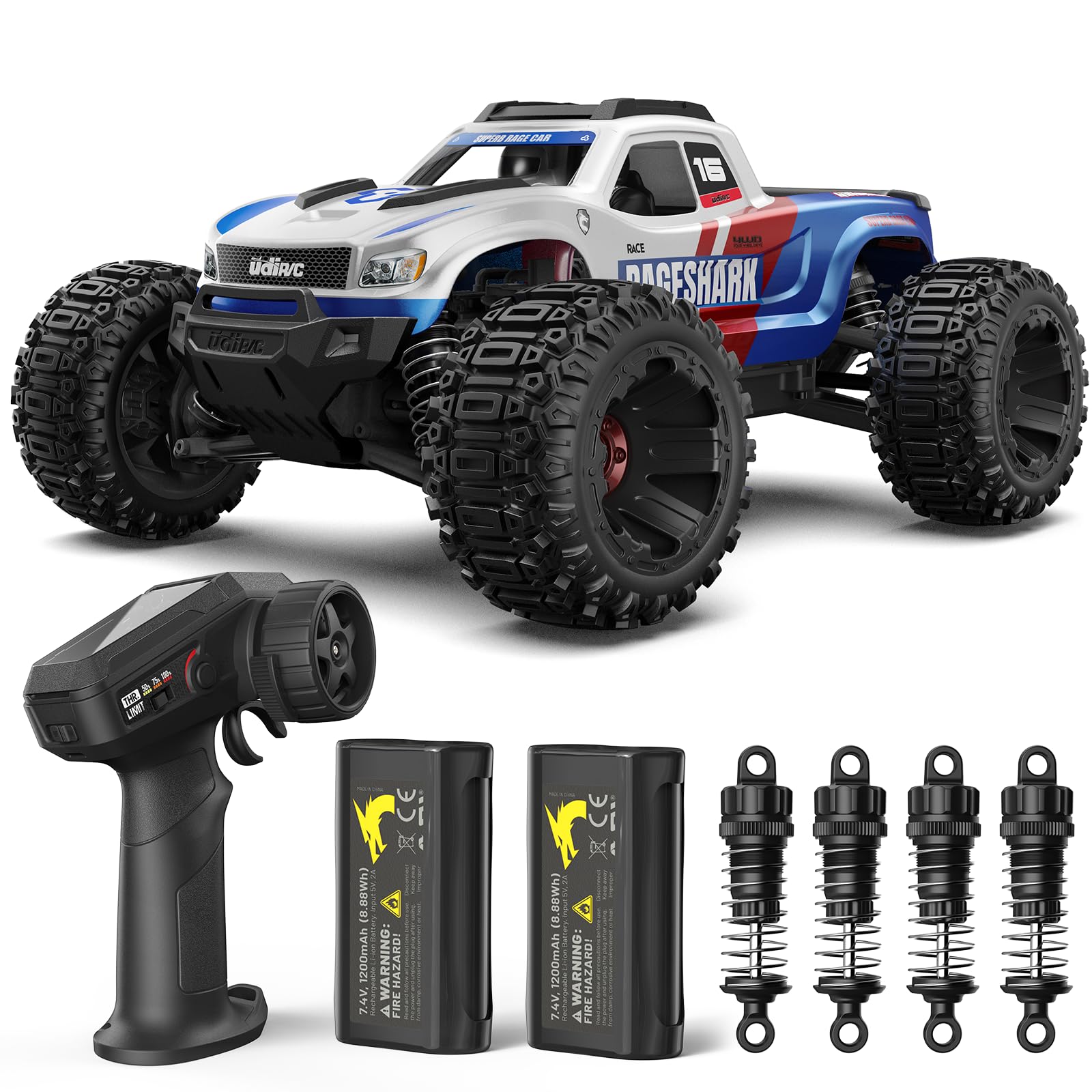
The UDIRC Rageshark enters the market as a 22 MPH ready-to-run car with a deliberate upgrade path that lets drivers scale up performance over time. The stage 1 550 brushed motor provides manageable power for learning, and the 3-speed control switch (50%, 75%, 100%) allows drivers to adjust the power level based on experience. The upgrade kits to reach 31 MPH or 56 MPH are designed to bolt onto the existing chassis without requiring a complete platform swap.
The chassis uses hobby-grade metal gears, metal drive shafts, and a rugged 4×4 drivetrain that survives hard landings and impacts. The 4-wheel independent suspension with adjustable oil-filled shocks provides stable handling during acceleration and over uneven surfaces. The included spare arms and CVDs are a thoughtful addition, especially for drivers who expect to push the car hard during the learning process.
Owner feedback is overwhelmingly positive, with multiple users noting that the car is durable, responsive, and backed by responsive customer service. The 1-year zero-hassle warranty provides peace of mind for new hobbyists. The included 2 rechargeable batteries keep runtime respectable. Some owners report that the wheel hubs can break when hitting curbs at speed, and the body must be removed to access the power switch — a minor inconvenience but worth noting for drivers who frequently power cycle between runs.
What works
- Deliberate upgrade path from 22 MPH to 56 MPH
- 3-speed throttle control suits multiple skill levels
- Spare parts included in the box
- 1-year warranty with responsive customer support
What doesn’t
- Body must be removed to access the power switch
- Wheel hubs can break when hitting curbs at speed
- Stock brushed motor is modest compared to brushless options
Hardware & Specs Guide
Drivetrain Layout
Two-wheel drive is the dominant configuration for organized RC drag racing because it reduces rotational mass in the front drivetrain and allows more precise tuning of weight transfer during launch. A 2WD car with a well-calibrated slipper clutch and soft rear tire can achieve better 60-foot times than many 4WD platforms, especially on prepared surfaces. Four-wheel drive provides an advantage on loose or unprepared surfaces where front tire pull helps maintain forward momentum, but the added drivetrain weight and friction can hurt top-end acceleration.
ESC and Motor Matching
The ESC’s amp rating and timing adjustability are critical for drag performance. A 100A ESC with adjustable timing curves allows you to advance or retard timing based on track conditions and battery state. Motors in the 3000–4000KV range offer a balance of torque and top speed for typical 330-foot drag courses. Lower KV motors (2000–3000KV) with higher torque can pull taller gearing for higher trap speeds but require a battery with sufficient discharge rate to maintain voltage under the sustained load of a full pass.
Battery Chemistry and Discharge Rating
Lithium polymer batteries remain the standard for RC drag racing due to their high energy density and discharge capability. A battery with a discharge rating of 50C or higher ensures that voltage sag does not limit motor performance during the most demanding part of the launch. Capacity in the 2200–5000mAh range provides enough energy for multiple passes between charges. Cells wired in 3S configuration (11.1V nominal) are common for cars targeting 50–60 MPH, while 4S (14.8V) and 6S (22.2V) setups support higher trap speeds.
Tire Compound and Surface Preparation
Foam tires with a soft compound are preferred for prepared drag surfaces because they conform to the track surface under load, increasing the contact patch and improving traction. Tire compound is measured by density rating; softer compounds provide more grip but wear faster. Rubber tires work on asphalt and concrete surfaces but require preheating — either with a tire warmer or a burnout — to reach optimal operating temperature. Tire diameter affects effective gearing; larger diameter tires increase top speed but reduce acceleration for a given gear ratio.
FAQ
What makes a dedicated drag RC car different from a basher or buggy?
Is 2WD or 4WD better for RC drag racing?
What battery setup should I use for drag racing?
Do I need a brushless motor for drag racing?
Final Thoughts: The Verdict
For most buyers looking for a competitive and well-supported platform, the best drag rc car winner is the Team Associated DR10 because it was purpose-built for drag racing and has the aftermarket parts ecosystem to support serious tuning. If you want massive scale presence and 6S power for street bashing with drag-style performance, grab the ARRMA Felony. And for an entry-level car with a clear upgrade path that grows with your skills, nothing beats the UDIRC Rageshark with its 56 MPH upgrade capability.

Certification: BSc in Mechanical Engineering
Education: Mechanical engineer
Lives In: 539 W Commerce St, Dallas, TX 75208, USA
Md Amir is an auto mechanic student and writer with over half a decade of experience in the automotive field. He has worked with top automotive brands such as Lexus, Quantum, and also owns two automotive blogs autocarneed.com and taxiwiz.com.