A drag race is won in the first few feet — that moment when the tires bite, the chassis squats, and the car drives straight down the groove. But finding an RC car that actually delivers that kind of repeatable, hard-launch performance takes more than a big motor number on a box. Chassis layout, drivetrain material, tire compound, and weight distribution all separate a real contender from a tire-shredding toy.
I’m Amir — the founder and writer behind Four Wheel Ask. My work focuses on dissecting manufacturer spec sheets, studying owner-reported durability data, and comparing build quality across hobby-grade platforms to identify which models truly hold up under the stress of competitive driving.
For enthusiasts who demand track-proven performance at the starting line, this thorough guide evaluates the very best drag racing rc cars available today.
How To Choose The Best Drag Racing RC Cars
Selecting a platform that can lay down consistent passes requires understanding a few non-negotiable elements. Speed alone means nothing if the car can’t put that power to the ground in a straight, controlled launch. Focus on these factors before you buy.
Chassis Layout & Weight Distribution
A dedicated drag chassis places the battery and motor low and centered to keep the mass transfer predictable under hard acceleration. Look for a long wheelbase and a low center of gravity — these two traits prevent the car from lifting the front end or veering sideways when you hit the throttle. Rail-style or carbon-fiber pan chassis designs offer the best rigidity for high-power builds.
Drivetrain: Belt vs. Shaft vs. Direct Drive
Belt-driven systems reduce rotational mass and parasitic drag, making them popular among serious drag racers. Shaft-driven 4WD setups provide more traction on loose or unprepared surfaces but add weight and friction. Direct-drive 2WD layouts eliminate the center differential entirely, delivering instant power to the rear wheels — ideal for prepped tracks but less forgiving on asphalt with debris.
Motor Type & ESC Tuning
Brushless motors offer higher efficiency, greater top-end speed, and programmable timing curves that let you tune the powerband for a specific track length. Brushed motors deliver smoother initial throttle linearity — helpful for beginners learning to launch without spinning out — but they lack the thermal headroom for repeated high-speed passes. A quality ESC with adjustable punch control, drag-brake, and throttle-curve settings is critical for dialing in consistent 60-foot times.
Battery Voltage & Discharge Rating
Higher voltage (3S or 4S LiPo) directly translates to more wheel speed, but only if the battery can sustain that voltage under load. Look for a discharge rating of at least 50C continuous to avoid voltage sag during a pass. Capacity in the 5000mAh to 7000mAh range provides enough runtime for multiple runs without adding excessive weight to the chassis.
Quick Comparison
On smaller screens, swipe sideways to see the full table.
| Model | Category | Best For | Key Spec | Amazon |
|---|---|---|---|---|
| Team Associated DR10 | RTR | Dedicated Drag Racing | 2WD Belt Drive | Amazon |
| ARRMA Felony 6S | RTR | Street Bash & High-Speed | 1/7 Scale 6S BLX | Amazon |
| AMORIL RLAARLO AK-787 | RTR | Extreme Speed Runs | Carbon Fiber Chassis | Amazon |
| Hosim MAZEK 1/10 | RTR | Premium Value Off-Road | 4S Ready 100A ESC | Amazon |
| Hosim Brushless 50mph | RTR | All-Terrain Speed | 50mph 3S Brushless | Amazon |
| DEERC 1611 | RTR | High-End Drivetrain | CNC Steel Gears | Amazon |
| UDIRC Fast RC | RTR | Beginners & Upgrade Path | Upgradable to 56mph | Amazon |
| TENSSENX 1/14 | RTR | All-Terrain Budget | 60KPH Brushed 4WD | Amazon |
| X-TMAGA HS14323 | RTR | Entry Level Fun | 40KPH Brushed 4WD | Amazon |
In‑Depth Reviews
1. Team Associated DR10 2WD Drag Race Car RTR

Team Associated built the DR10 as a purpose-designed drag platform, not a converted basher. The long-wheelbase 2WD chassis uses a belt-driven drivetrain that minimizes rotational mass and allows the car to coast freely after the throttle lifts — a critical trait for consistent trap speeds. The composite pan chassis keeps the weight low, and the adjustable rear shock tower gives tuners the ability to fine-tune squat and anti-squat characteristics for varying track prep conditions.
Owner reports consistently highlight the DR10’s straight-line stability out of the box. The included Reedy brushed motor and ESC provide enough punch for entry-level competition, while the modular design accepts aftermarket brushless upgrades without modification to the chassis rails. The rubber-sealed ball bearings and metal-geared transmission hold up well under the stress of repeated hard launches on prepped surfaces.
What makes the DR10 stand out in the drag category is its aftermarket support. Parts compatibility with the wider Team Associated ecosystem means you can swap in carbon-fiber upper decks, titanium turnbuckles, and purpose-built drag tires from multiple manufacturers without fabrication work. For a racer who wants a dedicated quarter-mile car that can grow with their skill level, this platform delivers the strongest foundation.
What works
- Purpose-built drag chassis with belt drive for low drag
- Excellent aftermarket parts support and upgrade path
- Straight-line stability right out of the box
What doesn’t
- Requires separate LiPo battery and charger purchase
- Brushed motor limits top-end speed for advanced racers
2. ARRMA 1/7 Felony 6S BLX Street Bash RTR

The ARRMA Felony is a 1/7-scale street machine that brings muscle-car styling to the drag strip. Its Spektrum Firma 150A Smart ESC paired with the 6S brushless motor delivers the kind of torque that can break traction well past the 60-foot mark if you aren’t careful with throttle application. The all-metal drivetrain — including steel differentials and driveshafts — is built to survive repeated full-throttle passes on asphalt without stripping gears or snapping axles.
Active Vehicle Control (AVC) integrated into the SR6110AT receiver provides real-time stability correction, which helps keep the car tracking straight under hard acceleration on less-than-perfect surfaces. The dBoots Hoons all-road tires are pre-glued and balanced, offering consistent contact patch across a range of pavement temperatures. The adjustable oil-filled shocks allow fine-tuning of ride height and compression damping to optimize weight transfer during launch.
The sheer scale and weight of the Felony give it an advantage in high-speed stability — it tracks straighter at 60-plus mph than most smaller 1/10-scale cars do at half that speed. The trade-off is that this car demands significant room to stop, and the included battery tray is sized for specific 6S packs. Owners who want to run dedicated drags should budget for a second set of street-compound tires to maximize grip on prepped track surfaces.
What works
- Massive 1/7 scale provides excellent high-speed stability
- AVC stability system helps maintain straight-line control
- All-metal drivetrain handles extreme torque loads
What doesn’t
- Requires purchase of 6S battery and charger separately
- Large size limits usable track locations
3. AMORIL RLAARLO 1/10 AK-787 Brushless RC Car

AMORIL’s AK-787 is engineered for speed-obsessed drivers who want a carbon-fiber chassis without stepping up to a full custom build. The lightweight carbon lower deck and triangular carbon upper support keep the structure rigid while cutting rotating mass — a combination that directly improves acceleration out of the hole. The suspended independent gearbox uses a 1/8-scale differential in a 1/10-scale car, adding durability margin for high-power brushless setups.
The split-structure center driveshaft is a clever design element: two separate steel shafts connected by an aluminum support prevent flex and resonance at high RPM, which is a common failure point on single-piece shafts in speed-run cars. The electrically operated liftable rear spoiler adjusts within a 15-degree range, allowing the driver to tune downforce for different track conditions without swapping parts. Vintage-style tires with simulated hubcaps and a rear diffuser optimize underbody airflow for reduced drag at speed.
Owner feedback on the AK-787 emphasizes the build quality of the CNC-machined components and the ease of maintenance thanks to the modular internal layout. The antenna organizer reduces receiver interference, and the adjustable battery space accommodates various pack sizes. For drivers who want a ready-to-run car that can hit extreme speeds with only minor tuning out of the box, this platform delivers a rare combination of lightweight construction and drivetrain toughness.
What works
- Carbon fiber chassis reduces weight without sacrificing rigidity
- Active liftable spoiler allows on-the-fly downforce adjustment
- Split steel driveshaft eliminates high-RPM flex issues
What doesn’t
- Premium pricing positions it above most mid-range options
- Vintage tire design may not suit all track surfaces
4. Hosim MAZEK 1/10 Brushless RC Truck RTR
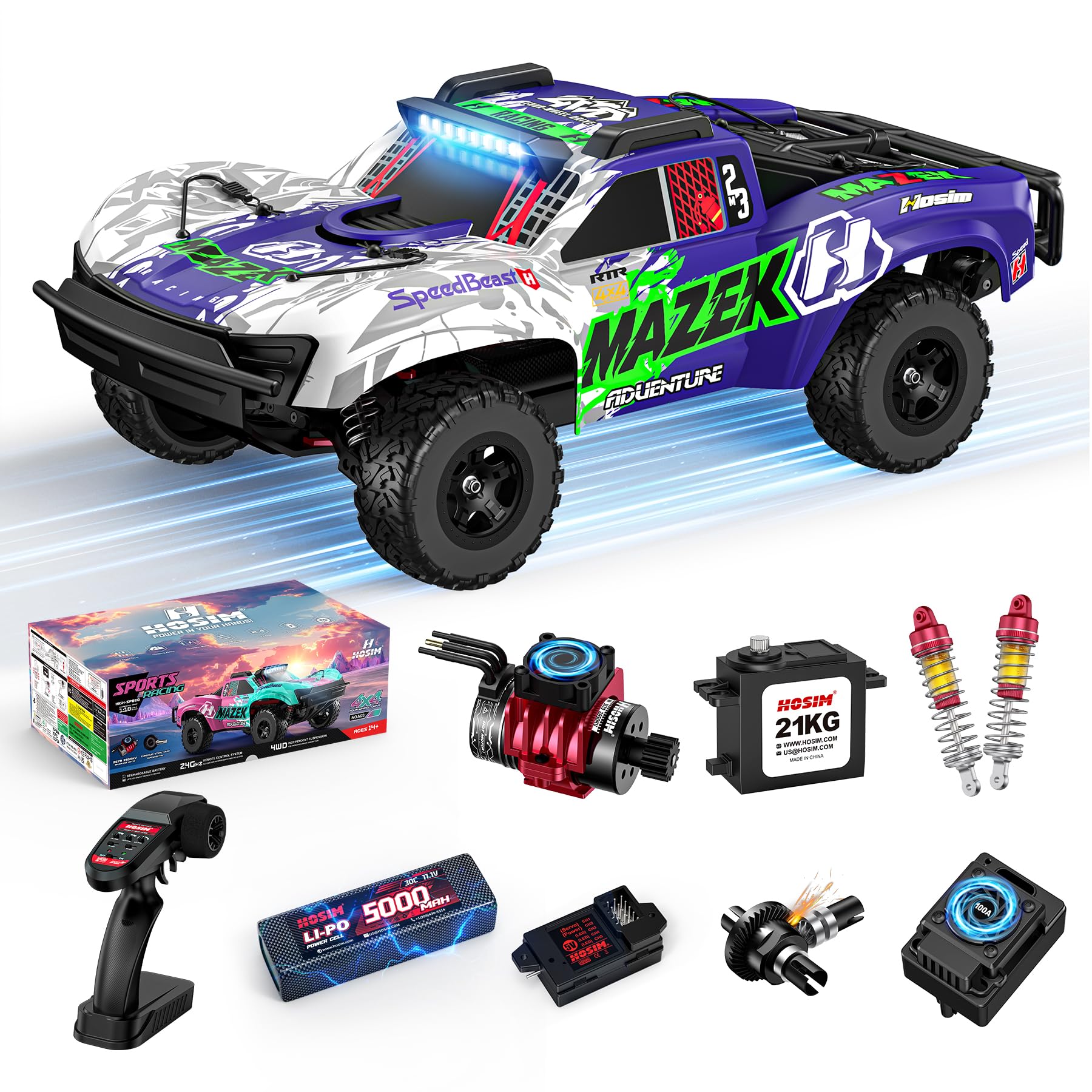
The Hosim MAZEK delivers 1/10-scale brushless performance at a price point that undercuts most comparable platforms by a significant margin. The 3670 2850KV motor paired with the 100A waterproof ESC is capable of hitting over 62 mph on the included 3S 5000mAh LiPo battery, and the system is 4S-ready for those who want to push past the 80-mph mark. The ESC features a built-in cooling fan and an aluminum heatsink, with a dedicated motor fan to manage thermal buildup during extended full-throttle runs.
Durability is addressed through a thickened nylon chassis with metal skid plates front and rear, protecting the undercarriage from impact damage during hard landings. The all-metal drivetrain includes three chromium-steel differentials, a steel driveshaft, and steel steering links — components typically found on cars costing significantly more. The 21kg high-torque servo delivers responsive steering authority, while the oil-filled metal shocks provide consistent damping through the full range of suspension travel.
The value proposition here is straightforward: you get a 4S-capable chassis with a metal drivetrain, a high-capacity battery, and a brushless system that can compete with cars in the mid-premium tier. Owners report that the included 3S pack provides around 25 minutes of runtime, with a simple swap to a second pack doubling that figure. The RTR package is genuinely complete — the truck arrives fully assembled and pre-tuned, requiring only a battery charge before the first pass.
What works
- Exceptional value for a 4S-ready brushless 1/10 platform
- All-metal drivetrain with three steel differentials
- Complete RTR package with 5000mAh battery included
What doesn’t
- Nylon chassis lacks the rigidity of carbon-fiber alternatives
- Cooling fans require periodic cleaning after off-road use
5. Hosim Brushless 50mph RC Car RTR
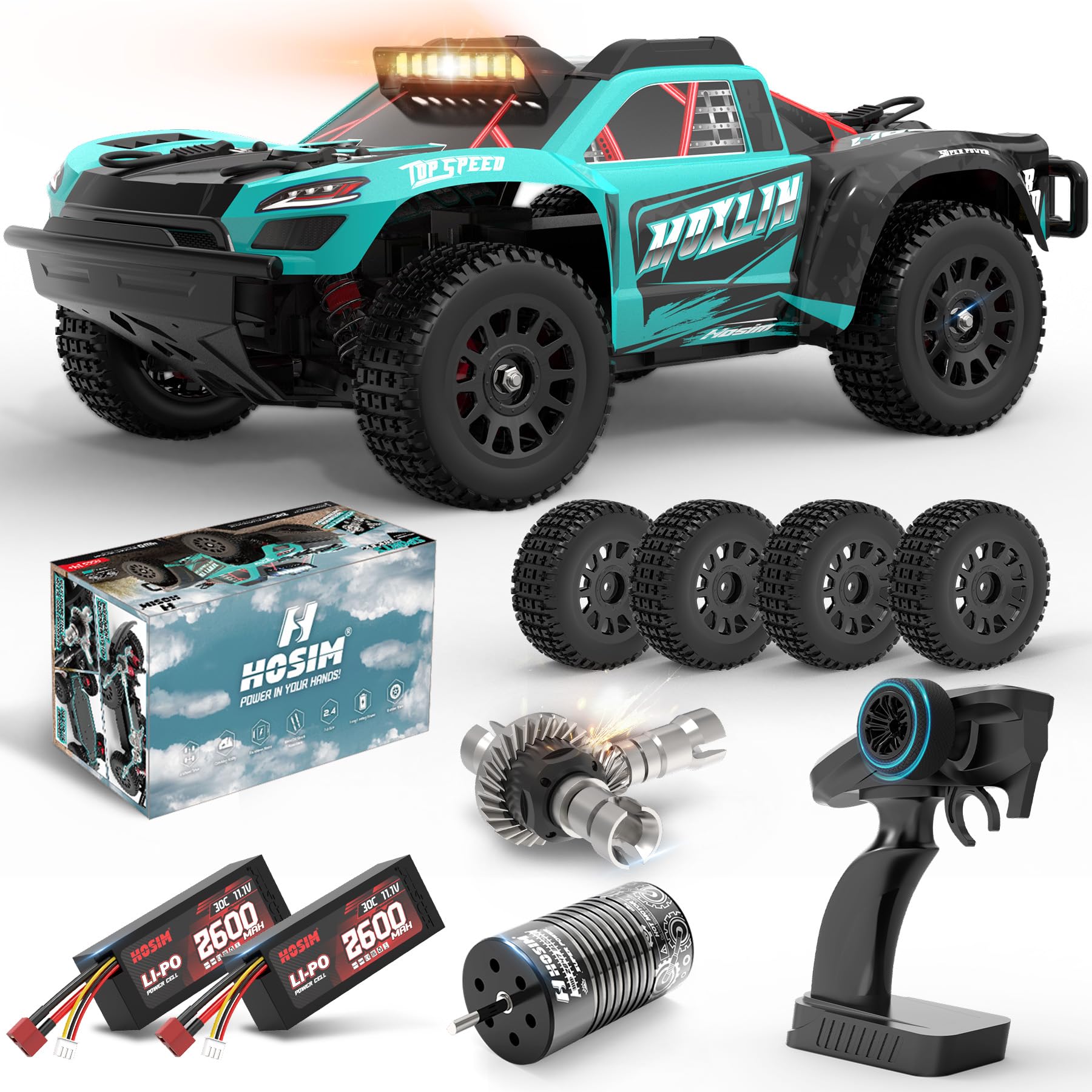
This Hosim model focuses on delivering reliable 50-mph performance with a battery system designed for extended runtime. The 2847 3100KV brushless motor and 45A ESC provide smooth, linear throttle response that helps maintain traction during the critical first few feet of acceleration. The included dual 2600mAh 3S LiPo batteries deliver over 50 minutes of combined runtime — enough for multiple full passes without returning to the charger.
The upgraded helical gear differential is machined from 40Cr chrome steel, reducing internal friction by roughly 30 percent compared to standard sintered gears. Owner data from extreme testing indicates that this differential survives over 200 hard launches without measurable wear, making it one of the most durable components in this price tier. The CNC aluminum chassis adds structural stiffness while keeping weight manageable, and the two complete sets of included tires allow the driver to swap between compounds depending on surface conditions.
LED headlights add a practical element for evening testing sessions, and the modular design simplifies access to the drivetrain for routine maintenance. The 2.4GHz transmitter offers a 150-meter range and includes a high/low-speed mode selector — useful for dialing back power when practicing launch technique on limited space. For a buyer who wants a brushless car with enough battery capacity for a full day of testing, this package delivers the best runtime-to-cost ratio in its class.
What works
- Dual 3S batteries provide over 50 minutes of runtime
- Chrome steel helical differential resists wear under high loads
- Two complete tire sets for surface-specific tuning
What doesn’t
- Assembly required out of the box
- Continuous full-throttle runs require cooldown breaks
6. DEERC 1611 1/14 Brushless RC Car
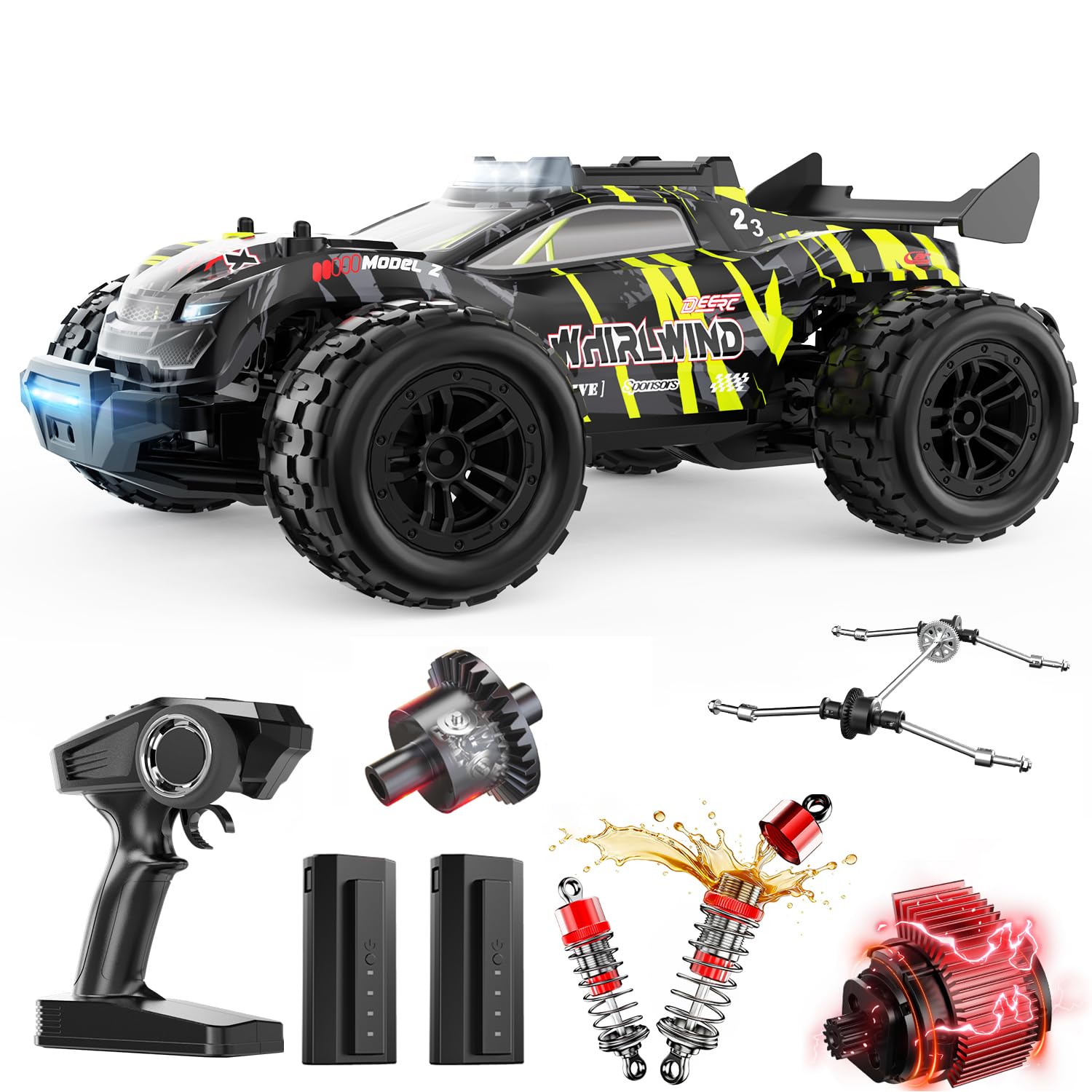
DEERC’s 1611 brings a CNC-machined all-metal drivetrain to the sub-100 price bracket — a feature set typically reserved for more expensive platforms. The 2840 4000KV brushless motor paired with the 45A waterproof ESC delivers a powerband that favors mid-range punch over peak RPM, making it easier to find traction on loose or damp surfaces. The included dual 7.4V 2000mAh Li-ion batteries push the car past 31 mph out of the box, with the ESC supporting 3S LiPo packs for speeds over 43 mph.
The all-metal drivetrain includes CNC steel pinion gears and a differential system designed to reduce wear under sustained high-RPM operation. The aluminum oil-filled hydraulic shocks provide consistent damping across uneven terrain, and the independent 4WD system distributes torque evenly to all four wheels for stable launches. The reinforced composite chassis includes a heat-sink-equipped motor mount and a ventilated battery compartment to manage thermal load during back-to-back runs.
Owners note that the pre-tuned RTR setup requires minimal adjustment for straight-line performance, and the 2.4GHz transmitter offers proportional throttle and steering control that feels responsive without being twitchy. The waterproof ESC and receiver allow operation in damp conditions, though the car is not designed for full submersion. For a buyer seeking a brushless platform with a metal drivetrain at a competitive price point, the DEERC 1611 offers a compelling balance of component quality and cost.
What works
- CNC-machined all-metal drivetrain at a competitive price
- 3S LiPo upgrade path for over 43 mph speed
- Oil-filled hydraulic shocks with consistent damping
What doesn’t
- Li-ion batteries included have lower discharge than LiPo
- 1/14 scale can feel small on full-size tracks
7. UDIRC Fast RC Car 1/16 RTR Monster Truck
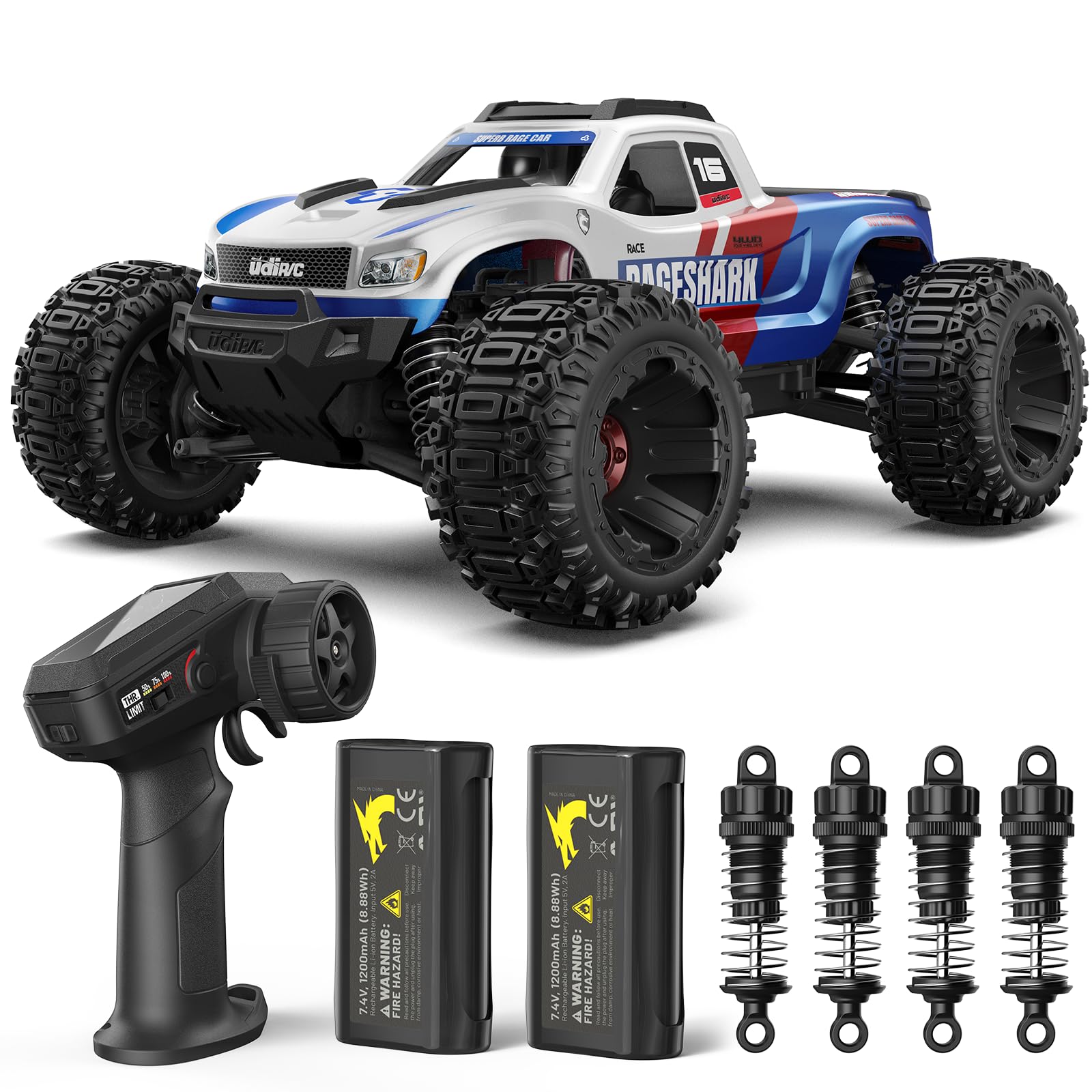
The UDIRC Fast RC Car is engineered as a platform that grows with the driver. The stock configuration runs at 22 mph with a brushed motor and 4WD drivetrain, but the chassis is designed to accept 31-mph and 56-mph upgrade kits that drop in without modification to the mounting points or transmission housing. This makes it an ideal entry point for drivers who want to learn the fundamentals of throttle control and chassis setup before committing to a high-power brushless system.
Durability is addressed through hobby-grade metal gears and drive shafts housed in a rugged 4×4 chassis that survives hard landings and impacts. The package includes spare control arms and CVDs — a practical acknowledgment that beginners will push the car to its limits during the learning process. The 3-speed control switch allows the driver to limit power to 50 percent for young or inexperienced operators, 75 percent for backyard exploration, and 100 percent for full-performance driving.
The 4-wheel independent suspension and adjustable oil-filled shocks provide a stable platform for practicing launch technique, and the precision steering trim enables controlled drifts and wheelies that help new drivers understand weight transfer dynamics. The included dual rechargeable batteries and DIY light kit add convenience for extended sessions. For a family or individual looking to enter RC drag racing with a car that won’t be outgrown after the first season, this modular approach offers a clear upgrade path without requiring a complete chassis replacement.
What works
- Modular upgrade path from 22 mph to 56 mph
- 3-speed power limiter suitable for all skill levels
- Spare parts included in the box for crash repairs
What doesn’t
- Stock 22 mph speed is slow for experienced drivers
- Upgrade kits require additional purchase
8. TENSSENX 1/14 4WD RC Truggy RTR
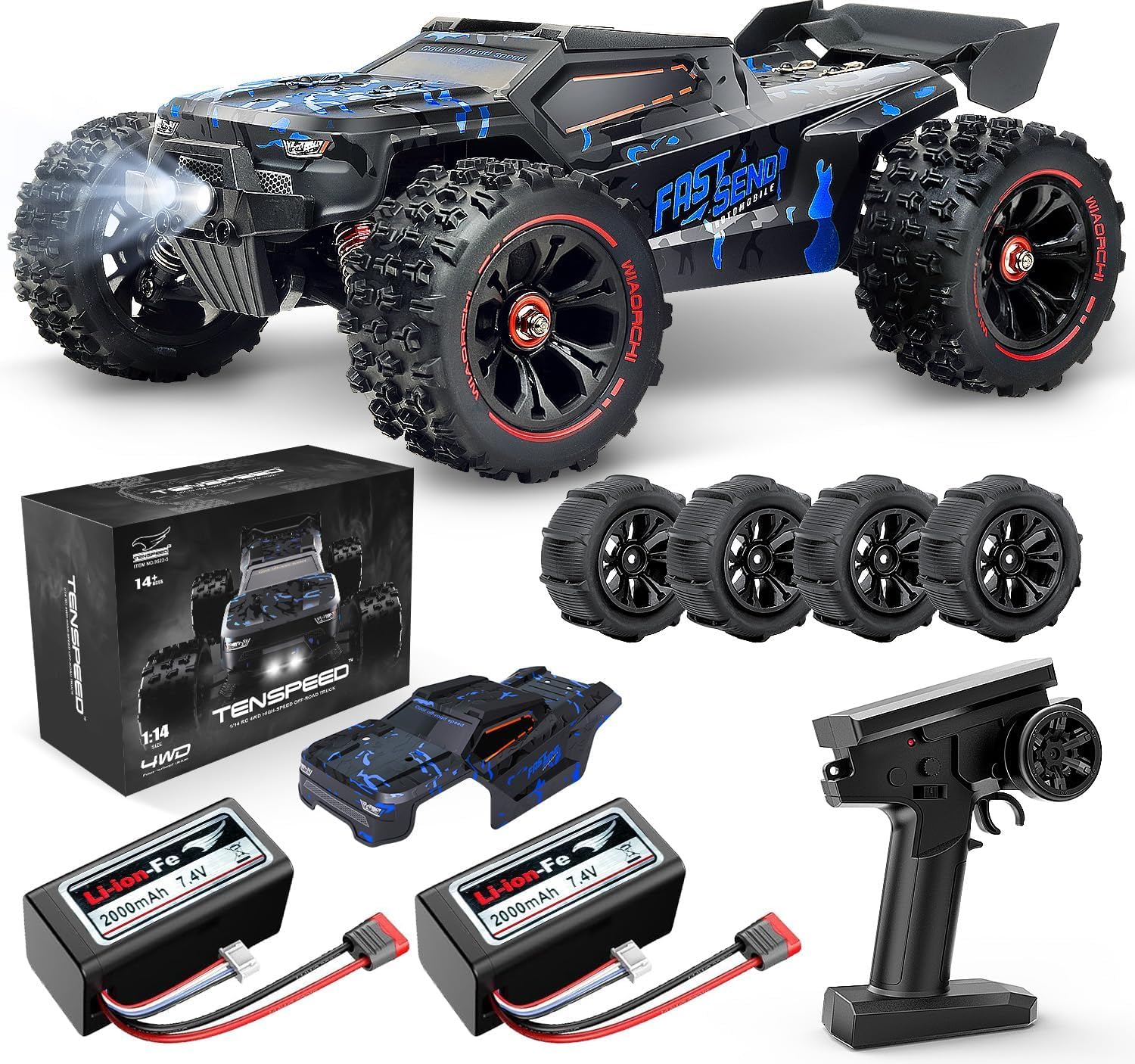
The TENSSENX truggy offers a 40-mph top speed from a 540 brushed motor at a price that undercuts most brushless competitors. The steel differentials, metal gearbox, and universal drive shaft provide a foundation that can handle the torque of the included motor without premature wear. The laser-cut aluminum chassis is reinforced with composite bracing that extends the structural lifespan compared to earlier designs in this price tier.
The dual-battery setup delivers up to 60 minutes of runtime, which is exceptional for a car in this category and allows for extended practice sessions without interruption. The swappable airless tires measure 111 millimeters in diameter and include paddle treads for loose surfaces — a useful feature for drivers who want to test traction on different terrain. The waterproof electronics and raised chassis clearance enable operation in snow, sand, and mud without immediate concern for component damage.
The 3-channel 2.4GHz transmitter provides a 300-foot range and an adjustable throttle limit that can be set between 70 and 100 percent, giving beginners a safety margin while they develop throttle control. The anti-vibration shocks and sponge-filled tires contribute to stable handling at the car’s top speed, and the tool-free suspension adjustments make it easy to experiment with ride height and spring preload. For a budget-conscious buyer who wants a durable, waterproof platform with long runtime, this truggy delivers reliable performance without requiring a significant upfront investment.
What works
- Up to 60 minutes of runtime from dual batteries
- Steel differentials and metal gearbox at a budget price
- Waterproof electronics for all-weather operation
What doesn’t
- Brushed motor limits top-end speed potential
- Airless tires provide less grip than rubber alternatives on pavement
9. X-TMAGA 1/14 All Terrain RC Car RTR

X-TMAGA’s entry-level offering uses a 390 brushed motor that prioritizes throttle linearity over peak power — a deliberate tuning choice that helps new drivers learn to launch without breaking traction. The motor delivers speeds up to 40 kph on good surfaces, and the adjustable alloy spring shock absorbers reduce chassis shake at higher speeds while filtering out bumps that can upset the car’s attitude during a pass. The modular dual 7.4V 1300mAh LiPo battery system provides roughly 50 minutes of combined runtime between the two packs.
The all-terrain airless tires measure 90 millimeters in diameter and are designed to handle grass, gravel, dirt, snow, sand, and mud — making this a versatile platform for drivers who don’t have access to a dedicated track. The 2.4GHz transmitter includes TRIM and SPEED buttons that allow proportional control of steering and throttle, with a speed-limiting feature that reduces power for novice drivers. The battery management system prevents overcharge, overdischarge, and short circuits, adding a layer of safety for younger operators.
Owner reviews emphasize the car’s durability relative to its cost, with the composite chassis and sealed electronics surviving the kind of impacts that typically end cheaper toy-grade cars. The lack of assembly requirements means the car is ready to run immediately after charging, and the compact 1/14 scale size makes it easy to transport to testing locations. For a first-time buyer who wants to explore drag racing without a significant financial commitment, this car provides a functional learning tool that can be operated in a wide range of environments.
What works
- Smooth throttle linearity ideal for beginner drivers
- 50 minutes of runtime from dual LiPo batteries
- Built-in battery management system for safe charging
What doesn’t
- Brushed motor lacks the top end for competitive racing
- Airless tires limit traction on prepared surfaces
Hardware & Specs Guide
Brushed vs. Brushless Motors
Brushed motors use physical carbon brushes to transfer current to the armature. They deliver smoother low-end throttle linearity, which helps beginners learn launch control without instantly breaking traction. The trade-off is lower peak RPM, higher internal friction, and shorter maintenance intervals — brush life typically degrades after 50 to 100 hard passes. Brushless motors replace brushes with an electronic controller, eliminating friction losses and allowing significantly higher RPM and thermal efficiency. A 4000KV brushless motor can spin roughly twice as fast as a comparable brushed unit while drawing less current, but the throttle response is more aggressive and requires finer finger control to avoid wheel spin on launch.
LiPo Battery Voltage & Discharge
Lithium Polymer (LiPo) batteries are the standard for high-performance RC drag racing. Voltage is measured in cells (S): a 2S pack delivers 7.4V nominal, 3S delivers 11.1V, and 4S delivers 14.8V. Higher voltage directly increases wheel speed, but only if the battery can sustain that voltage under load. The discharge rating (C-rating) indicates how much current the battery can deliver continuously: a 5000mAh pack rated at 50C can supply 250 amps. For drag racing, a discharge rating of 50C or higher is recommended to prevent voltage sag during the first two seconds of a pass, when current draw peaks. Always match the battery’s connector type and polarity to the ESC — XT60 and EC5 are common standards in the hobby.
2WD vs. 4WD Drivetrain
Two-wheel-drive (2WD) cars are lighter and have less drivetrain drag, making them the dominant choice for dedicated drag racing on prepped surfaces. The rear wheels handle both acceleration and braking, which requires careful weight distribution and suspension tuning to keep the chassis stable. Four-wheel-drive (4WD) cars distribute torque to all four wheels, providing more traction on loose or damp surfaces where a 2WD car would spin. The added drivetrain weight and friction reduce top speed potential but offer a wider margin of error during launch. For a dedicated drag car that will run on a prepared track, 2WD is the preferred layout. For all-terrain use or unprepared surfaces, 4WD provides more consistent traction.
ESC Programming & Punch Control
The Electronic Speed Controller (ESC) manages power delivery from the battery to the motor. Adjustable punch control sets how aggressively the motor engages when the throttle is first applied — a lower punch setting reduces wheel spin on loose surfaces, while a higher setting delivers instant torque for maximum acceleration on sticky track prep. Drag-brake settings control how quickly the car decelerates when the throttle is released, which affects stability at the top end and corner entry if the track has a turn. Many modern ESCs offer programmable throttle curves that let the driver tailor the powerband to the specific track length and surface conditions.
FAQ
What RC car scale is best for drag racing?
How much does a competitive drag RC car cost?
Do I need a special track for RC drag racing?
What tires are best for RC drag racing?
Can I upgrade a brushed RC car to brushless?
Final Thoughts: The Verdict
For most buyers, the best drag racing rc cars winner is the Team Associated DR10 because it is the only true purpose-built drag chassis in this lineup — every component is designed for straight-line performance, and the aftermarket support ensures you can continue developing the car as your skills advance. If you want extreme speed capability from a premium platform, grab the ARRMA Felony 6S. And for the best value in a 4S-ready brushless package, nothing beats the Hosim MAZEK 1/10.

Certification: BSc in Mechanical Engineering
Education: Mechanical engineer
Lives In: 539 W Commerce St, Dallas, TX 75208, USA
Md Amir is an auto mechanic student and writer with over half a decade of experience in the automotive field. He has worked with top automotive brands such as Lexus, Quantum, and also owns two automotive blogs autocarneed.com and taxiwiz.com.