Every professional mechanic knows that a hidden crack or blocked passage can turn a routine repair into a nightmare of guesswork and wasted labor. The right visual inspection tool eliminates that blind spot entirely, turning a dark engine cavity or a sewer pipe into a clearly documented scene you can diagnose without disassembly.
I’m Amir — the founder and writer behind Four Wheel Ask. My approach focuses on comparing sensor resolution, cable rigidity, articulation control, and real owner durability reports across dozens of models to identify the units that deliver consistent performance.
From inspecting combustion chambers through a spark plug hole to tracing a wall leak behind the drywall, a quality unit provides the visual evidence you need to make the right call. For professional mechanics and dedicated DIYers, finding the right best digital inspection camera means the difference between a precise diagnosis and unnecessary disassembly.
How To Choose The Best Digital Inspection Camera
Selecting the right inspection camera for automotive work requires balancing probe diameter, cable length, image quality, and articulation control. A unit that excels in a plumbing drain may be too bulky for a spark plug hole, while a camera designed for cylinder wall inspection may lack the reach for HVAC ductwork. Understanding the trade-offs in these core specs ensures you pick a tool that matches your specific diagnostic needs.
Probe Diameter and Cable Flexibility
The narrowest probes—around 5 to 6 millimeters—fit through standard spark plug holes and tight valve cover gaps without forcing. A semi-rigid cable holds its shape when bent, allowing you to guide it around engine components without constant readjustment. For longer runs through pipes or ducts, a flexible cable is easier to thread, but you trade some control over the tip position.
Articulation vs. Dual Lens Design
Two-way articulation lets you steer the camera tip up and down using a thumb wheel, giving you direct control over the viewing angle as you navigate around obstacles. Dual-lens cameras offer a fixed forward and side view that you can toggle between, which is simpler and often more durable but less maneuverable in complex cavities. Articulation is essential for engine work where you must inspect cylinder walls or valve seats; dual-lens designs work well for pipe and wall inspections where the cable path is straighter.
Screen Resolution and Storage
A larger IPS screen (4.3 to 5 inches) with 720P or higher resolution makes it easier to spot hairline cracks and carbon buildup. Onboard storage—usually a MicroSD card—allows you to capture photo and video evidence without relying on a phone connection. Models with built-in memory save you the extra purchase step but confirm the file format is compatible with your workflow (JPEG for photos, MP4 for video).
Battery Life and Build Durability
Inspection cameras with 4 hours or more of runtime can handle a full day of diagnostics without a midday recharge. The IP67 waterproof rating protects the probe from moisture and dust, which is critical when working in wet pipes or around coolant leaks. Check that the LEDs are adjustable—fixed brightness can cause glare on reflective metal surfaces inside an engine bore.
Quick Comparison
On smaller screens, swipe sideways to see the full table.
| Model | Category | Best For | Key Spec | Amazon |
|---|---|---|---|---|
| Foxwell Y400 | Premium | Automotive engine diagnostics | 6.2mm probe, 220° articulation | Amazon |
| Teslong NTS500 | Premium | Precision dual-lens inspection | 5.3mm probe, 9.8ft cable | Amazon |
| DEPSTECH DS650 | Mid-Range | Extended reach with articulation | 10ft cable, 210° articulation | Amazon |
| Acoath Two-Way Articulating | Mid-Range | Home and automotive versatility | 210° articulation, 32GB card | Amazon |
| DEPSTECH DS620 | Value | Triple-lens affordability | 16.5ft cable, triple lens | Amazon |
| Teslong NTS500-R | Premium | Professional one-shot articulation | 0.33in probe, wireless streaming | Amazon |
| Teslong 5mm Dual Lens | Mid-Range | Ultra-slim access, 6hr battery | 5.5mm probe, 5in screen | Amazon |
In‑Depth Reviews
1. Foxwell Y400 Two-Way Articulating Borescope
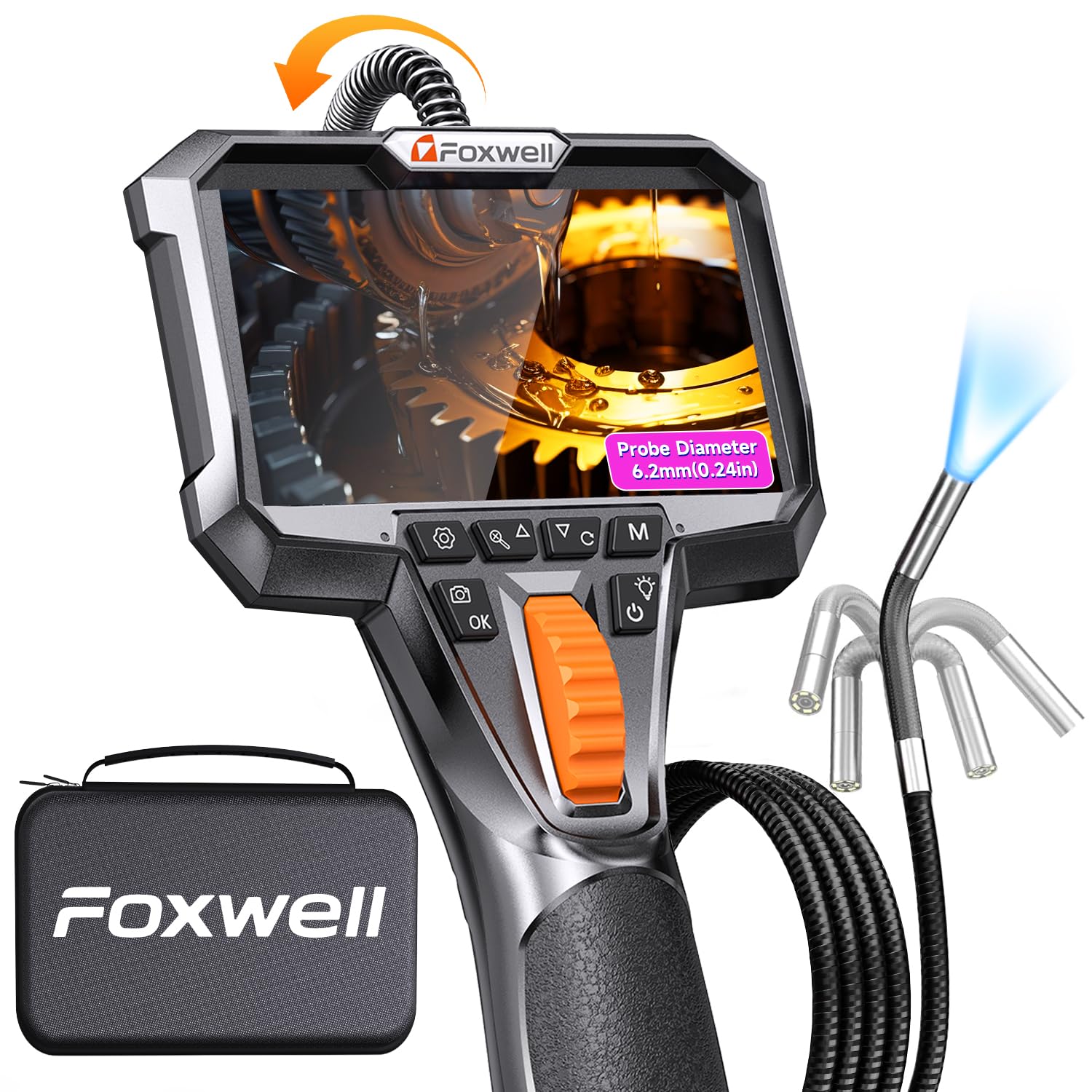
The Foxwell Y400 stands out for its ultra-slim 6.2mm probe combined with responsive 220-degree two-way articulation. This combination gives you the ability to steer the camera precisely around valve stems and through tight cylinder head passages without the cable fighting you. The HD IPS screen with 4X digital zoom lets you examine micro-cracks and carbon deposits in clear detail, while the 6 adjustable LEDs with three brightness levels eliminate harsh glare off polished metal surfaces.
Owner feedback from forklift mechanics and automotive technicians consistently highlights the build quality and the convenience of not needing any app or smartphone pairing. The overheat protection at 158°F adds a layer of safety for extended inspections inside hot engine compartments. The battery runtime of 5-7 hours is among the best in this category, supporting full-day diagnostic sessions without interruption. The included 32GB onboard storage handles thousands of photos and hours of video.
The one limitation is that the probe diameter, while slim, is still 6.2mm, which is slightly larger than the 5mm class units. This means it won’t fit into the very narrowest spark plug hole adapters. However, for the vast majority of automotive, HVAC, and plumbing inspections, the combination of articulation, clarity, and durability makes this the most well-rounded tool available in its price tier.
What works
- Ultra-slim probe with smooth 220° thumb-wheel steering
- Excellent battery life with 5-7 hours runtime
- Bright, adjustable LEDs with 4X zoom for detailed inspection
What doesn’t
- Probe diameter too large for some spark plug hole adapters
- No built-in wireless streaming for remote viewing
2. Teslong NTS500 Dual Lens Endoscope
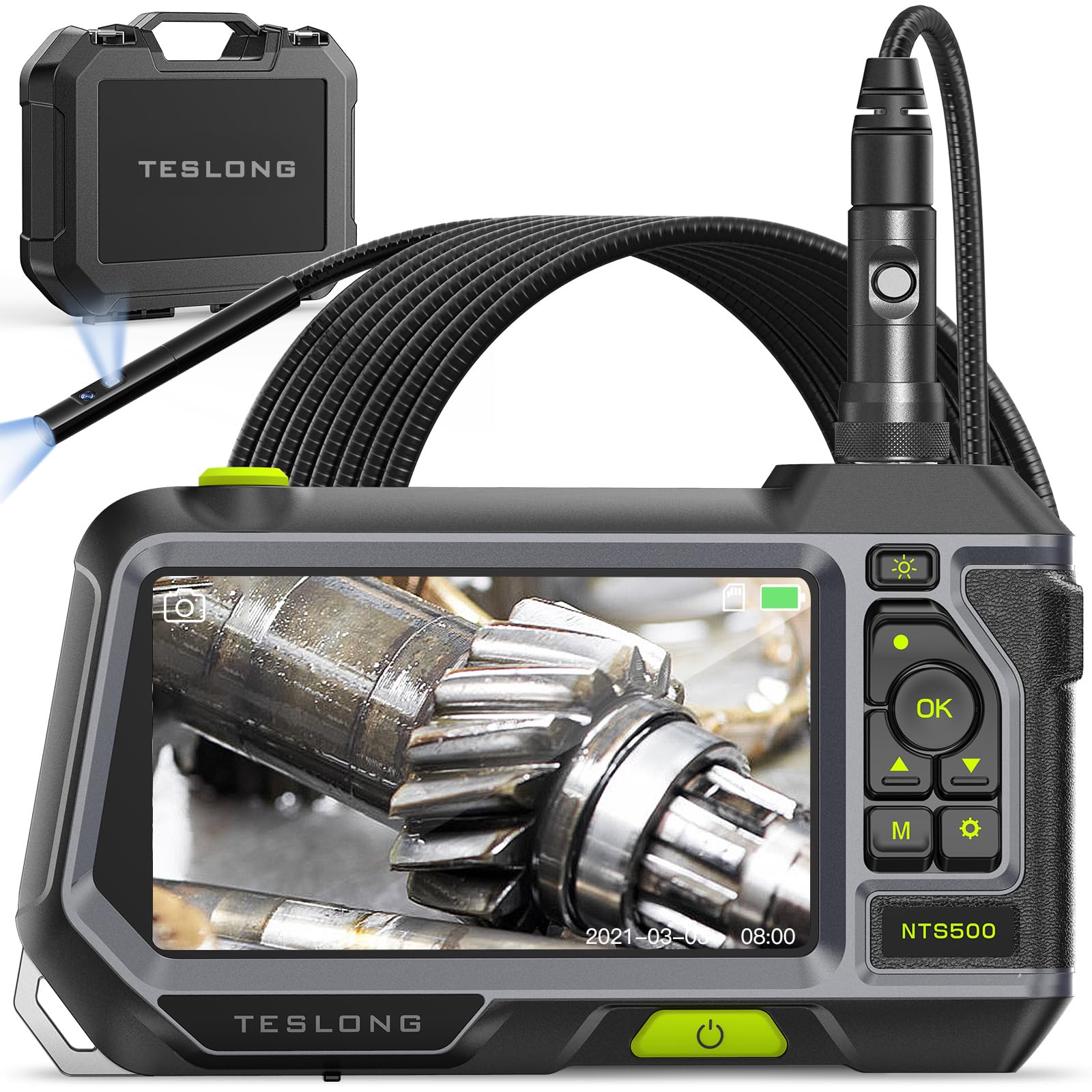
The Teslong NTS500 is a long-standing favorite among professional technicians who need a reliable dual-lens probe for narrow access points. The 5.3mm (0.21in) diameter is one of the slimmest available, easily passing through spark plug holes to inspect cylinder walls and piston tops. Toggling between the front and side cameras with a single button gives you two perspectives without moving the probe, which is especially useful when working in tight engine bays.
The 5-inch 720P IPS screen provides crisp images, and the 3500mAh battery delivers a solid 4 hours of continuous operation. The IP67 waterproof rating allows safe use in wet environments like plumbing drains and coolant systems. The semi-rigid cable holds its shape well, making it easy to route around obstacles. Owners report using this model for years without issues, citing the build quality and the replaceable probe design as major advantages over cheaper units.
One downside noted by users is the manual exposure control, which requires some adjustment in very dark or highly reflective environments. The 1MP effective still resolution is adequate for documentation but won’t match the sharpness of newer 2MP sensors. Despite these minor limitations, the NTS500 remains a benchmark for slim-probe dual-lens cameras, particularly for those who need a dependable tool for repeated automotive and industrial inspections.
What works
- Extremely slim 5.3mm probe for tight spark plug access
- Durable IP67 construction and replaceable cable design
- Long 9.8ft cable length for extended reach
What doesn’t
- Manual exposure control requires adjustment
- 1MP sensor resolution is lower than newer models
3. DEPSTECH DS650 10FT Articulating Endoscope
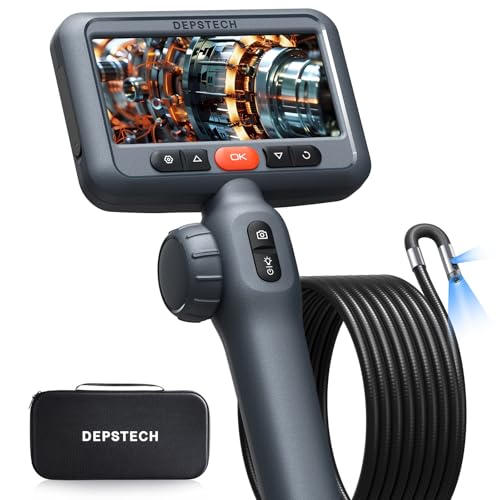
The DEPSTECH DS650 brings professional-grade articulation to an affordable mid-range package, featuring 210-degree bidirectional control and a 10-foot semi-rigid cable. This combination is ideal for technicians who need to inspect deep inside engine blocks or through long HVAC ducts without losing steering authority. The dual-lens design with split-screen view lets you see forward and side perspectives simultaneously, which is a real time-saver when navigating around obstacles.
The 4.5-inch IPS display delivers sharp 1080P images, and the Blaurt 3.0 technology helps maintain clarity even in low-light conditions. The 2200mAh battery provides over 4 hours of runtime, which is sufficient for most diagnostic sessions. The manual focus adjustment (optimal at 3-5cm) gives you control over close-up sharpness, and the 1.5X digital zoom helps spot small details. Owners of 2-stroke engines have praised this unit for cylinder and piston inspections.
Some users report that the manual focus can be tricky to dial in perfectly, especially in tight spaces where you can’t easily adjust the distance. The 0.33in probe is not as slim as the 5mm class units, so it won’t fit into the narrowest spark plug holes. However, for general automotive, home, and plumbing work where articulation and cable length matter more than absolute slimness, the DS650 delivers impressive value and performance.
What works
- Excellent 210° articulation with 10ft reach
- Dual-lens split-screen view for comprehensive inspection
- Good 1080P image quality with manual focus control
What doesn’t
- Manual focus requires patience to adjust
- Probe diameter too large for some narrow access points
4. Acoath Two-Way Articulating Borescope
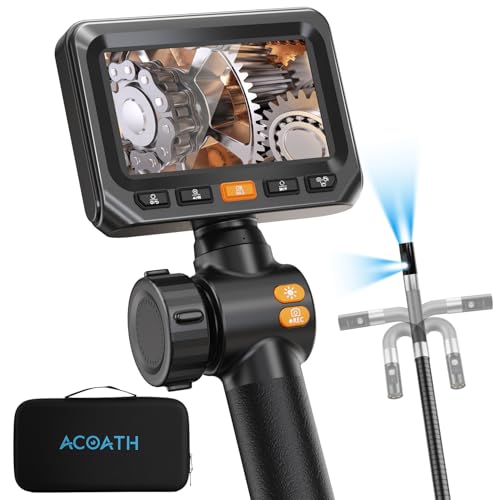
The Acoath two-way articulating borescope enters the market as a strong contender for value-conscious buyers who still want genuine articulation control. The 210-degree steering range and 420-degree total motion give you plenty of flexibility to navigate around engine components and pipe bends. The dual-lens design with 70-degree main and 60-degree side fields of view provides a complete picture without needing to rotate the probe manually.
The 4.3-inch IPS screen delivers true-to-life colors, and the 8 adjustable LEDs with 4 brightness levels handle dark environments well. The semi-rigid 5ft cable is shorter than some competitors but sufficient for most automotive and home inspections. The included 32GB card, carrying case, and accessory kit (magnet, hook, mirror) add significant value. Owner reviews consistently mention the clear picture quality and ease of use as standout features.
Battery life is a point of contention among users—some report excellent runtime, while others note it falls short of expectations for extended sessions. The 5ft cable length may be limiting for deep plumbing runs or long duct inspections. For those primarily working on cars, motorcycles, or home wall cavities, the Acoath offers a compelling feature set at a lower entry point, but heavier users may want to budget for a model with more battery capacity.
What works
- Reliable 210° articulation for tight spaces
- Complete accessory kit with case and 32GB card
- Clear 1080P image quality with adjustable LEDs
What doesn’t
- Battery life inconsistent across units
- Only 5ft cable length may limit reach
5. DEPSTECH DS620 Triple Lens Endoscope
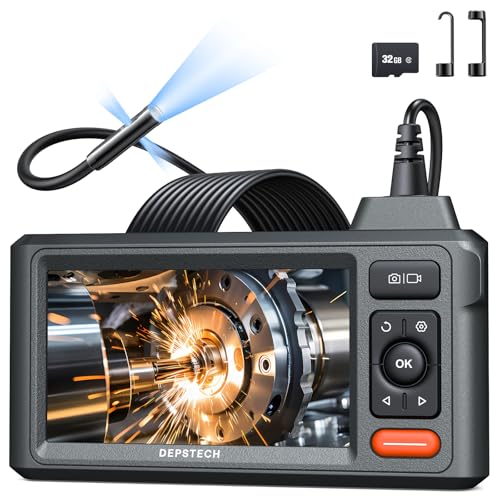
The DEPSTECH DS620 is a budget-friendly entry that punches above its weight with a triple-lens design and an exceptionally long 16.5-foot semi-rigid cable. The ability to switch between three viewing angles without repositioning the probe is a genuine time-saver when inspecting long pipe runs or deep wall cavities. The 5-inch IPS screen provides a large, clear display for real-time viewing, and the 2MP camera captures sharp 1080P images and video.
Owner feedback highlights the value for money, with many noting the image quality rivals more expensive units. The 32GB included storage and the IP67 waterproof probe make it suitable for damp environments like sewer lines and drainage pipes. The semi-rigid cable holds its shape well, giving you good control even at the full 16.5ft extension. The magnetic and hook attachments add retrieval capability for dropped bolts and debris.
The main trade-off is battery life, which averages 2-3 hours—enough for a few inspections but not a full workday. Some owners report inconsistent LED performance on the side cameras, with one unit showing a dimmer LED. For home DIYers and occasional automotive users who need long reach and multiple viewing angles without spending heavily, the DS620 represents a solid, practical choice.
What works
- Triple-lens design for versatile angle switching
- Very long 16.5ft cable for deep inspections
- Excellent image quality for the price point
What doesn’t
- Short 2-3 hour battery life
- Inconsistent LED brightness on side cameras
6. Teslong Two-Way Articulating Borescope

Teslong’s articulating borescope is built for professionals who need both precise steering control and the ability to share live footage with a team. The two-way articulating head gives you responsive control to inspect valve seats, cylinder walls, and gearboxes from multiple angles without moving the cable. The 5-inch IPS LCD screen with 3000mAh battery provides all-day operation, and the built-in wireless adapter allows streaming to an external tablet for collaborative diagnostics.
Automotive technicians frequently cite this model as a daily workhorse, praising the ease of use and the quality of the 2MP images. The 5ft semi-rigid gooseneck cable strikes a good balance between flexibility and control, holding its shape as you navigate around engine components. The included 32GB MicroSD card supports both JPG images and AVI video with audio recording, making it easy to document findings for customers or insurance claims.
The primary drawback is the price, which positions it at the higher end of the market. Some users mention that the 0.33in probe is not as slim as the dedicated dual-lens models, so it may not fit into the absolute narrowest access ports. For technicians who value wireless streaming and articulation control over absolute slimness, this Teslong model delivers a premium experience that justifies the investment.
What works
- Responsive two-way articulation for precise steering
- Built-in wireless streaming for team collaboration
- Excellent 2MP image quality with audio recording
What doesn’t
- Higher price point than non-articulating models
- 0.33in probe may not fit all spark plug ports
7. Teslong 5mm Dual Lens Inspection Camera

The Teslong 5mm dual-lens camera is purpose-built for ultra-slim access, with a 5.5mm probe that slides into spark plug holes and other narrow orifices with minimal clearance. The dual-lens design lets you toggle between forward and side views instantly, giving you two perspectives without needing to rotate the probe. The large 5-inch IPS screen displays 1080P HD images, and the 3500mAh battery delivers an impressive 6 hours of continuous use.
Industrial maintenance technicians and dealership mechanics frequently recommend this model for its combination of slim diameter, long battery life, and clear image quality. The included kickstand allows for hands-free viewing while you work, and the protective carrying case keeps everything organized. The accessory set includes a hook and magnet for retrieving dropped items, adding practical utility beyond simple inspection.
Some users have reported difficulty downloading photos from the device to a computer, citing software compatibility issues. The lack of articulation means you must rely on the dual lenses and cable bending for different angles, which can be limiting in complex cavities. For inspections where probe diameter and battery life are the top priorities—like engine cylinder bores and narrow ducts—this Teslong model is a top-tier choice.
What works
- Ultra-slim 5.5mm probe for tight access
- Exceptional 6-hour battery life
- Hands-free kickstand and protective case
What doesn’t
- Photo download software can be finicky
- No articulation—relies on dual lenses for angles
Hardware & Specs Guide
Probe Diameter
The diameter of the camera probe determines which access points it can enter. Slim 5-6mm probes fit through standard spark plug holes and small drain openings. Wider 8mm+ probes offer larger sensors but are limited to more open spaces like HVAC ducts and pipe cleanouts. The Foxwell Y400 uses a 6.2mm probe that balances slimness with durability, while the Teslong 5mm camera is the narrowest for the tightest ports.
Articulation vs. Dual Lens
Articulation uses a mechanical thumb wheel to steer the camera tip up and down, giving you precise control in complex cavities. Dual-lens cameras offer fixed forward and side views that you switch between with a button. Articulation is ideal for engine work where you need to navigate around valves; dual-lens designs are simpler and more reliable for straight pipe and wall inspections.
Screen Quality and Resolution
A 4.3 to 5-inch IPS screen with 720P or higher resolution provides clear real-time feedback. Higher resolution (1080P) helps identify hairline cracks and carbon buildup. The Foxwell Y400 and Teslong 5mm both offer excellent IPS panels. Avoid models with small, low-resolution screens that make detail hard to spot.
Battery Life and Charging
Battery life ranges from 2 to 7 hours depending on the model and LED usage. The Teslong 5mm leads with 6 hours, while the Foxwell Y400 offers 5-7 hours. Shorter battery life units like the DEPSTECH DS620 (2-3 hours) are fine for quick inspections but may need a mid-day charge for heavy use. USB-C charging is preferred for convenience.
Waterproof and Dust Resistance
IP67 rating means the probe is fully protected against dust and can be submerged in up to 1 meter of water for 30 minutes. This is essential for plumbing, drain, and wet engine inspections. All the reviewed models offer IP67 waterproof probes, ensuring reliability in damp environments.
Storage and File Formats
Onboard storage via MicroSD card is standard, with capacities ranging from 32GB to 128GB supported. JPEG for photos and MP4 or AVI for video are the common formats. Some models like the Teslong articulating borescope also support audio recording. Confirm the file format matches your documentation software before purchasing.
FAQ
Can a digital inspection camera see through walls?
What is the difference between an endoscope and a borescope?
How long should the cable be for automotive use?
Do I need an articulating borescope for engine diagnostics?
Can I use an inspection camera to retrieve dropped items?
Final Thoughts: The Verdict
For most buyers, the best digital inspection camera winner is the Foxwell Y400 because it combines the narrowest practical probe diameter with responsive articulation, excellent battery life, and a bright, zoomable screen—all at a price that delivers professional-grade capability without the professional-grade markup. If you need the slimmest possible probe for spark plug access and value long battery life, grab the Teslong 5mm Dual Lens. And for long-reach inspections where articulation and cable length are critical, nothing beats the DEPSTECH DS650.

Certification: BSc in Mechanical Engineering
Education: Mechanical engineer
Lives In: 539 W Commerce St, Dallas, TX 75208, USA
Md Amir is an auto mechanic student and writer with over half a decade of experience in the automotive field. He has worked with top automotive brands such as Lexus, Quantum, and also owns two automotive blogs autocarneed.com and taxiwiz.com.