A dead battery on a cold morning disrupts your entire schedule. The difference between a charger that nurses your battery back to health and one that slowly cooks it comes down to the internal charging algorithm, not the peak amp rating on the box. Most drivers grab whatever is on sale, only to find their battery sulfated and dead again six months later.
I’m Amir — the founder and writer behind Four Wheel Ask. I’ve spent years analyzing market data, comparing multi-stage charging profiles, and aggregating owner feedback across hundreds of battery charger models to separate genuine performance from marketing claims.
After reviewing dozens of models and owner reports, the best dedicated car battery charger must deliver reliable charging to protect your investment.
How To Choose The Best Dedicated Car Battery Charger
Selecting the right charger requires understanding your battery type, typical usage patterns, and the charging technology that prevents long-term damage. The following factors determine whether your battery lasts three years or six.
Charging Amperage: Matching Rate to Battery Size
Higher amps charge faster but generate more heat, which can warp plates in smaller batteries. A 10-amp unit suits a full-size SUV battery, while a 2-amp or 5-amp unit works better for motorcycles and lawn equipment. The sweet spot for most passenger cars sits between 5 and 10 amps for routine charging and maintenance.
Multi-Stage Charging: Bulk, Absorption, and Float
A genuine smart charger delivers three distinct phases. Bulk mode supplies maximum current until the battery reaches about 80% capacity. Absorption mode reduces current to top off the remaining 20% without overheating. Float mode then holds a steady voltage to prevent self-discharge. Chargers that skip or abbreviate any stage risk undercharging or overcharging the battery.
Desulfation and Reconditioning Technology
Lead-acid batteries naturally form sulfate crystals over time, which reduces capacity. A desulfation mode sends controlled high-frequency pulses to break down these crystals and recover lost performance. This feature can extend a battery’s useful life by months or even years, making it a priority for infrequently driven vehicles.
Battery Compatibility: Lead-Acid, AGM, Gel, and Lithium
Different chemistries require different voltage thresholds and charging profiles. AGM and gel cells need lower absorption voltages to avoid drying out, while Lithium (LiFePO4) batteries require a completely separate algorithm. A versatile unit that supports multiple chemistries saves you from buying separate chargers for each vehicle in your household.
Quick Comparison
On smaller screens, swipe sideways to see the full table.
| Model | Category | Best For | Key Spec | Amazon |
|---|---|---|---|---|
| CRAFTSMAN CMXCESM258 | Smart Charger | Best Overall | 12A, 4-in-1, LiFePO4 Ready | Amazon |
| Clore PL2310 | Smart Charger | Best Performance | 10A, Temp Compensation | Amazon |
| BatteryMINDer 1510 | Desulfator | Best Battery Care | 1.5A, Desulfation, 4-Bank | Amazon |
| CTEK US 0.8 | Maintainer | Best Value | 0.8A, 6-Stage, Splashproof | Amazon |
| ECO-WORTHY 5A | Smart Charger | Best Design | 5A, LCD, LiFePO4 Compatible | Amazon |
| LEICESTERCN 4-Pack | Trickle Charger | Best Value | 0.75A, 3-Stage, 4 Units | Amazon |
| NOCO Boost GB40 | Jump Starter | Best Premium | 1000A, Portable, USB-C | Amazon |
In-Depth Reviews
1. CRAFTSMAN 12A Car Battery Charger and Maintainer CMXCESM258

The CRAFTSMAN CMXCESM258 combines charging, maintaining, testing, and reconditioning in a single compact unit. Its 12-amp output delivers rapid recovery for deeply discharged batteries, while the 3-amp trickle mode safely maintains charge over long storage periods. Owner reports consistently highlight the straightforward interface and the fact that it handles everything from standard flooded cells to LiFePO4 chemistries without requiring manual profile selection.
The built-in battery tester provides a quick health check before you even connect the charger, saving time when diagnosing a no-start condition. The reconditioning mode uses a desulfation pulse sequence that several users report revived batteries their previous charger had deemed unrecoverable. At just over three pounds, the unit is light enough to move between vehicles easily, yet the clamps feel substantial and secure.
Reverse polarity protection prevents damage if you accidentally swap the clamps, a safety net that matters when working in dim garage lighting. The 6-foot AC cord combined with booster cables gives reasonable reach, though users with larger vehicles may wish for an extra foot. For the owner who wants one device that charges fast, maintains safely, tests accurately, and reconditions when needed, this Craftsman delivers across every category.
What works
- Rapid 12-amp charging for large batteries
- Built-in battery tester adds diagnostic value
- Reconditioning mode recovers sulfated batteries
- Lightweight and easy to move between vehicles
What doesn’t
- AC cord could be longer for truck owners
- No dedicated AGM profile selector
2. Clore Automotive PL2310 10-Amp Smart Charger
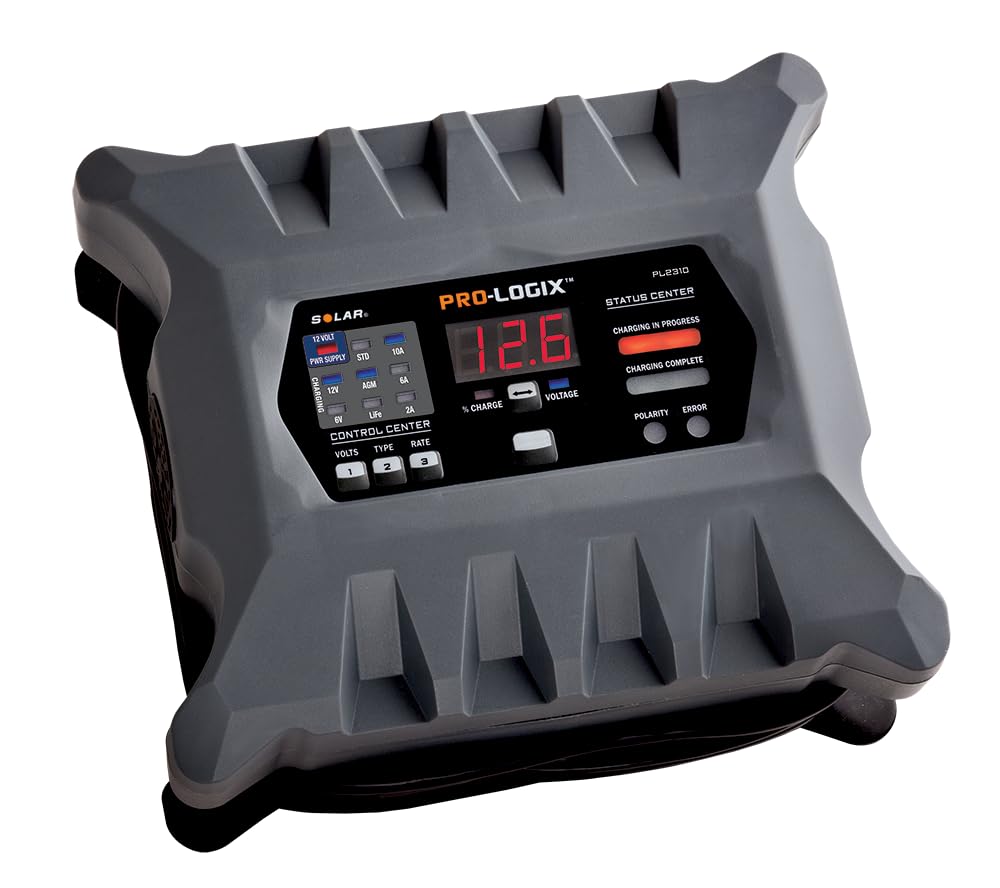
The Clore PL2310 stands apart from typical smart chargers because it includes active temperature compensation that adjusts voltage based on ambient conditions. This matters tremendously in unheated garages where winter temperatures can cause overcharging or undercharging. With selectable 2-amp, 6-amp, and 10-amp charge rates plus support for both 6-volt and 12-volt systems, this unit covers cars, motorcycles, boats, and classic vehicles from a single device.
The power supply mode delivers a stable voltage for diagnostics and ECU programming — a feature rarely found at this price point. Multiple automotive technicians report using the PL2310 specifically for flashing control modules because the output waveform remains clean and consistent. The digital display shows both voltage and charge percentage, giving real-time feedback that helps you decide when the battery is ready for service.
Build quality reflects Clore’s commercial-grade reputation. The case feels solid, the clamps have good spring tension, and the 10-amp setting genuinely pushes that current without tripping thermal limits. Some users note the instruction manual could be clearer regarding the multi-function programming, but once set up, the charger runs autonomously. For the driver who wants a rugged, accurate charger with professional-grade temperature compensation, this unit justifies every bit of attention it gets.
What works
- Temperature compensation prevents winter overcharging
- Clean power supply mode for ECU programming
- Multiple charge rates for different battery sizes
- Supports both 6V and 12V systems
What doesn’t
- Instruction manual lacks clarity on advanced functions
- Heavier than basic maintainers at nearly 4 pounds
3. BatteryMINDer 1510 Charger, Maintainer, and Desulfator

The BatteryMINDer 1510 uses a patented high-frequency desulfation algorithm that runs continuously during maintenance, not just as a one-time cycle. Owner data spanning multiple years shows this approach can extend battery life by up to four times compared to untreated batteries. The unit charges at 1.5 amps, which is deliberately slow to maximize the desulfation window and avoid thermal stress on older or weakened cells.
An ambient temperature sensor adjusts voltage in real time, ensuring the battery receives the correct charge whether the garage is sweltering in July or freezing in January. The unit can maintain up to four batteries simultaneously when connected via optional Y-connectors, making it ideal for households with multiple seasonal vehicles. The 90-to-240-volt AC input allows worldwide use for those who travel with an RV or boat.
Users report that batteries previously written off as dead often recover after a week connected to the 1510. The trade-off is the slow charge rate — this is not the tool for a quick recovery before your morning commute. But for long-term battery preservation and the ability to nurse weak batteries back to serviceable condition, the 1510 has few real competitors. The desulfation results alone make it a staple for collectors and seasonal vehicle owners.
What works
- Continuous desulfation extends battery life significantly
- Temperature compensation for all-season accuracy
- Can maintain up to four batteries at once
- Wide input voltage range for global use
What doesn’t
- 1.5-amp charge rate is slow for large batteries
- Y-connectors for multi-battery use sold separately
4. CTEK US 0.8 12V Fully Automatic 6-Step Charger

CTEK has earned a loyal following among automotive enthusiasts, and the US 0.8 demonstrates why the Swedish brand commands that respect. Despite the modest 0.8-amp rating, the charger employs a true six-stage process that includes desulfation, bulk, absorption, and float phases. This unit is designed for batteries from 1.2Ah to 32Ah, with the ability to maintain batteries up to 100Ah, covering motorcycles, lawn tractors, ATVs, and classic cars with minimal current draw.
The splashproof and dustproof housing means it can live in a damp garage or even outdoors under a cover without failing. The spark-proof connection and reverse polarity protection make it safe for owners who may not use a charger frequently. Multiple long-term owner reports mention units lasting seven years or more of continuous seasonal use, which speaks to the build quality and component selection.
Included accessories cover both permanent eyelet connections and alligator clamps, plus a storage bag that keeps everything organized. The main limitation is the charge speed — at 0.8 amps, recovering a deeply discharged car battery takes more than 24 hours. This charger is optimized for maintenance and slow recovery, not emergency jump-starts. For the price, the CTEK US 0.8 delivers professional-grade charging algorithms in a rugged, compact package that owners trust for years.
What works
- True six-stage charging with desulfation phase
- Splashproof and dustproof for harsh environments
- Multiple long-term owner reports of 7+ year lifespan
- Includes both clamps and eyelet connectors
What doesn’t
- Very slow charge rate at 0.8 amps
- Not suitable for large SUV or truck batteries
5. ECO-WORTHY 12V 5A Automatic Smart Battery Charger

The ECO-WORTHY 5A charger brings a clear LCD display and dual-chemistry support to the budget-friendly segment without cutting corners on safety. The screen shows voltage, current, and charge status, giving you real-time visibility that many chargers at this price level omit. It handles both standard lead-acid and Lithium (LiFePO4) batteries, automatically selecting the correct profile when connected.
The intelligent detection system identifies low voltage or sulfation and prompts the user to initiate a repair cycle, rather than simply attempting to force a charge that could damage the cell. This proactive communication helps owners make informed decisions about whether a battery is recoverable or needs replacement. The included SAE connector with a 10-amp fuse provides a permanent mounting option for vehicles with hard-to-reach batteries.
User feedback consistently praises the value proposition: a 5-amp smart charger with LCD feedback and lithium compatibility at a price that competes with basic trickle chargers. The unit does run slightly warm during extended bulk charging, but no failures have been reported in the aggregate owner data. For the budget-conscious owner who wants multi-chemistry support and diagnostic feedback without stepping up to premium pricing, the ECO-WORTHY 5A is a remarkably capable choice.
What works
- LCD display provides clear voltage and status readout
- Supports both lead-acid and LiFePO4 batteries
- Intelligent detection alerts user to sulfation issues
- Includes SAE connector for permanent installation
What doesn’t
- Runs warm during extended bulk charging
- No 6-volt support for classic vehicles
6. LEICESTERCN 4-Pack 12V Automatic Trickle Battery Charger Maintainer
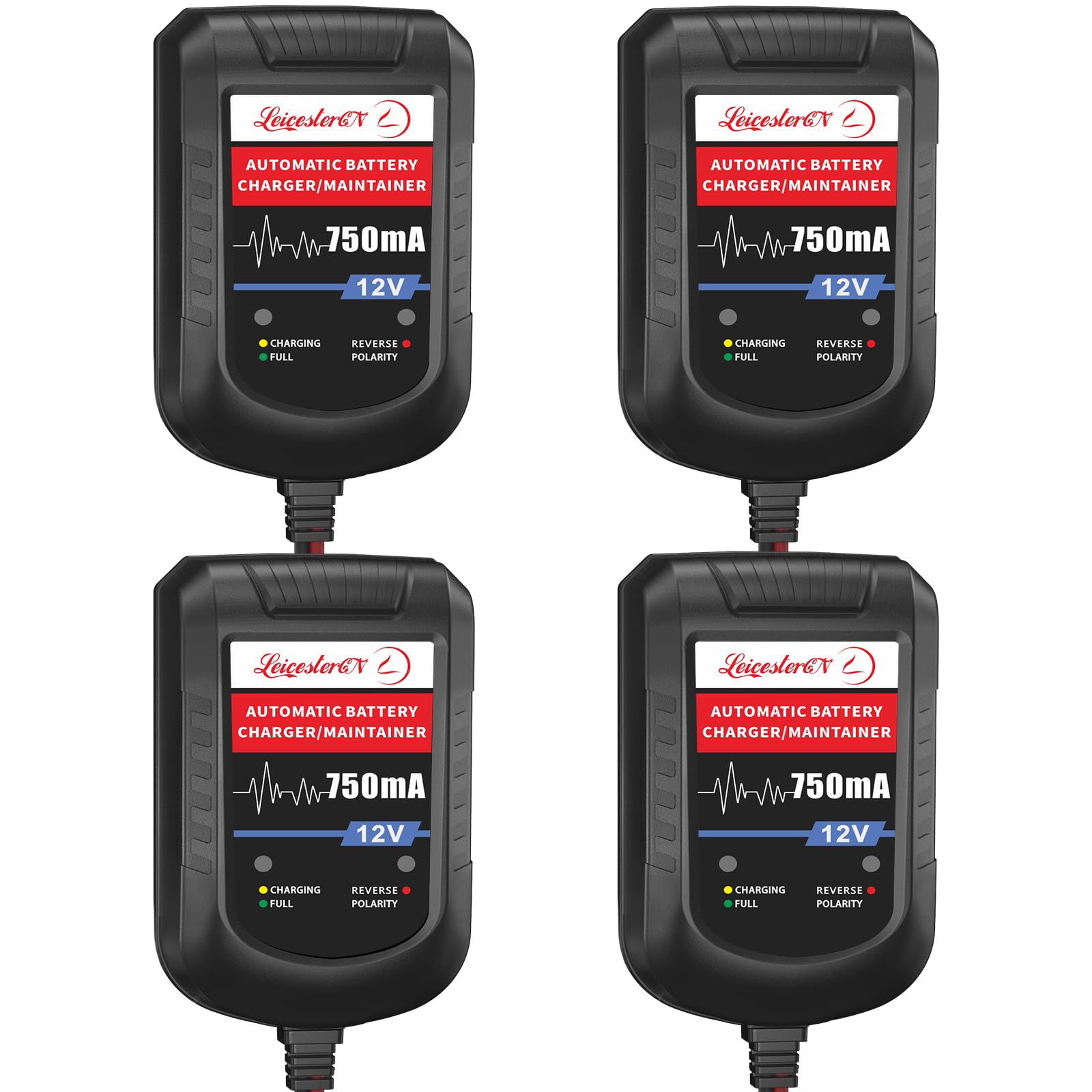
The LEICESTERCN 4-pack solves the problem every multi-vehicle owner faces: buying separate maintainers for each machine. Each unit delivers 750mA of charging current through a three-stage CC-CV(H)-CV(F) process that transitions automatically to float mode once the battery reaches full charge. The bi-color LED indicator shows yellow during charging, green when full, and red if polarity is reversed, providing clear status at a glance without needing to interpret a screen.
Compatibility spans flooded, AGM, gel cell, and SLA batteries up to 12 volts, covering cars, motorcycles, lawn mowers, boats, ATVs, and ride-on toys. The 8-foot total cable length (6-foot AC plus 2-foot DC) gives adequate reach for most installations, and the included ring terminals allow permanent connection for vehicles stored for extended periods. Owner data shows these units working reliably through full winter storage seasons with no failures.
The primary consideration is the 750mA current limit. This is strictly a maintainer — it will not recover a deeply discharged battery in a reasonable timeframe. Users report excellent results for keeping batteries topped off during seasonal storage, with several buyers purchasing additional packs to cover every vehicle in their fleet. For the owner managing multiple vehicles through winter or long-term storage, the per-unit cost of this 4-pack is hard to beat.
What works
- Excellent value for multi-vehicle households
- Three-stage smart charging with float mode
- Clear LED status indicators
- Works with flooded, AGM, and gel batteries
What doesn’t
- 750mA too slow for recovering dead batteries
- No lithium battery support
7. NOCO Boost GB40 1000A UltraSafe Lithium Jump Starter

The NOCO Boost GB40 occupies a different category than the other chargers on this list, serving as a portable lithium jump starter rather than a AC-powered charger. Its 1000-amp peak output starts engines up to 6.0L gas and 3.0L diesel without needing another vehicle or a wall outlet. The spark-proof technology and reverse polarity protection make it safe even for first-time users who may be stressed in an emergency situation.
The integrated 100-lumen LED flashlight includes seven modes including SOS and strobe, adding utility for roadside repairs after dark. The unit doubles as a power bank for smartphones and tablets, and recharges fully in about three hours via USB-C. At 2.4 pounds with a compact form factor, it fits in most glove boxes or under-seat storage compartments without sacrificing cargo space.
The GB40 excels as an emergency companion rather than a dedicated garage charger. It cannot perform multi-stage charging, desulfation, or long-term battery maintenance. Some users note that the lack of a wall charger in the box (USB-C cable only) is an oversight for a premium product. However, for drivers who want portable starting power, the ability to boost multiple vehicles on a single charge, and the peace of mind that comes with keeping a unit in the trunk, the NOCO GB40 is the definitive choice.
What works
- Portable 1000-amp starting power without a wall outlet
- Spark-proof and reverse polarity protected
- Integrated LED flashlight with multiple modes
- Compact enough for glove box storage
What doesn’t
- No wall charger included, only USB-C cable
- Cannot perform multi-stage maintenance charging
Hardware & Specs Guide
Multi-Stage Charging Profiles
The most important specification on any smart charger is the charging algorithm it uses. A basic single-stage charger applies a fixed current until the battery reaches a voltage threshold then shuts off, which often leads to undercharging. A proper multi-stage profile begins with bulk charging at maximum current until approximately 80% capacity, transitions to absorption mode at reduced current for the final 20%, and then enters float maintenance at a safe holding voltage. Some premium units add a desulfation stage that precedes bulk charging, sending high-frequency pulses to break down sulfate crystals before the main charge cycle begins. Chargers with true six-stage or seven-stage profiles provide the most complete battery care and are strongly preferred for seasonal vehicles that sit unused for months.
Desulfation and Reconditioning
Sulfation occurs naturally when lead-acid batteries sit at partial charge for extended periods, forming lead sulfate crystals that reduce capacity and increase internal resistance. A desulfation mode applies controlled voltage pulses at specific frequencies to dissolve these crystals and restore active material to the electrolyte. The effectiveness of desulfation depends on the pulse frequency, voltage amplitude, and duration of the treatment. Dedicated desulfation chargers like the BatteryMINDer 1510 run this process continuously during maintenance, while multi-function chargers offer it as a selectable mode. Batteries that fail to hold a charge due to severe sulfation may still be unrecoverable, but desulfation can extend the useful life of mildly sulfated batteries by months or years when applied regularly.
FAQ
Can I leave a smart charger connected all winter?
What amp rating do I need for a car battery charger?
Does desulfation really revive old batteries?
Can I charge a lithium battery with a lead-acid charger?
Is a jump starter better than a battery charger for emergencies?
Final Thoughts: The Verdict
For most buyers, the best dedicated car battery charger winner is the CRAFTSMAN CMXCESM258 because it combines fast 12-amp charging, a built-in battery tester, and a reconditioning mode in one affordable package that works with nearly every battery chemistry. If you want professional-grade temperature compensation and a stable power supply for diagnostics, grab the Clore PL2310. And for long-term battery preservation across multiple vehicles, nothing beats the desulfation capability of the BatteryMINDer 1510.

Certification: BSc in Mechanical Engineering
Education: Mechanical engineer
Lives In: 539 W Commerce St, Dallas, TX 75208, USA
Md Amir is an auto mechanic student and writer with over half a decade of experience in the automotive field. He has worked with top automotive brands such as Lexus, Quantum, and also owns two automotive blogs autocarneed.com and taxiwiz.com.