Nothing kills a road trip vibe faster than a dead laptop halfway through a movie or a CPAP machine that shuts off two hours into a camping stay. A DC to AC power inverter solves this instantly—turning your car’s 12V cigarette lighter socket into a standard wall outlet so you can run anything from a phone charger to a portable compressor without an external generator. The catch? Most buyers grab the first cheap unit they see and end up with a fried device or an inverter that trips the moment the load spikes.
I’m Amir — the founder and writer behind Four Wheel Ask. I’ve spent years dissecting the electrical specs, heat dissipation designs, and real-world owner feedback on DC converters for cars to separate the units that actually deliver clean, stable power from those that barely survive a single charge cycle.
Whether you need to juice a MacBook on a cross-country drive or keep a CPAP machine running overnight at a rest stop, this guide breaks down the five best options available right now and what really matters under the hood. You’ll walk away knowing exactly which dc converter for car fits your gear, your vehicle, and your real-world power needs.
How To Choose The Best DC Converter For Car
Selecting the right car power inverter requires matching its electrical output to your devices’ demands and your vehicle’s electrical system. Ignoring these three specs is the number one reason buyers end up with an inverter that shuts down or damages their gear.
Continuous vs Peak Wattage
Continuous wattage is the steady power the inverter can deliver indefinitely. Peak (or surge) wattage is the short burst it can handle for a second or two when a device like a fridge compressor or a CPAP heater starts up. A 300W continuous inverter with a 700W peak can handle startup spikes, but a 200W unit with a 400W peak may trip on the same load. Always match the continuous rating to the combined running wattage of everything you plug in.
USB-C Power Delivery (PD) Output
If you plan to charge a modern laptop, a standard 5V USB-A port is useless. You need a USB-C PD port rated at least 30W for a MacBook Air or 65W for a MacBook Pro. The PD wattage determines real charge speed—a 27W PD port will trickle-charge a 14-inch laptop, while a 65W PD port can push it to 50% in under 40 minutes.
Input Voltage Range and Vehicle Compatibility
Most cars use a 12V DC system, but modern EVs like Tesla models use 16V accessory sockets. A standard inverter with a 11–15V input range may not work in a Tesla. Look for units that explicitly list an 11–17V input range if you drive an EV. Also check the cigarette lighter plug length—some deep sockets require a longer plug to make contact.
Quick Comparison
On smaller screens, swipe sideways to see the full table.
| Model | Category | Best For | Key Spec | Amazon |
|---|---|---|---|---|
| BESTEK 300W | Premium | Universal high-power charging, Tesla compatibility | 11–17V input, 30W PD | Amazon |
| FSATBTNE 400W | Premium | High-speed laptop charging | 400W cont., 65W PD | Amazon |
| vansoet 300W | Mid-Range | All-around device power | 300W cont., 700W peak | Amazon |
| ALLWEI 300W | Mid-Range | Compact daily carry | Aluminum housing, 27W PD | Amazon |
| vansoet 200W | Budget | Entry-level, small electronics | 200W cont., 30W PD | Amazon |
In‑Depth Reviews
1. BESTEK 300W Car Power Inverter

The BESTEK 300W inverter earns the top spot because it solves the single biggest compatibility issue in this category: it works with Tesla’s 16V accessory socket thanks to its 11–17V input range, a feature most competitors simply do not offer. That alone makes it the only premium pick that fits both gas cars and modern EVs without a workaround. The 30W USB-C PD port and 18W QC 3.0 USB-A port give it solid fast-charging capability for iPhone and Android devices, while the metal housing and built-in intelligent chip protect against short circuits and overheating.
You get 300W of continuous power with a 700W peak surge, which is enough to run a CPAP machine, a 13-inch laptop, a camera charger, and a phone simultaneously without tripping. The compact footprint—4.2 x 1.8 x 3.1 inches—slides into a cupholder or glove box easily. The patented design (US D785,565 S) and UL certification add an extra layer of confidence for buyers who want verified safety, not just marketing claims.
On the downside, the unit uses a modified sine wave output, so it’s not suitable for sensitive medical equipment that requires pure sine wave. Also, the cigarette lighter adapter fits snugly, but some deeper sockets may require you to push it in firmly. For the vast majority of road-trippers, campers, and EV owners, this is the most forward-looking inverter you can buy right now.
What works
- Patented design works natively with Tesla 16V sockets
- Metal housing for drop protection and heat dissipation
- UL certified with multi-protection chip
What doesn’t
- Modified sine wave limits device compatibility
- Cigarette plug may need extra push in some vehicles
2. FSATBTNE 400W Power Inverter

If you need the highest raw wattage in this lineup, the FSATBTNE 400W inverter delivers 400W continuous and an 800W peak surge—enough to run a small portable refrigerator, a gaming laptop, and a phone charger simultaneously. The standout feature here is the 65W USB-C PD port, which can charge a MacBook Pro 14-inch to 50% in about 37 minutes, making it the fastest laptop charging option among these five products.
The aluminum alloy housing is built to dissipate heat efficiently, and the intelligent cooling fan adjusts its speed based on the inverter’s workload, keeping noise low during light loads. The built-in MCU chip monitors voltage, current, and temperature, automatically shutting down if any parameter exceeds safe limits. The 24-inch cigarette lighter cable gives you flexibility to position the inverter where it won’t block cup holders or gear shifters.
The trade-off is size: at 4.6 x 3.1 x 1.8 inches, it’s slightly larger than the BESTEK unit, and the modified sine wave output again limits compatibility with certain medical or audio equipment. Also, the CE certification is less rigorous than UL or ETL, so safety-conscious buyers may want to verify compliance independently. For power users who prioritize USB-C charging speed above all else, this is the strongest contender.
What works
- Highest continuous wattage (400W) in the test group
- 65W PD charges laptops faster than any competitor
- Aluminum housing with adaptive cooling fan
What doesn’t
- Slightly larger footprint reduces portability
- Only CE certified, not UL or ETL
3. vansoet 300W Power Inverter

Vansoet’s 300W inverter is the volume leader in this category for a reason: it offers a proven balance of power, protection, and warranty support that appeals to the widest range of drivers. With 300W continuous and a 700W peak surge, it can handle a CPAP machine, a breast pump, or a car vacuum cleaner without complaint. The two AC outlets and two USB ports (3.4A total) give you four device slots, though the USB ports lack modern PD fast-charging—they top out at standard 5V speeds.
The built-in intelligent cooling fan turns on automatically when temperatures rise and adjusts its speed based on the load, which keeps the unit quiet during light phone charging and only spins up audibly under heavy load. ETL certification adds a layer of safety verification, and the 180-day refund window plus 18-month replacement warranty shows confidence in the build quality. The red finish is polarizing but makes the inverter easy to find in a dark glove box.
The main drawback is the lack of USB-C PD output, so charging a modern laptop will require using one of the AC outlets with a separate charger brick, which adds bulk. The unit also runs warm under sustained 200W+ loads. For buyers who need a reliable, well-warranted inverter for mixed AC and USB charging without requiring laptop-speed USB-C, this is the safest bet.
What works
- ETL certified for verified safety
- Generous 180-day refund and 18-month warranty
- Automatic variable-speed cooling fan
What doesn’t
- No USB-C PD port for fast laptop charging
- Runs warm under sustained high load
4. ALLWEI 300W Power Inverter
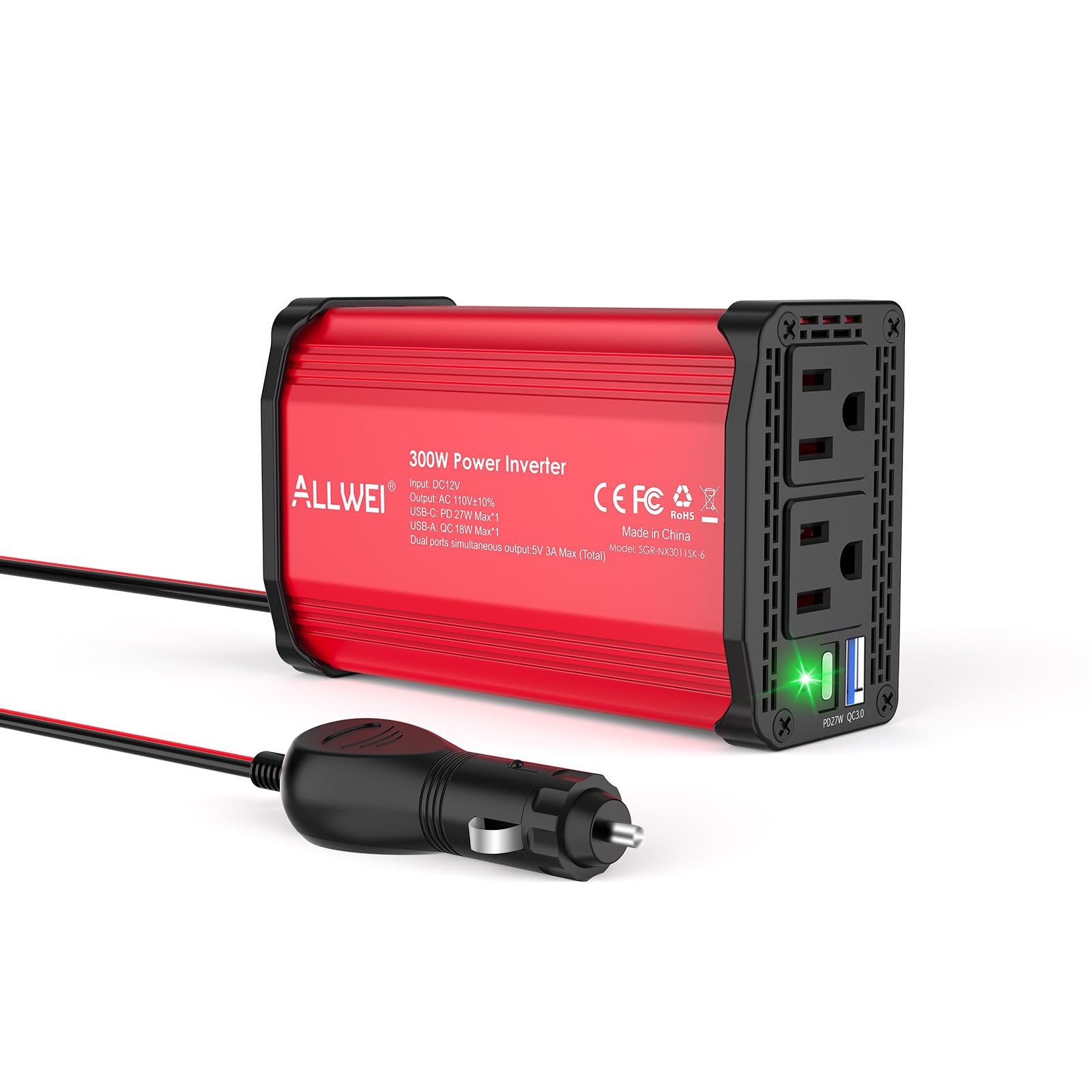
The ALLWEI 300W inverter prioritizes physical compactness without sacrificing build quality. At just 5.1 x 3.1 x 1.8 inches—roughly the size of a smartphone—it’s the most pocketable plug-and-play option here. The aluminum alloy housing doubles as a heat sink, effectively drawing heat away from the internal components during operation. It offers 27W USB-C PD and 18W USB-A fast charging, which handles most phones and tablets quickly, though it’s not powerful enough to fast-charge a full-size laptop.
ALLWEI includes two AC outlets, and the built-in intelligent chip provides protection against overheating, undervoltage, overcurrent, and short circuits. The cooling fan is marketed as near-silent and adjusts speed based on ambient temperature, which makes it a good fit for overnight use in a car or RV cabin. The unit also comes with an 18-month warranty and includes a user manual and cigarette lighter plug.
The limitation is the output: 27W PD means you can’t charge a MacBook Pro at full speed, and 300W continuous is sufficient for most road-trip electronics but won’t handle a mini-fridge or a large compressor. Some user feedback notes that the fan can still be audible in a quiet car at night. For daily commuters or weekend campers who value pocketability over maximum power, this is the most portable solution.
What works
- Smallest footprint in the group—phone-sized
- Aluminum housing for effective passive cooling
- Silent adaptive fan suitable for overnight use
What doesn’t
- 27W PD insufficient for full-size laptop fast charging
- Fan still audible in quiet cabin at low speed
5. vansoet 200W Car Power Inverter
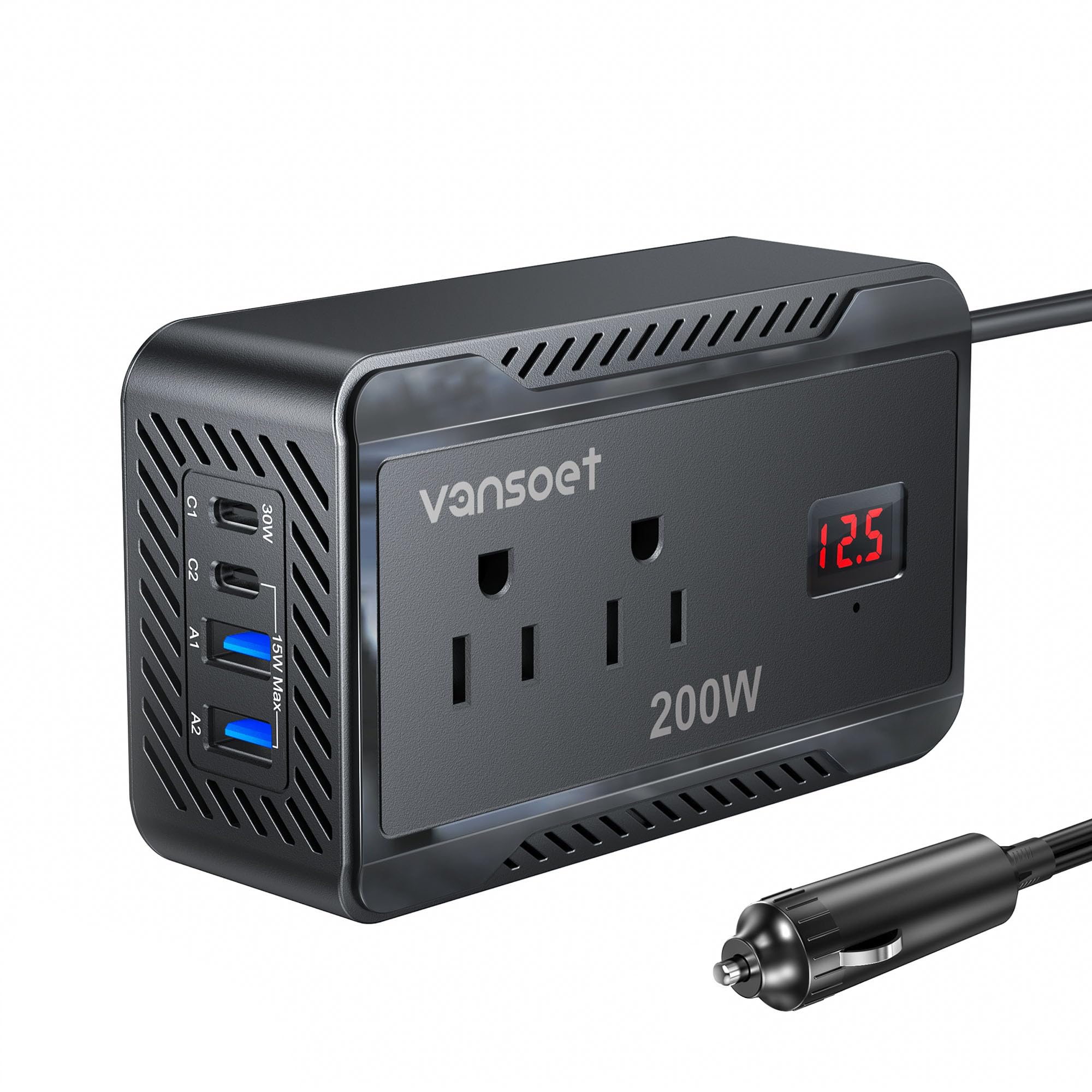
The vansoet 200W inverter is the budget-friendly entry point that still includes essential modern features like USB-C PD 30W and a 15W USB-A port. While 200W continuous output is the lowest in this group, it’s perfectly adequate for charging laptops, phones, tablets, and small electronics—just not power-hungry appliances like compressors or CPAP machines. The input voltage display screen is a nice touch, giving you real-time feedback on your vehicle’s battery voltage so you can avoid draining it too low.
ETL certification backs up the safety claims, and vansoet offers the same 180-day refund and 18-month warranty as their higher-wattage model. The adaptive cooling fan automatically adjusts speed based on output power, and the compact dimensions (5.5 x 4.5 x 2.2 inches) fit in a glove box or center console. The black finish is more understated than the red models, which some buyers may prefer.
The obvious limitation is headroom: if you ever need to power a 250W device, this inverter will trip. The two USB-A ports share a total output of 3A, so charging two tablets simultaneously will be slow. For the budget-conscious buyer who only needs to keep a phone, a tablet, and a slim laptop charged on short trips, this unit delivers everything essential at the lowest cost of entry.
What works
- Includes USB-C PD 30W at an entry-level price point
- Real-time input voltage display screen
- ETL certified with generous warranty coverage
What doesn’t
- 200W limit restricts use to small electronics only
- Shared USB-A output reduces multi-device charge speed
Hardware & Specs Guide
Modified Sine Wave vs Pure Sine Wave
All five inverters in this guide output modified sine wave (MSW), which is the standard for affordable car inverters. MSW works fine for laptops, phone chargers, LED lights, and most household electronics. However, devices with sensitive motors (some CPAP machines, medical equipment, high-end audio gear) or variable-speed drives may hum, run inefficiently, or fail to operate correctly on MSW. If you need to power such equipment, you must step up to a pure sine wave inverter, which costs significantly more and is not represented in this entry-to-mid-range category.
Continuous Wattage and Peak Surge
Continuous wattage is the maximum power the inverter can deliver indefinitely. Peak surge is the short burst (typically 1–2 seconds) it can handle when a device starts up—think compressor motors or heating elements. A 300W continuous inverter with a 700W peak can start a device that draws 600W for a split second, but a 200W unit with a 400W peak may trip. When buying, add up the running watts of all devices you plan to use simultaneously, then ensure the inverter’s continuous rating exceeds that number by at least 20% for headroom.
FAQ
Can I use a 300W inverter to power a mini fridge?
What happens if I plug a device that draws 400W into a 300W inverter?
Does a DC converter drain my car battery when the engine is off?
Final Thoughts: The Verdict
For most buyers, the dc converter for car winner is the BESTEK 300W because it combines future-proof Tesla compatibility, solid 300W continuous power, and UL certification in a compact metal housing. If you need the fastest laptop charging possible, grab the FSATBTNE 400W for its 65W PD port. And for a budget-friendly entry point that still includes USB-C PD, nothing beats the vansoet 200W.

Certification: BSc in Mechanical Engineering
Education: Mechanical engineer
Lives In: 539 W Commerce St, Dallas, TX 75208, USA
Md Amir is an auto mechanic student and writer with over half a decade of experience in the automotive field. He has worked with top automotive brands such as Lexus, Quantum, and also owns two automotive blogs autocarneed.com and taxiwiz.com.