The biggest lie in dash cams is that you need a permanent hardwire installation to get reliable, 24/7 protection. Most drivers are terrified of prying open A-pillars, tapping fuse boxes, or having a pro run cables through their interior. That fear keeps them from buying any camera at all. The best cordless dash cam solutions prove you can skip the wiring entirely without sacrificing the video quality that matters for insurance claims.
I’m Amir — the founder and writer behind Four Wheel Ask. After analyzing thousands of owner reports and cross-referencing sensor specs, battery types, and parking mode logic across dozens of models, I’ve seen exactly which cordless designs actually hold up to daily heat cycles and which ones drain dead in a month.
If you want total peace of mind without touching a single fuse or trim tool, this guide breaks down the best cordless dash cam options that deliver sharp evidence-grade footage with nothing more than a suction cup and a USB charger.
How To Choose The Best Cordless Dash Cam
Skipping the hardwire kit is convenient, but that freedom comes with a few hard limits. A truly cordless dash cam session runs on internal battery charge or super capacitor reserve, so understanding power management, sensor quality, and storage endurance becomes your real filtering criteria.
Battery vs. Super Capacitor — The Temperature Test
Standard Lithium-Ion batteries swell and degrade when parked in direct sun. A super capacitor handles -20°C to 70°C far better, but holds less run time for parking mode. If your cordless dash cam lives in a hot climate or vents to the windshield, prioritize super capacitor models for longevity.
Sensor Generation — STARVIS 1 vs. STARVIS 2
Night vision in a cordless setup depends on the sensor, not the lens aperture alone. STARVIS 2 sensors like the Sony IMX678 and IMX675 deliver roughly 4.6 times higher light sensitivity than first-gen STARVIS. That gap translates directly to whether you can read a plate at 30 feet in a dim parking lot or just see a blur.
Parking Mode Without Hardwire — Realistic Expectation
Without a hardwire kit, your cordless dash cam relies on its internal power reserve for parking monitoring. Time-lapse mode uses the least energy and can stretch coverage for several hours. Sentry or motion detection modes drain faster. If 24-hour parking is essential, plan on a model with a super capacitor and low-bitrate continuous recording.
Storage and Wi-Fi — The Cordless Bottleneck
4K footage is massive. Without a fast Wi-Fi link, you will wait minutes to download a single clip. Look for Wi-Fi 6 (5.8 GHz) for 30 MB/s transfer speeds. Also confirm the included microSD card meets the write speed required for your chosen resolution — freebies under 128 GB often fail under sustained 4K loops.
Quick Comparison
On smaller screens, swipe sideways to see the full table.
| Model | Category | Best For | Key Spec | Amazon |
|---|---|---|---|---|
| ROVE R2-4K Dual Pro | Premium | Maximum video clarity with dual STARVIS 2 | 4K Front + 2K Rear / IMX678 + IMX675 | Amazon |
| VIOFO A229 Plus 3CH | Premium | 3-channel coverage with professional-grade HDR | 1440P+1440P+1080P / Dual STARVIS 2 | Amazon |
| BOTSLAB 4CH 3K | Premium | 360-degree all-side view with magnetic side cams | 3K Front / Dual Side / Rear / 560° FOV | Amazon |
| FAIMEE F9 4K+2K+2K | Mid-Range | Triple-channel value with GPS and app control | 4K Front + 2K Interior + 2K Rear | Amazon |
| Pelsee S3 Touch | Mid-Range | Touchscreen and voice control with full color night vision | 4K Front + 1080P Rear / STARVIS 2 | Amazon |
| 70mai A800SE 4K | Mid-Range | Affordable 4K dual cam with included 128GB card | 4K Front + 1080P Rear / F1.55 Aperture | Amazon |
| Garmin Dash Cam Mini 3 | Compact | Ultra-compact stealthy design with polarizer | 1080P Front / Built-in Clarity Polarizer | Amazon |
In‑Depth Reviews
1. ROVE R2-4K Dual Pro
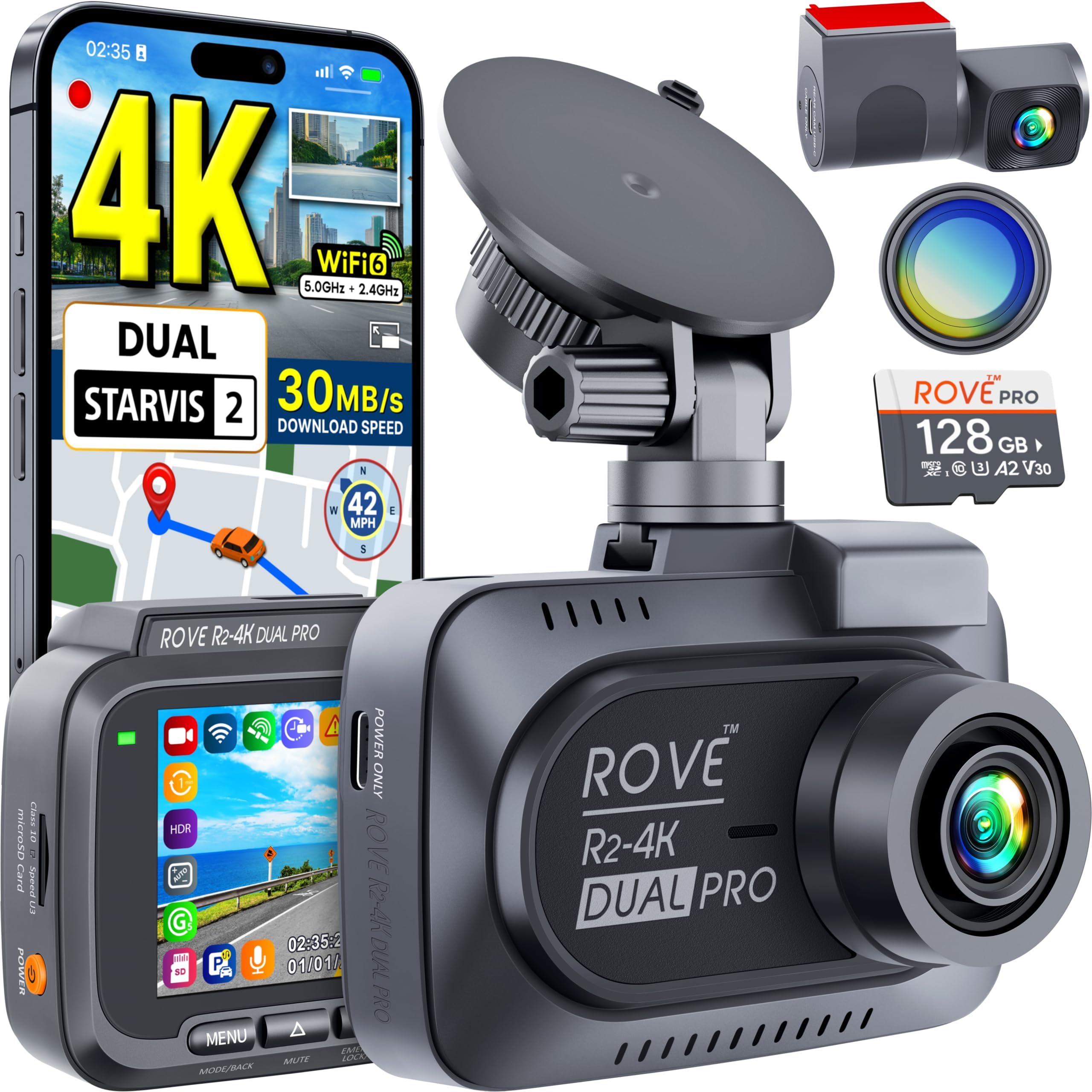
This is the current king of cordless resolution. The ROVE R2-4K Dual Pro packs a Sony IMX678 (8MP) in the front and an IMX675 (5MP) in the rear — both STARVIS 2 generation — so you get 4K front and 2K rear at 30 fps with negligible motion blur. The F1.7 front aperture and F1.55 rear aperture drink ambient light, making license plates visible at night without a hardwired booster.
The Wi-Fi 6 module hits 30 MB/s download speeds over 5 GHz, so pulling a 4K clip to your phone takes seconds instead of minutes. The included 128 GB ROVE PRO card is endurance-rated for constant overwrite loops, and the suction mount holds firm even on textured windshields. It writes GPS, speed, and compass data directly into the video file for the free ROVE GPS Player.
The parking mode offers three options (time-lapse, motion, collision) but will drain the super capacitor reserve within hours without the optional hardwire kit. Still, for daily driving with battery-free capacitor reliability, this model nails the balance between spec sheet and real-world ownership.
What works
- Front and rear both use genuine STARVIS 2 sensors for unmatched low-light detail
- Wi-Fi 6 transfer is genuinely fast enough for 4K files
- Included 128GB card and CPL filter add serious value
What doesn’t
- Parking mode is limited without the separately sold hardwire kit
- App connection can conflict with Android Auto on some phones
2. VIOFO A229 Plus 3CH
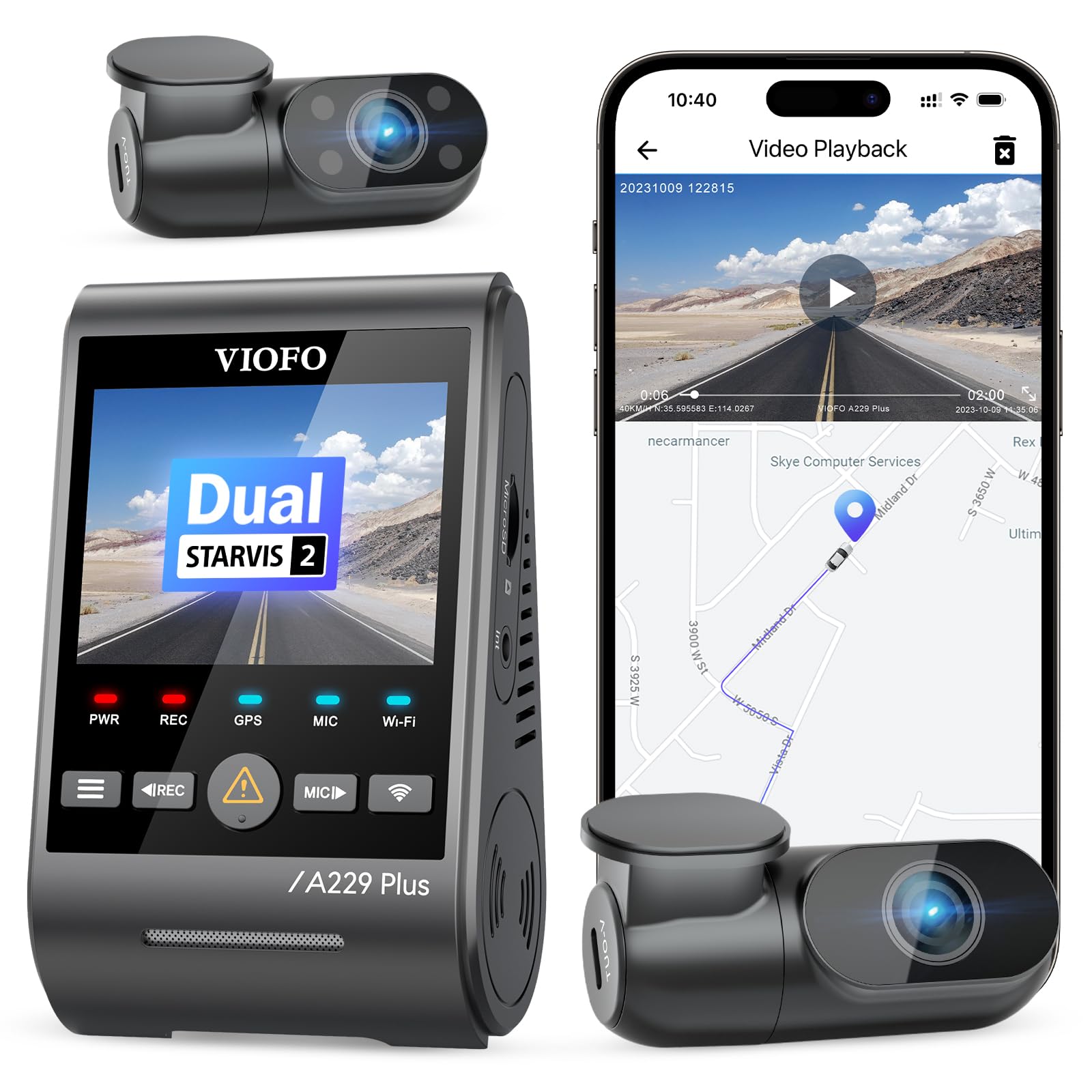
VIOFO built this model around the IMX675 sensor for both front and rear, then added a third interior camera with its own STARVIS sensor and infrared LEDs. The 1440P + 1440P + 1080P resolution stream means every channel gets HDR treatment, so license plates stay readable even when the sun is behind you or the cabin is pitch black.
The interior IR camera is a standout for rideshare drivers. Four infrared LEDs activate automatically in low cabin light, capturing black-and-white detail of passengers without washout. The GPS module locks onto GPS, BEIDOU, GALILEO, and GLONASS simultaneously, giving you satellite-level position accuracy in playback.
Voice control covers 12 commands including “Lock the Video” and “Take Photo,” which keeps hands on the wheel. The 5 GHz Wi-Fi is fast enough for previews but not as quick as the ROVE’s Wi-Fi 6 for full downloads. The super capacitor construction ensures it survives summer dashboards without battery bulge.
What works
- Three-channel HDR with genuine STARVIS 2 on all cameras
- Infrared interior camera works in complete darkness
- Quad-mode GPS delivers best-in-class tracking accuracy
What doesn’t
- No included memory card — you must buy a high-endurance one separately
- Menu system can be confusing for first-time users
3. BOTSLAB 4CH 3K
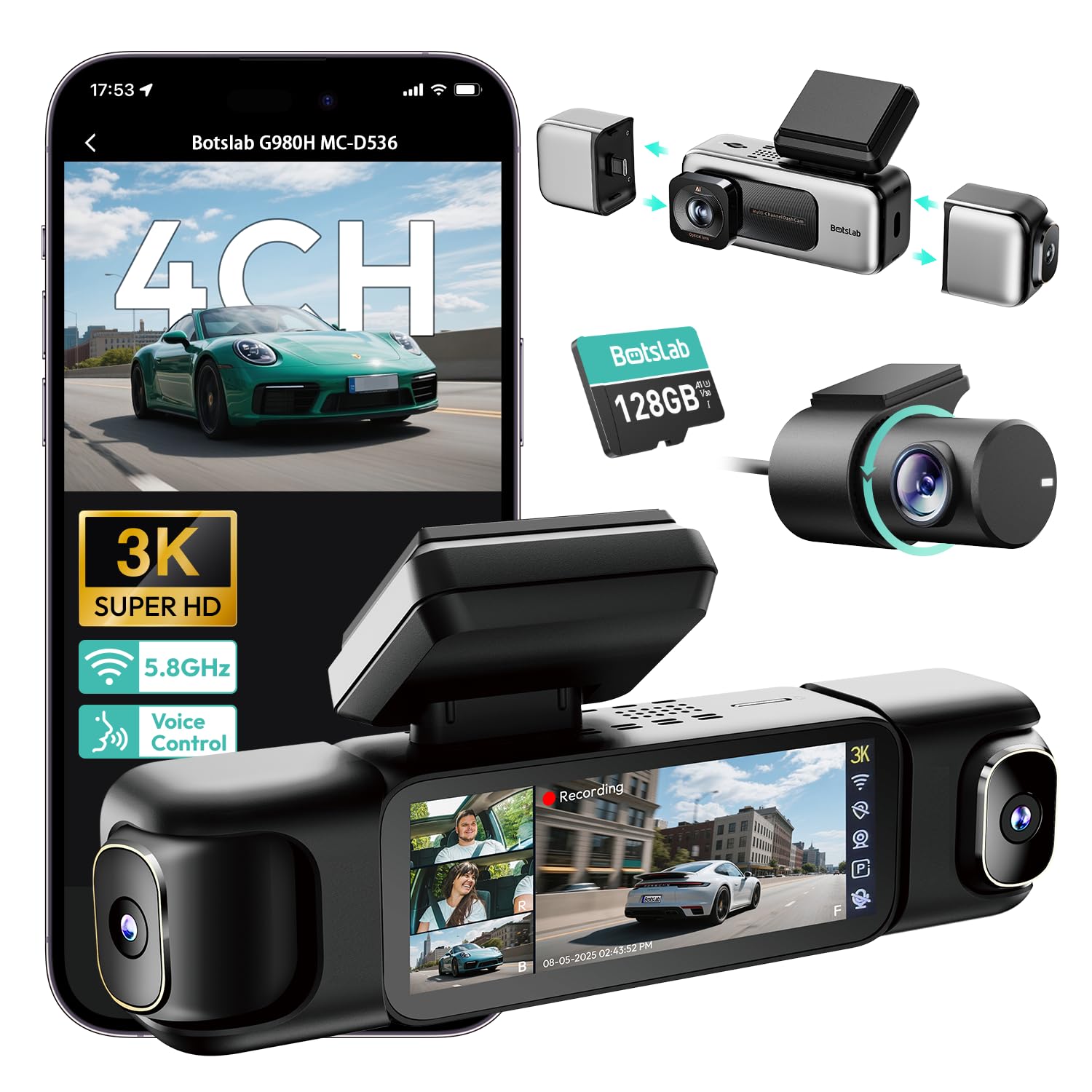
The BOTSLAB goes where no dual-cam can — into the blind spots. With a 3K front camera, two detachable magnetic side cameras, and a rear camera, you get a true 560-degree composite view. The side cams attach magnetically, so you can pop them off when parking or switch to a three-channel mode (4K + 1080P × 2) for everyday driving.
The 3.18‑inch touchscreen shows all four feeds in a split-screen layout, so you never need to swipe through menus after an incident. Voice control and the dedicated DVplayer software let you generate GPS route animations on your PC. The super capacitor design handles temperature extremes well, and the included 128 GB card is ready out of the box.
Night performance relies on F1.8 aperture and 940 nm infrared LEDs rather than STARVIS sensors, so low-light license plate reading is good but not at the same level as the VIOFO or ROVE. Parking mode offers time-lapse, sentry, and collision detection, but you will need the separate hardwire kit for 24-hour coverage.
What works
- True 360-degree coverage with side-cam mounting flexibility
- Touchscreen split-screen playback saves time reviewing incidents
- Super capacitor design is heat-tolerant and long-lasting
What doesn’t
- Night detail is limited by non-STARVIS sensors on side and rear cams
- Side cameras add complexity to installation and cable management
4. FAIMEE F9 4K+2K+2K
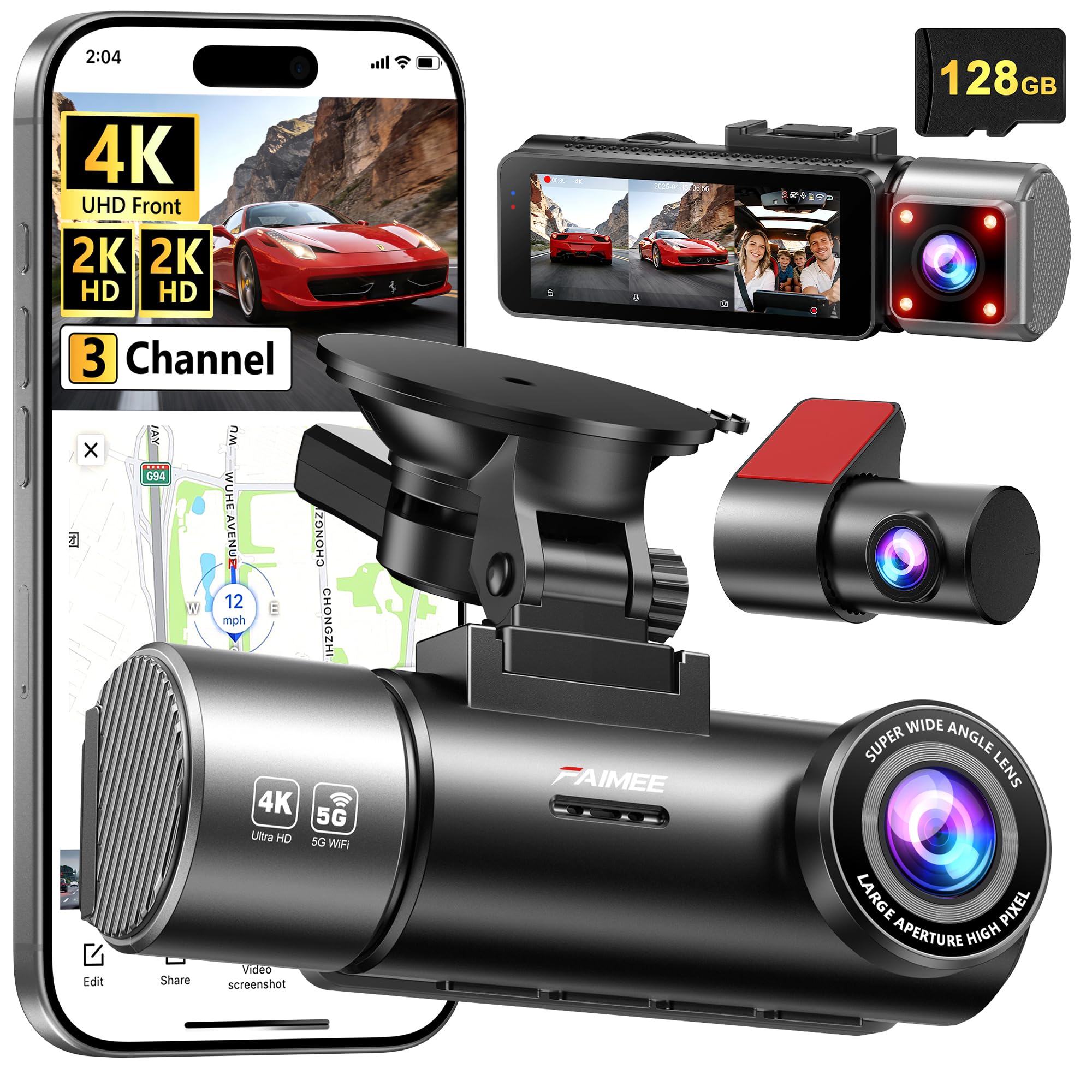
The FAIMEE F9 is the budget-friendly entry point into three-channel recording without slumming on resolution. The front camera records 4K at 25 fps, while the interior and rear cameras each deliver 2K. The 170-degree front lens and 150-degree rear lens minimize the typical blind spots that cause trouble in three-cam rigs.
Built-in GPS logs speed, route, and location, viewable on Google Maps within the FAIMEE app. The dual-band Wi-Fi (2.4+5.8 GHz) connects reliably, and the app is fully optional — you can use the camera standalone without creating an account. The free 128 GB high-endurance card is rated for dash cam write cycles.
Night performance uses an F1.8 aperture and WDR, but does not carry a STARVIS sensor, so fine plate detail at speed under streetlights is less reliable than premium models. The parking mode requires the hardwire kit and supports time-lapse only. The 18-month warranty and 24/7 support are strong for this tier.
What works
- Triple-channel recording at a price lower than most dual-cam premium models
- App is truly optional — no forced account creation
- Included 128GB card and 18-month warranty
What doesn’t
- Front camera maxes at 25fps, not 30fps, which can miss fast action
- No STARVIS sensor limits night license plate readability
5. Pelsee S3 Touch
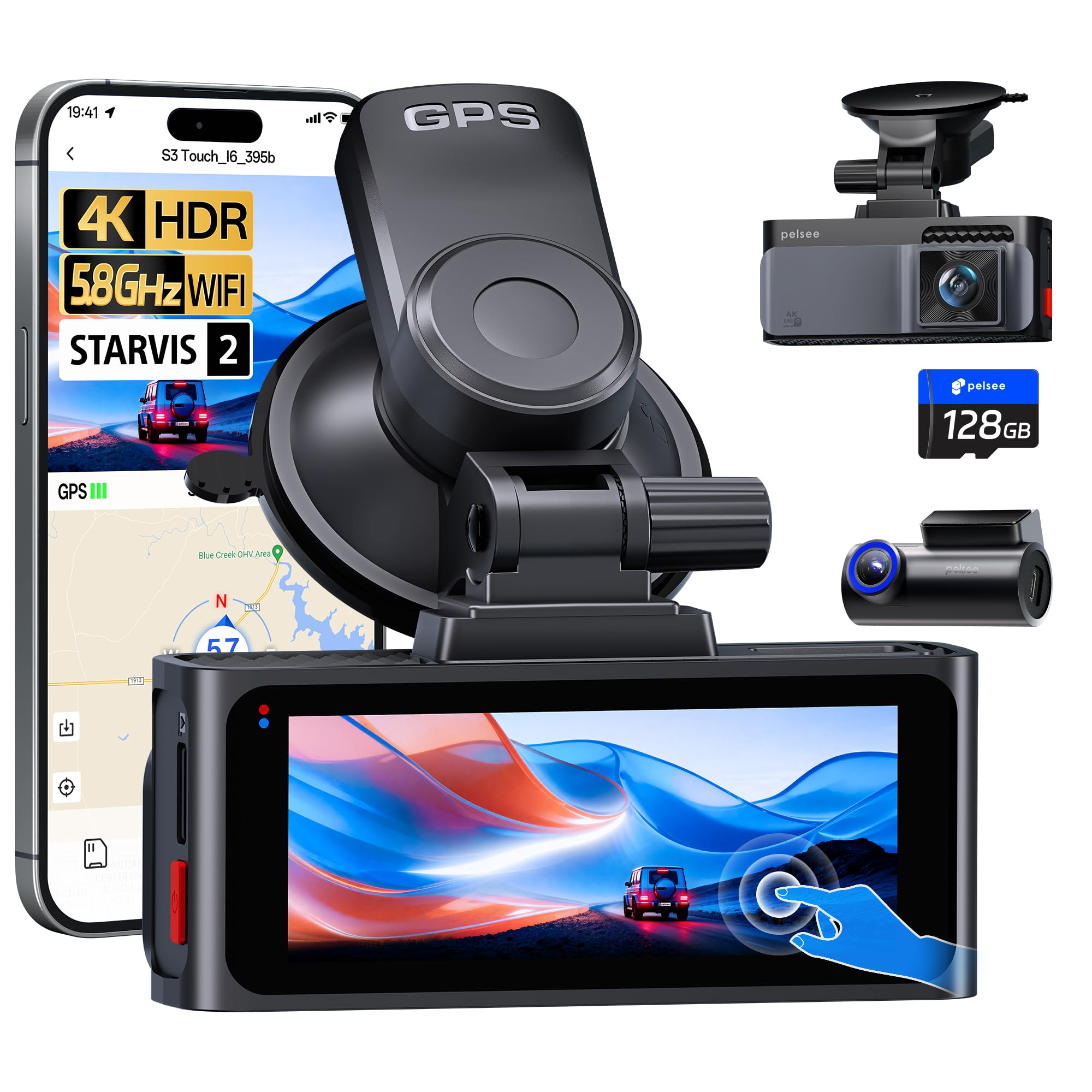
The Pelsee S3 Touch brings a STARVIS 2 sensor to the mid-range bracket, which is a rarity at this price point. The front 4K HDR camera paired with the STARLIT full-color night vision system means you get color footage in extremely dim conditions — not just grayscale IR. That color helps identify vehicle colors at night.
The 3.39‑inch IPS touchscreen is responsive and makes menu navigation much faster than button-based rivals. Voice commands like “Open Recording” and “Lock the Video” work reliably without shouting. The 5.8 GHz Wi-Fi 6 provides up to 30 MB/s downloads, and the included 128 GB card means no extra purchase.
The battery is a Lithium-Metal cell rather than a super capacitor, which raises a durability flag for hot climates. Pelsee recommends a 4-hour initial charge, and the real-time clock can reset if the battery fully depletes. Parking mode (hardwire required) supports time-lapse and motion detection.
What works
- STARVIS 2 sensor at a mid-range price point is excellent for night clarity
- Full-color night vision works as advertised in very low light
- Touchscreen and voice control make live settings changes easy
What doesn’t
- Lithium battery degrades faster than super capacitor in high heat
- Firmware requires an initial long charge before first use
6. 70mai A800SE 4K
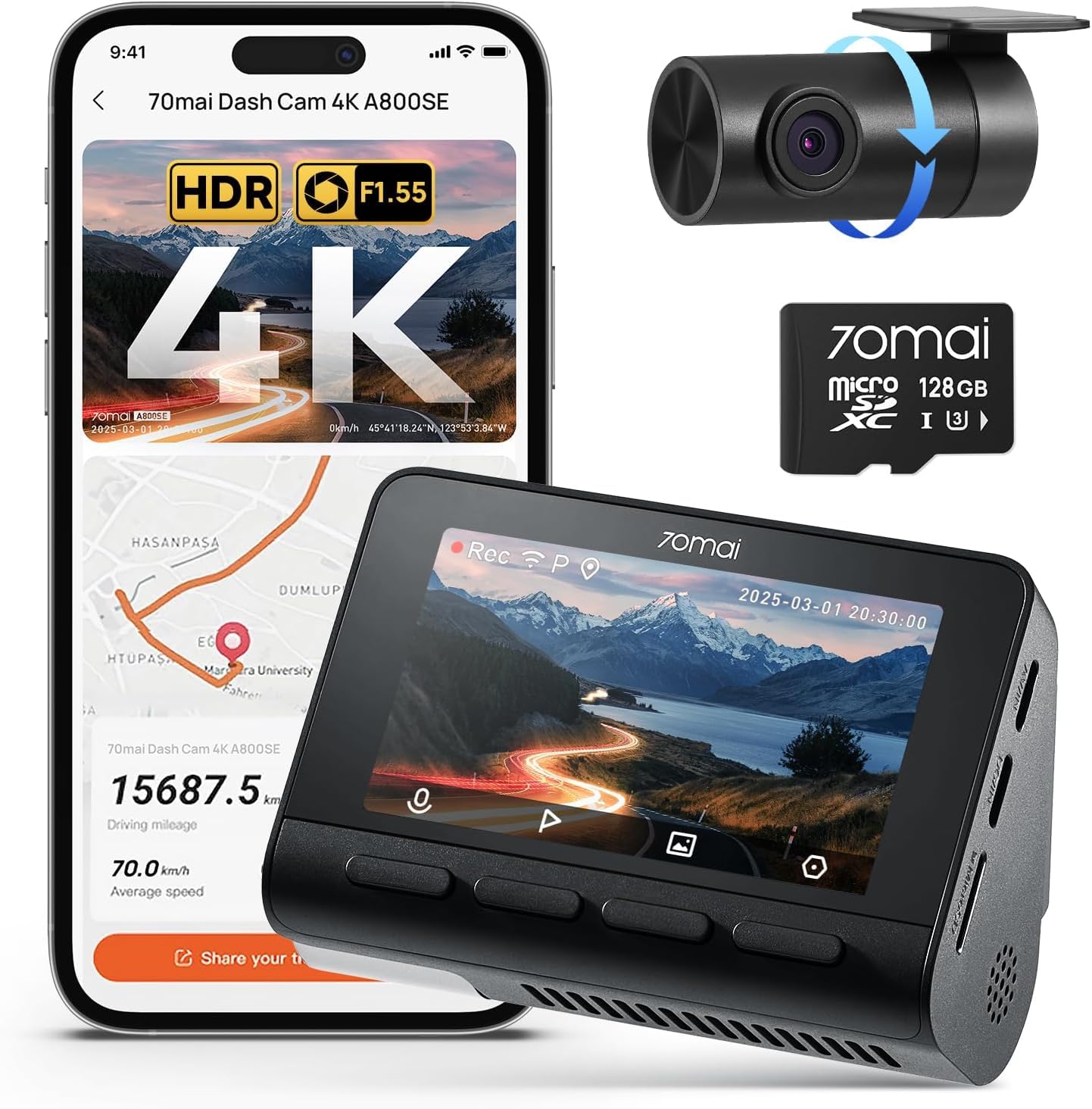
The 70mai A800SE proves you don’t need to spend premium money for genuine 4K front recording. The front camera captures 3840×2160P at 30 fps with an F1.55 aperture and dual HDR, producing footage that holds up in tunnels and at dusk. The rear camera is 1080P with an adjustable lens that can also point inside the cabin.
Wi-Fi 6 is built in, and the 70mai app provides live preview and quick downloads. ADAS alerts for lane departure and forward collision are functional if not best-in-class. The free 128 GB card is a meaningful bonus — many competitors at this price ship with no storage at all.
The G-sensor can be overly sensitive, locking videos during potholes and speed bumps, which fills the protected folder faster than expected. Parking mode requires the hardwire kit, but time-lapse recording works well when hardwired. The overall build is solid with an 18-month warranty and local service centers in the US.
What works
- Genuine 4K front recording at an entry-level price
- Included 128GB card and Wi-Fi 6 make it ready to use immediately
- ADAS alerts are useful for long highway drives
What doesn’t
- G-sensor crash sensitivity is too low, causing false emergency locks
- Rear camera orientation instructions are unclear during installation
7. Garmin Dash Cam Mini 3

The Garmin Mini 3 is about the size of a car key and is designed to disappear behind your rearview mirror. The 1080P recording with a 140-degree field of view is modest by modern standards, but the built-in Garmin Clarity polarizer lens cuts windshield reflections better than any software filter can. That polarizer is a genuine hardware advantage for daytime glare.
Voice control works for saving clips and starting/stopping audio recording, and the Garmin Drive app allows you to sync up to four Mini 3 units for multi-angle coverage. The parking guard feature can send phone notifications, but it requires a paid Vault subscription and a constant Wi-Fi connection — not truly cordless in that mode.
The Lithium Manganese Dioxide battery is rated for hot car interiors, but the trade-off is a very limited parking reserve. If you want a truly invisible temporary camera for rental cars or occasional trips, the Mini 3 is unmatched. If you need 4K resolution or extensive parking monitoring, this is not the right platform.
What works
- Extremely compact size fits anywhere without blocking view
- Built-in polarizer eliminates windshield glare naturally
- Garmin brand reliability and ecosystem for multi-cam syncing
What doesn’t
- 1080P resolution is outdated compared to budget 4K alternatives
- Parking mode and remote live view require paid subscription
Hardware & Specs Guide
STARVIS 2 Sensor Generation
This is the single most important component for cordless night vision. STARVIS 2 sensors like the Sony IMX678 and IMX675 deliver approximately 4.6 times greater light sensitivity than first-generation STARVIS, with 2.5 times improved dynamic range. Models using these sensors (ROVE R2-4K Dual Pro, VIOFO A229 Plus, Pelsee S3 Touch) can reliably read license plates in street-lit parking lots and tunnels without needing a hardwire power boost for the sensor. Non-STARVIS cameras rely on larger apertures and WDR software, which helps but cannot match the noise floor of a genuine STARVIS 2 chip.
Super Capacitor vs. Lithium Battery
The internal power source determines your cordless dash cam’s lifespan. Super capacitors (used in ROVE, VIOFO, and BOTSLAB) operate safely from -20°C to 70°C and do not swell or leak in a hot windshield parking environment. Their downside is shorter reserve run time — typically enough for graceful shutdown and a few minutes of parking recording. Lithium-based cells (Pelsee S3 Touch, Garmin Mini 3) can hold charge longer for parking mode but degrade faster in direct sun. For a cordless unit that stays plugged into a USB port during drives, a super capacitor is almost always the better long-term choice.
FAQ
Can a cordless dash cam record while parked without a hardwire kit?
What memory card speed do I need for 4K cordless recording?
Will a cordless dash cam drain my car battery if left plugged in?
How does the Garmin Mini 3 compare to 4K cordless dash cams for evidence quality?
Final Thoughts: The Verdict
For most buyers, the best cordless dash cam winner is the ROVE R2-4K Dual Pro because it combines dual STARVIS 2 sensors, fast Wi-Fi 6 transfer, and a super capacitor design in a truly cordless package that handles both daily commutes and occasional parking incidents. If you need three-channel coverage for rideshare or fleet use, grab the VIOFO A229 Plus 3CH for its unmatched infrared cabin recording. And for a compact stealthy backup that fits in a glove box, nothing beats the Garmin Dash Cam Mini 3.

Certification: BSc in Mechanical Engineering
Education: Mechanical engineer
Lives In: 539 W Commerce St, Dallas, TX 75208, USA
Md Amir is an auto mechanic student and writer with over half a decade of experience in the automotive field. He has worked with top automotive brands such as Lexus, Quantum, and also owns two automotive blogs autocarneed.com and taxiwiz.com.