A compressed air paint sprayer is the single biggest upgrade you can make to any garage or workshop paint job — the difference between a lumpy, orange-peel finish and a smooth, reflective surface that looks like it rolled out of a professional booth. The wrong gun wastes material, clogs mid-pass, and leaves you sanding more than spraying.
I’m Amir — the founder and writer behind Four Wheel Ask. I’ve spent years dissecting compressed air paint sprayer specifications, comparing nozzle geometry, CFM requirements, and cup-seal designs across hundreds of owner reports and technical datasheets to separate the tools that actually deliver from those that frustrate.
This guide focuses on the models that atomize consistently, clean up without a fight, and hold up to repeated use. After reviewing numerous owner reports, the ideal best compressed air paint sprayer delivers professional-grade results without breaking your wallet.
How To Choose The Best Compressed Air Paint Sprayer
Selecting the right sprayer comes down to understanding three variables: the material you are spraying, the air volume your compressor delivers, and the level of finish you expect. A gun that works beautifully for thin urethane basecoat may struggle with thick epoxy primer, and a high-CFM gun on a small tank leads to pulsating spray and skipped sections.
Nozzle Size and Material Viscosity
The nozzle orifice determines how much paint flows per second and how finely it atomizes. A 1.0 mm to 1.3 mm nozzle suits thin materials like clear coat, sealer, and light basecoat. A 1.4 mm to 1.8 mm nozzle handles primer, high-build urethane, and thicker single-stage paints. A 2.0 mm or larger nozzle is reserved for heavy latex, textured coatings, or industrial enamels. Using a nozzle too small for thick paint causes tip dry and spitting; using one too large for thin paint produces runs and wasted material.
Air Consumption and Compressor Compatibility
Every spray gun has a rated CFM (cubic feet per minute) requirement at a given PSI. HVLP guns typically need 4 to 10 CFM at 10 to 40 PSI. A 20-gallon compressor with a 5.0 SCFM rating at 90 PSI can run most HVLP guns intermittently, but continuous spraying for large projects demands a larger tank or a higher-output pump. Matching the gun to your compressor prevents the frustration of the motor kicking on mid-pass and ruining the finish.
Cup Design and Feed System
Gravity-feed cups sit on top of the gun and use gravity to move paint into the fluid nozzle. They work well with small volumes and allow you to use every drop. Siphon-feed cups hang below the gun and rely on air pressure to pull paint up; they are better for larger volumes but waste more material. Pressure pots push paint from a separate tank and are ideal for continuous production spraying, but they require more setup and cleaning effort.
Quick Comparison
On smaller screens, swipe sideways to see the full table.
| Model | Category | Best For | Key Spec | Amazon |
|---|---|---|---|---|
| BEETRO HVLP | HVLP Gravity | Multi-project versatility | 1.4 / 1.8 mm nozzles, 1000 ml cup | Amazon |
| DeVilbiss 802342 | HVLP Gravity | Spot repairs and basecoat | 1.0 / 1.3 mm tips, carrying case | Amazon |
| DeVilbiss 802343 | HVLP System | Two-gun painting system | Primer + topcoat guns | Amazon |
| BATAVIA 700W | HVLP Electric | Furniture and home projects | 4 nozzles, 3 patterns, 6 ft hose | Amazon |
| PHALANX Airless | Airless | Large surface and house painting | 3000 PSI, 780 W, 25 ft hose | Amazon |
| NEIKO 31213A | HVLP Gravity | Budget entry-level painting | 1.3 mm nozzle, 600 cc cup | Amazon |
| California Air Tools 1810C | Pressure Pot | Resin casting and bubble-free work | 10 gallon, 80 PSI max, 60 PSI operating | Amazon |
In‑Depth Reviews
1. BEETRO HVLP Air Spray Gun with Storage Box
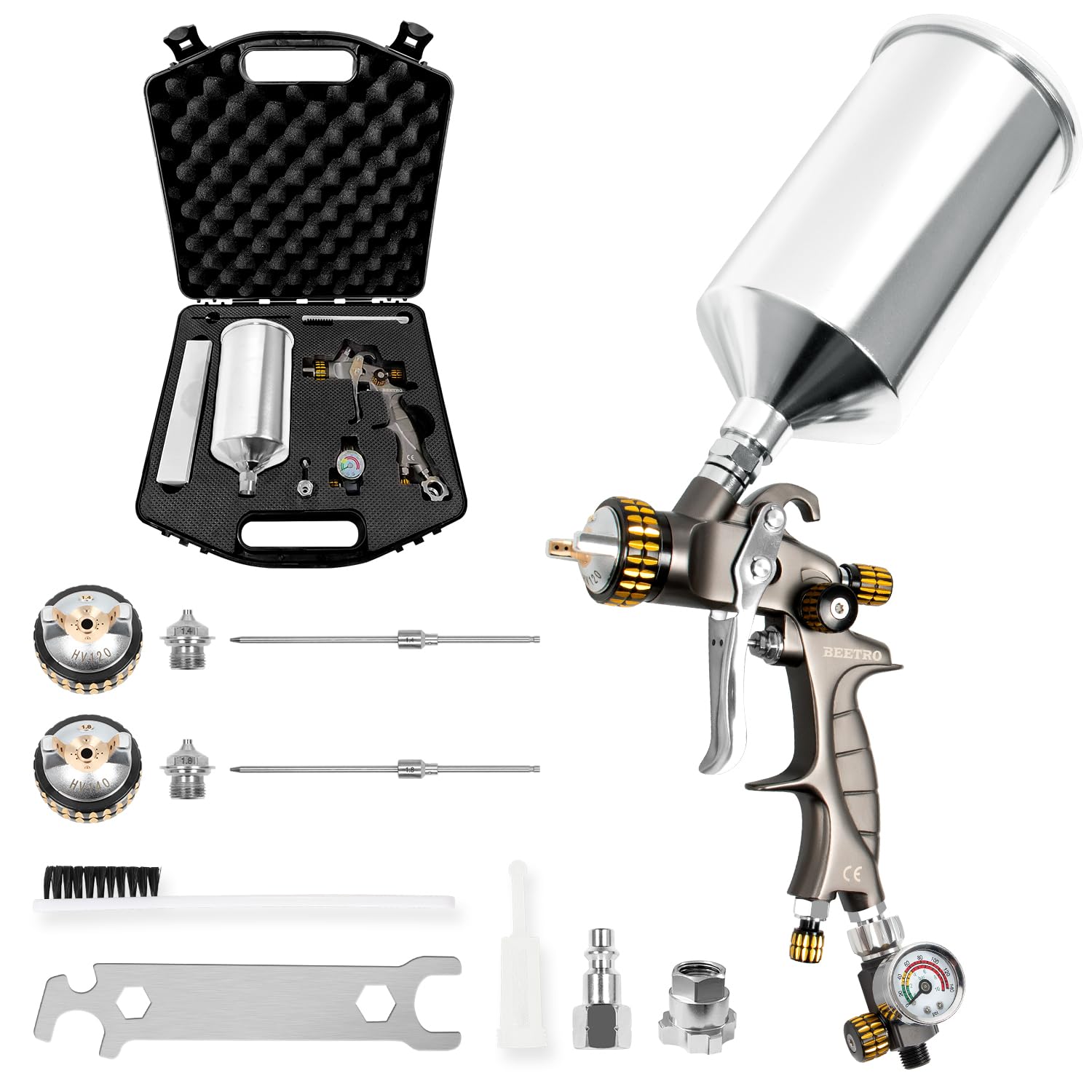
The BEETRO HVLP arrives in a protective foam-lined storage box with two stainless steel nozzle sets — a 1.4 mm already installed and a 1.8 mm spare — plus a 1000 ml aluminum cup and a Type 2 adapter for disposable cup liners. The all-metal build uses an O-ring-free design that simplifies cleaning with chemical agents and thinners, and the press-fit cup lid with no threads eliminates a common failure point found on cheaper guns.
Owner feedback consistently highlights the smooth, even spray pattern and the ability to lay down primer and basecoat with minimal orange peel. One user reported painting 70 kitchen cabinets and drawers with a flawless finish, while another achieved a professional-looking RV paint job on a first attempt. The three adjustable knobs for fluid, pattern, and air provide fine-grained control that rivals guns costing significantly more.
The only downsides reported are a lid that some owners found slightly less secure than screw-on designs and minimal documentation that includes only a parts diagram. A couple of users received duplicate nozzle sizes instead of the full set, though customer support addressed the issue. For the DIY enthusiast or small-shop user who wants one gun that handles everything from primer to clear coat, this kit delivers exceptional value.
What works
- Dual stainless steel nozzles cover primer and topcoat needs
- O-ring-free design simplifies deep cleaning
- Foam case protects the gun between projects
What doesn’t
- Cup lid fit is less reassuring than threaded designs
- Documentation is minimal beyond a parts diagram
- Occasional nozzle size mix-up reported
2. DeVilbiss 802342 StartingLine HVLP Gravity Spray Gun Kit

The DeVilbiss StartingLine kit comes with a 1.3 mm fluid tip for basecoat and clear coat atomization plus a 1.0 mm tip and 250 cc plastic cup for spot repairs. The blow-molded carrying case keeps everything organized, and the included air regulator with gauge helps you dial in consistent pressure. This is a dedicated two-gun system rather than a single gun with interchangeable nozzles, which means each gun stays tuned for its specific role.
Users report that the spray pattern is smooth and predictable right out of the box, with one 35-year professional noting that the pattern is excellent after testing with solvent at 10-15 PSI. The kit includes a cleaning brush set and maintenance wrench, so you have what you need for proper upkeep. Many owners call it the best value in entry-level HVLP, with performance that sits well above its price class and close to DeVilbiss higher-end lines.
Some minor compromises appear in the plastic components and the detail gun needle, which a few owners fixed with a light lubricant. The 1.8 mm tip is not included, so heavy primer application requires a separate purchase. Keeping the air pressure low — around 10-15 PSI for base and clear — is essential to avoid pattern distortion. For the serious DIY automotive painter who wants a reputable brand with good support, this kit is a smart entry point.
What works
- Two dedicated guns for spot repair and full panel work
- Predictable spray pattern with proper pressure setup
- Included regulator and gauge for pressure control
What doesn’t
- Some plastic components feel less durable than all-metal alternatives
- Detail gun needle may need lubrication out of the box
- Heavy primer work requires separate tip purchase
3. DeVilbiss 802343 Auto Painting/Priming Kit

The DeVilbiss 802343 is a two-gun system that pairs a dedicated sealing and priming gun with a separate basecoat, clearcoat, and topcoat sprayer. This separation means you never have to swap nozzles or risk contaminating a topcoat finish with residual primer particles. The gravity-feed HVLP design keeps overspray low and transfer efficiency high, which is critical for both material savings and a clean work environment.
DIY automotive owners have used this set to repaint classic cars like a 1970 Barracuda with professional-level results, praising the even atomization and easy cleanup. One owner reported that the high-build 2K primer laid down beautifully and the basecoat-clearcoat combination produced a finish that looked like a professional booth job. The durability of the paint cups — which do not collapse like thinner disposable options — is another frequently mentioned plus.
The bundled regulator and gauge are functional but some owners recommend replacing them for finer pressure control, as the stock unit can be imprecise. Thinner paints may cause a small leak around the needle when the trigger is depressed, though snugging the guide nut and applying a trace of lubricant resolves this. For the hands-on owner who wants a complete system without buying individual components, this kit simplifies the workflow considerably.
What works
- Dedicated primer and topcoat guns eliminate cross-contamination
- Durable all-metal cup design resists collapsing
- Proven results on classic car restoration projects
What doesn’t
- Stock regulator may need upgrading for fine pressure control
- Thin paints can cause minor needle leakage
- PPS adapter fit can be confusing to match
4. BATAVIA 700W HVLP High Power Spray Paint Gun

The BATAVIA 700W uses a split-design approach where the motor and spray gun are separate components connected by a 6.5-foot flexible hose. The handheld spray gun weighs only one pound, which dramatically reduces arm fatigue during long painting sessions. Four nozzle sizes — 1.0 mm, 1.5 mm, 2.0 mm, and 3.0 mm — cover everything from thin varnish to thick latex, and three spray patterns (horizontal, vertical, circular) adapt to different surface geometries.
Users consistently praise the even coverage and lack of clogging, even with thick latex paints that typically cause problems for budget sprayers. The visible anti-backflow design prevents paint from dripping back into the motor, and the ETL certification provides peace of mind. One owner reported spraying Sherwin-Williams Emerald and Pro Classic without any thinning and achieving a smooth finish with self-leveling paints, which is a strong indicator of the turbine’s atomization capability.
The plastic nozzles are functional but may wear faster than brass or stainless steel alternatives, and the paint jar is somewhat difficult to clean thoroughly because of its shape. The turbine motor heats up after extended use and requires periodic rests to avoid overheating. For homeowners tackling furniture, cabinets, fences, and walls who want the convenience of an electric HVLP without needing a separate air compressor, this unit delivers strong results for the investment.
What works
- Ultra-light spray gun reduces arm fatigue on long jobs
- Four nozzle sizes handle stains, enamels, and latex
- Anti-backflow design prevents messy drips into the motor
What doesn’t
- Plastic nozzles may wear faster than metal alternatives
- Turbine motor needs cooling breaks during extended use
- Paint jar shape makes thorough cleaning tedious
5. PHALANX Airless Paint Sprayer

The PHALANX Airless Paint Sprayer takes a different approach by using a 780 W motor that generates 3000 PSI to push paint directly through the tip without needing compressed air. This airless method allows spraying without thinning even thick latex, and the 25-foot hose reaches high ceilings and awkward corners without moving the base unit. The anti-drip technology stops paint from leaking when the trigger is released, keeping the work area cleaner.
Owner reports confirm that this sprayer covers large areas very quickly — one user painted two 20-foot shipping containers in about 10 minutes per outside, and another completed a shed in the same time frame. The direct-feed system draws paint straight from 1 to 5 gallon buckets, reducing refill downtime. ETL certification and a one-year warranty with US-based customer support add confidence for buyers who want a reliable tool for whole-house projects.
The learning curve involves understanding paint thinning requirements and managing overspray, which is more significant with an airless unit than with HVLP. Setup and cleanup take longer than with simpler sprayers, and some early units experienced a pressure control knob defect that required replacement. Users emphasize that reading the instructions thoroughly and cleaning immediately after use are essential for reliable operation. This is a dedicated surface-coverage machine rather than a precision automotive finisher.
What works
- Covers large areas extremely fast without thinning paint
- Draws directly from 1-5 gallon buckets for minimal refills
- US-based customer support with one-year warranty
What doesn’t
- Significant overspray compared to HVLP systems
- Setup and cleanup take longer than simpler sprayers
- Early units had pressure control knob reliability issues
6. NEIKO 31213A Air Spray Paint Gun

The NEIKO 31213A is an all-steel HVLP gravity-feed spray gun with a 1.3 mm stainless steel nozzle and brass air cap, paired with a 600 cc aluminum cup. The one-piece gun body resists corrosion and provides a solid feel that rivals guns at twice the price. Operating pressure sits at 10 PSI with a 40 PSI maximum and 4.5 CFM average air consumption, making it compatible with smaller hobbyist compressors that might struggle with higher-flow guns.
Buyers report that this gun sprays significantly better than the cheap alternatives found at local hardware stores, with one owner using it to paint a welded steel workbench and toolboxes with impressive results. The 1.3 mm tip is well-suited for clear coat, basecoat, and light-viscosity coatings, and the three adjustment knobs provide reasonable control over fluid flow, pattern width, and air volume. The included metal air gauge and cleaning brush add immediate utility out of the box.
The gun is slightly heavier than more expensive options, which leads to arm fatigue during extended spraying sessions. The regulator gauge can fog up when exposed to solvent, and replacement parts are not available, so damage to the tip effectively ends the gun’s service life. Fan control also requires several turns before the pattern visibly changes, which reduces fine-tuning precision. For the budget-conscious DIYer who needs a reliable backup gun or a first tool to learn on, this is a solid starting point.
What works
- All-steel body with brass air cap provides excellent durability
- Low 10 PSI operating pressure works with smaller compressors
- Noticeably better spray quality than entry-level retail guns
What doesn’t
- Heavier build causes fatigue on long paint sessions
- No replacement parts available if the tip gets damaged
- Fan control requires multiple turns to adjust pattern
7. California Air Tools 1810C 10 Gallon Pressure Pot
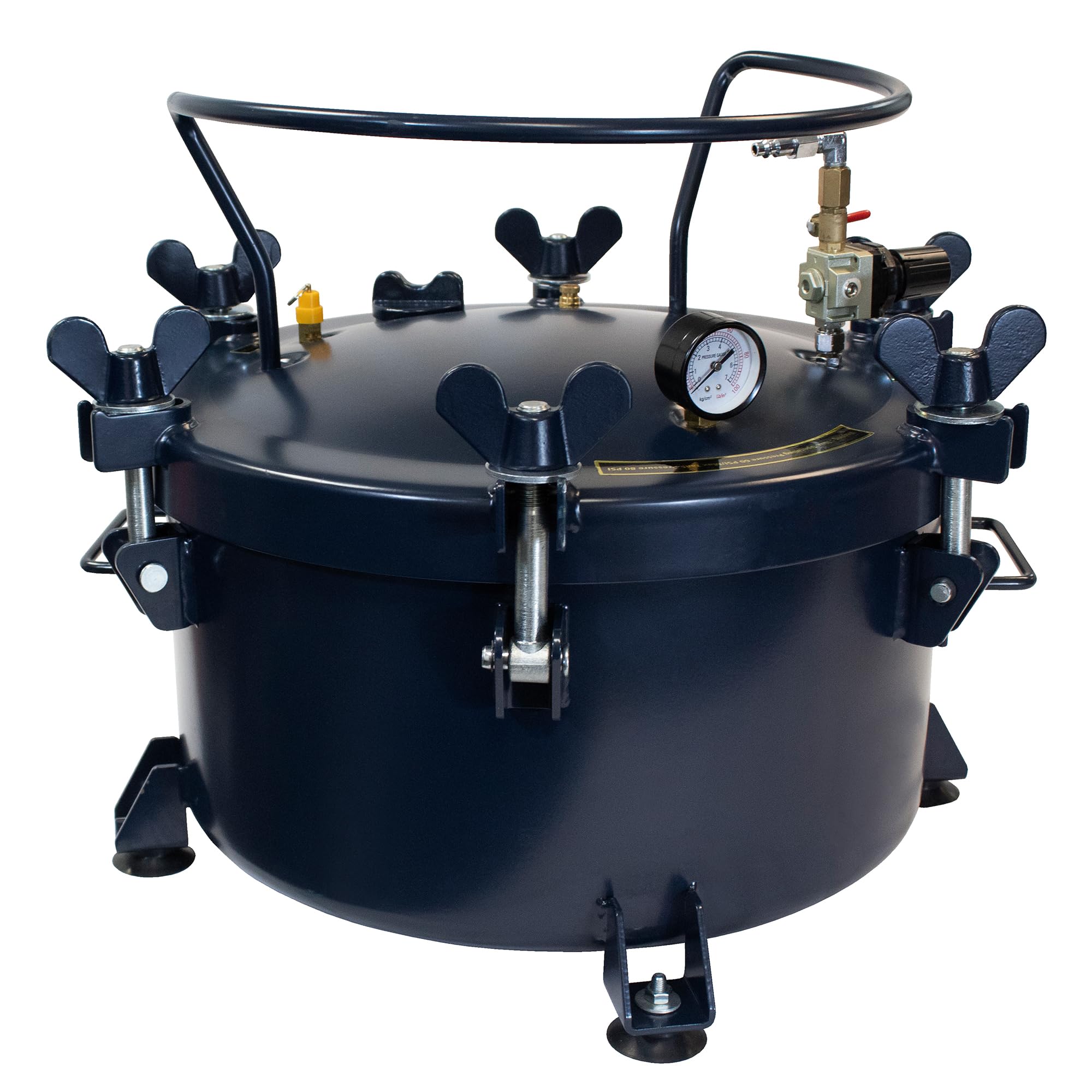
The California Air Tools 1810C is a 10-gallon pressure pot designed primarily for epoxy resin casting, but its coated steel tank, precise pressure regulation, and 80 PSI maximum make it relevant for any application that requires bubble-free material delivery under controlled pressure. The tank features an input connector, regulator, on/off ball valve, and pressure relief valve, plus rubber feet for stability and castors for mobility.
Resin artists report that this pot holds pressure exceptionally well, losing only 1-2 PSI over 24 hours from temperature changes and maintaining consistent pressure throughout the curing cycle. The wing-nut seal design closes easily with a snug turn, and the coated steel interior allows straightforward cleanup of cured resin or casting material. One owner noted that after receiving a replacement regulator from the manufacturer, the unit performed flawlessly and produced crystal-clear, bubble-free castings.
The unit is heavy at 64 pounds, so the castors are essential for moving it around the workspace. The initial regulator setup requires careful adjustment — watching instructional videos is recommended to ensure the safety valve functions correctly. While not a paint sprayer in the traditional sense, this pressure pot serves the needs of craftspeople who need controlled-pressure material delivery for specialized coatings and casting work. The one-year limited warranty and responsive customer support add reassurance for the investment.
What works
- Excellent pressure retention over extended periods
- Easy seal closure with wing-nut design
- Responsive customer service from manufacturer
What doesn’t
- Heavy 64-pound build requires castors for mobility
- Initial regulator setup needs careful calibration
- Not a traditional paint sprayer; specialized use case
Hardware & Specs Guide
Nozzle Size and Material Matching
The nozzle diameter directly determines the viscosity range a gun can handle. A 1.0 mm to 1.3 mm nozzle atomizes thin materials like urethane basecoat, clear coat, and sealer with fine droplet size for a smooth finish. A 1.4 mm to 1.8 mm nozzle handles medium-viscosity materials such as high-build primer, single-stage urethane, and epoxy. Nozzles at 2.0 mm and above are designed for heavy latex, textured coatings, and industrial enamels. Using a nozzle that is too small for the material causes tip dry, spitting, and inconsistent pattern; using one that is too large wastes paint through overspray and increases the risk of runs.
Air Consumption and Compressor Matching
HVLP spray guns typically consume between 4 and 10 CFM at operating pressures of 10 to 40 PSI. A compressor with a 20-gallon tank and a pump rating of at least 5.0 SCFM at 90 PSI can run most HVLP guns for intermittent spraying, but continuous full-panel work requires a larger tank or a higher-output pump. Pressure pots operate at higher pressures — typically 40 to 60 PSI — and require consistent air delivery to maintain even material flow. Matching the gun’s CFM requirement to the compressor’s output prevents pressure drop that causes pulsating spray and inconsistent finish quality.
Cup Design and Material Delivery
Gravity-feed cups use a top-mounted design that allows paint to flow downward into the fluid nozzle by gravity alone. This system wastes very little material and is ideal for small to medium jobs where quick color changes are needed. Siphon-feed cups mount below the gun and use air pressure to pull paint upward; they hold larger volumes but waste more material and are harder to clean. Pressure pots deliver material from a separate tank under regulated air pressure, providing consistent flow for large-scale or production work but requiring more setup time and maintenance.
Adjustable Controls and Pattern Tuning
Most compressed air paint sprayers include three adjustment points: fluid control (needle adjust knob) regulates the volume of paint released per trigger pull; pattern control adjusts the fan width from a tight circle to a wide oval; and air adjustment valve controls the atomization air pressure. Dialing in the correct balance between these three controls is the primary skill required for a professional finish. A common starting point is to set the air pressure to 10-15 PSI for base and clear, open the fan wide, and turn the fluid knob 1-2 turns open, then fine-tune from there based on the material response.
FAQ
Can I use a compressed air paint sprayer with a small portable compressor?
What is the difference between HVLP and airless sprayers for automotive work?
How do I clean a compressed air paint sprayer properly?
What nozzle size should I use for clear coat?
Final Thoughts: The Verdict
For most buyers, the best compressed air paint sprayer winner is the BEETRO HVLP because it combines dual stainless steel nozzles, a 1000 ml cup, and a protective storage case in a package that handles primer, basecoat, and clear coat with professional-level results. If you want a dedicated two-gun system for primer and topcoat separation, grab the DeVilbiss 802343. And for homeowners tackling furniture and large surfaces without an air compressor, nothing beats the BATAVIA 700W for lightweight handling and nozzle versatility.

Certification: BSc in Mechanical Engineering
Education: Mechanical engineer
Lives In: 539 W Commerce St, Dallas, TX 75208, USA
Md Amir is an auto mechanic student and writer with over half a decade of experience in the automotive field. He has worked with top automotive brands such as Lexus, Quantum, and also owns two automotive blogs autocarneed.com and taxiwiz.com.