Nothing kills a smooth drive in a Chevy like a persistent TPMS warning light that stays lit after every cold start. Chevrolet pickup trucks, SUVs, and sedans rely on the tire pressure monitoring system to keep you safe and your tires at optimal inflation. When an original sensor dies — typically after five to seven years when the internal battery drains — the only fix is a precise replacement that communicates correctly with the vehicle’s ECU.
I’m Amir — the founder and writer behind Four Wheel Ask. I spend my time analyzing TPMS sensor compatibility data, GM-frequency signaling patterns, and real owner feedback from Chevy drivers to identify which replacement sensors actually deliver on their promises.
A dependable replacement prevents blowout risks, extends tread life, and preserves fuel economy, and this guide breaks down the top contenders for any chevy owner searching for the best chevy tire pressure sensor.
How To Choose The Best Chevy Tire Pressure Sensor
Chevy uses two distinct TPMS frequencies depending on the model year and platform. The wrong frequency means the sensor never talks to the ECU. Understanding frequency, battery type, and the relearn process separates a smooth swap from a frustrating waste of time.
315MHz vs 433MHz – Getting the Frequency Right
Full-size Chevrolet trucks and SUVs built before roughly 2018 — Silverado 1500 through 2016, Tahoe through 2014, Suburban through 2014 — generally run 315MHz sensors. Newer models like the 2019+ Silverado 1500, 2018+ Traverse, and 2016+ Malibu switched to 433MHz. Installing a 433MHz sensor on a 2010 Silverado will never wake the TPMS module. Always verify your vehicle’s frequency in the owner manual or by inspecting the original sensor’s printed part number before buying a replacement set.
Battery Life and Internal Cell Chemistry
Every OEM-style TPMS sensor contains a sealed non-replaceable battery designed to last five to eight years. Budget-friendly sensors often use standard CR2 or CR2032 coin cells, while premium units pack automotive-grade CR2050 batteries that handle extreme temperatures from -40°F to 257°F. A low-temp battery rating of 40°F means the sensor will struggle in northern winters; look for a lower temperature rating if you drive in freezing climates.
Pre-Programmed vs Blank Sensors
Pre-programmed sensors arrive set to a specific vehicle make, model, and frequency. Install them and run a relearn procedure. Blank sensors require a dedicated TPMS programming tool that reads and writes the sensor ID. For DIY owners, pre-programmed units are significantly easier — no need to buy a + programming tool. The catch is that you still must activate the sensors in sequence using a TPMS scan tool to teach the car where each sensor is located.
Quick Comparison
On smaller screens, swipe sideways to see the full table.
| Model | Category | Best For | Key Spec | Amazon |
|---|---|---|---|---|
| Masoll Gen 2 Bundle | External | DIY drivers wanting a quick swap with included tool | 1.5 PSI accuracy | Amazon |
| Masoll E80 Dual-Antenna | Premium | Full-size trucks and SUVs needing strong signal | 1.5 PSI accuracy | Amazon |
| A-Premium APTPMS188 | Premium | Drivers wanting certified high-precision NXP chips | ±0.06 Bar accuracy | Amazon |
| SZKAIDAG 315MHz Set | Budget | Older Chevy trucks 2007-2016 | 315MHz frequency | Amazon |
| CDWTPS 433MHz Set | Mid-Range | 2018+ Chevy models needing 433MHz | 433MHz frequency | Amazon |
| RENECTIV 433MHz | Value | Budget-conscious buyers with newer Chevy models | 3% measurement accuracy | Amazon |
| Jsueng 315MHz Set | Budget | Broad GM vehicle coverage from 2002-2024 | 315MHz frequency | Amazon |
In‑Depth Reviews
1. Masoll Gen 2 TPMS Sensor with Relearn Tool
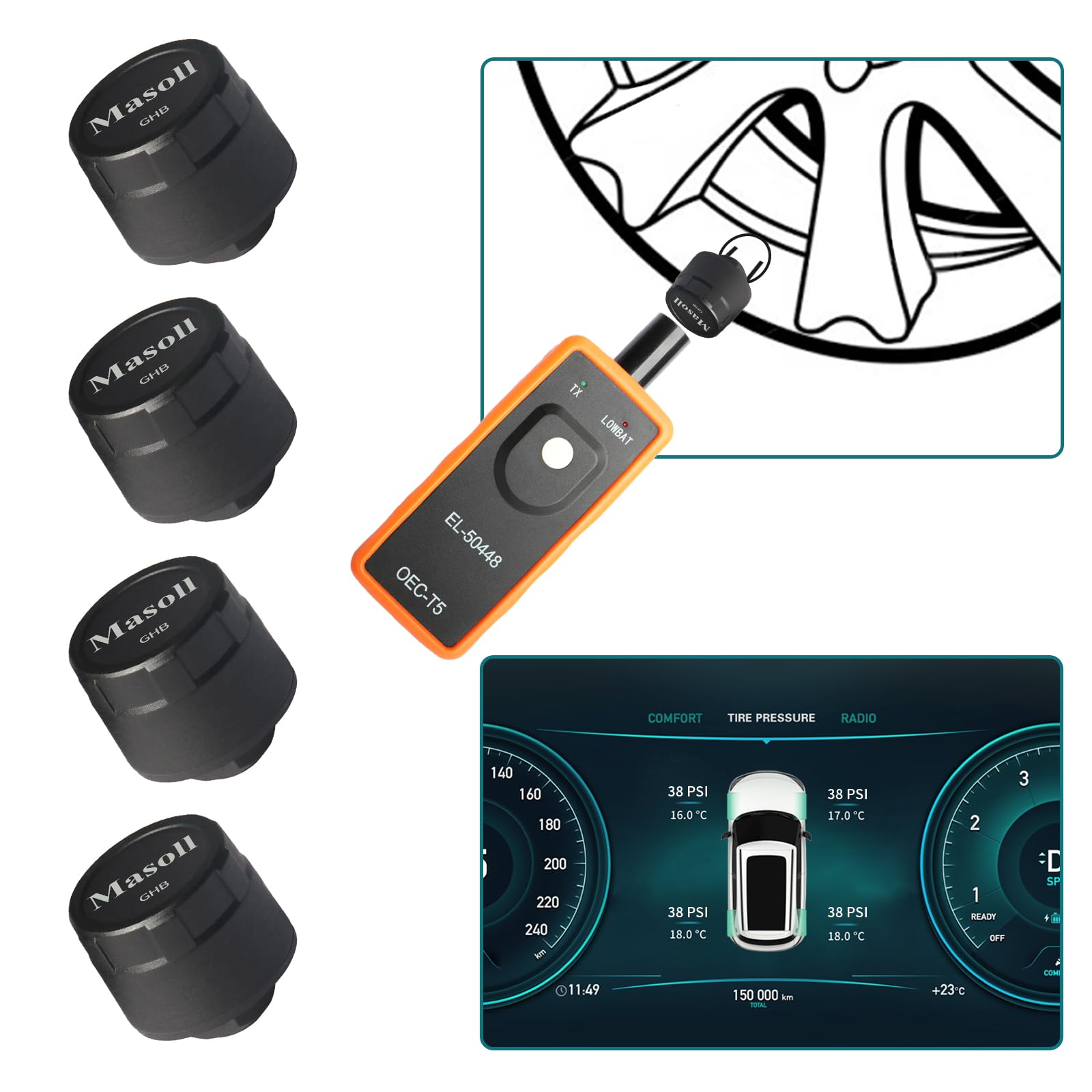
The Masoll Gen 2 stands apart because it uses an external screw-on design that threads onto the tire valve stem — no tire dismounting, no mounting fees. Installation takes roughly five minutes with the included EL-50448 TPMS relearn tool, making it the most DIY-friendly option on this list for any GM vehicle built after 2006, including the Silverado, Tahoe, and Traverse. The external form factor also means replacing the battery (a standard coin cell) is a two-minute job, solving the typical five-to-seven-year sealed sensor mortality problem.
Masoll claims 1.5 PSI measurement accuracy, which is solid for keeping tire pressures within the placard range. The Gen 2 features a wider vehicle coverage list than its predecessor, extending compatibility to pickup trucks without signal dropout. Users simply screw each sensor onto the valve stem, activate with the provided tool, and the car learns the new IDs during a standard TPMS relearn sequence. This is the only product in the lineup that includes the activation tool in the box.
External sensors do sit exposed to road debris, car washes, and potential theft, so this design is best for drivers who want a zero-labor solution and don’t parallel park on busy streets. The battery life is rated at about two years with a replaceable cell, which is shorter than sealed internal units but infinitely serviceable. For Chevy owners who change their own tires seasonally or rotate frequently, the convenience factor here is unmatched.
What works
- Complete bundle includes four sensors plus the TPMS relearn tool
- External mount requires zero tire shop visits
- Replaceable battery avoids total sensor disposal
- Broad compatibility across GM brands after 2006
What doesn’t
- External sensors are vulnerable to physical damage and theft
- Battery life shorter than sealed internal sensors at roughly two years
- Not the correct form factor for all Chevy TPMS systems
2. Masoll E80 Dual-Antenna TPMS Sensor
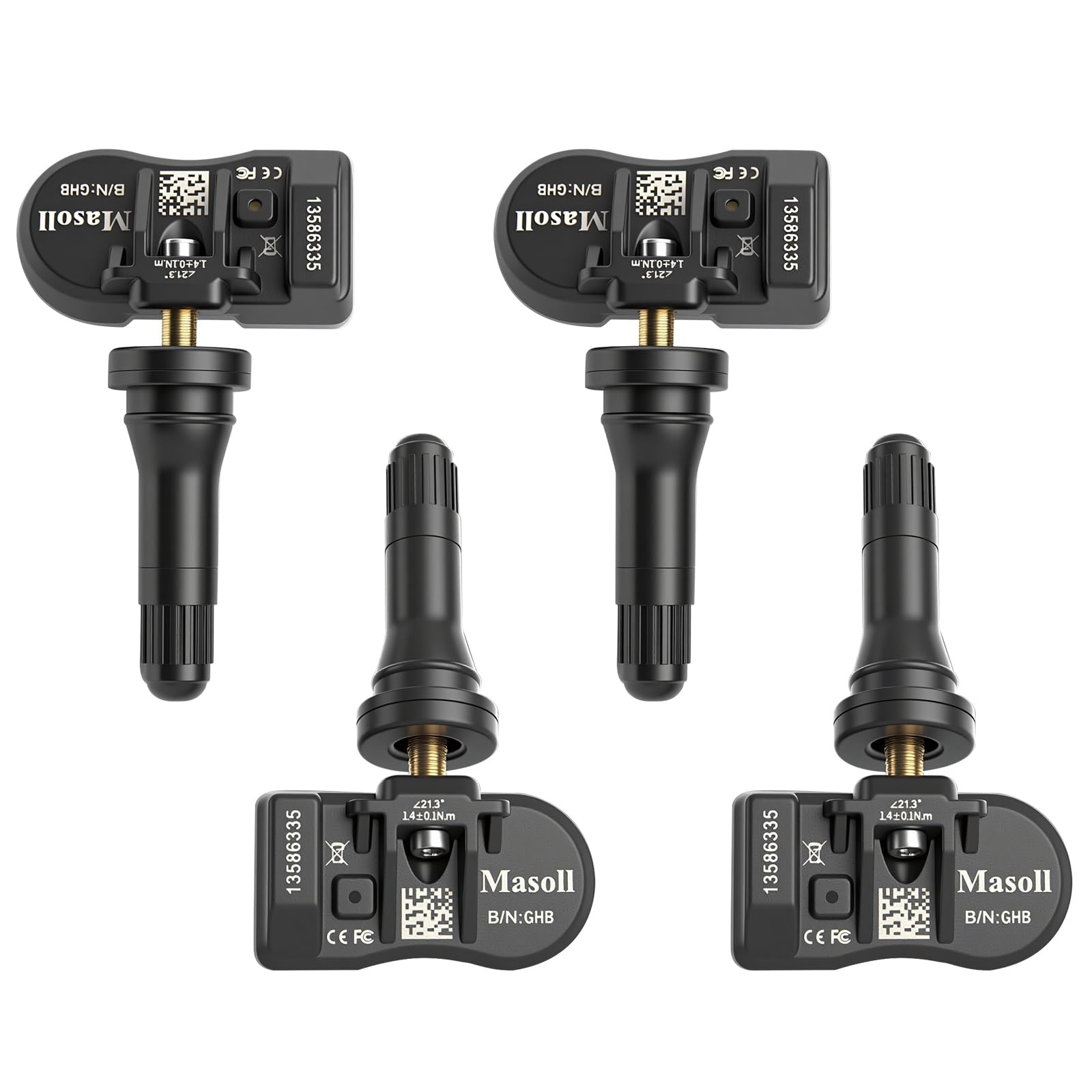
The Masoll E80 is the company’s internal-mount sensor designed for full-size Chevy trucks and SUVs where signal strength across a long wheelbase matters. Its dual-antenna layout sends a stronger RF signal to the receiver module located behind the glovebox or in the B-pillar of trucks like the 2007-2016 Silverado and 2007-2014 Tahoe. This makes a real difference on long-body crew cab models where a single-antenna sensor may drop the signal at highway speeds.
Accuracy sits at 1.5 PSI, and the sensor uses an automotive-grade CR2050 battery with a temperature range of -40°F to 257°F. That cold-tolerance rating is critical for owners in northern states where budget sensors stiffen and stop transmitting around 40°F. The rubber valve stem includes corrosion protection and seamless molding to prevent the typical zinc valve stem rot that seizes sensors to the wheel after two winters of road salt exposure.
The sensor is pre-programmed for GM vehicles, but you still need a TPMS activation tool to wake each sensor in sequence during the relearn procedure. Masoll backs this sensor with a 24-month warranty, which is a step above the 12-month coverage most budget options offer. For owners of long-wheelbase Chevy trucks who want zero cold-weather signal loss, this is the most technically robust internal option available.
What works
- Dual-antenna design maintains signal on crew cab trucks
- Automotive CR2050 battery handles -40°F to 257°F range
- 24-month warranty outpaces the standard 12-month coverage
- Rubber valve resists corrosion from road salt
What doesn’t
- No activation tool included in the package
- Pre-programmed only — no blank option for custom programming
- Not compatible with vehicles requiring 433MHz frequency
3. A-Premium APTPMS188 433MHz Sensor Set

The A-Premium set stands out for its compliance certifications — fully FCC and IC approved — and its use of a high-precision NXP semiconductor chip that delivers ±0.06 Bar measurement accuracy (roughly 0.87 PSI). That is tighter tolerance than the 1.5 PSI rating of the Masoll units, which matters for drivers who want the most granular tire pressure data displayed in the DIC readout. The sensors are tested in-house to SAE J2657 standards, the same testing protocol used by Tier 1 OE suppliers.
This set covers the 433MHz frequency required by newer Chevy models including the 2019-2021 Silverado 1500, 2018-2024 Traverse, 2016-2024 Malibu, 2017-2024 Acadia, and the 2018-2024 Enclave. The valve stem uses upgraded aluminum components while remaining compatible with OE rubber valve stems, offering a lighter assembly that resists the cracking that rubber stems develop after three to four years of ozone exposure. The CR2050 battery inside this unit is the same automotive-grade cell used in factory GM sensors.
Real owner reports on 2019 Malibu and 2019 GMC Sierra confirm the sensors paired immediately with a standard TPMS scan tool and delivered accurate PSI readings after the relearn procedure. The 1-second response time means the DIC updates pressure data quickly after inflation adjustments. A-Premium includes a 2-year guarantee on the set, matching the longest warranty found among these seven products. This is the pick for owners who want the closest thing to OE without visiting the dealership parts counter.
What works
- FCC and IC certified with SAE J2657 testing compliance
- ±0.06 Bar accuracy provides the tightest pressure tolerance
- Aluminum valve stem resists cracking and corrosion
- Two-year warranty mirrors OEM coverage periods
What doesn’t
- 433MHz only — not compatible with older 315MHz Chevy models
- Relearn tool sold separately
- No blank programming option for custom vehicle fitment
4. CDWTPS 433MHz TPMS Sensor 4-Pack
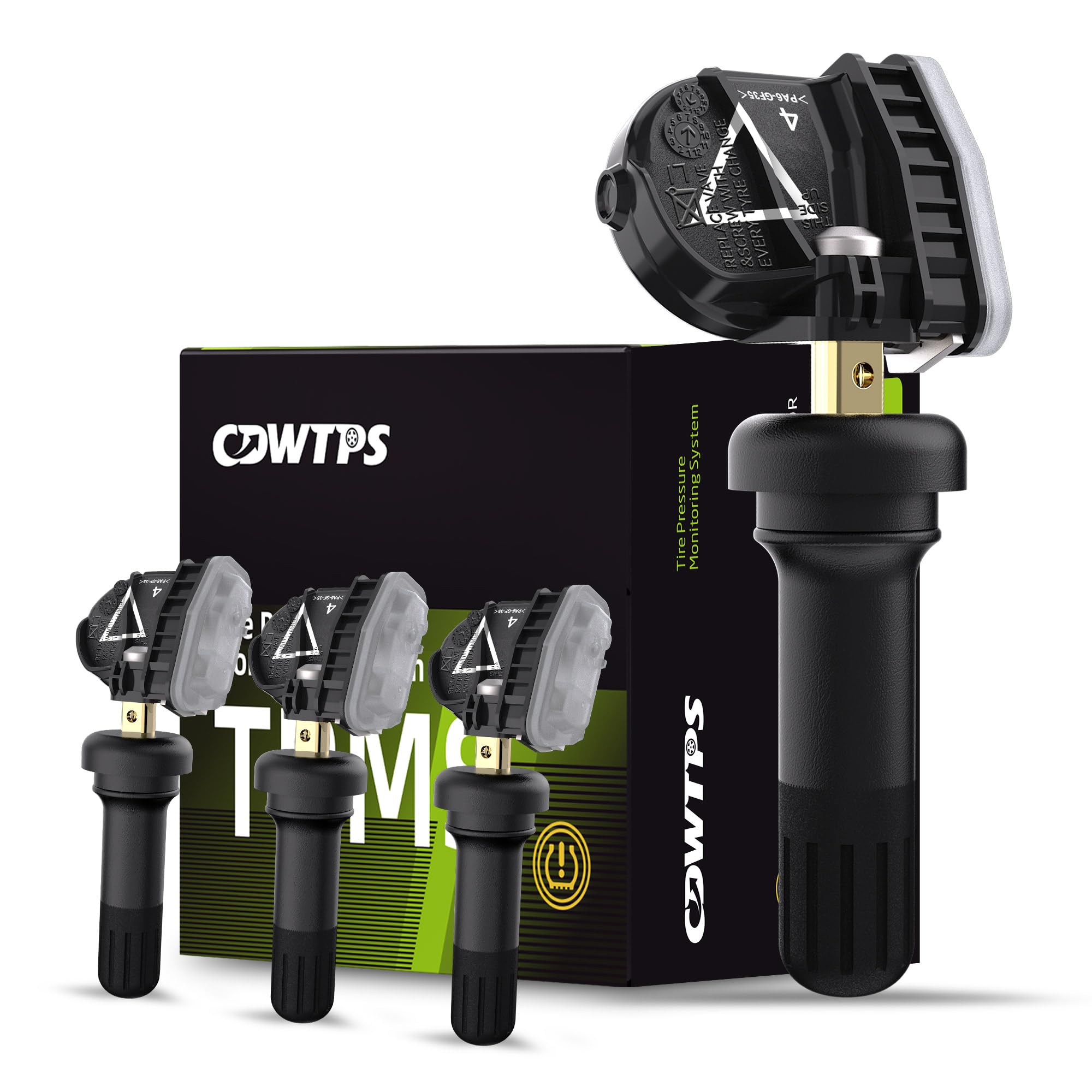
The CDWTPS set targets 2017-and-later Chevy, GMC, Cadillac, and Buick models with its 433MHz frequency and broad OEM part number cross-reference covering 13516165, 13522631, 13528563, and fourteen other OE numbers. Real owner reports on both a 2017 GMC Acadia and a 2018 GMC Acadia confirm the sensors paired successfully using an affordable TPMS activation tool from Amazon, and the PSI readings displayed accurately in the instrument cluster immediately after the relearn procedure. One verified owner called them a direct replacement that worked perfectly.
The sensors ship with four included CR2 batteries and use a 900-kPa chip rated for five to eight years of normal use. The operating temperature range of 40°F to 125°F covers the typical driving climate in most of the continental US, though owners in extreme northern or desert climates will want a sensor rated for wider margins. CDWTPS tests every unit before shipping and backs the set with a one-year warranty.
There is a single verified report of one sensor failing after one week with no seller response to replacement requests, which is a risk with entry-level tier pricing. That said, the majority of reviews are positive, with multiple owners noting the set saved them roughly 85% compared to big-box auto parts store pricing. For a 2018+ Chevy Traverse or 2019+ Silverado 1500 owner who wants to spend less while maintaining full functionality, this set is a sensible compromise.
What works
- Covers 2018+ Chevy models at a competitive price point
- Pre-programmed for direct installation with no coding
- Verified fits on GMC Acadia and Sierra models
- Includes four CR2 batteries
What doesn’t
- Customer support response issues reported on failed units
- Limited temperature range compared to premium options
- One-year warranty is the industry minimum
5. SZKAIDAG 315MHz TPMS Sensor 4-Pack
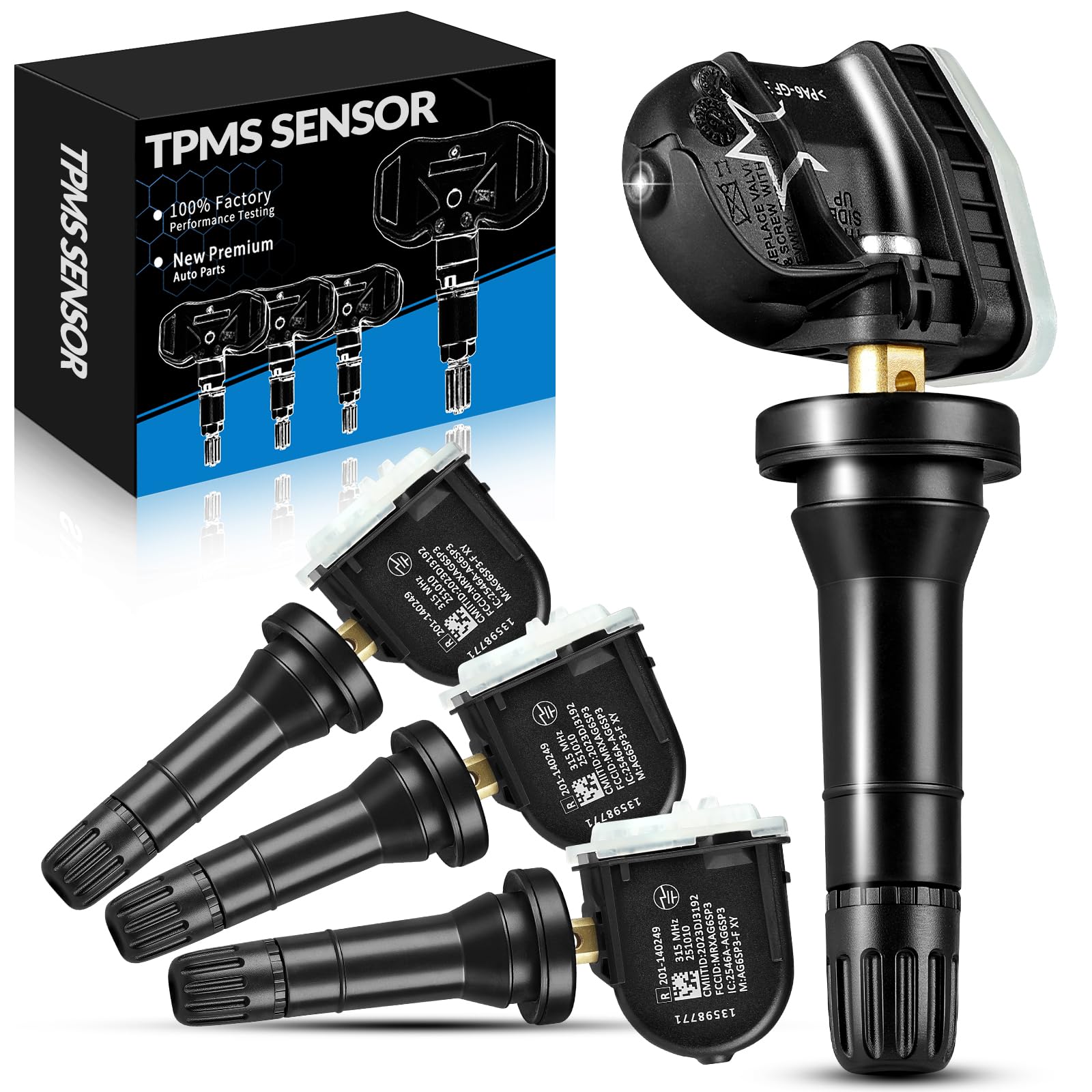
The SZKAIDAG set is purpose-built for older Chevy models that use the 315MHz frequency — the dominant standard for 2007-2016 Silverado 1500/2500/3500, 2007-2020 Tahoe, 2007-2014 Suburban, and 2007-2022 Express vans. This set covers a massive cross-section of GM vehicles spanning Chevrolet, GMC, Buick, Cadillac, Saturn, Pontiac, Saab, and Hummer — making it the most expansive compatibility list of any sensor in this guide. If you own a 2009 Chevy Avalanche or a 2010 GMC Yukon XL 2500, this set will fit without question.
The sensors claim a 0.1-second response time, which is quick enough to update pressure readings in the DIC almost instantly after air is added. The measuring range is 20 to 80 PSI, covering everything from standard passenger car pressures to the higher inflation requirements of heavy-duty truck tires on the Silverado 3500. OE cross-reference numbers include 13598771, 13598772, 13586335, 13581558, and 13589597 — all common GM part numbers from the 2007-2016 generation.
The set requires a TPMS activation tool for the relearn procedure, and automaker-specified procedure involves a scan tool to teach each wheel position. SZKAIDAG’s documentation is minimal, so owners should have the step-by-step relearn instructions from their owner manual ready. No verified owner reviews are available yet for this newer release, but the extensive fitment list makes it a safe bet for anyone with a mid-2000s to mid-2010s GM vehicle who wants maximum coverage at a moderate spend.
What works
- Extensive GM vehicle coverage including Hummer, Saab, and Saturn
- 315MHz frequency correct for 2006-2016 Chevy trucks
- 0.1-second response time for immediate pressure updates
- 20-80 PSI range covers heavy-duty truck applications
What doesn’t
- No owner reviews yet to validate real-world reliability
- Included documentation lacks detailed relearn instructions
- Not compatible with 433MHz system from 2017+ models
6. RENECTIV 433MHz TPMS Sensor 4-Pack
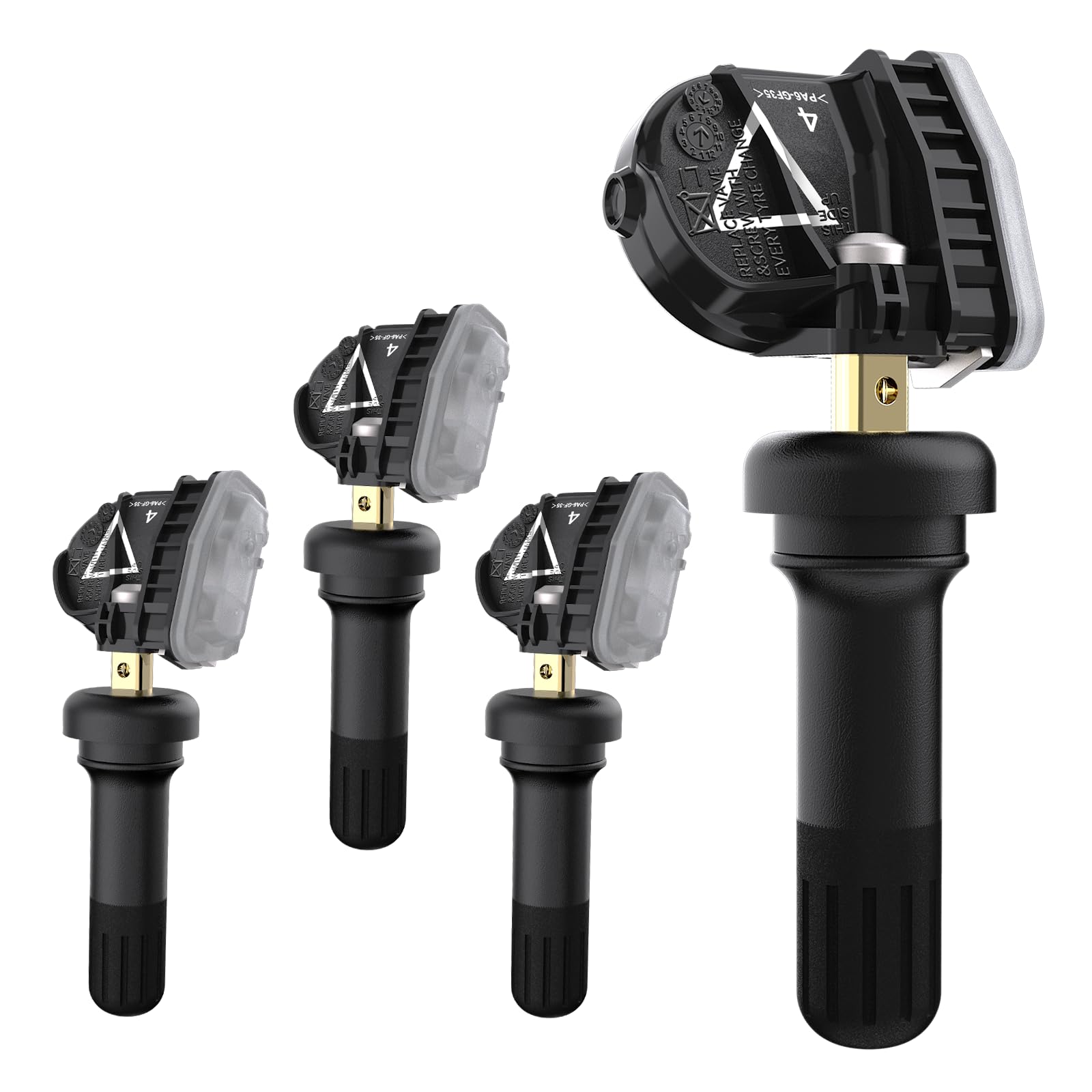
The RENECTIV set is a 433MHz option for newer Chevy models — Blazer, Camaro, Cruze, Impala, Malibu, Silverado, TrailBlazer, and Traverse — and replaces OE numbers 13598773, 13512347, and 13516165. The sensors are pre-programmed to the buyer’s vehicle specifications at the factory, so no manual programming is needed before installation. The internal CR2032 battery is rated for five to eight years of service, and the sensors can withstand temperatures from 40°F to 125°F.
The 3% measurement accuracy rating is the loosest tolerance among these seven products. For a driver who just wants the TPMS light off and doesn’t need hyper-accurate PSI tracking on a performance car, this is acceptable. But for someone who tracks tire pressure precisely for fuel economy or towing stability, a sensor with 1.5 PSI or better accuracy like the Masoll E80 or the A-Premium set will provide more consistent data. The flange mounting style is standard for internal sensors and requires tire dismounting for installation.
RENECTIV includes a one-year warranty and the set comes pre-programmed to your exact vehicle when you order, which eliminates the compatibility guessing game. The 433MHz frequency limits this set to 2017+ Chevrolet models exclusively. There are no verified owner reviews available for this product, so the performance data relies entirely on manufacturer claims. For a budget-friendly entry into 433MHz replacement, it works, but the accuracy and low-temperature specs lag behind the Masoll and A-Premium offerings.
What works
- Pre-programmed to your specific vehicle at ordering
- CR2032 battery rated for five to eight years
- Coverage for popular 2017+ Chevy models
- Simple activation with TPMS scan tool
What doesn’t
- 3% measurement accuracy is the widest tolerance in the lineup
- No verified owner reviews to confirm reliability
- Temperature range of 40-125°F may struggle in extreme climates
7. Jsueng 315MHz GM TPMS Sensor 4-Pack
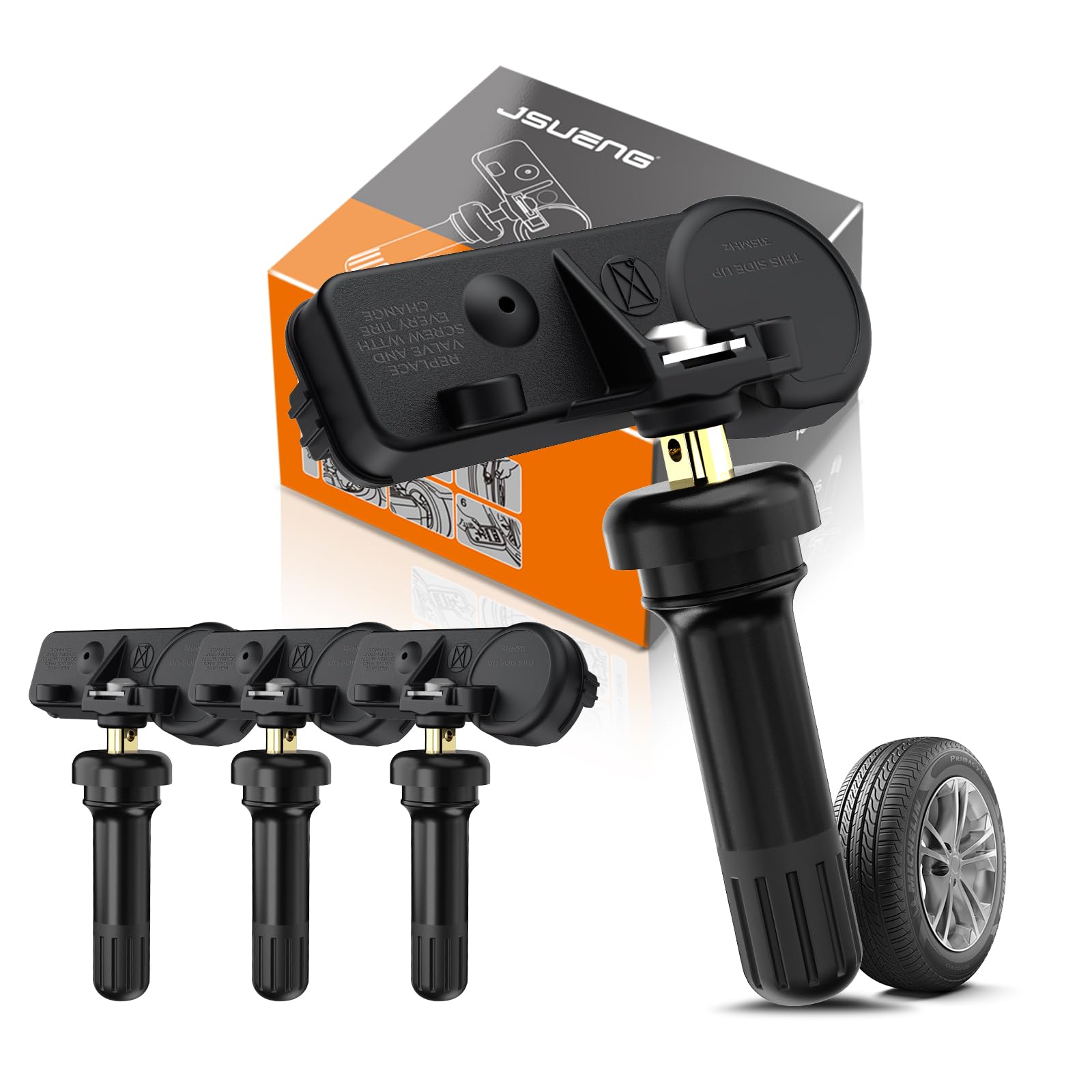
The Jsueng set is the broadest-ranging sensor in terms of year coverage, spanning from a 2002 Chevy Aveo all the way to a 2024 Chevy Express van. It operates on 315MHz and replaces over twenty OEM part numbers including 13586335, 13598771, 13598772, and 13581558. This set is essentially a lottery ticket for Chevy owners who have a pre-2017 vehicle and want a single set that might work across multiple GM vehicles in their household. The pre-programmed sensor still requires a TPMS scan tool for the relearn procedure.
The sensors ship with one CR2 battery each and are tested at the factory for durability, high and low temperature tolerance, and mechanical performance. The 5.8-ounce total weight for the set is light, and the dimensions are standard for an internal sensor. Jsueng provides a detailed 10-step OBDII relearn procedure in the product description, which is helpful for DIY owners who own a compatible TPMS tool. The procedure involves activating each sensor with a scan tool at the tire sidewall, using an OBD connector to transfer data to the ECU, and driving for at least five minutes at 28 mph.
The obvious trade-off at this price point is that the build quality and battery chemistry are basic. The set lacks the dual-antenna design, high-precision chip, or extended temperature range of the premium options. There are also no verified owner reviews on record, so real-world reliability is unconfirmed. Still, for an owner of a 2008 Silverado who just needs a functioning TPMS sensor set without spending much, the Jsueng set covers the required 315MHz frequency and fits the vehicle.
What works
- Extremely broad year range from 2002 to 2024
- Replaces over twenty different GM OEM part numbers
- OBDII relearn instructions provided
- Each set factory tested before shipment
What doesn’t
- No verified owner reviews available
- Basic battery and chip construction
- No activation tool included
Hardware & Specs Guide
315MHz vs 433MHz Frequency
Chevy vehicles built from roughly 2002 through 2016 use 315MHz TPMS sensors. Starting around the 2017 model year, many Chevrolet models — including the Silverado 1500, Traverse, Malibu, and Equinox — transitioned to 433MHz sensors. Installing a 433MHz sensor on a 315MHz vehicle produces no signal and a permanently lit TPMS warning light. The simplest way to determine your vehicle’s frequency is to look at the original sensor’s printed part number and cross-reference it online, or check the service manual section covering Tire Pressure Monitoring.
Sealed Battery vs Replaceable
Internal OEM-style sensors use sealed CR2, CR2032, or CR2050 batteries that last five to eight years and then require complete sensor replacement. External sensors, like the Masoll Gen 2, use user-replaceable coin cells that last roughly two years but can be swapped without tools. Automotive-grade CR2050 batteries, found in the Masoll E80 and A-Premium sets, are designed for extreme temperatures from -40°F to 257°F. Standard CR2032 cells used in entry-level sensors operate reliably only between 40°F and 125°F.
FAQ
Why does my Chevy Silverado need a TPMS relearn procedure after replacing sensors?
Can I use 433MHz sensors on my 2009 Chevy Tahoe?
How do I know which tire pressure sensor fits my Chevy model?
Will a pre-programmed sensor work immediately after installation?
Final Thoughts: The Verdict
For most buyers, the best chevy tire pressure sensor winner is the Masoll Gen 2 Bundle because it eliminates the tire shop visit entirely, includes the activation tool, and uses a replaceable battery that avoids the planned obsolescence of sealed sensors. If you want maximum signal strength for a long-bed Silverado with the tightest PSI accuracy, grab the A-Premium APTPMS188 set. And for an entry-level 433MHz replacement on a 2018+ Traverse or Malibu, nothing beats the CDWTPS set.

Certification: BSc in Mechanical Engineering
Education: Mechanical engineer
Lives In: 539 W Commerce St, Dallas, TX 75208, USA
Md Amir is an auto mechanic student and writer with over half a decade of experience in the automotive field. He has worked with top automotive brands such as Lexus, Quantum, and also owns two automotive blogs autocarneed.com and taxiwiz.com.