Every time you flick on the A/C or heat in your car, you are pulling outside air through a thin panel of media sitting behind your glove box. If that media is the original factory-installed filter (or worse, nothing at all), you are effectively recirculating road dust, diesel soot, pollen, and exhaust fumes directly into the cabin. A carbon-infused cabin filter traps these microscopic particles and chemically adsorbs the volatile organic compounds that create that distinct “traffic smell” inside the passenger compartment.
I’m Amir — the founder and writer behind Four Wheel Ask. I analyze automotive cabin air filtration systems by studying filtration media construction, carbon layer density, pleat count per inch, and real-world owner feedback to determine which drop-in replacements actually perform over a full service interval.
For this guide I compared five popular activated carbon cabin filters across multiple makes and model ranges to identify the most effective options. Your search for the best carbon filter for car ends with a clear set of recommendations that balance filtration efficiency, OEM fitment precision, and carbon layer performance.
How To Choose The Best Carbon Filter For Car
A carbon cabin filter is not a commodity part — differences in media density, carbon bonding method, and gasket material directly affect how much particulate and odor gets through before the 12-month change interval. Here are the three factors that separate a decent filter from a truly effective one.
Carbon Layer Density and Bonding Method
The cheapest carbon filters use a light spray of powdered carbon on one side of a paper media. That carbon layer erodes within weeks. Premium filters bond activated carbon granules into a fused mat within the media layers, ensuring the carbon remains active for the full service interval. Look for “activated carbon mat” or “dual-layer carbon” in the description rather than vague “activated carbon” claims.
Pleat Count and Media Surface Area
Standard paper cabin filters typically have 20 to 30 pleats per filter. A carbon filter should maintain a similar or higher pleat density to offset the airflow resistance created by the carbon layer. More pleats mean more surface area, which translates to lower static pressure drop and longer time before the filter clogs with trapped particles.
Sealing Gasket vs. Foam Frame
Most OEM cabin filters rely on a soft foam frame that compresses against the filter housing to prevent air bypass. Aftermarket carbon filters sometimes substitute a thinner felt or cardboard edge. Any unfiltered air that slips around the media defeats the purpose of installing a carbon filter in the first place. A flexible foam perimeter seal is the mark of a well-engineered replacement.
Quick Comparison
On smaller screens, swipe sideways to see the full table.
| Model | Category | Best For | Key Spec | Amazon |
|---|---|---|---|---|
| MANN-FILTER CUK 1919 | Premium | Maximum odor and gas adsorption | MERV 11 with dual-layer carbon mat | Amazon |
| ECOGARD XC10621C | Mid-Range | Modern Toyota and Subaru models | 8.46″ x 7.24″ x 1.14″ fused carbon media | Amazon |
| Purolator PBC35667 | Mid-Range | Electrostatic particle capture plus odor control | Electrostatically-charged micro fibers | Amazon |
| RICHWEI CF10285 | Value | Wide Toyota, Lexus, and Scion compatibility | 8.43″ x 7.6″ x 1.18″ activated carbon nonwoven | Amazon |
| RICHWEI CF10134 | Value | Honda and Acura applications | 9.25″ x 1.18″ x 8.82″ carbon nonwoven | Amazon |
In‑Depth Reviews
1. MANN-FILTER CUK 1919 Cabin Air Filter
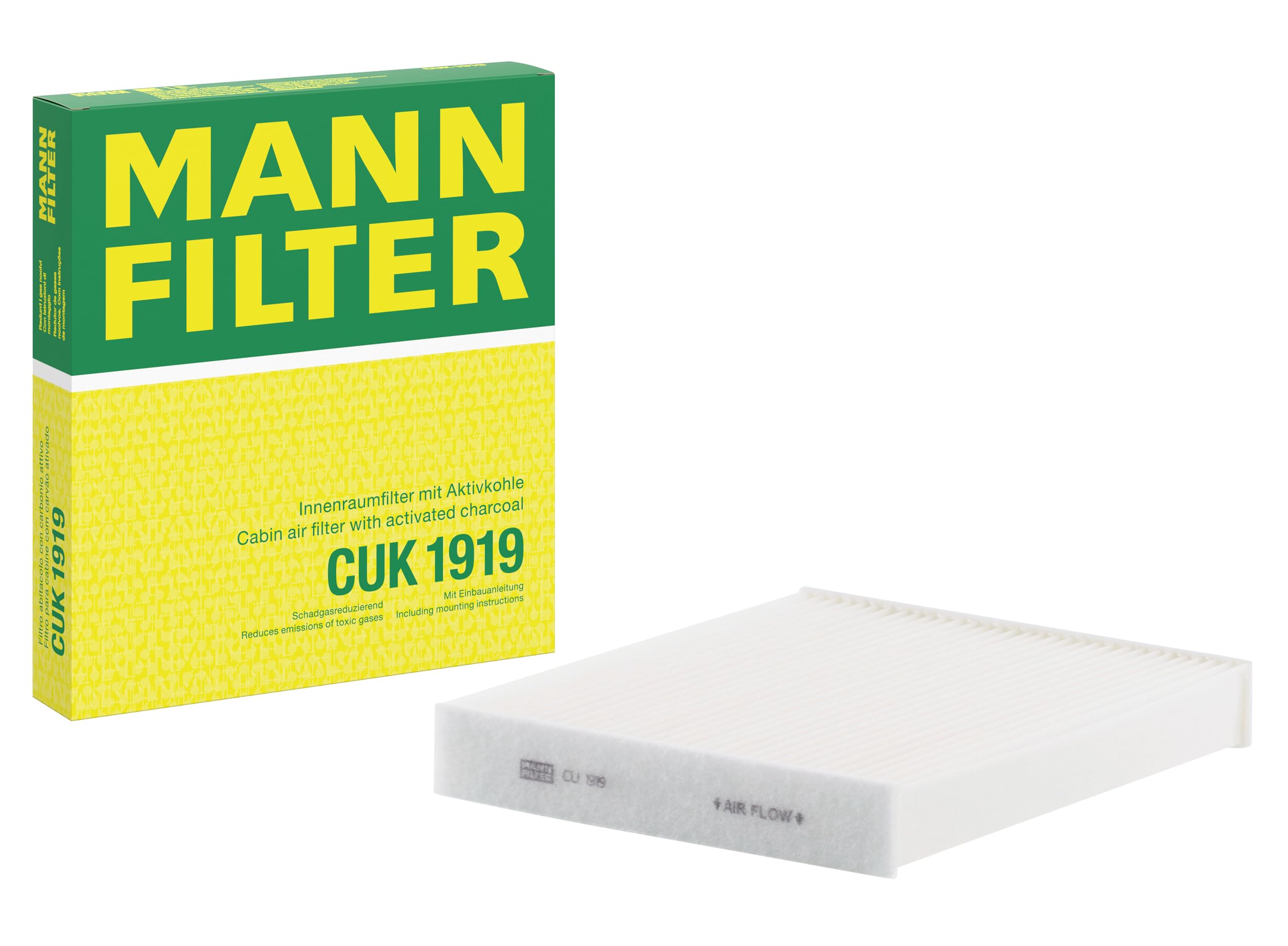
MANN-FILTER brings their German filtration engineering to the cabin air space with the CUK 1919, a dual-layer carbon filter that carries a certified MERV 11 rating. That MERV number tells you this filter captures nearly 100 percent of particles larger than 1 micron — think mold spores, fine dust, and brake pad particulates — while the dense activated carbon mat adsorbs ozone, nitrogen oxides, and sulfur dioxide. The carbon layer is fully fused into the media rather than dusted on, so it maintains adsorption capacity across the full 12-month service interval.
The physical dimensions come in at 7.64 inches by 8.46 inches with a 1.18-inch thickness, and the foam frame provides a compliant seal that compresses evenly into the housing slot. This filter is compatible with select models from Jaguar, Land Rover, Lexus, Scion, Subaru, and Toyota — check your specific part number cross-reference before ordering. The dual-layer construction also resists moisture degradation better than single-paper filters, making it a strong choice for humid climates where mold growth inside the cabin air box is a concern.
Installation is a standard glove-box-removal procedure that takes under 15 minutes. The premium price point reflects the genuine MERV rating and fused carbon construction, which you simply do not find in budget carbon filters. For drivers who spend significant time in urban traffic, tunnels, or behind diesel trucks, the CUK 1919 delivers measurable air quality improvement that cheaper filters cannot match.
What works
- Certified MERV 11 captures over 99% of particles above 1 micron
- Fused activated carbon mat lasts the full service interval without degrading
- Foam perimeter seal prevents unfiltered air bypass
What doesn’t
- Higher initial investment compared to carbon-coated paper filters
- Vehicle fitment is limited to specific model years; always verify cross-reference
2. ECOGARD XC10621C Premium Cabin Air Filter

ECOGARD designed the XC10621C specifically for the latest generation of Toyota and Subaru platforms, covering model years 2018 through 2026 for Camry, 2019 through 2025 for RAV4 and Corolla, plus the Subaru Outback, Ascent, and Crosstrek. The 8.46-inch by 7.24-inch by 1.14-inch dimensions drop into the filter housing with a near-OEM fit, and the activated carbon media is fused into the pleated structure rather than coated on the surface. This fused carbon approach means the filtration layer does not shed powder into your HVAC system over time.
The pleat density is consistent with the factory Toyota filter, so airflow remains at spec while the carbon layer adsorbs exhaust fumes and road odor molecules. Owners report a noticeable reduction in the smell of diesel exhaust when sitting in traffic, which is the primary benefit of upgrading from a standard paper filter to a carbon variant. The XC10621C also includes compatibility with the Lexus RX350, ES350, and RX450h, making it a solid one-filter solution for households with multiple Toyota-family vehicles.
ECOGARD does not publish a MERV rating, so you are relying on the media construction rather than a certified number. However, owner feedback across tens of thousands of installations indicates consistent filtration performance through the full year of use. If you drive a post-2019 Toyota or Subaru and want carbon filtration without the premium price of the MANN-FILTER, the XC10621C hits a strong value sweet spot.
What works
- Fused carbon media does not shed powder into the HVAC system
- Precise OEM fitment for late-model Toyota and Subaru vehicles
- Covers multiple Lexus models, simplifying multi-vehicle households
What doesn’t
- No certified MERV rating, so direct efficiency comparison is harder
- Fitment range is narrower than universal-application carbon filters
3. Purolator PBC35667 PurolatorBOSS Cabin Air Filter
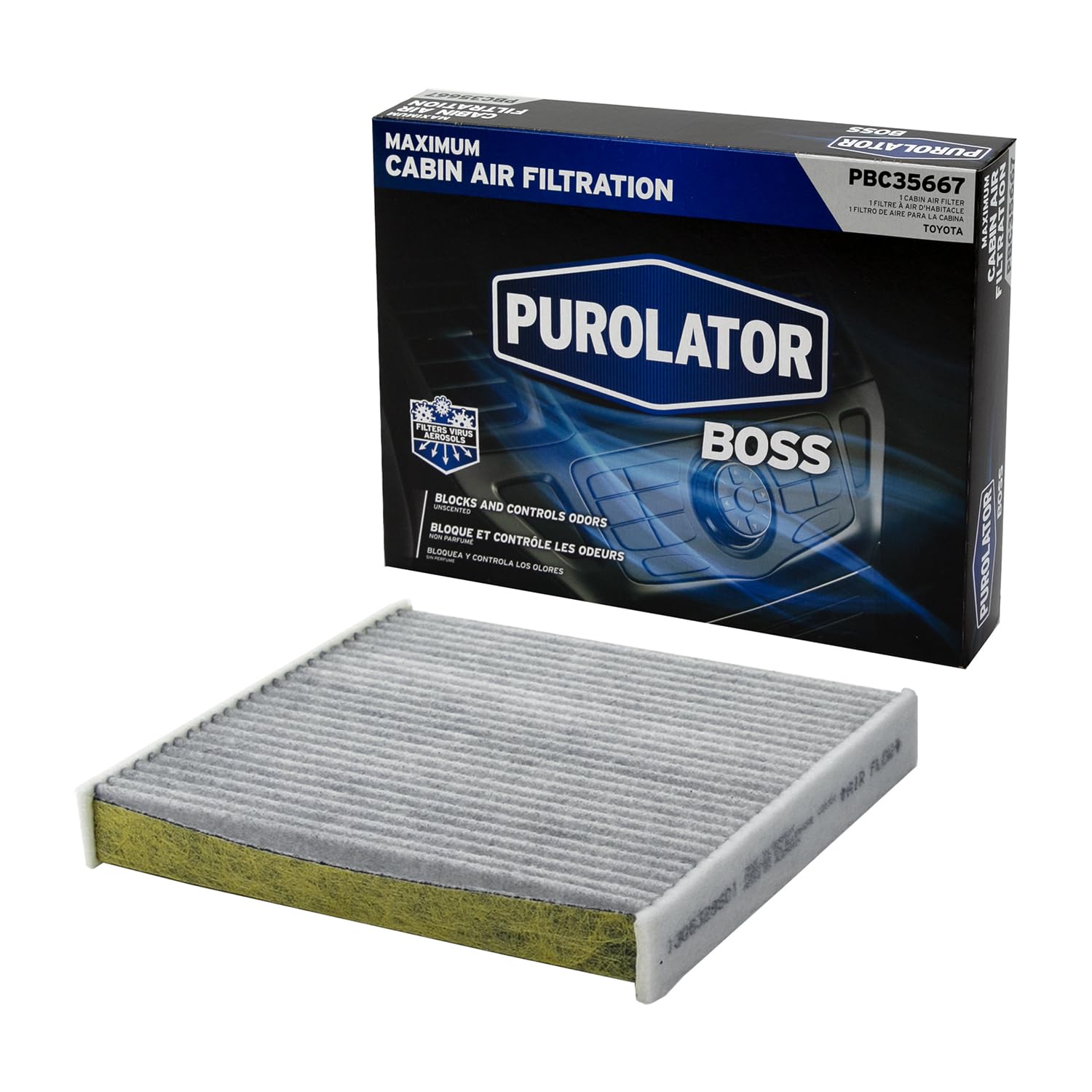
Purolator takes a different engineering approach with the PBC35667 by incorporating electrostatically-charged micro fibers into the media structure. These charged fibers attract microscopic particles the way a static-charged balloon attracts dust, pulling finer particulates out of the airstream than a purely mechanical filter medium could capture. The activated carbon layer is integrated to handle gas-phase contaminants and odors, creating a two-stage system that traps particles physically and adsorbs fumes chemically.
The filter dimensions measure 8.46 inches by 7.48 inches by 1.14 inches, fitting the same Toyota RAV4, Camry, and Corolla applications as other CF10285-compatible filters. Purolator also claims the carbon layer inhibits odor-causing bacteria and mold growth on the filter surface itself, which is a different benefit than just trapping existing odors. The electrostatic charge is permanent and does not wash off over time, so particle capture efficiency stays elevated through the entire service life.
Purolator states a simple 15-minute installation window, which tracks with every cabin filter replacement I have performed. One factor to consider is that the electrostatic charge works best on dry air — in very humid environments, the micro fibers lose some of their attraction efficiency. Still, for the mid-range price point, you get genuine dual-stage filtration with a brand name that has decades of filter manufacturing behind it. The PurolatorBOSS is a confident pick for Toyota owners who want better particle capture than basic carbon paper but do not need the full MERV rating of the MANN-FILTER.
What works
- Electrostatic micro fibers enhance fine particle capture beyond mechanical filtration
- Activated carbon layer inhibits bacteria and mold growth on the media
- Trusted manufacturer with proven filter engineering history
What doesn’t
- Electrostatic efficiency drops in consistently high-humidity environments
- No certified MERV or particle capture percentage published
4. RICHWEI CF10285 Cabin Air Filter

RICHWEI targets the widest possible compatibility range with the CF10285, covering Toyota 4Runner, Avalon, Camry, Corolla, Highlander, Land Cruiser, Prius, RAV4, Sequoia, Sienna, Tundra, Venza, and Yaris across model years 2005 through 2022. The same filter also fits select Lexus CT, ES, GS, GX, IS, LS, LX, NX, and RX models plus Scion, Subaru, Land Rover, Jaguar, and even the Pontiac Vibe. That is an enormous application range, and it works because the 8.43-inch by 7.6-inch by 1.18-inch dimensions match the widely-used CF10285 form factor.
The media construction uses a nonwoven substrate with activated carbon integrated into the material. This is not a fused carbon mat like the MANN-FILTER, but the carbon layer is more substantial than a simple spray-on coating. Multiple thin layers of nonwoven create a depth-loading structure that traps particles throughout the media thickness rather than just on the surface, extending the time before airflow becomes restricted. At 0.73 pounds, the CF10285 has a noticeably heavier feel than standard paper cabin filters, which suggests a denser media pack.
For the entry-level price bracket, the CF10285 delivers a genuine activated carbon upgrade for a massive cross-section of Toyota and Lexus vehicles. The trade-off is that carbon efficiency is not certified, and some owners report the carbon layer can shed fine black powder during the first few minutes of use. If you need a drop-in carbon filter for a mid-2000s Camry or early-2010s RAV4 and the premium brands are overkill for your budget, the RICHWEI CF10285 gets the job done without breaking the bank.
What works
- Enormous vehicle compatibility across Toyota, Lexus, and other brands
- Density-loaded nonwoven media traps particles throughout the material thickness
- Entry-level price makes carbon filtration accessible for older vehicles
What doesn’t
- Carbon layer can shed fine black dust during initial use
- No MERV rating or certified particle capture efficiency
5. RICHWEI CF10134 Cabin Air Filter

Honda and Acura owners get their own dedicated carbon drop-in with the RICHWEI CF10134, which replaces the OEM part numbers 80219-SHJ-A01, 80292-SDA-407, and a host of other cross-references. The 9.25-inch by 1.18-inch by 8.82-inch dimensions fit the specific filter housing used across the 2003-through-2022 Accord, 2006-through-2015 Civic, 2007-through-2016 CR-V, and other Honda models including Odyssey, Pilot, and Ridgeline. Acura coverage extends to MDX, RDX, TL, TLX, and ILX among others.
The construction mirrors the CF10285 above — a nonwoven medium with embedded activated carbon designed for depth loading. The carbon layer targets the odors and ozone that accumulate in the passenger cabin, especially noticeable in Honda models where the cabin air intake sits low near the cowl and pulls in road-level exhaust. At 0.4 kilograms, the CF10134 feels lighter than the Toyota version but still carries a more substantial media density than the paper filters it replaces.
For owners of older Honda vehicles where paying a premium for a brand-name filter feels unjustified, the CF10134 offers a perfectly functional carbon upgrade at a minimal cost. The nonwoven construction holds up well across the standard 12-month replacement cycle in moderate climates. The main limitation is the same as the Toyota version — the carbon is not fused, so initial shedding is possible, and there is no independent certification for particle capture rates. But for the price, it transforms a basic paper filter into an odor-combating carbon element.
What works
- Dedicated fitment for a broad range of Honda and Acura models
- Depth-loading nonwoven media extends filter life before clogging
- Budget-friendly entry point for carbon filtration
What doesn’t
- Carbon layer not fused, may shed fine particles initially
- No certified efficiency rating for particle or gas capture
Hardware & Specs Guide
MERV Rating
The Minimum Efficiency Reporting Value (MERV) measures a filter’s ability to capture particles between 0.3 and 10 microns. A MERV 11 rating, as found on the MANN-FILTER CUK 1919, captures over 85 percent of 1-to-3-micron particles and over 90 percent of 3-to-10-micron particles. Most carbon cabin filters do not carry a MERV rating because the certification is voluntary for the automotive aftermarket — but when present, it is the single most objective indicator of particle filtration performance.
Activated Carbon Media Types
There are two dominant carbon integration methods. The lower-cost approach applies a carbon coating to one side of the filter media — this layer erodes and loses effectiveness within a few weeks. The premium approach fuses activated carbon granules into the media structure itself, creating a permanent adsorption layer that remains active for the full service interval. Filters using fused carbon, like the MANN-FILTER and ECOGARD, resist shedding and maintain consistent odor removal over 12 months.
FAQ
How often should I replace my car’s carbon cabin filter?
Will a carbon filter reduce my car’s airflow from the vents?
What is the difference between a HEPA cabin filter and a carbon cabin filter?
Final Thoughts: The Verdict
For most buyers, the best carbon filter for car winner is the MANN-FILTER CUK 1919 because its certified MERV 11 rating and fused dual-layer carbon mat deliver measurable air quality improvement that budget-priced carbon filters simply cannot match. If you want a precise OEM-like fit for late-model Toyota or Subaru vehicles without the premium price, grab the ECOGARD XC10621C. And for a budget-friendly carbon upgrade that covers a massive range of older Toyota and Honda models, nothing beats the RICHWEI CF10285 for the driver who simply wants to stop inhaling road fumes on the daily commute.

Certification: BSc in Mechanical Engineering
Education: Mechanical engineer
Lives In: 539 W Commerce St, Dallas, TX 75208, USA
Md Amir is an auto mechanic student and writer with over half a decade of experience in the automotive field. He has worked with top automotive brands such as Lexus, Quantum, and also owns two automotive blogs autocarneed.com and taxiwiz.com.