A car subwoofer that can’t deliver clean, chest-thumping bass at 30 Hz is just a paperweight in your trunk. The real challenge isn’t finding something that makes noise—it’s picking a driver that matches your amplifier’s RMS output, fits your enclosure’s airspace, and doesn’t distort when you crank the volume during your commute.
I’m Amir — the founder and writer behind Four Wheel Ask. I’ve spent years analyzing car audio component specs, comparing voice coil configurations, sensitivity ratings, and power handling across dozens of models to separate the genuine performers from the overhyped boxes.
After sifting through technical datasheets and owner feedback on installation fitment, real-world output, and long-term reliability, I’ve assembled the definitive guide to help you find the best car woofer for your ride and your budget.
How To Choose The Best Car Woofer
Selecting the right subwoofer for your vehicle involves understanding how power handling, impedance, cone material, and enclosure compatibility all work together. Ignoring any of these factors can lead to muddy bass, blown drivers, or wasted money on an amp that can’t drive the load.
Match RMS Power, Not Peak Wattage
The RMS (Root Mean Square) rating tells you the continuous power a woofer can handle cleanly, while peak wattage is a meaningless marketing number for a millisecond burst. Your amplifier’s RMS output should closely match or slightly exceed the subwoofer’s RMS rating. A woofer rated at 250 watts RMS paired with a 300-watt RMS amp will play loudly and safely.
Single vs. Dual Voice Coil Configurations
Dual voice coil (DVC) subwoofers offer wiring flexibility that single voice coil (SVC) units cannot match. A DVC 2-ohm woofer can be wired to present a 1-ohm or 4-ohm load to the amplifier, letting you optimize power delivery. SVC woofers are simpler but lock you into a single impedance path. For builds where the amplifier is stable at lower impedances, DVC unlocks more wattage.
Cone Material and Enclosure Fitment
Polypropylene cones offer a good balance of rigidity and weight for daily listening, while mica-injected or glass-fiber reinforced cones add stiffness for lower distortion at high output. Shallow-mount designs (mounting depth under 3.5 inches) are essential for behind-the-seat installations in trucks or coupes. Always verify the sub’s mounting depth and cutout diameter against your planned enclosure or vehicle space.
Quick Comparison
On smaller screens, swipe sideways to see the full table.
| Model | Category | Best For | Key Spec | Amazon |
|---|---|---|---|---|
| Rockford Fosgate Prime R2D2-10 | Component | Build quality in a budget | 250W RMS, 2-ohm DVC | Amazon |
| Audiopipe TXX-BDC2-12 | Component | High power SPL builds | 750W RMS, 150 oz magnet | Amazon |
| Pioneer TS-A2000LD2 | Shallow Mount | Tight installation spaces | 250W RMS, 2.625″ depth | Amazon |
| Pioneer TS-A3000LS4 | Shallow Mount | 12″ shallow bass in trucks | 400W RMS, 3.5″ depth | Amazon |
| MTX TNE212D Bundle | Loaded Enclosure | All-in-one system install | Dual 12″, 1200W peak load | Amazon |
| JBL SUBBP12AM | Powered Sub | Simple powered integration | 150W RMS, 450W peak | Amazon |
| Rockford Fosgate P300-10T | Powered Sub | Truck under-seat bass | 300W RMS, slim enclosure | Amazon |
| Alpine PWE-S8 | Powered Sub | Ultra-compact under seat | 120W RMS, 8″ woofer | Amazon |
| SVS SB-1000 Pro | Home/Studio | Reference audio quality | 325W RMS, 12″ driver | Amazon |
In‑Depth Reviews
1. Rockford Fosgate Prime R2D2-10

Rockford Fosgate’s Prime series brings proven engineering to an affordable price point. The R2D2-10 uses a mica-injected polypropylene cone that resists flexing under pressure, and the stamp-cast basket with spider venting—a feature often reserved for more expensive lines—keeps the motor assembly cool during extended playback. With a 2-ohm dual voice coil, you can wire this sub to present a 1-ohm or 4-ohm load, giving you leeway to match nearly any entry-to-mid-level mono amplifier.
Frequency response drops to 28 Hz, meaning it can reproduce the lowest bass notes in modern hip-hop and EDM without sounding soggy. The required mounting depth of 4.319 inches and a cutout diameter of 9.125 inches make it compatible with standard prefab sealed or ported boxes. Owners consistently note that this sub handles well above its 250-watt RMS rating when given clean power, with Rockford’s 1-year warranty covering any factory defects.
Where it falls short is raw SPL output compared to high-excursion competitors. If you’re chasing 140 dB competition numbers, you’ll need more cone area and power. But for a daily driver who wants tight, musical bass that integrates with a factory stereo upgrade, this is a tough unit to beat at this tier.
What works
- Excellent build quality with vented basket
- DVC wiring flex for 1-ohm or 4-ohm loads
- Clean extension down to 28 Hz
What doesn’t
- Limited peak SPL for competition use
- Requires moderate enclosure volume for full output
2. Audiopipe TXX-BDC2-12
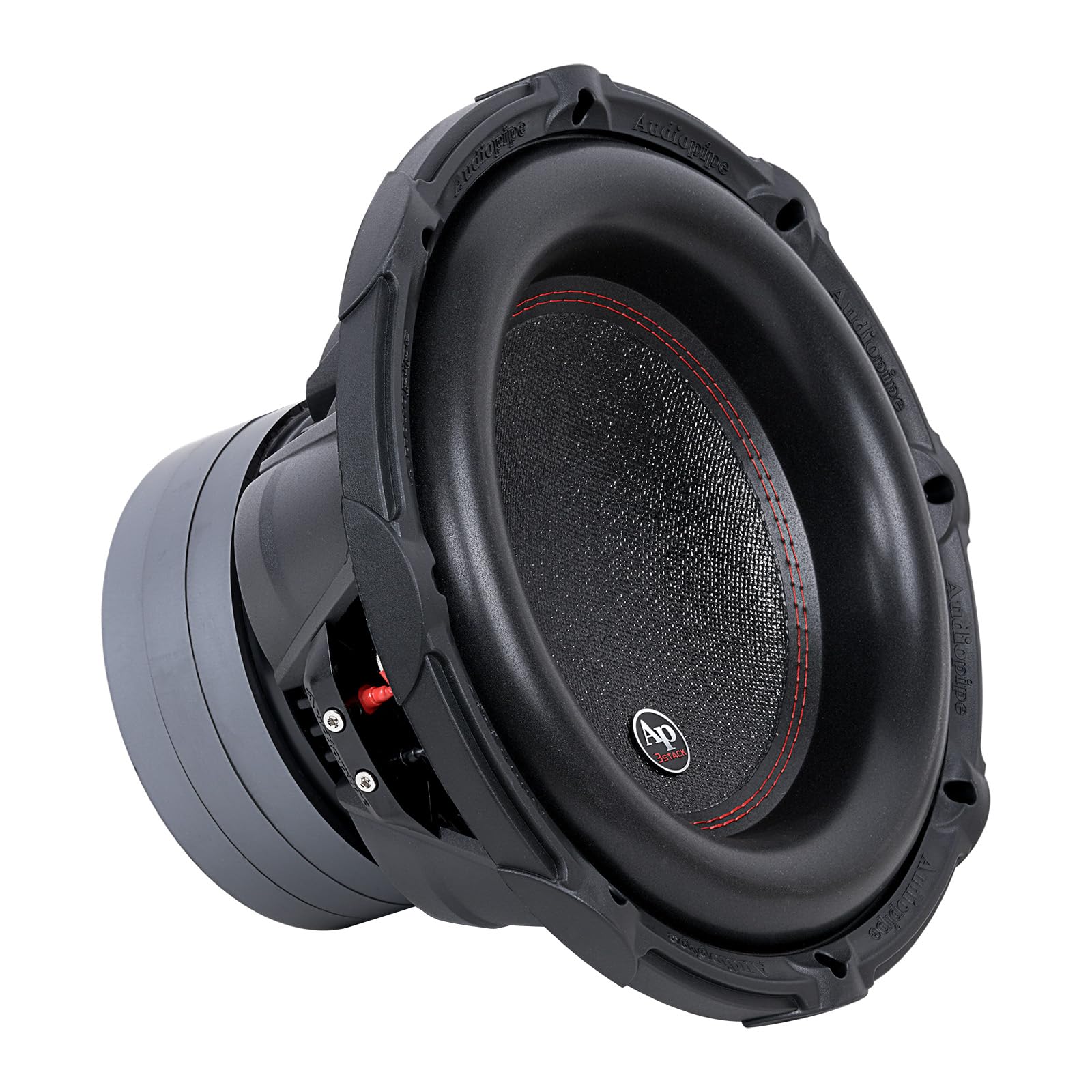
The Audiopipe TXX-BDC2-12 is built for sheer output. Its double stack magnet structure weighs 150 ounces, providing massive magnetic force to control the composite cone at high excursion levels. The 2.5-inch black aluminum voice coil (BASV) handles thermal loads better than copper, shedding heat during sustained high-power sessions. With 750 watts RMS and 1500 watts peak on tap, this sub is geared toward SPL enthusiasts running dedicated mono amplifiers in the 800-1000 watt range.
Frequency response spans 20 Hz to 900 Hz, giving it surprising midbass capabilities if you run it in a properly sized ported enclosure. The patent pipe multi-connect terminals make wiring series or parallel configurations straightforward without weak solder joints. The painted aluminum basket provides ventilation channels that reduce heat soak—a common failure point in lesser subs at high wattage.
The trade-off is a sensitivity rating of 88 dB, which is average for this power class, meaning you’ll need substantial amplifier power to realize its full potential. It’s also physically large and heavy, so measure your enclosure’s mounting depth carefully before committing. This is not a casual drop-in upgrade; it’s a serious component for a serious system.
What works
- 150 oz double stack magnet for extreme cone control
- BASV high-temp voice coil resists thermal failure
- Rugged aluminum basket with ventilation
What doesn’t
- Needs amplifier power above 800W RMS to shine
- Heavy and physically large for tight installs
3. Pioneer TS-A2000LD2

Pioneer’s A-Series shallow-mount subwoofers solve a common problem: fitting real bass into vehicles with no trunk space. The TS-A2000LD2 measures just 2.625 inches in mounting depth, allowing it to slide under seats or behind panels in coupes, extended cab trucks, and sports cars. Despite the shallow profile, the glass-fiber and mica-reinforced IMPP cone keeps distortion low at its 250-watt RMS rating.
Its 2-ohm single voice coil simplifies wiring but limits your amplifier matching options—you need an amp stable at 2 ohms to extract its full capability. Pioneer recommends a 0.5 cubic foot sealed enclosure, which is small enough to custom-fabricate into nearly any vehicle corner. The 83 dB sensitivity is typical for an 8-inch driver, so expect tight midbass punch rather than deep sub-30 Hz extension.
Installers appreciate the included trim ring and gasket kit that clean up the appearance in exposed applications. The trade-off for the shallow depth is reduced maximum excursion compared to full-frame 8-inch subs, meaning you’ll hit mechanical limits sooner at high volume. This is an excellent choice for adding musical bass reinforcement without sacrificing cargo or passenger space.
What works
- Ultra-slim 2.625″ mounting depth for tight spots
- Glass-fiber reinforced cone for low distortion
- Includes trim ring and mounting hardware
What doesn’t
- Limited Xmax restricts deep bass output
- SVC design limits wiring flexibility
4. Pioneer TS-A3000LS4

Pioneer’s TS-A3000LS4 brings the shallow-mount concept to a 12-inch driver, offering more cone area than the 8-inch sibling while maintaining a slim 3.5-inch mounting depth. It handles 400 watts RMS and peaks at 1500 watts, pushing enough air to pressurize a standard sedan cabin when paired with an amplifier in the 400-500 watt RMS range. The glass-fiber and mica-reinforced IMPP cone provides the rigidity needed to keep the 12-inch cone from distorting under high excursion.
This sub uses a 4-ohm single voice coil, which simplifies amplifier pairing but limits power extraction to the 4-ohm rating of your amp. Pioneer suggests a 0.8 cubic foot sealed enclosure—about 60% larger than the 8-inch’s box—which is still achievable in many truck under-seat zones. The 88 dB sensitivity is a welcome improvement, meaning you get more output per watt than smaller shallow subs. Frequency response reaches deep enough for most bass-heavy music genres.
The primary downside is that despite the shallow design, the 3.5-inch depth and 12-inch diameter still require careful measurement behind seats or panels. True full-frame 12-inch subs with 6-inch+ depths will out-perform it in maximum volume, but for installations where depth is the limiting factor, this Pioneer is one of the few options that delivers real 12-inch bass without a major sacrifice.
What works
- 12-inch cone area in a slim 3.5″ package
- High 88 dB sensitivity for loud output per watt
- Works in compact 0.8 cu ft sealed box
What doesn’t
- 4-ohm SVC limits low-impedance amp pairing
- Not a replacement for full-frame high-Xmax subs
5. MTX 12-Inch Dual Subwoofer Bundle

The MTX loaded enclosure bundle is the closest thing to a turnkey bass solution on this list. It combines a dual 12-inch MTX subwoofer enclosure rated at 1200 watts peak, a Planet Audio 1500-watt monoblock amplifier, and a Soundstorm 8-gauge wiring kit. For someone buying their first serious system, this removes the guesswork of matching components. The enclosure is built from 5/8-inch MDF with aircraft-grade black carpet, measuring 26.63 inches wide by 13.5 inches deep by 14 inches tall.
The Planet Audio amplifier includes variable bass boost, high and low-level inputs, and a low-pass filter, allowing you to tune the system to your vehicle’s acoustics. The 8-gauge wiring kit is adequate for the power level, though upgrading to 4-gauge is recommended if you plan to push the system hard. This bundle will fill a sedan or SUV cab with chest-thumping bass when properly tuned, and the dual 12-inch cone area moves enough air to satisfy most enthusiasts.
The catch is that the 1200-watt rating is peak power for the entire system, not the continuous RMS output—you’ll likely see around 300-400 watts RMS total to the subs with the included amp. The enclosure requires substantial trunk space, so measure before buying. Professional installation is recommended because the amplifier tuning, grounding, and electrical system load require knowledge to get right without damaging components.
What works
- Complete bundle with amp and wiring included
- Dual 12-inch cone area for deep bass
- MDF enclosure with durable carpet finish
What doesn’t
- Large enclosure needs significant trunk space
- Included amp RMS power is modest for dual 12s
6. JBL SUBBP12AM

JBL’s SUBBP12AM is an amplified subwoofer system that integrates the amplifier and driver into a single enclosure. The built-in amp delivers 150 watts RMS (450 watts peak) that is precisely matched to the 12-inch polypropylene woofer, eliminating the need to calculate impedance loads or amp matching. The Slipstream port design reduces turbulence noise, delivering clean, distortion-free bass even at high output levels—a common weak point in ported powered subs.
Frequency response is rated from 35 to 120 Hz, focusing on the sub-bass range where music’s lowest notes live. The included remote sub level control lets you dial in bass from the driver’s seat without reaching into the trunk. Installation is straightforward: connect power, ground, and signal, and the auto-turn-on feature detects audio input. This makes it an ideal upgrade for factory stereos where you want added bass without replacing the head unit.
The limitation is the 150-watt RMS power—it won’t compete with dedicated amp-and-subwoofer combos running 500+ watts. For moderate listening levels in a sedan or SUV, it provides clean, musical bass reinforcement. Hardcore bass heads looking to shake rearview mirrors should look elsewhere. The built-in amp is also non-configurable, so you’re locked into JBL’s tuning.
What works
- Self-powered with perfectly matched amp
- Slipstream port eliminates chuffing noise
- Remote level control for on-the-fly adjustment
What doesn’t
- 150W RMS is modest for SPL enthusiasts
- Non-configurable amplifier tuning
7. Rockford Fosgate P300-10T

Rockford Fosgate’s Punch P300-10T is a purpose-built amplified subwoofer for trucks with limited space. The slim enclosure measures 21.7 inches wide by 13.3 inches deep by 7.9 inches tall, with a bottom depth of 4.8 inches, allowing it to fit under the rear seats of many full-size and extended cab trucks. The built-in 300-watt class-D amplifier is impedance-optimized for the 10-inch driver, delivering punchy bass without requiring an external amp.
It includes an adjustable 12 dB/octave low-pass crossover, a variable bass boost EQ, and a 0/180-degree phase switch—features typically found on standalone amplifiers. The speaker-level inputs make it compatible with factory head units that lack RCA outputs, while the line-level inputs work with aftermarket systems. Frequency response extends down to 25 Hz, giving it real sub-bass capability despite the compact enclosure.
The downsides are that the 300-watt RMS output, while respectable, won’t pressurize a large cab the way a bigger system would. The enclosure is also not the smallest on the market, so measure your truck’s under-seat clearance carefully. For owners of Tacomas, F-150s, and Silverados who want drop-in bass without fabricating custom boxes, this Rockford package is among the most reliable options available.
What works
- Truck-optimized slim enclosure design
- Built-in 300W class-D amp with tuning controls
- Speaker-level inputs for factory stereo use
What doesn’t
- Limited output for large truck cabs
- Not the most compact under-seat option
8. Alpine PWE-S8

The Alpine PWE-S8 is one of the most compact powered subwoofers on the market, designed specifically to fit under or behind seats in vehicles with minimal room. Its built-in class-D amplifier delivers 120 watts RMS (240 watts peak) to the 8-inch high-excursion cone, prioritizing installation ease over ultimate output. The enclosure is self-contained, requiring only power, ground, and signal connections to operate, making it a viable option for adding bass to a factory system in a Miata, coupe, or compact truck.
Frequency response spans 32 to 150 Hz, covering the sub-bass range without trying to extend into infrasonic territory where small drivers struggle. The built-in amplifier includes an adjustable low-pass filter and phase control to blend with your existing speakers. Alpine’s engineering ensures the class-D amp runs cool and efficient, even in tight underseat installations with limited airflow.
The major trade-off is power and output. With 120 watts RMS driving an 8-inch driver, you will feel the bass in the cabin, but it will not compete with a dedicated 12-inch setup. It’s designed for musical bass reinforcement—tight and controlled—not for hair-trick SPL. If your goal is to add low-end presence to a daily driver without a major installation project, the PWE-S8 delivers exactly that.
What works
- Extremely compact for under-seat installs
- Self-powered with cool-running class-D amp
- Simple setup with factory or aftermarket stereos
What doesn’t
- 120W RMS is low for high-volume listening
- 8-inch driver limited in deep sub-bass extension
9. SVS SB-1000 Pro

The SVS SB-1000 Pro represents the ceiling of subwoofer performance available through standard consumer channels. Its Sledge STA-325D amplifier delivers 325 watts RMS with over 820 watts peak, using discrete MOSFET output combined with class-D efficiency for vanishingly low distortion. The 12-inch high-excursion driver features a dual ferrite magnet motor assembly and a long-throw parabolic surround that produces massive excursion with accuracy, even at ear-splitting levels. The sealed cabinet is acoustically inert with extra-thick MDF bracing.
What truly sets the SB-1000 Pro apart is the 50 MHz Analog Devices DSP and the accompanying smartphone app. You can adjust volume, manage custom presets for different music genres, and fine-tune parametric EQ settings from your phone—no need to reach behind the enclosure. The app also provides in-room tuning to compensate for your vehicle or room’s acoustic quirks. Frequency response is flat and deep, extending well below 20 Hz, reproducing content that smaller subs simply cannot.
The drawbacks for car audio use are its size and weight—this is a home theater subwoofer that can be used in a vehicle, but it demands significant real estate. It’s also priced well above the rest of this list, reflecting its reference-level components. For listeners who demand the lowest distortion, deepest extension, and granular DSP control, the SB-1000 Pro is in a class of its own. For casual car audio upgrades, it may be overkill.
What works
- Reference-grade distortion and frequency extension
- Smartphone DSP app for precise tuning
- Sealed cab with rigid bracing for clean output
What doesn’t
- Large and heavy for vehicle integration
- Premium pricing over typical car subs
Hardware & Specs Guide
RMS Power and Amplifier Matching
RMS (Root Mean Square) is the continuous wattage a subwoofer can handle without damage. Your amplifier’s RMS output at your target impedance should fall between 75% and 125% of the sub’s RMS rating. Overpowering risks mechanical failure; underpowering with a clipped signal from a weak amp also damages voice coils. A 250W RMS sub paired with a 300W RMS amp at the correct impedance is a safe, loud combination.
Voice Coil Configurations
Dual voice coil (DVC) subs allow you to wire the coils in series or parallel, changing the total impedance load presented to the amplifier. A DVC 2-ohm sub can be wired to 1-ohm (parallel) or 4-ohm (series). Single voice coil (SVC) subs offer a fixed load, typically 2 or 4 ohms. DVC gives you flexibility to match amplifiers that are stable at lower impedances, extracting more power from the same amp.
FAQ
Do I need a dual voice coil subwoofer for my car?
How do I match a subwoofer to my car’s factory stereo?
What enclosure works best for a shallow-mount subwoofer?
Final Thoughts: The Verdict
For most buyers, the car woofer winner is the Rockford Fosgate Prime R2D2-10 because it combines proven build quality, dual voice coil wiring flexibility, and clean 250-watt RMS power at a very accessible price point. If you need shallow-mount bass for a tight truck cab, grab the Pioneer TS-A3000LS4 for genuine 12-inch output in a slim package. And for uncompromising reference-grade audio, nothing beats the SVS SB-1000 Pro with its smartphone DSP tuning and sub-20 Hz extension.

Certification: BSc in Mechanical Engineering
Education: Mechanical engineer
Lives In: 539 W Commerce St, Dallas, TX 75208, USA
Md Amir is an auto mechanic student and writer with over half a decade of experience in the automotive field. He has worked with top automotive brands such as Lexus, Quantum, and also owns two automotive blogs autocarneed.com and taxiwiz.com.