A great car wash starts long before you pick up a sponge — it begins with the attachment on your hose or pressure washer. The wrong nozzle or foam cannon turns a simple rinse into a frustrating mess of weak spray, uneven soap coverage, or leaking connections. Choose wisely, and every wash feels like a professional detail session in your own driveway.
I’m Amir — the founder and writer behind Four Wheel Ask. I’ve spent years digging into product specifications, analyzing build quality reports, and aggregating thousands of owner feedback entries to separate the gear that genuinely delivers from the ones that just look good on a shelf.
Not every attachment fits every setup, and the differences in materials, pressure ratings, and foam density can make or break your routine. After evaluating build quality and owner feedback across dozens of models, I identified the best car wash hose attachment for most owners.
How To Choose The Best Car Wash Hose Attachment
Selecting the right hose attachment depends on your existing equipment and how much contact you want with the paint. A foam cannon suits pressure‑washer owners who want thick, clingy soap. A heavy‑duty hose nozzle works for those rinsing with standard garden water pressure. The first decision is which category fits your workflow.
Foam Cannon vs. Hose Nozzle
Foam cannons attach to pressure washers and mix water with soap to create dense snow foam that loosens dirt before you touch the paint. Hose nozzles screw directly onto a garden hose and provide adjustable spray patterns for rinsing and light cleaning. If you own a pressure washer, a foam cannon drastically reduces swirl risk. If you only have a garden hose, a high‑quality brass nozzle gives you the spray control you need.
Build Quality & Materials
Look for brass fittings, stainless steel filters, and reinforced plastic bodies. Cheap zinc or fully plastic constructions corrode quickly and develop leaks around the threaded connections. A rubberized grip on hose nozzles prevents slipping when wet, and a wide‑mouth opening on foam cannons makes pouring soap mess‑free. These material choices directly affect how many seasons the attachment lasts.
PSI & GPM Compatibility
Every foam cannon has a recommended PSI range. Low‑pressure units under 1500 PSI need a smaller orifice to produce decent foam. High‑pressure units reaching 3000 PSI or more handle standard orifices and generate thicker foam. Garden hose nozzles don’t rely on PSI the same way, but a brass‑head nozzle delivers a noticeably stronger jet than plastic versions regardless of your home water pressure.
Adjustability & Ease of Use
The best attachments let you dial in foam thickness or switch between mist, jet, and fan patterns without swapping parts. A rotatable nozzle head and a regulator knob for soap concentration give you precise control. Transparent bottles on foam cannons help you see soap levels at a glance. Simple connection types — like 1/4‑inch quick connects or 3/4‑inch GHT threads — reduce setup time and compatibility headaches.
Quick Comparison
On smaller screens, swipe sideways to see the full table.
| Model | Category | Best For | Key Spec | Amazon |
|---|---|---|---|---|
| Adam’s Polishes Standard Foam Cannon | Foam Cannon | Thick foam coverage | 32 oz / Adjustable intake valve | Amazon |
| MTM Hydro PF22 Foam Cannon Kit | Foam Cannon Kit | Professional‑grade durability | 1100–5000 PSI / Italian build | Amazon |
| AstroAI Foam Cannon | Foam Cannon | Mid‑range value | 1L bottle / Brass fittings | Amazon |
| Raincovo Foam Cannon | Foam Cannon | Budget performance | Stainless steel filter / M22 | Amazon |
| RAINPOINT Garden Hose Nozzle | Hose Nozzle | Garden hose use | 3/4″ GHT / Brass head | Amazon |
In‑Depth Reviews
1. Adam’s Polishes Standard Foam Cannon

Adam’s Polishes built this foam cannon as a dedicated detailing tool rather than a generic accessory, and that focus shows in every component. The 32‑ounce transparent bottle holds enough liquid to coat an entire vehicle without refills, and the adjustable intake valve lets you fine‑tune the soap‑to‑water ratio for thick, clingy foam that stays on vertical panels. Owner reports consistently highlight how the blanket of foam reduces friction during the wash contact stage, directly lowering the risk of micro‑marring on clear coats.
The recommended minimum operating pressure of 870 PSI with at least 1.3 GPM means most electric pressure washers can drive it effectively. The adjustable spray pattern shifts from a concentrated jet to a wide fan, giving you flexibility for both soap application and final rinse. The brass quick‑connect and threaded fittings match standard pressure washer guns without adapters in most cases.
Where this unit separates itself from budget competitors is the consistency of foam output over multiple washes. The internal metering design doesn’t clog with thicker shampoos, and the wide mouth makes pouring soap straightforward. For anyone who wants professional‑level foam without stepping up to a commercial‑grade price tag, this is the reference point.
What works
- Consistently thick foam even at lower PSI
- Clear bottle shows soap level clearly
- Adjustable intake valve for precise soap control
What doesn’t
- Requires a pressure washer — not for garden hoses
- Plastic bottle can crack if dropped on concrete
2. MTM Hydro PF22 Foam Cannon & SG28 Trigger Gun Kit

MTM Hydro’s PF22 is the foam cannon that professional detailers reference when comparing aftermarket units. Manufactured in Italy from fiberglass‑reinforced plastic, this kit includes the patented PF22 foam cannon, the SG28 spray gun, multiple plug adapters, and brass fittings — essentially everything needed to replace or upgrade a pressure washer’s stock setup. The PSI range of 1100 to 5000 covers nearly every electric and gas pressure washer on the market, making it a universal fit for serious users.
The soap injection knob is the standout feature here. Unlike fixed‑orifice cannons that deliver a single foam density, the PF22 lets you dial in the exact thickness by adjusting the dilution on the fly. Owner feedback from commercial users notes that the fiberglass‑reinforced body holds up better over years of use than standard plastic units, and the brass quick‑connect maintains a leak‑free seal even under high pressure. The SG28 spray gun itself is a professional‑grade component with an ergonomic handle and a stainless steel wand.
This is not the cheapest path to a foam cannon, but the total package — gun, cannon, fittings, and proven Italian manufacturing — represents a long‑term investment. The kit simplifies setup because all the adapters are included, so there is no second trip to the hardware store. For detailers who wash multiple vehicles weekly or want commercial reliability, this kit justifies its position at the top of the performance spectrum.
What works
- Soap injection knob for variable foam density
- Fiberglass‑reinforced plastic outlasts standard units
- Complete kit with gun, adapters, and fittings
What doesn’t
- Higher upfront cost compared to entry‑level foam cannons
- Heavier than all‑plastic designs
3. AstroAI Foam Cannon
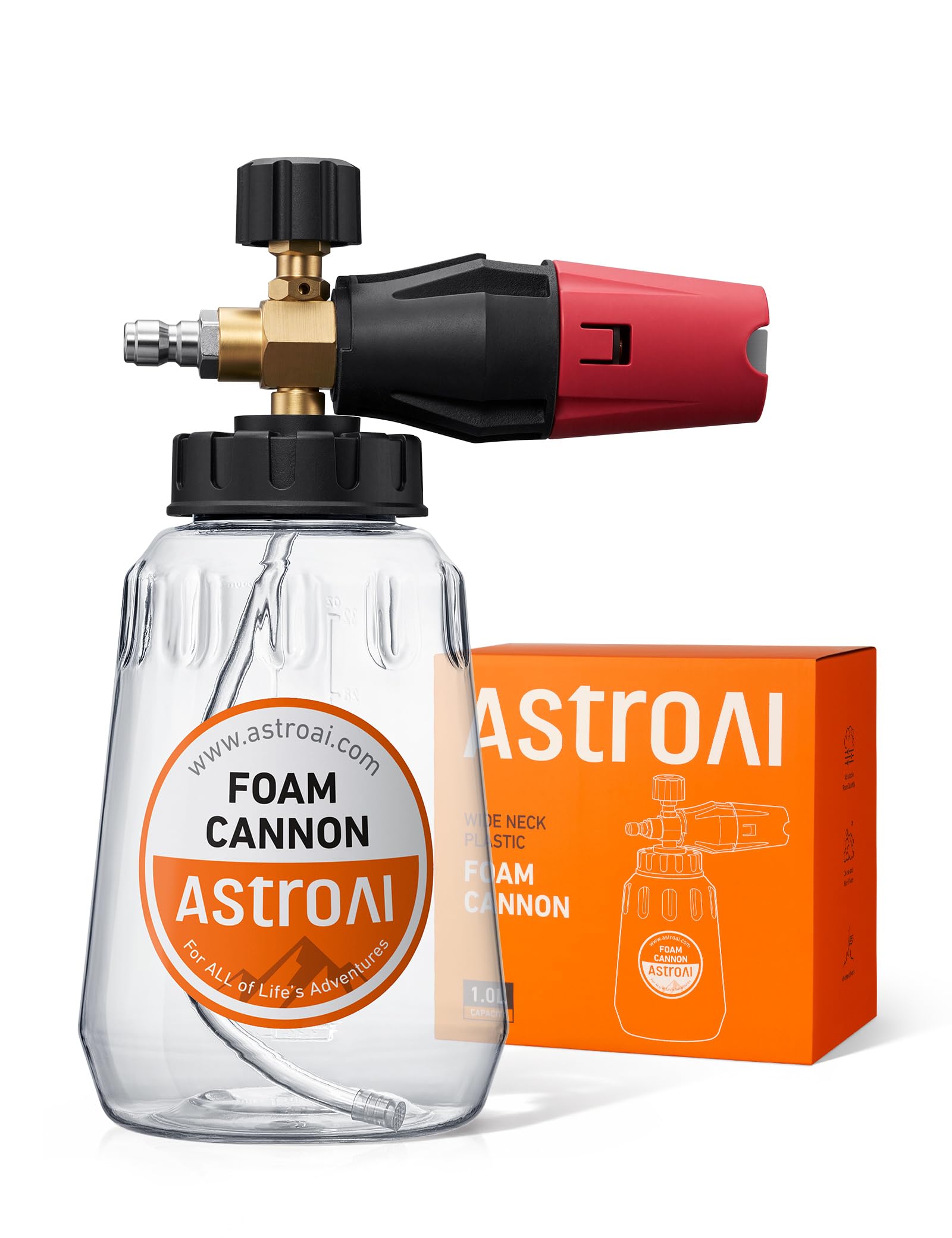
AstroAI has built a reputation for delivering capable gear at accessible price points, and this foam cannon continues that trend. The 1‑liter clear bottle features calibration markings so you can measure the soap‑to‑water ratio without opening the lid, a small detail that saves time and reduces waste. The 1/4‑inch quick connector fits most standard pressure washer guns, and the brass fittings provide corrosion resistance that cheap all‑plastic units lack.
The adjustable nozzle rotates 360 degrees and switches from a jet stream to a wide fan pattern, giving solid coverage for both soap application and rinsing. Owner data indicates that using a non‑wax detergent is important to prevent internal clogging, which is a common issue across many foam cannons at any price. The wide‑neck design genuinely makes pouring soap easier — no funnel required, and no spilled cleaner on the garage floor.
Performance is best in the 1000‑3000 PSI range, covering the vast majority of electric pressure washers used by home detailers. Foam thickness is good but not as dense as what the Adam’s or MTM units produce; the difference is noticeable on vertical panels with heavy grime. Still, for someone stepping up from a bucket and sponge for the first time, this cannon delivers a meaningful improvement in wash quality and contact‑safety without stretching the budget.
What works
- Calibration markings on the bottle for accurate soap mix
- Brass fittings resist corrosion
- Wide neck simplifies soap pouring
What doesn’t
- Foam density lags behind premium cannons
- Requires careful detergent selection to avoid clogs
4. Raincovo Foam Cannon

Raincovo’s foam cannon targets owners of lower‑pressure washers with a smart design choice: a replaceable 1.1 mm orifice nozzle that boosts foam production when working below 1500 PSI. This makes it one of the few budget‑friendly options that actually adapts to the equipment rather than forcing the equipment to adapt to it. The stainless steel filter is a genuine upgrade over plastic mesh screens — it resists deformation and allows for better flow consistency over time.
The 1‑liter clear bottle has a wide mouth that makes mixing and rinsing straightforward, and the adjustable nozzle rotates to any angle for tight spots around wheel wells and bumpers. The regulator knob gives manual control over foam thickness, though owners note that finding the sweet spot takes a couple of test sprays. Compatibility with both M22 14mm and 1/4‑inch quick connects means it fits a broader range of pressure washer brands without adapter hunting.
Build quality is a step above the very cheapest cannons thanks to the stainless elements and brass fittings, but the body remains mostly plastic. The unit performs best when rinsed thoroughly after each use — hard water deposits inside the nozzle will affect spray pattern over time. For the price, the Raincovo offers the most flexible low‑pressure performance available, making it a strong pick for owners of electric washers under 1800 PSI who still want decent foam.
What works
- Additional 1.1 mm orifice improves low‑pressure foam
- Stainless steel filter lasts longer than plastic
- Dual connector compatibility (M22 and 1/4″)
What doesn’t
- Plastic body not as impact‑resistant as reinforced versions
- Foam adjustment takes trial and error
5. RAINPOINT Garden Hose Nozzle
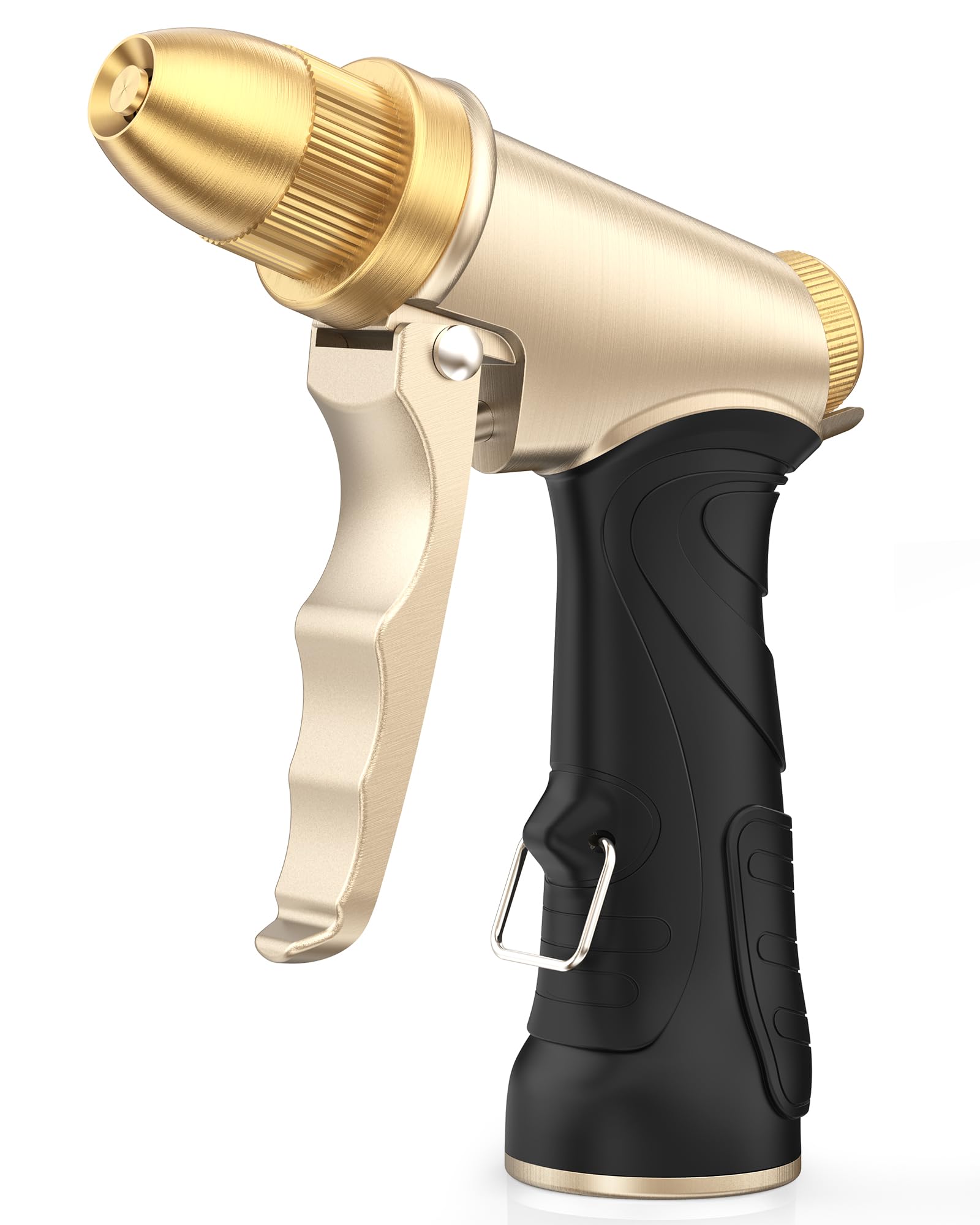
Not every car wash requires a pressure washer. The RAINPOINT hose nozzle proves that a well‑built manual sprayer can handle rinsing, pre‑soak, and light cleaning duties with authority. The body is constructed from heavy‑duty zinc and brass rather than the cheap plastic found on most hardware‑store nozzles. The brass head delivers a genuinely high‑pressure jet even on standard garden hose water pressure, making it effective for knocking loose dirt from wheels and lower panels before the wash mitt touches the paint.
The threaded connector uses the standard 3/4‑inch GHT fitting, so it screws onto any American garden hose without an adapter. Spray patterns range from a fine mist suitable for wetting delicate surfaces to a concentrated jet that reaches the roof of an SUV. The rubber grip is heat‑resistant and stays comfortable during extended sessions, and the lock mechanism holds the trigger open — a small feature that reduces hand fatigue when rinsing a whole vehicle.
Where this nozzle fits into a wash routine is as the initial rinse and final rinse tool. It does not produce foam like a cannon, but it applies water with enough control to avoid forcing grit across the paint. The metal construction suggests a lifespan measured in years rather than months, and the one‑piece brass head eliminates the leakage points found in multi‑piece plastic designs. For owners who prefer foam‑free washing or simply want a durable backup sprayer, this is the smart buy.
What works
- All‑metal construction with brass head
- Strong jet performance from standard hose pressure
- Ergonomic rubber grip with trigger lock
What doesn’t
- Not compatible with pressure washers
- No foam or soap mixing capability
Hardware & Specs Guide
Foam Density & Soap Ratio
Foam cannons rely on the Venturi effect to mix water with detergent. The ratio of air to liquid determines whether the foam is thin and runny or thick and creamy. Units with an adjustable intake valve let you dial in the mixture: a higher soap concentration produces denser foam that clings to vertical surfaces and dwells longer, breaking down road grime before the wash mitt makes contact. Fixed‑orifice cannons deliver a single ratio, which may be too thin for heavy soiling or too thick for light maintenance washes.
Material Construction & Durability
The connector and internal components see the most stress. Brass and stainless steel fittings resist corrosion from soap chemicals and hard water, while zinc alloy bodies withstand drops and knocks better than standard plastics. Fiberglass‑reinforced plastic, used in commercial‑grade units, provides a balance of impact strength and light weight. Plastic bottles on foam cannons are common, but wide‑mouth designs are easier to clean and less likely to trap dried soap residue that clogs the pickup tube over time.
Connector Compatibility
Foam cannons typically use 1/4‑inch quick connects or M22 threaded fittings. Many kits include both options or adapters to bridge different pressure washer brands. Garden hose nozzles use 3/4‑inch GHT (garden hose thread) as the standard in North America. Checking your pressure washer’s connection type before purchase avoids the frustration of a part that does not screw on. A quick‑connect system on the foam cannon side also makes swapping between the cannon and a standard spray wand effortless.
Maintenance & Care
Every foam cannon should be flushed with clean water after each use. Soap residue left inside the bottle and nozzle dries into a film that reduces foam quality and can block the internal metering orifice. Storing the unit indoors away from direct sunlight prevents UV degradation of plastic components and keeps the rubber O‑rings from drying out. Hose nozzles benefit from the same rinse habit — minerals in hard water can seize the rotating head if the nozzle is left wet for weeks at a time.
FAQ
Can I use a foam cannon with a standard garden hose?
What PSI do I need for a foam cannon to work well?
How much soap should I put in a foam cannon?
Are brass hose nozzles better than plastic ones?
How do I prevent my foam cannon from clogging?
Final Thoughts: The Verdict
For most buyers, the best car wash hose attachment winner is the Adam’s Polishes Standard Foam Cannon because it balances thick foam output, easy adjustability, and proven build quality at a price that makes sense for regular home detailers. If you want professional‑grade durability and a complete gun‑and‑cannon kit, grab the MTM Hydro PF22 Kit. And for a straightforward, no‑pressure‑washer-needed solution that still delivers strong rinsing control, nothing beats the RAINPOINT Garden Hose Nozzle.

Certification: BSc in Mechanical Engineering
Education: Mechanical engineer
Lives In: 539 W Commerce St, Dallas, TX 75208, USA
Md Amir is an auto mechanic student and writer with over half a decade of experience in the automotive field. He has worked with top automotive brands such as Lexus, Quantum, and also owns two automotive blogs autocarneed.com and taxiwiz.com.