A turbocharger is the heart of forced induction — and choosing the wrong one can leave you chasing boost leaks, oil smoke, and a lighter wallet. The market is flooded with options that look identical on paper but differ dramatically in materials, balancing, and real-world durability. This guide cuts through the marketing noise to focus on what actually keeps a turbo alive under sustained load.
I’m Amir — the founder and writer behind Four Wheel Ask. My approach relies on deep market research, cross-referencing technical specifications with thousands of verified owner reports to separate parts that deliver from those that disappoint.
Through extensive analysis of owner feedback and technical data, this best car turbo guide focuses on turbochargers with proven real-world reliability and genuine performance capability.
How To Choose The Best Car Turbo
Selecting a turbocharger goes far beyond matching a flange pattern. You need to evaluate bearing technology, compressor wheel metallurgy, turbine housing material, and the quality of balance work — all of which determine whether the unit lasts 10,000 miles or 100,000. This section walks through the core decisions.
Bearing Technology: Journal vs. Ball Bearing
Journal bearing turbos use a thin film of oil to float the shaft and are the traditional, lower-cost design. They work well for street applications but require consistent oil pressure and warm-up time. Ball bearing turbos, like the Garrett Powermax series, reduce friction at the shaft, allowing quicker spool and better transient response. They tolerate lower oil pressure at idle but come at a significant price premium. For a daily-driven vehicle that sees stop-and-go traffic, a quality journal bearing unit with proper oil maintenance can perform reliably for years. For high-performance builds where every millisecond of spool matters, ball bearing is the clear choice.
Compressor and Turbine Wheel Materials
Compressor wheels are typically cast aluminum or machined billet aluminum. Billet wheels, as seen on the maXpeedingrods T4 and the Billet T78, offer improved airflow geometry and higher burst strength because the material is cut from a solid forging rather than cast. Turbine wheels face extreme thermal stress — entry-level units use cast Inconel or K18, while premium options move to Mar-M or Inconel 713C. Turbine housing material also matters: ductile iron handles up to roughly 1,300°F, while silicon-molybdenum (SiMo) housings, like those on the Billet T78, extend tolerance to over 1,500°F for sustained high-boost use.
Balancing and Assembly Quality
A turbocharger spins at speeds exceeding 150,000 RPM. Even a microscopic imbalance can lead to shaft whip, seal failure, and bearing collapse within a few thousand miles. Premium units from Garrett undergo dynamic balancing on Schenck machines, with VSR (very strict residual) balancing for the highest-speed applications. Budget turbos often skip this step or use basic single-plane balancing. Always look for a balance sheet in the box — if the manufacturer does not provide one, there is a reason.
Quick Comparison
On smaller screens, swipe sideways to see the full table.
| Model | Category | Best For | Key Spec | Amazon |
|---|---|---|---|---|
| Garrett Power Max GT3788VA | Diesel | 6.0L Powerstroke upgrade | Stage 2, 41.8 lb, 360° thrust bearing | Amazon |
| Garrett Duramax 848212-5001S | Diesel | 6.6L LMM/LLY/LBZ, direct OE | OE-spec, includes banjo bolt and sensor | Amazon |
| Garrett GT2056S 743250-5014S | Diesel | 6.0L Powerstroke stock replacement | 100% new GT3782VA, 40 lb | Amazon |
| Garrett Powermax GTP38R | Diesel | 7.3L Powerstroke ball bearing | Ball bearing, bolt-in kit, 30 lb | Amazon |
| VIV TD04-17T 49131-07031+07041 | Gas | N54 335i twin turbo upgrade | Billet 17T, 650 hp, 33.8 lb | Amazon |
| VIV Billet T78 7875 | Gas | LS / high-horsepower street builds | T4, A/R.96/.75, 800-1000 hp, 22.8 lb | Amazon |
| Stigan 847-1446 | Gas | 1.4T Cruze/Sonic/Trax/Encore | Brand new, 2-year warranty, 12 lb | Amazon |
| A-Premium F-150 CL3Z-6K682-C | Gas | 3.5L Ecoboost left-right pair | KO3, wastegate + gaskets, 28.4 lb | Amazon |
| maXpeedingrods T4 JD Series | Gas | 4.0L-6.0L, up to 600 hp | T4 flange, billet wheel, 38.9 lb | Amazon |
| A-Premium Cruze APTBC001 | Gas | 1.4L Cruze/Sonic/Trax/Encore | OE replacement, wastegate + gasket, alloy steel | Amazon |
| maXpeedingrods GTP38 | Diesel | 7.3L Ford Super Duty / Excursion | Direct OEM replacement, 16.7 kg | Amazon |
In‑Depth Reviews
1. Garrett Power Max GT3788VA Turbo Kit — Ford Power Stroke 6.0L

The Garrett Power Max GT3788VA represents a genuine step up from the factory 6.0L Powerstroke turbo. This Stage 2 kit uses a larger compressor wheel and a revised turbine housing that shifts the power band upward, providing measurable gains in peak boost and top-end horsepower without sacrificing drivability entirely. Owner reports consistently praise the improved whistle and the ability to hold boost at higher RPM ranges compared to the stock GT3782VA.
Installation feedback indicates a direct bolt-in fit for 2004-2007 Ford 6.0L trucks, though the larger housing requires dropping the transmission crossmember about four inches to gain clearance during reassembly. This is a known nuance, not a design flaw — plan for it. The unit includes all necessary hardware, and owners who replaced a failed stock unit report immediate resolution of boost codes and smoke issues.
Some owners note that spool at low RPM is slightly slower than the stock turbo, which is expected given the larger flowing architecture. Once above 2,000 RPM, the turbine hits hard and pulls strong to redline. The build quality matches Garrett’s reputation, with tight shaft tolerances and a proper balance sheet included. This is the pick for a 6.0L owner who wants genuine performance without moving to an aftermarket custom kit.
What works
- Significant top-end power gain over stock
- Bolt-in fitment with all hardware included
- Genuine Garrett build quality and balance
- Eliminates underboost and oil-smoke codes
What doesn’t
- Slow spool from dead stop compared to stock
- Requires dropping crossmember for install
- Housing not chrome as depicted in some listings
2. Garrett 848212-5001S Chevrolet/GMC 6.6L Duramax Turbocharger

The Garrett 848212-5001S is the factory-spec replacement for 6.6L Duramax engines spanning the LLY, LBZ, and LMM generations, covering Chevrolet Silverado and GMC Sierra 2500/3500 models from 2004 through 2010. This is a brand-new unit, not a remanufactured core, and it includes the banjo bolt, cobalt pins, and sensor needed for a complete swap. Owner reports confirm that it fits and performs identically to the original equipment turbo when the truck was new.
One important detail surfaced in owner feedback: the turbo ships with an LMM-style billet compressor wheel, which is not backward-compatible with the older LBZ wheel design. Buyers with a 2004-2005 LLY or 2006-2007 LBZ need to verify whether their truck has been updated to the LMM wheel pattern. Most stock trucks work fine, but it is worth checking the turbo identification tag before ordering to avoid a compatibility issue.
Installation is straightforward for a qualified mechanic, and the turbo runs clean with no boost faults or oil leakage when properly primed. Owners describe the performance as identical to OEM with minor factory updates that improve reliability. For Duramax owners who want a drop-in replacement with zero guesswork and genuine Garrett engineering, this is the standard.
What works
- Brand-new, not remanufactured
- Includes banjo bolt, sensor, and pins
- OE-perfect fitment and performance
- Genuine Garrett with full factory support
What doesn’t
- LMM wheel may not suit older LBZ trucks
- No install gasket kit included
- Premium price reflects OE-level cost
3. Garrett 743250-5014S GT2056S / GT3782VA Turbo — Ford 6.0L

The Garrett GT3782VA (part number 743250-5014S) is the stock replacement turbo for 2005.5-2007 Ford 6.0L Powerstroke diesel engines. Unlike remanufactured units that reuse compressor and turbine wheels with unknown fatigue cycles, this turbo is 100% newly manufactured. Garrett’s compressor wheel testing protocol mandates one million cycles before introduction, which effectively eliminates the hub burst and wheel splitting risks that plague rebuilt cores.
Owner feedback highlights a critical advantage: the solenoid control valve on this unit uses stricter oil-flow regulation parameters that reduce the volume of oil directed toward the turbine end seal. This directly addresses the seal leakage problem that causes the white-blue smoke cloud familiar to 6.0L owners. The turbo arrives with all necessary bolts, O-rings, and a gasket — though several owners recommend purchasing a separate install kit to have spare seals on hand before you start.
Installation takes a full day for a DIY owner with moderate mechanical experience, and those who have done it report that the truck runs like new afterward. Shifting smooths out, acceleration returns, and boost codes disappear. The cost is roughly mid-range compared to dealer pricing, and the build quality justifies the spend for anyone who wants to avoid the uncertainty of a remanufactured core.
What works
- 100% new, zero fatigue cycles on rotating assembly
- Solenoid valve design reduces turbine seal leaks
- Complete hardware kit included in box
- Restores factory boost response and reliability
What doesn’t
- Lacks install kit with extra seals
- Full-day install for first-time DIY owners
- No significant power gain over stock
4. Garrett Powermax GTP38R Ballbearing Turbocharger — 7.3L Powerstroke
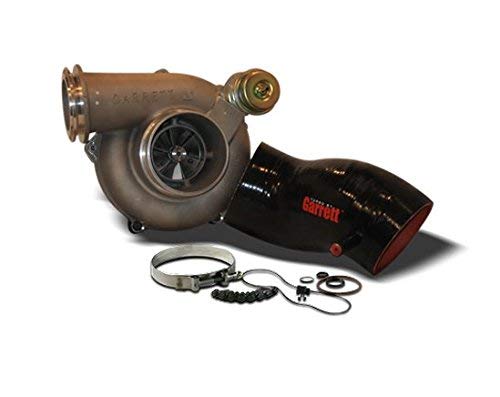
The Garrett Powermax GTP38R is the definitive ball-bearing upgrade for the 7.3L Powerstroke. It uses Garrett’s patented dual ball-bearing cartridge, which dramatically reduces internal friction compared to the factory journal bearing design. The result is noticeably quicker spool, less turbo lag in daily driving, and a broader power band that pulls harder through the mid-range and top end. The kit is truly bolt-in, including new bolts, O-rings, and the Y-pipe and downpipe adapters that align perfectly with the factory plumbing.
Owner reports from Excursion and F-Series applications confirm that the unit eliminates the surge and smoke issues common with worn stock turbos. The compressor housing is significantly larger than the factory GTP38 — roughly three times the volume — which contributes to the improved airflow. Some owners note that the MAF bracket and crankcase breather tube require minor adjustment for a clean fit, and the wastegate arm may arrive loose from the factory, requiring a quick quarter-turn on the nut to set preload correctly.
Durability feedback is mixed but instructive: many owners report tens of thousands of trouble-free miles, while a smaller subset experienced bearing noise or seizure after installation. In cases where metal fragments were found in the oil, warranty claims were denied, which underscores the critical importance of a clean oil supply and proper turbo priming. For 7.3L owners who accept that this is a high-performance upgrade requiring meticulous installation, the GTP38R delivers a transformative driving experience.
What works
- Dual ball-bearing design for quick spool
- Complete bolt-in kit with all hardware
- Eliminates surge and reduces smoke
- Significant mid-range and top-end improvement
What doesn’t
- MAF bracket and breather tube need adjustment
- Wastegate arm often loose from factory
- Bearing failures reported if oil supply is contaminated
5. VIV TD04-17T 49131-07031+07041 Billet Twin Turbos — BMW N54 335i

The VIV TD04-17T twin turbo set is designed specifically for the N54 engine found in the E89, E90, E91, E92, and E93 335i chassis — left-hand drive only. This is an upgraded 17T billet configuration that claims 650 horsepower capability, using high mixed-flow forged billet compressor wheels with extended tip geometry. Owner reports confirm that these turbos deliver a dramatic improvement in transient response compared to the factory units, with one owner running full bolt-ons at 21 psi and reporting excellent behavior across multiple pulls.
Build quality impressions are positive at the unboxing stage: the turbos arrive with VSR balance sheets, tight shaft play tolerances, and solid packaging that suggests careful handling from the overseas manufacturer. Several owners note that the turbos appear identical in fitment to other Chinese 17T offerings but emphasize that the execution — particularly the billet wheel finish and housing casting — feels a step above the cheapest alternatives.
The durability picture is less certain. One owner experienced seal failure at roughly 900 miles on an MHD Stage 2+ tune, which resulted in smoke under acceleration and increased oil consumption. Others have accumulated 3,000 miles without issue, running the turbos hard on JB4 and custom tunes. The supplied gaskets and hardware are widely recommended to be replaced with OEM quality parts. This is a high-risk, high-reward upgrade for the N54 enthusiast who understands the trade-offs of budget twin-turbo solutions.
What works
- Excellent spool and transient response
- VSR balance sheets included in box
- Cost-effective alternative to Pure Stage 2
- Direct bolt-on for N54 LHD chassis
What doesn’t
- Seal failures reported before 1,000 miles
- Supplied gaskets and hardware are low quality
- Wastegate rattle common out of the box
6. VIV Billet T78 7875 T4 A/R.96/.75 Turbocharger — 800-1000 hp

The VIV Billet T78 7875 is a T4-flanged, 800-1000 horsepower turbo that punches well above its price point. The turbine housing is constructed from silicon-molybdenum, which withstands exhaust gas temperatures exceeding 1,500°F without cracking or warping — a critical feature for high-boost applications on LS, 6.0L, and other large-displacement builds. The compressor features a full-machined billet aluminum wheel with aerodynamic profiling that improves flow efficiency and boost response.
Owner feedback from LS swaps and truck applications indicates that this turbo spools quickly for its size, with reports of strong boost onset around 3,000 RPM on a 5.3L and a 6.0L. One owner running 6 psi on a stock 5.3L reported that the turbo spools “quickly” and that the truck maintained perfect performance over 500 miles. Another owner installed it on an 82 GMC short wide with a 6.0L single-turbo setup and noted that the spool time felt perfectly matched to the displacement.
The unit uses a journal bearing with a copper alloy construction, which is well-suited for street use where consistent oil pressure is available. A few owners noted that the compressor housing uses an RTV seal rather than an O-ring, which is typical at this price point but worth checking during installation. The turbo arrives with a balance sheet and zero shaft play out of the box. For a budget-conscious builder targeting 800-plus horsepower, this is the strongest value proposition in this size class.
What works
- SiMo housing handles extreme EGTs
- Billet compressor wheel for efficient flow
- Quick spool on 5.3L-6.0L engines
- Balance sheet and zero shaft play out of box
What doesn’t
- RTV seal instead of O-ring on compressor cover
- Appearance may differ from listing photo
- Journal bearing requires clean oil at all times
7. Stigan 847-1446 Turbocharger — Chevy Cruze / Sonic / Trax / Buick Encore 1.4T
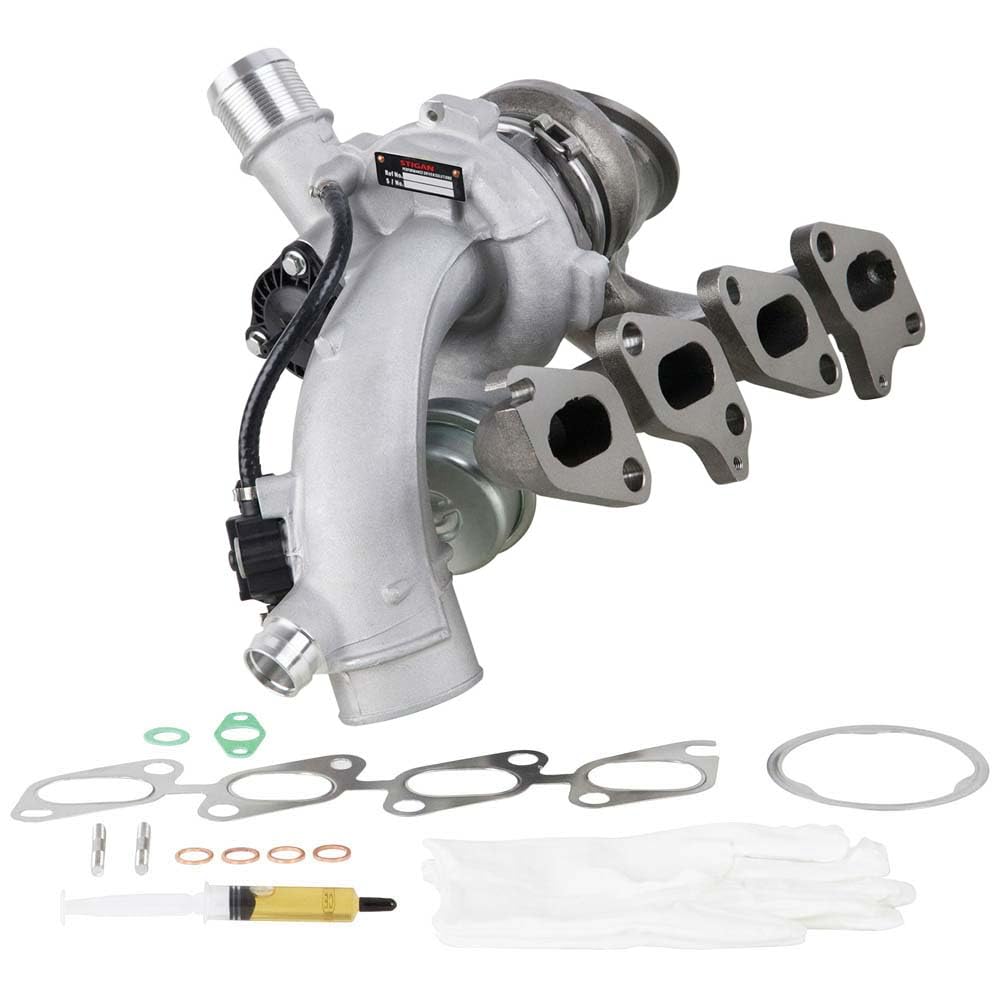
The Stigan 847-1446 is an exact-fit replacement turbocharger for GM’s 1.4L EcoTec engine family, covering the Chevy Cruze (2011-2015), Sonic (2012-2020), Trax (2015-2020), and Buick Encore (2013-2020 without the High Output package). Every component is brand new — nothing remanufactured, no core deposit required. The turbo is backed by a two-year unlimited-mileage warranty, which is significantly longer than most competitors in this segment.
Owner reports consistently highlight that the kit arrives complete with all gaskets and even a syringe for pre-lubricating the bearings during installation. Multiple owners who upgraded from cheaper alternatives note that the Stigan turbo solved overboost codes and erratic boost behavior that plagued the budget units. The build quality is described as noticeably better than the entry-level competition, with tighter shaft clearances and a more robust wastegate actuator.
There is a critical warranty condition that buyers must know: the two-year warranty requires installation of a new oil supply line. The Amazon listing does not explicitly state this requirement, but the instructions inside the box do. Owners who reused their old oil line risk voiding the warranty. One owner also reported a wastegate lever failure after a few miles, though the seller offered a replacement and store credit. For Cruze and Sonic owners who plan to keep their cars long-term, the Stigan is the mid-range sweet spot between cheap replacements and dealer-priced OEM units.
What works
- Brand new, not remanufactured — no core charge
- Two-year unlimited-mileage warranty
- Complete kit with gaskets and pre-lube syringe
- Restores factory boost and power reliably
What doesn’t
- Warranty requires new oil supply line (not stated online)
- Wastegate lever failure reported on some units
- Higher price than generic budget turbos
8. A-Premium Complete Turbo Kit — Ford F-150 3.5L Ecoboost 2011-2012

This A-Premium turbo kit provides both left and right side turbochargers for the 2011-2012 Ford F-150 equipped with the 3.5L Ecoboost V6. The kit includes the wastegate actuator and all necessary gaskets, making it a complete replacement solution for the KO3-based factory system. Each turbo is constructed with high-grade alloy housings designed to dissipate heat rapidly at extreme rotational speeds, which is particularly important for the tight packaging of the Ecoboost engine bay.
Owner feedback emphasizes the substantial cost savings compared to OEM Ford parts — the pair is priced at roughly a fraction of what two dealer-sourced turbos would cost. Fitment is reported as direct and problem-free, with the turbos bolting up without the need for modifications. The majority of buyers describe the quality as “good” or “very good” for the price, noting that the turbos restored lost power and eliminated boost-related check engine lights.
There are two areas of concern based on cumulative owner reports. First, the packaging is described as minimal, and some turbos arrived with cosmetic damage to the boxes, though the units themselves were intact. Second, one owner reported a turbo malfunction at less than 1,000 miles, just before the one-year warranty expired, and described a difficult warranty claim process. This is a solid budget-oriented twin-turbo solution for Ecoboost owners, but the warranty limitation means it is best suited for those who can handle a potential out-of-warranty replacement.
What works
- Complete pair with wastegate and gaskets included
- Direct bolt-in fitment for 2011-2012 F-150
- Substantial savings compared to OEM Ford turbos
- Restores factory boost and performance
What doesn’t
- Packaging is minimal and offers limited protection
- One-year warranty requires strict timing for claims
- Early failure reported on at least one unit
9. maXpeedingrods T4 Turbo JD Series — 4.0L-6.0L Engine, Up to 600 hp
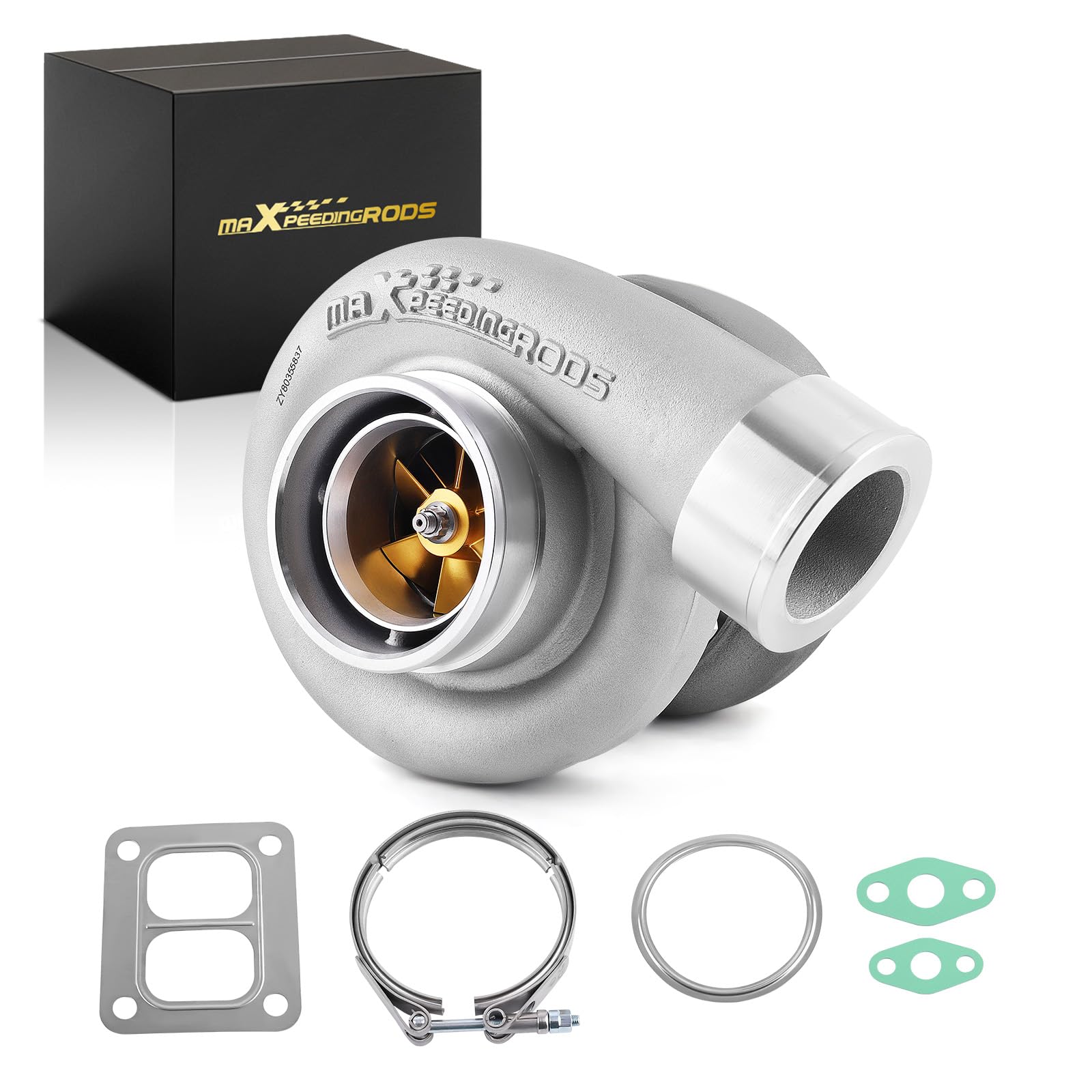
The maXpeedingrods T4 JD Series turbo is a value-oriented option for 4.0L to 6.0L gasoline engines, with a rated capacity of up to 600 horsepower. It uses a forged full-machined billet aluminum compressor wheel with an aerodynamic profile designed to improve airflow and compression efficiency across the operating range. The turbine housing is made of silicon-molybdenum, rated to withstand exhaust temperatures up to 1,562°F, while the upgraded alloy turbine wheel is rated to 1,832°F for oxidation stability.
Owner impressions are generally positive, with several buyers commenting that the fit and finish exceeded expectations for the price point. The turbo bolts up to standard T4 manifolds without issue, and the billet wheel shows clean machining with no visible casting imperfections. One owner planning a Foxbody Mustang build noted that the turbo looked “well built” and was eager to see its performance on the track. Another used it as a replacement for a different budget turbo that suffered from oil starvation and reported that the maXpeedingrods unit was noticeably better in both quality and appearance.
There is one critical warning from the owner feedback: a 6.0L LS builder reported that the turbo overheated at only 8 psi of boost, causing intake temperature spikes that made the setup unusable. This suggests that the turbo’s cooling and flow characteristics may not suit every engine combination, particularly larger-displacement LS engines that generate significant exhaust volume at low boost. This is not a universal failure — multiple other owners on similar engines reported success — but it indicates that this turbo is best matched to engines in the 4.0L-5.3L range rather than pushed to the upper limit of its stated displacement range.
What works
- Billet compressor wheel with excellent machining
- SiMo housing for high-temperature durability
- Good fit and finish for the budget price
- Quick spool characteristics on smaller engines
What doesn’t
- Overheating reported on 6.0L LS at low boost
- Not all engines in stated range are compatible
- Limited owner data on long-term durability
10. A-Premium APTBC001 Complete Turbo — Chevy Cruze / Sonic / Trax / Buick Encore 1.4L
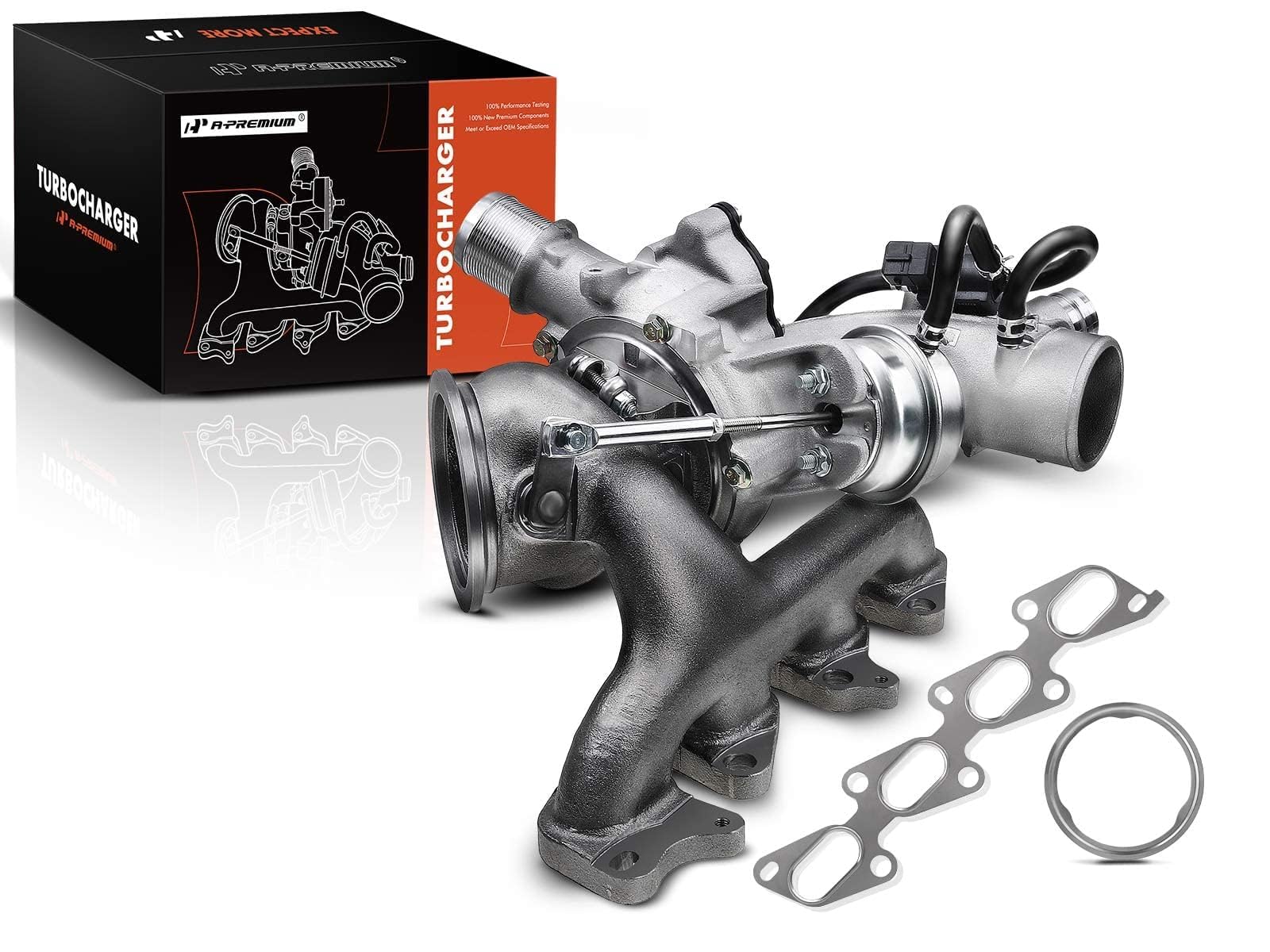
The A-Premium APTBC001 is a complete turbocharger assembly for the GM 1.4L EcoTec LUV engine, covering the Cruze (2011-2015), Sonic (2012-2020), Trax (2013-2021), and Buick Encore (2013-2021). The unit features a sealing device installed between the compressor wheel and bearing support, which is specifically designed to prevent oil from leaking into the intake manifold — a common failure point on high-mileage EcoTec turbos. The compressor and turbine housing are made of high-grade alloy steel and brass for heat dissipation.
Owner reports show a split experience. On the positive side, many buyers report successful installations that eliminated the P0299 low-boost code and restored full power. One owner with a 2014 Cruze at 83,000 miles noted that the turbo fit like the OEM unit and required a full day to install, with the oil return and coolant pipes being the most frustrating part of the job. Another owner reported 11,000 trouble-free miles on a Chevy Trax after a year of use, with no check engine light since the swap.
There are also reports of defective units arriving out of the box, causing stalling and oil leaks immediately after installation. In those cases, the company’s warranty process did not cover labor or related expenses, and some owners were left with a non-functional turbo and no recourse beyond the cost of the part itself. A-Premium offers a one-year unlimited-mileage guarantee that covers the part only. The key to success, according to long-term owners, is performing an oil change before and after installation and properly priming the turbo with clean oil before the first start.
What works
- OE-spec fitment with sealing device to prevent oil leaks
- Restores full boost and eliminates P0299 code
- Good results when installed with proper priming
- Budget-friendly alternative to Stigan or OEM
What doesn’t
- Defective units reported with no labor coverage
- Warranty covers part only, not installation costs
- Oil return and coolant pipes are difficult to access
11. maXpeedingrods GTP38 Basic PVL Series — Ford 7.3L Super Duty / Excursion

The maXpeedingrods GTP38 Basic PVL Series is a direct OEM replacement turbocharger for Ford 7.3L Powerstroke engines, covering the F-250, F-350, F-450, F-550 Super Duty (1999-2003) and Excursion (2000-2003). It is engineered as a bolt-in replacement requiring no modifications, with OE part number cross-references including F81Z6K682CARM, 1831383C92, and over a dozen factory numbers. The compressor wheel is forged from premium aluminum alloy with aerodynamic profiling, and the turbine housing is ductile iron rated to 1,292°F.
Owner feedback on this unit runs the gamut from enthusiastic to frustrated. On the positive side, many buyers report that the turbo arrived well-packaged with protective covers over all ports, pre-lubricated bearings, and torque seal markings on critical fasteners. One company installed it on a Ford F350 and reported being happy with the towing performance improvement. Another owner with initial doubts was impressed by the overall quality, calling it “high quality” after installation.
The negative reports focus on hardware quality issues. One owner reported that the four allen head bolts that secure the compressor housing backed out after two months, stripping the threads on two of them — and customer service stated they did not stock those parts at the US warehouse. Another owner noted that while the turbo bolted up well and lasted roughly 100,000 miles, the overall quality did not feel on par with the original Garrett unit. This is a functional budget replacement for a 7.3L that needs to get back on the road, but owners should plan to use thread-locker on critical fasteners and potentially upgrade the hardware independently.
What works
- Direct OEM replacement with no modifications
- Well-packaged with protective port covers
- Delivers towing performance improvement
- Stood up to 100k miles on one owner’s truck
What doesn’t
- Allen head bolts known to back out
- US warehouse does not stock replacement hardware
- Overall quality not on par with original Garrett
Hardware & Specs Guide
Bearing Systems
Journal bearings use a copper-alloy sleeve that relies on a continuous film of oil to float the rotating shaft. They are durable when oil changes are maintained but require higher oil pressure at idle. Ball bearing turbos, like the Garrett GTP38R, use caged steel balls to reduce friction, allowing the shaft to spin more freely at low RPM. Ball bearing units cost more but offer faster spool, better transient response, and less sensitivity to oil pressure drops at idle. For street-driven trucks and daily drivers, a high-quality journal bearing turbo with proper oil maintenance delivers reliable service. For competition or towing applications where every bit of response matters, ball bearing is the superior architecture.
Compressor Wheel Metallurgy
Compressor wheels are either cast or machined from billet. Cast wheels are poured into molds and then finished — they are cost-effective but can have microscopic porosity that weakens the structure at high RPM. Billet wheels, such as those on the Billet T78 and maXpeedingrods T4, are cut from a solid forging of 2618 or 6061 aluminum. The machining process eliminates internal voids and allows for complex aerodynamic blade profiles that improve flow efficiency. For builds targeting over 20 psi of boost or sustained high-RPM operation, billet wheels provide a measurable safety margin against burst failure.
Turbine Housing Materials
Turbine housings must withstand extreme thermal cycling and exhaust gas temperatures. Ductile iron (used on the maXpeedingrods GTP38) is the entry-level material, with a temperature ceiling around 1,300°F. Silicon-molybdenum (SiMo) housings, found on the Billet T78 and maXpeedingrods T4, push that limit beyond 1,560°F while offering better resistance to thermal cracking. The highest-end housings use Inconel or stainless steel alloys that can live above 1,800°F. For street vehicles that rarely exceed 1,200°F exhaust gas temperature, ductile iron is sufficient. For tuned diesels or high-boost gasoline builds, SiMo or better is strongly recommended.
Balancing Standards
A turbocharger rotating assembly must be balanced to within a few thousandths of a gram to avoid destructive vibration at operational speeds. ISO 16949 and ISO 9001 certifications indicate that a manufacturer follows documented quality-control procedures, but they do not guarantee individual unit balance. The highest standard is VSR (Very Strict Residual) balancing, which uses Schenck or similar machines to measure and correct imbalance at multiple planes. The VIV TD04-17T and Billet T78 sets include VSR balance sheets, which allow the installer to verify the quality before installation. If a turbo does not include a balance sheet, assume it was not dynamically balanced to any meaningful standard.
FAQ
What are the signs of a failing turbocharger?
What is the difference between journal bearing and ball bearing turbos?
How important is priming a new turbo before starting the engine?
Can I install a larger turbo on my stock engine without supporting modifications?
Final Thoughts: The Verdict
For most buyers, the best car turbo winner is the Garrett Power Max GT3788VA because it delivers a genuine Stage 2 performance upgrade with factory-level build quality, direct bolt-in fitment for the 6.0L Powerstroke, and measurable real-world gains that owners consistently verify. If you want a premium OE-spec replacement for a diesel truck, the Garrett 848212-5001S Duramax is the safest bet. And for a budget-friendly street turbo that punches above its weight on an LS or small-block build, nothing beats the VIV Billet T78 7875.

Certification: BSc in Mechanical Engineering
Education: Mechanical engineer
Lives In: 539 W Commerce St, Dallas, TX 75208, USA
Md Amir is an auto mechanic student and writer with over half a decade of experience in the automotive field. He has worked with top automotive brands such as Lexus, Quantum, and also owns two automotive blogs autocarneed.com and taxiwiz.com.