Upgrading your dashboard with a stereo that treats Android Auto like a first-class citizen rather than an afterthought is the single most impactful change you can make to an older vehicle. Wireless connectivity, responsive touchscreens, and tunable audio processing have moved from luxury features to expected standards, and the units that nail the Android phone experience deliver seamless navigation, clear calling, and rich music playback without demanding a second thought about cables or compatibility.
I’m Amir — the founder and writer behind Four Wheel Ask. My work focuses on evaluating wireless protocol implementation, display panel quality, audio DSP tuning, and long-term owner feedback to separate genuine upgrades from spec-sheet noise.
Choosing the right unit means understanding wireless protocols, display technology, and audio processing capabilities. After thoroughly analyzing dozens of car stereos across wireless protocols, display quality, and audio processing, here is the definitive best car stereo for android phones.
How To Choose The Best Car Stereo For Android Phones
Android phones pair with car stereos through either a wired USB connection or a wireless Wi-Fi link after an initial Bluetooth handshake. The difference in daily convenience is massive, but wireless implementation quality varies significantly across brands and price tiers. Understanding what makes a stereo genuinely great for Android users starts with a few key decisions.
Wireless vs. Wired Android Auto
Wireless Android Auto relies on a 5 GHz Wi-Fi direct connection between your phone and the head unit. This eliminates cable clutter and automatically connects when you enter the car, but it draws more phone battery and can introduce latency on cheaper chipsets. Wired connections remain more stable and charge your device simultaneously. Many mid-range and premium units now support both, giving you the flexibility to choose based on trip length and battery level.
Display Panel Quality and Brightness
The screen is your primary interface for navigation and media selection. QLED panels, increasingly common in the mid-range, offer higher contrast and better sunlight readability than standard LCDs. Resolution also matters: 1024×600 is the baseline, but 1280×720 QLED units provide noticeably sharper map detail. Resistive touchscreens found on some brand-name units are less responsive than capacitive but work with gloves — a consideration for colder climates.
Audio Processing and Output Flexibility
Built-in digital signal processors (DSP) with multiband equalizers let you tune the soundstage to your vehicle’s acoustics. Units with 4.2-channel outputs — front, rear, and two dedicated subwoofer pre-outs — allow integration with aftermarket amplifiers without signal degradation. Look for 10-band or higher EQ controls if you prioritize audio customization, and verify pre-out voltage (2V or higher) for cleaner signal transmission to external amps.
Installation Compatibility and Required Adapters
Standard double DIN openings measure roughly 7 x 4 inches, but many vehicles require a dash kit, wiring harness adapter, and antenna adapter to achieve a clean factory-like fit. Some units include multiple mounting frames, but vehicles with irregular dash shapes — common in older trucks and SUVs — may still need a universal dash kit. Always verify your vehicle’s specific requirements before purchasing to avoid installation delays.
Quick Comparison
On smaller screens, swipe sideways to see the full table.
| Model | Category | Best For | Key Spec | Amazon |
|---|---|---|---|---|
| Sony XAV-AX4000 | Prem. Wireless | Flawless wireless Android Auto | 6.95″ capacitive touch, 14-band EQ, Maestro ready | Amazon |
| PLZ MP-928W | Mid QLED | Vibrant QLED display at a fair price | 7″ QLED 1280×720, DSP, 10-band EQ, fast-charge USB | Amazon |
| Alpine iLX-W670 | Audiophile | Precision audio tuning and sound staging | 7″ display, 13-band EQ, 6-channel time correction | Amazon |
| SJOYBRING W021 QLED | QLED Value | Budget-friendly QLED upgrade with dual subs | 7″ QLED 1280×720, 4.2-channel, wireless AA/CP | Amazon |
| JENSEN J1CA7 | Certified | Reliable brand with 3-year warranty | 7″ LED 1024×600, certified AA/CP, 1.5A USB charging | Amazon |
| Sony XAV-AX3200 | Compact | Easy installation in tight dash spaces | 7″ anti-glare resistive touch, compact rear chassis, 2V pre-outs | Amazon |
| SJOYBRING B0CT5P32L7 QLED | Physical Knob | Tactile volume control with QLED clarity | 7″ QLED 1280×720, 4.2-channel, SWC, physical knob | Amazon |
| Kissound KS9702 | Budget DSP | DSP audio processing on a tight budget | 7″ IPS 1024×600, DSP, 4.1-channel, dual mics | Amazon |
| SJOYBRING W005 | Entry Level | Feature-rich starter unit for Android Auto | 7″ HD 1024×600, wireless AA/CP, Bluetooth 5.3, physical knob | Amazon |
In‑Depth Reviews
1. Sony XAV-AX4000

Sony’s XAV-AX4000 sits at the top of the wireless Android Auto hierarchy for good reason. The 6.95-inch capacitive touchscreen delivers responsive, glare-resistant operation, and the wireless Android Auto implementation is among the most reliable tested — owner reports consistently describe seamless reconnection and minimal latency compared to lesser units. The compact chassis mounts in a single-DIN space while presenting a large display, making it a strong candidate for vehicles with limited depth behind the dash.
Audio tuning reaches a level rarely seen at this tier. The built-in DSP offers 14-band graphic equalization with time alignment adjustable down to one-centimeter increments across five addressable channels. This precision allows for genuine soundstage customization rather than the coarse adjustments typical of most aftermarket stereos. Four preset and two manual wallpaper options let you tailor the interface aesthetically, and Maestro readiness enables retained accessory power and vehicle data integration in compatible vehicles.
Owner feedback highlights the boot speed, the stability of wireless CarPlay and Android Auto connections, and the noticeable sound quality improvement over factory units. A small number of reports mention occasional screen freezing or Bluetooth persistence issues after disconnecting, but these appear isolated rather than systemic. For Android users who want the most polished wireless experience with professional-grade audio controls, this Sony delivers the complete package without compromise.
What works
- Wireless Android Auto connects quickly and stays stable
- 14-band EQ with 1cm time alignment for precise staging
- Compact single-DIN chassis fits tight dash spaces
What doesn’t
- Premium price positions it above most mid-range competitors
- Occasional screen freeze reports from long-term owners
2. PLZ MP-928W

The PLZ MP-928W brings QLED display technology and DSP audio processing to a price point that undercuts most competitors by a wide margin. The 1280×720 quantum-dot panel provides noticeably better color saturation and contrast than standard 1024×600 LCDs, and the anti-glare coating keeps navigation readable in direct sunlight. Wireless Android Auto connects reliably, and the inclusion of a fast-charging USB port means your phone gains meaningful charge during shorter trips rather than merely maintaining battery level.
Audio flexibility is generous for this segment. The unit includes a 10-band equalizer paired with a digital signal processor, and the 4.2-channel architecture provides front, rear, and dual subwoofer pre-outs for integrating aftermarket amplification. The upgraded amplifier chip delivers clean output at moderate volumes, though pushing to maximum power introduces some distortion — typical for this power class. Steering wheel control compatibility via an optional module adds convenience without requiring a separate adapter purchase in many cases.
Owner reports consistently praise the display brightness and the wireless connection stability, with several noting that the unit transformed the feel of older vehicles like Jeeps and Ford Expeditions. The included backup camera provides adequate night vision, and the hidden rear USB port keeps the dash clean. The primary limitation is the lack of a Wi-Fi hotspot feature, which the listing clearly states, and some users note that the microphone wire is shorter than ideal for overhead console routing.
What works
- QLED display at a price well below typical QLED units
- 10-band EQ with DSP for customized sound tuning
- Fast-charge USB port keeps devices powered
What doesn’t
- No Wi-Fi hotspot functionality
- Microphone cable length limits routing options
3. Alpine iLX-W670

Alpine has built a decades-long reputation for audio-first head units, and the iLX-W670 continues that tradition with a focus on sound quality rather than spec-sheet gimmicks. This is a wired-only Android Auto and Apple CarPlay unit — no wireless connectivity — which eliminates the battery drain and latency concerns that plague some wireless implementations. The trade-off is a rock-solid, instantly responsive connection every time you plug in, and the 1.5A USB port ensures your phone charges at a meaningful rate during use.
The audio processing suite is where this Alpine truly separates itself. The 13-band graphic equalizer offers granular frequency control, and the six-channel time correction allows precise alignment of each speaker’s arrival time at the listening position. The Sound Boost menu adds expanded bass and mid-bass controls alongside subwoofer adjustments, and the Lighting Link feature lets you coordinate Alpine’s PrismaLink subwoofer lighting directly from the screen. Crossover adjustments for front, rear, and subwoofer channels give experienced tuners full control over the soundstage.
Owner feedback from enthusiasts emphasizes the build quality and the intuitive interface layout. The customizable home screen accepts personal background images, and the five-color key illumination helps match factory dashboard lighting. PowerStack capability allows direct mounting of Alpine amplifiers behind the unit, saving installation space. The absence of wireless Android Auto will disappoint some buyers, but for those who prioritize connection stability and audio precision above cable-free convenience, this Alpine rewards the investment with every drive.
What works
- 13-band EQ with 6-channel time correction for pro-level tuning
- Rock-solid wired connection with no dropouts or lag
- PowerStack saves space by mounting amps behind the unit
What doesn’t
- No wireless Android Auto or Apple CarPlay
- Premium price without a physical volume knob
4. SJOYBRING W021 QLED

The SJOYBRING W021 represents a meaningful step up from the brand’s baseline models, swapping the standard 1024×600 LCD for a 1280×720 QLED panel that dramatically improves map readability and video playback clarity. Wireless Android Auto and Apple CarPlay connect automatically via Bluetooth handoff to a Wi-Fi direct link, and the integration feels fluid for a unit at this tier. The 1080P video support via USB mirroring adds entertainment flexibility when parked, though using navigation apps while driving remains the primary use case.
Audio architecture follows the 4.2-channel layout with front, rear, and dual subwoofer RCA pre-outs, allowing connection to multiple amplifiers without Y-splitters. The independent Bluetooth module and dedicated antenna improve connection stability compared to shared-chip designs, and streaming music or taking calls remains clear even at highway speeds. Steering wheel control integration requires a separate interface module, but the unit itself supports the necessary protocols for seamless SWC mapping once the adapter is installed.
The included HD night vision backup camera provides a 170-degree viewing angle with automatic activation in reverse. Installation follows the standard double DIN process, though some vehicles may require a dash kit and wiring adapters depending on the factory configuration. The QLED panel’s anti-glare properties are noticeable in bright conditions, and the color accuracy makes Google Maps and Waze significantly easier to read at a glance compared to standard LCD units in the same price neighborhood.
What works
- QLED panel delivers excellent brightness and color for navigation
- 4.2-channel outputs with dual subwoofer pre-outs
- Stable Bluetooth connection with dedicated module
What doesn’t
- No built-in DSP for advanced sound tuning
- SWC requires separate interface module purchase
5. JENSEN J1CA7
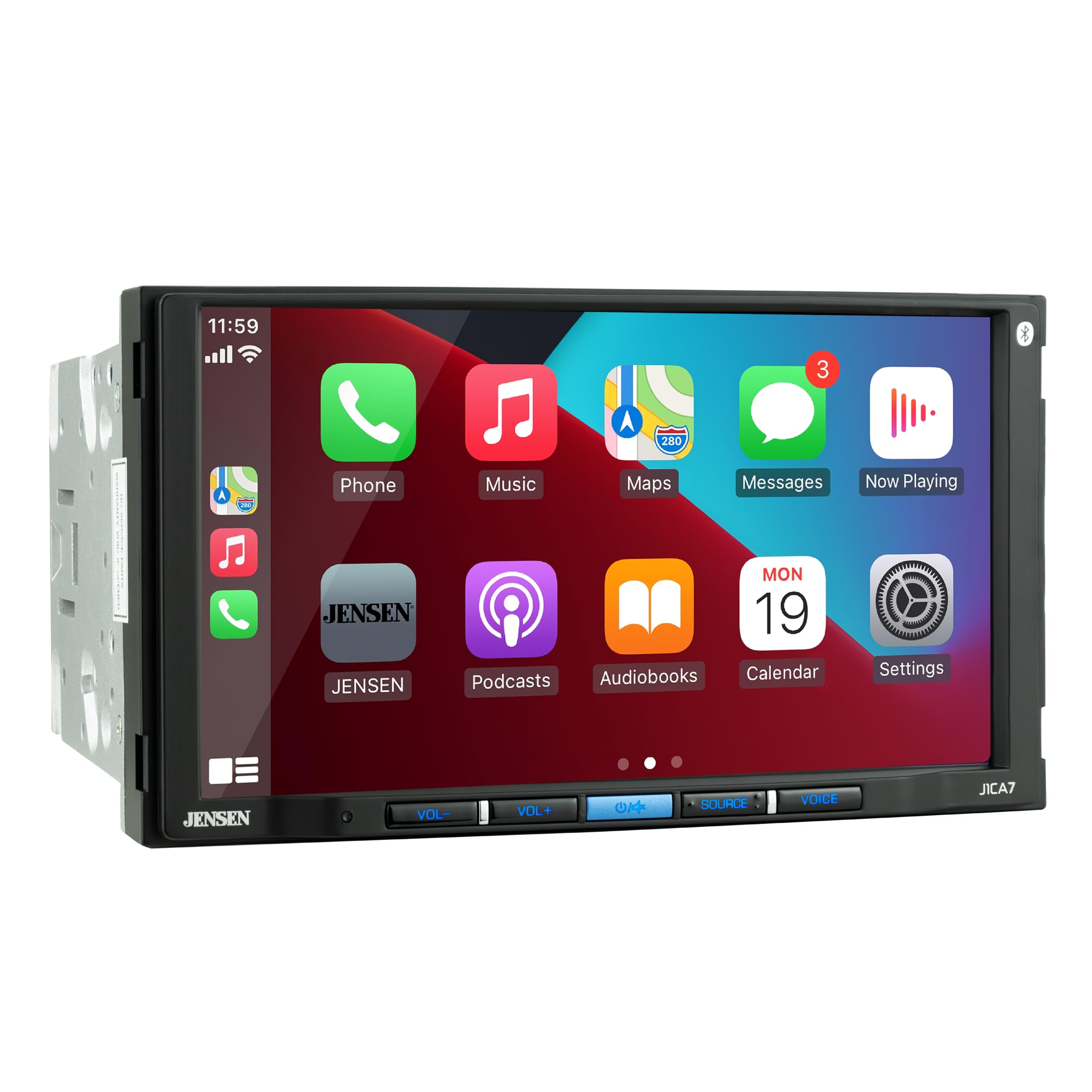
Jensen’s J1CA7 takes a refreshingly straightforward approach: certified Apple CarPlay and Android Auto compatibility backed by a standard 2-year warranty that extends to 3 years upon product registration. The certification matters because it guarantees compatibility with both Apple and Google’s latest OS updates — a concern with generic units that may lose functionality after phone software revisions. The 7-inch LED display runs at 1024×600 resolution, adequate for navigation and media display without the pixel density of QLED alternatives.
Connectivity covers the essentials without unnecessary frills. Bluetooth hands-free calling and music streaming pair quickly, and the rear USB port provides 1.5A fast charging to keep your phone topped up during longer drives. The backup camera input is standard RCA with auto-switching on reverse engagement, though the camera itself is sold separately. The interface is clean and responsive, with physical volume and tuning knobs that provide tactile feedback — a safety advantage over full-touchscreen designs that require visual confirmation for adjustments.
Owner feedback highlights the straightforward installation and the reliability of the Android Auto connection. The unit lacks advanced audio processing — no DSP, no multiband EQ, no subwoofer crossover adjustments — making it better suited for users running factory speakers who prioritize connectivity over sound customization. A small number of reports mention audio dropouts after extended use, and the absence of an auxiliary input may matter for users with older media devices. For buyers who value brand accountability and warranty support above feature density, the Jensen delivers predictable, certified performance.
What works
- Certified compatibility guarantees future OS updates work
- 3-year warranty after registration is best in class
- Physical knobs enable safer tactile control while driving
What doesn’t
- No DSP or advanced EQ for sound customization
- No auxiliary input on the rear of the unit
6. Sony XAV-AX3200

Sony’s XAV-AX3200 is a masterclass in practical design for difficult installations. The compact rear chassis — notably shorter than many competitors — fits into dash cavities that reject longer units, making it a top choice for European and Asian vehicles with limited behind-dash depth. The resistive touchscreen with anti-glare coating is a deliberate choice: it works with gloves, which matters for cold-weather drivers, and the reduced reflectivity keeps the display readable when the sun hits at an unfavorable angle.
Audio output uses gold-plated 2V pre-outs for front, rear, and subwoofer channels, providing clean signal transmission to external amplifiers. The rear 3.5mm A/V input adds flexibility for aftermarket camera or auxiliary source connections, and SiriusXM readiness expands content options for satellite radio subscribers. The wired Android Auto and Apple CarPlay connection is predictable and stable, lacking the convenience of wireless but avoiding the battery drain and connection variability that can plague wireless units in areas with Wi-Fi congestion.
The omission of advanced audio processing features like a multiband EQ or DSP reflects the AX3200’s positioning as a reliable connectivity hub rather than an audiophile tuning platform. The interface is clean and responsive, and Sony’s reputation for build quality provides reassurance for long-term ownership. The resistive touch requires slightly firmer presses than capacitive screens, which some users find less intuitive initially. For installations where space is at a premium and glove-friendly operation matters, this Sony is the pragmatic choice.
What works
- Compact chassis fits in tight dash spaces others can’t
- Anti-glare resistive screen works with gloves
- Gold-plated 2V pre-outs for clean signal to amps
What doesn’t
- No wireless Android Auto — wired only
- No built-in DSP or advanced equalizer
7. SJOYBRING B0CT5P32L7 QLED

This SJOYBRING QLED unit earns its place with a feature combination that many buyers specifically seek: a high-quality QLED display paired with a physical volume knob. The 1280×720 panel delivers the same vivid color reproduction and sunlight readability as the brand’s other QLED offerings, but the rotary encoder provides the tactile feedback that simplifies volume adjustments without taking your eyes off the road. Wireless Android Auto connects automatically via Bluetooth and Wi-Fi, and the interface responds with minimal lag during normal use.
The 4.2-channel audio architecture includes dedicated pre-outs for two subwoofers, enabling serious bass setups without signal splitting. The built-in amplifier delivers 240W total with 60W max per channel, providing enough headroom for moderate speaker upgrades without requiring immediate external amplification. Custom EQ settings allow basic tone shaping, though the unit lacks the DSP-based processing found on more expensive competitors. Steering wheel control integration works via an optional interface module, and the backup camera included in the package provides reliable night vision for safer reversing.
Owner reviews consistently highlight the value proposition: wireless Android Auto, QLED display, physical knob, and subwoofer outputs at a price that undercuts units missing one or more of these features. The touchscreen exhibits minor lag between presses — common at this tier — but the physical knob mitigates the impact for volume adjustments. Some users report needing to modify mounting brackets for specific vehicle fitments, particularly in older trucks. For buyers who prioritize the knob-and-display combination above all else, this SJOYBRING hits the sweet spot.
What works
- Physical volume knob with QLED display — rare combination
- Dual subwoofer outputs for serious low-end setups
- Wireless Android Auto connects reliably every time
What doesn’t
- Touchscreen exhibits minor input lag
- Some vehicle fitments require bracket modification
8. Kissound KS9702

The Kissound KS9702 delivers a surprisingly complete feature set at an entry-level price that undercuts most wireless Android Auto units. The 7-inch IPS display runs at 1024×600 resolution with adequate brightness for most conditions, and the 4.1-channel audio architecture includes a subwoofer output for bass reinforcement. The inclusion of a DSP with 10-band EQ at this price point is the headline feature — it allows genuine soundstage tuning that most budget units completely omit, making this a strong choice for users who want to dial in their audio without spending premium money.
Wireless Android Auto and Apple CarPlay connect through the Bluetooth-then-Wi-Fi handoff sequence, and the dedicated Bluetooth chip provides faster pairing and more stable streaming than older shared-chip designs. The dual-microphone setup — one built-in and one external with a 3.5mm jack — ensures clear voice pickup for calls and voice commands even in noisier cabins. The included 8-LED backup camera provides adequate night vision, and the 19.7-foot cable length covers most vehicle routing needs without extension.
Owner reports are overwhelmingly positive for the price, with many noting that the unit transforms older vehicles with a modern infotainment experience. A notable limitation is the lack of AM radio reception — multiple verified buyers report the unit cannot find AM stations, which matters for sports and talk radio listeners. The touch response is adequate but not flagship-grade, and installation typically requires separate wiring and antenna adapters depending on the vehicle. For budget-conscious Android users who want wireless connectivity and DSP audio, the Kissound delivers remarkable capability per dollar spent.
What works
- DSP with 10-band EQ at a budget-friendly price
- Dual microphones for clear calling in noisy cabins
- Wireless Android Auto connects quickly and reliably
What doesn’t
- No AM radio reception — confirmed by multiple owners
- Touchscreen responsiveness is merely adequate
9. SJOYBRING W005

The SJOYBRING W005 is the unit that started the brand’s rise in the value-oriented Android Auto space, and it remains a compelling entry point for drivers who want wireless connectivity without spending aggressively. The 7-inch 1024×600 HD display supports 1080P video playback and includes phone mirroring via USB for apps like Google Maps and YouTube when parked. The physical volume knob and dedicated buttons for common functions reduce reliance on the touchscreen for basic adjustments, improving safety during driving.
Bluetooth 5.3 provides faster pairing and reduced signal delay compared to older versions, and the independent Bluetooth module maintains stable connections even in areas with moderate wireless interference. The 4.2-channel audio architecture mirrors the brand’s more expensive models, with front, rear, and dual subwoofer pre-outs that allow for future amplifier upgrades without replacing the head unit. The included backup camera provides HD night vision with automatic reverse activation, and the 240W peak output delivers sufficient volume for factory speaker systems.
Owner feedback is remarkably positive for a unit at this level, with several verified buyers noting that it revived older vehicles — including a 2002 Tacoma — with modern functionality. The installation includes two optional mounting frames to accommodate different dash openings, though vehicles with non-standard dash shapes will still need a universal double DIN kit. The interface is straightforward if not visually polished, and the sound quality satisfies users running stock speakers. For the budget-focused Android user who wants wireless Auto, a physical knob, and subwoofer outputs, the W005 delivers immense value with minimal compromise on the essentials.
What works
- Bluetooth 5.3 with independent module for stable connections
- Physical volume knob and buttons reduce touchscreen reliance
- Dual subwoofer outputs enable future bass upgrades
What doesn’t
- Standard LCD lacks the contrast and brightness of QLED panels
- Non-standard dash shapes require separate dash kit purchase
Hardware & Specs Guide
Wireless Android Auto Protocols
Wireless Android Auto uses a Bluetooth low-energy handshake to establish the initial connection, then switches to a 5 GHz Wi-Fi Direct link for data transmission. The quality of this implementation depends on the Wi-Fi chipset and antenna design. Units with dedicated Bluetooth and Wi-Fi modules — like those using independent chips rather than combined SoCs — tend to maintain more stable connections and reconnect faster after signal loss. Latency varies from about 100ms on premium implementations to over 300ms on budget units, which affects how snappy navigation and music controls feel.
Display Technology: QLED vs. Standard LCD
QLED (Quantum Dot LED) panels use nanocrystal layers to produce more saturated colors and higher peak brightness than standard LCDs. In a car stereo context, the practical difference is most noticeable in direct sunlight: QLED screens maintain readability at lower brightness settings, reducing eye strain during daytime navigation. Standard 1024×600 LCDs are adequate for evening and overcast conditions but require higher backlight levels — and produce more glare — in bright environments. Resolution is equally important: 1280×720 QLED panels render map text and lane guidance with noticeably sharper detail than 1024×600 units.
Pre-Out Voltage and Audio Signal Quality
Pre-out voltage determines how cleanly the audio signal travels from the head unit to external amplifiers. Higher voltage — 2V or above — provides better signal-to-noise ratio and allows amplifiers to reach full output with less gain, reducing background hiss. Entry-level units typically offer 1.5V to 2V pre-outs, while premium units may reach 4V or higher. The number of pre-out channels also matters: 4.2-channel configurations (front, rear, dual subwoofer) allow independent amplifier connections without Y-splitters, preserving stereo separation and subwoofer control.
DSP and Equalizer Tuning Depth
A digital signal processor allows precise adjustment of frequency response, time alignment, and crossover points. Basic units offer 3-band or 5-band EQ with fixed frequency points. Mid-range units with DSP provide 10-band or 13-band EQ with selectable frequency centers, enabling room correction for vehicle-specific acoustics. Time alignment, measured in centimeters or milliseconds, adjusts the arrival time of sound from each speaker to the driver’s listening position, creating a cohesive soundstage. Premium units with per-channel time alignment and independent crossovers give experienced tuners the tools to build reference-quality in-car audio systems.
FAQ
Do all car stereos with Android Auto work with any Android phone?
Is wireless Android Auto better than wired?
Will a double DIN stereo fit my car?
What does DSP do in a car stereo?
Can I keep my factory backup camera with a new stereo?
Final Thoughts: The Verdict
For most buyers, the best car stereo for android phones winner is the Sony XAV-AX4000 because it delivers the most polished wireless Android Auto experience with professional-grade 14-band EQ tuning and a compact chassis that fits almost anywhere. If you want a vibrant QLED display without spending for the flagship, grab the PLZ MP-928W for its stunning panel and DSP audio at a mid-range price. And for audiophiles who prioritize connection stability and soundstage precision above all else, nothing beats the Alpine iLX-W670 with its 13-band EQ and six-channel time correction.

Certification: BSc in Mechanical Engineering
Education: Mechanical engineer
Lives In: 539 W Commerce St, Dallas, TX 75208, USA
Md Amir is an auto mechanic student and writer with over half a decade of experience in the automotive field. He has worked with top automotive brands such as Lexus, Quantum, and also owns two automotive blogs autocarneed.com and taxiwiz.com.