Nothing kills a morning faster than a dead ignition, and the difference between a reliable crank and a click of doom comes down to one component: the battery under your hood. Choosing the wrong unit means shortened life, weak winter starts, or premature failure that leaves you stranded at the worst possible moment.
I’m Amir — the founder and writer behind Four Wheel Ask. I’ve spent years studying battery chemistry, cold-cranking data sheets, and real-world owner reports to separate marketing claims from actual performance.
After comparing dozens of models across price tiers and technology types, the pattern becomes clear: real-world owner feedback confirms the best car starting battery prioritizes cold-cranking amps and robust AGM construction for long-term reliability.
How To Choose The Best Car Starting Battery
A starting battery’s job sounds simple — turn the starter motor and get the engine running — but the engineering behind that task varies enormously. Understanding a few core specifications will save you from buying a battery that fails early or simply doesn’t fit your vehicle’s tray.
Cold-Cranking Amps (CCA)
CCA measures the battery’s ability to start an engine at freezing temperature. A higher number means stronger current flow when oil is thick and chemical reactions slow down. For most passenger cars, 600 CCA is a safe minimum; larger engines or extreme winter climates benefit from 700 CCA or more. Ignoring this spec is the most common reason owners report slow cranks on cold mornings.
AGM vs Flooded vs Lithium Chemistry
Absorbent Glass Mat (AGM) batteries are sealed, vibration-resistant, and handle deep discharges better than conventional flooded batteries. They are the standard for modern start-stop systems and vehicles with high electrical loads. Lithium iron phosphate (LiFePO4) starting batteries are lighter and hold voltage longer, but require a compatible charging system and typically cost more upfront. Flooded batteries remain the most affordable option but demand regular maintenance and offer shorter cycle life.
Group Size and Terminal Layout
BCI group size defines the physical dimensions, terminal type, and post location. A battery that matches your vehicle’s original group size will drop into the tray and connect without adapter cables or shims. Always measure your existing battery’s length, width, height, and note whether the positive terminal sits on the left or right — mismatched polarity is a common fitment error.
Reserve Capacity and Warranty
Reserve capacity (RC) tells you how many minutes the battery can run essential electronics if the alternator fails. A higher RC provides a larger safety margin. Warranty length often correlates with build quality: premium batteries carry three to four years of free replacement, while budget options typically offer one to two years. A longer warranty signals manufacturer confidence in internal materials and assembly.
Quick Comparison
On smaller screens, swipe sideways to see the full table.
| Model | Category | Best For | Key Spec | Amazon |
|---|---|---|---|---|
| OPTIMA 34R RedTop | Premium AGM | High-Performance Vehicles | 800 CCA, SpiralCell | Amazon |
| Bosch S6523B S6 | Flat Plate AGM | European Cars | Group 48, 4 Yr Warranty | Amazon |
| Interstate MTX-34 | Starting AGM | Daily Drivers | 740 CCA, Group 34 | Amazon |
| ACDelco Gold 49AGM | Silver-Calcium | Luxury Sedans | Group 49, 36 Mo Warranty | Amazon |
| SDULIBITIY Lithium Group 26 | LiFePO4 | Weight Reduction | 600 CCA, 11 lbs | Amazon |
| Goodyear 35-AGM Platinum | AGM Starting | All-Weather Reliability | 650 CCA, Group 35 | Amazon |
| Weize Platinum AGM Group 35 | AGM Power | Stop-Start Vehicles | 650 CCA, 3 Yr Warranty | Amazon |
| Forgetyo 48-H6-AGM | AGM Starting | Trucks and SUVs | 800 CCA, Group 48 | Amazon |
| MARXON Group 34 | AGM Start-Stop | Start-Stop Efficiency | 650 CCA, Group 34 | Amazon |
| Relistart AGM Group 47 | AGM Value | Budget Replacement | 680 CCA, 2 Yr Warranty | Amazon |
| Autocessking H5 Group 47 | AGM Economy | Standard Commuters | 680 CCA, 100 RC | Amazon |
In‑Depth Reviews
1. OPTIMA Batteries High Performance 34R RedTop

The OPTIMA RedTop uses SpiralCell technology — a design that wraps 99.99 percent pure lead plates between glass fiber mats rather than stacking flat plates. This produces a denser, more vibration-resistant core that delivers 800 cold-cranking amps from a compact case. The cylindrical cell structure also reduces internal resistance, which means faster energy transfer to the starter motor on the first turn of the key.
Owner reports consistently praise the RedTop for surviving extreme temperature swings without losing cranking speed. The sealed AGM construction eliminates the need for water checks and prevents acid leaks even when mounted at angles. With a reserve capacity of 100 minutes, it provides ample backup power for accessory loads without compromising starting ability.
This battery carries a higher upfront cost compared to mainstream flooded units, but the build quality translates to fewer replacements over a typical ownership cycle. The 37.9-pound weight is noticeably lighter than many conventional Group 34 batteries, which helps with handling during installation and slightly reduces overall vehicle weight.
What works
- SpiralCell design delivers exceptional vibration resistance compared to flat-plate AGM batteries
- Fast-charging capability and consistent 800 CCA output across a wide temperature range
What doesn’t
- Premium pricing places it above mid-range AGM options with similar cold-cranking ratings
- SpiralCell case dimensions may require tray adapters in some vehicle applications
2. Bosch S6523B S6 Flat Plate AGM Battery

The Bosch S6 series is engineered for European and Asian vehicles that specify AGM from the factory. Its flat-plate absorbed glass mat construction uses Energy Life technology, which enhances charge acceptance and extends service life to roughly twice that of a conventional flooded battery. The maintenance-free, spill-proof case allows flexible mounting positions and eliminates corrosion around the terminals.
Owner feedback highlights the Bosch S6 as a direct-fit replacement for vehicles with start-stop systems and regenerative braking. The enhanced charge acceptance means the battery recovers quickly after each start event, which is critical for urban driving patterns with frequent engine cycling. The four-year free replacement warranty is among the most comprehensive in this category and reflects confidence in the internal plate design.
At 18.5 pounds, the S6523B is surprisingly light for an AGM battery of its capacity class, though some owners note that the published dimensions should be verified against the vehicle tray before purchase. The included roadside assistance adds a layer of security that few competitors offer at this tier.
What works
- Four-year free replacement warranty with roadside assistance provides long-term peace of mind
- Energy Life technology improves charge acceptance for start-stop driving cycles
What doesn’t
- Premium price point may exceed the budget of drivers with standard electrical demands
- Flat-plate design is less vibration-resistant than spiral-cell alternatives in off-road use
3. Interstate Batteries MTX-34 (Group Size 34)
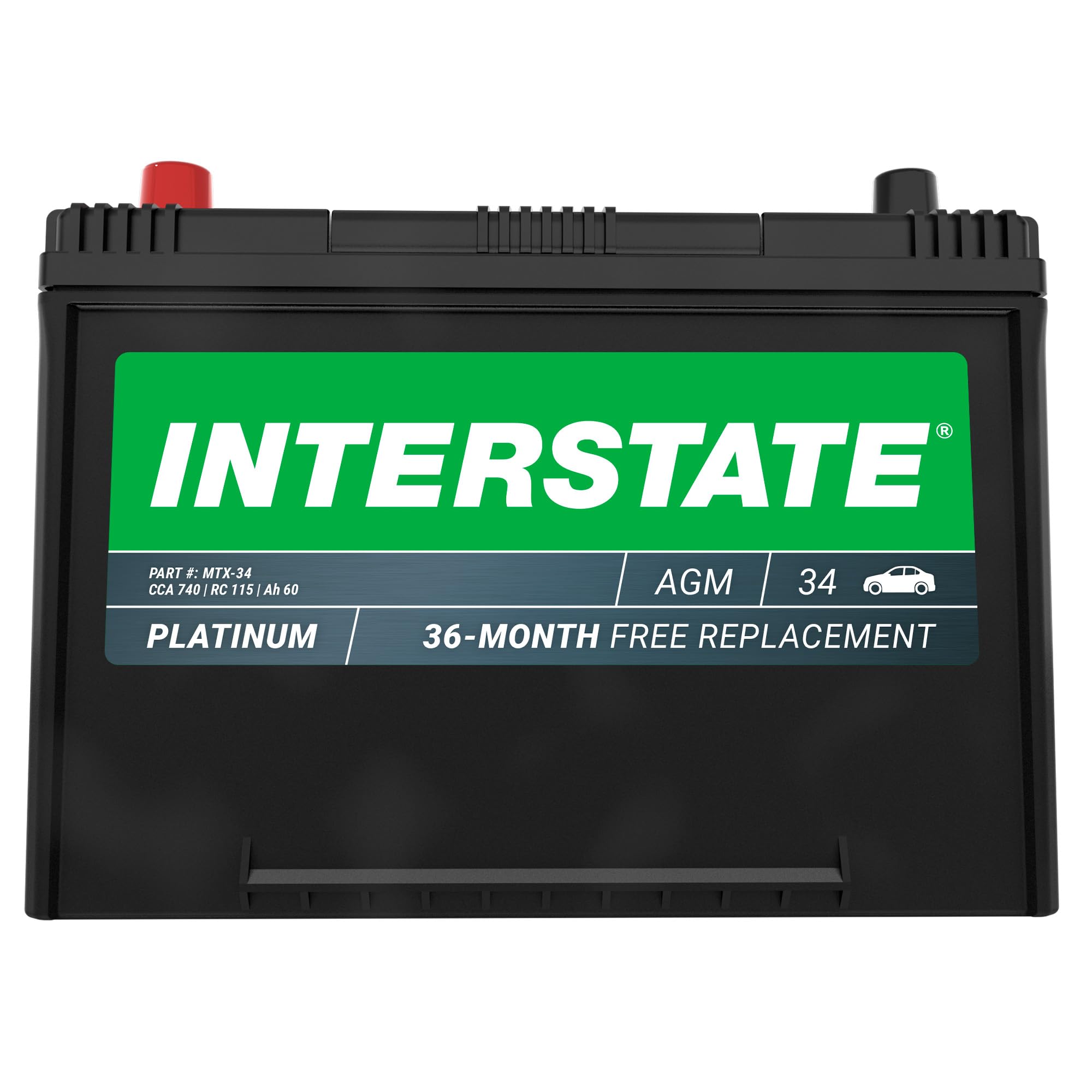
Interstate Batteries brings decades of distribution experience to the MTX-34, an AGM starting battery designed for passenger cars, SUVs, trucks, and vans that require Group 34 dimensions. The absorbed glass mat construction delivers 740 cold-cranking amps and 115 minutes of reserve capacity, which provides a meaningful safety buffer for vehicles with factory-installed accessories or aftermarket electronics.
The MTX series is engineered to provide twice the cycle life of conventional flooded batteries at 80 percent depth of discharge. This matters for owners who frequently make short trips or park for extended periods, as the battery withstands partial discharge cycles better than standard lead-acid designs. Faster recharging capability also helps maintain full charge during stop-and-go driving.
With 41.4 pounds and top-post terminals, the MTX-34 feels substantial and well-built during installation. Interstate’s reputation for quality control and widespread availability through distribution centers adds confidence, though the price sits firmly in the premium tier where buyers expect long-term durability.
What works
- Doubles the cycle life of flooded batteries at deep discharge levels, ideal for short-trip drivers
- Fits over 580 vehicle applications with Group 34 dimensions and top-post terminals
What doesn’t
- Weight of 41.4 pounds makes handling and installation slightly more cumbersome
- Premium pricing may be hard to justify for older vehicles without high electrical loads
4. ACDelco Gold 49AGM (88864539)
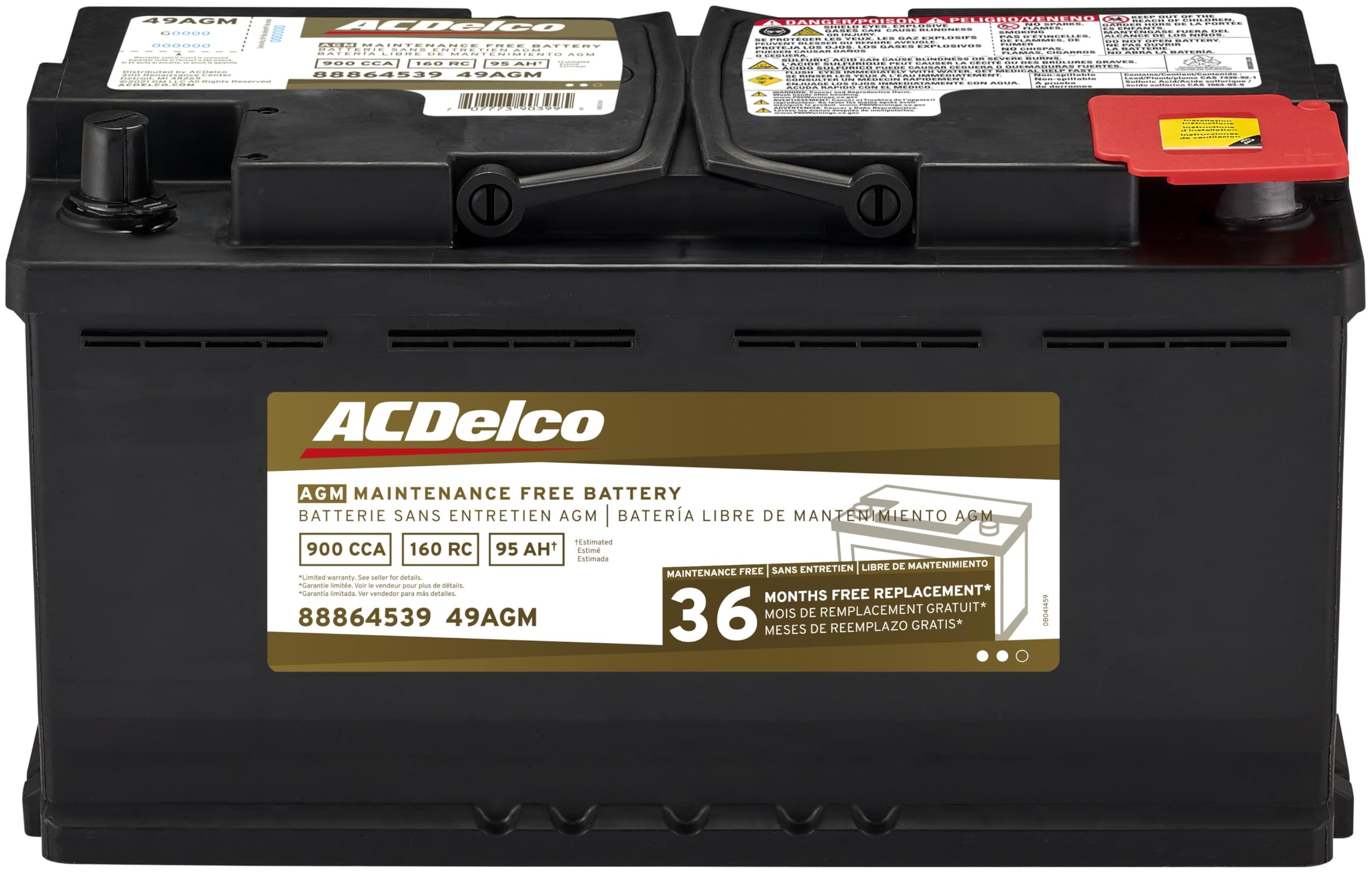
ACDelco’s Gold series uses a silver-calcium stamped grid rather than traditional lead-calcium, which improves conductivity and reduces internal resistance for cleaner current flow. The 49AGM is a Group 49 battery with marine terminals, making it a direct replacement for many European luxury sedans and SUVs that specify this fitment from the factory. The robust envelope separator with a puncture-resistant back prevents internal shorts and supports longer service life.
Owner reports from BMW, Mercedes-Benz, and Audi applications indicate the 49AGM meets OE specifications without requiring software coding or terminal adapters. The precision-manufactured ribbed case is 100 percent pressure tested to avoid future leaks, and the vent cap design resists acid weeping even when the battery is subjected to engine bay heat. High-density negative paste further improves cycle life compared to standard AGM formulations.
While the silver-calcium construction offers clear performance advantages, the marine terminal design may require ring terminals or adapter posts for vehicles with standard top-post clamps. The 36-month warranty is solid for this category and aligns with ACDelco’s reputation for OE-grade replacement components.
What works
- Silver-calcium stamped grid maximizes conductivity and extends cycle life over standard alloys
- Pressure-tested, acid-resistant case construction prevents long-term leakage and corrosion
What doesn’t
- Marine terminals require adapters for vehicles with standard top-post battery clamps
- Group 49 size is larger than typical passenger car batteries, limiting vehicle compatibility
5. SDULIBITIY Lithium Car Battery Group 26 LiFePO4
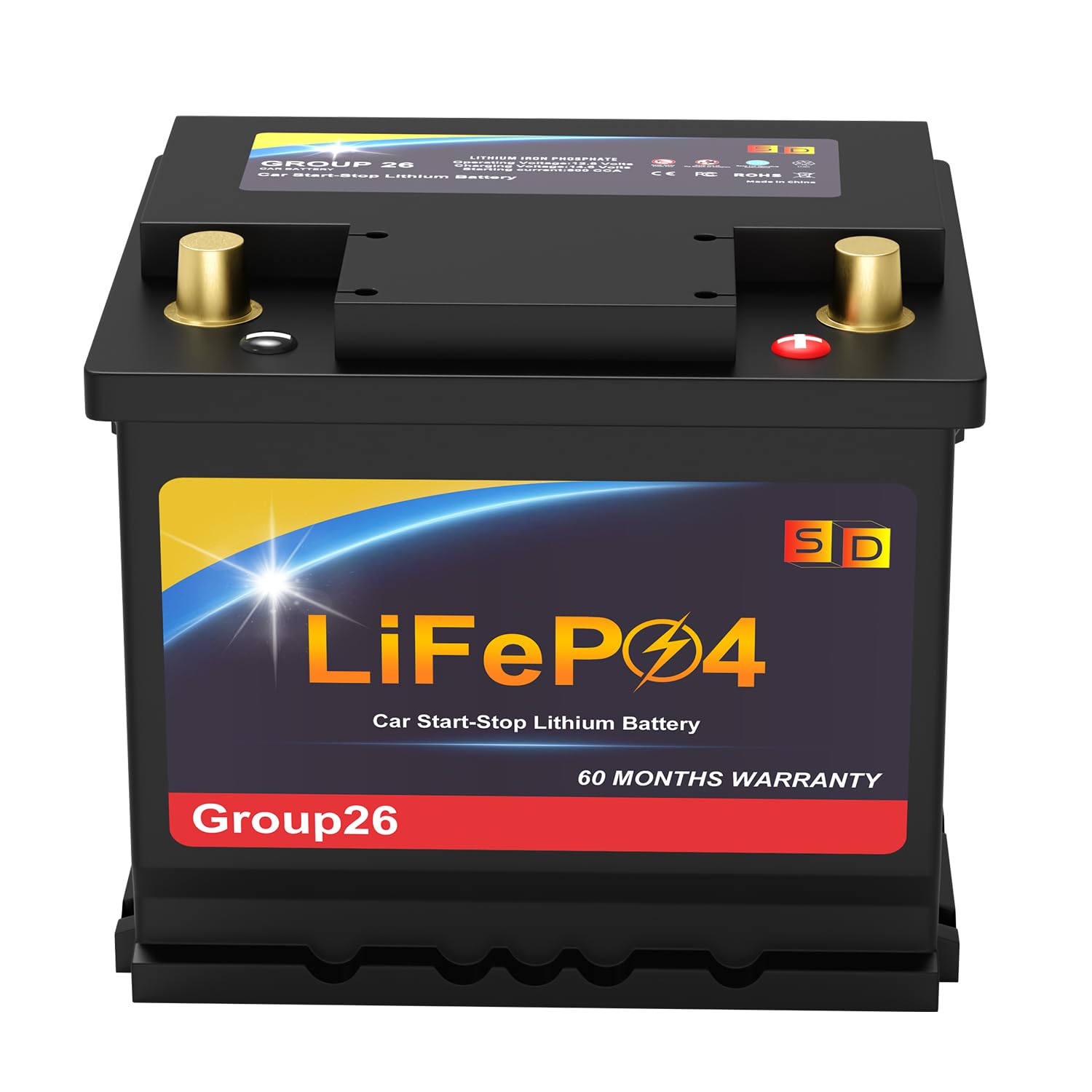
The SDULIBITIY Group 26 lithium starting battery uses LiFePO4 chemistry paired with a built-in battery management system (BMS) that protects against overcharge, over-discharge, overvoltage, and overcurrent. At 11 pounds, it weighs roughly one-third of a comparable lead-acid battery, which makes it attractive for lightweight builds, track cars, or any application where reducing front-end mass is a priority. The 600 cold-cranking amps provide enough power for most four- and six-cylinder engines.
Lithium iron phosphate cells maintain higher voltage under load compared to lead-acid, which means the starter motor sees consistent power even during extended cranking. The BMS also prevents the deep discharge damage that typically destroys lead-acid batteries when a vehicle sits unused for weeks. Owners report that the battery holds charge significantly longer than AGM units when the car is in storage.
Compatibility requires attention: not all charging systems are calibrated for lithium chemistry, and some alternators may overcharge without a compatible regulator. The group size 26 dimensions (8.14 x 6.88 x 7.08 inches) should be confirmed against the vehicle tray before purchase. This is not a drop-in replacement for every car, but for those with compatible systems, the weight savings are transformative.
What works
- Weighs only 11 pounds, reducing front-end mass by roughly 30 pounds versus lead-acid alternatives
- Built-in BMS prevents overcharge, over-discharge, and extends calendar life during storage periods
What doesn’t
- Requires vehicle charging system compatibility; some alternators may need a regulator update
- 600 CCA may be insufficient for large-displacement V8 engines in cold climates
6. Goodyear 35-AGM Platinum Series Group 35
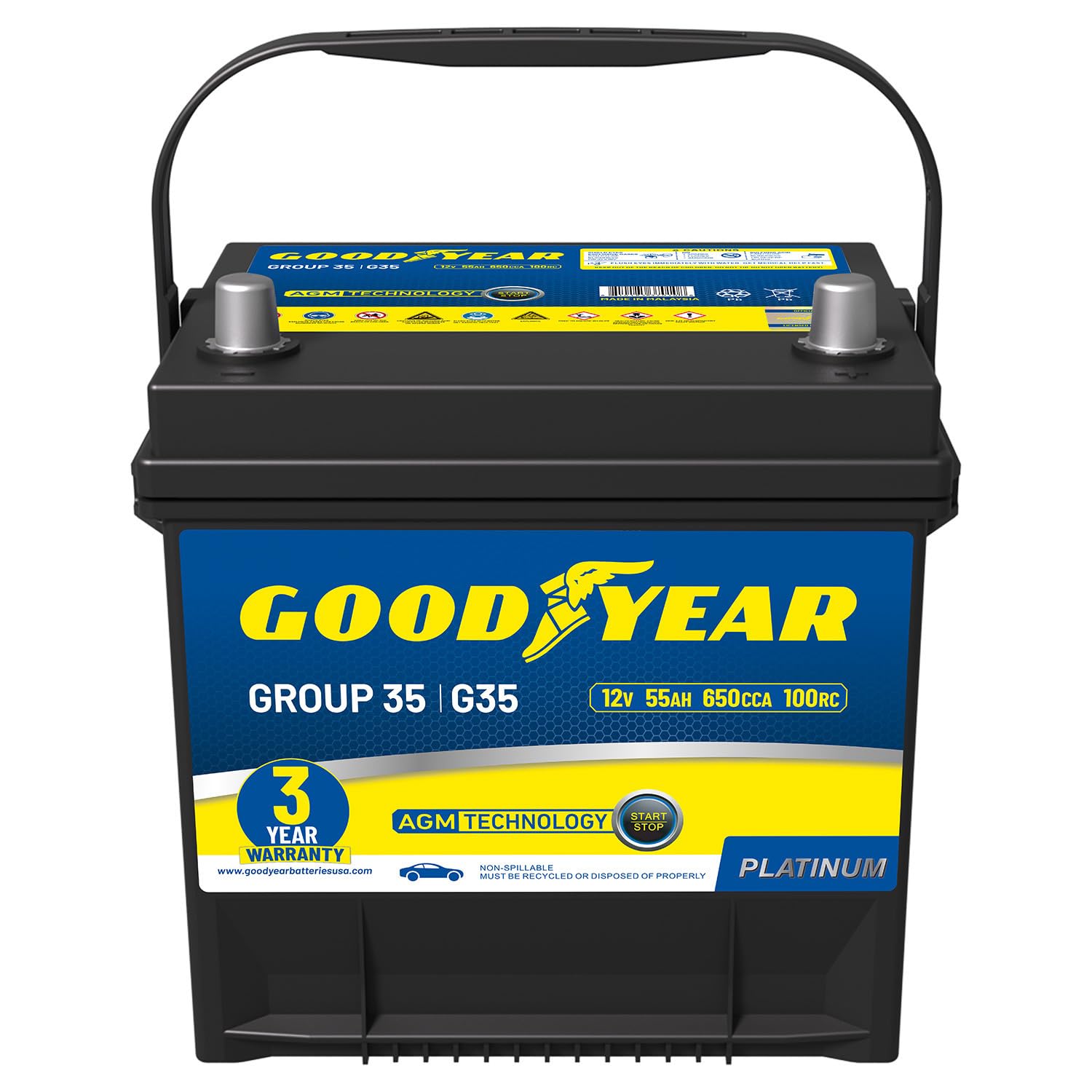
The Goodyear 35-AGM Platinum brings a trusted tire brand into the battery space with a Group 35 AGM that delivers 650 cold-cranking amps and 100 minutes of reserve capacity. The spill-proof, maintenance-free design allows mounting in multiple positions (excluding inverted), which adds flexibility for custom engine bays and non-standard installations. CE certification and ISO factory production support the build quality claims.
Owner feedback emphasizes consistent cranking performance across both hot summer and freezing winter conditions. The high discharge rate design ensures the battery can handle the electrical demands of modern vehicles with multiple control modules, infotainment systems, and accessory loads that draw power even when the ignition is off. The 36-month warranty provides solid coverage without requiring proof of professional installation.
At 39.7 pounds, the Goodyear 35-AGM is competitive with other Group 35 units in weight and fits a wide range of Japanese and American vehicles. The inclusion of mounting screws in the box simplifies installation, though the wire harness and mounting accessories are sold separately — a detail worth noting before starting the job.
What works
- CE-certified and ISO-built construction meets strict quality and safety manufacturing standards
- Versatile mounting positions add flexibility for non-standard vehicle installations
What doesn’t
- Mounting hardware and wire harness sold separately despite battery including terminal screws
- 650 CCA rating is adequate for most cars but marginal for large V8 engines in severe cold
7. Weize Platinum AGM Battery BCI Group 35

Weize Platinum AGM Group 35 offers a 650 CCA rating with 55 amp-hours of capacity in a compact case measuring 9.06 x 6.89 x 8.82 inches. The AGM construction delivers up to twice the cycle life of conventional flooded batteries, and the low self-discharge rate — less than 8 percent after 90 days — makes it a strong choice for seasonal vehicles or cars that sit for extended periods between drives. The operating temperature range spans from minus 22 to 158 degrees Fahrenheit.
Owner reports highlight the drop-in fitment for Group 35 applications in Honda, Toyota, Nissan, and Subaru models. The tapered terminals (left negative, right positive) match the standard layout for most Japanese vehicles, and the 37.69-pound weight is manageable for a single-person installation. The three-year warranty adds a layer of protection that exceeds what many economy-brand AGM batteries offer.
Weize positions the Platinum series as a direct upgrade for vehicles originally equipped with flooded batteries, provided the car accepts AGM chemistry. The charger voltage recommendation of 14.4 to 15.0 volts aligns with most modern alternator outputs, though owners with older charging systems should verify compatibility before purchase.
What works
- Low self-discharge rate makes it ideal for seasonal vehicles and extended storage periods
- Direct fitment for Japanese Group 35 applications without adapter modifications
What doesn’t
- Three-year warranty is competitive but shorter than premium brands offering four-year coverage
- 650 CCA may feel underpowered for full-size trucks with high-compression V8 engines
8. Forgetyo 48-H6-AGM BCI Group 48 AGM Car Battery
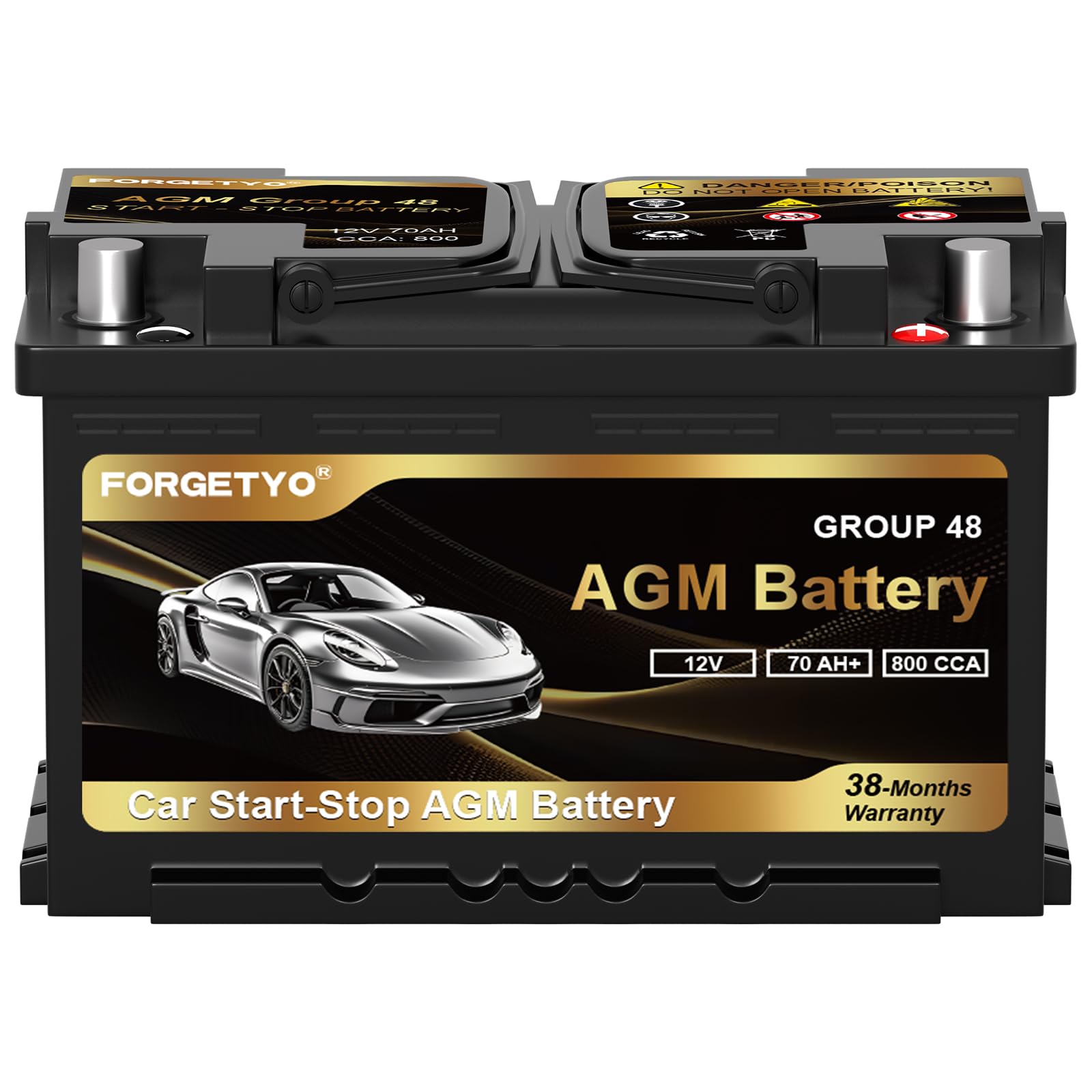
The Forgetyo 48-H6-AGM delivers an impressive 800 cold-cranking amps from a Group 48 (H6) case, making it one of the highest CCA ratings in its size class. The 70 amp-hour capacity and 132-minute reserve capacity provide substantial electrical headroom for vehicles with heated seats, premium audio systems, and other power-hungry accessories. The AGM construction is spill-proof and vibration-resistant, designed for both start-stop and conventional driving patterns.
Owner feedback indicates the 800 CCA output ensures confident cold starts even in subzero conditions where lower-rated batteries struggle. The 38-month warranty is notably longer than the industry standard for mid-range AGM batteries, which suggests the manufacturer has confidence in the internal plate and separator materials. The operating temperature range of minus 40 to 140 degrees Fahrenheit covers the vast majority of real-world driving environments.
At 43 pounds and dimensions of 10.9 x 6.88 x 7.5 inches, the Forgetyo 48-H6-AGM fits German and American vehicles that specify Group 48 or H6 batteries. The tapered terminals with left negative and right positive orientation should be verified against the vehicle’s original battery layout before purchase to avoid cable length issues.
What works
- 800 CCA rating provides exceptional cold-starting power for demanding winter climates
- 38-month warranty exceeds typical coverage for mid-range AGM batteries by a significant margin
What doesn’t
- 43-pound weight makes handling more difficult during removal and installation
- Terminal orientation must be carefully confirmed for vehicles with short OEM battery cables
9. MARXON Group 34 Start and Stop Car Battery

The MARXON Group 34 AGM battery is specifically engineered for vehicles with start-stop systems, where the engine cycles on and off at traffic lights to save fuel. The 55 amp-hour capacity and 650 CCA provide enough reserve for frequent restart events, and the company claims the design can reduce fuel consumption by roughly 10 percent per trip when paired with a functioning start-stop system. The AGM construction handles the repeated high-current draw better than flooded batteries would.
Owner feedback notes that the MARXON charges up to 40 percent faster than standard sealed lead-acid batteries thanks to improved material formulations in the plates. This faster charging acceptance is particularly beneficial in urban driving where trip times are short and the alternator has limited time to replenish the energy used during starting. The patented alloy composition also improves corrosion resistance and leak-proof performance compared to budget AGM alternatives.
Dimensions of 10.87 x 6.61 x 6.89 inches and a weight of 42 pounds place it within standard Group 34 specifications. MARXON backs the battery with a three-year warranty and maintains US-based customer support offices, which simplifies the claims process if an issue arises during the coverage period.
What works
- Fast charging acceptance recovers energy quickly during short stop-and-go driving cycles
- Patented alloy formulation improves corrosion resistance and leak-proof sealing over standard AGM
What doesn’t
- 650 CCA rating is adequate but not class-leading for Group 34 AGM batteries
- Start-stop fuel savings depend on vehicle system compatibility and may vary by driving conditions
10. Relistart AGM Battery BCI Group 47 (H5 Size)
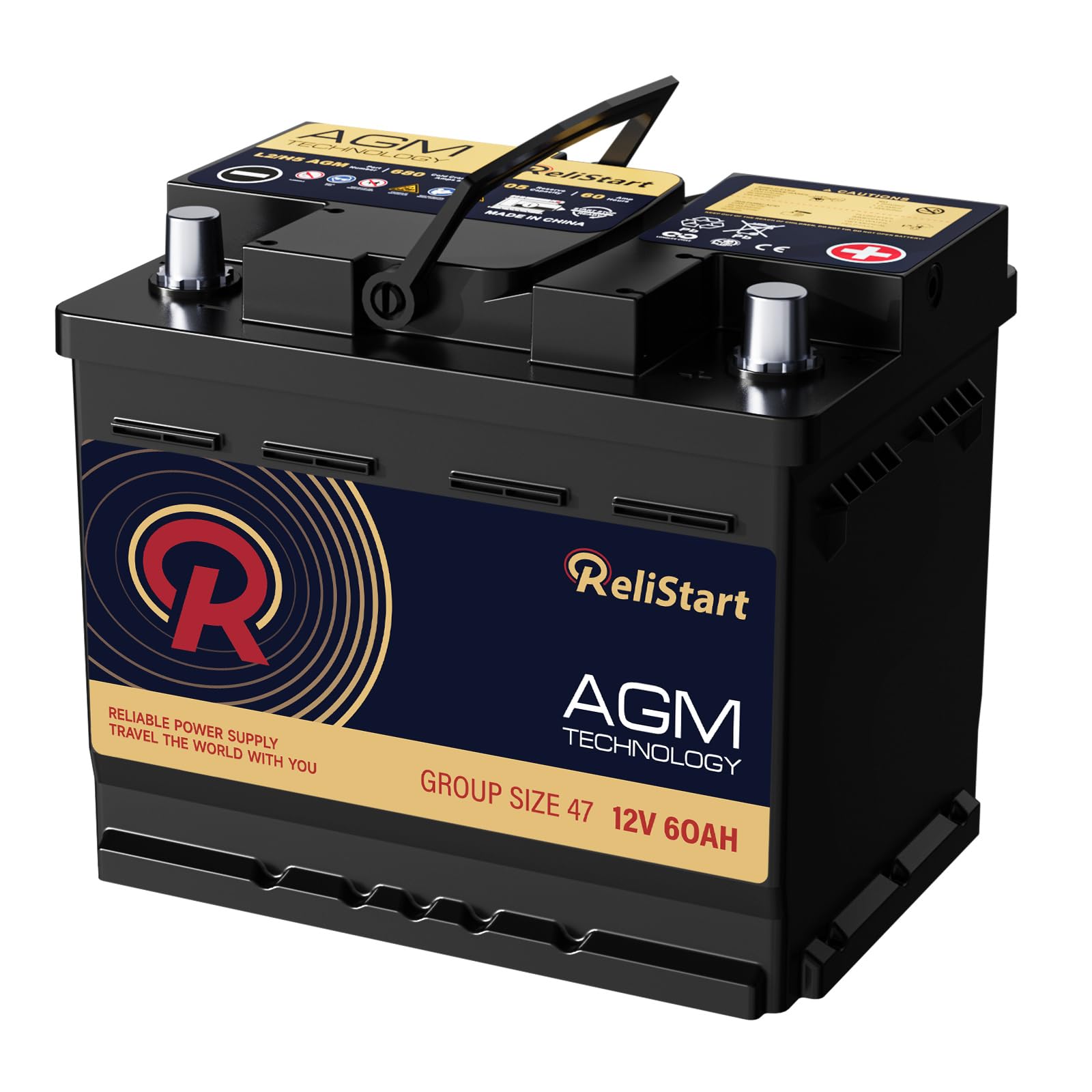
The Relistart Group 47 AGM battery delivers 680 CCA and 60 amp-hours from a standard H5 case, with a reserve capacity of 105 minutes that provides a generous safety margin for accessory power. The start-stop compatible design handles the repeated discharge-recharge cycles that occur in modern urban driving, and the AGM construction delivers roughly four times the cycle life of conventional flooded batteries in stop-start applications.
Owner reports emphasize the importance of verifying dimensions and terminal placement before purchase — the battery measures 9.53 x 6.85 x 7.48 inches with left negative and right positive terminals. When those specifications match the vehicle’s original battery, installation is straightforward and the battery delivers reliable cranking across temperature extremes. The self-discharge rate of less than 8 percent after 90 days makes it suitable for vehicles that are not driven daily.
With a two-year warranty and competitive pricing, the Relistart Group 47 is positioned as a value-oriented upgrade for drivers moving from flooded to AGM technology. The operating temperature range of minus 22 to 158 degrees Fahrenheit covers most North American climates, though owners in extreme northern regions may want higher CCA for deep winter confidence.
What works
- 105 minutes of reserve capacity provides extended accessory power during alternator failure scenarios
- Four times the cycle life of flooded batteries in start-stop applications justifies the AGM upgrade
What doesn’t
- Two-year warranty is shorter than many AGM competitors that offer three to four years
- Self-discharge data suggests careful storage practices are still needed for long idle periods
11. Autocessking H5 Group Size 47 Start and Stop AGM Automotive Battery
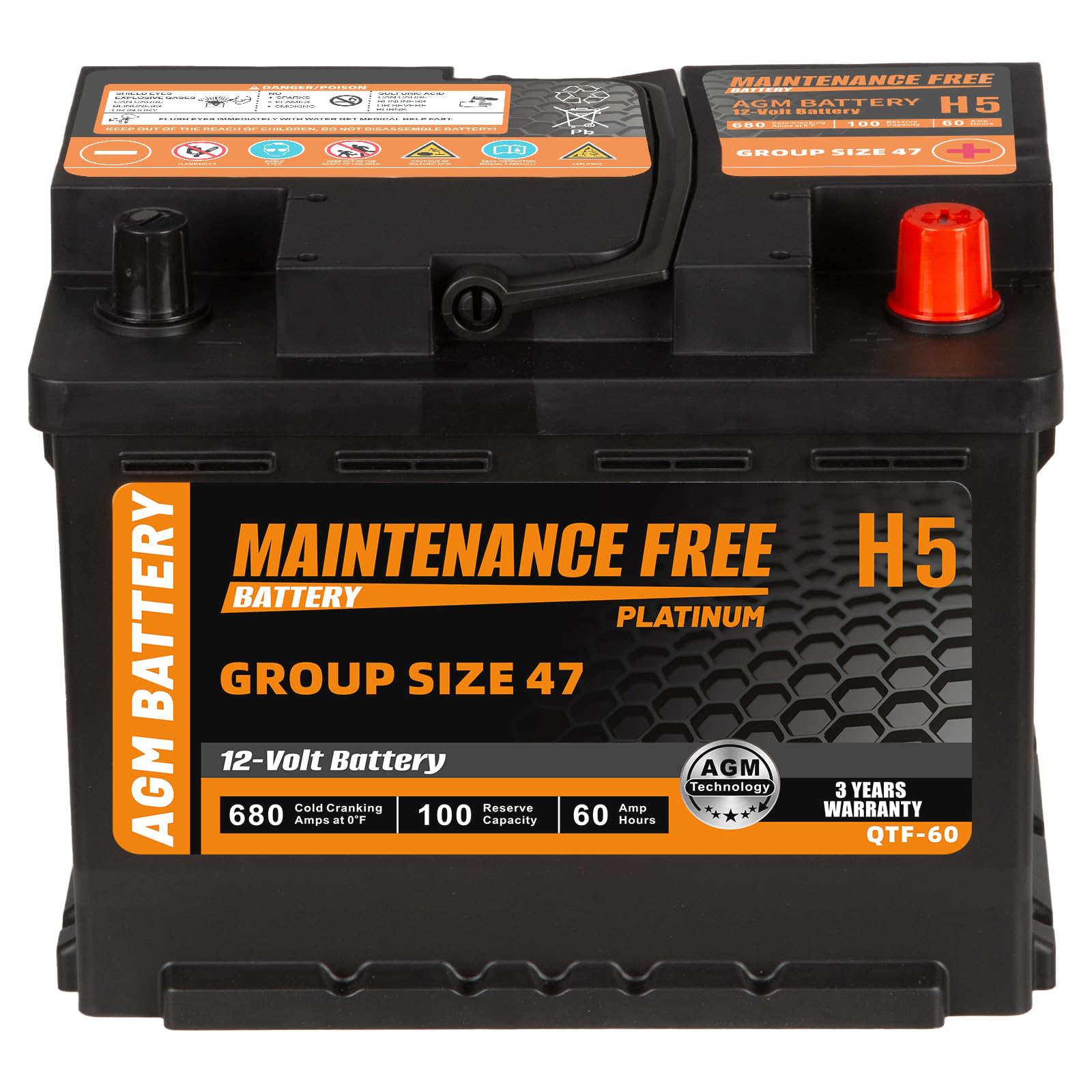
The Autocessking H5 Group 47 AGM battery provides 680 cold-cranking amps and 100 minutes of reserve capacity in a standard 47-size case. The high-density negative paste formulation improves conductivity and extends service life compared to basic AGM designs, while the 18-times vibration resistance rating suggests robust internal construction for vehicles that encounter rough roads or off-pavement conditions. The leak-proof vent cap and maintenance-free design eliminate the need for fluid checks.
Owner feedback positions this battery as a direct replacement for vehicles originally equipped with Group 47 (H5) batteries, including many European and Asian models. The operating temperature range of minus 18 to 140 degrees Fahrenheit covers standard climate conditions, with short-term tolerance extending to minus 40 degrees Fahrenheit for extreme cold snaps. The 38.76-pound weight is reasonable for the category and allows one-person handling during installation.
Autocessking specifies that this is a starting battery only and should not be used in deep-cycle applications such as solar projects. The pricing lands below many premium AGM options while still delivering the key benefits of AGM technology — spill-proof operation, vibration resistance, and maintenance-free ownership over the service life.
What works
- 18-times vibration resistance rating protects internal plates in rough-road driving conditions
- Competitive pricing brings AGM starting technology within reach of budget-conscious owners
What doesn’t
- Not suitable for deep-cycle applications, limiting use to starting-only vehicle roles
- Short-term cold tolerance of minus 40 degrees Fahrenheit may not satisfy extreme northern climates
Hardware & Specs Guide
Cold-Cranking Amps (CCA)
CCA is the industry standard measurement for a battery’s ability to start an engine at 0 degrees Fahrenheit. It measures the current the battery can deliver for 30 seconds while maintaining at least 7.2 volts. A higher CCA number provides stronger starting power in cold weather. For most four- and six-cylinder engines, 600 to 700 CCA is sufficient. Eight-cylinder engines, diesel engines, and vehicles driven in severe winter climates benefit from 750 CCA or above. Choosing a battery with CCA far below the vehicle’s original specification will result in slow cranking and eventual no-start conditions on cold mornings.
Reserve Capacity (RC)
Reserve capacity measures how many minutes a fully charged battery at 80 degrees Fahrenheit can deliver 25 amps of current before its voltage drops below 10.5 volts. This simulates the battery running the vehicle’s essential electronics — fans, fuel pump, engine control unit — if the alternator fails. A higher RC provides a larger safety window to reach a repair shop. Typical passenger car batteries offer between 80 and 130 minutes of reserve capacity. Vehicles with aftermarket audio systems, winches, or auxiliary lighting should prioritize batteries at the upper end of this range.
BCI Group Size
The Battery Council International assigns group size codes that standardize physical dimensions, terminal type, and terminal location. Common passenger car sizes include Group 35 (many Japanese vehicles), Group 47/H5 (compact European and Asian), Group 48/H6 (mid-size European and American), Group 34 (domestic pickups and SUVs), and Group 49 (large European luxury sedans). A battery matching the vehicle’s original BCI group size will fit the tray without modifications and place the terminals within reach of the factory cables. Always cross-reference dimensions even within the same group size, as slight variations exist between manufacturers.
AGM vs Flooded vs Lithium Chemistry
Absorbent Glass Mat (AGM) batteries use fiberglass mats to hold the electrolyte between lead plates, making them spill-proof, vibration-resistant, and capable of higher discharge rates than flooded batteries. They are required for vehicles with start-stop systems and are the recommended choice for modern cars with high electrical loads. Flooded (wet cell) batteries are the least expensive option but require periodic water checks, produce hydrogen gas during charging, and have shorter cycle life. Lithium iron phosphate (LiFePO4) starting batteries weigh significantly less, hold voltage better under load, and have very long shelf life, but require compatible charging systems and cost more initially. Matching chemistry to the vehicle’s original equipment is critical, as many modern cars will not accept a downgrade from AGM to flooded.
FAQ
What does CCA mean and how much do I really need?
Can I replace a flooded battery with an AGM battery?
How often should I replace my car starting battery?
What happens if I install the wrong group size battery?
Does a higher CCA battery damage my car’s electrical system?
Final Thoughts: The Verdict
For most buyers, the best car starting battery winner is the OPTIMA 34R RedTop because its SpiralCell construction delivers unmatched vibration resistance, reliable 800 CCA output, and a proven track record across extreme climates. If you want European-specific fitment with the longest warranty coverage, grab the Bosch S6523B S6. And for a lightweight performance upgrade that sheds roughly 30 pounds off the front axle, nothing beats the SDULIBITIY Lithium Group 26 in compatible vehicles.

Certification: BSc in Mechanical Engineering
Education: Mechanical engineer
Lives In: 539 W Commerce St, Dallas, TX 75208, USA
Md Amir is an auto mechanic student and writer with over half a decade of experience in the automotive field. He has worked with top automotive brands such as Lexus, Quantum, and also owns two automotive blogs autocarneed.com and taxiwiz.com.