Every decibel your system delivers travels through a single link: the speaker wire. Gauge, conductor purity, jacket flexibility — each variable either preserves or degrades the signal path. Choosing wrong means audible loss you cannot fix with any amplifier or head unit upgrade.
I’m Amir — the founder and writer behind Four Wheel Ask. I spend my time dissecting product specifications, comparing conductor materials and strand counts, and aggregating long-term owner feedback to separate marketing claims from real-world performance data.
Whether you are wiring a daily driver or a competition build, understanding the trade-offs between oxygen-free copper and copper-clad aluminum, proper gauge selection, and jacket durability matters most. That is exactly what this guide to best car speaker wires delivers — a no-fluff breakdown of five distinct options ranked by measurable signal integrity and build quality.
How To Choose The Best Car Speaker Wires
Speaker wire is the most underrated component in a car audio system. A poorly chosen wire introduces resistance, noise, and eventual signal degradation. Three variables determine performance: conductor material, gauge, and jacket construction.
Oxygen-Free Copper vs. Copper-Clad Aluminum
OFC (oxygen-free copper) offers higher conductivity and lower resistance per foot than CCA (copper-clad aluminum). OFC also resists oxidation better over years of temperature cycling inside a vehicle door or trunk. CCA is lighter and cheaper but carries measurable signal loss on longer runs or higher-power systems. For builds over 300 watts RMS, OFC is the correct choice.
Gauge Selection Based on Power and Distance
Thicker wire (lower gauge number) carries more current with less voltage drop. For runs under 50 feet to a speaker drawing moderate power, 16 gauge suffices. For subwoofers or runs exceeding 50 feet, 12 gauge is the minimum. High-power systems benefit from 10 or even 8 gauge on the main power feed, but for speaker-level signals, 12 gauge OFC handles nearly any aftermarket setup.
Strand Count and Jacket Flexibility
Higher strand counts produce more flexible wire that routes easily through tight door jambs and under carpets. Soft PVC jackets resist kinking and lay flat after uncoiling. For outdoor or in-wall runs, CL3 rated jackets add fire and moisture resistance. Always match the jacket rating to the installation environment.
Quick Comparison
On smaller screens, swipe sideways to see the full table.
| Model | Category | Best For | Key Spec | Amazon |
|---|---|---|---|---|
| KnuKonceptz Kord 12 AWG OFC | Premium OFC | Audiophile-grade signal integrity | 12 AWG, 294 strands, true OFC | Amazon |
| GEARit CL3 Outdoor 16/4 OFC | Outdoor OFC | Weather-exposed or in-wall runs | 16 AWG, 4-conductor, CL3 rated | Amazon |
| GEARit 12 AWG CCA 100ft | Mid-Range CCA | Budget-conscious home or car installs | 12 AWG, CCA, polarity markings | Amazon |
| DS18 SW-12GA-100RB CCA | Budget CCA | Entry-level systems on a tight budget | 12 AWG, CCA, 100 ft, ultra-flex | Amazon |
| GS Power 16 AWG CCA 6-Color | Multi-Use CCA | Multi-project wiring with color coding | 16 AWG, 6 colors, 300 ft total | Amazon |
In‑Depth Reviews
1. KnuKonceptz Kord Speaker Kable 12 Gauge OFC

KnuKonceptz builds its reputation on honest specifications, and the Kord Speaker Kable delivers exactly what the label states: true 12 AWG oxygen-free copper with 294 finely stranded conductors per leg. The translucent blue Ultra Flex PVC jacket lays flat immediately after uncoiling with zero coil memory, making routing through door boots and under carpets effortless. Each foot is printed with the wire material and gauge so there is no guessing what you installed years later.
Owner feedback consistently highlights the audible clarity improvement over CCA wire, particularly in the midrange and treble regions where resistance-induced signal loss becomes noticeable. Multiple long-term users with 40-plus years of audiophile experience report that this wire competes with cables costing significantly more. The 50-foot length suits most car audio installations, though longer builds may need two rolls for rear channels or subwoofer runs.
The only real consideration is the premium investment over CCA alternatives. For systems running moderate power levels under 300 watts, the difference may not justify the cost. But for anyone building a system where every decibel and every detail matters, this is the benchmark wire in its class. The strand flexibility also makes soldering and crimping cleaner than stiffer budget wire.
What works
- True 12 AWG oxygen-free copper with verified strand count
- Ultra-flex jacket lays flat with zero coil memory
- Owner reports audibly cleaner signal versus CCA alternatives
- Specs printed directly on the jacket for long-term identification
What doesn’t
- Higher upfront cost compared to CCA wire of similar gauge
- 50-foot roll may be insufficient for very large vehicles with long runs
2. GEARit Outdoor Speaker Wire CL3 Rated 16 Gauge OFC
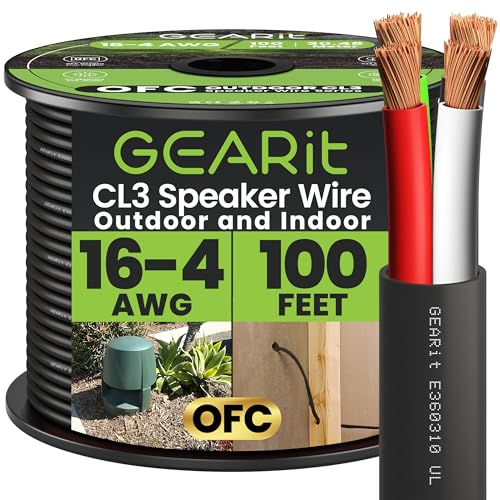
GEARit designed this 16 AWG four-conductor cable specifically for environments where standard PVC jackets degrade. The CL3 rating means the jacket passes fire resistance standards for in-wall installation, and the oxygen-free copper conductors resist corrosion better than CCA when exposed to humidity, temperature swings, or direct burial conditions. At 100 feet with four conductors, this wire handles stereo pairs or bi-wired speakers from a single pull.
Reviewers who installed this around pools, in gardens, or along exterior walls consistently report no signal degradation after multiple seasons of weather exposure. The flexible jacket remains pliable in colder temperatures without stiffening, and the clear polarity markings on each foot eliminate guesswork during long runs. The OFC construction delivers noticeably cleaner sound than standard CCA outdoor wire, especially over distances exceeding 50 feet where resistance accumulates.
The trade-off is weight and bulk — four 16 AWG conductors inside a CL3 jacket make the cable stiffer than a standard two-conductor wire of the same gauge. Bending tight corners inside a vehicle door may require additional care. For dedicated outdoor or in-wall installations, however, this wire solves problems that no CCA alternative can address. The price reflects the OFC material and CL3 certification, but the longevity justifies the investment.
What works
- CL3 rated for in-wall and direct burial applications
- OFC conductors resist corrosion in outdoor environments
- Four conductors allow stereo or bi-wire runs in one pull
- Clear polarity markings and foot markers simplify installation
What doesn’t
- Bulkier and stiffer than standard two-conductor wire
- 16 gauge limits power handling for high-output subwoofers
3. GEARit 12 Gauge Speaker Wire 100ft CCA
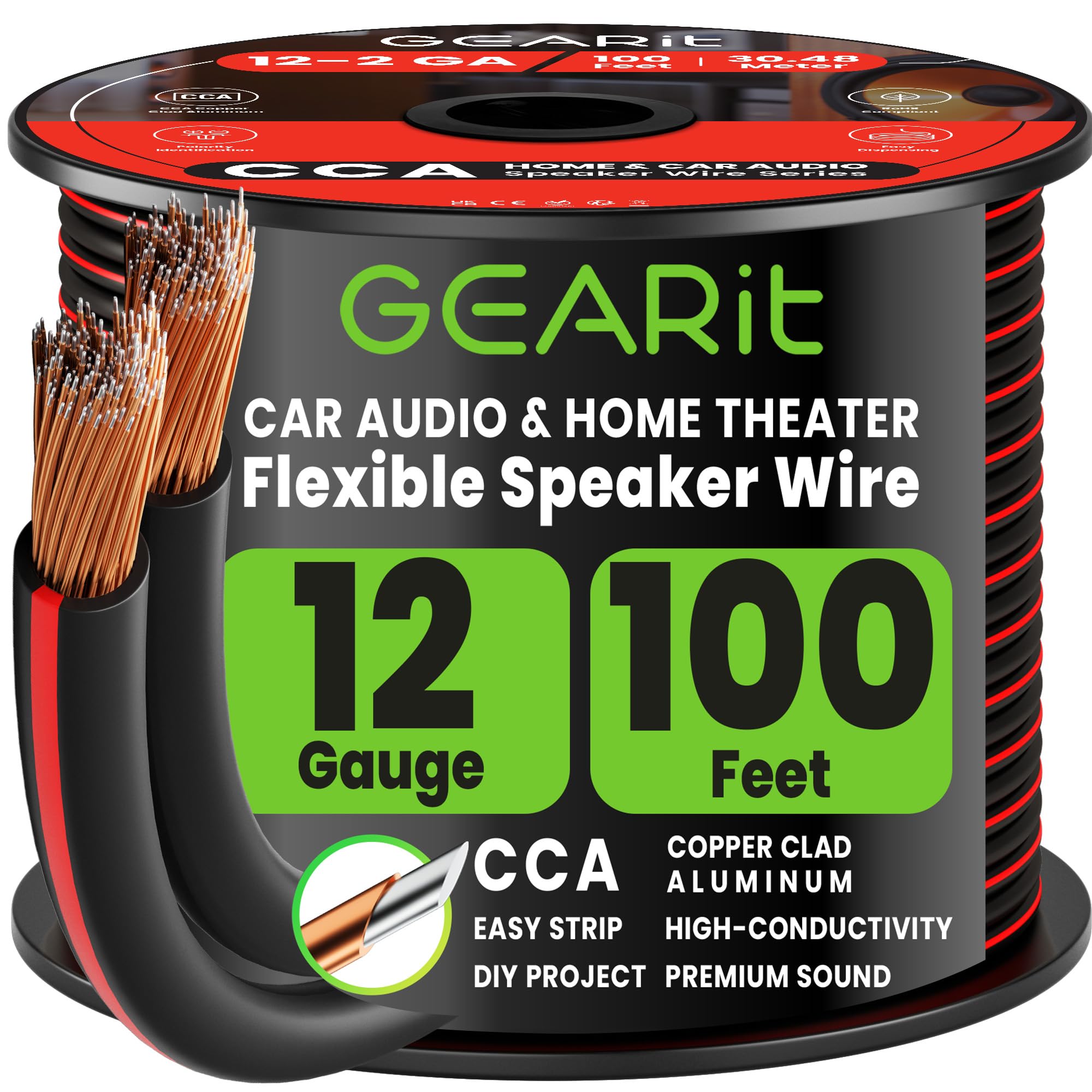
GEARit’s 12 AWG CCA wire strikes the balance between affordability and real usability. The copper-clad aluminum construction keeps the weight down and the price accessible while maintaining acceptable conductivity for moderate-power systems. The soft PVC jacket is noticeably flexible and resists kinking, and the sequential foot markers printed every twelve inches let you measure and cut precisely without a tape measure.
Multiple verified buyers describe the wire as easy to strip, quick to terminate into banana plugs or spade connectors, and free of tangling when unrolled. The clear polarity markings on each conductor reduce installation errors, which matters when running wire through tight spaces where you cannot easily re-check connections. For a home theater surround sound setup or a car audio system under 300 watts RMS, this wire delivers clean signal transfer without wasting budget on OFC overhead.
The limitation is the CCA conductor itself. Over very long runs or in high-power applications, the higher resistance of aluminum versus pure copper becomes measurable. Some owners noted that the wire felt slightly less robust than pure copper alternatives when stripped and terminated repeatedly. For its intended audience — DIY installers building practical systems on a budget — this wire offers strong value with no deal-breaking flaws.
What works
- Affordable price point for 100 feet of 12 AWG wire
- Flexible jacket routes easily through tight interior spaces
- Foot markers and polarity markings speed up installation
- Multiple color options for blending with home decor
What doesn’t
- CCA conductor has higher resistance than OFC on long runs
- Not ideal for high-power systems exceeding 300 watts RMS
4. DS18 SW-12GA-100RB 12-GA Ultra Flex Speaker Wire CCA

DS18 brings its car audio brand reputation to this 12 AWG CCA wire, and the standout feature is the ultra-flex jacket. The PVC compound is noticeably softer than budget spools from hardware stores, making it easy to snake through door conduits and behind dash panels without fighting coil memory. The red and black color coding is clear and runs the full length, so polarity identification is straightforward even in dim lighting.
Owner feedback leans positive for basic installations: connecting two-way speakers to an amplifier, wiring a subwoofer in a trunk, or retrofitting factory speaker harnesses. Several buyers noted the 100-foot spool was enough for multiple vehicles or projects, which improves the per-project value. The CCA construction, while not audiophile-grade, performs adequately for systems where the amplifier output stays under 250 watts RMS and run lengths are under 30 feet.
The wire’s 10-strand construction per conductor is lower than the multi-strand count found on premium OFC wire, which makes it slightly stiffer at the termination point. Some reviewers mentioned that other brands offered a more refined feel for a marginal price increase. For a no-regrets budget spool that gets the job done without fuss, the DS18 wire serves its purpose well, but it is not the wire you choose when chasing every last decibel of clarity.
What works
- Ultra-flex jacket routes easily through tight vehicle spaces
- 100 feet provides enough length for multiple projects
- Clear red/black color coding simplifies polarity matching
- Very accessible price point for entry-level builds
What doesn’t
- Low strand count reduces flexibility at termination points
- CCA conductor limits performance in high-power applications
5. GS Power 300ft CCA 16 Gauge Wire 6-Color Pack
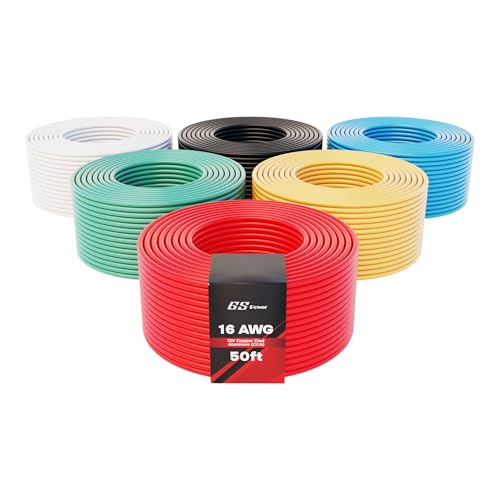
GS Power takes a different approach with this six-color, 300-foot assortment of 16 AWG CCA wire. Rather than a single two-conductor spool, you get six individual 50-foot rolls in black, red, blue, white, yellow, and green. This color-coding system is invaluable for multi-speaker installations, trailer wiring, or any project where keeping channel polarity and position organized saves hours of troubleshooting.
The wire is rated for 12-volt automotive use with a flexible PVC jacket that handles routing through dashboards, door jambs, and along chassis frames. The 42-strand construction per conductor gives reasonable flexibility for a 16 AWG wire. Owner reviews highlight the value of having matched colors for front left, front right, rear left, and rear right channels without needing labels or tape. The 105°C temperature rating means the insulation holds up under hood or near exhaust routing better than standard PVC.
The limitations stem from the 16 AWG gauge and CCA material. For full-range speakers or tweeters, 16 gauge is adequate, but subwoofers or long runs benefit from thicker 12 or 14 gauge wire. Some buyers noted that the individual rolls are shorter than expected for a full car audio build covering four doors plus a subwoofer. This wire excels as a shop staple for miscellaneous low-voltage projects rather than a dedicated high-fidelity car audio wire.
What works
- Six distinct colors simplify multi-channel wiring organization
- 300 total feet covers multiple vehicles or projects
- 105°C rated jacket suitable for engine bay or chassis runs
- Very low per-foot cost for budget-minded DIYers
What doesn’t
- 16 AWG gauge limits power handling for subwoofer applications
- CCA conductor not ideal for long runs or high-fidelity systems
Hardware & Specs Guide
Oxygen-Free Copper (OFC)
OFC contains at least 99.99% pure copper with minimal oxygen content, reducing oxidation and signal loss over time. It offers lower resistance per foot than CCA, making it the preferred conductor for systems where every watt reaches the speaker. The higher cost is offset by better frequency response, particularly in the midrange and treble, and longer service life in vehicles exposed to temperature swings.
Copper-Clad Aluminum (CCA)
CCA uses an aluminum core with a thin copper coating. It is lighter and significantly cheaper than OFC, but its resistance is roughly 1.5 times higher per foot. This matters most on runs exceeding 30 feet or when power demands exceed 300 watts RMS. For budget builds and moderate listening levels, CCA delivers acceptable performance at a fraction of the price.
Wire Gauge and Strand Count
American Wire Gauge (AWG) numbers decrease as wire thickness increases — 12 AWG is thicker than 16 AWG. Thicker wire carries more current with less voltage drop. Strand count affects flexibility: 200-plus strands per conductor allows tight-radius bends without kinking, while lower strand counts produce stiffer wire that is harder to route through vehicle cavities.
Jacket Ratings: PVC vs. CL3
Standard PVC jackets handle interior vehicle use well but soften under heat and become brittle in cold. CL3 rated jackets pass fire and smoke resistance tests for in-wall installation and resist UV and moisture degradation better outdoors. For door installations, standard PVC suffices; for under-carpet, chassis, or exterior runs, CL3 rated wire adds long-term reliability.
FAQ
What gauge speaker wire should I use for car audio?
Is OFC speaker wire worth the extra cost over CCA?
Can I use outdoor CL3 rated wire inside my car?
Does speaker wire polarity matter in car audio?
Final Thoughts: The Verdict
For most buyers, the best car speaker wires winner is the KnuKonceptz Kord 12 AWG OFC because it delivers verified pure copper construction, high strand count flexibility, and genuine signal integrity at a fair premium. If you need a weather-resistant solution for outdoor or in-wall runs, grab the GEARit CL3 16/4 OFC. And for budget-conscious DIYers building moderate-power systems, the GEARit 12 AWG CCA 100ft offers the most value without compromising installation ease.

Certification: BSc in Mechanical Engineering
Education: Mechanical engineer
Lives In: 539 W Commerce St, Dallas, TX 75208, USA
Md Amir is an auto mechanic student and writer with over half a decade of experience in the automotive field. He has worked with top automotive brands such as Lexus, Quantum, and also owns two automotive blogs autocarneed.com and taxiwiz.com.