Lifting a car on uneven concrete with a scissor jack is a gamble no experienced owner takes twice. A solid set of ramps eliminates the wobble, the crawl, and the constant worry about a jack stand slipping, giving you a stable platform for oil changes, brake work, and undercarriage inspections. The choice comes down to lift height, load rating, and how low your vehicle sits before the bumper makes contact.
I’m Amir — the founder and writer behind Four Wheel Ask. I spend my time comparing load specifications, incline angles, material durability, and verified owner experiences across dozens of automotive service products to separate genuinely safe designs from those that cut corners.
After reviewing load ratings, incline specs, and build quality, the best car ramp lift options prove their worth for safe, reliable garage maintenance.
How To Choose The Best Car Ramp Lift
Selecting the right ramp set means balancing your vehicle weight, ground clearance, and the type of maintenance you perform. Ramps are a multi-year purchase, so understanding the key specs upfront prevents a costly mismatch.
Load Capacity and Gross Vehicle Weight
Every ramp pair carries a maximum weight rating, often expressed per ramp and per pair. Your vehicle’s gross weight — fully loaded with fluids, passengers, and cargo — should stay well under the pair rating. A margin of 20–30% is standard practice among experienced DIY owners, especially for trucks and SUVs used in routine hauling.
Incline Angle and Ground Clearance
The loading angle determines whether a low front bumper clears the ramp before the tires make contact. Angles between 8° and 13° are common. Cars with aftermarket lowering springs or factory aero kits need a shallower incline — typically under 10° — to avoid scraping. Measuring your front lip height before purchasing saves a lot of frustration on the first drive up.
Material and Build Design
Heavy-duty impact-resistant plastic (PP or ABS) dominates the market for its corrosion resistance and lightweight portability. Steel ramps exist but add significant weight and can mar garage floors. Look for honeycomb or ribbed internal structures that distribute weight evenly, plus rubber anti-slip pads on the base to prevent sliding on smooth concrete.
Quick Comparison
On smaller screens, swipe sideways to see the full table.
| Model | Category | Best For | Key Spec | Amazon |
|---|---|---|---|---|
| Eastwood One Piece Ramps | Premium | Reliable all-around garage use | 3-ton load, 8.5″ lift, ASME certified | Amazon |
| ROBLOCK Removable Ramps | Performance | Detachable tail for jack access | 20,000 lb GVW, 9° slope, 2.6″ lift | Amazon |
| VEVOR Car Ramps | Premium | High-chassis trucks and SUVs | 16,000 lb GVW, 6.7″ lift, 17° incline | Amazon |
| HOXWELL Portable Ramps | Value | Budget-friendly daily maintenance | 10,000 lb GVW, 4.1″ lift, 13° slope | Amazon |
| MaxxHaul 50515 Ramps | Design | Wide tires and stable traction | 6,500 lb pair, 6.25″ lift, rubber stops | Amazon |
| Tomioka Racing Super Slopes | Value | Low-profile and lowered cars | 6,600 lb pair, 9.05° angle, 3″ lift | Amazon |
| OULEME Low Profile Ramps | Value | Entry-level lifting for 4-corner access | 6,600 lb pair, 8.6° angle, 2.5″ lift | Amazon |
In‑Depth Reviews
1. Eastwood One Piece Car Ramps

Eastwood brings a certified, no-nonsense design that prioritizes safety certification over flashy features. Each ramp holds 6,000 pounds (3 tons) and lifts vehicles 8.5 inches, which provides generous clearance for oil pan access, transmission service, and exhaust work. The ASME-PASE 2014 certification means the design has passed third-party load and stability testing — a standard not every ramp on this list meets.
Owner reports highlight the non-slip underside pads that keep the ramps planted on smooth garage concrete, even during the initial drive-up. The textured top surface provides reliable tire grip, and the integrated carry handles make positioning straightforward without dragging. The one-piece construction eliminates concerns about joints or welds failing under repeated use. Eastwood also backs these with a 1-year limited warranty and lifetime tech support.
The main trade-off is weight — at just over 21 pounds per pair, these are among the heavier plastic ramps, but that solid feel translates directly to stability. They are not designed for extreme low-profile sports cars; the incline works best for sedans, crossovers, and light trucks with moderate ground clearance.
What works
- ASME safety certified for verified load performance
- 8.5-inch lift height provides excellent undercarriage access
- Non-slip rubber base prevents sliding during use
- Lifetime tech support from an established brand
What doesn’t
- Heavier than many competitors at over 21 pounds
- Incline angle may not suit extremely lowered cars
- 6,000 lb pair rating limits use with heavy-duty trucks
2. ROBLOCK Removable Low Profile Car Ramps

ROBLOCK addresses a persistent frustration with traditional ramps — the ramp body blocks access to the floor jack point once the vehicle is on the ramps. The detachable tail section on this model splits away, leaving a clear workspace for a jack to reach the subframe or pinch welds. The overall length adjusts from 15.35 to 27.83 inches, giving flexibility for different wheelbase vehicles.
The GVW rating of 20,000 pounds per pair is among the highest in this comparison, though the actual lift height is a modest 2.6 inches — just enough to slide a low-profile jack underneath. The 9° slope works well for cars with aftermarket suspension and factory aero kits, as confirmed by owners of lowered Audi S5 and BMW sedans who report no bumper contact during loading. The grooved surface and bottom non-slip pads keep the ramps stable on concrete.
This design is purpose-built for the specific workflow of raising a lowered car to then jack it further. It is not intended as a standalone lift for working under the vehicle. The internal honeycomb structure resists collapse, and the plastic material holds up well against corrosion. Owners note the lightweight 8.39-pound pair weight makes them easy to reposition.
What works
- Detachable tail frees up jack access space
- Adjustable length accommodates different wheelbases
- Extremely high 20,000 lb GVW rating
- Lightweight and easy to store
What doesn’t
- Only 2.6 inches of lift height
- Not a standalone work ramp for undercarriage access
- Detachable joint requires proper alignment each use
3. VEVOR Car Ramps 16,000 lb GVW
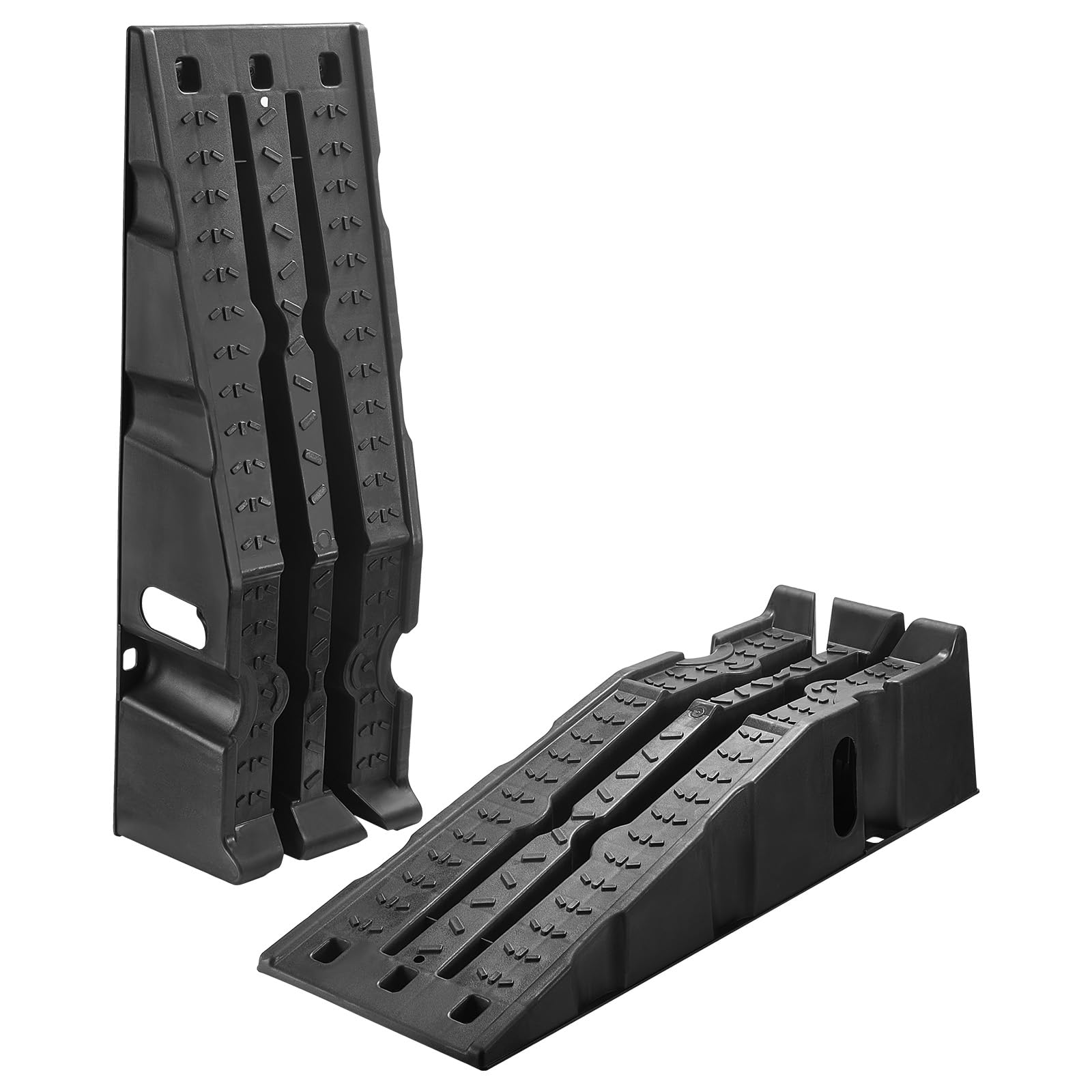
VEVOR targets the high-chassis segment with a 6.7-inch lift height and a 17° incline that suits mid-size SUVs, trucks, and Jeeps. The 16,000-pound GVW per pair (8,000 pounds per pair actual load capacity) means this set can handle heavy-duty applications such as full-size pickup maintenance or agricultural light trucks. The wide 12-inch platform accommodates larger tire footprints without overhang.
The impact-resistant polypropylene construction includes a honeycomb top surface that channels moisture away while increasing tire traction. Owners driving Toyota Sequoias and slammed 240SXs both report stable engagement — the rubber pads on the bottom prevent sliding on painted garage floors. The stackable design allows both ramps to nest together for trunk transport, which is rare for ramps in this lift-height class.
The 17° incline is noticeably steeper than low-profile options. Vehicles with less than 5 inches of front clearance will likely scrape the bumper. This is a ramp designed for ground clearance, not for sports cars or lowered builds. Some owners mention placing jack stands underneath as a secondary safety measure, which is always a recommended practice regardless of the ramp rating.
What works
- 6.7-inch lift height for excellent undercarriage access
- High 16,000 lb GVW suitable for trucks and SUVs
- Honeycomb drainage surface improves wet traction
- Stackable design for compact storage
What doesn’t
- 17° incline too steep for low-profile vehicles
- Heavier than low-profile alternatives at 18.5 pounds
- Some owners recommend additional jack stands for peace of mind
4. HOXWELL Portable Car Ramps

HOXWELL delivers a balanced set of specs at a point that appeals to the home garage owner who wants a capable ramp without overspending. The 10,000-pound GVW rating covers most passenger cars, crossovers, and light trucks, while the 4.1-inch lift height provides enough clearance for oil changes and basic undercarriage inspections. The 8.1-inch width comfortably accepts wider tires without the sidewalls hanging over the edge.
The 13° incline is moderate — gentle enough for sedans like the 2025 Toyota Camry (5.5-inch front clearance) while still manageable for compact SUVs. Owners with lowered project cars report the curved groove at the top provides a tactile stop that signals when the tire is fully seated. The anti-slip texture on the driving surface improves grip, and the bottom rubber pads hold position on smooth concrete without creeping forward during loading.
Each pair weighs only 8.8 pounds, making these among the lightest full-size ramps available. The internal honeycomb structure uses interlocking support walls to distribute weight, and the polypropylene material resists corrosion and cleaning chemicals. Some owners note the plastic feels less dense than premium alternatives, but no structural failures were reported in verified reviews.
What works
- Good balance of lift height and incline angle
- Lightweight at 8.8 pounds per pair
- Wide platform accommodates larger tires
- Non-slip base and driving surface
What doesn’t
- Plastic density feels lower than premium competitors
- Not ideal for extreme low-profile sports cars
- Limited warranty details from manufacturer
5. MaxxHaul 50515 Car Ramps

MaxxHaul focuses on stability through width and a high-traction driving surface. At 12 inches wide and 35.5 inches long, these ramps offer a generous footprint that reduces the risk of tire misalignment during the approach. The 6.25-inch lift height provides solid clearance for mid-size vehicles like the Subaru Outback and Honda Odyssey, as confirmed by multiple owner reports of easier oil changes and underbody inspections.
The deep grooved surface runs the full length of the ramp, channeling water and oil while maintaining tire bite. Rubber pads bonded to the base prevent the ramp from sliding on concrete, a feature that owners consistently highlight as effective even on painted garage floors. The hollow underside includes wall-mount holes for storage, and the 20.1-pound weight per pair reflects the thicker plastic construction.
One owner reported a minor crack developing after several uses, though the ramp remained functional. The 3,250-pound per-ramp rating works for sedans and crossovers but may be marginal for heavy-duty trucks. The 90-day warranty is shorter than the industry average, so buyers should factor that into the value equation. Overall, this is a straightforward, no-frills ramp that prioritizes grip and stability.
What works
- Wide 12-inch platform for stable tire placement
- Effective rubber non-slip base pads
- Deep grooves channel debris and improve traction
- Wall-mount holes for organized storage
What doesn’t
- 90-day warranty is shorter than most competitors
- Occasional reports of surface cracking over time
- Load rating marginal for heavy-duty trucks
6. Tomioka Racing Super Slopes Low Profile Ramps

Tomioka Racing solves a specific problem — getting a floor jack under a vehicle that sits too low for even a low-profile jack. With a 9.05° loading angle and only 3 inches of lift height, these ramps are designed purely as an intermediate step, not as a work platform. Owners of lowered Mitsubishi Evo X and stock C7 Corvette Z06 report clearing the front splitter without damage, something traditional ramps cannot offer.
The honeycomb channel design prevents moisture accumulation while providing tire traction during the short drive-up. The compact dimensions (27.5 inches long, 7.75 inches wide, 2.5 inches tall) allow both pieces to nest together for storage under a workbench or in a tool chest. At roughly 8 pounds per pair, they are among the most portable options available, making them convenient for track days or mobile detailing work.
The 6,600-pound pair rating is generous relative to the size, but the low height means they are not a substitute for jack stands. Their purpose is to create enough clearance (about 2.5–3 inches) to slide a jack under the chassis. Multiple owners confirm this workflow works reliably for cars with less than 3.5 inches of ground clearance. The plastic material holds up well, though repeated heavy truck use is not recommended given the compact footprint.
What works
- Ultra-low 9.05° incline clears low bumpers
- Nests together for compact storage
- Lightweight and portable for track use
- Effective for cars with under 3.5 inches clearance
What doesn’t
- Only 3 inches of lift height — not a work platform
- Narrow footprint may not suit wide tires
- Designed solely as a jack-access aid
7. OULEME Low Profile Car Service Ramps 4-Pack

OULEME delivers a 4-pack of low-profile ramps at a price point that appeals to the budget-conscious owner who needs to lift all four corners simultaneously. The 2.5-inch lift height and 8.6° incline mirror the Tomioka approach — these are access ramps, not work platforms. The value proposition lies in having four units right out of the box, which simplifies differential fluid changes and brake jobs that require lifting both axles.
The polypropylene construction keeps each ramp at approximately 3.5 pounds, making the entire set easy to carry and position. Six anti-slip blocks on the underside prevent sliding on smooth surfaces, a detail that owners of M340i and Maserati models mention as effective during single-person operation. The mesh channel design drains oil and water while adding structural rigidity without excess weight.
The trade-off for the low price is material density — the plastic feels lighter than the Tomioka or ROBLOCK alternatives, and some owners wish the stop at the top was more pronounced. The 2.5-inch height is just enough for a floor jack, but owners of very low cars may still struggle with jack clearance. For standard sedans and coupes with moderate ground clearance, this set provides a cost-effective way to gain access without permanent garage modifications.
What works
- Four ramps included for lifting all corners
- Very lightweight at 3.5 pounds each
- Effective anti-slip base pads
- Shallow 8.6° incline suits low front bumpers
What doesn’t
- Only 2.5 inches of lift height
- Plastic feels less dense than premium options
- Stop at top could be more defined
Hardware & Specs Guide
Load Rating and Safety Margins
The load capacity printed on each ramp pair represents the maximum gross vehicle weight it should support. A healthy safety margin — typically 20% above your vehicle’s actual weight — accounts for dynamic loading during the drive-up and any shifting while you work. Ramps rated 6,000–8,000 pounds per pair cover most sedans and crossovers, while 10,000 pounds and above suit trucks and large SUVs. Always check the rating per ramp if you plan to use a single ramp for one wheel only.
Incline Angle and Approach Clearance
The incline angle determines whether your front bumper clears the ramp during loading. Angles between 8° and 10° work for lowered and low-profile vehicles. Angles above 13° require at least 6 inches of front clearance to avoid scraping. Measure from the ground to the lowest point of your front bumper or air dam before purchasing. A ramp with a longer overall length typically produces a shallower effective angle, which is gentler on aero kits and splitter lips.
Material Construction and Longevity
Impact-resistant polypropylene (PP) and ABS plastic dominate the market because they resist corrosion, absorb vibration, and remain lightweight. Honeycomb internal structures distribute point loads from the tire contact patch across the entire ramp body, preventing localized cracking. Rubber anti-slip pads on the base are critical for concrete and epoxy garage floors — ramps without them can slide forward under tire torque. Avoid ramps with sharp internal edges or thin wall sections, as these are prone to stress fractures over repeated use.
Storage and Portability Considerations
Ramps that nest or stack together save significant floor space in a home garage. Look for integrated carry handles or wall-mount holes if you plan to hang them. Weight per pair ranges from under 9 pounds for compact access ramps to over 21 pounds for full-size certified designs. Portability matters if you take ramps to track days, mobile service calls, or shared garage spaces. Stackable designs also simplify transport in a trunk or cargo area without rattling.
FAQ
Are plastic car ramps safe to use under a vehicle?
How do I know which ramp incline my car needs?
Can I drive a truck onto ramps rated for passenger cars?
What is the difference between low-profile and high-lift ramps?
Final Thoughts: The Verdict
For most buyers, the best car ramp lift winner is the Eastwood One Piece Ramps because they combine ASME safety certification, a generous 8.5-inch lift height, and reliable non-slip construction at a fair price point. If you drive a lowered car and need a detachable tail for jack access, grab the ROBLOCK Removable Ramps. And for heavy-duty truck or SUV maintenance with maximum lift, nothing beats the VEVOR Car Ramps with their 16,000-pound GVW rating and stable wide platform.

Certification: BSc in Mechanical Engineering
Education: Mechanical engineer
Lives In: 539 W Commerce St, Dallas, TX 75208, USA
Md Amir is an auto mechanic student and writer with over half a decade of experience in the automotive field. He has worked with top automotive brands such as Lexus, Quantum, and also owns two automotive blogs autocarneed.com and taxiwiz.com.