Choosing a cabin air solution for your vehicle means navigating a confusing mix of 12V fans, ceramic heaters, and defrosting gadgets. The real challenge is finding a unit that delivers consistent airflow or warmth without draining your battery or sounding like a hair dryer.
I’m Amir — the founder and writer behind Four Wheel Ask. My approach relies on deep market research, analyzing product specifications, build quality, and owner feedback across dozens of models to separate genuine performance from marketing hype.
Whether you defrost your windshield on winter mornings or keep the cabin cool in summer, the best car heater fan dramatically improves your daily commute.
How To Choose The Best Car Heater Fan
Selecting the right cabin climate accessory starts with understanding whether you need cooling airflow or active heating. Most 12V fans simply move air, while ceramic PTC heaters and auxiliary heater cores actually raise temperature. The choice depends on your climate, vehicle type, and how you use the cabin.
Airflow vs. Active Heating
A standard 12V fan circulates existing cabin air to create a wind-chill effect that makes you feel cooler. True heaters use PTC ceramic elements or a heater core fed by engine coolant to raise the temperature. If you drive in cold climates and need defrosting, a unit with active heating is essential. For summer relief, a high-flow fan with adjustable direction is the better tool.
Power Source and Electrical Load
Most accessories plug into a 12V cigarette lighter socket, but some draw enough current to exceed a typical 10A fuse. Fans rated around 15–30 watts are safe for continuous use. PTC heaters often draw 100–200 watts and may require a dedicated circuit or careful monitoring of battery voltage, especially during short trips. USB-powered fans offer convenience but deliver much lower airflow.
Build Quality and Mounting
Plastic blades and housings keep weight and cost down, but metal construction handles vibration and heat better in heavy-duty applications. Look for reinforced pivot points, rubberized clamps, or adhesive bases that stay put on rough roads. Fans with 360-degree rotation and independent head adjustment provide better coverage for multiple passengers.
Noise Levels and Comfort
Fan noise is measured in decibels, with most quality units operating below 50 dB — roughly the level of a quiet conversation. Larger blades spinning at lower RPM move more air with less noise. Stepless speed controls or multi-speed switches let you balance airflow against sound, which matters on long drives or when passengers are resting.
Quick Comparison
On smaller screens, swipe sideways to see the full table.
| Model | Category | Best For | Key Spec | Amazon |
|---|---|---|---|---|
| DICMKY Dual Head | Oscillating | Full cabin coverage | 270° oscillation, brushless motor, 3 speeds | Amazon |
| Cisbelw 3‑Head | Triple‑Flow | Multi‑passenger cooling | 3 independent heads, 360° rotation | Amazon |
| XOOL Clip Fan | Clip‑On | Rear seat & tight spaces | 4‑inch dual heads, stepless speed, <50 dB | Amazon |
| CRAFTZONE 8″ Metal | Heavy‑Duty | Tractors, trucks & off‑road | Metal blade, 2‑speed, powder‑coated housing | Amazon |
| Saihisday Aux Heater | Auxiliary Heat | Winter defrosting & cabin heat | 4‑port, 12V, under‑dash, 6.8 lbs | Amazon |
| BESMORY USB Mist Fan | Mist + Fan | Dry climate cooling | Dual head, mist function, 360° tilt | Amazon |
| KINOWJI Heater/Defroster | Heater + Defroster | Fast windshield defrosting | 200W PTC, 360° base, ABS housing | Amazon |
| Yerloa Dual Head | Budget Dual | Entry‑level cabin airflow | 2 speeds, 360° heads, 12V plug | Amazon |
| ZONETECH Single Head | Basic Portable | Simple dashboard cooling | 360° rotation, 8‑ft cord, adhesive base | Amazon |
| MICLSRS Dual Head | Clip‑On Budget | Quick clip‑on installation | 51‑inch cord, 2 speeds, 360° heads | Amazon |
| Flylin PTC Heater | Compact Heater | Small‑space spot heating | 100W PTC, 0.04 kg, 65°C max | Amazon |
In‑Depth Reviews
1. DICMKY Dual Head Auto Oscillating Car Fan

This dual-head fan from DICMKY stands out for its automatic oscillation, which sweeps airflow across a 270-degree arc. Most fixed-position fans leave one side of the cabin stagnant, but the oscillating function ensures both driver and passenger receive consistent cooling. The brushless motor also contributes to a quieter ride at all three speed settings, making it a strong candidate for long highway trips or family road journeys.
Each fan head tilts manually for precise directional control, and the independent touch switches allow you to run one head or both at different speeds. Two integrated USB charging ports are a thoughtful addition, freeing up the cigarette lighter socket for other accessories. The 48.5-inch cord provides enough reach to place the unit on the dashboard or center console without stretching.
Owner feedback commonly highlights the sturdy build and smooth rotation mechanism. The 12V/24V compatibility broadens its appeal to both passenger vehicles and commercial trucks. If you want a single fan that covers the whole front cabin without compromise, this model delivers the best balance of features and everyday usability.
What works
- Automatic oscillation provides even cabin coverage
- Brushless motor runs quietly even on high speed
- USB ports add convenience without extra adapters
- Independent head controls for flexible airflow
What doesn’t
- Larger footprint may crowd small dashboards
- Oscillation mechanism adds weight
2. Cisbelw 3-Head Car Cooling Fan

With three independent fan heads, the Cisbelw delivers the highest raw airflow potential in this lineup. Each head rotates a full 360 degrees, allowing you to direct cool air toward the driver, front passenger, and rear seat simultaneously. This makes it an ideal choice for minivans, large SUVs, or any vehicle where rear passengers feel neglected by the factory HVAC system.
The fan is powered by a standard 12V cigarette lighter plug, and the 51-inch cord offers plenty of slack for mounting on the dash, center console, or even the rear seat armrest. All three heads share a single speed control, so you adjust them together rather than independently. The plastic construction keeps weight low, and the ABS housing resists warping in direct sunlight.
Reports from owners consistently praise the dramatic airflow improvement over single or dual-head designs. The noise level remains moderate on the lower setting, though high speed produces a noticeable whoosh. If you regularly carry passengers and need to cool every corner of the cabin, this triple-head fan justifies its mid-range position.
What works
- Three heads cover more cabin area than any dual design
- Each head rotates independently for custom direction
- Long cord allows flexible placement options
- ABS housing holds up well in hot interiors
What doesn’t
- Single speed control for all heads limits adjustment
- Plastic blades may collect dust and require cleaning
3. XOOL Clip Car Fan

The XOOL Clip Fan solves a common complaint: how to direct cool air to the backseat without cluttering the dashboard. Its adjustable clamp attaches firmly to seat headrests, grab handles, or even stroller frames, making it equally useful in cars, baby strollers, and camping tents. The 4-inch dual heads are compact but the stepless speed control lets you dial in exactly the airflow intensity you want, from a whisper to a brisk breeze.
Each head rotates 360 degrees and tilts independently, so you can aim one at a rear-facing child seat and another at the side window. The noise level stays under 50 dB, which owners confirm is quiet enough for sleeping passengers. The 12V cigarette lighter plug is compatible with all standard car sockets, and the cord length is adequate for most rear-seat mounting positions.
Beyond the car, the clip design makes it a versatile travel accessory for RVs, boats, and outdoor events. The safety grid spacing is tight enough to prevent small fingers from reaching the blades — a detail that families with young children appreciate. For anyone who needs targeted airflow in the second row or a compact fan that travels anywhere, the XOOL is a clever and practical solution.
What works
- Clip mount frees up dashboard space
- Stepless speed control offers fine adjustment
- Quiet operation suits sleeping passengers
- Safety grid protects little fingers
What doesn’t
- Smaller 4-inch blades move less air than larger fans
- Clip may not fit thick or contoured headrests
4. CRAFTZONE 8″ Metal Heavy-Duty Fan
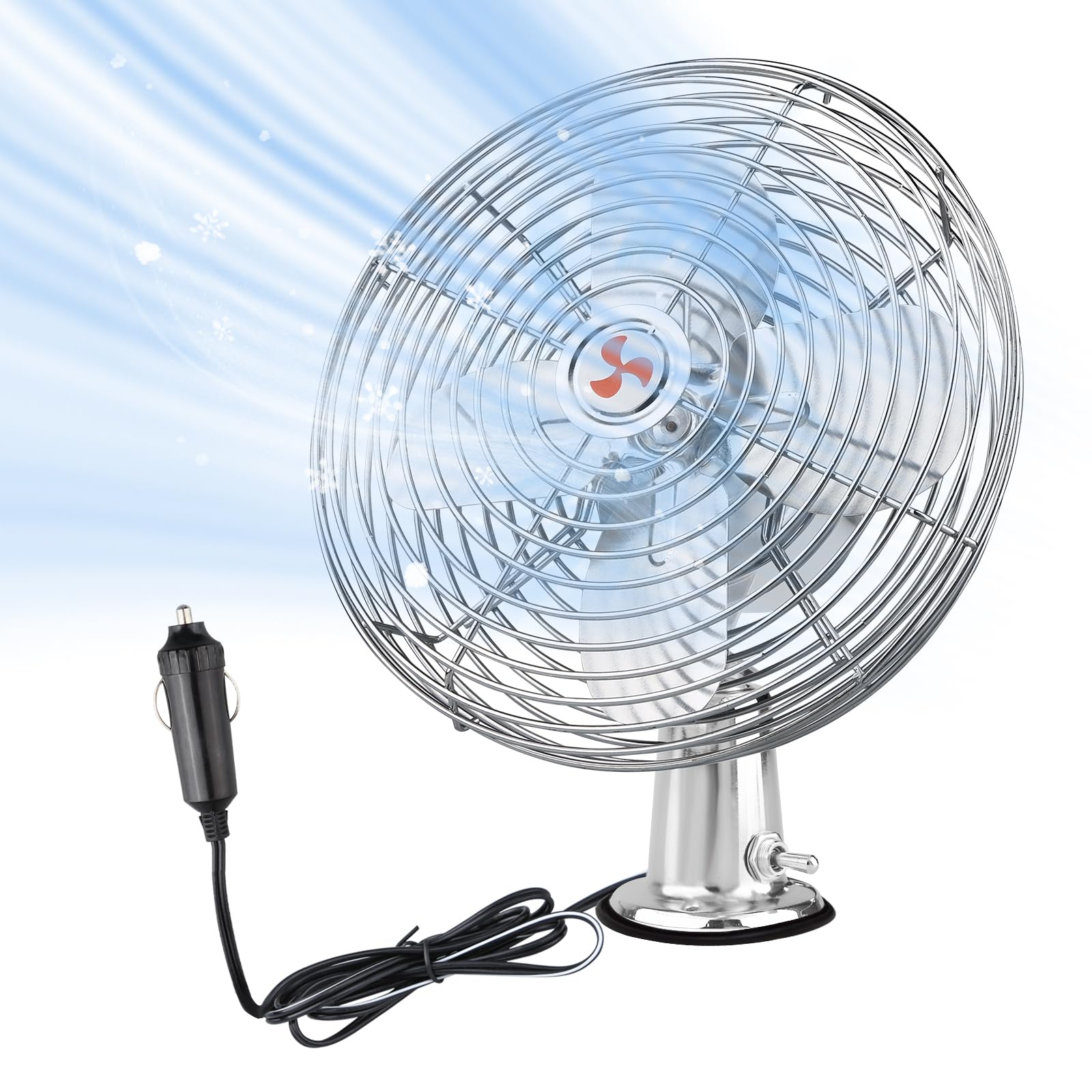
Unlike the plastic-fan norm, the CRAFTZONE 8-inch uses a metal blade and powder-coated steel housing, built specifically for the vibration and dust found in tractors, forklifts, buses, and off-road vehicles. The 2-speed switch is mechanical and positive — no touch panels to fail after a season of exposure. It plugs into any standard 12V outlet and comes with a wall-mount bracket for permanent installation.
The larger blade diameter moves substantial air at modest RPM, which keeps noise lower than small high-speed fans. Owners operating heavy equipment report that the fan withstands constant jostling and temperature swings without rattling or losing balance. The silver powder coat is corrosion-resistant, making it suitable for boats and marine environments as well.
While the design lacks the tilting heads or oscillation of passenger-car fans, the rugged build is exactly what commercial and agricultural users need. If your vehicle sees dirt, debris, or relentless sun and you need a fan that simply works without fuss, this metal unit is the most durable option in this guide.
What works
- Metal construction handles heavy vibration and dust
- Large blade moves high volume at low noise
- Powder-coated finish resists corrosion
- Wall-mount bracket allows permanent installation
What doesn’t
- Heavier than plastic fans at over 0.7 kg
- No adjustable tilt or oscillation feature
5. Saihisday 12V Car Auxiliary Heater

The Saihisday is a true auxiliary heater that taps into your vehicle’s coolant system rather than relying on a resistive element. With four vent ports and a powerful blower motor, it delivers genuine warmth to the cabin — not just recirculated air. Designed for underdash installation, it acts as a secondary heater core for vehicles with weak factory heat or for added comfort in the rear of vans and trucks.
Installation requires connecting to the vehicle’s heater hoses using a 5/8-inch inner diameter water hose (not included), and wiring the 3-speed switch to a 12V power source. This is a more involved project than plug-and-play fans, but the result is real engine-heated air that can keep a windshield clear and passengers warm even in freezing conditions. The unit weighs nearly 7 pounds, reflecting the quality of the motor and core.
Owner reports from van and RV owners emphasize the dramatic improvement in cabin temperature during winter months. This is not a toy or a portable fan — it’s a permanent upgrade that solves chronic heating issues. If you need serious defrosting capability and are comfortable with basic mechanical installation, this auxiliary heater is the most capable thermal solution on the list.
What works
- Provides real engine-heated air, not just fan breeze
- Four vents distribute warmth across wide area
- Sturdy construction suitable for permanent installation
- Effective defroster for cold-climate drivers
What doesn’t
- Requires coolant hose installation and wiring
- Heavy and bulky compared to portable fans
- Not compatible with all vehicle coolant systems
6. BESMORY Dual Head Car Fan with Mist

The BESMORY distinguishes itself with a built-in misting function that adds humidity to the airflow, providing an extra layer of cooling relief in dry climates. Fill the small water tank with clean water and activate the mist mode to spray a fine fog that drops the perceived temperature more effectively than fan alone. This makes it especially useful in arid regions where evaporative cooling is welcome.
It runs on USB power, so you can plug it into a car charger, power bank, laptop, or wall adapter. The dual heads each rotate 360 degrees and tilt 180 degrees independently, offering flexible direction control. Two speed settings let you choose between gentle circulation and max cooling. The whisper-quiet operation is confirmed by owners who use it with infants in the backseat.
Safety features include low-heat components and circuit protection for extended use. The tape-mount base secures to the dashboard without drilling. While the mist function adds a unique benefit, you do need to refill the tank periodically and use only clean water to avoid mineral buildup. For drivers in hot, dry climates who want more than just moving air, this fan delivers noticeable extra comfort.
What works
- Mist function provides evaporative cooling in dry heat
- USB power works with multiple sources
- Quiet operation suits families with babies
- Dual heads with full rotation for flexible direction
What doesn’t
- Water tank needs frequent refills
- USB power limits maximum airflow vs 12V fans
- Mist may leave light moisture on surfaces
7. KINOWJI Portable Car Heater Defroster
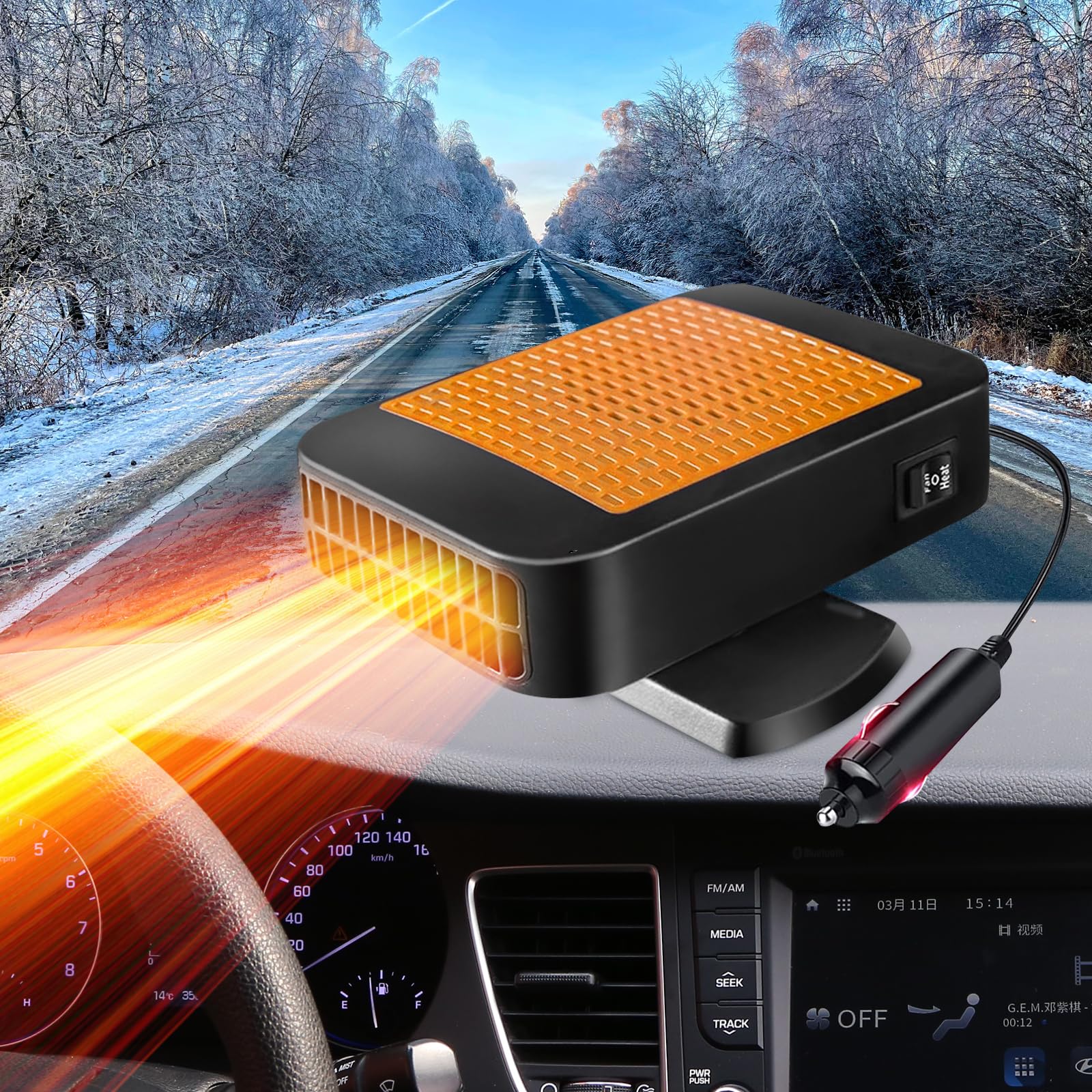
The KINOWJI is a 200-watt PTC ceramic heater that plugs directly into your 12V cigarette lighter socket and produces heat within seconds. It doubles as a windshield defroster, using a 360-degree rotating base to aim warm air exactly where needed — whether that’s the windshield, side windows, or directly at occupants. The ABS housing resists heat and deformation, keeping operation safe even during extended use.
Weighing just over 12 ounces, it’s light enough to move between vehicles or store in a glove box. The fan portion can also be used alone for cooling in summer, giving it year-round utility. Owners in cold climates report that it effectively clears light frost and condensation, reducing the need to run the engine solely for defrosting. The 200-watt draw is modest for a heater but still significant for a 12V circuit; monitoring battery voltage during extended idle use is recommended.
Build quality feedback is generally positive, with the rotary base holding up well to daily adjustment. The heating element reaches full temperature quickly, and the fan distributes the warmth evenly. For drivers who want plug-and-play warmth without permanent installation, the KINOWJI is the most practical portable heater in this guide.
What works
- PTC ceramic heating provides instant warmth
- 360° base targets airflow precisely
- Lightweight and fully portable
- Works as both heater and cooling fan
What doesn’t
- 200W draw should be monitored on short trips
- Primarily a defroster, not full cabin heater
- ABS plastic may feel less durable than metal options
8. Yerloa Dual Head Car Fan
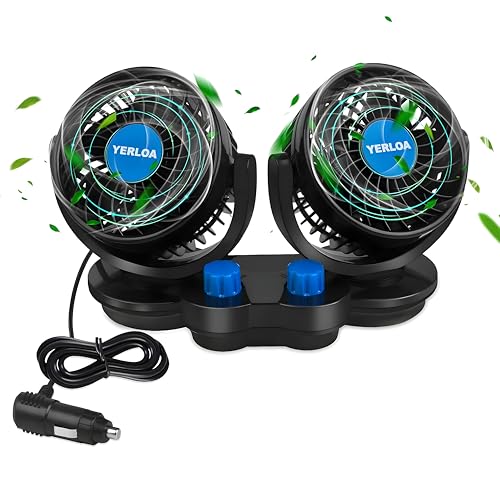
Yerloa offers a no-frills dual-head fan that focuses on delivering adequate airflow at a budget-friendly price point. Each head rotates a full 360 degrees, allowing independent aiming for driver and passenger. The two-speed switch gives you a basic choice between gentle circulation and stronger breeze, and the 12V cigarette lighter plug works in any standard socket. It’s designed to be truly plug-and-play with no installation steps beyond inserting the plug.
The plastic construction keeps weight low, and the fan is compact enough to fit on the dashboard or center console without obstructing the windshield view. Owners commonly mention that it helps circulate air in older vehicles where factory HVAC struggles to reach the back seat. The noise level is moderate — noticeable on high speed but not intrusive during conversation or music.
While it lacks advanced features like oscillation or USB ports, the Yerloa delivers exactly what most budget buyers need: reliable airflow from a dual-head design that won’t break the bank. For a spare car, a teenager’s first vehicle, or anyone who just wants a bit of air movement on a hot day, this fan offers solid basic performance.
What works
- Simple plug-and-play operation
- Dual heads cover driver and passenger
- Compact footprint fits small dashboards
- Affordable entry into 12V cabin fans
What doesn’t
- Plastic blades may flex under heavy use
- Only two speed settings limit adjustability
- No oscillation or advanced features
9. ZONETECH Single Head Car Cooling Fan

The ZONETECH is a straightforward single-head fan designed for basic dashboard or armrest mounting. Its key feature is the 8-foot power cord, which gives exceptional flexibility to position the fan anywhere within a vehicle, including far rear seats or cargo areas. The 3M adhesive base secures the fan to nearly any surface without drilling or clamps, making it a truly temporary or permanent installation option.
The fan head rotates 360 degrees and tilts conveniently, allowing you to direct airflow around the cabin. The protective circuits help prevent overheating and overloading, which is a reassurance for long-duration use. Owners who run the fan for extended periods — some report 9-10 hours daily — note that it holds up well without motor failure or excessive noise increase.
The single-head design obviously limits coverage compared to dual or triple units, and the plastic blades are best suited for occasional rather than commercial use. However, for the price, the ZONETECH is a reliable entry-level option that prioritizes long cord reach and secure adhesion. It works well as a supplemental fan for the back of an SUV or for a driver who needs focused airflow at their seat.
What works
- 8‑foot cord allows placement anywhere in the cabin
- Adhesive base mounts securely without tools
- Protective circuits prevent overheating
- 360° rotation for directional control
What doesn’t
- Single head covers limited area
- Plastic build feels less premium than metal options
- Adhesive may weaken in extreme heat
10. MICLSRS Dual Head Car Fan

The MICLSRS fan uses a clip-on base that attaches firmly to the dashboard edge or air vent slats without requiring adhesive or tools. The dual heads each rotate 360 degrees, giving you the ability to aim one toward the driver and one toward the passenger. Two speed settings offer basic airflow control, and the 51-inch power cord provides enough length to route the fan to most seating positions.
Build quality focuses on simplicity and ease of installation. The clip has a strong spring that holds position even on bumpy roads, and the compact dimensions mean it won’t block your view of the road. Owners appreciate being able to remove the fan in seconds when not needed, making it ideal for rental cars or shared vehicles. The plastic blades and housing keep the weight very low.
While the clip-on approach is convenient, it may not fit all dashboard designs — particularly those with curved or padded surfaces. The two-speed switch is basic, and there is no mist or oscillation function. For a no-tools, grab-and-go dual-head fan that works when you need it and stores away when you don’t, the MICLSRS is a practical budget pick.
What works
- Clip-on base installs without tools or adhesive
- Dual heads cover both front occupants
- Lightweight and fully portable
- Long cord reaches rear seating areas
What doesn’t
- Clip may not fit thick or curved dash trim
- Only two speeds limit fine adjustment
- Plastic construction feels less durable over time
11. Flylin PTC Ceramic Space Heater
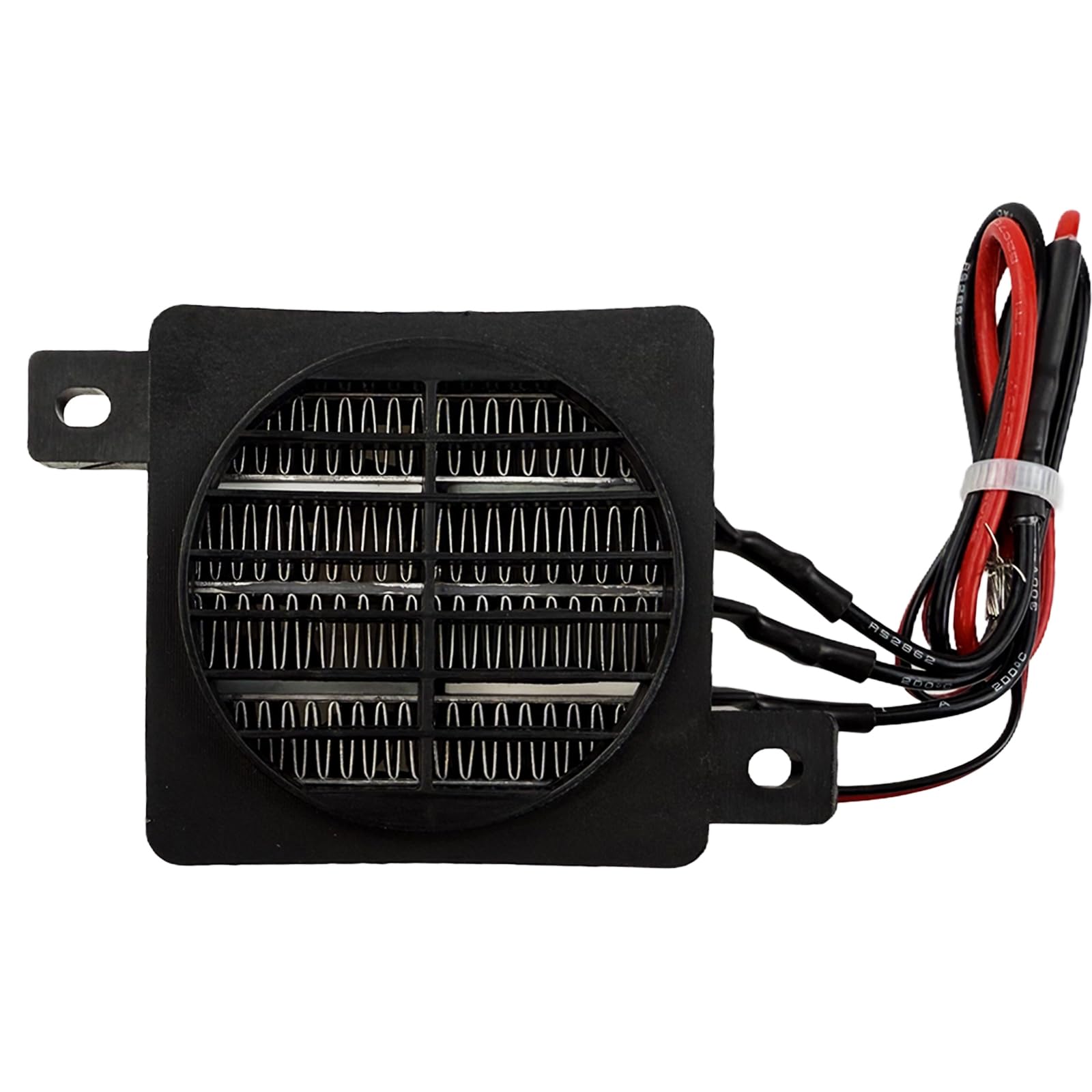
The Flylin is a tiny PTC ceramic heater designed for spot heating in small spaces — think inside a glove box, under a desk, or within a compact vehicle cabin up to about 0.5 cubic meters. It draws 100 watts and operates from a 12V supply, with a maximum temperature of 65°C. The ceramic element offers automatic constant temperature control for energy efficiency and safety.
At just 0.04 kg (about 1.4 ounces), this is more of a heating component than a full cabin fan. It uses high-temperature resistant gel wires rated above 200°C, and the manufacturer states a heating life exceeding 3 years with less than 10% power attenuation. The form factor is a simple pedastal mount that sits on any flat surface, and it includes no fan blade for air movement — relying instead on the PTC element’s own convection.
Customer feedback is limited, but the engineering approach is sound for targeted spot heating. This is not a replacement for a vehicle’s HVAC system or even a conventional car heater fan. It is best suited for very small enclosures, equipment cabs, or as a supplementary heat source in an already-warm cabin. Buyers should understand the niche application before purchasing.
What works
- Ultra-compact and lightweight for spot placement
- PTC ceramic heating is safe and energy efficient
- Constant temperature control prevents overheating
- Long heating life with minimal power loss
What doesn’t
- Only heats very small spaces up to 0.5 m³
- No fan blade means limited air circulation
- Not suitable as primary vehicle heater
Hardware & Specs Guide
Motor Types: Brushless vs. Brushed
Brushless DC motors are the preferred choice for modern 12V fans because they generate less friction, produce less heat, and operate more quietly than brushed alternatives. They also last longer since there are no brushes to wear out. Brushed motors are cheaper but noisier and less efficient; they are typically found in budget or older fan designs. The DICMKY unit uses a brushless motor, which contributes to its low noise and extended lifespan ratings.
Heating Elements: PTC Ceramic vs. Resistive Wire
PTC (Positive Temperature Coefficient) ceramic heaters automatically regulate their temperature — as the element gets hotter, its electrical resistance increases, reducing power draw and preventing runaway heating. This makes PTC heaters inherently safer and more efficient than traditional nickel-chrome wire elements. The Flylin and KINOWJI units both use PTC technology. Resistive wire heaters are cheaper but require separate thermal fuses and are more prone to failure if airflow is blocked.
Blade Design and Material
Larger blades moving at lower RPM produce more airflow with less noise, which is why the 8-inch CRAFTZONE fan achieves good circulation at moderate sound levels. Plastic blades are lightweight and inexpensive but can warp in extreme heat or under constant sun exposure. Metal blades resist deformation and vibration but add weight and cost. For passenger-vehicle use, high-quality ABS plastic with a reinforced hub offers the best balance of durability and weight.
Power Draw and Electrical Safety
Most 12V cigarette lighter circuits are fused at 10A or 15A, giving a maximum continuous draw of about 120W to 180W at nominal voltage. Plugging a 200W PTC heater like the KINOWJI into a 10A circuit leaves little headroom, so it should not be used simultaneously with other high-draw accessories. Fans rated 15–30W are safe to run indefinitely. Always check your vehicle’s fuse rating and consider using a dedicated circuit for any device that draws more than 8 amps continuous.
FAQ
Can a 12V car heater fan drain my battery?
What is the difference between a car fan and a car heater fan?
How do I install a hardwired auxiliary car heater?
Will a USB car fan provide enough airflow?
What size fan do I need for my truck or SUV?
Final Thoughts: The Verdict
For most buyers, the best car heater fan winner is the DICMKY Dual Head Oscillating Fan because it delivers wide, even coverage with a quiet brushless motor and useful USB ports in a single package. If you want serious winter defrosting without permanent installation, grab the KINOWJI Portable Car Heater. And for heavy-duty use in trucks, tractors, or off-road vehicles, nothing beats the CRAFTZONE 8-inch Metal Fan.

Certification: BSc in Mechanical Engineering
Education: Mechanical engineer
Lives In: 539 W Commerce St, Dallas, TX 75208, USA
Md Amir is an auto mechanic student and writer with over half a decade of experience in the automotive field. He has worked with top automotive brands such as Lexus, Quantum, and also owns two automotive blogs autocarneed.com and taxiwiz.com.