Brake fluid is the single most neglected safety component in most vehicles, yet it determines whether your stopping distance stays consistent or turns spongy when you need it most. Choosing the wrong formulation can compromise pedal feel, accelerate internal corrosion, or even lead to vapor lock during demanding drives.
I’m Amir — the founder and writer behind Four Wheel Ask. My approach to automotive product analysis focuses on cross-referencing technical specifications with long-term owner feedback to identify which formulations actually hold up under real-world conditions rather than just on paper.
After reviewing boiling point data, viscosity ratings, and corrosion resistance claims across multiple DOT classifications, I have identified the best car brake oil options that deliver reliable stopping power across every driving condition.
How To Choose The Best Car Brake Fluid
Selecting brake fluid is not about picking the most expensive bottle on the shelf. The right choice depends on your vehicle’s brake system design, your driving environment, and the thermal demands you place on the system. Understanding the technical specifications behind each DOT class helps you make an informed decision.
Understanding DOT Classifications
DOT 3, DOT 4, and DOT 5.1 are all glycol-based and miscible with one another, but each carries a different dry boiling point minimum. DOT 5, by contrast, is silicone-based and should never be mixed with glycol fluids. Many modern vehicles with ABS and stability control now specify DOT 4 Low Viscosity (DOT 4 LV) to ensure rapid fluid movement through tiny valve orifices in the modulator.
Wet vs. Dry Boiling Point
Brake fluid is hygroscopic — it absorbs moisture from the atmosphere over time. The dry boiling point refers to fresh fluid straight from a sealed container, while the wet boiling point reflects performance after the fluid has absorbed a typical amount of water. For street-driven cars, the wet boiling point is the more meaningful number because your fluid will never stay perfectly dry after the first few months in service.
Viscosity and ABS Compatibility
Low-viscosity formulations (often labeled DOT 4 LV or ISO 4925 Class 6) are engineered to flow more easily at cold temperatures. This characteristic is critical for vehicles equipped with electronic stability control and ABS, where rapid fluid movement through narrow passages directly affects activation speed and modulation precision.
Quick Comparison
On smaller screens, swipe sideways to see the full table.
| Model | Category | Best For | Key Spec | Amazon |
|---|---|---|---|---|
| Motul RBF 660 | Racing | Track days & high-heat driving | Dry BP 325°C / Wet BP 204°C | Amazon |
| Castrol SRF | Racing | Extreme motorsport & rally use | Wet BP 270°C (highest available) | Amazon |
| Pentosin Super DOT 4 | Premium | European vehicles with ABS | 1 liter / OE spec for Audi, BMW, Porsche | Amazon |
| Brembo L04210 | Premium | High-performance street & track | DOT 4 LV / 1 liter / Low viscosity | Amazon |
| Wilwood 570 | Racing | Auto-cross & dual-sport street/track | DOT 3 / Dry BP 570°F / 12 oz | Amazon |
| Maxima DOT 5.1 2-Pack | Performance | Motorcycle & high-temp street use | Dry BP 516°F / Wet BP 369°F / 32 oz total | Amazon |
| Motorex DOT 5.1 | OEM | KTM & European motorcycle systems | DOT 5.1 / 0.25 liter metal can | Amazon |
| Liqui Moly DOT 5.1 | Premium | German-engineered brake systems | DOT 5.1 / 250 ml / Made in Germany | Amazon |
| Ford PM-20 | OEM | Ford & Lincoln with LV requirement | DOT 4 LV / 16 oz / WSS-M6C65-A2 | Amazon |
| Motorcraft PM20 | OEM | Ford fleet & multi-vehicle households | DOT 4 LV / 16 oz / OE quality | Amazon |
| Lucas Oil DOT 4 12-Pack | Value | Bulk replacement & fleet maintenance | DOT 4 / 12 oz bottles / 144 oz total | Amazon |
In‑Depth Reviews
1. Motul RBF 660 Factory Line DOT 4 Racing Brake Fluid
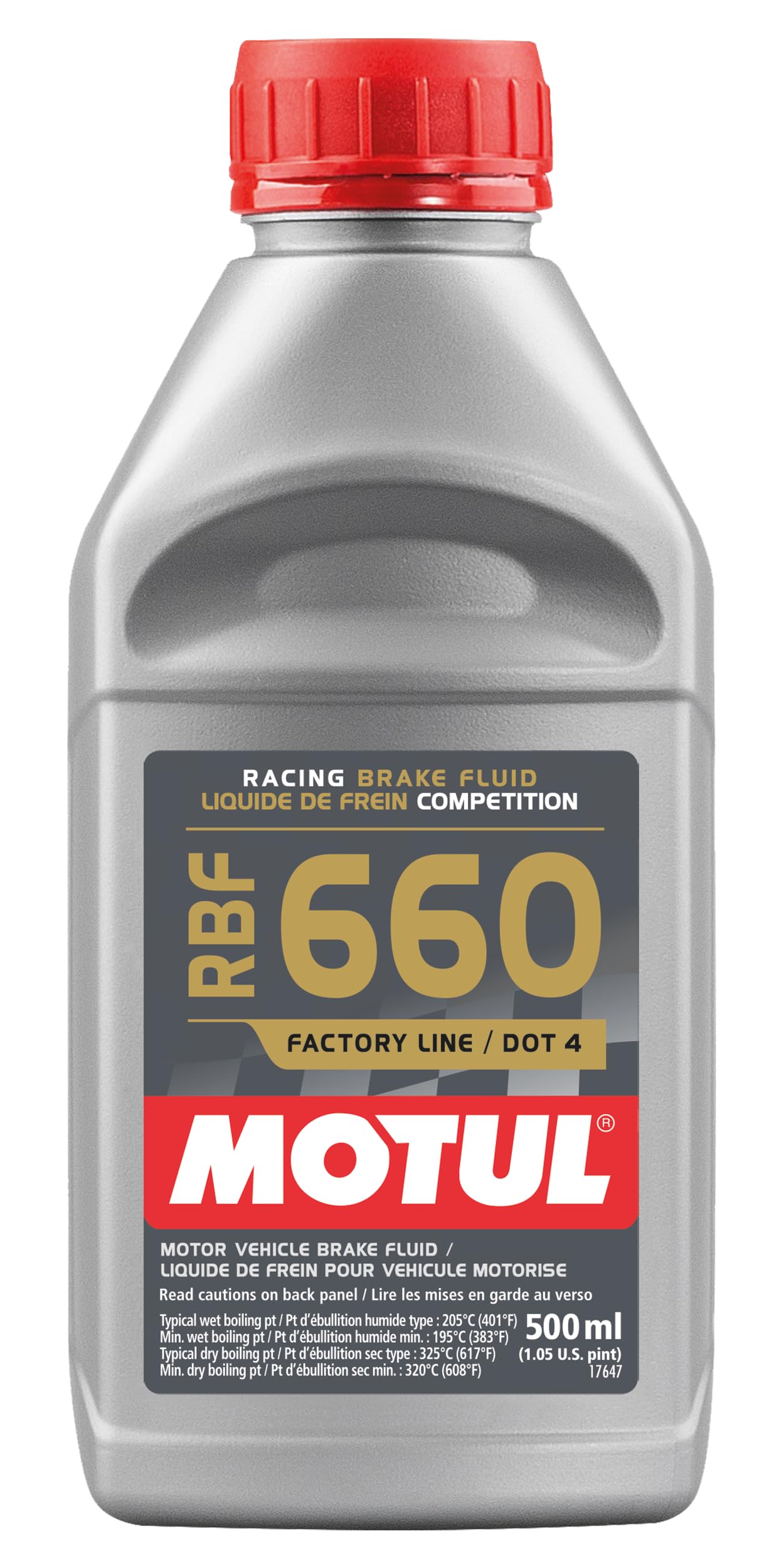
The Motul RBF 660 sits at the top of the performance pyramid for drivers who push their braking systems hard enough to induce fade with standard fluids. Its 100 percent synthetic formulation delivers a dry boiling point of 325°C and a wet boiling point of 204°C — numbers that place it well above typical DOT 4 offerings and into genuine racing territory. Owner feedback from track day participants consistently highlights the elimination of pedal sponginess after repeated heavy braking zones.
Beyond raw thermal capacity, the RBF 660 formulation resists moisture ingress better than many competitors, which extends the usable service interval for enthusiasts who do multiple events per season. Field reports from users of heavy SUVs and sportbikes alike note that the fluid maintains consistent pedal modulation even when ambient temperatures climb or brake temps spike above normal operating ranges. The 500 ml bottle size provides enough volume for most single-vehicle flush and bleed procedures.
Some users coming from standard DOT 3 or DOT 4 fluids report a subtly firmer pedal feel immediately after the swap, which aligns with the fluid’s higher film strength and lower compressibility under thermal load. The RBF 660 meets DOT 4 specifications and is backwards compatible with systems designed for DOT 3 or DOT 4, though a full flush is strongly recommended when switching from a different brand or formulation to avoid chemistry conflicts.
What works
- Exceptional dry and wet boiling points resist fade during aggressive track sessions
- Consistent pedal feel reported by owners of heavy vehicles and sport motorcycles
- Superior moisture resistance compared to many standard DOT 4 formulations
What doesn’t
- Premium pricing over standard DOT 4 fluids may be unnecessary for casual street use
- 500 ml bottle is sufficient for one flush but leaves no extra for future top-offs
2. Castrol SRF Racing Brake Fluid

The Castrol SRF holds a legendary reputation in motorsport circles for one specific reason: its wet boiling point of 270°C is higher than most fluids achieve when dry. This unique characteristic means the SRF retains fade resistance even after absorbing moisture, making it the go-to choice for endurance racing, rally stages, and high-speed track events where fluid cannot be changed between sessions. Owner reports from competitive environments describe consistent pedal firmness across full days of abuse.
The SRF uses an exclusive European ester-based chemistry that differs from standard glycol formulations. Users who have run the fluid for extended periods note that it stays clear longer than conventional options, and multiple Ducati owners report that the SRF solved chronic clutch line air entrapment issues that other fluids could not fix. The fluid meets DOT 4 requirements but operates well beyond those minimums in every meaningful metric.
The primary trade-off is cost — the SRF commands a significant premium per liter, and owners who track their cars frequently mention that the fluid still benefits from annual replacement due to its hygroscopic nature despite the high wet boiling point. It is also highly corrosive to paint, so careful bleeding technique is essential. For street-only drivers who never approach thermal limits, the SRF’s capabilities will far exceed what the system can actually demand.
What works
- Highest wet boiling point of any commercially available brake fluid
- Remains clear and effective longer than standard options under track use
- Proven performance in endurance racing and extreme thermal environments
What doesn’t
- Very expensive per liter compared to standard DOT 4 fluids
- Requires annual flushing for optimal performance despite high wet boiling point
3. Pentosin Super DOT 4 Brake Fluid

The Pentosin Super DOT 4 is the factory-spec fluid for a wide range of European vehicles from Audi, BMW, Mercedes-Benz, Porsche, and Land Rover. Its formulation emphasizes corrosion resistance and stable viscosity across temperature extremes, making it particularly well-suited for modern ABS and stability control systems that demand rapid fluid response. Owner feedback from Subaru and Jaguar owners alike confirms that this fluid performs reliably in both daily driving and moderate performance use.
What sets the Pentosin apart from generic DOT 4 fluids is its documented OE approval chain — the fluid carries multiple OEM part numbers including BMW 81 22 9 407 510 and Mercedes-Benz 000 989 08 07 10. Users who switched from standard aftermarket fluids frequently report a noticeable improvement in pedal consistency, especially in vehicles with complex brake-based stability interventions. The 1-liter bottle provides generous capacity for a full flush plus some reserve.
Some recent production batches have shifted labeling from “Made in Germany” to “German Technology,” which has prompted discussion among long-time users about potential sourcing changes. However, no measurable degradation in performance has been reported in the available owner data. The fluid remains a top-tier choice for European car owners who want to maintain factory-specified protection without paying dealer parts counter markup.
What works
- OE-approved for multiple premium European manufacturers
- Excellent corrosion resistance protects ABS modulator internals
- 1-liter bottle offers good volume for complete system flush
What doesn’t
- Label sourcing change raises questions about formulation consistency
- Not ideal for extreme track use where racing-specific fluids excel
4. Brembo L04210 DOT 4 LV Brake Fluid
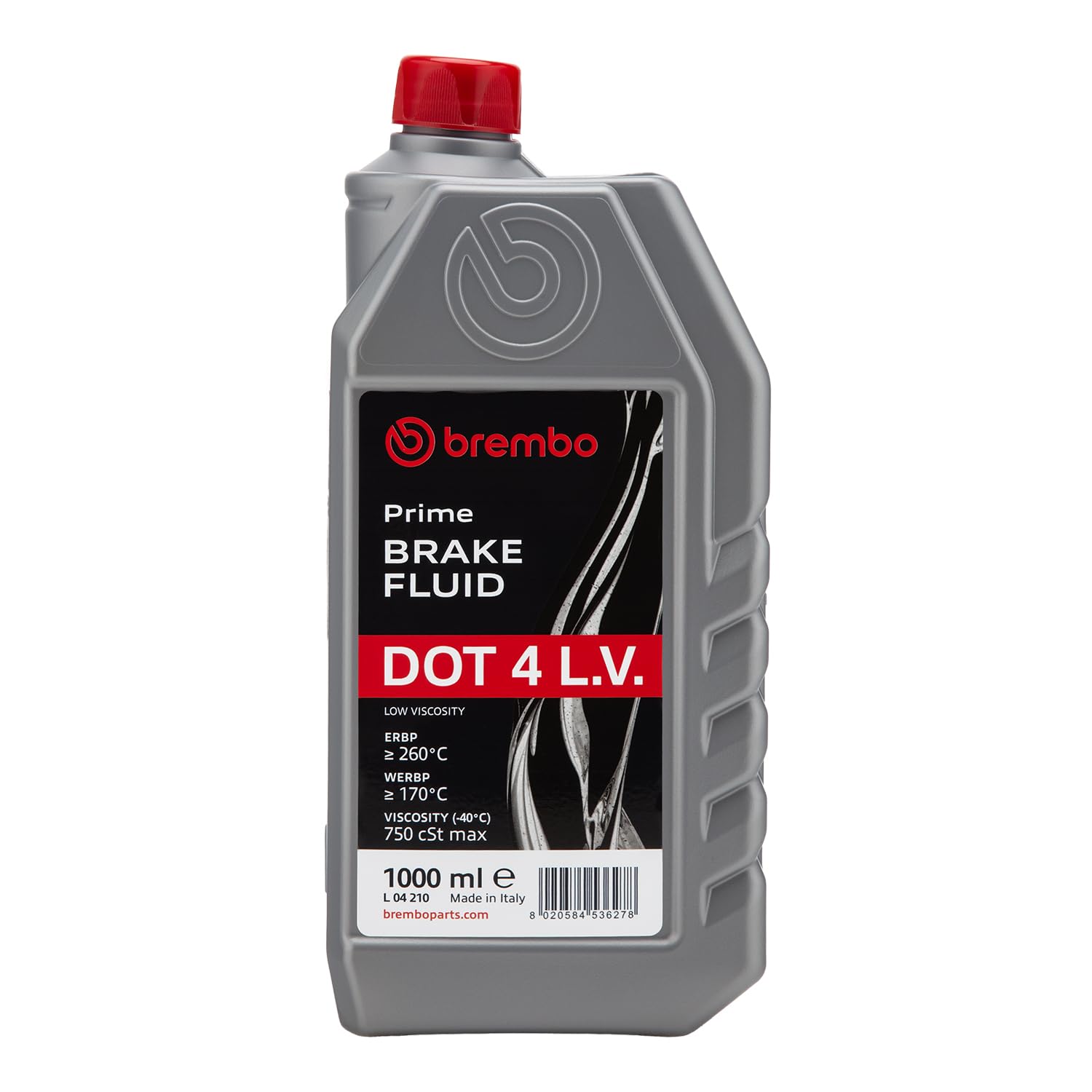
The Brembo L04210 is engineered specifically for vehicles equipped with the latest generation of electronic brake control systems, including ABS, ESP, ASR, TCS, and EBD. Its low-viscosity DOT 4 LV formulation ensures that fluid moves rapidly through the small orifices in modern ABS modulators, particularly in cold weather when thicker fluids can delay system response. Owners of high-performance Maserati and Ford vehicles have reported improved pedal modulation after switching to this fluid.
The 1-liter bottle size provides ample volume for a complete brake and clutch system flush on most passenger vehicles. User data from long-term installations indicates that the Brembo fluid maintains stable wet boiling point performance well beyond the typical two-year service interval, though annual replacement is still recommended for vehicles subjected to track use or frequent mountain driving. The fluid meets ISO 4925 Class 6 standards for low viscosity.
Some users noted that the Brembo L04210 carries a price point above many generic DOT 4 fluids, but those who have compared it side-by-side with standard formulations consistently highlight the firmer pedal feel and more precise modulation — particularly in vehicles with high-performance brake packages. The fluid is compatible with DOT 3 and DOT 4 systems, though a full flush is advisable when switching from a different brand.
What works
- Low-viscosity formulation optimizes ABS and stability control response
- Full 1-liter capacity covers complete system flush with margin
- Long-term wet boiling point stability reported by multiple owners
What doesn’t
- Premium pricing compared to standard DOT 4 alternatives
- Low-viscosity特性 may not benefit older vehicles without electronic brake systems
5. Wilwood 570 Hi-Temp Racing Brake Fluid

The Wilwood 570 brake fluid is a purpose-built racing formulation that prioritizes thermal stability above all else. With a dry boiling point of 570°F, it is engineered for vehicles operating in high-temperature environments such as auto-cross, drag racing, and dual-sport street and track machines. Owner reports from dedicated race car builders indicate that this fluid effectively eliminates fade during sessions where brake temperatures soar well beyond what standard DOT 3 or DOT 4 fluids can tolerate.
One notable aspect of the Wilwood 570 is its specific application notes — the manufacturer recommends this fluid for hydraulic clutch systems as well as brake systems, and multiple users have confirmed excellent results when using it in Wilwood master cylinders serving aftermarket clutch setups. The 12-ounce bottle size is compact but sufficient for a single brake system flush on most dedicated race cars, though owners of larger vehicles may need multiple bottles.
Users who have run the Wilwood 570 in moderate-temperature dirt track and street performance applications report that the fluid never approaches its boiling limits under those conditions, which speaks to the generous thermal headroom built into the formulation. The DOT 3 classification means it is compatible with systems designed for DOT 3 fluid, but owners should note that it is not recommended for mixing with other brake fluid types due to the specific additive package.
What works
- Very high dry boiling point suitable for extreme track temperatures
- Works well in both brake and hydraulic clutch applications
- Compact bottle size convenient for dedicated race vehicle use
What doesn’t
- 12-ounce bottle may be insufficient for full flush on larger vehicles
- Not recommended for mixing with other brake fluid brands or types
6. Maxima Racing Oils DOT 5.1 Brake Fluid 2-Pack

The Maxima Racing Oils DOT 5.1 formulation delivers genuine racing-grade performance at a per-ounce cost that undercuts many premium competitors. With a dry boiling point of 516°F and a wet boiling point of 369°F, this fluid meets or exceeds the requirements of DOT 5.1, DOT 4, and DOT 3 standards, making it a versatile upgrade for virtually any hydraulic brake or clutch system. Owner feedback from motorcycle riders, particularly those with Italian brands that specify DOT 5.1, confirms excellent results.
The 2-pack configuration provides 32 total ounces of fluid, which is sufficient for a full brake system flush on most cars plus a complete motorcycle flush, or two separate vehicle services. Users who have compared the Maxima fluid against higher-priced options note that the performance gap is negligible for all but the most extreme motorsport applications. The anti-vapor lock chemistry actively fights both water contamination and vaporization under high heat.
The safety seal on the bottles received some criticism from users who found it unusually difficult to remove cleanly, but this is a minor packaging issue rather than a fluid performance concern. The Maxima fluid is fully compatible with SBR, EPDM, and natural rubber seals, and it mixes with other DOT 3, DOT 4, and DOT 5.1 fluids if a top-off is needed before a full flush can be performed.
What works
- Excellent boiling point specifications at a competitive per-ounce cost
- 2-pack provides generous total volume for multiple vehicles
- Fully compatible with DOT 3, DOT 4, and DOT 5.1 systems
What doesn’t
- Safety seal is difficult to remove according to multiple user reports
- Not targeted at the extreme wet boiling point needs of endurance racing
7. Motorex DOT 5.1 Brake Fluid

The Motorex 300287 is the factory-recommended brake fluid for KTM enduro and dual-sport motorcycles, and its 0.25-liter metal can is designed specifically for the tight spaces found on off-road and adventure bikes. The DOT 5.1 formulation provides a higher boiling point than standard DOT 4, which is beneficial for motorcycles that experience sustained brake application during technical off-road riding or downhill sections. Owner feedback from the KTM community confirms that this fluid meets the performance requirements of demanding off-road use.
The metal can construction is a deliberate design choice — it eliminates the risk of moisture ingress through permeable plastic walls during storage and provides a stable base that resists tipping during use. Users who have worked with this fluid on multiple brake bleeds note that the compact can fits easily into tight workshop spaces and the pour spout design minimizes spills. The 0.25-liter volume is perfectly sized for a single motorcycle brake system flush with minimal waste.
While the small bottle size is ideal for motorcycles, it is not practical for automotive brake system flushes that typically require 0.5 to 1.0 liters. Owners of cars that specify DOT 5.1 will need multiple cans, which increases the total cost compared to larger-format competitors. The Motorex fluid is compatible with other DOT 5.1, DOT 4, and DOT 3 systems, but its niche sizing positions it primarily as a motorcycle-specific solution.
What works
- Factory-recommended fluid for KTM motorcycles with proven off-road performance
- Metal can construction prevents moisture absorption during storage
- Compact size reduces waste for single-motorcycle service
What doesn’t
- Very small volume requires multiple cans for automotive use
- Higher per-ounce cost compared to larger-format DOT 5.1 options
8. Liqui Moly DOT 5.1 Brake Fluid

The Liqui Moly DOT 5.1 brake fluid is a German-engineered formulation that bridges the gap between street performance and light track use. Its DOT 5.1 classification provides a higher dry boiling point than standard DOT 4, making it suitable for drivers who occasionally push their brakes hard but do not require a full racing fluid. The 250 ml bottle is compact and features a wide base design that users consistently praise for stability during bleeding procedures — the bottle does not tip over easily.
Owner feedback reveals an interesting split in use cases: automotive owners use this fluid for European cars that specify DOT 5.1, while a significant number of bicycle owners with high-end SRAM hydraulic brakes report excellent results when using Liqui Moly as a service fluid. The Made in Germany labeling carries weight with buyers who prioritize manufacturing origin in their purchasing decisions, and multiple users describe the fluid as a noticeable upgrade over Finishline brand alternatives.
The 250 ml volume is enough for a single bicycle brake service or a small motorcycle flush, but automotive applications will require multiple bottles. Some users expressed surprise at the actual bottle size relative to product listing images, noting that the wide bottle design creates an optical illusion of larger capacity. This is a packaging presentation issue rather than a product quality concern, but it has generated enough discussion to warrant attention.
What works
- Stable wide-base bottle design prevents spills during bleeding
- German engineering with strong reputation for quality consistency
- Works well in automotive, motorcycle, and bicycle hydraulic systems
What doesn’t
- 250 ml volume is small for automotive brake system flushes
- Bottle appears larger in photos than actual capacity
9. Ford Genuine PM-20 DOT 4 LV Brake Fluid
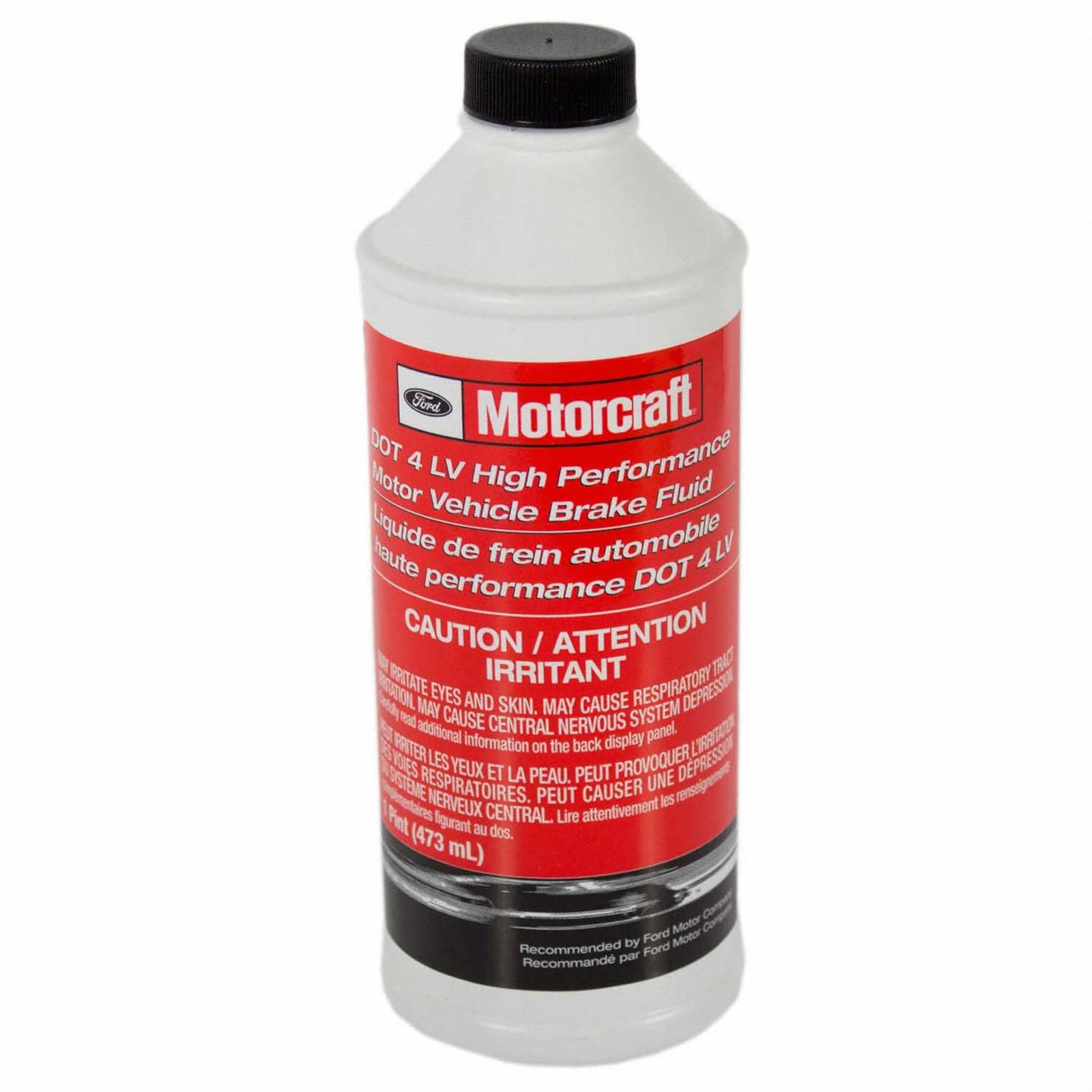
The Ford Genuine PM-20 is the factory-specified brake fluid for Ford and Lincoln vehicles that require WSS-M6C65-A2 (ISO 4925 Class 6) DOT 4 Low Viscosity fluid. This specification became mandatory for certain models beginning in the 2012-2013 model years, and using a non-compliant fluid can compromise ABS and stability control performance. Owner reports from Fiesta, F-150, and F-250 owners confirm that this fluid maintains pedal consistency and system reliability over extended service intervals.
The low-viscosity formulation is specifically engineered to improve response times in ABS modulators and electronic stability control systems, particularly in cold weather when standard DOT 4 fluids become thicker and slower to move through valve passages. Users who have compared the PM-20 against generic DOT 3 or DOT 4 fluids note that the pedal feel is noticeably more consistent across temperature extremes. The 16-ounce bottle provides enough volume for a single brake system flush on most Ford passenger vehicles.
Some owners of older Ford vehicles that do not require the LV specification question whether the PM-20 provides any benefit over standard DOT 3 or DOT 4 fluids. For those vehicles, the low-viscosity characteristic is unnecessary, and a standard DOT 4 fluid may be a more cost-effective choice. However, for any Ford or Lincoln model that specifically calls for WSS-M6C65-A2 compliance, the PM-20 is the correct and recommended option.
What works
- Factory-spec fluid for Ford and Lincoln LV requirements
- Low viscosity improves ABS and stability control response in cold weather
- Proven long-term reliability across multiple Ford platforms
What doesn’t
- No benefit for vehicles that do not require DOT 4 LV specification
- 16 oz bottle may be insufficient for larger vehicles with dual calipers
10. Motorcraft PM20 DOT 4 LV Brake Fluid
The Motorcraft PM20 is chemically identical to the Ford Genuine PM-20 and carries the same WSS-M6C65-A2 (ISO 4925 Class 6) DOT 4 Low Viscosity specification. It is the recommended fluid for Ford and Lincoln vehicles requiring this standard, and it is also suitable for vehicles that specify WSS-M6C65-A1 (DOT 3). Owner feedback from Focus ST, F-150, and Expedition owners consistently rates this fluid as a reliable option that delivers consistent pedal feel under both street and light track conditions.
Multiple long-term Ford owners report that they keep a bottle of this fluid on hand at all times after experiencing issues with less expensive alternatives such as Valvoline DOT 3/4 and Prestone. The Motorcraft formulation appears to provide better long-term corrosion protection and more stable boiling point retention according to user reports spanning multiple vehicle platforms. The 16-ounce bottle is appropriately sized for a single vehicle service on most Ford passenger cars and light trucks.
Some users note that the bottle size feels small relative to the price point, particularly when compared to aftermarket DOT 4 options that offer larger volumes for similar cost. However, for owners who prioritize OEM specification compliance and have experienced problems with non-OEM fluids in the past, the Motorcraft PM20 represents a known quantity that delivers predictable results. It is not formulated for extreme track use, but it meets the demands of daily driving and occasional performance driving.
What works
- OE-spec fluid for Ford and Lincoln vehicles with LV requirements
- Proven reliability across multiple Ford platforms with consistent pedal feel
- Better corrosion protection reported compared to some aftermarket alternatives
What doesn’t
- Small bottle size relative to price compared to aftermarket options
- Not formulated for high-temperature track or racing applications
11. Lucas Oil DOT 4 Synthetic Brake Fluid 12-Pack

The Lucas Oil DOT 4 Synthetic Brake Fluid 12-pack is a bulk-value solution for households or small shops that service multiple vehicles. Each 12-ounce bottle contains a high-quality blend of polyethylene glycol ethers and additives that meet DOT 4 specifications, and the 12-bottle configuration provides 144 total ounces — enough for multiple complete brake system flushes or ongoing maintenance across a fleet. Owner feedback from Corvette owners using this fluid for clutch system service confirms reliable performance with no degradation issues.
The formulation is designed to be compatible with all brake system rubber components, preventing seal hardening or softening that can occur with incompatible fluids. Lucas Oil’s additive package also provides corrosion protection and lubricity that some users report translates to a slightly firmer pedal feel compared to bargain-basement DOT 4 options. User data from Tacoma owners who used this fluid with speed bleeders reported very low moisture content in freshly opened bottles.
The 12-pack format is overkill for a single-vehicle owner who only needs a flush every two to three years, and individual bottles do not reseal perfectly once opened. However, for multi-car households, DIY enthusiasts who service vehicles for friends and family, or small repair shops, the bulk format provides significant cost savings per ounce compared to buying single bottles. The Lucas Oil DOT 4 meets the needs of daily-driven vehicles and light performance use, though it is not designed for track conditions.
What works
- Excellent value per ounce for multi-vehicle or fleet maintenance
- Compatible with all rubber seal materials — prevents hardening or softening
- Low moisture content reported in freshly opened bottles
What doesn’t
- 12-pack volume is excessive for single-vehicle owners
- Not formulated for high-temperature track or racing applications
Hardware & Specs Guide
Glycol vs. Silicone Base Fluids
Most brake fluids on the market use a glycol-ether base (DOT 3, DOT 4, and DOT 5.1) which is hygroscopic — it absorbs moisture from the air over time. This characteristic actually protects internal components because absorbed moisture stays suspended in the fluid rather than pooling in low spots where it could cause localized corrosion. DOT 5 silicone fluid is hydrophobic and does not absorb moisture, but it is compressible, leading to a spongy pedal feel, and it is not compatible with ABS systems. For the vast majority of modern vehicles, glycol-based DOT 4 or DOT 5.1 is the correct choice.
Boiling Point Ratings Explained
The dry boiling point measures fluid performance when fresh from a sealed container, while the wet boiling point reflects performance after the fluid has absorbed approximately 3.7 percent water by volume — the typical saturation level after one to two years of service. For street-driven vehicles, the wet boiling point is the more meaningful specification because your fluid will inevitably absorb moisture. Racing fluids prioritize dry boiling point for fresh-fluid track use, while premium street fluids emphasize wet boiling point retention for long-term reliability.
FAQ
How often should I replace brake fluid?
Can I mix DOT 4 with DOT 5.1 brake fluid?
What does DOT 4 LV mean on brake fluid?
Is DOT 5.1 better than DOT 4 for my car?
Final Thoughts: The Verdict
For most buyers, the best car brake oil winner is the Motul RBF 660 because it delivers genuine racing thermal performance in a formulation that remains compatible with street-driven ABS systems. If you want the highest wet boiling point available for extreme endurance use, grab the Castrol SRF. And for cost-conscious owners who need a reliable DOT 4 fluid for routine maintenance across multiple vehicles, nothing beats the bulk value of the Lucas Oil DOT 4 12-pack.

Certification: BSc in Mechanical Engineering
Education: Mechanical engineer
Lives In: 539 W Commerce St, Dallas, TX 75208, USA
Md Amir is an auto mechanic student and writer with over half a decade of experience in the automotive field. He has worked with top automotive brands such as Lexus, Quantum, and also owns two automotive blogs autocarneed.com and taxiwiz.com.