A loose or corroded battery connection is the fastest way to turn a reliable vehicle into a no-start frustration. The terminals and connectors bridging your battery to the electrical system determine voltage stability, charging efficiency, and long-term dependability — yet many drivers overlook the hardware until a failure leaves them stranded.
I’m Amir — the founder and writer behind Four Wheel Ask. I’ve spent years studying battery terminal metallurgy, contact pressure engineering, and real-world owner reports to identify the connectors that actually hold up under heat, vibration, and corrosive underhood conditions.
When selecting best car battery wire connectors, material quality, gauge fit, and corrosion resistance determine long-term performance and reliable power.
How To Choose The Best Car Battery Wire Connectors
Selecting the right battery terminal connectors goes beyond matching post size. Raw material, current-handling capacity, and environmental sealing separate a connection that lasts years from one that degrades in months.
Raw Material: Brass vs Alloy vs Zinc
Brass offers the best balance of conductivity and corrosion resistance for automotive use. Forged and machined brass terminals maintain consistent contact pressure and resist the acidic buildup that plagues cheaper zinc castings. Alloy terminals can be acceptable for light-duty applications, but they typically suffer higher internal resistance and faster surface oxidation under hood heat.
Gauge Compatibility and Current Capacity
A terminal is only as capable as the wire it secures. Connectors rated for 2/0 or 4/0 AWG main feeds support high-current alternator and inverter loads, while those limited to 8 AWG work best for accessory circuits. Oversized terminals that accept multiple gauge sizes offer flexibility for expanding electrical systems without replacing hardware.
Corrosion Resistance and Environmental Sealing
Underhood moisture, road salt, and battery acid vapor accelerate terminal degradation. Look for anti-corrosion washers, sealed covers, or surface treatments such as marine-grade chrome or zinc plating. Multi-point sealing — including heat shrink and dustproof caps — prevents wicking and creep corrosion along the wire strands.
Mounting Configuration and Access
Standard top-post terminals fit most passenger vehicles, but remote jump-post kits simplify access in trucks, RVs, and vehicles with buried batteries. Multi-way connectors with independent set-screws allow clean organization of multiple power and ground leads without stacking ring terminals on a single stud.
Quick Comparison
On smaller screens, swipe sideways to see the full table.
| Model | Category | Best For | Key Spec | Amazon |
|---|---|---|---|---|
| Recoil PBT-D08 | Terminal Clamps | High-conductivity builds | Forged brass, 4 outputs per clamp | Amazon |
| Vgate 8-Way | Multi-Way | Complex multi-cable setups | 8-way, 4/0 to 8 AWG support | Amazon |
| SUNMORN Top Post | Top Post | Daily driver reliability | Brass, anti-corrosion washers | Amazon |
| GMURA Jump Post Kit | Remote Mount | Easy engine bay access | 47-inch cables, IP67 caps | Amazon |
| DLronwey Military | Entry-Level | Budget-conscious installs | Alloy, includes lugs and covers | Amazon |
In‑Depth Reviews
1. Recoil PBT-D08 2-Pack Premium Solid Brass Battery Terminals

The Recoil PBT-D08 uses forged and machined brass rather than cast zinc, delivering markedly lower internal resistance and superior mechanical strength. Each terminal splits into four outputs — two accepting 0/2/4 AWG and two accepting 8 AWG — which simplifies organizing main power feeds alongside smaller accessory circuits without stacking washers.
High-temperature polycarbonate housings provide insulation and protect against underhood heat, while the marine-grade satin chrome finish resists the acidic corrosion that rapidly degrades untreated terminals. Oversized convex set-screws apply even clamping pressure across the wire strands, reducing the risk of hot spots or loosening under vibration.
Owners of dual-battery setups, high-output audio systems, and off-road vehicles consistently report stable voltage and zero corrosion after extended service. The two-pack format covers both positive and negative posts with identical hardware, and the solid brass construction eliminates the brittleness common in budget alloy connectors.
What works
- Forged brass construction provides excellent conductivity
- Four independent outputs per terminal streamline wiring
- Marine-grade chrome finish resists corrosion long-term
What doesn’t
- Higher upfront investment than basic alloy terminals
- Polycarbonate covers add bulk in tight battery boxes
2. Vgate 8-Way Lead Acid Battery Terminal Connector

The Vgate 8-Way connector solves the problem of limited post real estate by integrating four hole-holders and four threaded studs into a single terminal block. It accepts wire sizes from 4/0 AWG down to 8 AWG, making it one of the most versatile options for vehicles with multiple high-current loads or auxiliary battery banks.
Compatibility extends across SAE, DIN, and EN tapered top posts, and the design supports system voltages from 6 V to 48 V. The brass contact surfaces maintain low resistance even under sustained high draw, and the grooved base prevents acid wicking without requiring a corrosion pad on the post.
Setup is straightforward: identify the correct hole for each wire gauge, tighten the set-screws, and attach the clamp to the battery post. A two-year warranty backs the unit, though owners should note that lithium batteries require a separate stud-to-post adapter for proper fitment.
What works
- Eight connection points accommodate complex electrical layouts
- Wide gauge range from 4/0 down to 8 AWG
- Grooved base design prevents acid contact without pads
What doesn’t
- Lithium battery setups need an additional adapter
- Larger footprint may not fit very compact battery trays
3. SUNMORN Top Post Battery Terminal Connectors
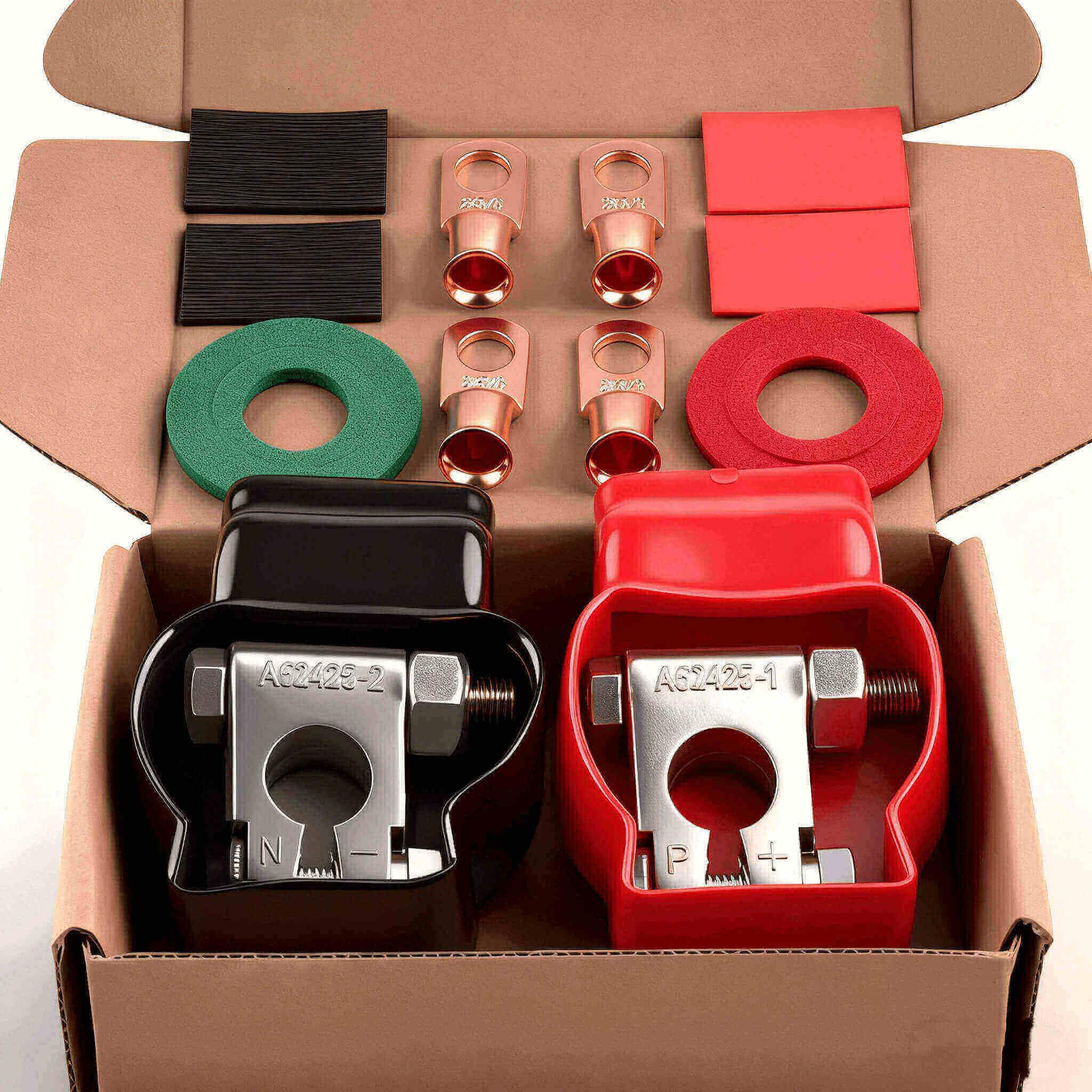
The SUNMORN terminals pair heavy-duty brass construction with an anti-corrosion coating that stands up to moisture, battery acid, and extreme temperature swings. The precisely machined clamping surfaces create a snug fit on SAE top posts, reducing the loosening that vibration causes in stamped steel or cast alloy connectors.
High-temperature resistance ensures the terminals maintain their structural integrity under sustained engine bay heat, while the included anti-corrosion washers and heat shrink tubing address two common failure points in a single package. The kit also supplies four 2-gauge 3/8-inch copper lugs, eliminating the need to source hardware separately.
For daily drivers and marine applications where corrosion is a constant concern, the combination of brass metallurgy and protective coatings delivers reliable performance at a competitive entry point. The clear positive-negative labeling and lever-actuated clamp design make installation and future battery swaps straightforward.
What works
- Anti-corrosion coating handles harsh underhood and marine environments
- Includes washers, heat shrink, and copper lugs
- High-temperature rating prevents heat deformation
What doesn’t
- Limited to 2 AWG maximum wire size
- Brass alloy may not match pure copper conductivity for extreme builds
4. GMURA Battery Jump Post Kit with Cable and Mounting Bracket
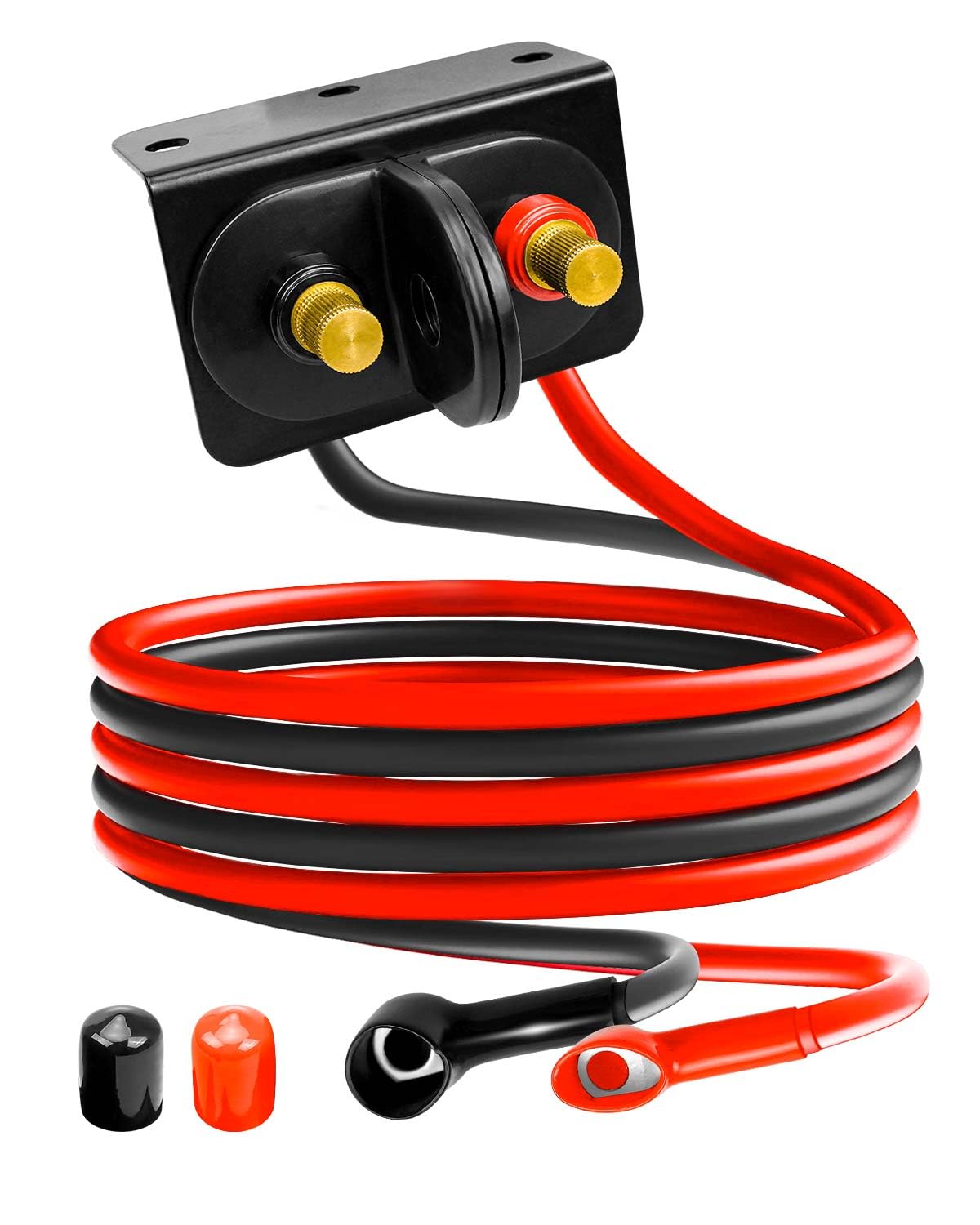
The GMURA jump post kit relocates battery connection points to a convenient location using two 47-inch, 7 AWG pure copper cables and a mounting bracket. This eliminates the need to reach into cramped battery trays or remove covers every time the vehicle needs a jump start or trickle charge.
Each terminal post features a brass core with a spray-painted surface treatment that resists oxidation and corrosion, while the included IP67-rated dustproof caps seal the connection points against moisture and debris when not in use. The positive and negative cables are color-coded red and black respectively, removing guesswork during installation.
Designed for trucks, RVs, boats, UTVs, and race cars where the main battery is tucked away, the kit simplifies both emergency jumping and routine maintenance charging. The compact base can be securely mounted on flat surfaces near the grille, fender, or firewall, keeping termination points accessible without cluttering the engine bay.
What works
- Remote relocation makes jumping and charging much easier
- IP67 caps keep terminals dry and clean
- Pure copper cables deliver consistent current flow
What doesn’t
- 7 AWG cable may be undersized for very high-crank engines
- Fixed cable length limits mounting location options
5. DLronwey Military Spec Battery Terminal Connectors
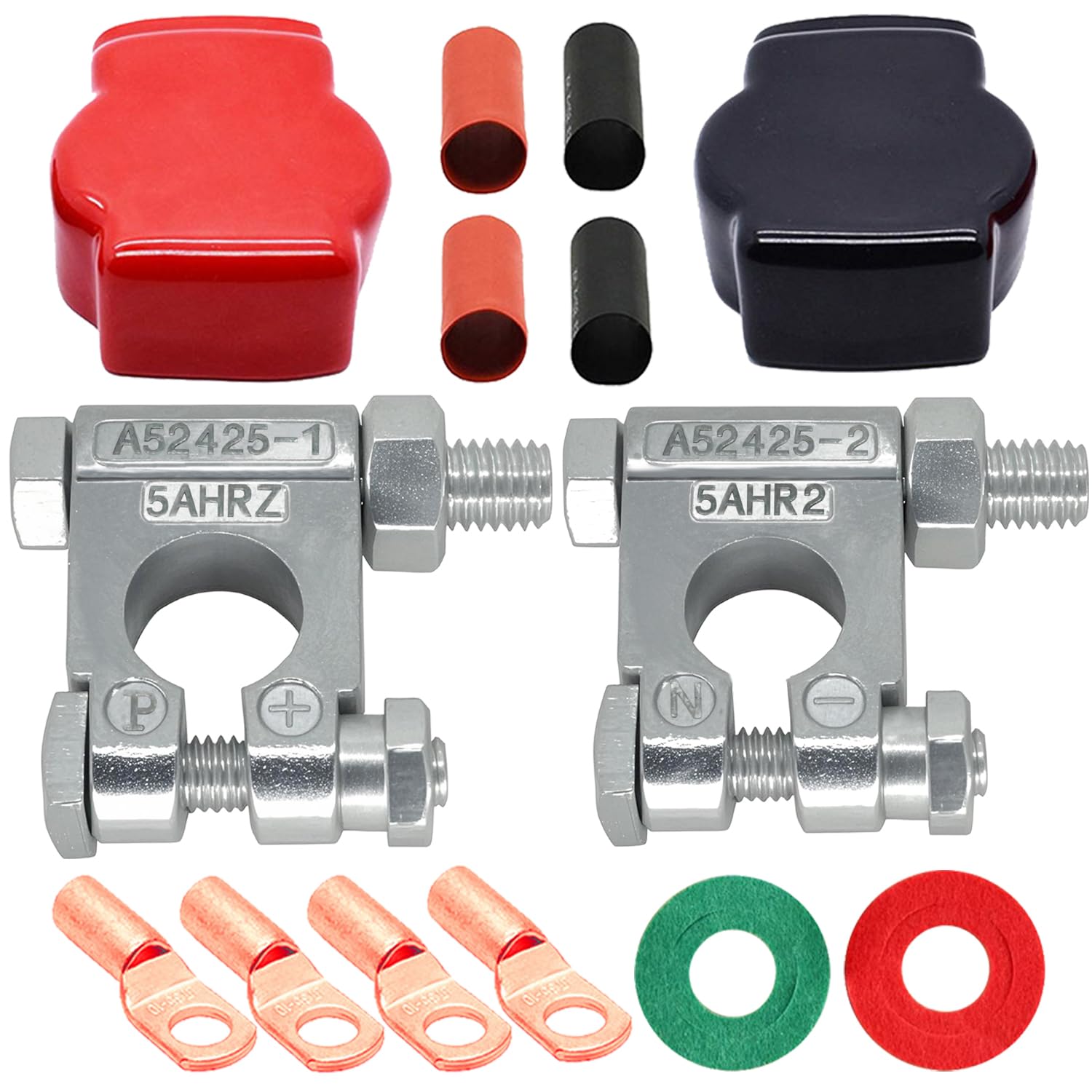
The DLronwey military-style terminals use a heavy-duty alloy construction that balances conductivity with mechanical toughness for general automotive, marine, RV, and camper applications. Each terminal accepts multiple wire gauges, and the kit includes four 2-gauge 3/8-inch copper lugs, heat shrink tubing, anti-corrosion washers, and color-coded waterproof covers.
Clear positive and negative markings reduce installation errors, and the compact footprint fits standard top-post batteries without interfering with hold-downs or adjacent components. The included storage case keeps spare hardware organized, which is useful for mobile installers or owners who frequently reconfigure their electrical system.
This kit serves as a solid entry-level solution for basic battery connections where extreme current loads or severe environmental exposure are not primary concerns. The one-year warranty and 24-hour response commitment provide reassurance for first-time buyers stepping up from corroded factory terminals.
What works
- Complete bundle includes lugs, heat shrink, and covers
- Compact design fits most standard battery trays
- One-year warranty with rapid support response
What doesn’t
- Alloy material has higher resistance than pure brass
- Limited to 2 AWG maximum wire size
Hardware & Specs Guide
Material Science: Brass vs Alloy vs Zinc
Brass — specifically forged or machined brass — offers the highest conductivity and corrosion resistance among common terminal materials. Its copper-zinc composition maintains structural rigidity under heat and resists the acidic vapors that cause zinc and pot-metal alloys to corrode from within. Alloy terminals (typically aluminum or mixed metals) are lighter and cheaper but suffer higher voltage drop under sustained load. Zinc castings should be avoided entirely for high-current applications; they become brittle with age and often develop surface oxidation that increases resistance over time.
Gauge Compatibility and Current Ratings
A terminal’s wire-gauge range directly determines its maximum current capacity. A connector rated for 2/0 AWG can handle upwards of 175 amps continuous, while an 8 AWG terminal is typically limited to 50-60 amps. Multi-way terminals that accept multiple gauge sizes (e.g., 2/0, 1/0, and 4 AWG in the same block) offer flexibility for expanding electrical systems without replacing hardware. Always match the terminal’s gauge rating to the largest wire in your system to avoid bottlenecking current flow and creating a fire risk at the connection point.
FAQ
What is the best material for car battery wire connectors?
Can I use these terminals with any battery type?
How do I prevent corrosion on battery terminals?
Do I need a special tool to install battery terminal connectors?
Final Thoughts: The Verdict
For most buyers, the best car battery wire connectors winner is the Recoil PBT-D08 because its forged brass construction, four independent outputs, and marine-grade corrosion resistance deliver a level of reliability that justifies the investment for any serious build. If you need multi-cable flexibility for complex electrical systems, grab the Vgate 8-Way. And for convenient remote jump access in trucks or RVs, nothing beats the GMURA Jump Post Kit.

Certification: BSc in Mechanical Engineering
Education: Mechanical engineer
Lives In: 539 W Commerce St, Dallas, TX 75208, USA
Md Amir is an auto mechanic student and writer with over half a decade of experience in the automotive field. He has worked with top automotive brands such as Lexus, Quantum, and also owns two automotive blogs autocarneed.com and taxiwiz.com.