Lead-acid batteries rely on a precise electrolyte mixture, and topping off with the wrong fluid gradually degrades plate material and shortens service life. Using plain tap water introduces minerals that accelerate sulfation and internal corrosion, so choosing the right fluid isn’t a minor detail — it directly determines how many seasons your battery delivers reliable cranking power.
I’m Amir — the founder and writer behind Four Wheel Ask. I’ve spent years analyzing automotive battery care products, comparing purity specifications, and reviewing owner feedback to identify what truly keeps batteries performing at their best.
From lab-grade deionized water to practical filling tools, the right choice depends on your battery type and how you maintain it. After comparing dozens of options, I’ve identified the top contenders for maintaining optimal battery health with the best car battery fluid on the market.
How To Choose The Best Car Battery Fluid
Selecting the right fluid for your battery is about matching purity with your specific battery type and maintenance routine. The wrong water introduces contaminants that reduce capacity and shorten lifespan, while the right one keeps the electrochemical process clean and efficient.
Purity Level: Deionized vs Distilled
Both deionized (DI) and distilled water remove dissolved solids, but DI water typically achieves lower conductivity through ion exchange, making it the preferred choice for battery top-offs. Distilled water works well too, but always check the label for ASTM or ACS certification to confirm mineral removal meets battery-grade standards.
Packaging and Dispensing
Water stored in plastic bottles can absorb impurities over time if the container isn’t sealed properly. Look for bottles with tamper-evident seals and opt for sizes you’ll use within a few months. A dedicated filler tool with a flex bulb gives you precise control and prevents splashing acid during top-offs.
Application Fit
Flooded lead-acid batteries in cars, boats, golf carts, and solar banks all require periodic fluid checks. For high-maintenance banks with multiple cells, a larger gallon jug paired with a filler tool saves significant time. For occasional passenger car use, smaller containers are more practical and reduce storage concerns.
Quick Comparison
On smaller screens, swipe sideways to see the full table.
| Model | Category | Best For | Key Spec | Amazon |
|---|---|---|---|---|
| HAVENLAB Deionized Water | Deionized | Battery top-off & cooling | 1 Gallon, sterile | Amazon |
| MAXTITE Type II Deionized | Deionized | Lab-grade purity | 1 Gallon, ASTM certified | Amazon |
| RPI Distilled Water | Distilled | Lab & industrial use | 4 Liters, reagent grade | Amazon |
| Indco Deionized Water | Deionized | Multi-purpose maintenance | 1 Gallon, demineralized | Amazon |
| WirthCo 20410 Filler | Filler Tool | Precision fluid addition | 6″ stem, flex bulb | Amazon |
In‑Depth Reviews
1. HAVENLAB Deionized Water

HAVENLAB’s deionized water is marketed as completely pure and mineral-free, which aligns exactly with what flooded lead-acid batteries demand. Owner reports consistently highlight the sturdy jug design and the convenience of a resealable container that doesn’t leak during storage — a practical detail when you’re keeping it in the garage for months at a time. Multiple buyers mention using it specifically for battery banks in solar setups, where water quality directly affects cycle life.
The water tests to a high purity level suitable for lab equipment, pharmaceutical blending, and industrial cooling, so battery top-off is well within its capabilities. The one-gallon size hits a sweet spot for most passenger car and marine battery owners — enough for several maintenance sessions without taking up excessive shelf space. A handful of users in the review data also use it for soldering irons and calibration meters, confirming the consistency batch to batch.
For anyone maintaining a standard flooded battery who wants a reliable, single-source fluid without hunting for specialty brands, this jug delivers the purity you need without overcomplicating the purchase. The packaging durability alone makes it a step above thinner bottles that crack or spill after partial use.
What works
- Consistently high purity verified by multiple use cases
- Sturdy, leak-resistant jug design
- Versatile for battery, lab, and cooling applications
What doesn’t
- No built-in dispensing spout for precise pouring
- One-gallon size may be more than casual users need
2. MAXTITE Type II Deionized Water
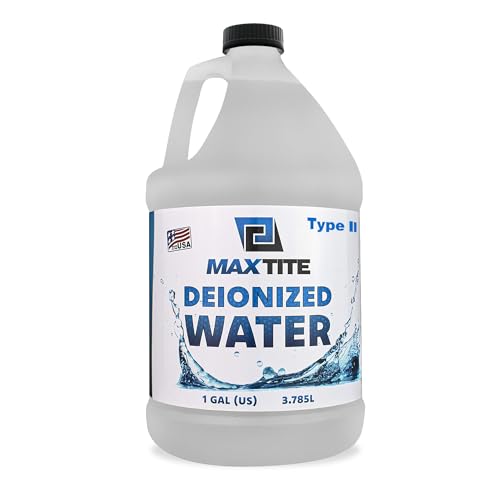
MAXTITE’s Type II deionized water carries ASTM D1193-24 and ACS certification, which places it firmly in the laboratory-grade category. For battery maintenance, that level of certification means you’re getting water with extremely low conductivity and minimal dissolved solids — exactly what prevents parasitic drain on the electrolyte balance. Owners in the review data confirm its use for chemistry projects, fog juice ingredients, and skincare formulation, all of which demand consistent purity.
The one-gallon bottle is practical for automotive use, and the packaging arrives well-sealed to maintain sterility during transit. Multiple verified reviews mention that the water leaves no residue, which is the primary concern when topping off battery cells. The certification alone sets it apart from generic distilled water sold at grocery stores, giving you documented proof of purity rather than marketing claims.
For the owner who wants a verified purity standard without paying a premium for boutique battery water, this is the most cost-effective route to genuine Type II deionized water. It also works for coolant top-offs and parts cleaning, so one jug covers several garage tasks.
What works
- ASTM and ACS certified purity with documented standards
- Versatile across lab, cosmetic, and automotive use
- No residue or contaminants reported by users
What doesn’t
- Bottle lacks a measured pour spout
- Certification may be more than casual users require
3. RPI Distilled Water, Laboratory Grade
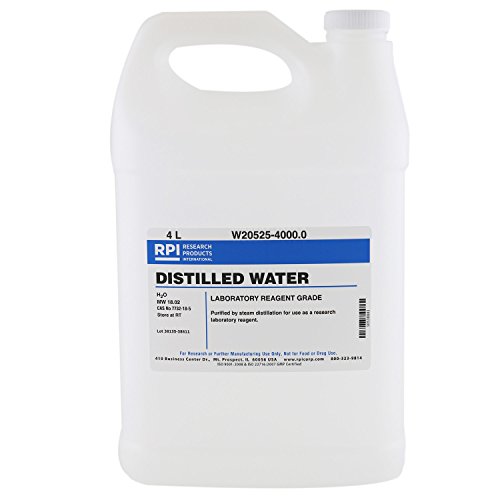
RPI markets this distilled water as laboratory reagent grade, meaning it meets stringent specifications for research and manufacturing environments. With a stated boiling point of 100 degrees Celsius and a CAS number of 7732-18-5, the labeling is unambiguous about its composition and purity. Owners in the review data have used it for motor cleaning, acrylic paint decanting, and CPAP machines — tasks where mineral deposits would cause immediate problems.
The 4-liter format is roughly equivalent to a gallon but packaged in a slim, lab-style bottle that stores easily on a shelf. The reagent-grade designation indicates lower ionic contamination than standard grocery-store distilled water, which matters for batteries that sit through deep discharge cycles. Some users note the price feels high compared to bulk distilled water, but the purity guarantee justifies the cost for critical applications like battery maintenance or sensitive laboratory work.
If you prefer distilled over deionized and want documented laboratory-grade purity rather than ambiguous “purified” labels, RPI’s offering provides traceable quality. It’s especially suitable for owners who maintain multiple batteries or use the same water for other precision tasks.
What works
- Laboratory reagent grade with documented specifications
- Compact 4-liter bottle stores neatly
- Versatile for battery, lab, and cleaning applications
What doesn’t
- Higher cost per volume than standard distilled water
- Not labeled specifically for automotive battery use
4. Indco Deionized Water

Indco’s deionized water is positioned as a prime demineralized solution suitable for deep cleaning, cooling systems, cosmetics, and hygiene products — a broad compatibility list that includes automotive battery maintenance. The one-gallon bottle is practical for periodic top-offs, and owner reviews highlight its use in steam floor mops, carnivorous plant care, and laboratory work, all of which demand low mineral content. The absence of residue after evaporation is consistently noted across verified purchase reports.
The product is labeled as caffeine-free and unflavored, which is standard for deionized water but worth noting for clarity. The packaging weight of over 8 pounds confirms the bottle is robust enough to withstand shipping without leaks. Multiple lab professionals in the review data mention using it as a cost-effective alternative to specialty reagent water for non-critical applications, citing the value as a key advantage.
For the garage user who needs reliable deionized water for battery top-offs and also wants a multipurpose supply for cooling systems or parts cleaning, this bottle covers all those bases without demanding a premium. The consistent purity and solid packaging make it a straightforward, no-surprises choice.
What works
- Reliable deionized quality with no residue
- Versatile across automotive, lab, and household use
- Sturdy packaging that ships without leaks
What doesn’t
- No certification standard printed on the label
- Limited to one-gallon format
5. WirthCo 20410 Battery Fluid Filler

While not a fluid itself, the WirthCo 20410 is the tool that makes fluid addition precise and mess-free. Designed with a flexible bulb and a rigid stem, it allows you to draw water from your container and dispense it directly into battery cells without drips or overflows. Owner reviews consistently praise its dual use — many use it for extracting and replacing brake fluid and power steering fluid as well, making it a versatile shop tool beyond battery maintenance.
The construction uses a metal or aluminum stem with a well-sealed bulb that doesn’t leak after repeated use. Multiple verified buyers report using it on golf cart batteries with multiple cells, noting that the capacity holds enough fluid to fill several cells without constant refilling. The 6-inch stem reaches deep into battery wells without contacting the plates, reducing the risk of contamination or short circuits during top-offs.
For anyone maintaining flooded batteries, this filler eliminates the guesswork and mess of pouring from a bottle. It’s a one-time purchase that pairs with any of the deionized water products above, making routine maintenance faster and cleaner. The low cost relative to the convenience it delivers makes it a practical addition to any battery care kit.
What works
- Precise, dripless dispensing into tight battery cells
- Durable metal stem and leak-free bulb
- Works for brake fluid and power steering fluid too
What doesn’t
- Not a fluid — requires separate purchase of water
- Small capacity requires refilling for multi-cell banks
Hardware & Specs Guide
Deionized vs Distilled Water
Deionized water undergoes ion exchange to remove dissolved salts and minerals, achieving lower conductivity than distillation alone. Distilled water is boiled and condensed, which removes bacteria and most solids but may leave trace ions. For battery top-offs, both work well, but DI water is generally preferred because lower conductivity means less risk of internal shorting across the plates over time.
Conductivity and Purity Levels
Purity is measured by resistivity in megohm-centimeters or conductivity in microsiemens. Type II deionized water typically has a resistivity of 1–10 MΩ·cm, while distilled water often falls below 1 MΩ·cm. ASTM and ACS certifications provide third-party verification that the water meets these standards. For battery use, lower conductivity directly translates to fewer mineral deposits on plates.
Storage and Shelf Life
Deionized and distilled water absorb carbon dioxide from the air over time, which can lower pH and increase conductivity. Store containers tightly sealed in a cool, dark place and avoid using water that has been opened for more than six months. Plastic bottles can also leach impurities if stored in direct sunlight or high temperatures.
Proper Filling Technique
Always top off flooded cells after charging, not before, because charging causes the electrolyte level to rise. Fill to just below the bottom of the fill well — typically ¼ to ⅛ inch above the plates. Overfilling leads to acid spillage during driving, while underfilling exposes plates and causes permanent sulfation damage.
FAQ
Can I use tap water for my car battery in an emergency?
How often should I check my battery fluid level?
Is deionized water better than distilled water for batteries?
Can I use battery fluid filler on AGM or gel batteries?
Final Thoughts: The Verdict
For most buyers, the best car battery fluid winner is the HAVENLAB Deionized Water because it offers verified purity, a sturdy container, and versatile use across multiple garage tasks. If you want documented ASTM certification without overspending, grab the MAXTITE Type II Deionized Water. And for precise, mess-free application, nothing beats the WirthCo 20410 Battery Fluid Filler paired with any high-purity water.

Certification: BSc in Mechanical Engineering
Education: Mechanical engineer
Lives In: 539 W Commerce St, Dallas, TX 75208, USA
Md Amir is an auto mechanic student and writer with over half a decade of experience in the automotive field. He has worked with top automotive brands such as Lexus, Quantum, and also owns two automotive blogs autocarneed.com and taxiwiz.com.