A head unit that combines reliable satellite navigation with high-fidelity audio is no longer a luxury — it’s the central command for your daily drive. The market has shifted from basic CD receivers to full multimedia hubs that project maps, manage calls, and tune every driver channel with digital signal processing. The challenge is separating the units that deliver genuine GPS performance and clean sound from those that merely tick feature boxes.
I’m Amir — the founder and writer behind Four Wheel Ask. Over the past decade I’ve analyzed hundreds of head unit spec sheets, parsed owner feedback across forums and verified reviews, and mapped the real-world trade-offs between display quality, navigation accuracy, audio processing, and long-term reliability.
Whether for daily commuting or road trips, the best car audio system with gps delivers accurate navigation alongside rich, clear audio — no compromises, no guesswork.
How To Choose The Best Car Audio System With GPS
Selecting a head unit that merges navigation and audio is different from buying a standard stereo. You are evaluating a device that must maintain a stable GPS lock, render maps clearly, process audio with minimal distortion, and connect to your smartphone without dropouts. Ignoring any one of these pillars leads to a system that frustrates more than it enhances.
GPS Performance and Satellite Acquisition
A car audio system with GPS is only as good as its ability to lock onto satellites quickly and maintain that lock through tunnels, tree cover, and urban canyons. Look for receivers that support multiple satellite constellations — GPS, GLONASS, Galileo, or BeiDou — since broader constellation support translates to faster fixes and better accuracy in challenging environments. Units with external GPS antenna inputs generally outperform those relying solely on internal antennas because you can position the puck for the clearest sky view.
Display Quality and Sunlight Readability
Navigation is a visual task. A low-resolution or glossy screen that washes out in daylight renders turn-by-turn instructions nearly useless. Prioritize capacitive touchscreens with IPS or HD LCD panels that offer wide viewing angles and high contrast. Anti-glare coatings and high-luminance backlights (measured in nits) make a concrete difference when the sun hits the dashboard. Physical volume knobs or shortcut buttons are also worth considering — they let you adjust audio without looking away from the road.
Audio Processing and Sound Tuning
Built-in digital signal processors (DSP) have become standard at the mid-range and premium tiers. A DSP with a multi-band graphic equalizer (13-band or higher), time alignment, and speed-compensated volume control allows you to tailor the soundstage to your vehicle’s cabin acoustics. Preamp output voltage matters too: 4V or 5V pre-outs deliver a cleaner signal to external amplifiers, reducing noise floor and improving overall clarity at higher volumes.
Smartphone Integration and Connectivity
Wireless Apple CarPlay and Android Auto eliminate the cable clutter and automatically hand off navigation from your phone to the head unit. Units that support both wired and wireless connections offer flexibility if Bluetooth latency becomes an issue. Beyond smartphone mirroring, look for dual-band Wi-Fi (2.4 and 5 GHz) for faster tethering, Bluetooth 5.0 for stable hands-free calls, and USB ports that support large storage devices — especially if you plan to store offline map data locally.
Quick Comparison
On smaller screens, swipe sideways to see the full table.
| Model | Category | Best For | Key Spec | Amazon |
|---|---|---|---|---|
| Sony XAV-AX6000 | Multimedia Receiver | Best Overall | Wireless CPlay/AA, 5V pre-outs, anti-glare | Amazon |
| Alpine iLX-507 | Multimedia Receiver | Premium Display | 1280×720 WXGA, wireless CPlay/AA | Amazon |
| Pioneer AVH-2550NEX | DVD Multimedia | Performance Audio | HD Radio, FLAC, 13-band EQ, Hi-Volt RCA | Amazon |
| Sony XAV-AX4000 | Multimedia Receiver | Best Value | Wireless CPlay/AA, 14-band EQ, 1-DIN mount | Amazon |
| KENWOOD DMX1057XR | Floating Screen | Premium Design | 10.1″ HD, wireless CPlay/AA, 4 camera inputs | Amazon |
| Pioneer AVH-3500NEX | Motorized Screen | Single-DIN Premium | 7″ motorized, wired CPlay/AA, 13-band EQ | Amazon |
| Power Acoustik HD-14KIT | Motorcycle HU | Harley Touring | IPx5 waterproof, wireless CPlay/AA, 13-band EQ | Amazon |
| ATOTO A6PF | Android HU | Feature-Rich Budget | Android 10, 2G+32G, GPS tracking app | Amazon |
| Soundstream VRCPAA-7DRM | Digital Media RCVR | Entry-Level GPS | 7″ HD touch, wireless CPlay/AA, backup cam incl. | Amazon |
In-Depth Reviews
1. Sony XAV-AX6000

The Sony XAV-AX6000 strikes a near-perfect balance between modern aesthetics and functional audio engineering. Its bezel-less 7-inch capacitive touchscreen with an anti-glare layer makes map reading comfortable even under direct windshield exposure, a detail that budget units often overlook. The compact rear chassis simplifies installation in tight dash cavities, and the gold-plated 5V pre-amp outputs on the front, rear, and subwoofer channels provide a clean signal path for external amplifiers — a spec that serious audio builders look for at this tier.
Wireless Apple CarPlay and Android Auto are standard, and the inclusion of an HDMI input expands connectivity for rear-seat entertainment or auxiliary displays. The built-in DSP lacks the deep parametric control of higher-end processors, but the 14-band equalizer and time alignment down to 1-centimeter resolution offer plenty of tuning range for most cabin layouts. SiriusXM readiness and rear camera input round out the package without inflating complexity.
Owner reports consistently highlight the responsiveness of the touch interface and the improved audio clarity over factory head units. A few users note that the wireless CarPlay connection occasionally takes an extra moment to establish on cold starts, but this is common across the category and not exclusive to Sony. For a daily driver that needs reliable GPS routing and studio-like audio staging, the XAV-AX6000 delivers where it counts.
What works
- Anti-glare display stays readable in bright daylight
- 5V gold-plated pre-outs reduce noise floor with external amps
- Compact rear chassis eases installation in tight dashes
- HDMI input adds flexibility for video sources
What doesn’t
- Wireless CarPlay can lag briefly on cold start
- No CD/DVD drive for physical media users
- DSP lacks fully parametric band control
2. Alpine iLX-507

The Alpine iLX-507 stands apart from the crowd primarily because of its 7-inch WXGA display with a 1280×720 resolution — a spec that puts it ahead of the typical 800×480 panels found in most competitors. The difference is immediately noticeable when running navigation apps: map details, street labels, and point-of-interest icons appear crisp and readable without squinting. The capacitive touch layer is responsive, and the mechanical volume knob on the lower bezel provides tactile feedback that touch sliders cannot match.
Wireless Apple CarPlay and Android Auto connect and reconnect reliably, and the built-in Bluetooth handles hands-free calling without the echo issues reported on some earlier Alpine models. Audio output is routed through a 16-watt RMS internal amplifier, which is modest compared to the 45W peak ratings on some competitors, but the unit is designed for users who plan to run external amplification. The front and rear camera inputs support up to two cameras, and FLAC playback via USB covers high-resolution audio files without conversion.
Verified owner feedback frequently praises the display clarity as a class-leading feature, with several users describing it as the best screen they have seen in a DIN-sized receiver. The primary criticism centers on the rotary encoder for volume — a few owners report that the knob feels slightly wobbly after extended use. For buyers who prioritize map readability and wireless smartphone integration above all else, the iLX-507 remains a benchmark choice.
What works
- 1280×720 WXGA display is the sharpest in its class
- Mechanical volume knob reduces eyes-off-road time
- Wireless CarPlay and Android Auto connect quickly
- Clean 16W RMS output with FLAC support
What doesn’t
- Internal amp is modest for direct speaker driving
- Volume knob can develop lateral play over time
- No native GPS maps — relies entirely on smartphone
3. Pioneer AVH-2550NEX

The Pioneer AVH-2550NEX is built for the audio enthusiast who wants HD Radio, FLAC playback, and a comprehensive equalizer without stepping into the four-figure price bracket. Its 6.8-inch capacitive touchscreen is slightly smaller than the 7-inch panels on most rivals, but the trade-off is a higher pixel density and faster menu response. The 13-band graphic EQ combined with a high-voltage RCA output section gives the audio tuner granular control over frequency response and signal integrity.
Wired Apple CarPlay and Android Auto are standard, and while the absence of wireless connectivity feels dated by 2024 standards, the USB connection ensures consistent latency-free audio and charging. Built-in Bluetooth supports hands-free calling and audio streaming, and the Amazon Alexa integration via the Pioneer Smart Sync app adds voice control for navigation, weather, and music selection. The CD/DVD drive is a welcome inclusion for owners with physical media libraries — a feature disappearing from many modern receivers.
Owner reviews consistently note the improved sound quality over factory systems, particularly the clarity of HD Radio broadcasts compared to standard AM/FM. A recurring concern involves the small volume buttons flanking the screen, which some drivers find difficult to locate without glancing away from the road. For the listener who values sound customization and broadcast radio quality over wireless convenience, the AVH-2550NEX remains a strong performer.
What works
- HD Radio delivers noticeably clearer broadcast audio
- 13-band EQ and Hi-Volt RCA outputs for serious tuning
- CD/DVD drive supports physical media collections
- Amazon Alexa integration via Smart Sync app
What doesn’t
- Wired-only CarPlay and Android Auto
- Volume buttons are small and hard to find by touch
- Touchscreen UI has a slight learning curve
4. Sony XAV-AX4000

The Sony XAV-AX4000 packages nearly the same wireless smartphone integration and audio tuning capabilities as its higher-end sibling, the AX6000, into a more affordable chassis. The 7-inch capacitive touchscreen fits a single-DIN mounting profile, which matters for vehicles with limited dashboard depth — a use case the floating-screen trend has largely ignored. The 14-band graphic equalizer and 5-channel time alignment with 1-centimeter resolution offer the same DSP backbone found in units costing significantly more.
Wireless Apple CarPlay and Android Auto operate smoothly, and the Maestro-ready status means the receiver can integrate with factory steering wheel controls, vehicle data displays, and retained auxiliary inputs in compatible vehicles. The rear camera input supports dynamic guidelines when paired with an aftermarket camera, and the Sony Music Center app provides an alternative control surface if preferred. The physical volume knob on the left side of the faceplate is a thoughtful touch that many competitors have abandoned in favor of all-touch interfaces.
Owner feedback highlights the straightforward installation process and the responsive touchscreen as standout qualities. A few users report that the Bluetooth microphone sensitivity could be higher for noisy cabin environments, and the pre-out voltage (2V) is lower than the premium-tier units, meaning external amplifiers will require more gain. For the buyer who wants a reliable GPS-enabled multimedia receiver without overspending, the AX4000 represents the strongest value proposition in this lineup.
What works
- Single-DIN mount fits shallow dash spaces
- 14-band EQ and 1cm time alignment for precise tuning
- Maestro compatible with factory system integration
- Physical volume knob for quick adjustments
What doesn’t
- 2V pre-outs require more amplifier gain
- Bluetooth mic sensitivity is average in noisy cabs
- No HDMI input for video sources
5. KENWOOD eXcelon Reference DMX1057XR

The KENWOOD DMX1057XR is a statement piece. Its 10.1-inch floating HD display with an electrostatic capacitive touch panel dominates the dashboard, and the high-luminance white LED backlight ensures the screen remains legible even when direct sunlight streams through the windshield. The floating design requires a double-DIN mounting location but allows adjustable viewing angles, which helps reduce glare and puts the map display closer to the driver’s natural line of sight.
Wireless Apple CarPlay and Android Auto are standard, and the unit supports up to four camera inputs — front, rear, and two side cameras — which is a rare capability that benefits large vehicles, motorhomes, or builds requiring 360-degree visibility. The iDatalink Maestro RR compatibility means factory features like steering wheel controls, parking sensors, and dynamic guide lines integrate seamlessly in supported vehicles. Audio tuning is handled by a 13-band equalizer with time alignment, and FLAC playback via USB covers high-resolution audio files without downsampling.
Owner reports from verified purchasers describe the display quality as “incredible” and note that the intuitive widget-based interface reduces distraction while driving. A noteworthy concern raised by multiple users involves the microphone jack — the plastic connector has been reported to fail after roughly a year of normal use, and warranty claims for this issue have been inconsistent. For the driver who wants the largest, most vivid navigation display available in a DIN form factor, the DMX1057XR sets the benchmark, though the microphone durability is worth monitoring.
What works
- 10.1-inch HD display with adjustable viewing angle
- Four camera inputs for comprehensive vehicle coverage
- iDatalink Maestro RR integration for factory features
- Wireless CarPlay and Android Auto with smooth operation
What doesn’t
- Microphone jack connector can fail prematurely
- Large screen may obstruct vent or controls in some dashes
- Premium price places it beyond casual buyers
6. Pioneer AVH-3500NEX

The Pioneer AVH-3500NEX solves a specific packaging problem: it delivers a 7-inch touchscreen in a single-DIN chassis by using a motorized mechanism that extends and retracts the display. This is the right solution for vehicles that lack double-DIN depth but still demand a large-screen navigation interface. The motorized screen tilts to reduce glare and retracts fully when the vehicle is parked, adding a layer of security by hiding the head unit from view.
Wired Apple CarPlay and Android Auto are supported, and the 13-band equalizer with time alignment provides the same sound-shaping capabilities found in Pioneer’s double-DIN NEX lineup. The built-in CD/DVD drive is a rarity at this price tier and preserves physical media playback for users who have not transitioned entirely to streaming. Rear camera input with customizable parking guide lines is included, and the HD Radio tuner pulls in digital broadcasts with noticeably lower noise than analog FM.
Owner feedback emphasizes the robust build quality of the motorized mechanism and the clarity of the display once extended. The primary drawback cited in long-term ownership is the same small volume button design seen on the 2550NEX — drivers with larger fingers find them fiddly. For the single-DIN vehicle owner who refuses to compromise on screen size or audio tuning depth, the AVH-3500NEX remains the most compelling option available.
What works
- Motorized 7-inch screen fits single-DIN openings
- Retractable display provides theft deterrence
- CD/DVD drive for physical media compatibility
- 13-band EQ and time alignment for audio tuning
What doesn’t
- No wireless CarPlay or Android Auto
- Volume buttons are small and difficult to operate by touch
- Motorized mechanism adds a potential failure point
7. Power Acoustik HD-14KIT

The Power Acoustik HD-14KIT is a purpose-built head unit for 2014 and newer Harley-Davidson Touring models — Road Glide, Street Glide, Ultra Limited, and Tri-Glide. It uses a plug-and-play harness that mates directly to the factory connectors, eliminating wire splicing and reducing installation time. The IPx5 liquid ingress protection rating means the unit can handle direct water exposure during rain rides or pressure washes without internal damage, a critical requirement for motorcycle electronics.
The 7-inch optically bonded LCD with capacitive touch supports wireless Apple CarPlay and Android Auto, giving riders access to GPS navigation, music, and calls through the handlebar thumb controls. Audio processing includes a 13-band equalizer, active crossovers, and a Class D 4-channel amplifier that is 2-ohm stable — specs aimed at riders who have upgraded their fairing speakers and want clean power delivery without adding a separate amp. RCA outputs are available for those who do run external amplification.
Given the specialized nature of this unit, owner feedback is largely centered on fitment accuracy and weather resistance, both of which receive positive marks. The optical bonding of the LCD reduces glare on sunny rides, and the handlebar control integration means gloves don’t complicate basic operation. The limitation is that it only fits Touring Harley models — riders with other brands or Dyna/Softail platforms will need to look elsewhere. For the Harley Touring owner seeking modern GPS and audio in a weatherproof package, this is the most direct upgrade path available.
What works
- IPx5 waterproof rating handles rain and washing
- Plug-and-play harness for 2014+ Harley Touring models
- Class D 2-ohm stable amp for upgraded speakers
- Wireless CarPlay and Android Auto via thumb controls
What doesn’t
- Only fits 2014+ Harley-Davidson Touring models
- No CD/DVD or physical media playback
- Limited to fairing-mount installation geometry
8. ATOTO A6PF

The ATOTO A6PF runs full Android 10 on an ARM Cortex A55 octa-core processor with 2GB of RAM and 32GB of storage, which means it functions as a standalone Android device rather than relying solely on smartphone mirroring. The 7-inch IPS display with 1024×600 resolution offers wide 178-degree viewing angles, and the capacitive touch layer responds without the lag sometimes seen on budget Android head units. Dual-band Wi-Fi (2.4 and 5 GHz) and dual Bluetooth provide flexible internet connectivity via tethering or hotspots.
Wireless Apple CarPlay and Android Auto are supported, but the real differentiator is the ATOTO exclusive GPS tracking app (TrackHU), which uses OsmAnd for offline navigation with four-satellite positioning and offers real-time vehicle tracking with 15-second refresh intervals, geofence alerts, and trip playback with speed data. This makes the A6PF a compelling choice for fleet vehicles or owners who want to monitor vehicle location without a separate GPS tracker. The DSP includes a 36-band equalizer, time correction, and speed-compensated volume control — tuning depth that rivals units costing several times more.
Verified owner reports highlight the impressive feature density for the price point, with particular praise for the offline navigation capability and the dual Bluetooth implementation. Some users note that the 2GB of RAM can feel constrained when running multiple apps simultaneously, and the interface occasionally stutters when switching between heavy navigation maps and streaming audio. For the tech-oriented buyer who wants a full Android experience and GPS tracking on a budget, the A6PF delivers exceptional versatility, provided realistic expectations are set for RAM-limited multitasking.
What works
- Full Android 10 OS with offline GPS navigation via OsmAnd
- 36-band EQ with time correction and SCVC
- Exclusive TrackHU app for real-time vehicle tracking
- Dual Bluetooth and 5 GHz Wi-Fi for flexible connectivity
What doesn’t
- 2GB RAM limits heavy multitasking
- UI can stutter when switching between apps
- Backup camera not included despite having input
9. Soundstream VRCPAA-7DRM
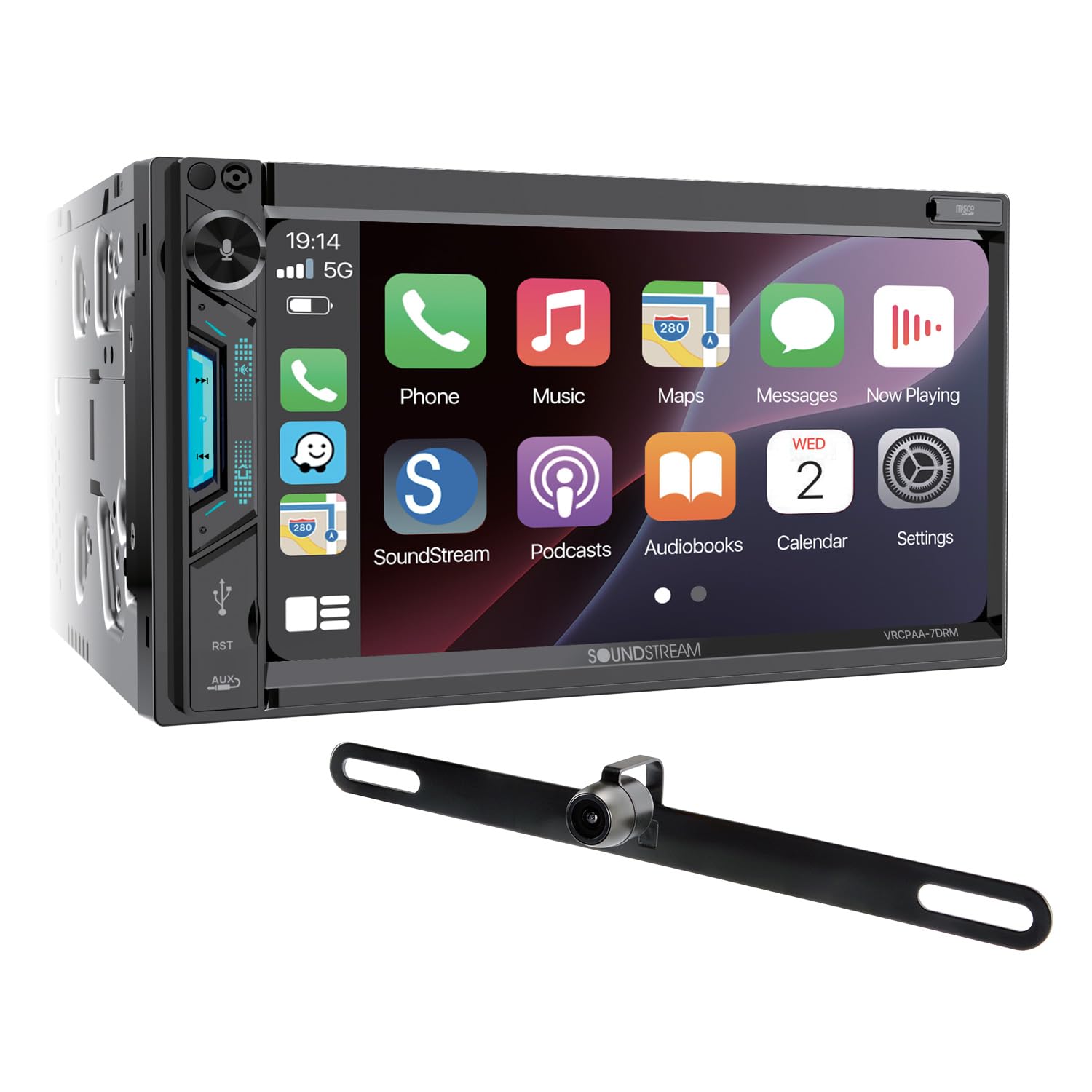
The Soundstream VRCPAA-7DRM is the most budget-conscious entry in this lineup, yet it manages to include both wireless Apple CarPlay and Android Auto alongside a bundled backup camera — a combination that keeps upfront costs low for drivers transitioning from a basic factory radio. The 7-inch HD capacitive touchscreen uses a mechless design (no CD/DVD slot), which reduces mechanical failure points and allows a shallower mounting depth. The 10-band graphic equalizer with user presets provides enough tuning range to correct the worst factory speaker deficiencies.
Audio output is handled by a 300W peak 4-channel amplifier section with front, rear, and subwoofer 4V RCA pre-outs — an unusual spec at this price point that preserves the option to add external amplification later. Bluetooth streaming and hands-free calling work reliably within the expected range, and the front USB and microSD slot support media playback up to 64GB with ID3 tag display. The included backup camera is a genuine value-add, as most head units in this bracket sell the camera separately.
Owner reviews from verified purchasers describe the unit as an excellent value for the cost, with several noting that it has been installed across multiple vehicles without issues. The most common concern involves long-term reliability — a small but notable subset of users report wireless CarPlay connectivity dropping out after several months of use, and customer support responsiveness has been inconsistent. For the budget-conscious buyer who needs GPS navigation and audio streaming today without a large investment, the VRCPAA-7DRM offers the lowest barrier to entry, though durability expectations should be tempered accordingly.
What works
- Includes backup camera in the box
- 4V RCA pre-outs for future amplifier expansion
- Mechless design improves reliability and mounting fit
- Wireless CarPlay and Android Auto at entry-level pricing
What doesn’t
- Wireless connectivity can degrade after several months
- Customer support response is inconsistent
- No rear USB port for permanent cable routing
Hardware & Specs Guide
Display Technology
The display is your primary interface for GPS navigation, so resolution and brightness directly impact usability. Entry-level units typically use 800×480 TFT-LCD panels with resistive touch, while mid-range and premium models move to 1024×600 or 1280×720 IPS displays with capacitive touch. Capacitive screens support multi-touch gestures like pinch-to-zoom on maps, and IPS technology maintains color accuracy and contrast when viewed from off-center positions. For vehicles with bright interiors, look for anti-glare coatings and high-luminance backlights (400 nits or more) — these specs make the difference between a readable map and a reflection-filled mirror.
GPS Antenna and Positioning
GPS performance depends on the receiver’s chipset and antenna configuration. Head units that support multiple satellite constellations — GPS, GLONASS, Galileo, and BeiDou — acquire locks faster and maintain them in challenging environments like dense tree cover or urban high-rises. External GPS antenna inputs provide flexibility to mount the puck on the dashboard or roof for a clear sky view, which is especially important in vehicles with metallic windshields or ceramic tints that block satellite signals. Units that rely solely on an internal antenna may struggle in areas with partial sky coverage.
Digital Signal Processing (DSP)
A DSP allows you to tune the audio output to your vehicle’s specific cabin acoustics. Key parameters include graphic equalizer bands (10-band is entry-level, 13- to 36-band is mid-to-premium), time alignment (adjusts the arrival time of sound from each speaker to the driver’s ear), and speed-compensated volume control (automatically raises volume as road noise increases). Preamp output voltage — measured in volts — determines how cleanly the signal reaches external amplifiers: 2V is standard, 4V is good, and 5V is premium. Higher voltage reduces the noise floor and allows amplifiers to run at lower gain settings for cleaner sound.
Wireless Connectivity Standards
Wireless Apple CarPlay and Android Auto rely on Bluetooth for the initial handshake and Wi-Fi for the data stream. Dual-band Wi-Fi (2.4 GHz and 5 GHz) is important because 5 GHz offers lower latency and less interference from other vehicle electronics. Bluetooth 5.0 provides stable hands-free calling and audio streaming with improved range over older versions. For head units with native Android operating systems (like the ATOTO A6PF), Wi-Fi tethering to a phone hotspot enables full app functionality including real-time traffic and online map updates without consuming phone storage.
FAQ
What should I look for in a GPS-enabled car audio system?
Does a car audio system with GPS require a monthly subscription?
Can I install a GPS head unit myself, or should I hire a professional?
Will a new GPS head unit improve the sound of my factory speakers?
Final Thoughts: The Verdict
For most buyers, the car audio system with gps winner is the Sony XAV-AX6000 because it combines wireless smartphone mirroring, a crisp anti-glare display, and 5V pre-outs in a package that installs cleanly without breaking the bank. If you want the sharpest navigation display available, grab the Alpine iLX-507 for its 1280×720 WXGA panel that makes map details pop. And for the single-DIN vehicle owner who refuses to sacrifice screen size, nothing beats the Pioneer AVH-3500NEX and its motorized 7-inch display that disappears when parked.

Certification: BSc in Mechanical Engineering
Education: Mechanical engineer
Lives In: 539 W Commerce St, Dallas, TX 75208, USA
Md Amir is an auto mechanic student and writer with over half a decade of experience in the automotive field. He has worked with top automotive brands such as Lexus, Quantum, and also owns two automotive blogs autocarneed.com and taxiwiz.com.