Finding a bike rack that survives the punishing vibration, wind exposure, and weight distribution challenges of camper travel requires more than just picking the highest-rated model from the car world. Campers introduce unique variables — tongue load limits, propane tank clearance, bumper strength, and extended highway miles — that most standard racks simply aren’t engineered to handle.
I’m Amir — the founder and writer behind Four Wheel Ask. I’ve spent years analyzing product specifications, studying owner-reported failure points, and comparing build quality metrics across hundreds of hitch-mounted racks to understand what actually holds up on a travel trailer or motorhome.
After reviewing owner feedback and build quality across dozens of racks, I found the most durable camper-friendly options for best camper hitch bike rack.
How To Choose The Best Camper Hitch Bike Rack
Selecting a rack for camper use demands a different set of priorities than a standard vehicle rack. Campers introduce higher wind loads, greater vibration from trailer suspension, and critical weight distribution concerns that can affect handling and safety. Understanding these factors before buying saves both money and frustration.
Weight Capacity and Tongue Load
Every camper has a specified tongue weight limit — the downward force the hitch can safely bear. A bike rack loaded with two heavy e-bikes can easily add 80 to 160 pounds of tongue load, which must be subtracted from your camper’s available tongue weight. Exceeding this limit compromises steering response and braking stability. Always check your camper’s hitch rating before selecting a rack, and account for the rack’s own weight, which can range from 30 to nearly 80 pounds.
RV Approval and Bumper Compatibility
Not all racks carry RV approval, which typically indicates the rack has been tested for the higher vibration and wind-load environments typical of trailer travel. Some campers lack a standard hitch receiver altogether and rely on aftermarket bumper adapters or A-frame tongue mounts like the Stromberg Carlson Bike Bunk. Racks designed specifically for RV use often include reinforced welds, anti-wobble hardware, and corrosion-resistant finishes that standard racks omit.
Tilt and Fold Access
Campers require frequent access to rear compartments, propane tanks, and storage hatches. A rack that tilts down or folds away without tools makes daily life significantly easier. Some premium racks allow tilting even with bikes loaded, while budget options require full unloading. Pay attention to clearance — a tilted rack still needs room between the bikes and the ground, especially on uneven campsites.
Build Quality and Security Features
Racks on campers endure continuous highway vibration, weather exposure, and occasional rough roads. Look for all-steel or steel-and-aluminum construction with powder-coated finishes. Integrated locking mechanisms — both to secure bikes to the rack and the rack to the hitch — are essential for campground security. Anti-wobble hitch tighteners, threaded locking pins, and reinforced wheel cradles separate durable designs from those that develop looseness and rattling over time.
Quick Comparison
On smaller screens, swipe sideways to see the full table.
| Model | Category | Best For | Key Spec | Amazon |
|---|---|---|---|---|
| Hollywood RV Rider | Premium | RV and fifth wheel use | 160 lb capacity, locking cable and hitch | Amazon |
| Thule T2 Pro XTR | Premium | Premium everyday use | 120 lb capacity, tool-free AutoAttach | Amazon |
| Yakima HoldUp | Premium | Car and SUV use | 120 lb capacity, SKS locks, tilting | Amazon |
| CRAVOT CyberRack S2 | Heavy Duty | Extra-heavy e-bikes | 300 lb capacity, 3-position folding | Amazon |
| Swagman Traveler XC2 | RV Approved | Trailers and campers | 35 lb per bike, bumper adapter included | Amazon |
| Young Hitch Rack with Ramp | Best Value | E-bike owners on a budget | 200 lb capacity, integrated ramp | Amazon |
| Black Widow eBike Rack | E-Bike | Single heavy e-bike transport | 400 lb capacity, aluminum ramp | Amazon |
| WILDROAD Hitch Rack | Mid-Range | Fat tire and standard bikes | 180 lb capacity, foldable and tiltable | Amazon |
| ARKSEN Hitch Rack | Value | Budget e-bike transport | 150 lb capacity, anti-wobble design | Amazon |
| Stromberg Carlson Bike Bunk | Bunk | A-frame tongue mounting | 100 lb capacity, 14-55 inch frame width | Amazon |
| VEVOR Hitch Rack | Entry | Light-duty occasional use | 160 lb capacity, tilting and folding | Amazon |
In‑Depth Reviews
1. Hollywood RV Rider Hitch Bike Rack

The Hollywood RV Rider is purpose-built for the specific demands of RV and camper travel, with a reinforced receiver tube and a threaded, key-locked hitch pin that eliminates both lateral and vertical movement. Its 160-pound total capacity accommodates two e-bikes up to 80 pounds each, and the integrated cable lock with matching-key functionality provides theft deterrence across the rack, hitch, and bikes.
Owner feedback consistently highlights the rock-solid stability this rack delivers on long highway trips, with several users reporting thousands of miles of trouble-free towing behind fifth wheels and motorhomes. The articulating vertical bar aids loading the rear bike, while the crossbar clamps with knob locks hold frames securely without scratching. The included hitch stabilizer u-bolt addresses the vertical movement that plagues many competitors.
The main trade-off is convenience — the rack uses bolts with lock washers rather than quick-release pins, making adjustments slower. Some owners noted the center bar can interfere with pedals on the innermost bike, typically solved by removing that pedal. The lack of an integrated loading ramp is the most common owner wish list item for heavier e-bikes.
What works
- Bomber construction with threaded locking hitch pin
- Integrated cable lock secures both bikes and rack
- True RV-rated stability tested over thousands of miles
What doesn’t
- Bolts and knobs slow down adjustments compared to pin-based designs
- No loading ramp for heavy e-bikes
- Center bar may contact pedals on some bike configurations
2. Thule T2 Pro XTR Hitch Bike Rack

The Thule T2 Pro XTR represents the benchmark for premium hitch rack design, featuring the AutoAttach system that makes installation and removal truly tool-free. The HitchSwitch lever allows one-handed tilting for rear vehicle access even with bikes loaded, and the integrated wheels let you roll the rack around when it is off the vehicle — a thoughtful touch for storage and positioning.
Owner reports emphasize the dramatic improvement in loading speed compared to strap-based racks, with experienced users cutting mount time from 20 minutes to seconds. The zero-frame-contact design secures bikes by the wheels only, making it ideal for carbon frames and full-suspension mountain bikes. Generous 12.5-inch spacing between bike positions with side-to-side adjustability prevents handlebar and pedal interference.
The rack accommodates tires up to 5 inches wide without adapters, fitting fat bikes and plus-tire mountain bikes effortlessly. Owners note the rack is heavy — over 50 pounds — which makes mounting and removal a two-person job for many. A hitch extension is typically required for vehicles with spare tires mounted on the rear, such as Jeeps and some SUVs. Thule explicitly states this rack is not compatible with trailers, campers, or RVs.
What works
- Tool-free AutoAttach system is incredibly quick
- Wheels allow easy rolling when off the vehicle
- HitchSwitch tilting works with bikes loaded
What doesn’t
- Not RV-approved — not suitable for camper use
- Very heavy at over 50 pounds
- Poor assembly documentation
3. Yakima HoldUp Hitch Mount Tray Bike Rack
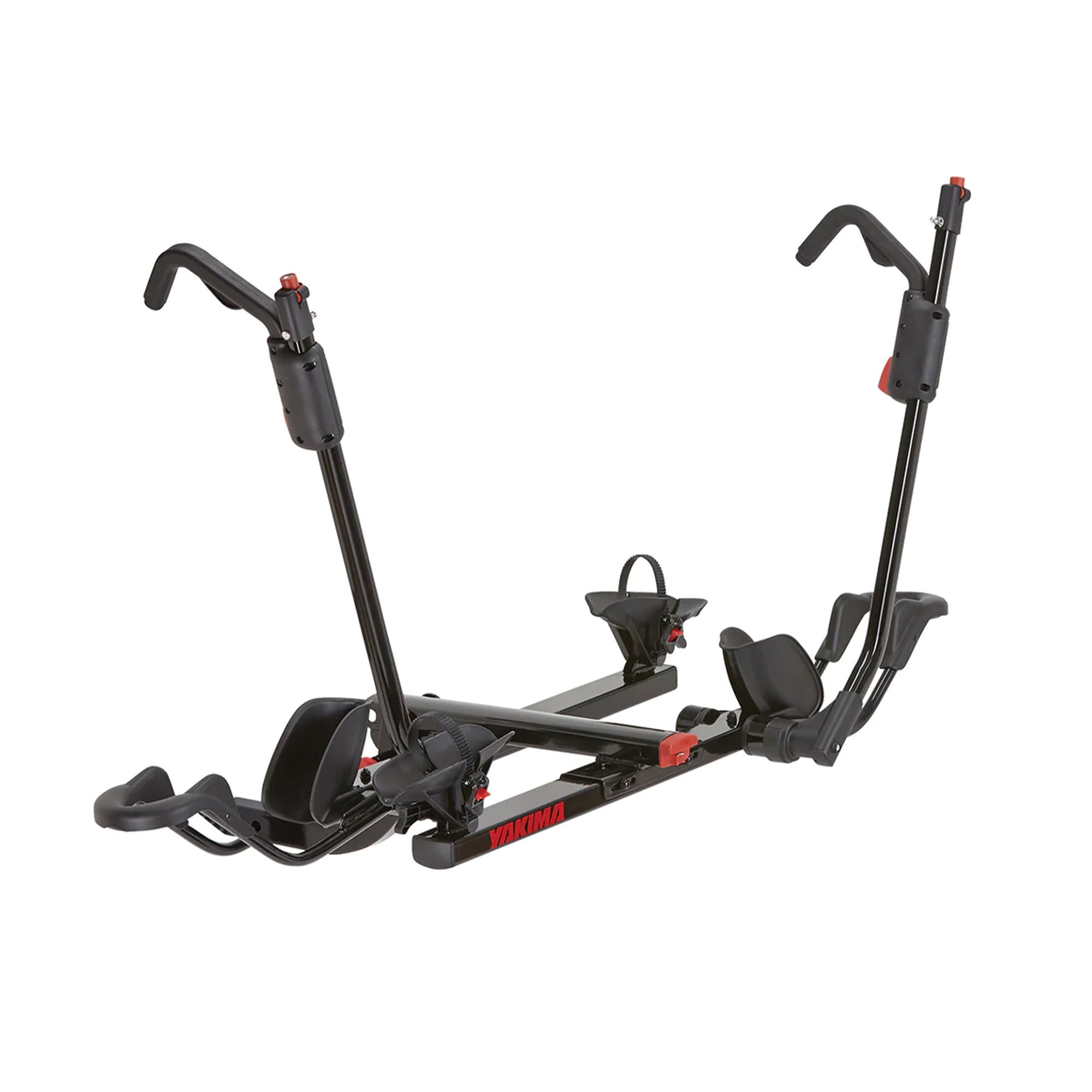
The Yakima HoldUp is widely regarded as one of the most thoughtfully engineered tray-style racks on the market, with adjustable wheel trays that slide side-to-side to prevent bike-to-bike contact — a common frustration with fixed-position racks. Each tray supports up to 60 pounds for a total of 120 pounds, and the integrated SKS locks secure both bikes to the rack and the rack to the vehicle with a single key system.
Owners frequently compare the HoldUp favorably against the Kuat NV, noting the adjustable trays provide better clearance between differently sized bikes. The tilting mechanism provides rear-of-vehicle access with bikes loaded, though several users report it requires significant effort to tilt with heavy e-bikes mounted. Assembly time ranges from 30 to 90 minutes depending on mechanical experience.
The rack’s weight is a recurring theme in owner reviews — at 49 pounds it is solid and stable but cumbersome for frequent removal. The hitch pin requires a wrench for tightening, which some owners find tedious compared to tool-free competitors. Backup sensors on some vehicles may trigger false alerts when the rack is folded up. Yakima explicitly states this rack is not compatible with trailers, campers, or RVs.
What works
- Adjustable trays prevent bike contact and rattling
- SKS locking system provides integrated security
- High build quality with limited lifetime warranty
What doesn’t
- Not RV-approved — no camper use
- Requires wrench for hitch pin
- Very heavy and awkward to handle solo
4. CRAVOT CyberRack S2 Ebike Rack
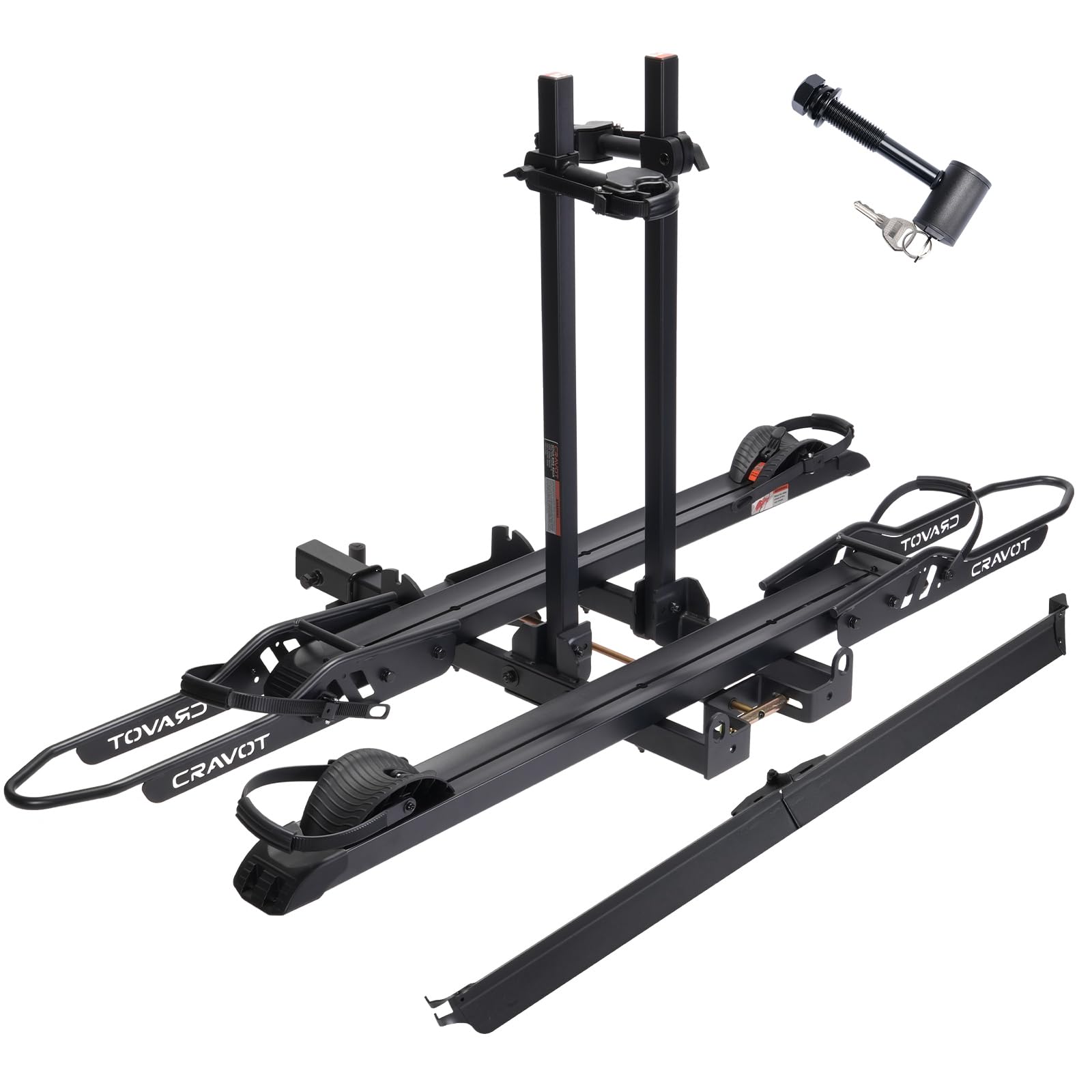
The CRAVOT CyberRack S2 stands apart with a massive 300-pound total capacity — the highest on this list — making it the only serious option for transporting two heavy cargo e-bikes or fat-tire electric bikes on a camper. The V-shaped front wheel cradle accommodates tire widths up to 5 inches and wheelbases up to 52 inches, while the bolt system with shock-absorbing threads delivers stability that owners describe as rock solid.
Assembly is straightforward with metric tools, and the integrated ramp makes loading heavy e-bikes manageable without lifting. The three-position folding system allows the rack to be pulled up when not in use, tilted down for trunk access, or laid flat for loading. Owners with 50-inch wheelbase e-bikes confirm the rack accommodates these larger frames without issue.
The primary drawback is weight — at 78 pounds this is the heaviest rack reviewed, making installation and removal a two-person operation. The ramp has no dedicated storage position and folds somewhat awkwardly. Some owners reported plastic shims on the hitch bracket popping out during installation, requiring a crowbar to re-fit. The threaded hitch bolt provides excellent stability but requires a wrench for removal.
What works
- Industry-leading 300-pound capacity
- V-shaped cradles fit fat tires and long wheelbases
- Three-position folding for loading and access
What doesn’t
- Extremely heavy at 78 pounds
- Ramp storage is awkward and not integrated
- Minor assembly quality control issues reported
5. Swagman Traveler XC2 RV Approved Hitch Rack

The Swagman Traveler XC2 is one of the few racks that carries explicit RV approval and includes a 2-inch bumper adapter for campers without standard receivers. The light but sturdy design keeps bikes secure even on long journeys, and the ability to fold the upright bar down provides quick access to the rear of the RV without removing the rack or bikes.
Owner reports from travelers with 1,800-mile trips confirm the rack holds bikes securely with no issues when properly installed. The bolt-on bumper adapter works well with 4.5-inch continuous steel welded RV bumpers, though owners caution against overtightening the adapter, which can compress the bumper and interfere with drain hose access. The inverted U-wheel retainers grip tires firmly with no wobble.
The 35-pound per bike capacity is the most significant limitation — this rack is not suitable for modern e-bikes, many of which exceed 50 pounds each. Some owners noted the bikes sit close to the RV body, requiring creative solutions like pool noodle padding or ratchet straps for additional clearance. The rack is not foldable for storage when not in use.
What works
- Explicit RV approval and bumper adapter included
- Lightweight and easy to install
- Folds down for rear access without removing bikes
What doesn’t
- Low 35-pound per bike limit — no e-bike compatibility
- Bikes sit close to RV body, may need padding
- Overtightening adapter can damage bumper
6. Young Hitch Mount Bike Rack with Ramp
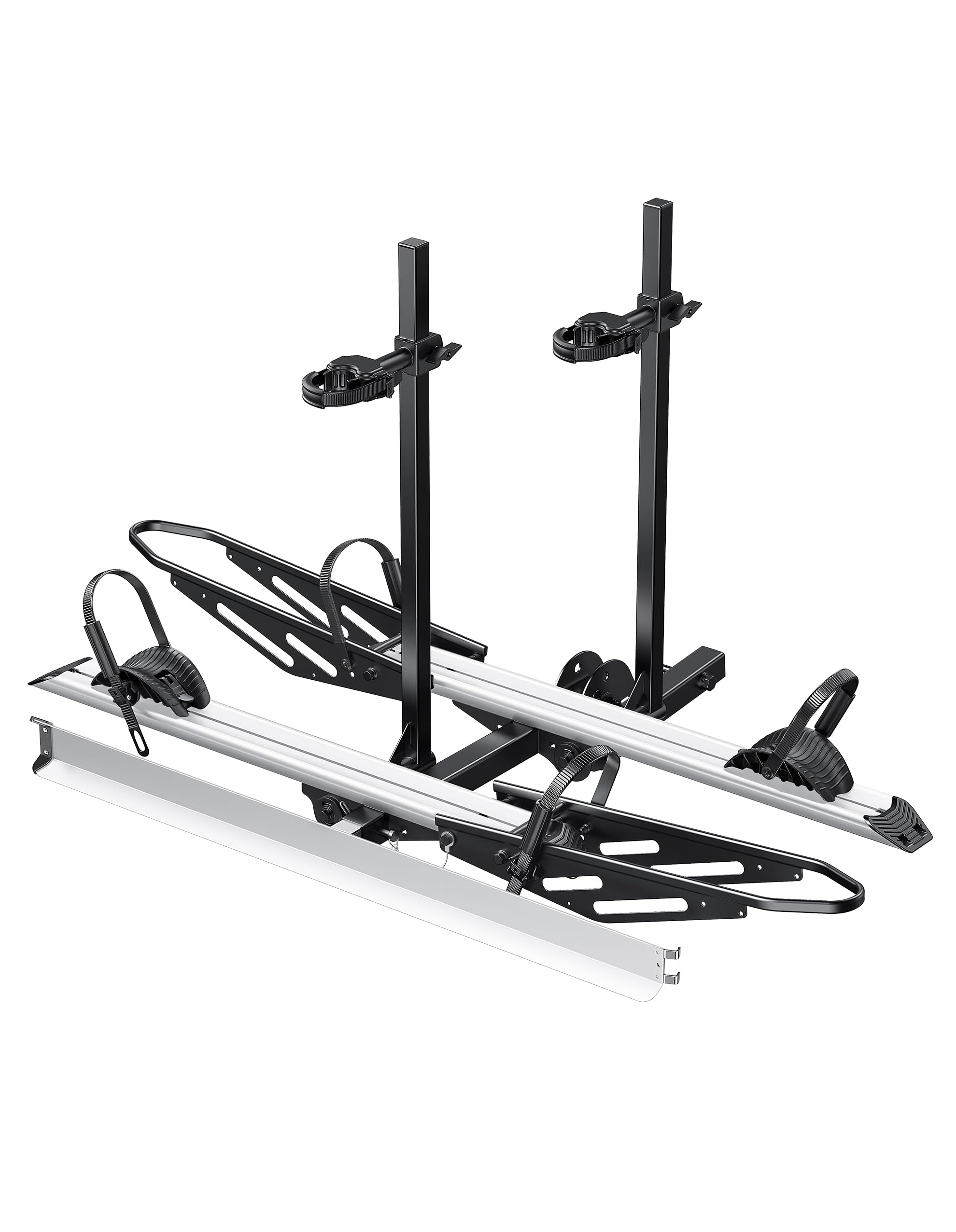
The Young Hitch Rack delivers an impressive combination of capacity and convenience at a price point that undercuts many competitors by a significant margin. The 200-pound total capacity handles two e-bikes weighing up to 100 pounds each, and the integrated loading ramp — which stores neatly in the frame when not in use — solves the primary ergonomic challenge of loading heavy electric bikes.
Owner feedback emphasizes the sturdy build quality and minimal wobble during transit, with several users confirming the rack handles step-through e-bike frames without issue. The two-arm fixation system with patent-secured wheel cradles keeps bikes firmly in place, and the anti-wobble structure prevents swaying and bumping against the vehicle. Assembly takes about an hour with most parts pre-assembled.
The most notable limitation is the lack of a tilt-away feature — accessing the rear of the vehicle requires removing the rack or bikes. The plastic tire straps and aluminum platform surface raise some durability concerns for long-term use. Instructions received criticism for poor quality images and incorrect tool references. Fat tires up to 4 inches wide fit, but owners report minimal clearance.
What works
- Excellent 200-pound capacity at a competitive price
- Integrated ramp stores neatly in the frame
- Minimal wobble with proper assembly
What doesn’t
- No tilt-away function for rear access
- Poor assembly documentation
- Plastic straps and aluminum surface may wear over time
7. Black Widow eBike Rack with Ramp

The Black Widow eBike Rack takes a different approach than most — it is designed as a single-bike carrier with a massive 400-pound capacity, making it ideal for a single extremely heavy e-bike, fat-tire bike, or even a small dirt bike. The roll-on, roll-off ramp eliminates lifting entirely, and the rust-resistant aluminum tray keeps the rack weight manageable at 37 pounds despite the heavy-duty capacity.
Owner reviews confirm the rack handles 75-pound e-bikes with ease, and the ramp — which stores onboard — makes loading accessible even for older riders or those with physical limitations. The included anti-rattle device and hitch pin provide solid connection stability, and the youth bike adapter adds versatility for smaller frames. The aluminum construction resists corrosion better than steel alternatives.
The single-bike design limits utility for families or couples traveling together. Owners noted the plastic knobs for ramp storage are weak and prone to breaking or falling off. The rack lacks a center stabilizer pole, which means bikes can lean side-to-side during transit — a safety concern that several owners addressed with aftermarket modifications. Assembly instructions were described as poor with small, unclear images.
What works
- Exceptional 400-pound capacity for heavy single bikes
- Roll-on ramp eliminates lifting
- Lightweight aluminum construction resists rust
What doesn’t
- Single-bike only — no capacity for two
- No center stabilizer, bikes can lean
- Weak plastic ramp storage knobs
8. WILDROAD Hitch Bike Rack
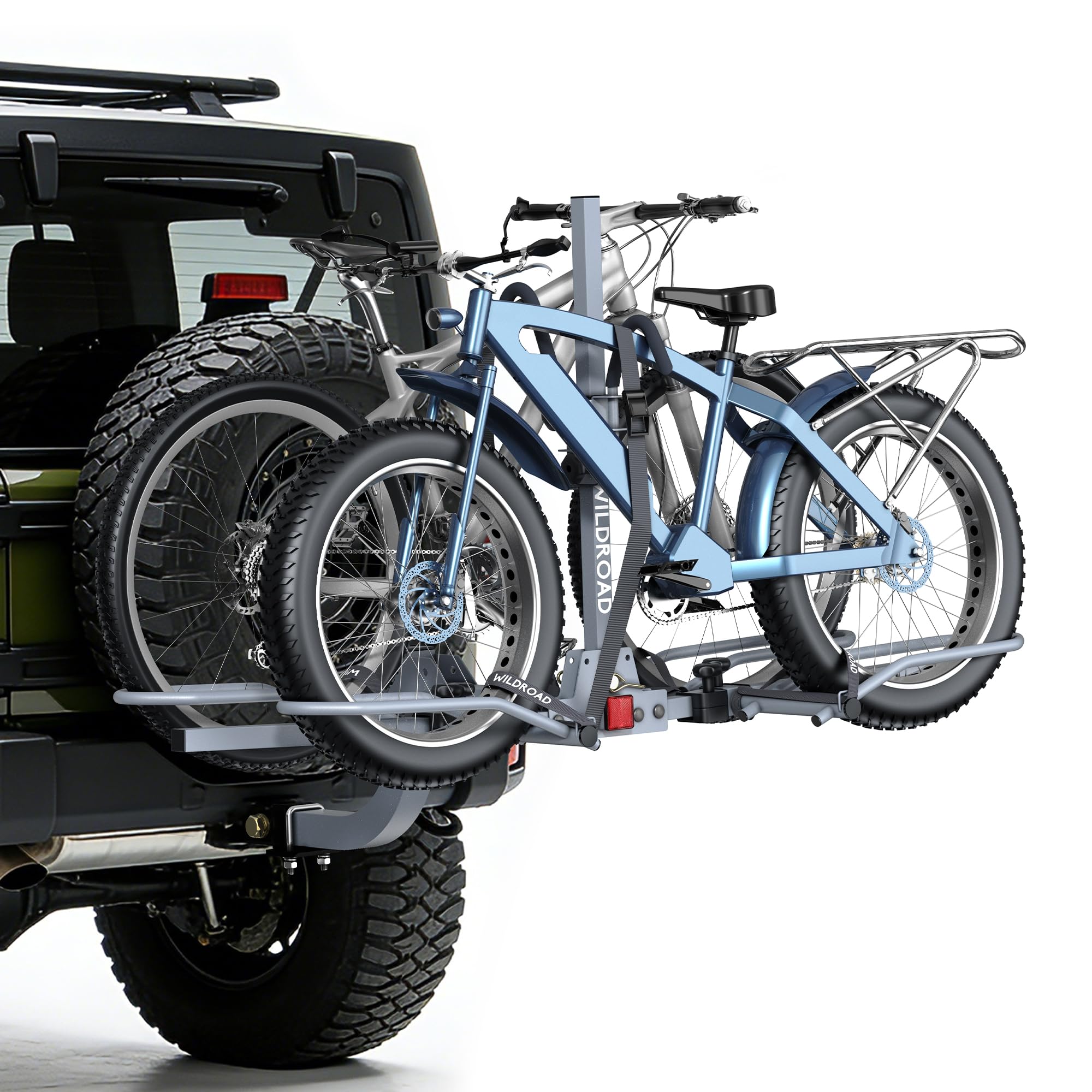
The WILDROAD Hitch Rack offers genuine heavy-duty construction at a mid-range price, with an 180-pound total capacity that comfortably accommodates two standard e-bikes. The anti-wobble fastener and screw-in hitch pin work together to minimize movement, and the foam-padded hooks with heavy-duty nylon straps secure frames without damaging paint. The rack folds up for space-saving storage when not in use and tilts down for trunk access.
Owner reports after hundreds of miles of use confirm the rack maintains its stability with no loosening or shifting. The adjustable hooks and tire holders accommodate a wide range of bike sizes, and the reflective plug at the hitch end improves nighttime visibility. Several owners noted the build quality rivals racks costing significantly more, with solid materials and secure fitment.
The foam J-hook covers are a weak point — several owners reported they are flimsy and prone to tearing, with some replacing them with heater hose for longer life. A rivet at the top of the center post can interfere with removing the J-hook for mounting. The rack requires a crossbar on the bike — it is not usable with step-through frames without an aftermarket adapter bar, which adds significant cost.
What works
- Sturdy construction at a competitive price
- Anti-wobble fastener and screw-in hitch pin
- Folds up for compact storage when empty
What doesn’t
- Foam J-hook covers are flimsy and short-lived
- Requires crossbar — not step-through compatible
- Rivet on center post hinders hook removal
9. ARKSEN Bike Rack Hitch for Car

The ARKSEN Hitch Rack provides a compelling balance of capacity and affordability, supporting up to 150 pounds total with 75 pounds per bike. The tilt design allows trunk access even with bikes loaded, and the built-in hitch tightener with anti-wobble design reduces sway during transit. Reflective stickers improve nighttime safety — a useful feature for campers parked on roadside shoulders.
Owner feedback highlights the rack’s ability to handle heavy e-bikes like Lectric 3.0 models weighing 110 pounds combined, with users reporting secure transport and minimal movement. Assembly takes approximately one hour, and the rust-resistant powder coating holds up well in weather. The padded arms hold bikes securely without damage, and the rack fits a wide range of vehicle types including SUVs, trucks, and RVs.
The main complaints center around convenience and adjustability. The rack does not fold up for storage, meaning it must be removed when not in use to avoid occupying the hitch receiver. The tire holders are not adjustable and may require added straps for a truly secure fit on narrower tires. Some owners expressed concern about the long-term durability of the Velcro straps used for wheel retention.
What works
- Good value for the weight capacity offered
- Anti-wobble design reduces sway effectively
- Tilt function provides rear access with bikes loaded
What doesn’t
- Does not fold up — must be removed when not in use
- Non-adjustable tire holders may need supplemental straps
- Velcro straps raise durability questions for long-term use
10. Stromberg Carlson CC-275 Trailer Tongue Bike Bunk
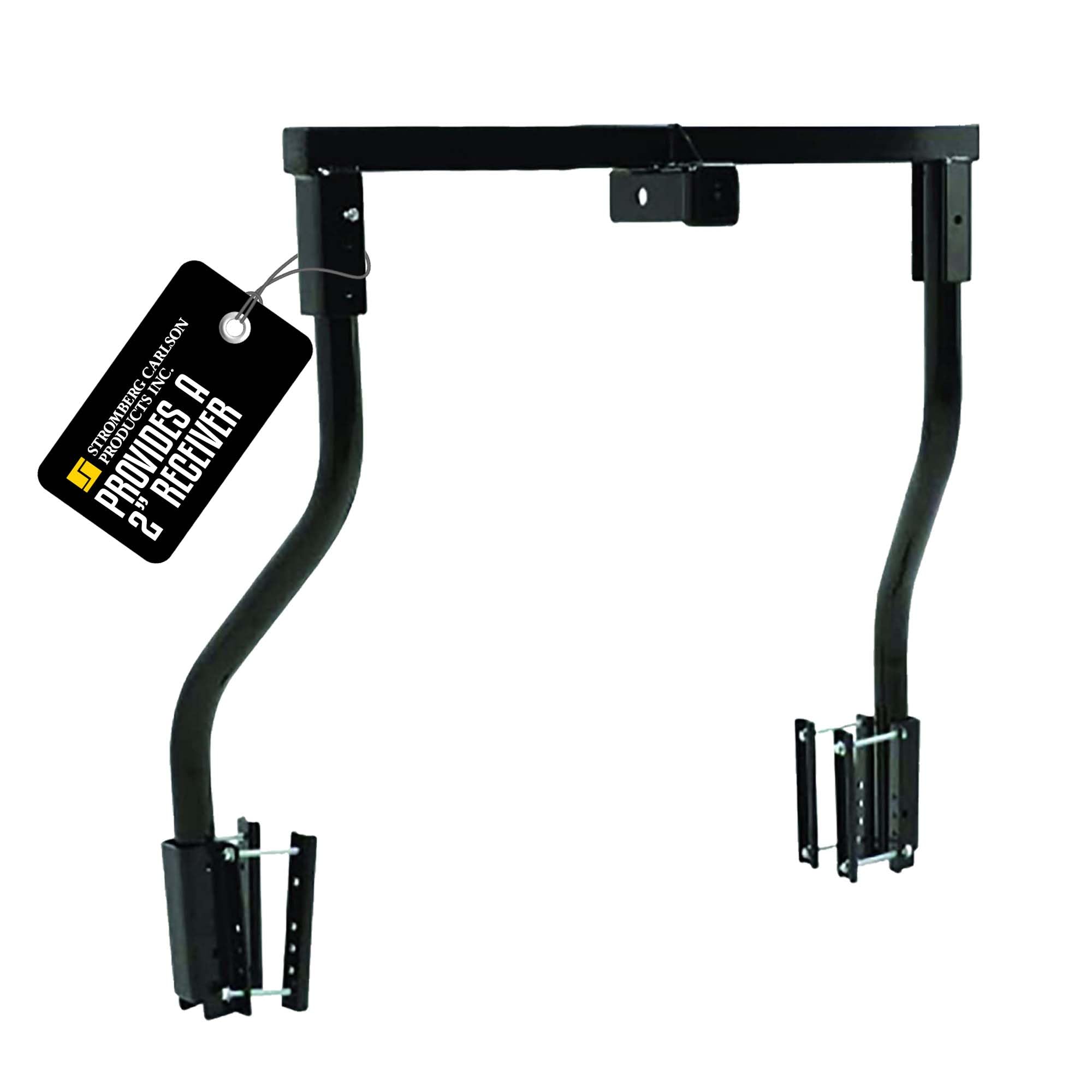
The Stromberg Carlson CC-275 is not a bike rack itself but rather an A-frame mounting system that creates a raised 2-inch receiver on your trailer tongue, allowing you to mount any RV-approved bike rack in the softest riding area of your camper. The adjustable posts accommodate frame widths from 14 to 55 inches, and the all-steel construction supports up to 100 pounds of rack-plus-bike weight.
Owners with pop-up campers and travel trailers lacking rear bumpers consider this product essential, as it provides a secure mounting location without relying on flimsy bumper attachments. The design sits above propane tanks, and owners report successful modification for electric box clearance and battery placement. Many users fabricated additional support braces to increase the effective load capacity beyond the 100-pound rating.
The installation is demanding — drilling 3/8-inch holes in the trailer frame is required, and some bolts may be too short depending on frame thickness. The listed weight of 15 pounds is inaccurate; the actual unit weighs approximately 45 to 50 pounds, which adds significant tongue load. Propane tank covers must be replaced with soft vinyl or flip-top hard covers for valve access. The product requires mechanical skill to install properly.
What works
- Creates a receiver on trailers without bumpers
- Adjustable frame width from 14 to 55 inches
- Puts bikes in the softest riding zone on the tongue
What doesn’t
- Installation requires drilling and mechanical experience
- Actual weight is 45-50 pounds, not 15 as listed
- Propane tank covers typically need replacement
11. VEVOR Hitch Mount Bike Rack

The VEVOR Hitch Rack enters the market at a budget-friendly price point with a 160-pound total capacity and a tilting-and-folding design that provides rear vehicle access and space-saving storage. The heavy-duty steel construction with a 14-inch connection pipe offers ample distance from the vehicle — particularly useful for campers with spare tires mounted on the rear. The safety latch and anti-wobble device aim to reduce movement during transit.
Owner feedback is mixed, with many praising the value and ease of installation while others report quality control issues. Several users confirm the rack works well for lighter loads, with one owner noting a single 40-pound e-bike felt secure. The adjustable knobs accommodate different bike sizes, and the included straps with soft cushions prevent surface damage during transport.
Quality control concerns appear frequently in reviews. Rubber protectors on the top clamps have been reported falling off at highway speeds, allowing the metal clamp to scratch bike frames. The cotter pin design received criticism for poor fitment and incorrect sizing. Assembly required approximately two hours, and some owners found the number of parts excessive. The rack performs adequately for light-duty occasional use but may not withstand regular camper travel.
What works
- Very accessible price for the capacity offered
- Tilting and folding design for access and storage
- Long connection pipe clears rear-mounted spares
What doesn’t
- Rubber protectors fall off at highway speeds
- Cotter pin is poor quality and undersized
- Assembly is lengthy and parts-intensive
Hardware & Specs Guide
Hitch Class and Receiver Size
Camper hitch bike racks require a 2-inch receiver, typically found on Class III or IV hitches. Class III hitches handle up to 600 pounds tongue weight, while Class IV supports up to 1,000 pounds. Always verify your camper’s hitch class before purchasing, as using a rack that exceeds the hitch rating creates a dangerous safety condition. Some lightweight campers use 1.25-inch receivers, which require an adapter but significantly reduce available rack options and load capacity.
Weight Rating and Real-World Limits
The listed weight capacity on any rack includes the weight of the bikes plus the rack itself. A rack rated for 160 pounds total may weigh 35 pounds, leaving only 125 pounds for bikes — roughly two average e-bikes. Tongue weight on a typical travel trailer ranges from 10 to 15 percent of total trailer weight. Adding a heavy rack and bikes can consume 100 to 200 pounds of available tongue weight, potentially pushing the trailer past its rated limit and affecting sway control.
Anti-Wobble and Stability Systems
Camper travel introduces continuous low-frequency vibration that loosens standard hitch connections over time. Look for anti-wobble devices that use threaded bolts or camming mechanisms to press the rack shank tightly against the receiver walls. The most effective designs eliminate both lateral and vertical play. Some premium racks integrate the anti-wobble system into the locking hitch pin, providing security and stability in a single component.
Corrosion Resistance and Materials
Campers travel through rain, road salt, and coastal environments that accelerate corrosion. Powder-coated steel provides adequate protection if the coating remains intact, but chips and scratches expose bare metal to rust. Aluminum racks eliminate rust concerns entirely but cost more and may flex under extreme loads. Stainless steel hardware — bolts, pins, and washers — is a critical detail that separates durable racks from those that develop seized fasteners within a single season of use.
FAQ
Can I use a standard car hitch rack on my camper?
How much tongue weight can my camper handle for a bike rack?
What is the best way to mount a bike rack on a camper without a hitch receiver?
Will a hitch bike rack block my camper’s rear camera or license plate?
Final Thoughts: The Verdict
For most RV and camper owners, the best camper hitch bike rack is the Hollywood RV Rider because it combines true RV-rated construction, integrated locking, and the stability needed for long-haul travel without compromise. If you need to carry exceptionally heavy e-bikes, the CRAVOT CyberRack S2 offers the highest capacity on the market. And for campers without a rear hitch receiver, the Stromberg Carlson CC-275 Bike Bunk is the only serious solution for creating a secure mounting point on the trailer tongue.

Certification: BSc in Mechanical Engineering
Education: Mechanical engineer
Lives In: 539 W Commerce St, Dallas, TX 75208, USA
Md Amir is an auto mechanic student and writer with over half a decade of experience in the automotive field. He has worked with top automotive brands such as Lexus, Quantum, and also owns two automotive blogs autocarneed.com and taxiwiz.com.