Choosing the right camshaft for a 350 small block means sorting through aggressive marketing claims and conflicting spec sheets. Many builders overestimate the duration they need or underestimate the importance of proper lifter selection. We analyzed customer reports, build quality data, and long-term reliability feedback across dozens of cam and lifter combinations to identify what truly works for street, strip, and everything in between.
I’m Amir — the founder and writer behind Four Wheel Ask. I have spent years studying small block Chevy engine specifications, analyzing camshaft performance data, and tracking owner-reported outcomes across thousands of builds to separate proven hardware from marketing hype.
Each recommendation here reflects real-world testing feedback and documented owner experiences. After analyzing owner reports and studying build quality across brands, we identified the best cam for 350 small block configurations that deliver real results.
How To Choose The Best Cam For 350 Small Block
Selecting a camshaft for a 350 small block requires balancing lift, duration, lobe separation, and lifter type against your intended use. Daily driver builds need different profiles than weekend strip cars. Understanding the core specs lets you avoid the common pitfalls that waste time and money.
Match Duration to Your Compression and Induction
Duration at 0.050-inch lift is the most reliable way to compare camshafts. A daily driver 350 with a stock converter and 8.5:1 compression should stay around 204 to 214 degrees. Once you pass 220 degrees, you are entering converter and gear territory. Higher compression and aggressive induction systems can support longer duration, but the power band shifts upward, requiring supporting modifications.
Lobe Separation Angle Dictates Idle Character
A 112-degree lobe separation angle offers a balanced idle with moderate vacuum, suitable for power brakes. Narrowing the LSA to 107 degrees creates a choppy idle with less vacuum but builds peak torque earlier. Widening to 114 degrees smooths the idle and broadens the torque curve at the expense of peak power. Choose your LSA based on whether you prioritize street manners or maximum mid-range punch.
Flat Tappet Versus Roller: Reliability and Cost
Hydraulic flat tappet cams have a proven track record but demand meticulous break-in procedures and zinc-rich oil. Roller cams eliminate break-in risk and allow more aggressive lobe profiles, but require retro-fit lifters and sometimes taller pushrods. For a budget-friendly street build, a flat tappet cam mated to high-quality lifters like the COMP Cams High Energy series remains a reliable choice. For a build that sees hard use, a roller conversion adds longevity and consistency.
Quick Comparison
On smaller screens, swipe sideways to see the full table.
| Model | Category | Best For | Key Spec | Amazon |
|---|---|---|---|---|
| Edelbrock 2102 | Mid-Range Kit | Balanced street upgrade | 204/214° Duration, 0.420/0.442″ Lift | Amazon |
| Comp Cams 12-601-8 | Premium Roller | Street/strip aggressive idle | 235/249° Duration, 0.521/0.507″ Lift | Amazon |
| JEGS 555-200106 | Mid-Range Kit | Peak horsepower 3000-6200 RPM | 234/234° Duration, 0.488/0.488″ Lift | Amazon |
| COMP Cams 812-16 | Lifter Set | Flat tappet reliability upgrade | 0.842″ Diameter, Patented Metering Valve | Amazon |
| Melling MTC-1 | Budget Cam | Mild street rebuild | 278/288° Adv. Duration, 112 LSA | Amazon |
| Spartshome 8 Pair | Budget Roller Lifters | Retro-fit roller conversion | 0.8425″ OD Hydraulic Roller | Amazon |
| maXpeedingrods HH66 | Budget Roller Lifters | Cost-effective roller swap | 0.842″ OD, Includes Link Bars | Amazon |
In‑Depth Reviews
1. Edelbrock 2102 Performer-Plus Camshaft and Lifter Kit

The Edelbrock 2102 Performer-Plus kit combines a satin-finished camshaft with a precision-matched lifter set, eliminating guesswork around compatibility. It uses a hydraulic flat tappet design with 204 degrees intake and 214 degrees exhaust duration at 0.050-inch lift, paired to 0.420-inch intake and 0.442-inch exhaust lift on a 112-degree lobe separation angle. These numbers target the builder who wants noticeable seat-of-the-pants improvement without sacrificing factory-style driveability.
Owner reports from builds including 1970 C10 trucks and various street-driven 350s describe a strong pull from idle through the mid-range, with the power delivery becoming noticeably sharper when the secondaries open. The idle remains mild enough for power brakes and automatic transmissions with factory stall converters. Several users running this kit on otherwise stock long-blocks noted that the Performer-Plus delivers a genuine power increase that is immediately felt without requiring a converter swap or gear change.
While a small number of owners reported quality-control concerns with Edelbrock camshafts during a specific production period, the majority of the 100-plus verified reviews rate this kit at 4.4 stars. Builders who follow the recommended break-in procedure and use high-zinc break-in oil have reported reliable long-term service. The kit includes both cam and lifters, making it a complete drop-in solution for the builder who values simplicity and proven results.
What works
- Complete cam and lifter kit for a straightforward swap
- Strong low-to-mid range torque improvement over stock
- Mild idle retains factory driveability and brake vacuum
What doesn’t
- Not designed for aggressive idle sound seekers
- Some isolated reports of cam quality variability
2. Comp Cams 12-601-8 Mutha’ Thumpr Hydraulic Roller Cam

The Comp Cams 12-601-8 Mutha’ Thumpr is a hydraulic roller camshaft engineered specifically for the builder who wants a hard-hitting exhaust note without sacrificing power. It features 235 degrees intake and 249 degrees exhaust duration at 0.050-inch lift, with 0.521-inch intake and 0.507-inch exhaust valve lift on a 107-degree lobe separation angle. The early intake valve opening and extended exhaust duration create aggressive overlap that produces the signature choppy idle the Thumpr series is known for.
Owner feedback consistently highlights the unmistakable idle character as the primary reason buyers choose this cam. The power band lives between 2,200 and 5,900 RPM, which means the engine needs at least 9.0:1 static compression, a 2,500 RPM or higher stall converter, and aftermarket induction to perform properly. Builders running this cam with headers, a matched intake, and rear gears report strong mid-range punch and a power curve that pulls hard to the top of the operating range. Several owners noted that the Thumpr delivers the attention-getting idle they wanted without sacrificing drivability when paired with the right supporting parts.
A small number of buyers found the product description confusing regarding fitment for specific small block applications, but those who ordered the correct part reported excellent fit and finish. The cam is made from high-quality materials and the lobe profiles are precision-ground. This cam is not for the budget builder or the daily driver looking for a mild upgrade. It is a purpose-built street/strip component that rewards careful parts matching with a distinctive character and genuine power gains.
What works
- Aggressive idle sound that draws attention
- Strong power from 2,200 to 5,900 RPM with proper supporting parts
- Hydraulic roller design eliminates flat tappet break-in risk
What doesn’t
- Requires high stall converter, gears, and induction upgrades
- Cam only; lifters and timing set not included
3. JEGS Hydraulic Flat Tappet Camshaft and Lifters 555-200106
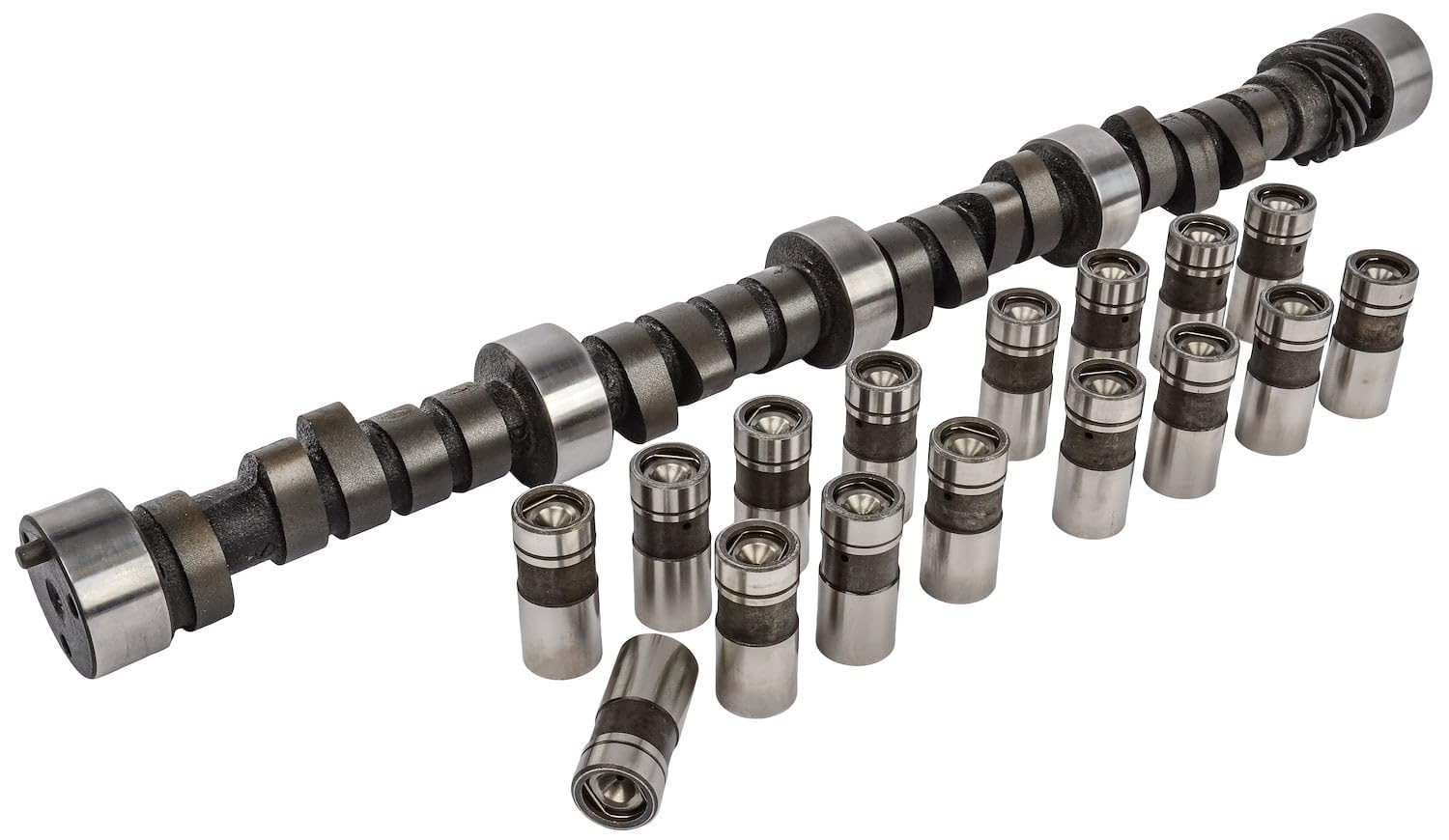
The JEGS 555-200106 is a complete flat tappet cam and lifter kit that delivers a 0.488-inch lift on both intake and exhaust with 234 degrees duration at 0.050-inch on a 114-degree lobe separation angle. The advertised duration is 292 degrees, which gives this cam a noticeably aggressive idle while maintaining decent manifold vacuum thanks to the wider LSA. The power band is rated from 3,000 to 6,200 RPM, targeting the builder who wants peak horsepower numbers without going to a full race profile.
Owners report that this cam produces a satisfying loping idle that announces its presence without being overly obnoxious, and the power delivery comes on strong once the RPM climbs past 3,000. One builder running a 350 with a 4-bolt main described it as the perfect middle ground between a street cam and a strip cam. The kit includes both camshaft and matched lifters, which simplifies the ordering process. Several owners noted the Made in USA manufacturing as a deciding factor.
There have been reports of lifter failure leading to cam lobe damage, though these instances are not the majority. One owner experienced a collapsed lifter after limited runtime that required replacing the cam and lifters along with downstream components. These failures typically stem from insufficient break-in procedures or oil with inadequate zinc content. Builders who are meticulous about break-in and use dedicated flat tappet break-in oil tend to report successful long-term results with this kit.
What works
- Complete kit with cam and matched lifters included
- Aggressive idle with decent manifold vacuum due to 114 LSA
- Domestic manufacturing and consistent quality control
What doesn’t
- Reported lifter failures in a small percentage of builds
- Power band requires converter and gears for street use
4. COMP Cams 812-16 High Energy Hydraulic Flat Lifter Set

The COMP Cams 812-16 High Energy lifter set is a dedicated hydraulic flat tappet lifter kit designed for Chevrolet small and big block engines using a 0.842-inch lifter bore. Each lifter features a patented orifice metering valve that precisely controls oil delivery to the rocker arms, reducing excessive oiling at high engine speeds while maintaining consistent lubrication. The lifters also use a longer piston than conventional designs, increasing the load-bearing surface area for improved longevity.
Owner feedback across nearly 350 ratings gives this set a strong 4.4-star average, with builders using them in applications from Land Rover Discovery II 4.6 engines to traditional SBC 350 builds. The lightweight check valve disc in each lifter provides quicker response at varying engine speeds, which translates to more stable valve control across the RPM range. Several owners specifically noted that these lifters were direct replacements for factory units and performed quietly after proper adjustment.
While the vast majority of owners report trouble-free operation, there is at least one documented case where the lifters failed during break-in and damaged the cam lobes. This risk is inherent with flat tappet designs and is not unique to this product. The lifters themselves require a compatible camshaft with the correct lobe profile. Builders pairing these with a quality flat tappet cam and following proper break-in procedures have reported excellent reliability and consistent valve control over thousands of miles.
What works
- Patented metering valve reduces oil starvation at high RPM
- Longer piston design increases bearing surface for durability
- Proven track record with strong owner satisfaction ratings
What doesn’t
- Flat tappet break-in risk remains a factor
- Requires compatible camshaft, sold separately
5. Melling Camshaft MTC-1 Hydraulic Flat Tappet

The Melling MTC-1 is a hydraulic flat tappet camshaft built in the United States with specs aimed at the budget-conscious builder looking for a mild upgrade. It delivers 0.420-inch intake lift and 0.433-inch exhaust lift with an advertised duration of 278 degrees intake and 288 degrees exhaust on a 112-degree lobe separation angle. This profile is designed for 262 to 400 cubic inch small block Chevy engines and is often used in truck and passenger car applications where low-end torque takes priority over peak power.
Owner reports are mixed in terms of consistency. One builder noted that the cam appeared to have been previously installed, with assembly lube present and a flat tappet witness mark visible on a lobe. Despite that, the same owner ran the cam in a 305 and reported satisfactory performance, noting it would work even better in a 350. Other owners described the cam as genuine Melling quality with good core dimensions and proper lobe finish out of the box.
There have been complaints about the product description not clearly specifying compatible engine years, which led to some buyers receiving an incorrect cam for their application. The MTC-1 is a budget-focused part and should be viewed as an OEM replacement or mild upgrade rather than a high-performance component. Builders who need a cam for a basic rebuild or stock replacement will find this cam fits the bill, but those chasing power numbers should look at more aggressive profiles.
What works
- Affordable price point for budget engine rebuilds
- Made in the United States with consistent quality
- Suitable for mild street and truck applications
What doesn’t
- Some units appear to have been previously handled or installed
- Product fitment description lacks clarity for certain year ranges
6. 8 Pair Retro Fit Hydraulic Roller Lifters for SBC by Spartshome

This retro-fit hydraulic roller lifter set from Spartshome provides an aftermarket solution for converting non-roller small block Chevy engines to a roller cam configuration. The lifters feature a 0.8425-inch outside diameter and fit 265, 283, 327, 350, 302, 307, and 400 cubic inch blocks. Each lifter uses a steel wheel design that rides on a dedicated roller cam lobe, reducing friction and allowing more aggressive profiles than flat tappet designs.
Owners working with 355 cubic inch stroker builds reported that the lifters fit well but noted they are taller than stock flat tappet lifters, requiring shorter pushrods to achieve correct geometry. One owner measured the lifter bore interference at approximately 0.001 to 0.002-inch smaller than ideal but found they installed easily and ran quietly after initial oiling. The consensus among experienced builders is that a high-volume oil pump is recommended to ensure adequate oil delivery to the roller trunnions.
While the feedback is generally positive, one owner pointed out that the product description could be misleading for stock applications, as the taller lifter body changes pushrod length requirements. The set does not include installation instructions, and professional installation is recommended. For builders who are willing to measure and adjust pushrod length, these lifters offer a cost-effective entry point into roller cam performance without requiring machine work to the block.
What works
- Enables roller cam conversion in non-roller blocks
- Smooth and quiet operation after proper setup
- Competitive pricing for a full roller lifter set
What doesn’t
- Taller than stock lifters, requiring shorter pushrods
- No installation instructions included
7. maXpeedingrods Hydraulic Roller Lifters HH66 for Chevy SBC

The maXpeedingrods HH66 hydraulic roller lifter set offers an economical way to convert a small block Chevy engine to a roller cam setup. The lifters have a 0.842-inch outside diameter with a steel wheel diameter of 0.700 inches and a total length of 2.992 inches with a seat height of 2.590 inches. They are designed to fit 265, 283, 327, 350, 302, 307, and 400 cubic inch engines and include the link bars necessary for roller cam operation.
Owner experiences vary significantly with this product. Several builders have successfully run these lifters in 454 and 383 stroker engines with no issues, describing them as good quality for the price point and appreciating the fast shipping. However, a notable portion of owners report that the lifters are substantially taller than stock flat tappet units, requiring custom pushrod lengths. One detailed account described the lifters failing within the first hour of operation, with excessive noise followed by complete lifter collapse.
The geometry difference is significant enough that one owner measured nearly an inch of additional height compared to stock 350 lifters, which meant stock pushrods were completely unsuitable. This is not a drop-in replacement, and builders should budget for adjustable pushrods and a pushrod length checker. The quality control appears inconsistent, with some sets performing well and others failing quickly. For the budget-constrained builder willing to take the time for proper measurement and setup, these lifters represent a gamble that can pay off, but the safer choice is a more established brand.
What works
- Low entry price for a full roller lifter conversion
- Link bars included, no separate tie-bar purchase needed
- Works in multiple SBC displacements with proper setup
What doesn’t
- Significantly taller than stock, requiring custom pushrods
- Inconsistent quality control with early failure reports
Hardware & Specs Guide
Camshaft Lift and Duration Explained
Valve lift determines how far the valve opens. More lift increases airflow potential but stresses valvetrain components and requires stiffer springs. Duration is the number of crankshaft degrees the valve stays open. Duration at 0.050-inch lift is the industry standard for comparing cam profiles because it removes the ramps from the measurement. A street 350 typically uses 204 to 220 degrees at 0.050. Beyond 220 degrees, the power band moves above 3,000 RPM and requires a higher stall converter and steeper gears to feel responsive in daily driving.
Lobe Separation Angle and Idle Character
The lobe separation angle is the distance in degrees between the intake and exhaust lobe peak centers. A tighter LSA around 107 degrees creates more overlap, producing a choppy idle but reducing manifold vacuum, which can interfere with power brakes. A wider LSA around 114 degrees smooths the idle and broadens the torque curve but reduces peak power potential. The 112-degree LSA used by the Edelbrock 2102 and the Melling MTC-1 represents a strong compromise that supports power brakes while still delivering a noticeable cam character.
Flat Tappet Versus Roller Lifter Design
Hydraulic flat tappet lifters use a flat face that rides directly on the cam lobe. They rely on a break-in procedure that seats the lifter face to the lobe through controlled wear. Flat tappet cams require zinc-based oil additives and a strict 20-minute break-in at varying RPM. Hydraulic roller lifters use a steel wheel that rolls over the cam lobe, eliminating the break-in wear process and allowing more aggressive ramp rates. Retro-fit roller lifters, like the Spartshome and maXpeedingrods sets, allow roller conversions in blocks originally designed for flat tappet lifters without machine work.
Matching Cam to Compression and Induction
A camshaft with longer duration effectively reduces dynamic compression because it allows the intake valve to stay open later, bleeding off cylinder pressure. A 350 with 8.5:1 static compression will feel soft with a long-duration cam because the dynamic compression drops below the threshold for efficient combustion. Engines running 9.5:1 or higher compression can support longer duration profiles. Builders should also match the cam to the induction system: a dual-plane intake paired with a 204-214 degree cam works well for street use, while a single-plane intake and a 230-plus degree cam require higher RPM operation.
FAQ
What is the difference between hydraulic flat tappet and hydraulic roller lifters for a 350 small block?
What cam specs should I choose for a daily driver 350 small block?
Do I need to replace lifters when installing a new camshaft in my 350 small block?
How important is the break-in procedure for a new flat tappet cam?
Final Thoughts: The Verdict
For most builders, the best cam for 350 small block winner is the Edelbrock 2102 Performer-Plus kit because it balances real-world torque improvement with driveability and includes both cam and lifters in one package. If you want a distinctive, hard-hitting idle sound and have the supporting modifications to match, grab the Comp Cams 12-601-8 Mutha’ Thumpr. And for a budget-friendly street build that prioritizes reliability, nothing beats the COMP Cams 812-16 High Energy lifter set paired with a compatible flat tappet cam.

Certification: BSc in Mechanical Engineering
Education: Mechanical engineer
Lives In: 539 W Commerce St, Dallas, TX 75208, USA
Md Amir is an auto mechanic student and writer with over half a decade of experience in the automotive field. He has worked with top automotive brands such as Lexus, Quantum, and also owns two automotive blogs autocarneed.com and taxiwiz.com.