Diagnosing an internal engine problem without tearing it apart used to require a leap of faith — that was before articulation and high-resolution imaging became accessible outside dealer bays. A modern borescope turns guesswork into visual certainty, letting you inspect cylinder walls, valves, and hidden cavities with a flexible probe that bends where your eyes cannot.
I’m Amir — the founder and writer behind Four Wheel Ask. My work focuses on analyzing product specifications, comparing build quality across price tiers, and documenting real owner feedback to recommend tools that actually hold up during repeated diagnostics.
Whether you are hunting for carbon buildup on a piston or verifying a gasket seal inside a tight manifold, the right scope makes the difference between a quick fix and an unnecessary teardown. For mechanics and DIYers seeking the best borescope for automotive, selecting the right tool starts with understanding articulation and probe diameter.
How To Choose The Best Borescope For Automotive
Automotive inspection scopes have evolved beyond simple analog cables. Key factors like articulation range, probe thickness, screen clarity, and battery endurance cut the time spent diagnosing hidden problems. Focusing on these specifications helps you avoid the frustration of a tool that can’t reach or can’t show enough detail.
Articulation — The Make-or-Break Feature
A non-articulating scope forces you to bend the entire cable to look around corners, which often fails inside complex engine bays. Two-way articulation (typically 180 to 220 degrees) allows the tip to steer independently, letting you inspect valve seats, cylinder walls, and turbocharger inlets without removing the probe. The more articulation range, the higher your success rate on blind inspections.
Probe Diameter and Cable Length
Standard probes measure around 0.33 inches (8.5 mm), but these often cannot pass through spark plug holes without a tight squeeze. Ultra-slim probes under 0.25 inches (6.2 mm) fit into far more access points, including glow plug ports and small oil passages. Cable length matters less for passenger cars (4 to 6 feet is enough) but becomes critical for truck, bus, or heavy-equipment work where longer reach is needed.
Screen Resolution and Lighting
A dim display with low contrast hides hairline cracks and carbon deposits. Look for 1080p IPS panels at least 4.3 inches across, paired with adjustable LED brightness on the probe tip. Dual-lens systems that offer forward and side views reduce the need to rotate the cable, saving time on each inspection.
Quick Comparison
On smaller screens, swipe sideways to see the full table.
| Model | Category | Best For | Key Spec | Amazon |
|---|---|---|---|---|
| FOXWELL Y400 | Articulating | Professional engine diagnostics | 0.24in probe, 220° articulation, 5.3ft cable | Amazon |
| Acoath Two-Way | Dual Lens | Versatile home & shop use | 32GB card, 5ft semi-rigid, 210° articulation | Amazon |
| KAIWEETS Articulating | Ultra-Slim | Tight spark plug hole work | 0.25in probe, 5.3ft, 3000mAh battery | Amazon |
| DEPSTECH DS650 (5FT) | Dual Lens | Split-screen side-by-side views | 4.5in screen, 32GB card, IP67 | Amazon |
| Teslong 5mm | Dual Camera | Long battery endurance | 5in screen, 3500mAh, 6hr runtime | Amazon |
| Anykit Articulating | Budget Articulating | Entry-level articulation on a budget | 0.22in probe, 4ft cable, 4.3in screen | Amazon |
| DEPSTECH DS650 (10FT) | Extended Reach | Long-reach industrial inspections | 10ft semi-rigid, 4.5in, 2200mAh | Amazon |
In-Depth Reviews
1. FOXWELL Y400 Two-Way Articulating Borescope
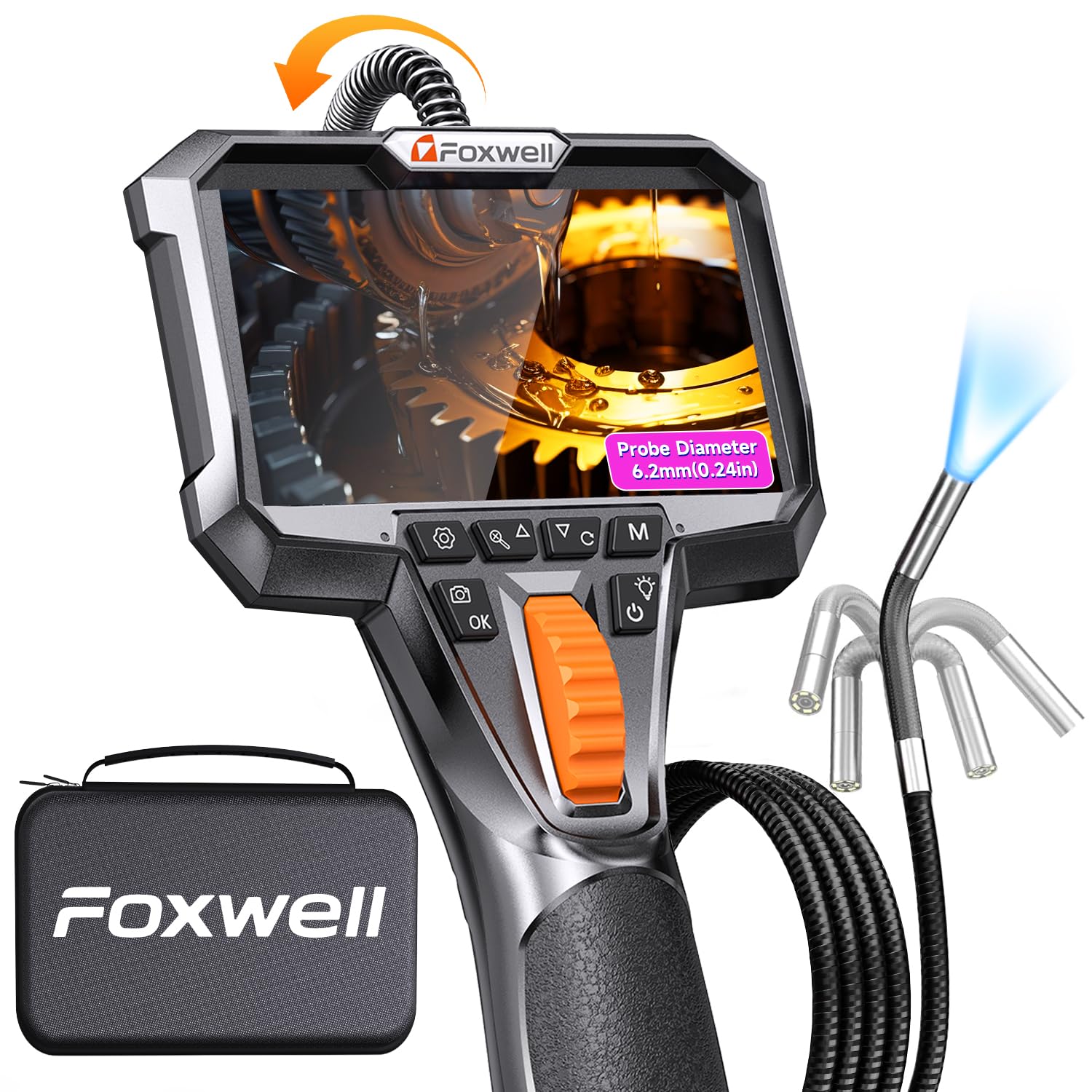
The FOXWELL Y400 combines an ultra-slim 0.24-inch probe with a market-leading 220 degrees of two-way articulation, which delivers more steering range than most competitors without adding bulk. The thumb-wheel control stays smooth even when wearing gloves, allowing precise navigation around cylinder walls and valve seats without fighting a stiff cable.
Image quality is handled by a 2MP sensor feeding a responsive IPS display that holds true color in dim shop lighting. The 6 adjustable LEDs produce enough illumination to overcome carbon buildup and oil residue. On-board storage includes 32GB for media, and the battery endurance of 5 to 7 hours outpaces typical all-day diagnostic shifts.
Smart overheat protection automatically shuts down the probe at 158 degrees F, matching real-world exhaust and engine block temperatures. The IP67 waterproof rating adds confidence when inspecting wet cooling systems or condensation inside intake tracts. For professional-grade articulation and durability, the Y400 sets a strong benchmark.
What works
- 220° articulation delivers excellent maneuverability in tight engine bays
- Ultra-slim 0.24in probe fits spark plug and glow plug ports
- Long battery life and included 32GB storage for extended use
What doesn’t
- No dual-lens option for simultaneous forward and side view
- Price sits at the higher end of the mid-range segment
2. Acoath Two-Way Articulating Borescope
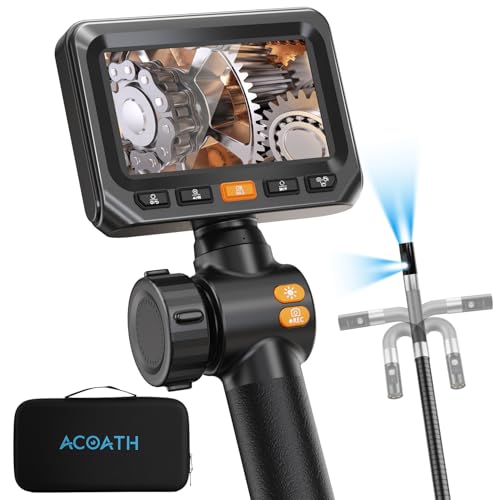
The Acoath borescope stands out immediately with its dual-lens design that toggles between a 70-degree forward view and a 60-degree side view at the push of a button. This eliminates the need to twist the probe when switching perspectives, which is a meaningful time saver when inspecting intake runners or behind timing covers.
The 4.3-inch IPS screen reproduces 1080p footage with realistic color, and the 8 adjustable LEDs provide four levels of brightness that handle everything from dark sumps to reflective cylinder bores. Owners consistently report that the semi-rigid 5-foot cable holds its shape reliably during complex routing, reducing frustration during deep engine inspections.
A built-in 32GB card comes pre-installed, and the kit includes a protective case, magnet, hook, and mirror attachments. The 24-month warranty is longer than what most competitors offer at this price point, adding to the overall value proposition for a shop that needs a reliable backup scope.
What works
- One-button lens switching between forward and side views
- Generous accessory kit with case and retrieval tools
- 24-month free warranty covers longer ownership
What doesn’t
- Probe diameter of 0.33in is wider than ultra-slim options
- Articulation limited to 210° rather than 220°
3. KAIWEETS 210° Articulating Borescope
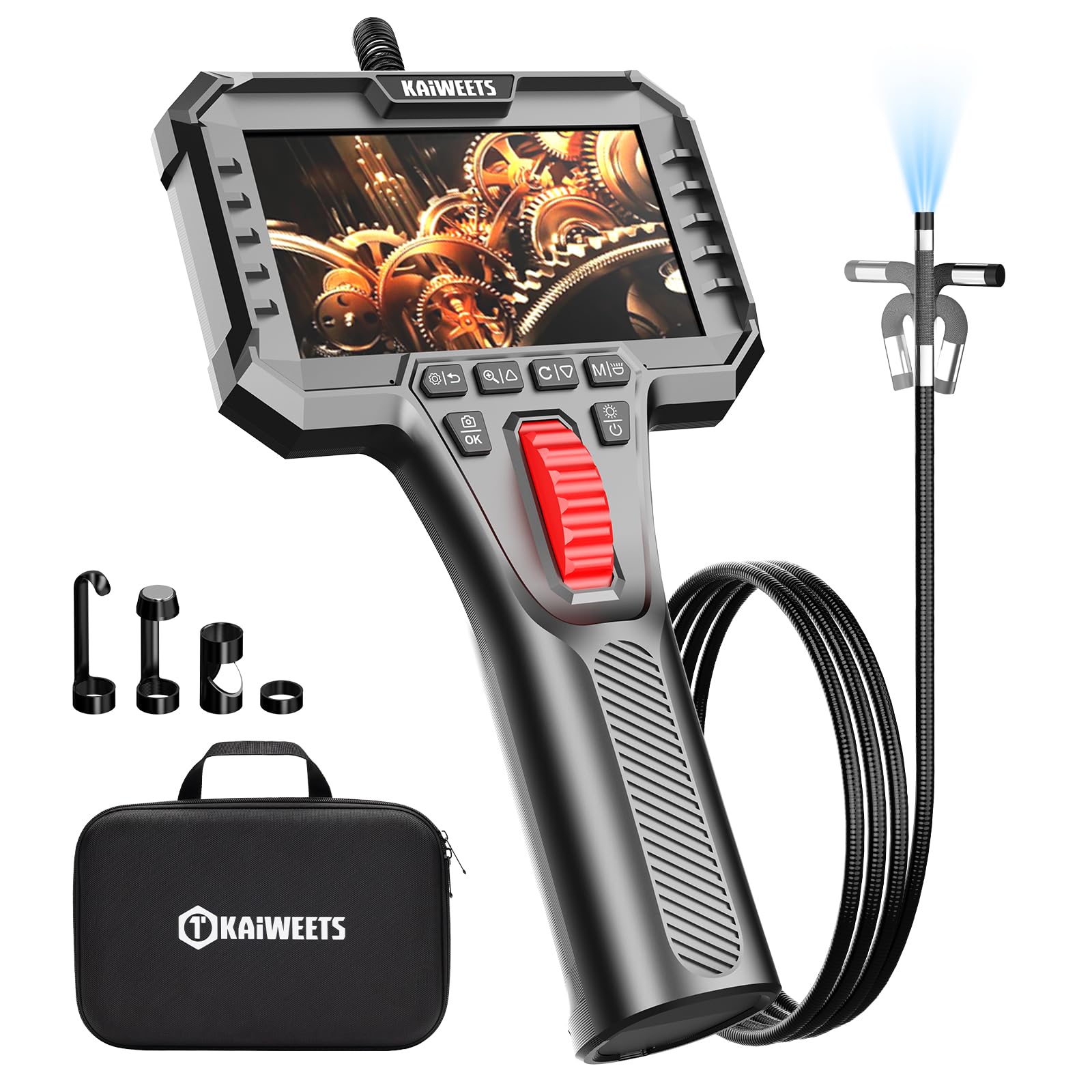
The KAIWEETS articulating borescope strikes a deliberate balance between slim probe diameter and articulation utility. With a 0.25-inch tip and 210 degrees of two-way bending, it passes through tight access points that defeat many 8mm scopes while still providing enough steering to look around piston rings and valve stems.
The 4.3-inch 1080p IPS display benefits from a rear-mounted auxiliary flashlight that improves visibility in dim garage lighting conditions. Owner reports highlight that the 6 adjustable probe LEDs produce even light distribution without harsh hotspots, which matters when trying to spot micro-cracks or sand-casting defects on rough metal surfaces.
Battery performance is rated at 5 hours from the 3000mAh cell, and the kit includes a protective carrying case, magnet, hook, side mirror, and a pre-installed lens protector. The IP67 waterproof probe adds resilience for inspections involving coolant or oil residue without hesitation.
What works
- Ultra-slim 0.25in probe fits narrow entry points
- Rear auxiliary flashlight improves work area visibility
- Full accessory set included out of the box
What doesn’t
- Single-lens design requires cable rotation for side views
- Articulation range slightly shorter than FOXWELL
4. DEPSTECH DS650 Dual Lens 5FT

The DEPSTECH DS650 5-foot version delivers a thoughtful layout with a 4.5-inch IPS screen and a side-mounted control wheel that lets you steer the dual-lens tip with one hand. The split-screen mode simultaneously displays both the forward and side camera views, reducing the back-and-forth that plagues single-lens scopes during complex cavity inspections.
Image quality is tuned with Blaurt 3.0 processing and manual focus optimized for a 3 to 8 cm working distance, which aligns perfectly with the proximity needed to inspect gasket surfaces and bearing journals. Owners report that the 1.5x digital zoom preserves usable detail without introducing excessive pixelation, making it easier to confirm hairline fractures.
The 2200mAh battery delivers roughly 4 hours of runtime, and the included 32GB TF card stores plenty of photo and video evidence. The IP67 rating and high-temp warning system add protection when working near exhaust manifolds or after turbo operation.
What works
- Dual-lens split-screen improves inspection efficiency
- Manual focus dial for precise close-up capture
- Rugged EVA case and 32GB storage included
What doesn’t
- Battery endurance falls short of competitors at 4 hours
- Probe diameter (0.33in) limits access to tight ports
5. Teslong 5mm Dual Lens Inspection Camera

The Teslong 5mm inspection camera uses a dual-lens system (forward and 90-degree side view) with a button toggle that avoids rotating the cable mid-job. The ultra-slim 5.5mm probe diameter is one of the narrowest on this list, making it the first choice for inspecting internals through restricted ports like oil filler necks or small vacuum line fittings.
The 5-inch IPS screen is the largest display among the reviewed units, and the 3500mAh battery delivers up to 6 hours of continuous use — enough to cover a full day of diagnostic work without recharging. Owners commonly mention that the kickstand on the back of the unit enables hands-free operation, which is helpful when both hands are needed to manipulate the probe or tools.
Image capture is handled at 1080p resolution (2MP) with automatic exposure, and the kit includes a magnet and hook for retrieving dropped hardware. The semi-rigid 5-foot cable holds shape well, though it lacks the articulation found on steerable scopes.
What works
- Largest 5-inch display among the group
- 6-hour battery life for all-day diagnostics
- Ultra-slim 5.5mm probe accesses very tight ports
What doesn’t
- No articulation — cable must be manually shaped
- Lacks a dedicated carrying case in the base kit
6. Anykit Articulating Borescope
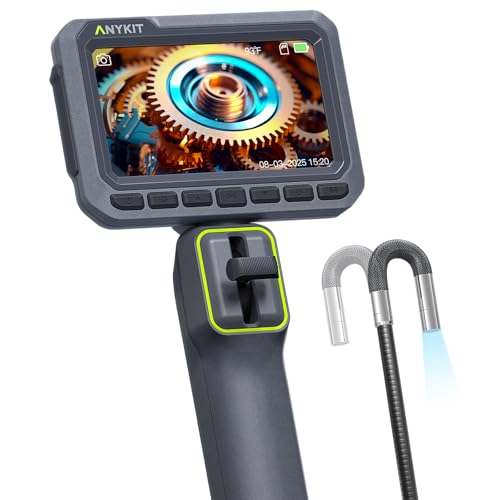
The Anykit articulating borescope brings two-way 210-degree steering to a more accessible price segment without eliminating essential features. The 0.22-inch probe is one of the thinnest available, allowing it to pass through spark plug holes and small ports that block thicker cables. The 4.3-inch 1080p IPS screen offers clear visuals with a 180-degree image flip for orientation correction when the cable twists.
Owner feedback consistently notes that the semi-rigid 4-foot cable is easier to manage in passenger-engine applications compared to longer lengths, and the 3000mAh battery delivers roughly 5 hours of operation. A built-in overheat alarm displays a red icon on-screen when probe temperatures climb near exhaust or hot engine components.
The kit includes an 8GB TF card and a USB-C charging port, though the included storage is lower than competing 32GB offerings. For occasional DIY use or as a backup scope, the Anykit provides solid articulation at a lower investment threshold.
What works
- Extremely slim 0.22in probe for tight access
- Built-in overheat alarm protects the probe
- Good battery life for a compact unit
What doesn’t
- Only 8GB included storage (upgradable)
- 4ft cable may be too short for truck or bus engines
7. DEPSTECH DS650 Dual Lens 10FT
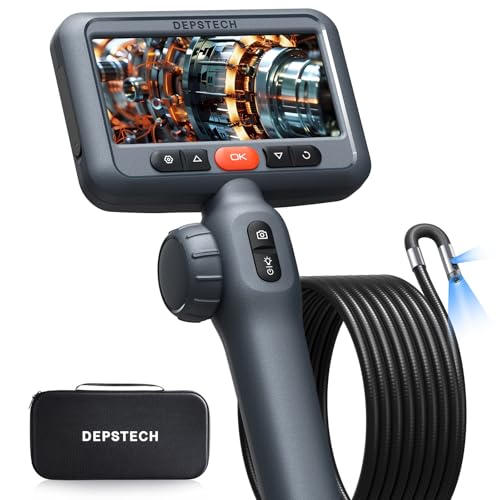
The 10-foot version of the DEPSTECH DS650 extends the dual-lens split-screen experience to applications that require longer reach, such as inspecting behind firewall cavities, inside exhaust headers, or down long intake runners on V8 engines. The 210-degree bidirectional articulation and side-mounted control wheel remain identical to the 5-foot model, maintaining the same one-handed steering feel.
The 4.5-inch IPS screen is paired with manual focus (3 to 8 cm range) and a 1.5x zoom that works best at the 3 to 5 cm optimal distance. Owners note that the IP67 waterproofing and high-temp warning allow safe use around hot manifolds and wet coolant passages, though the 2200mAh battery yields roughly 4 hours of operation — shorter than some shorter-cable competitors.
The 32GB card and EVA carrying case are identical to the 5-foot kit. For mechanics who frequently work on larger vehicles or equipment where a 5-foot cable forces awkward positioning, the 10-foot DS650 eliminates that limitation without sacrificing image quality or articulation.
What works
- Extended 10-foot cable for large engine bays and trucks
- Dual-lens split-screen with one-hand control
- IP67 waterproof with high-temp warning system
What doesn’t
- Battery runtime shorter than shorter-cable options
- Probe diameter (0.33in) limits ultra-tight access
Hardware & Specs Guide
Articulation Mechanics
Two-way articulation uses a thumb-wheel connected to a set of internal cables that bend the tip. Range is measured in degrees (180 to 220 is typical). Higher articulation reduces the need to reposition the entire scope and is essential for inspecting valve seats, cylinder bores, and turbo internals without removing the probe.
Probe Materials and Durability
The probe sheath is usually braided stainless steel or reinforced polymer with an IP67 or higher waterproof rating. This prevents damage from oil, coolant, and moisture. A semi-rigid gooseneck construction holds the shape you set, allowing you to route the cable around obstacles while keeping the tip aimed at the inspection target.
Imaging Sensor and Lighting
Most automotive scopes use a 2MP CMOS sensor delivering 1080p resolution. Adjustable white LEDs (usually 6 to 8) around the probe tip provide illumination. Dual-lens systems add a 60 to 90 degree side camera that can be toggled without moving the cable, reducing inspection time.
Battery Chemistry and Capacity
Li-ion battery packs between 2200mAh and 3500mAh dominate the market. Capacity directly correlates to runtime, which ranges from 4 to 7 hours depending on screen brightness and LED usage. Overheat protection circuits are becoming standard to prevent probe damage during extended use near hot engine parts.
FAQ
What probe diameter do I need for spark plug inspections?
Can I use a borescope inside a running engine?
What is the difference between semi-rigid and fully articulating cables?
How many hours of battery life is realistic for all-day diagnostics?
Do dual-lens borescopes eliminate the need for articulation?
Final Thoughts: The Verdict
For most buyers, the borescope for automotive winner is the FOXWELL Y400 because its 220-degree articulation combined with an ultra-slim probe delivers unmatched access for professional engine diagnostics. If you need dual-lens efficiency, the Acoath Two-Way provides forward and side views at a strong value. And for extended reach in larger vehicles, the DEPSTECH DS650 10FT keeps the same dual-lens clarity without cable-length compromise.

Certification: BSc in Mechanical Engineering
Education: Mechanical engineer
Lives In: 539 W Commerce St, Dallas, TX 75208, USA
Md Amir is an auto mechanic student and writer with over half a decade of experience in the automotive field. He has worked with top automotive brands such as Lexus, Quantum, and also owns two automotive blogs autocarneed.com and taxiwiz.com.