A trailer jack that bolts directly to the frame eliminates the need for welding, yet many buyers overlook critical differences in load ratings, travel range, and crank mechanism. The wrong choice leaves you struggling to level on uneven ground or replacing a bent unit after a single season.
I’m Amir — the founder and writer behind Four Wheel Ask. I have spent years analyzing product specifications, studying owner-reported failure points, and comparing build quality across dozens of trailer jack models to separate durable designs from short-lived hardware.
Choosing the right best bolt-on trailer jack means matching capacity to your trailer’s tongue weight and frame type for reliable support every time.
How To Choose The Best Bolt-On Trailer Jack
Bolt-on trailer jacks look similar at first glance, but small differences in capacity rating, travel length, and mounting hardware determine whether a jack feels sturdy or wobbly after a few months. Focus on these four factors before picking a model.
Understanding Load Capacity — Static vs. Dynamic
Manufacturers often list two numbers: a static capacity (jack fully extended, not moving) and a dynamic lift capacity (weight it can raise while cranking). Static ratings can be double the lift rating. For a utility trailer under 3,000 pounds tongue weight, a 2,000-pound lift capacity provides ample margin. Heavier RVs or car haulers benefit from 5,000-pound static-rated units that handle side loads without flexing.
Mounting Style — Bolt-On vs. Weld-On Considerations
Bolt-on jacks attach through pre-drilled holes or clamp brackets, making them ideal for DIY installs and future swaps. Weld-on units offer a cleaner look but require fabrication skills. Check whether the bolt pattern matches your A-frame width — some universal models include adjustable brackets, while others fit only standard 2-inch by 3-inch frames.
Drive Mechanism — Top-Wind, Side-Wind, or Electric
Top-wind handles crank vertically above the jack, which works well when there is clearance above the coupler. Side-wind handles rotate horizontally, making them easier to operate near a tailgate or trailer tongue. Electric jacks eliminate manual effort entirely but require a battery or 12V power source and add complexity that can fail in remote camping situations.
Travel Range and Retracted Height
Travel range determines how much vertical adjustment you have for leveling on uneven ground. A 10-inch travel suits flat driveways, while 14 to 15 inches handles campsite slopes. Retracted height matters for towing clearance — if the jack cannot swing up fully, it drags on steep driveways. Measure your frame height and desired ground clearance before ordering.
Quick Comparison
On smaller screens, swipe sideways to see the full table.
| Model | Category | Best For | Key Spec | Amazon |
|---|---|---|---|---|
| Reese Pro Series RV20000103 | Sidewind | A-Frame Trailers & RVs | 2,000 lbs, 14″ Travel | Amazon |
| Curt 28575 Drop Leg | Heavy-Duty | Heavy-Duty Towing | 8,000 lbs Support, 15″ Travel | Amazon |
| VEVOR Electric | Electric | Effortless Lifting | 4,000 lbs, 9.8″-33.8″ Range | Amazon |
| Curt 28300 Swivel | Swivel | Swivel Mount Applications | 3,000 lbs Support, 10.5″ Travel | Amazon |
| Bastion Distribution BJ-5000TW-1 | Topwind | High Capacity on a Budget | 5,000 lbs Stationary, 14.8″ Travel | Amazon |
| VEVOR 2500 lbs Swivel | Swivel | Utility & Horse Trailers | 2,500 lbs Dynamic, 15″ Travel | Amazon |
| Reese Towpower 74413 | Topwind | Light-Duty Trailers | 1,000 lbs, 10″ Travel, Chrome | Amazon |
In‑Depth Reviews
1. Reese Pro Series RV20000103

Reese Pro Series earns the top spot because it balances a proven 2,000-pound lift capacity with a sidewind handle that keeps your hands clear of the coupler. The cast-iron construction and precision-fitted parts deliver a solid feel during cranking, and owner reports consistently mention that it replaces OEM jacks on travel trailers and cargo haulers with zero modifications to existing bolt holes.
The 14-inch travel range provides enough vertical adjustment for most campsite leveling situations, and the 9-inch retracted height keeps the jack tucked high when towing. Multiple buyers note that the sidewind mechanism requires less effort than top-wind designs when working close to a tailgate or trailer tongue, making daily hitching noticeably smoother.
Some owners wish the included mounting hardware included lock washers, but the bolt pattern matches standard A-frame spacing on most trailers under 6,000 pounds gross vehicle weight. For the majority of recreational and utility trailer owners, this Reese model delivers the most hassle-free installation and reliable daily operation.
What works
- Drop-in replacement for many OEM jacks with same bolt pattern
- Sidewind handle allows easy cranking near tailgates
- Cast-iron body resists bending under repeated loads
What doesn’t
- Mounting hardware lacks lock washers out of the box
- Not rated for trailers exceeding 6,000 lbs GVWR
2. Curt 28575 Side Wind Heavy Duty Drop Leg Jack
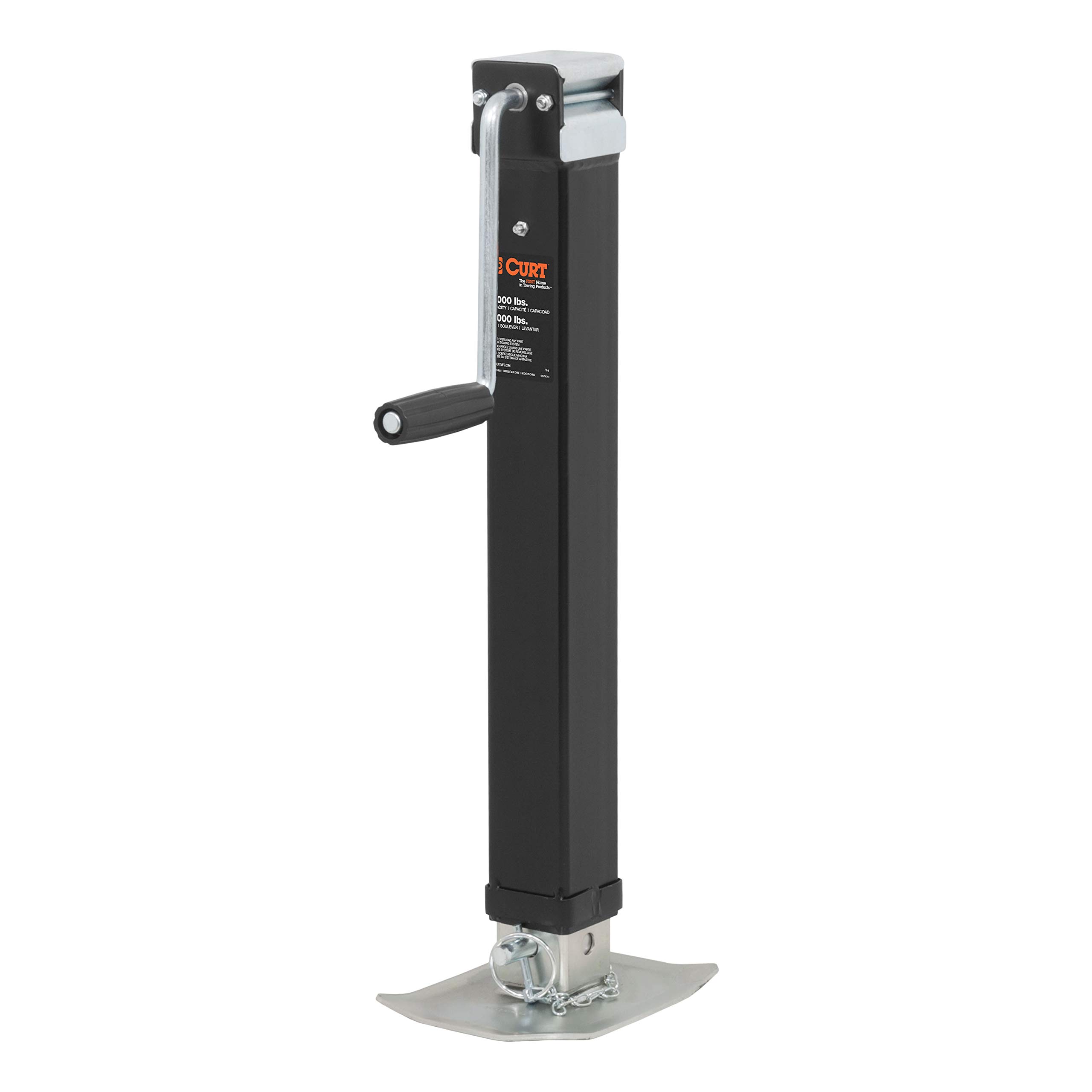
This Curt drop-leg jack is built for trailers that push past the 5,000-pound tongue weight mark. With an 8,000-pound support capacity and a 7,000-pound lift rating, it handles heavy equipment haulers, large flatbeds, and horse trailers without any flex. The 15-inch vertical travel provides generous range for uneven terrain, and the side-wind handle keeps cranking smooth even under load.
The drop-leg feature allows you to extend an additional leg section for extra ground contact on soft surfaces, which owners of dump trailers and car haulers find invaluable when parking on gravel or grass. The black powder coat finish resists corrosion well, and the integrated grip on the handle adds comfort during repeated cranking sessions.
Installation requires welding the mounting plate directly onto the trailer tongue, so this jack is not a simple bolt-on swap. Buyers with basic welding skills report the process is straightforward, but those who prefer a bolt-on solution should look elsewhere. The packaging during shipping has drawn some criticism, though the jack itself arrives undamaged.
What works
- Massive 8,000 lb support capacity for heavy trailers
- Drop leg provides extra stability on soft ground
- Side-wind operation remains smooth under heavy loads
What doesn’t
- Weld-on installation requires fabrication skills
- Drop leg pins can be inconvenient to adjust frequently
3. VEVOR Electric Trailer Jack

The VEVOR electric jack replaces manual cranking with a simple push-button operation, making it a strong choice for RV owners who want to avoid the physical effort of raising and lowering a heavy trailer tongue. The 4,000-pound lifting capacity covers most travel trailers and fifth-wheel campers, and the 9.8-inch to 33.8-inch height range accommodates both low-profile and lifted trailer frames.
Owners consistently highlight the robust carbon steel construction and the included waterproof sunshade cover that protects against UV damage and moisture. The 90-degree rotating installation holes prevent tailgate interference, a detail that matters for truck owners who open the tailgate while hitched. A manual hand crank is included as a backup for power outages or electrical failures.
Some users note that the wiring requires a solid 12V connection with a dedicated ground wire — relying on chassis grounding through the mounting bolts can cause intermittent operation. The unit is heavier than manual jacks, but the time saved during setup and takedown makes it worthwhile for frequent campers. The control switches are physical buttons rather than touchpads, which owners prefer for reliability.
What works
- Push-button lifting eliminates manual cranking effort
- Includes waterproof cover and emergency hand crank
- Rotating bolt pattern prevents tailgate interference
What doesn’t
- Requires reliable 12V power and dedicated ground wire
- Heavier than manual jacks, adding tongue weight
4. Curt 28300 Top Wind Bracket Mount Jack
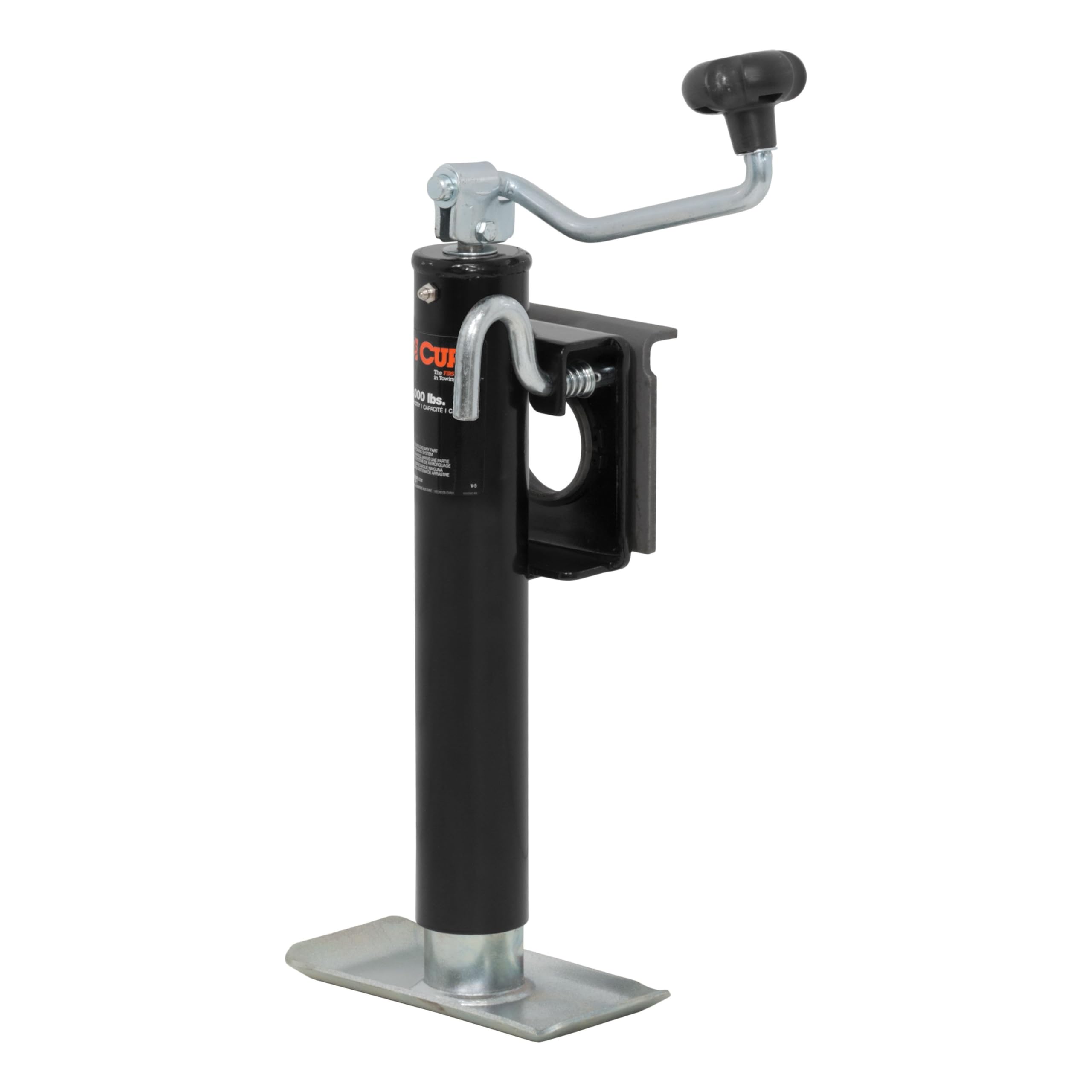
The Curt 28300 stands out for its swivel bracket design, which allows the jack to swing up and lock out of the way when towing. This feature is especially useful for trailers where ground clearance is tight, as the 11.5-inch retracted height with the swivel engaged keeps the jack well above pavement. The 3,000-pound support capacity and 2,000-pound lift rating suit mid-size utility trailers and smaller RVs.
A grease fitting on the gear housing lets you maintain smooth operation over years of use, a detail that speaks to Curt’s emphasis on long-term serviceability. The black powder coat combined with a zinc-plated finish provides dual-layer corrosion protection against road salt and moisture. The top-wind handle includes an integrated grip that makes cranking comfortable even with gloved hands.
The bracket requires welding onto the trailer frame, which limits its appeal for buyers seeking a pure bolt-on installation. Owners with welding experience praise the easy setup and durable feel, but those without access to a welder should consider Curt’s bolt-on alternatives. The 10.5-inch vertical travel is adequate for flat ground but may feel limited on steep campsite slopes.
What works
- Swivel bracket allows jack to swing up for maximum clearance
- Grease fitting enables long-term gear maintenance
- Dual-layer corrosion protection finish
What doesn’t
- Bracket requires welding for installation
- 10.5-inch travel may be insufficient for steep sites
5. Bastion Distribution BJ-5000TW-1 Top-Wind Jack

Bastion Distribution delivers a 5,000-pound stationary capacity at a price point that undercuts most competitors with similar ratings. The top-wind mechanism operates smoothly out of the box, and the pre-mounted rectangular footpad provides a stable base on dirt, gravel, or asphalt without requiring additional hardware. The 14.8-inch travel range gives enough lift for leveling on uneven terrain.
The alloy steel construction with powder-coated finish holds up well against weather exposure, and owners report that the jack retains its smooth operation even after months of outdoor storage. The included retaining clip holds the footpad securely in place, a small but appreciated detail that prevents rattling during transit. Installation is straightforward for standard A-frame trailers with pre-drilled bolt holes.
Some users note that the black and silver finish is more prone to showing scratches than all-black models, and the 5,000-pound capacity is a stationary rating — the dynamic lift capacity is lower, which matters when cranking under heavy tongue weight. The six-month warranty is shorter than the lifetime coverage offered by Curt, but the price-to-capacity ratio remains compelling for budget-conscious buyers.
What works
- High 5,000 lb stationary capacity at a competitive price
- Rectangular footpad provides stable ground contact
- Smooth top-wind operation right from the box
What doesn’t
- Dynamic lift capacity is lower than stationary rating
- Finish shows scratches more easily than all-black models
6. VEVOR 2500 lbs Swivel Trailer Jack
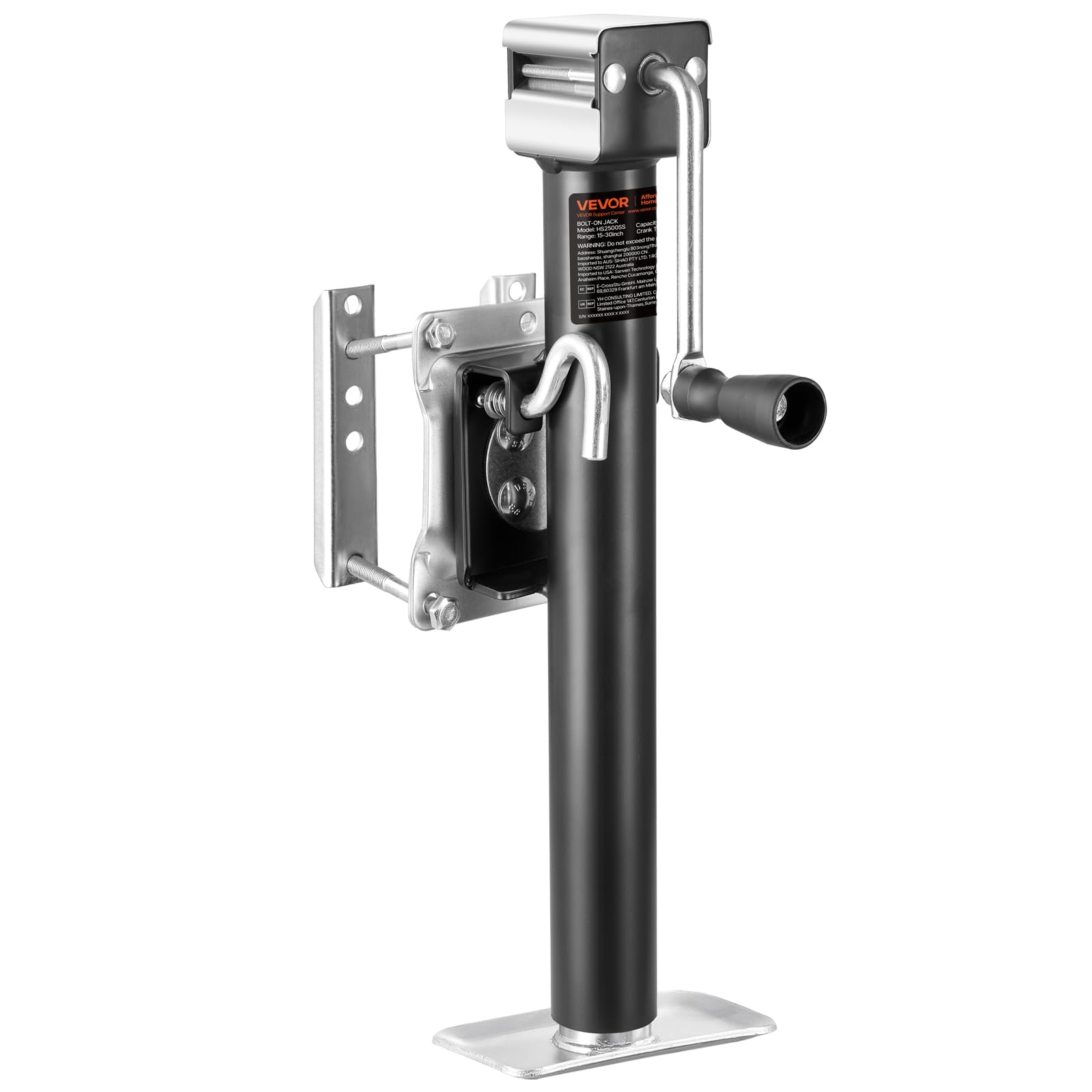
This VEVOR model offers a 2,500-pound dynamic load capacity with a swivel bracket that lets the jack pivot out of the way during towing. The 15-inch vertical travel is generous for this class, allowing you to level on sloped campsites without running out of adjustment. The carbon steel construction with galvanized inner and outer tubes provides corrosion resistance that holds up in coastal or wet environments.
The three-level height adjustment gives flexibility for different trailer heights, and the ergonomic handle makes cranking comfortable even during extended use. Owners note that the installation hardware is complete and the bolt pattern fits most standard A-frame trailers without modification. The powder-coated black finish looks clean and resists chipping better than bare metal alternatives.
Some buyers mention that the gear ratio requires more cranking effort under heavy tongue loads compared to lower-geared jacks, and the swivel bracket adds a small amount of play that may be noticeable on rough roads. Overall, this VEVOR delivers solid build quality and useful features at a price that undercuts many comparable models from established brands.
What works
- 15-inch travel range offers ample leveling adjustment
- Swivel mount allows jack to swing up for clearance
- Galvanized tubes provide strong corrosion resistance
What doesn’t
- Gear ratio requires more effort under heavy tongue weight
- Swivel bracket introduces slight play during towing
7. Reese Towpower 74413 Round Swivel Jack

Reese Towpower 74413 is a straightforward side-mount jack rated for 1,000 pounds of lift, making it suitable for lightweight boat trailers, utility trailers, and smaller campers. The chrome finish gives it a polished look that resists surface rust better than painted alternatives, and the top-wind handle allows quick adjustments from above the coupler. The 10-inch travel covers basic leveling needs on flat driveways and gentle slopes.
The heavy-gauge steel construction feels solid for its class, and the swivel mechanism with a 3/8-inch pull-pin release lets you swing the jack out of the way when not in use. Owners report smooth operation out of the box and note that installation is simple with basic hand tools. The included foot plate provides adequate ground contact for firm surfaces.
The 1,000-pound capacity limits this jack to trailers under about 2,000 pounds gross vehicle weight, and the chrome finish can chip if struck by road debris. Several buyers mention checking the retracted height carefully before purchasing, as the 10-inch travel may not provide enough clearance for lifted trailers. For small, lightweight trailers, this Reese model offers reliable performance at a reasonable entry point.
What works
- Chrome finish resists rust better than painted jacks
- Swivel mechanism with pull-pin is easy to operate
- Simple installation with basic hand tools
What doesn’t
- 1,000 lb capacity limits use to lightweight trailers
- 10-inch travel may lack clearance for lifted frames
Hardware & Specs Guide
Load Capacity Ratings
Static capacity is the maximum weight a jack can support when fully extended and stationary. Dynamic lift capacity is the weight it can raise while cranking. A jack rated for 5,000 pounds static may only lift 2,000 pounds dynamically. Always use the dynamic rating when matching a jack to your trailer’s tongue weight to avoid premature gear wear or handle breakage.
Travel Range and Heights
Travel range is the total vertical distance the jack can extend. Retracted height is the lowest position when fully collapsed — critical for ground clearance during towing. Extended height is the maximum reach. Measure from your trailer frame to the ground at the coupler and add a few inches for slope adjustment before selecting a model.
Mounting Types
Bolt-on jacks attach through pre-drilled holes or u-bolt brackets on the A-frame. Weld-on jacks require direct welding to the frame rail. Some models offer swivel brackets that bolt on and allow the jack to pivot up, combining bolt-on convenience with the clearance of a weld-on design.
Crank Mechanisms
Top-wind jacks have the handle entering vertically from above, requiring clearance above the coupler. Side-wind jacks have a horizontal handle that stays clear of tailgates and couplers. Electric jacks use a motor and gearbox for push-button operation but require a 12V power source and add weight to the tongue.
FAQ
What is the difference between static and dynamic load capacity on a trailer jack?
Can I replace a weld-on trailer jack with a bolt-on model?
Final Thoughts: The Verdict
For most buyers, the best bolt-on trailer jack winner is the Reese Pro Series RV20000103 because it combines a proven 2,000-pound lift capacity with a convenient sidewind handle and straightforward bolt-on installation that fits most A-frame trailers. If you want electric push-button convenience, grab the VEVOR Electric Trailer Jack. And for heavy-duty towing where nothing less than 8,000 pounds of support will do, nothing beats the Curt 28575 Drop Leg Jack.

Certification: BSc in Mechanical Engineering
Education: Mechanical engineer
Lives In: 539 W Commerce St, Dallas, TX 75208, USA
Md Amir is an auto mechanic student and writer with over half a decade of experience in the automotive field. He has worked with top automotive brands such as Lexus, Quantum, and also owns two automotive blogs autocarneed.com and taxiwiz.com.