A secondary drive belt that’s too loose slips under load, robbing acceleration and wearing the belt edges. One that’s too tight overloads bearings, shortens belt life, and can even snap under hard throttle. The difference between a perfect ride and a drivetrain headache comes down to one number in pounds — and without a dedicated gauge, you’re just guessing that number.
I’m Amir — the founder and writer behind Four Wheel Ask. I’ve spent years analyzing market data, manufacturing specs, and aggregated owner feedback across the belt gauge tool category to separate tools that deliver repeatable accuracy from those that leave you chasing a false reading.
This guide evaluates the five most relevant models on the shelf today so you can confidently select a best belt gauge tool that matches your bike’s drive train requirements and your own tolerance for mechanical uncertainty.
How To Choose The Best Belt Gauge Tool
Not all belt tension gauges measure the same range or use the same mechanism. Picking the wrong one for your bike’s belt — whether a flat Harley secondary belt or a V-belt on an industrial machine — guarantees inaccurate readings and wasted adjustment time.
Gauge Range and Application Fit
Motorcycle secondary drive belts typically require a tension specification around 10 lb measured at the belt’s midpoint. Tools like the ARES 15033 and the OTC 4748 are calibrated specifically for this 10 lb standard, making them a direct fit for Harley-Davidson and most ATV secondary belts. The Gates 91107 Krikit, by contrast, covers 30-160 lb and is designed for automotive accessory V-belts — it will not read the low tension your bike’s belt needs. Match the gauge’s load range to your vehicle’s service manual spec, not the other way around.
Build Material and Indicator Mechanism
The most durable units use a die-cast aluminum body with a nylon or steel indicator arm. A pressure pad that seats the belt without slipping matters more than brand name. Look for clear gauge markings — some tools use a sliding scale while others use a spring-loaded piston. A pocket clip and compact body make the tool convenient to carry during roadside adjustments, but the priority should always be mechanical repeatability over portability.
Quick Comparison
On smaller screens, swipe sideways to see the full table.
| Model | Category | Best For | Key Spec | Amazon |
|---|---|---|---|---|
| ARES 15033 | Universal L-Pad | Harley / ATV secondary drive belts | 10 lb specification | Amazon |
| Motion Pro 08-0350 | Flat Belt | Flat belt tension reference | Built‑in scale for easy reference | Amazon |
| Gates 91107 Krikit | V-Belt | Automotive accessory V-belts | 30‑160 lb range | Amazon |
| OTC 4748 | Secondary Drive | Precision 10 lb setting after wheel service | 7.8″ tool length | Amazon |
In‑Depth Reviews
1. ARES 15033 Belt Tension Gauge
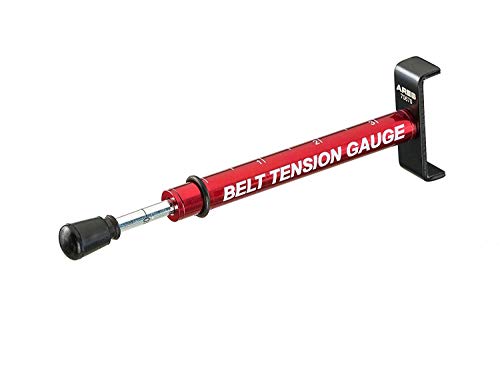
The ARES 15033 is purpose-built for the 10 lb specification that Harley-Davidson and most ATV secondary drive belts require. Its universal L-shaped pad cradles the belt securely during the pull, eliminating the rocking or slipping you get with a simple hook design. This design consistency translates directly to repeatable readings — you can measure, adjust, and recheck without the measurement shifting because the belt shifted.
The gauge body uses a rubberized grip and clear markings that remain legible even after repeated shop exposure. At roughly 7.4 inches long, it fits easily into a tool roll or side bag for roadside tension checks after wheel service or belt replacement. The included Performance Assurance Limited Lifetime Warranty backs the tool against manufacturing defects, which adds confidence for daily professional use.
Application-specific tools sometimes sacrifice versatility, but the ARES covers any vehicle with a secondary belt and a 10 lb spec. That includes most modern Harley touring and cruiser models as well as many UTVs. For riders who want a single tool that handles the most common belt tension scenario without guesswork, this model delivers the cleanest workflow.
What works
- L-pad design holds belt steady during measurement
- Limited lifetime warranty backs the tool
- Clear, easy-to-read markings
What doesn’t
- Only accurate for 10 lb spec applications
- Rubber grip can wear with heavy solvent exposure
2. Motion Pro 08-0350 Belt Tension Gauge

Motion Pro’s 08-0350 offers a built-in reference scale for flat belts, making it a practical choice for mechanics who work on multiple belt types but want a single gauge in the drawer. The tool weighs only 0.1 pounds and relies on a simple mechanical reading — no batteries, no springs that lose calibration. This simplicity means it will likely outlast plastic-bodied alternatives in a busy garage environment.
The design targets Harley-Davidson motorcycles directly, but the flat belt style accommodates other secondary drive belts that use a similar profile. The included Drive Train Tools classification in its specs confirms that Motion Pro engineered this gauge for drivetrain service rather than generic automotive use. That focus shows in the pocket-friendly form factor and the clear scale markings.
At an entry-level price point, the trade-off is that the gauge requires the user to interpret the scale visually without a locking mechanism. If you need a positive capture of the reading to compare before and after adjustments, you’ll want to hold the reading manually. For quick tension checks during routine maintenance, however, this tool gets the job done without complicating the process.
What works
- Extremely lightweight and portable
- No calibration drift over time
- Designed specifically for flat motorcycle belts
What doesn’t
- No locking mechanism to hold the reading
- Scale interpretation requires a steady hand
3. OTC 4748 Belt Tension Gauge

OTC’s 4748 is a dedicated secondary drive belt gauge calibrated for the 10 lb specification common on Harley-Davidson motorcycles. At 7.8 inches in length, the tool provides enough reach to access the belt on bagger and touring models where space between the swingarm and belt is tight. The gauge uses a straightforward spring-loaded mechanism that produces a reading with consistent force application.
The tool’s design prioritizes simplicity and repeatability — you position the gauge at the belt’s midpoint, pull until it clicks or indicates the set point, and read the tension. OTC specifies this gauge for use after belt replacement, adjustment, or wheel service, which matches exactly when most riders need a reliable reading. The 0.035 ounce weight is negligible, so the tool disappears into a vest pocket or handlebar bag.
One limitation is that the gauge is specific to 10 lb spec systems. If you work on vehicles that require a different tension spec, this tool won’t adapt. Additionally, the compact design means the scale markings are small — mechanics with impaired vision may need reading glasses to interpret the measurement accurately in dim shop lighting.
What works
- Long body reaches belts on touring bikes
- Simple spring operation, no interpretation required
- Extremely lightweight and pocketable
What doesn’t
- Scale markings are small
- Not adaptable to non-10 lb spec applications
Hardware & Specs Guide
Gauge Mechanism
Belt tension gauges use either a spring-loaded plunger that compresses against a calibrated spring or a sliding scale indicator that moves as tension is applied. Spring-loaded designs like those in the OTC 4748 provide a positive stop that indicates the exact tension reading. Sliding scale designs, such as the Motion Pro 08-0350, require the user to hold the gauge steady while reading the measurement. The spring-loaded mechanism generally produces more repeatable results for beginners, while the sliding scale offers faster readings for experienced mechanics.
Range and Application
Every belt system has a manufacturer-specified tension value. Motorcycle secondary drive belts almost always use a 10 lb specification measured at the belt’s center point. Tools designed around this spec — the ARES 15033 and OTC 4748 — are calibrated for that exact load. The Gates Krikit 91107, by contrast, measures 30-160 lb, making it suitable for automotive alternator and water pump V-belts but unusable for motorcycle secondary belts. Always match the gauge’s range to the service manual spec; a gauge that reads too high will give no useful reading on a 10 lb system.
FAQ
What does the 10 lb specification mean on a belt tension gauge?
Can a Gates Krikit gauge be used on a Harley secondary drive belt?
Final Thoughts: The Verdict
For most buyers, the best belt gauge tool winner is the ARES 15033 because its universal L-pad design and 10 lb calibration deliver repeatable readings on the most common secondary belt application. If you need a budget-friendly option for quick flat belt checks, grab the Motion Pro 08-0350. And for reaching belts on tight touring bike swingarms, nothing beats the OTC 4748.

Certification: BSc in Mechanical Engineering
Education: Mechanical engineer
Lives In: 539 W Commerce St, Dallas, TX 75208, USA
Md Amir is an auto mechanic student and writer with over half a decade of experience in the automotive field. He has worked with top automotive brands such as Lexus, Quantum, and also owns two automotive blogs autocarneed.com and taxiwiz.com.