That first flight with a beginner RC helicopter often ends the same way — a wobble, a drift, then a sudden meeting with the wall. The learning curve is real, but the technology to flatten it has never been more affordable. Today’s micro helis pack barometric altitude hold, 2.4GHz anti-interference, and metal frames that survive the inevitable bumps, all while keeping the controls simple enough for an eight-year-old to master on Christmas morning.
I’m Amir — the founder and writer behind Four Wheel Ask. I’ve spent thousands of hours analyzing RC helicopter specs, crash-test data from owner reviews, and the engineering choices that separate frustration from fun for first-time pilots.
This guide breaks down the real-world flight behavior, build quality, and battery endurance of five models so you can confidently find the best beginner helicopter rc for a smooth first flight.
How To Choose The Best Beginner RC Helicopter
Choosing the right first helicopter means looking past the flashy LED lights and focusing on the systems that make flight forgiving. New pilots need stability, durability, and a control scheme that doesn’t require a pilot’s license to understand.
Altitude Hold and Gyroscopic Stability
Altitude hold uses a barometric pressure sensor to lock the helicopter at a fixed height when you release the throttle. This alone eliminates the most frustrating part of learning — fighting up and down drift. A built-in gyroscope adds axial stability, resisting sideways drift caused by air currents or imperfect balance. These two technologies transform a twitchy toy into a predictable learning platform.
Channel Count and Control Fidelity
A 3-channel helicopter controls throttle, yaw (rotation), and forward/backward pitch. This is ideal for indoor beginners because it removes the roll (left/right tilt) control, simplifying the learning process. A 4-channel model adds that roll axis, enabling banked turns and more natural flight — but demands quicker reflexes. For children and absolute beginners, 3-channel is the safer starting point.
Battery Configuration and Flight Time
Flight time on a beginner helicopter ranges between 12 and 30 minutes total, but you need to look at how that time is delivered. A single battery means a short session followed by a long recharge wait. Models that include two modular batteries allow swap-and-go flying, effectively doubling your air time. Look for USB-C charging convenience and lithium-ion cells with overcharge protection for safety during family use.
Quick Comparison
On smaller screens, swipe sideways to see the full table.
| Model | Category | Best For | Key Spec | Amazon |
|---|---|---|---|---|
| XIKOTEC (Blue) | Premium Build | Rugged durability & longer flight | Alloy steel frame, 2 batteries (26-30 min) | Amazon |
| POCO DIVO S107H | Compact Classic | Smooth hovering in tight indoor spaces | Barometric altitude hold, 3-channel, 8.7 in | Amazon |
| VATOS XK913 | Zero Assembly | Gift-ready out of the box for ages 12+ | No assembly, altitude hold, 130-160 ft range | Amazon |
| XIKOTEC (Green) | Modern Charging | Convenient USB-C fast charging | 2 modular USB-C batteries, 20 min flight time | Amazon |
| Cheerwing U12 | Entry Level | Affordable starter with solid metal frame | Metal frame, 2 speed modes, 2 batteries | Amazon |
In‑Depth Reviews
1. XIKOTEC Remote Control Helicopter (Blue)
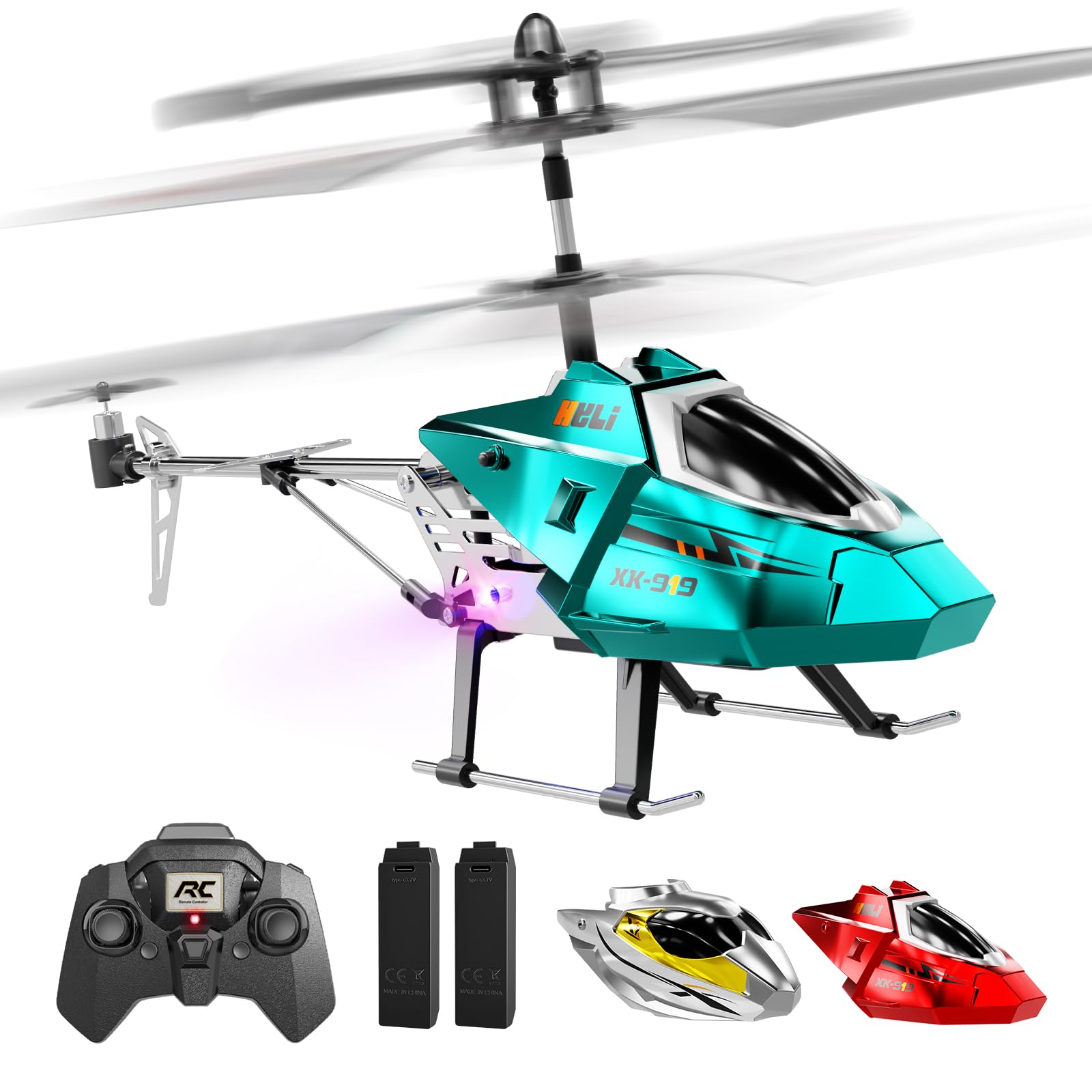
The XIKOTEC Blue stands apart from the rest of the pool thanks to its alloy steel frame — a feature usually reserved for more expensive models. This frame shields the control boards and gears from the punishment of repeated crashes, which is exactly what every beginner helicopter goes through. The two included modular batteries deliver a combined 26 to 30 minutes of flight time, significantly outlasting the single-battery competition that typically taps out around 12 minutes.
Feedback from owners confirms that children as young as six pick up the one-key takeoff and landing within minutes, and the height maintenance function keeps the heli locked at a stable altitude when the throttle is released. Three interchangeable metallic shells add visual variety without affecting balance, and the 2.4GHz system allows up to 60 feet of interference-free control even with multiple remotes active in the same room.
Remember the critical startup sequence — helicopter first, then remote — or binding fails. The lightweight build is strictly for indoor use; outdoor breezes will push it around. Owners note the 3-channel control is simpler to learn than 4-channel, but experienced pilots may outgrow the limited maneuverability within a few weeks.
What works
- Alloy steel frame absorbs crashes without breaking
- Two modular batteries provide nearly 30 minutes of total air time
- Interchangeable metallic shells keep the look fresh
- Simple one-key takeoff and landing for total beginners
What doesn’t
- Requires precise startup order or binding fails
- 3-channel controls feel limiting after a few weeks of practice
- Lightweight design cannot handle outdoor wind
2. POCO DIVO S107H Altitude Hold RC Helicopter

The POCO DIVO S107H is an evolution of the legendary S107G platform that has been a staple in the beginner category for years. What sets this version apart is the addition of barometric pressure technology for altitude hold, which allows the helicopter to hover at a fixed height automatically. This feature alone removes the biggest headache for new pilots: the constant need to adjust throttle to maintain altitude.
At just 8.7 inches long, this is the most compact model in the lineup, making it ideal for flying in smaller rooms without bumping into furniture. The metal frame and body provide crash resistance that plastic-only competitors cannot match, and the 2.4GHz spread spectrum technology allows ten or more helicopters to fly simultaneously without signal conflict. The one-key takeoff and landing simplifies the startup ritual significantly.
Batteries are not included, which is an unusual omission that forces an additional purchase before first flight. The small size also means shorter flight endurance compared to larger models, and the fixed-height system lacks the low-battery alert found on some competitors. Owners consistently praise the rock-solid hover, but the lack of forward flight speed can feel slow for pilots ready to progress.
What works
- Barometric altitude hold delivers a truly locked hover position
- Compact 8.7-inch size fits small indoor spaces
- Metal frame provides good crash protection
- 2.4GHz supports multiple helicopters flying together
What doesn’t
- No batteries included — you must buy them separately
- Small size limits total flight time per battery
- Forward speed feels slow for progressing pilots
3. VATOS RC Helicopter XK913

The VATOS XK913 targets the gift-giver who wants zero setup friction. This model ships with no assembly required — charge the built-in battery, turn on the helicopter first, then the controller, and you are airborne. The altitude hold function uses barometric pressure technology to lock the hover height automatically after takeoff, and the built-in gyroscope corrects drift so the heli stays where you point it without constant thumb corrections.
The remote range of 130 to 160 feet in open, obstacle-free conditions gives more breathing room than the typical 50-meter ceiling on most indoor models. LED lights make the helicopter visible in dimmer rooms, and the 2.4GHz system prevents interference when multiple helicopters are flown together. The trim control allows fine correction for any drifting or tilting that develops from minor crash damage.
The tradeoff for the no-assembly convenience is a single built-in battery that delivers only about 12 minutes of flight time after a one-hour charge. There is no spare battery included, so sessions end abruptly and require a long recharge pause. The plastic construction lacks the metal frame found on competing models, meaning durability takes a small hit on harder impacts.
What works
- Completely ready to fly out of the box with zero assembly
- Altitude hold and gyroscope keep the hover steady
- LED lights add visibility in indoor environments
- 130-160 foot range beats typical competitor limits
What doesn’t
- Single integrated battery limits total flight to 12 minutes
- No spare battery included; must wait for recharge
- Plastic frame is less durable than metal-framed options
4. XIKOTEC RC Helicopter (Green) with USB-C Charging

The green XIKOTEC variant focuses on modern charging convenience. Two modular batteries each feature a USB-C port for faster recharging compared to the older micro-USB or barrel connectors found on most budget helicopters. Combined flight time from both batteries is around 20 minutes, which sits between the single-battery budget units and the premium twin-pack offerings. The USB-C standard means a single cable can charge both packs simultaneously with a multi-port adapter.
The helicopter uses the same 3.5-channel control with a built-in gyro stabilizer as its blue sibling, providing top-tier precision and stability for indoor flight. The one-key takeoff and landing function simplifies operation for absolute beginners, and the low-battery alert from the remote gives a clear warning before power drops mid-air. The 2.4GHz frequency delivers reliable connection at up to 50 meters indoors without interference from other 2.4GHz toys in the same room.
Battery health requires some attention — the manufacturer recommends storing the batteries at 50-60 percent charge when not in use to extend their lifespan. The propeller replacement process requires matching A blades on top and B blades on the bottom; incorrect placement causes erratic flying behavior. The green color shell is the only included option, with no interchangeable bodies.
What works
- Two USB-C modular batteries charge quickly with modern cables
- 20 minutes total flight time from the included batteries
- Low-battery alert prevents unexpected mid-air crashes
- Stable 3.5-channel control with gyro is forgiving for beginners
What doesn’t
- Battery storage requires partial charge maintenance for longevity
- Propeller orientation is critical — wrong placement causes erratic flight
- Only one color shell included, no customization
5. Cheerwing U12 Remote Control Helicopter

The Cheerwing U12 is the most budget-conscious entry in this lineup, yet it packs a metal frame that competes with models costing more. This crash-resistant construction uses flexible blades that bend rather than break on impact, making it a practical choice for families expecting rough handling. The altitude hold function locks the helicopter at a set height when you release the throttle, and the built-in gyroscope keeps the flight stable without constant manual correction.
Two speed modes allow the pilot to start slow and increase responsiveness as their confidence grows — a feature that extends the learning lifespan of the helicopter beyond the first few flights. The 2.4GHz remote prevents signal interference when multiple helicopters are flown together, and the one-key takeoff and landing removes the trickiest part of the startup sequence. Two batteries are included, along with spare parts such as a tail blade and connector buckle.
The 3-channel control system limits banking maneuvers to yaw turns rather than coordinated rolls, which is appropriate for beginners but becomes a ceiling for progression. Some owners note the yellow color is difficult to track against certain wall colors in low light. The lightweight design means outdoor operation is not recommended, and the charging time to flight time ratio is less favorable compared to models with USB-C fast charging.
What works
- Metal frame and flexible blades survive repeated crashes
- Two speed modes let beginners progress at their own pace
- Two batteries and spare parts included in the box
- Altitude hold and gyroscope make first flights manageable
What doesn’t
- 3-channel control limits advanced maneuverability
- Yellow color can be hard to see against light walls
- Slower charging compared to USB-C equipped models
Hardware & Specs Guide
Barometric Altitude Hold
A pressure sensor measures the helicopter’s altitude relative to the ground and automatically adjusts rotor speed to maintain that height. When you release the throttle stick, the helicopter stops descending and locks in place instead of falling. This is the single most impactful feature for a beginner because it eliminates the constant throttle feathering that causes the most crashes in early flight.
3-Channel vs 4-Channel Control
Three-channel control gives you throttle, yaw (left/right rotation), and forward/backward pitch. This is the standard for indoor beginner helicopters because it removes the complexity of roll control. A 4-channel system adds lateral tilt, enabling banked turns but demanding faster reflexes and spatial awareness. For a first-time pilot, 3-channel provides the gentlest learning curve with the fewest potential for crashes.
Lithium-Ion Battery Care
Lithium-ion cells powering these micro helicopters have specific care requirements that extend their cycle life. Store at 50-60 percent charge if you are not flying for more than a week. Over-discharging below 3.0 volts per cell causes permanent capacity loss. Overcharge protection circuits in models featuring triple protection (overcharge, overcurrent, low voltage) are a safety essential for families leaving the helicopter plugged in unattended.
2.4GHz Spread Spectrum Technology
Unlike older infrared or 27MHz systems, 2.4GHz spread spectrum assigns a unique frequency pair to each transmitter-receiver combination. This means multiple helicopters can fly in the same room without cross-interference. The technology also offers longer range (typically 50-160 feet indoors) and instant reconnection if the signal drops briefly behind an obstruction.
FAQ
What is the startup order for a beginner RC helicopter?
Can beginner RC helicopters fly outdoors?
How do altitude hold and one-key takeoff actually work?
Final Thoughts: The Verdict
For most buyers, the best beginner helicopter rc winner is the XIKOTEC Blue because its alloy steel frame, two-battery endurance, and three interchangeable shells deliver the most forgiving learning experience with the best crash survival rate. If you want the most compact hover in tight indoor spaces, grab the POCO DIVO S107H. And for a zero-assembly gift that flies straight out of the box, nothing beats the VATOS XK913.

Certification: BSc in Mechanical Engineering
Education: Mechanical engineer
Lives In: 539 W Commerce St, Dallas, TX 75208, USA
Md Amir is an auto mechanic student and writer with over half a decade of experience in the automotive field. He has worked with top automotive brands such as Lexus, Quantum, and also owns two automotive blogs autocarneed.com and taxiwiz.com.