A corroded battery terminal post is the single most common cause of mysterious electrical gremlins, from dim headlights to a no-start condition that leaves you stranded. The factory lead terminals that came on your car, boat, or RV were designed for the bare minimum current flow, and they often develop a white powdery crust that turns a solid connection into a high-resistance headache. Upgrading to a properly engineered terminal post solves that problem permanently, delivering consistent power to your starter, lights, and accessories regardless of the weather.
I’m Amir — the founder and writer behind Four Wheel Ask. I’ve spent years analyzing battery terminal designs, alloy compositions, and real-world corrosion data to separate the heavy-duty performers from the stamped-metal junk that degrades within a season.
The market is flooded with cheap zinc and aluminum alloy knockoffs, but a true battery terminal post upgrade demands thick copper lugs, marine-grade corrosion protection, and a clamping mechanism that grips the tapered post without cracking the battery case.
How To Choose The Best Battery Terminal Post
Choosing the right terminal post is more than just picking the cheapest set. The wrong material or post taper can lead to voltage drop, overheating, and a battery that fails prematurely. Focus on these four factors to ensure your electrical system stays rock-solid.
Material Conductivity and Corrosion Resistance
The terminal’s base metal determines how efficiently power flows from the battery to your starter and accessories. Pure copper provides the highest conductivity among common terminal materials, followed closely by brass. Zinc and aluminum alloys are cheaper but introduce measurable resistance and corrode faster when exposed to battery acid and road salt. Look for terminals made from 99.9% pure copper or forged brass with a tin-plated or satin-chrome finish for long-term oxidation protection.
Post Taper Compatibility: SAE, DIN, and EN
Most automotive batteries use a SAE tapered post — wider at the base and narrower at the top. European vehicles often use DIN or EN tapers, which have slightly different dimensions. A terminal designed for SAE posts will not clamp securely on a DIN post, leading to intermittent connectivity. Always confirm your battery’s post type before purchasing. Some premium terminals include interchangeable adapter collars, allowing a single clamp to fit multiple taper standards.
Number of Outputs and Wire Gauge Capacity
If you run aftermarket accessories like off-road lights, air compressors, or a high-output audio amplifier, a standard single-wire terminal will force you to stack ring terminals on a single stud — a messy and unreliable setup. Multi-way terminals with four, eight, or twelve independent connection points let you run separate cables for each accessory, reducing voltage drop and simplifying troubleshooting. Check the maximum wire gauge the terminal accepts: larger terminals can handle 4/0 AWG welding cable, which is essential for high-amp inverters and dual-battery systems.
Hardware and Sealing Components
The included hardware often separates a quality kit from a frustrating one. Oversized convex screws with a large contact patch distribute clamping force evenly and resist loosening from vibration. Anti-corrosion washers placed between the terminal and the battery post prevent galvanic corrosion. Heat-shrink tubing protects ring-terminal crimps from moisture, and molded polycarbonate or rubber boots provide insulation and physical protection against accidental shorts. A kit that includes all of these extras saves you a trip to the hardware store.
Quick Comparison
On smaller screens, swipe sideways to see the full table.
| Model | Category | Best For | Key Spec | Amazon |
|---|---|---|---|---|
| Recoil PBT-D08 | Premium Brass | Marine & high-amp builds | Forged brass, 4 outputs (0/2/4 + 8 AWG) | Amazon |
| Vgate 8-Way | Multi-Port Aluminum | Heavy accessory loads | 6061 aluminum, 8 connection points | Amazon |
| BetyBedy 12-Way | High-Capacity | Audio & dual-battery setups | 6061 aluminum, 12 connection points | Amazon |
| DLronwey Military Spec | Entry-Level Combo | Budget replacement | Alloy material, includes 2 AWG lugs | Amazon |
| Bateria Power Pure Copper | Budget Copper Kit | Cost-conscious copper upgrade | 99.9% pure copper, 2 AWG lugs | Amazon |
In‑Depth Reviews
1. Recoil PBT-D08 2 Pack Premium Solid Brass

The Recoil PBT-D08 is built from forged and machined brass, not the stamped zinc or aluminum that most budget terminals rely on. Brass delivers excellent conductivity while resisting the corrosion that white-powder deposits cause on lead or bare copper over time. The marine-grade satin chrome finish adds an extra layer of oxidation protection, making this set a legitimate choice for saltwater boats, off-road rigs, and daily drivers in snow-belt states.
Each terminal splits into four dedicated outputs — two large ports for 0/2/4 AWG cable and two smaller ports for 8 AWG wire. This layout lets you run the main starter cable on a big port while keeping accessory wires like amplifiers or lighting relays on separate small ports, preventing a single loose connection from killing everything. The oversized convex screws dig into the cable lug with impressive clamping force, and the high-temperature polycarbonate cases provide insulation that handles under-hood heat without softening.
Installation is straightforward thanks to the included adapter collars that let the clamp fit both SAE and DIN taper posts. The one drawback is that the kit does not include ring terminals or heat-shrink tubing, so you will need those separately if your wires lack proper terminations. For a pure brass terminal with marine-grade corrosion resistance, this Recoil set sets the benchmark.
What works
- Forged brass body with satin chrome finish resists corrosion far better than zinc or aluminum.
- Four isolated outputs prevent accessory wiring from overloading the main starter circuit.
- Adapter collars allow a secure fit on both SAE and DIN tapered posts.
What doesn’t
- Does not include ring terminals, lugs, or heat-shrink tubing for the wires.
- Brass is heavier than aluminum alternatives, which matters in weight-sensitive builds.
2. Vgate 8-Way Lead Acid Battery Terminal Connector

The Vgate 8-Way terminal is machined from 6061 aluminum, chosen for its combination of light weight and structural rigidity. Unlike softer alloys that strip threads easily, 6061 holds up to repeated tightening cycles, which is important when you are securing multiple ring terminals under the hood of a truck or RV. The design includes four hole-holders and four threaded studs, giving you eight independent connection points without the clutter of stacked lugs on a single bolt.
Two of the hole-holders accept 2/0 AWG cable and the other two accept 1/0 AWG, so you can run a main battery cable and a secondary feed for an auxiliary fuse block on separate large ports. The remaining four studs handle smaller-gauge accessory wires cleanly. The terminal fits SAE, DIN, and EN tapered posts, but it explicitly does not fit JIS pencil posts, so verify your battery’s taper before ordering. A two-year warranty backs this unit, which is longer than most competitors offer on aluminum terminals.
Several owners of dual-battery diesel trucks have praised the Vgate for its ability to organize the wiring mess that accumulates from winch controllers, air compressors, and aftermarket lighting. The only practical limitation is the aluminum construction — while lightweight and strong, aluminum has lower conductivity than pure copper or brass. For typical 12V automotive loads under 200 amps, the difference is negligible, but hardcore off-roaders running high-amp inverters may prefer a copper-based terminal.
What works
- Eight independent connection points keep wiring organized and reduce voltage drop from stacked lugs.
- 6061 aluminum is lightweight and resists thread stripping during frequent adjustments.
- Fits SAE, DIN, and EN post tapers with no adapter collars required.
What doesn’t
- Aluminum has lower conductivity than copper or brass under sustained high-amp loads.
- Does not include any lugs, ring terminals, or anti-corrosion washers.
3. BetyBedy 12-Way Battery Terminal Connectors

The BetyBedy 12-Way terminal pushes the multi-port concept further than most, offering six hole-holders and six threaded studs on a single clamp per terminal. That is twelve potential connection points, which is overkill for a stock sedan but makes perfect sense for an overlanding truck with a dual-battery setup, a winch, air compressor, auxiliary lighting, a fridge, and a high-power audio system. Each hole-holder accepts cables from 8 AWG all the way up to 4/0 AWG, so you can route your main battery cable through one large port and branch smaller accessories through the remaining holes.
Machined from 6061 aluminum with a black anodized finish, the terminal resists surface corrosion while keeping weight down. The kit includes four 5/16-inch copper wire lugs, heat-shrink tubing, fiber washer-protectors, and hex wrenches, so you have everything needed to complete the installation without a separate trip to buy hardware. The clamp design uses a single Allen bolt to secure the terminal to the tapered post, which provides even clamping pressure across the contact surface.
Some users have noted that the anodized finish can scratch if over-tightened, revealing bare aluminum underneath. Also, the included copper lugs are limited to 5/16-inch stud size, so if your terminal requires 3/8-inch lugs you will need to supply them separately. For anyone building a complex electrical system with multiple high-current loads, the 12-way connection density of the BetyBedy is hard to beat at this price tier.
What works
- Twelve independent connection points accommodate the most complex accessory wiring loads.
- Includes copper lugs, heat-shrink tubing, washers, and wrenches for a complete installation kit.
- Accepts cables from 8 AWG up to 4/0 AWG through the hole-holders.
What doesn’t
- Anodized finish can scratch with aggressive tightening, exposing raw aluminum.
- Included copper lugs are only 5/16-inch, requiring separate purchase for 3/8-inch terminals.
4. DLronwey Military Spec Battery Terminal Connectors
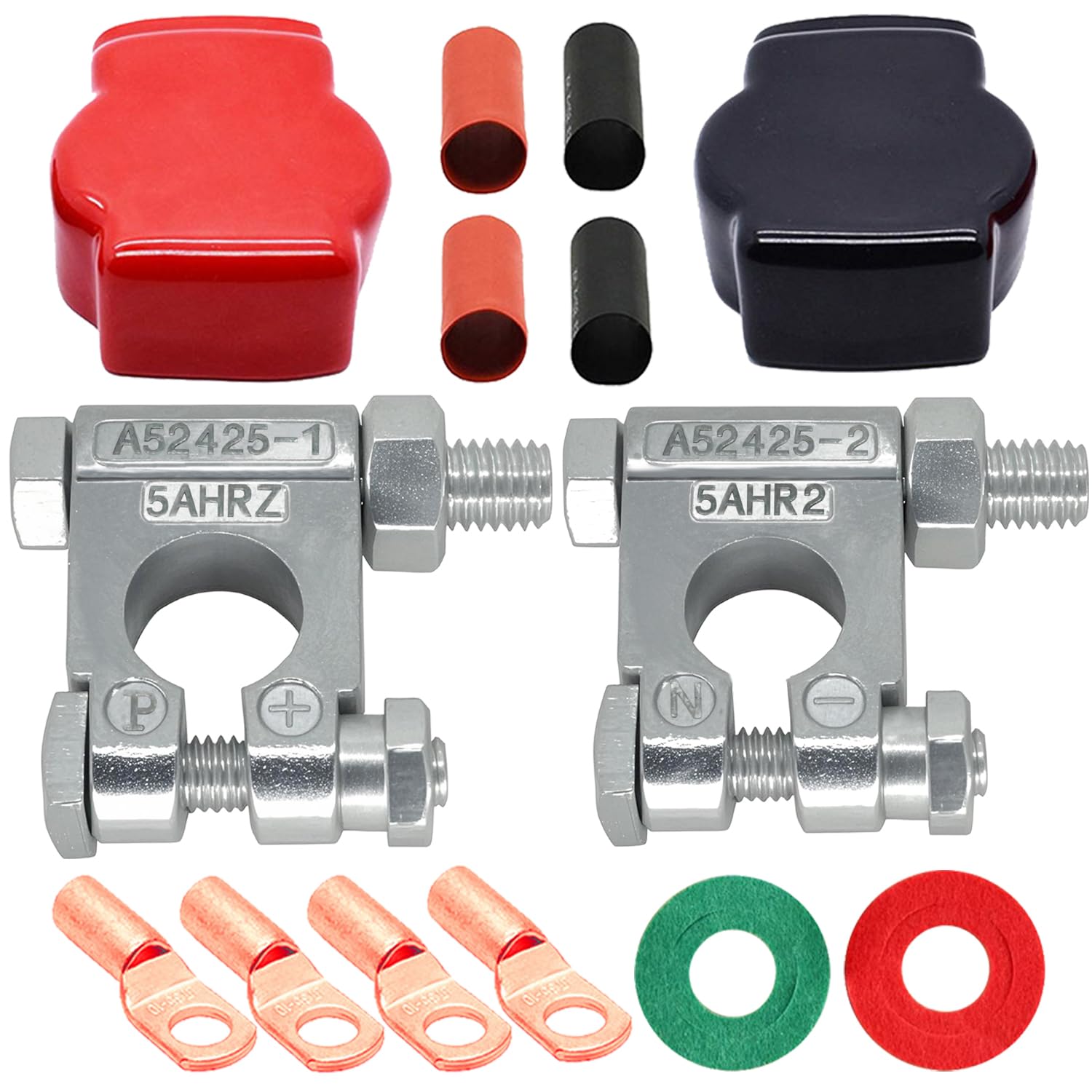
The DLronwey Military Spec kit is built around a machined alloy body that offers solid durability at a price that undercuts most copper or brass alternatives. While the alloy composition does not match pure copper for conductivity, it still delivers reliable current flow for standard automotive systems on cars, trucks, and tractors without demanding high-amp accessories. The kit includes four 2-gauge 3/8-inch copper lugs, four heat-shrink tubes, two protective covers, and two anti-corrosion washers, making it one of the most complete entry-level packages available.
The red and black military-style covers snap over the terminal body to shield the connection from moisture and accidental shorts. The positive and negative terminals are clearly labeled and use different bolt sizes to prevent mixing them up during installation. Each terminal can accept multiple wires, though the included lugs are designed specifically for 2 AWG cable, so if you need to run 4 AWG or 1/0 AWG you will need to supply your own lugs. One year of support is included, which adds peace of mind for a budget-tier product.
Owners of older trucks like the 1998 Ram 2500 Cummins have reported that these terminals outperform corroded factory clamps and restore full starting power. The main trade-off is the alloy material — it is not as conductive as the pure copper or brass found in premium kits, and the clamping mechanism feels slightly less robust than forged alternatives. For a straightforward replacement on a daily driver without extensive electrical modifications, this DLronwey kit gets the job done without breaking your budget.
What works
- Comprehensive kit includes lugs, heat-shrink, boots, and anti-corrosion washers out of the box.
- Military-style covers provide effective waterproofing and short protection.
- One-year warranty and 24-hour support for any issues.
What doesn’t
- Alloy material has lower conductivity than pure copper or brass terminals.
- Included lugs are limited to 2 AWG, not suitable for larger welding cable.
5. Bateria Power Pure Copper Terminal Connectors Kit
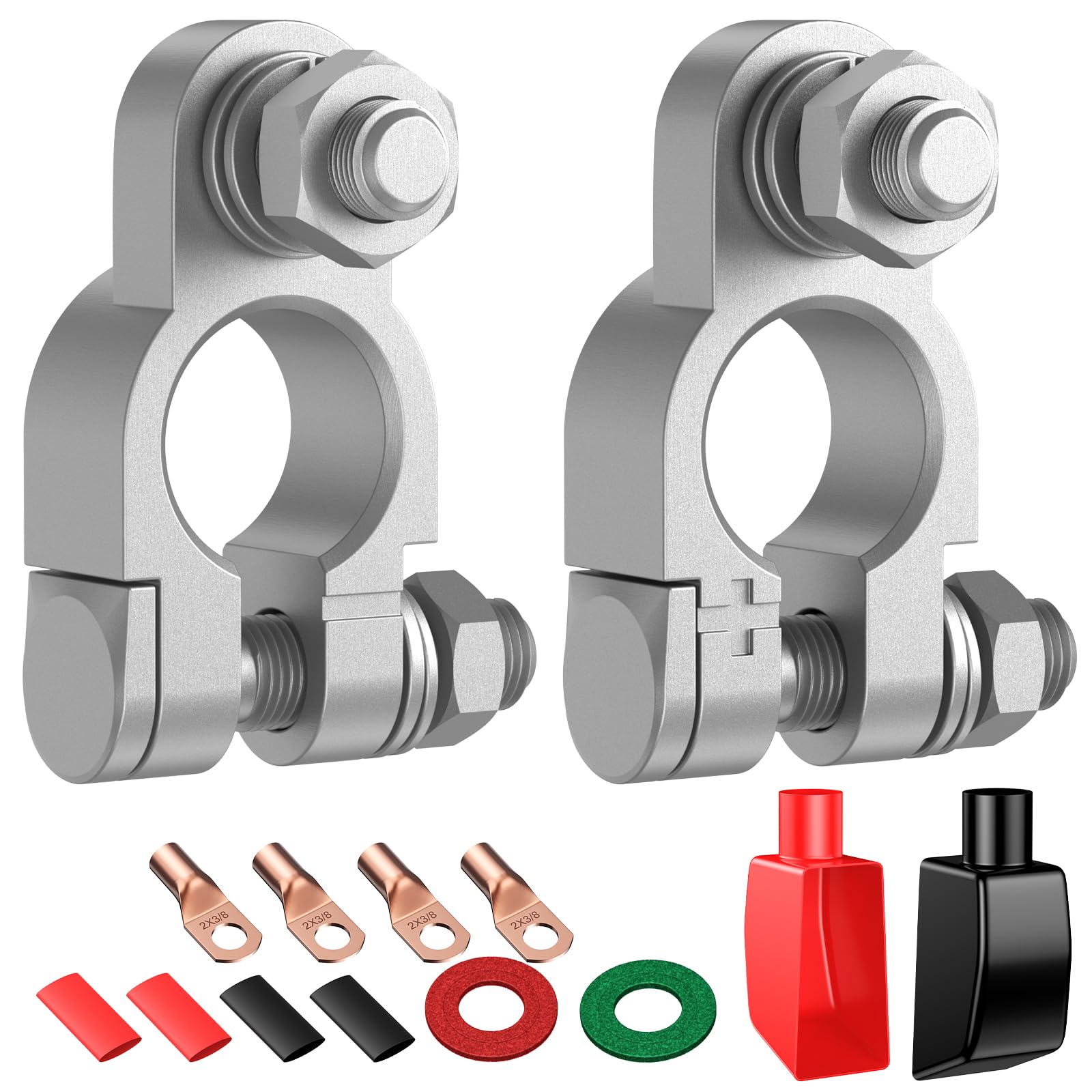
The Bateria Power kit uses 99.9% pure copper for the terminal bodies, which is a significant step up in conductivity compared to the zinc and aluminum alloy options that dominate the budget aisle. Pure copper generates less heat under load, which translates to lower voltage drop during high-current events like engine cranking or winching. The tin-plated hardware — including the bolts, nuts, and washers — adds corrosion resistance that bare copper lacks on its own, making these terminals a strong choice for marine applications and humid climates.
The kit ships with four 2-gauge 3/8-inch copper lugs, heat-shrink tubing, terminal covers, and anti-corrosion washers. The anti-corrosion washers sit between the terminal and the battery post, creating a barrier that prevents the galvanic reaction that typically forms white powder on lead posts. Installation is simple thanks to the included bolts and nuts, and the terminals tighten down with a standard wrench. The positive and negative sides are clearly differentiated by the red and black color of the covers and by different terminal diameters.
Reviews from Subaru Legacy owners highlight the excellent fit on modern side-post and top-post batteries, with the copper material delivering a marked improvement over factory clamps. The one caveat is that the terminal bodies, while copper, are not as physically massive as the forged brass Recoil units — they work perfectly for moderate accessory loads but may feel undersized for builds pulling over 200 amps continuously. For a pure copper terminal set that includes all the necessary hardware at a price that stays reasonable, the Bateria Power kit is a smart entry point.
What works
- 99.9% pure copper delivers superior conductivity and lower operating temperatures.
- Tin-plated hardware resists corrosion much better than bare copper or zinc alloys.
- Complete kit with lugs, heat-shrink, covers, and anti-corrosion washers included.
What doesn’t
- Terminal body is physically smaller than forged brass competition, limiting lug stacking space.
- Only supports 2 AWG lugs out of the box, requiring separate lugs for 4 AWG or 1/0 AWG.
Hardware & Specs Guide
Post Taper Standards
Battery terminal posts are not a universal size. The most common standard is SAE, which features a tapered cone that is wider at the base and narrower at the top. European batteries often use DIN or EN tapers, which have slightly different angles and diameters. Installing an SAE-only clamp on a DIN post can result in a loose connection that arcs and generates heat. Premium terminals like the Recoil PBT-D08 include interchangeable adapter collars that let one clamp fit multiple taper standards, eliminating guesswork when switching batteries.
Material Conductivity Ranking
Conductivity is measured as a percentage of the International Annealed Copper Standard (IACS). Pure copper ranks at or near 100% IACS, making it the top choice for minimizing voltage drop. Forged brass typically falls between 20% and 30% IACS, which is still far better than zinc alloys (roughly 15% IACS) or aluminum (around 62% IACS but with higher contact resistance). For high-amp applications such as dual-battery winch setups, copper or copper-based terminals are strongly preferred over aluminum, despite aluminum’s weight advantage.
AWG Wire Gauge and Lug Size
The lug hole diameter and the wire gauge it accommodates must match your system’s current demand. A 2 AWG cable is adequate for most starter circuits drawing up to about 150 amps, but a 4/0 AWG cable is necessary for inverters or winches that pull 300 amps or more. Check whether the terminal uses 3/8-inch or 5/16-inch studs — these are the two most common lug hole sizes. The BetyBedy kit includes 5/16-inch lugs, while the Recoil terminal accepts both 3/8-inch and 5/16-inch depending on the port.
Anti-Corrosion Measures
Galvanic corrosion happens when dissimilar metals — like a lead battery post and a copper terminal — contact each other in the presence of an electrolyte (battery acid mist or road salt). Anti-corrosion washers made from felt or fiber create an insulating barrier that blocks this reaction. Tin-plated or satin-chrome finishes on the terminal hardware also slow oxidation. The Bateria Power and DLronwey kits both include anti-corrosion washers, while the Recoil terminal relies on its marine-grade chrome finish and polycarbonate boot for protection.
FAQ
Can I use aluminum battery terminals on a lead-acid battery?
What is the difference between SAE and DIN battery terminal posts?
How many wires can I connect to a single battery terminal post?
Do I need to replace both the positive and negative terminals at the same time?
Final Thoughts: The Verdict
For most buyers, the battery terminal post winner is the Recoil PBT-D08 because its forged brass body and marine-grade satin chrome finish provide the best combination of corrosion resistance and conductivity for daily drivers, boats, and off-road vehicles. If you run an extensive accessory network with multiple high-amp loads, grab the Vgate 8-Way for its lightweight aluminum body and eight independent connection points. And for a pure copper upgrade that includes all the necessary lugs and anti-corrosion washers at a budget-conscious price, nothing beats the Bateria Power Pure Copper Kit.

Certification: BSc in Mechanical Engineering
Education: Mechanical engineer
Lives In: 539 W Commerce St, Dallas, TX 75208, USA
Md Amir is an auto mechanic student and writer with over half a decade of experience in the automotive field. He has worked with top automotive brands such as Lexus, Quantum, and also owns two automotive blogs autocarneed.com and taxiwiz.com.