A dead battery or failing alternator leaves you stranded without warning, yet most drivers rely on a simple voltage reading that hides the real story. Modern battery and alternator testers use conductance technology, variable carbon-pile loads, and algorithm-driven analysis to reveal internal resistance, state of health, and cranking power in seconds — separating a healthy battery from one that’s about to fail.
I’m Amir — the founder and writer behind Four Wheel Ask. My work involves deep market research, comparing product specifications, analyzing build quality, and aggregating owner feedback to identify which tools deliver consistent, accurate diagnostics across different vehicle platforms.
A quality tester eliminates guesswork and prevents unnecessary part replacements. Choosing the right battery and alternator tester means investing in a device that matches your vehicle types, battery chemistries, and testing needs — whether you’re maintaining a fleet or your personal garage.
How To Choose The Best Battery And Alternator Tester
Shopping for a battery and alternator tester means looking beyond brand names. The right tool will give you actionable data — not just a “good/bad” light. Focus on these factors to match a tester to your actual needs.
Test Method: Conductance vs. Carbon Pile Load
Conductance testers (like most digital handheld units) pass a small AC signal through the battery to measure internal resistance and plate condition. They’re fast, safe, and can test discharged batteries. Carbon pile load testers apply a real heavy current (100–500A) and measure voltage drop — they’re more “real world” but generate heat and need a charged battery. Choose conductance for convenience and consistency; choose carbon pile for definitive load verification on large batteries.
Voltage and Battery Chemistry Support
Most testers handle 12V systems, but if you work with 6V classics, 24V trucks, or lithium batteries (LiFePO₄), you need a tester that explicitly supports those chemistries. Many modern units now include AGM, EFB, Gel, and lithium modes. Ignoring this can lead to false “replace” calls on start‑stop batteries or misdiagnosis on deep‑cycle marine batteries.
CCA Range and Display Quality
Cold cranking amps (CCA) ratings vary from small motorcycle batteries (100 CCA) to heavy‑duty truck batteries (2000+ CCA). Ensure your tester covers the range you encounter. A clear color display, backlit screen, and intuitive menu navigation greatly reduce errors during diagnosis, especially in low‑light garages or direct sunlight.
Quick Comparison
On smaller screens, swipe sideways to see the full table.
| Model | Category | Best For | Key Spec | Amazon |
|---|---|---|---|---|
| FOXWELL BT301 | Mid-Range | Best Overall | 12V, 100-2000 CCA, 2.8″ color display | Amazon |
| TOPDON AL500B | Mid-Range | OBD2 + Battery Combo | 12V battery, 12/24V cranking, OBD2 scan | Amazon |
| BT90 PRO (Acclope) | Premium | Cloud Reporting | 6V/12V/24V, 30-3800 CCA, QR print | Amazon |
| TOPDON BT300P | Premium | Built-in Printer | 12V battery, 12/24V cranking, thermal printer | Amazon |
| VDIAGTOOL BT300 | Value | Entry-Level Pro | 6V/12V, 5-3000 CCA, 2.8″ TFT | Amazon |
| KONNWEI KW650 | Mid-Range | Waveform Analysis | 6V/12V, 100-2000 CCA, STM32 chip | Amazon |
| OTC 3181 | Professional | Heavy-Duty Load | 130A load, 6V/12V, analog meter | Amazon |
| Clore Solar 1874 | Professional | Carbon Pile Load | 500A variable load, 12V, 1000 CCA | Amazon |
| Autel MaxiBAS BT506 | Premium | Adaptive Conductance | 6V/12V, 100-2000 CCA, Bluetooth | Amazon |
| CTEK 4.3 Test & Charge | Charger/Tester | Battery Maintenance | 12V charger, alternator test, 8-step | Amazon |
| Battery Tender 026-0020 | Budget | Simple Load Test | 12V/100A, 6V/50A, analog meter | Amazon |
In‑Depth Reviews
1. FOXWELL BT301
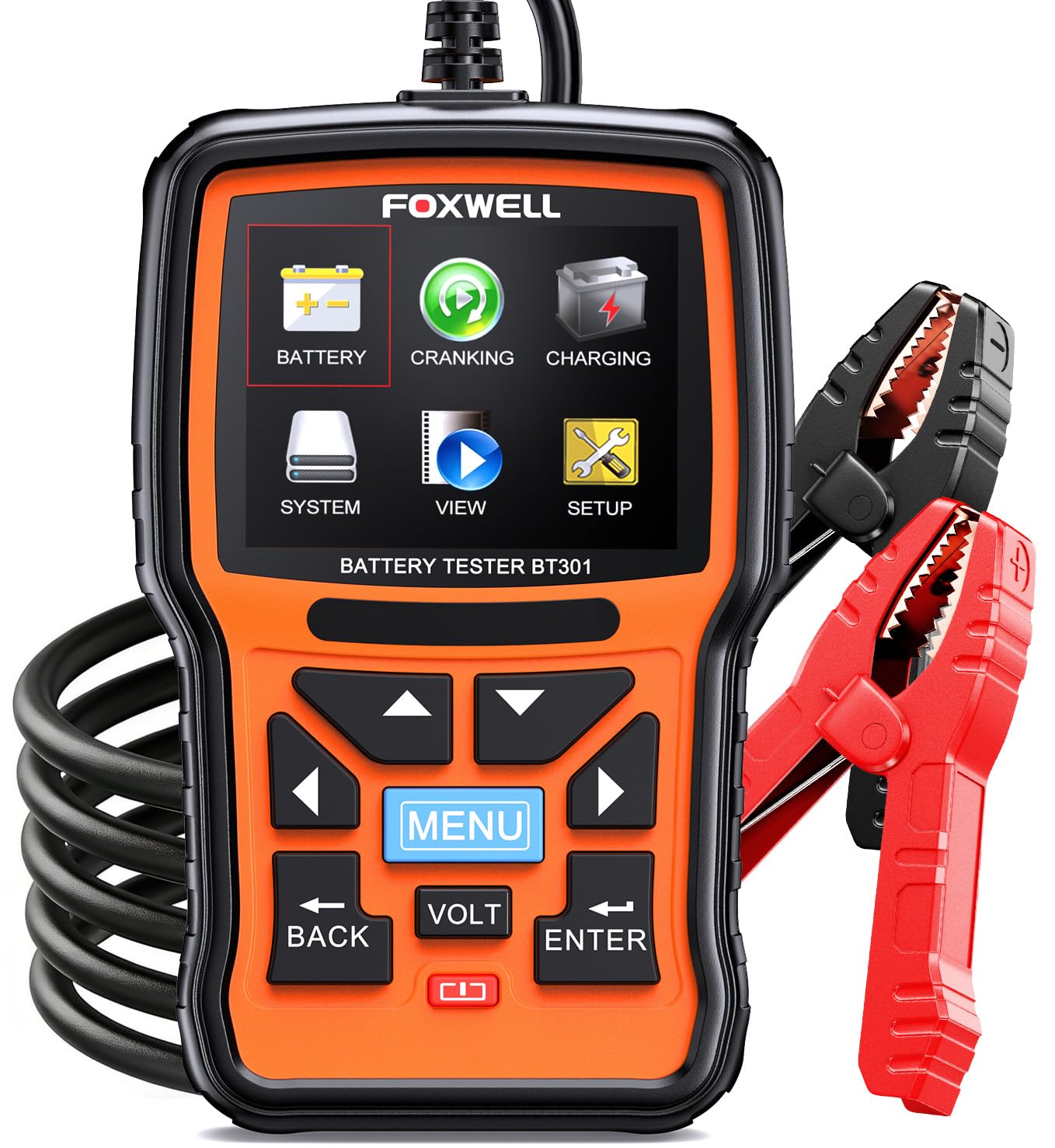
The FOXWELL BT301 is an upgraded version of the popular BT100, engineered for DIYers and professionals who need reliable battery, starter, and alternator diagnostics. Its extended 6.5‑foot cable allows convenient testing from the driver’s seat, and the 2.8‑inch color display remains readable in bright sunlight or dim garages. With support for flooded, AGM, EFB, and GEL batteries (100–2000 CCA), it covers most 12V passenger vehicles, SUVs, trucks, and marine applications.
Owner feedback consistently praises the BT301’s near‑lab‑grade accuracy — one reviewer recorded CCA measurements within 5 amps of the rated value, and voltage readings matched a calibrated Fluke multimeter. The cranking and alternator tests provide clear “pass/borderline/fail” results, and the unit is powered entirely by the battery under test, eliminating the need for internal batteries or external power adapters. The included carrying bag adds portability.
Some users noted that direct battery post connection is required for accurate results; grounding elsewhere can introduce errors. A few also wished for a Bluetooth data‑logging feature, though the dedicated screen and simple menu system already deliver fast on‑the‑spot diagnostics for most scenarios.
What works
- High 99.9% accuracy in real-world tests
- Long cable offers flexibility in tight engine bays
- Crisp color display with intuitive interface
What doesn’t
- No Bluetooth or wireless connectivity
- Must be clamped directly to battery posts
- Not compatible with lithium batteries
2. TOPDON AL500B

The TOPDON AL500B combines a full OBD2 diagnostic scanner with a battery and alternator tester in one compact handheld tool. It supports all OBD2 modes (reads/clears codes, live data, freeze frame, I/M readiness) and includes a battery test for 12V batteries plus cranking and charging tests for 12V and 24V systems. The 2‑inch color screen and simple button layout make it straightforward to use, even for beginners.
User reports confirm the AL500B matches the results of professional Midtronics testers on battery health, while the OBD2 side works quickly on vehicles from 1996 and newer. The unit stores diagnostic trouble codes and can print reports via a connected computer. Several mechanics appreciated having a single tool for both drivability and electrical system troubleshooting, reducing the need to carry separate devices.
Some users noted the battery test leads are relatively short, and there is no internal battery — the tool must be powered by the vehicle’s OBD2 port or an external source to view stored data. Additionally, professional users may miss wireless OBD2 capability and advanced service functions like BMS reset.
What works
- Two tools in one: OBD2 scanner and electrical system tester
- Accurate battery and alternator diagnostics
- One-touch I/M readiness check
What doesn’t
- Short battery test leads limit placement
- No Bluetooth; must connect to computer to print
- No internal battery for standalone data review
3. BT90 PRO (Acclope)
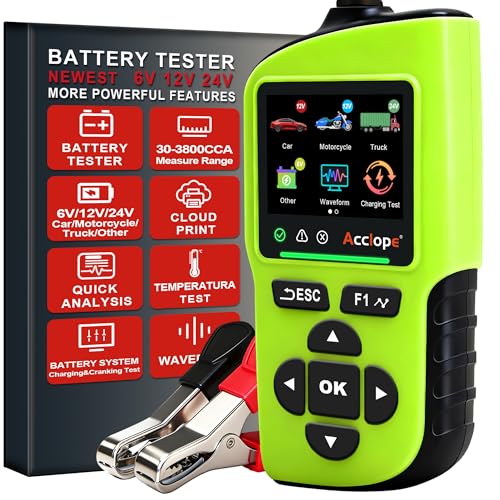
The BT90 PRO from Acclope pushes diagnostic data into the cloud with a QR‑code print system that generates time‑stamped reports — ideal for fleet managers and service writers who need traceable proof. It covers 6V/12V/24V batteries from 2–360 Ah and 30–3800 CCA, supporting flooded, AGM, EFB, GEL, and lithium chemistries. The tool also ingests ambient temperature to correct CCA readings, reducing cold‑weather misdiagnosis.
Field reviews highlight its repeatability: tests on known good AGM batteries matched the readings of high‑end impedance checkers, and the unit’s four‑metric diagnosis (SOH, SOC, voltage, internal resistance) helps pinpoint whether the fix is a recharge, load test, or replacement. The cloud print feature saves time by eliminating manual paperwork. The rugged housing and daylight‑readable screen are built for shop floors.
A few users warned that the tester and the battery should be within 10°F of each other for best consistency, and the tool draws power from the battery under test — no internal battery means you cannot review stored results without a power source. The interface, while intuitive, requires selecting the correct battery type for optimal accuracy.
What works
- Cloud print QR system for professional reporting
- Wide voltage and chemistry coverage including lithium
- Temperature‑compensated readings improve accuracy
What doesn’t
- No internal battery for standalone operation
- Temperature matching required for best results
- Menus can be deep for first-time users
4. TOPDON BT300P

The TOPDON BT300P integrates a thermal printer directly into the tester, allowing instant invoice‑ready printouts of battery, cranking, and charging results. It works on 12V batteries (100–2000 CCA) and supports 12V/24V cranking and charging tests. The spark‑free copper clamps and reverse‑polarity protection add a layer of safety during high‑energy testing. The 2.4‑inch color screen remains clear under various lighting.
Owner experiences confirm that the printed receipts are accepted by auto‑parts retailers for warranty returns. One user successfully used the printout to get a defective marine battery replaced under warranty. The tool’s accuracy was benchmarked against a much more expensive shop analyzer and found to be within 1% on CCA and voltage. The included carrying bag and three rolls of thermal paper get you started immediately.
Some users found the menu navigation slightly unintuitive at first, requiring a short learning curve to select the correct battery type and standard. The printer uses standard thermal paper (readily available), but the tool itself cannot print if the paper runs out mid‑diagnosis. A few reports noted initial defective units, but Topdon’s customer support resolved them quickly.
What works
- Built-in printer produces warranty‑ready reports
- Spark‑free, reverse‑polarity protected clamps
- Accurate to within 1% of professional testers
What doesn’t
- Menu system takes practice to master
- Printer requires stocking thermal paper
- Limited to 12V batteries (cranking test handles 24V)
5. VDIAGTOOL BT300
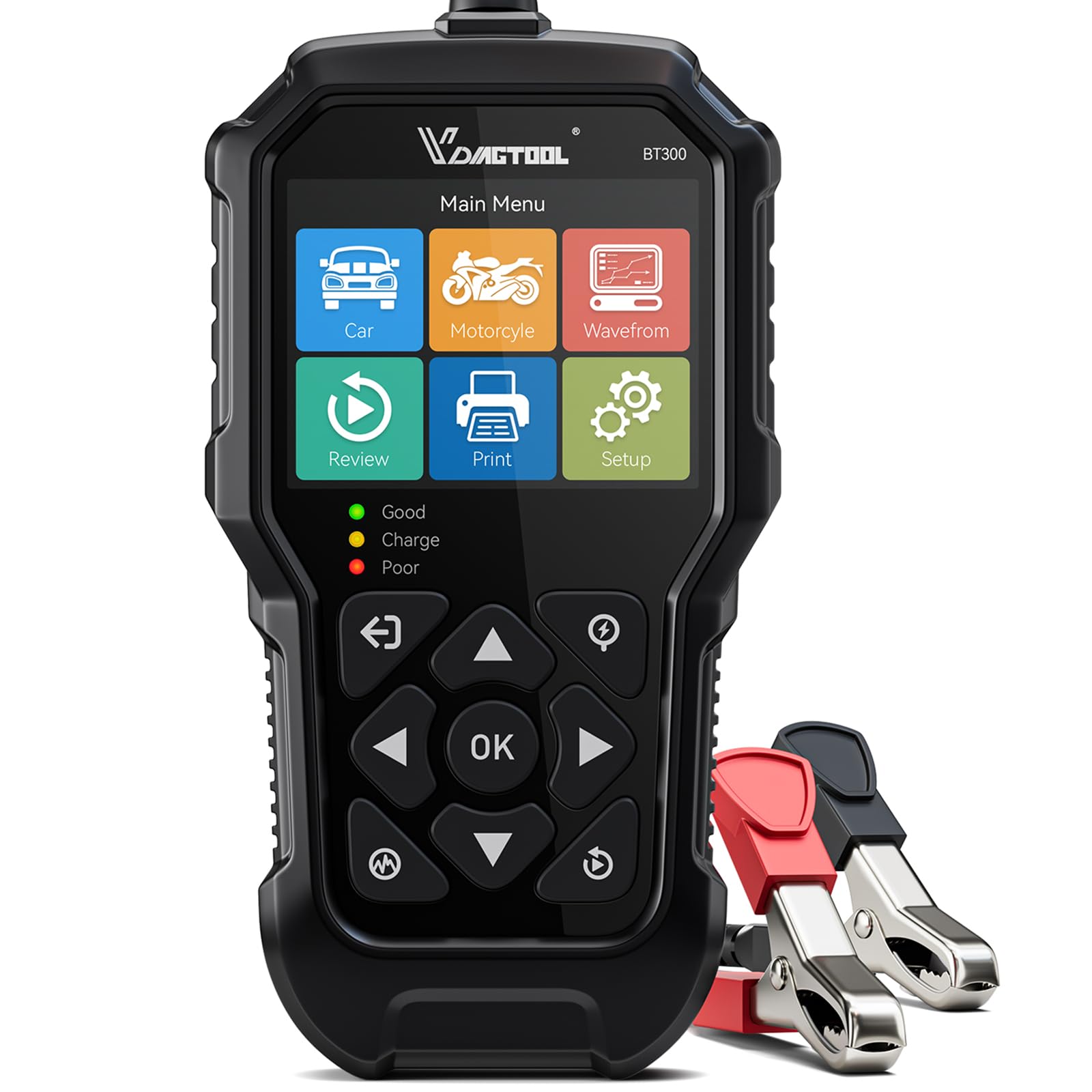
The VDIAGTOOL BT300 brings professional‑grade capabilities at a budget‑friendly price point. It tests 6V and 12V batteries from 5–3000 CCA, covering flooded, AGM, GEL, and EFB types. The 2.8‑inch HD TFT display shows voltage, internal resistance, CCA, SOH, and SOC simultaneously, along with a real‑time waveform. Cranking and charging tests check starter motor draw and alternator output, with clear green/yellow/red LED indicators.
Reviews highlight the BT300’s ease of use — connect, select battery type, and read results in seconds. One long‑term user reported consistent accuracy across motorcycles, cars, and trucks, and appreciated the ability to connect the tester to a computer for printing detailed reports. The compact size makes it easy to store in a glovebox or tool drawer.
Some owners noted the alligator clips could be more substantial for heavy‑duty truck batteries, and the unit does not support lithium chemistries. A few mentioned that the included instructions were minimal, but the intuitive interface compensates. Overall, it offers strong value for DIYers who want detailed diagnostics without spending heavily.
What works
- Wide CCA range (5–3000) for diverse vehicles
- Large color display with waveform graph
- Computer connectivity for report printing
What doesn’t
- Clamps could be more robust
- No lithium battery support
- Instructions lack depth
6. KONNWEI KW650

The KONNWEI KW650 uses an STM‑32 processor to deliver above 99.5% accuracy with a one‑key voltage waveform analysis — a feature rare at its price tier. It tests 6V and 12V batteries (100–2000 CCA) including flooded, AGM flat/spiral, and GEL. The waveform display helps beginners visualize voltage fluctuations while professionals can export data to a computer for deeper analysis of in‑car systems.
Users report that the KW650 quickly identifies weak cells and provides clear “recharge or replace” recommendations. The unit also functions as a starter and alternator tester, measuring cranking voltage drop and charging output. The firmware is updatable, and the tool supports 12 languages. Several reviewers appreciated the compact size and the replaceable clamp kit.
A few owners noted that the included manual could be more detailed for advanced features, and the tool does not support lithium batteries. The waveform analysis, while useful, requires a PC connection to fully exploit, which may be overkill for simple battery checks. For those who want to dig into electrical system behavior, it’s a capable choice.
What works
- Fast, high‑accuracy STM‑32 chip
- Voltage waveform analysis for detailed troubleshooting
- Firmware updatable via USB
What doesn’t
- No lithium support
- Advanced features need PC for full use
- Manual could be more thorough
7. OTC 3181 130A Load Tester

The OTC 3181 is a traditional 130‑amp carbon pile load tester built for rugged shop use. It works on both 6V and 12V batteries and delivers a full load in 10 seconds to reveal how a battery holds up. The analog meter is large and easy to read, with a zero‑adjust feature for accuracy. The clamps are designed to grip both top‑post and side‑post batteries securely, and the tool can be stored on a wall or toolbox using the integrated brackets.
Reviewers confirm that this tester exposes weak batteries that show acceptable voltage at rest but fail under load. One saved hundreds of dollars by identifying a dry‑cell boat battery that appeared fine with a multimeter. The heavy‑duty construction and simple operation make it a favorite among mechanics who prefer a no‑electronics approach. It also doubles as a voltmeter for checking alternator output.
Some owners reported that the analog meter on their unit was slightly off (about 1.3V) compared to a Fluke multimeter, though the load test pass/fail zone was still clear. A few noted that rapid consecutive tests can overheat the internal resistor — it’s best to follow the cool‑down period. The lack of digital precision is a trade‑off for durability and low cost.
What works
- True 130A load exposes hidden battery weakness
- Rugged, shop‑proof construction
- Works on 6V and 12V batteries, top and side posts
What doesn’t
- Analog meter accuracy can vary unit to unit
- No internal resistance or SOH data
- Must allow cooling between tests
8. Clore Solar 1874 500A Load Tester

The Clore Solar 1874 is a professional‑grade carbon pile tester capable of variable loads up to 500 amps. It tests 12V batteries (up to 1000 CCA) and allows assessment of starter draw and alternator output while the vehicle is running. The large gauges are easy to read, and the heavy‑duty clamps cut through corrosion for a solid connection. The housing is built to withstand daily abuse in a busy shop.
Users report that the 1874 correctly labeled a battery with 13V at rest as “replace” when loaded to 100A — something a voltmeter would miss. The variable load control (a rotating knob) gives precise control over test current. Several mechanics own both conductance testers and this carbon pile, using the 1874 as the final authority on marginal batteries.
Negative feedback centers on the knob: it requires several full turns before any load is applied (around 5 turns), and there is no hard stop at the end, which could cause a short if rotated too far. A few owners experienced dangerous shorting when the clamps touched, though proper connection technique minimizes risk. The unit is also large and bulky for mobile use.
What works
- Variable load up to 500A for heavy batteries
- Large, clear analog gauges
- Heavy‑duty clamps penetrate corrosion
What doesn’t
- Knob requires many turns with no end stop
- Potential for shorting if clamps touch
- Large and heavy, not portable
9. Autel MaxiBAS BT506
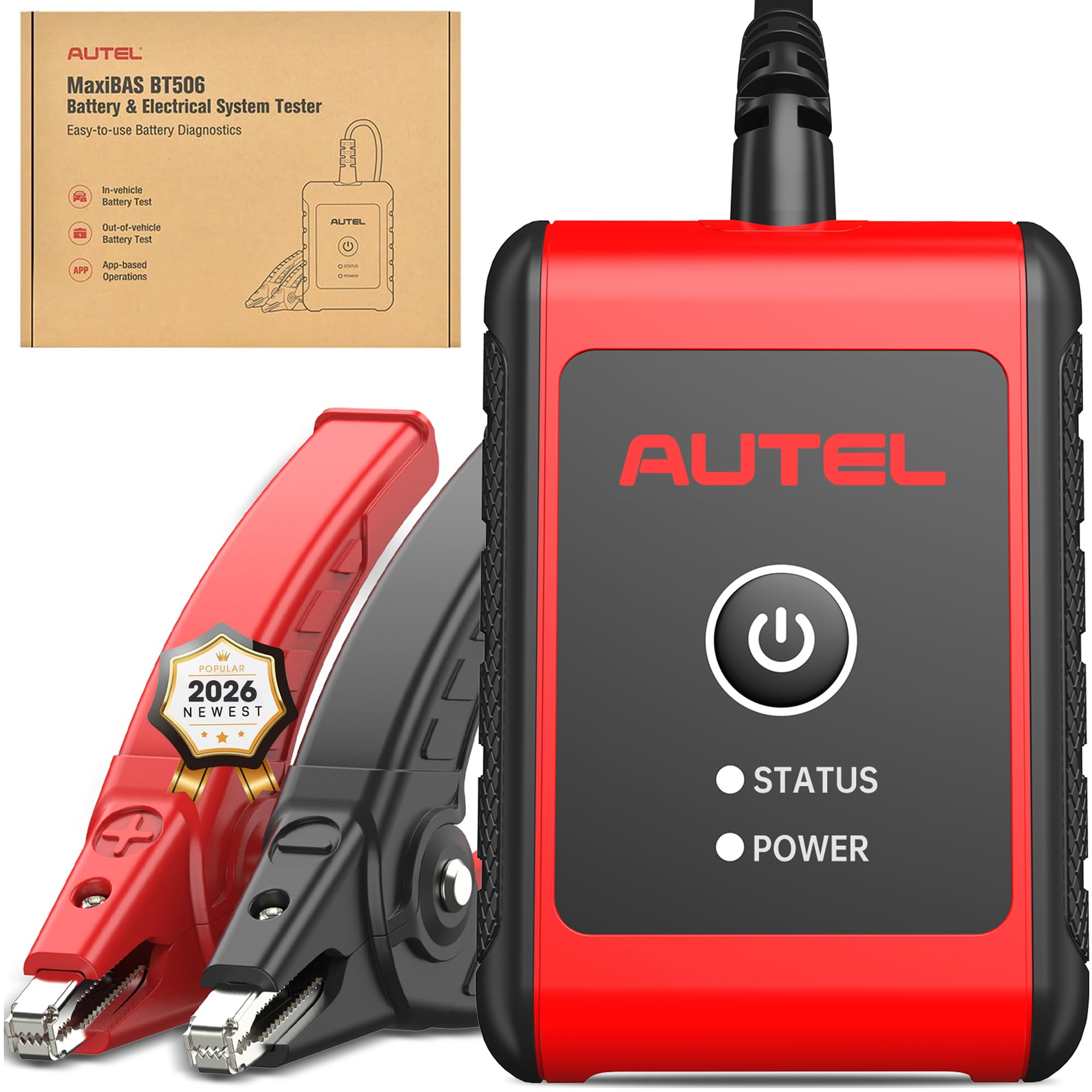
The Autel MaxiBAS BT506 uses adaptive conductance technology to analyze 6V and 12V batteries (100–2000 CCA) with high precision. It wirelessly connects to Autel scan tools (via Bluetooth) or to a smartphone app for viewing and sharing test reports. The tester also performs cranking and charging system tests, and it can record test history for later reference. The BT506 is part of the MaxiBAS system, which allows expansion to include battery registration and reset functions with an additional accessory.
Owner feedback highlights the seamless integration with Autel scan tools: one user paired it with an MK808BT PRO and got professional‑grade reports with battery location diagrams. The tester reliably identified weak cells and charging system faults, saving batteries that were prematurely replaced. The ability to upload data to the cloud and share with customers is a strong plus for service shops.
Some users noted that the BT506 is not compatible with wired Autel scanners, only wireless models. The initial setup requires pairing via a smartphone app, which some found slightly fiddly. The tool also does not have a built-in display — it relies entirely on the connected scanner or phone, meaning you cannot use it standalone. For Autel ecosystem users, it’s an excellent addition.
What works
- Adaptive conductance for accurate, fast testing
- Wireless connectivity with Autel scanners and smartphones
- Professional reports with battery location diagrams
What doesn’t
- No standalone display; requires a host device
- Only works with Autel wireless scanners
- Setup via smartphone app can be tricky
10. CTEK 4.3 Test & Charge

The CTEK 4.3 Test & Charge is a fully automatic 12V battery charger that also performs battery and alternator testing. Its patented system recovers sulfated batteries, charges, and then maintains them with float/pulse mode. Three test programs check the battery’s condition and the vehicle’s charging system output. It’s designed for long‑term storage maintenance and works with all lead‑acid types (flooded, AGM, Gel, EFB) up to 160Ah.
Users value the set‑and‑forget operation: connect, select a program, and the charger handles the rest. The alternator test helps confirm whether the charging system is functioning correctly. The spark‑free circuitry and reverse polarity protection ensure safe operation. It’s particularly popular among owners of classic cars, boats, and seasonal vehicles that sit unused for months.
Some reviewers pointed out that the tester function is not as detailed as dedicated testers; it gives a simple “good/charge/replace” indication rather than full CCA or internal resistance numbers. The charger also cannot test 6V or 24V systems. For those who want a combined maintenance tool rather than a diagnostic powerhouse, it’s a solid choice.
What works
- Combines charger, maintainer, and tester
- Excellent for long-term storage and battery recovery
- Safe, spark‑free operation
What doesn’t
- Tester gives limited diagnostic detail
- Only 12V, no 6V or 24V support
- Slow charging compared to dedicated chargers
11. Battery Tender 026-0020
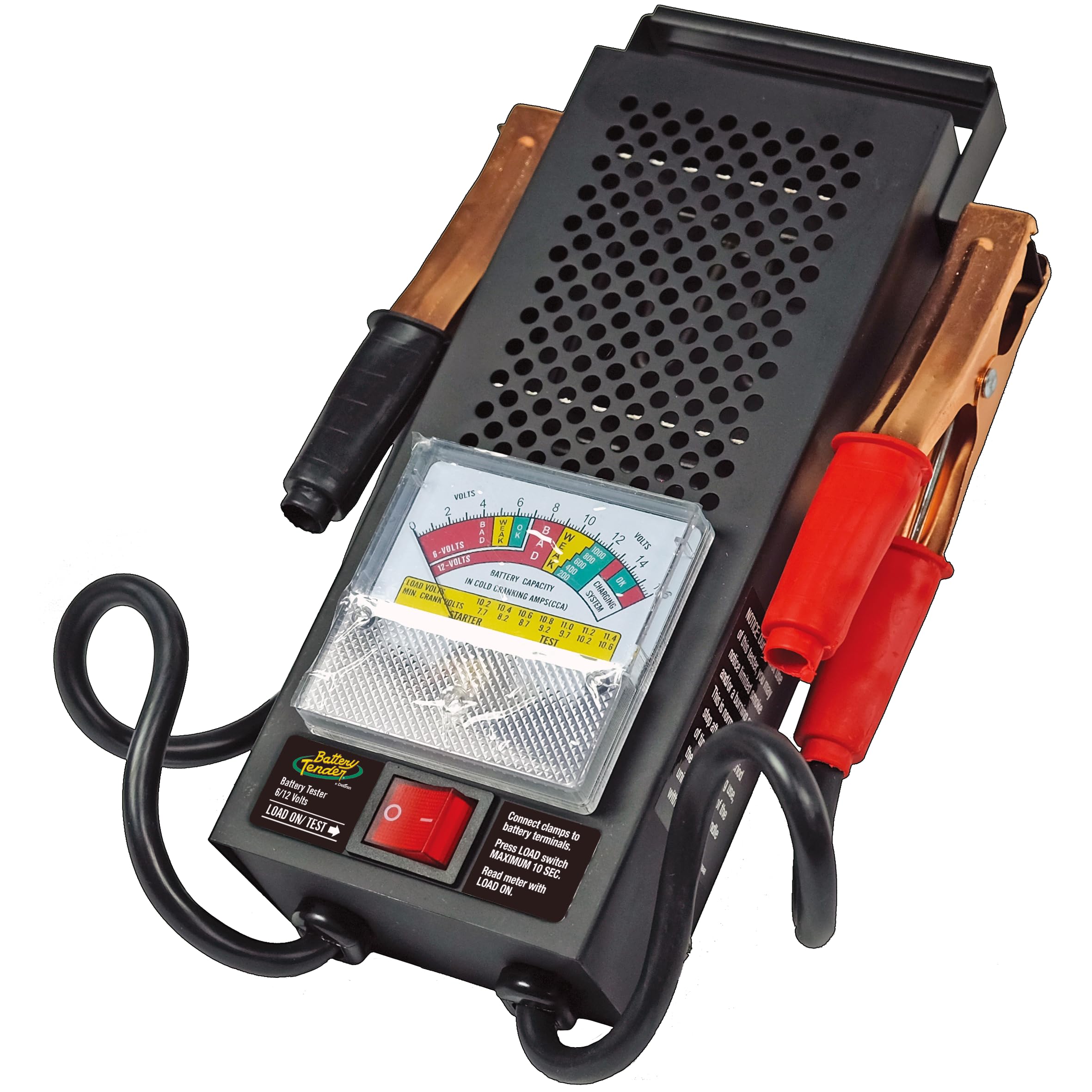
The Battery Tender 026-0020 is an affordable analog load tester from a trusted name in battery care. It performs a 100‑amp load test on 12V batteries and a 50‑amp test on 6V batteries, covering automotive, marine, and power sport applications up to 1000 CCA. The color‑coded display and single toggle switch make it extremely simple to use. Rubber‑insulated handles and heavy‑duty alligator clamps prioritize safety.
Owner feedback emphasizes the straightforward operation: clamp, read voltage, flip the switch to load, and read the meter. Many use it as a quick check before heading to the parts store. The tool also works as a basic voltmeter for alternator output and starter draw. For the budget price, it reliably distinguishes healthy batteries from those nearing end of life.
Some users wish the meter had finer resolution or a digital readout. The load test is a fixed 100A (not adjustable) and cannot be used on high‑CCA batteries over 1000 CCA. The analog needle may be less precise than digital alternatives, but for a simple pass/fail check, it gets the job done without batteries or electronics to fail.
What works
- Simple, tool‑proof operation
- Load tests both 6V and 12V batteries
- Durable construction with safety features
What doesn’t
- Fixed 100A load not adjustable
- Analog meter accuracy limited
- Not suitable for batteries over 1000 CCA
Hardware & Specs Guide
Conductance Test Method
Most modern handheld testers (like the VDIAGTOOL BT300, FOXWELL BT301, and Autel BT506) use conductance technology. A small AC signal is injected into the battery to measure internal resistance, plate surface area, and chemical state. This method is fast, does not require a fully charged battery, and provides data such as CCA, state of health (SOH), and state of charge (SOC). It’s the preferred method for routine diagnostics and works safely with AGM, EFB, and Gel batteries.
Carbon Pile Load Testing
Testers like the OTC 3181 and Clore Solar 1874 use a resistive carbon pile to draw a high current (100–500A) from the battery while measuring voltage drop. This is the most realistic simulation of engine cranking conditions. Carbon pile testers are the gold standard for heavy‑duty and deep‑cycle batteries, but they generate significant heat, require a charged battery, and can be dangerous if misused. They offer no SOH or internal resistance data.
Voltage Range & Chemistry Support
Your tester must match the electrical system: 6V for vintage cars, 12V for most modern vehicles, and 24V for trucks, buses, and some marine systems. Chemistry support is equally critical — not all testers can handle AGM, EFB, Gel, or lithium (LiFePO₄) batteries. Using a tester without a dedicated lithium mode may incorrectly flag a healthy lithium battery as “replace.”
Data Logging & Reporting
Professional users benefit from testers that store results, print receipts, or upload to the cloud. The BT90 PRO and TOPDON BT300P have built-in print capabilities, while the Autel BT506 and TOPDON AL500B can export data to a computer or smartphone. Printed reports are often required for warranty claims, fleet tracking, and customer communication. If you work in a shop, prioritize a model with easy report generation.
FAQ
Can a battery and alternator tester diagnose a bad alternator?
Do I need a conductance tester or a carbon pile tester?
What does CCA mean and why does it matter?
Can I test a lithium battery with a standard tester?
Why does my tester show different results on the same battery?
Final Thoughts: The Verdict
For most buyers, the battery and alternator tester winner is the FOXWELL BT301 because it combines lab‑grade accuracy, a long cable, and a vivid color display at a mid‑range price point that suits both DIYers and professionals. If you want OBD2 scanning in the same package, grab the TOPDON AL500B. And for heavy‑duty carbon pile testing that reveals the true load capability, nothing beats the Clore Solar 1874.

Certification: BSc in Mechanical Engineering
Education: Mechanical engineer
Lives In: 539 W Commerce St, Dallas, TX 75208, USA
Md Amir is an auto mechanic student and writer with over half a decade of experience in the automotive field. He has worked with top automotive brands such as Lexus, Quantum, and also owns two automotive blogs autocarneed.com and taxiwiz.com.