A bar end mirror that wanders at speed or delivers a shaky, distorted image is worse than no mirror at all — it breaks your focus and undermines the whole point of having rearward visibility. The best bar end mirrors lock into your handlebars with a secure expanding wedge or shim system, use convex glass (not plastic) for a true wide field of view, and survive highway vibration without creeping out of position. Getting this right means looking once at the glass and seeing everything you need behind you.
I’m Amir — the founder and writer behind Four Wheel Ask. I’ve spent years analyzing motorcycle and bicycle mirror specifications, comparing build materials from billet aluminum to injection-molded housings, and aggregating long-term owner feedback to identify which designs actually hold up over thousands of miles.
Mounting compatibility, lens clarity, and vibration resistance separate the mirrors that disappear into your ride from those that become a constant annoyance. Whether you ride a naked sportbike or a classic cruiser, best bar end mirrors balance a wide field of view with rock-solid stability at highway speeds.
How To Choose The Best Bar End Mirrors
Bar end mirrors look simple, but the difference between a mirror that stays put for years and one that loosens after a single ride comes down to mounting mechanics, lens material, and housing construction. Understanding these factors helps you pick a set that matches your handlebar type and riding style without trial-and-error returns.
Mounting System: Wedge vs. Shim vs. Expansion Sleeve
The mounting method determines how firmly the mirror grips the inside of your handlebar. Expanding wedge systems use a cone and bolt to push against the inner wall — they work well when the bolt is torqued properly and threadlocker is applied, but some designs rely on aluminum-on-aluminum friction that can slip over time. Shim-based systems use rubber or plastic sleeves that compress as you tighten, offering better vibration isolation. Expansion sleeves with a separate cone piece provide the most secure grip across varying inner diameters, but they require careful orientation during installation.
Lens Quality and Curvature
Convex glass lenses provide a wider field of view than flat mirrors, which is critical for spotting vehicles in adjacent lanes without turning your head. Genuine glass — not acrylic or polycarbonate — resists scratching and maintains optical clarity across temperature swings. Blue-tinted anti-glare coatings reduce headlight glare at night, but some riders with prescription glasses report that the blue tint darkens the image too much in low light. Standard clear glass offers the most neutral view in all conditions.
Housing Material and Vibration Resistance
Full billet aluminum housings damp vibration better than cast alloy or plastic because the material density absorbs resonance rather than transmitting it to the mirror face. Heavier mirrors (around 0.7 to 0.8 kilograms per pair) tend to sit more stable at highway speeds, but the mounting system must be robust enough to support the weight without loosening. CNC-machined bodies with a threaded stem and lock nut allow fine-tuned positioning that holds against wind blast and road vibration.
Quick Comparison
On smaller screens, swipe sideways to see the full table.
| Model | Category | Best For | Key Spec | Amazon |
|---|---|---|---|---|
| KEMIMOTO Bar End Mirrors | Mid-Range | Universal motorcycle fitment | Billet aluminum, blue glass, 13-19mm ID | Amazon |
| FENRIR CNC Aluminum Mirrors | Premium | Cafe racer / retro builds | CNC aluminum, blue lens, M6/M8 bolts | Amazon |
| MZS Adventure Mirrors | Performance | Dirt / adventure bike | Foldable, HD glass, 8mm/10mm bolts | Amazon |
| KEMIMOTO Round Mirrors | Value | Clean round profile | CNC aluminum, 3.5″ round, blue glass | Amazon |
| Hafny Drop Bar Mirror | Design | Drop bar bicycles | HD glass, 360° pivot, 16-24mm ID | Amazon |
In-Depth Reviews
1. KEMIMOTO Motorcycle Bar End Mirrors

The KEMIMOTO bar end mirrors deliver a combination of build quality and practical performance that justifies their mid-range positioning. The housing is machined from full billet aluminum rather than cast alloy, which translates to a noticeably solid feel during handling and minimal vibration transfer to the mirror face at highway speeds. The 3.86-inch by 1.93-inch convex blue glass provides an extended field of view while reducing glare from headlights behind you — a genuine safety benefit during night rides.
Installation uses an expanding aluminum wedge system with three different thicknesses of plastic sleeves to accommodate handlebar inner diameters between 13 and 19 millimeters. The wedge design requires proper torque application and blue threadlocker to prevent loosening over time — a step that some owners initially overlook, leading to slippage that is easily corrected. Once secured, the mirror stem holds its position through rough pavement and sustained vibration, as confirmed by multiple owners reporting zero movement after hundreds of miles on bikes ranging from a Honda Grom to a BMW R nineT.
The universal fitment works across street cruisers, scooters, ATVs, and UTVs, making this set a practical one-size solution for multiple vehicles. The blue-tinted lens does slightly reduce low-light brightness compared to clear glass, but the trade-off in glare reduction is worth it for riders who frequently travel after dark. The packaging could be more protective, but the mirrors themselves arrive undamaged when the outer box is intact.
What works
- Full billet aluminum housing resists corrosion and damps vibration effectively
- Blue anti-glare lens cuts headlight flare without distorting the image
- Three sleeve sizes provide broad compatibility across handlebar IDs
What doesn’t
- Expanding aluminum wedge requires careful torquing and threadlocker for a permanent grip
- Blue tint reduces brightness in very low-light conditions
2. FENRIR CNC Aluminum Alloy Bar End Mirrors

The FENRIR mirrors represent a step up in precision machining and overall fit and finish, with a CNC-machined aluminum alloy body and a durable black powder coating that resists chipping and fading. The round cafe racer profile suits retro, naked, and sport bike builds where aesthetics matter as much as function. The convex blue-tinted lens has an R1200 curvature rating, providing a moderately wide field of view that is clear and distortion-free according to long-term owner reports.
Mounting uses an expansion sleeve system that requires tightening three screws on the stem — even if the threads appear to exceed the nut, the manufacturer instructs you to keep turning until the assembly locks inside the bar. This design works reliably when blue threadlocker is applied, and owners who follow this method report no loosening after thousands of miles on single-cylinder thumpers and highway commutes alike. The mirrors fit handlebars with M6 or M8 threaded inserts and include adapters for common applications, though some European and Japanese models may need a separate adapter purchased separately.
The flat mirror face — not convex — drew criticism from one owner who expected a wider rear view, so riders who prioritize maximum peripheral coverage should verify their preference before buying. That said, the build quality is uniformly praised: the stems stay rigid at high speed, the glass does not wobble, and the finish still looks fresh after a full season of exposure. These mirrors feel premium in hand and justify their position as a top-tier option for discerning builders.
What works
- CNC-machined aluminum body with durable powder coating and excellent fit
- Expansion sleeve mounting holds securely at highway speeds with threadlocker
- Classic round profile complements retro and naked bike aesthetics perfectly
What doesn’t
- Flat glass limits rear field of view compared to convex alternatives
- Some models require additional adapters for certain European and Japanese bikes
3. MZS Adventure Motorcycle Mirrors

The MZS adventure mirrors are engineered for riders who need durability and versatility on loose surfaces. The housing uses impact-resistant ABS injection molding rather than aluminum, which keeps weight down and allows the mirror to flex slightly under impact without cracking. The HD clear glass lens provides a bright, neutral image without tint distortion, making it a strong choice for night riding and variable light conditions where every bit of clarity matters.
A key differentiator is the foldable design: the stem pivots at the mount so the mirror can be pushed inward when navigating tight trail sections or during transport, then snapped back into position without retightening. The aluminum adjustable stem and mount provide 360 degrees of swivel, and the included 8mm and 10mm bolts cover a wide range of adventure, dirt, and dual-sport applications. Owners report that the mirror stays put through rough off-road use and holds its angle after repeated folding cycles.
Slightly more vibration is transmitted to the glass compared to heavier billet aluminum options — a common trade-off with ABS housings on single-cylinder bikes — but the image remains usable and clear without significant distortion. The mirrors are not intended as OEM replacements for specific models, but as a universal aftermarket upgrade they deliver exactly what the adventure segment requires: a robust, adjustable view that can take abuse and keep functioning. The value proposition is strong for riders who prioritize impact resistance over pure aesthetic refinement.
What works
- Foldable stem survives trail impacts and folds flat for tight clearance situations
- HD clear glass delivers bright, neutral image ideal for night and variable light
- Includes both 8mm and 10mm bolts for broad adventure and dirt bike fitment
What doesn’t
- ABS housing transmits more vibration than billet aluminum alternatives
- Industrial look may not suit street-focused or retro builds
4. KEMIMOTO Round Bar End Mirrors

The round KEMIMOTO mirrors offer a familiar classic shape with modern construction — full billet aluminum housing and a 3.5-inch convex blue glass lens. The build quality mirrors the brand’s other bar end offering, with the same vibration-resistant housing and corrosion resistance that owners consistently praise as feeling more expensive than the price suggests. The convex glass provides a useful wide view that eliminates blind spots without the excessive magnification that makes distant objects appear too small.
Fitment covers handlebar inner diameters from 13 to 19 millimeters using an expanding aluminum system similar to the brand’s blue-lens model, but this version explicitly lists compatibility restrictions for Yamaha MT-07, MT-09 (2013-2020), MT-10, XSR700, XSR900 (2016-2021), and several other models. Owners of those bikes will need to confirm fitment before purchasing. The round shape gives a clean, purposeful look that works well on street cruisers, scooters, and ATVs, and the blue-tinted glass adds a subtle aesthetic accent.
Installation is straightforward with clear instructions, though the expanding sleeve orientation is critical — an owner noted that the wrong orientation prevents the wedge from gripping. Once correctly positioned and torqued with threadlocker, the mirrors stay locked in place through wind and vibration, as demonstrated by multiple reports of zero movement after hundreds of miles on Ducati Monsters and Royal Enfield 650s. This set delivers strong value for riders who want the round silhouette without sacrificing build quality.
What works
- Full billet aluminum housing with premium feel and lasting finish
- 3.5-inch convex blue glass provides wide, clear rear view
- Universal fitment covers a broad range of motorcycles, scooters, and ATVs
What doesn’t
- Not compatible with many Yamaha MT and XSR model years — verify before purchase
- Expanding sleeve orientation must be precise or the wedge will not grip
5. Hafny Drop Bar Bike Mirror
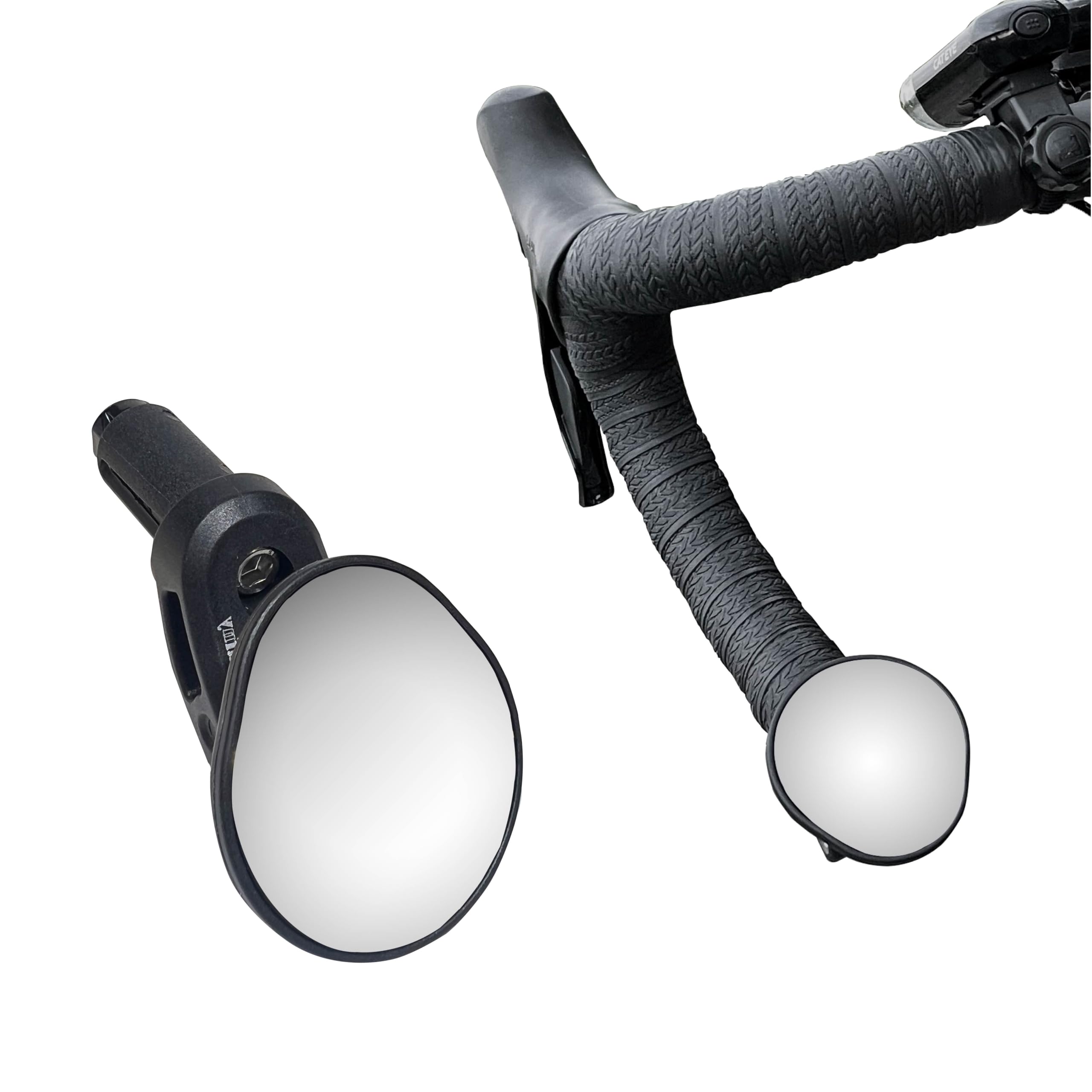
Hafny’s HF-M956-FR06 is purpose-built for drop bar bicycles, where handlebar geometry and rider position differ significantly from motorcycle applications. The mirror uses an HD anti-glare convex glass lens — not plastic — which provides a crystal-clear image with zero distortion, a feature that matters intensely for cyclists who rely on rearward visibility to spot approaching vehicles and e-scooters. The 360-degree pivot allows precise positioning within the drop bar curve without interfering with hand placement.
The expanding rubber wedge fits inner diameters from 16 to 24 millimeters, covering most standard drop bar sizes. Installation takes about two minutes with a single hex key, and the mirror sets firmly without shifting after bumps or road vibration. The glass lens is more susceptible to scratching than plastic if wiped with an abrasive cloth, but the optical payoff — clear, undistorted, and glare-free — is worth the careful maintenance. Some owners note that the viewing area could be slightly larger, though the trade-off is a low-profile silhouette that does not catch the wind or look bulky.
This mirror is engineered for cyclists who treat rear visibility as a non-negotiable safety component rather than an afterthought. The convex shape trades some magnification for a wider field of view, making it effective for spotting tailgaters and vehicles in adjacent lanes. The blue anti-glare coating on some versions can appear too dark for riders who wear prescription glasses — the standard clear glass version offers better low-light performance. For drop bar cyclists, this is the most refined bar end mirror available in this segment.
What works
- HD anti-glare convex glass delivers distortion-free optical clarity
- Quick two-minute installation with a secure expanding wedge fit
- Low-profile design integrates cleanly into drop bar aerodynamics
What doesn’t
- Glass lens scratches more easily than plastic if not cleaned carefully
- Viewing area is modest compared to larger motorcycle-style mirrors
Hardware & Specs Guide
Expanding Wedge Mounting
Most bar end mirrors anchor inside the handlebar using a tapered cone that expands against the inner wall as the bolt tightens. The system relies on friction between the wedge and the bar material — aluminum wedges on aluminum bars can gall or slip if not torqued with threadlocker. Rubber or plastic expansion sleeves provide better grip across a wider range of inner diameters and offer superior vibration damping. The critical measurement is the handlebar’s inner diameter (ID), not the outer diameter (OD), which varies by manufacturer and bar type.
Convex vs. Flat Lens Geometry
Convex lenses curve outward to capture a wider angle of the rear environment, reducing blind spots at the cost of making objects appear smaller and farther away. Flat lenses provide a 1:1 perspective with better distance judgment but a narrower field of view. The curvature radius (expressed as R1200 or similar) defines the degree of convexity — a lower number means more curve and a wider view. Glass lenses maintain consistent optical properties across temperature changes, while acrylic or polycarbonate can distort under heat or UV exposure over time.
Billet Aluminum vs. ABS Housing
Billet aluminum is machined from a solid block of metal, resulting in a dense, vibration-absorbing body that transfers minimal resonance to the mirror glass. CNC machining allows tighter tolerances on threaded stems and pivot joints, which prevents loosening over time. ABS injection-molded housings are lighter and cheaper, and they flex slightly under impact rather than cracking, making them suitable for off-road and adventure use. The trade-off is increased vibration transmission at sustained highway speeds, which can blur the mirror image on single-cylinder and parallel-twin engines.
Anti-Glare Lens Coatings
Blue-tinted mirrors use a thin-film coating that filters out high-frequency blue light wavelengths, reducing the harsh glare from LED and halogen headlights behind you. The coating also adds a subtle reflective tint that can make the mirror appear more stylish. The downside is a reduction in overall light transmission, which can make the image appear darker in twilight or heavily shaded environments. Clear glass with no tint offers maximum brightness and contrast, but it does nothing to reduce headlight glare. Riders who frequently ride at night in urban areas benefit more from blue-tinted glass than daytime recreational riders.
FAQ
Will bar end mirrors fit any motorcycle or bicycle handlebar?
How do I stop bar end mirrors from vibrating or loosening?
Are blue-tinted or clear glass mirrors better for night riding?
Can I use motorcycle bar end mirrors on a bicycle?
Do I need to remove the existing bar end weight before installing bar end mirrors?
Final Thoughts: The Verdict
For most riders, the best bar end mirrors winner is the KEMIMOTO Blue Lens Mirrors because they combine full billet aluminum construction, an effective anti-glare convex lens, and broad universal fitment at a price that undercuts premium options without cutting corners on build quality. If you want the precision and classic appearance of a CNC-machined round mirror, grab the FENRIR CNC Aluminum Mirrors. And for adventure or off-road use where impact resistance and foldability are non-negotiable, nothing beats the MZS Adventure Mirrors.

Certification: BSc in Mechanical Engineering
Education: Mechanical engineer
Lives In: 539 W Commerce St, Dallas, TX 75208, USA
Md Amir is an auto mechanic student and writer with over half a decade of experience in the automotive field. He has worked with top automotive brands such as Lexus, Quantum, and also owns two automotive blogs autocarneed.com and taxiwiz.com.